The Advent reflection I shared today with the Basildon Chapter was based on Malcolm Guite's Advent Antiphon sonnets and Steve Bell's use of them on Keening for the Dawn:
'We are at the beginning of a holy season in which we connect again with our ‘inconsolable longing’, as C.S. Lewis called it, our yearning for the One who is to come and is also, mysteriously, the One who has come already, come as child, come as fellow-sufferer, come as Saviour, and yet whose coming, already achieved, we hold at bay from ourselves, so that we have to learn afresh each year, even each day, how to let him come to us again.
In the first centuries the Church had a beautiful custom of praying seven great prayers calling afresh on Christ to come, calling him by the mysterious titles he has in Isaiah,' calling to him; O Emmanuel (God With Us) ; O Sapientia (Wisdom); O Radix (Root); O Oriens (Daystar); O Clavis (Key); O Adonai (Great Lord); and O Rex Gentium (Desire of Nations).
'These antiphons were sung before and after the Magnificat at Vespers, according to the Roman use, on the seven days preceding Christmas Eve (17–23 December). They are addressed to God, calling for him to come as teacher and deliverer, with a tapestry of scriptural titles and pictures that describe his saving work in Christ. In the medieval rite of Salisbury Cathedral that was widely followed in England before the Reformation, the antiphons began on 16 December and there was an additional antiphon (‘O Virgin of virgins’) on 23 December; this is reflected in the Calendar of The Book of Common Prayer, where 16 December is designated O Sapientia (O Wisdom).'
'Until a few years ago, I didn’t know what these “Great O Antiphons” were; although I was well acquainted with the song (O come, O come Emmanuel) that preserves the tradition and these seven ancient, prophetic names' for the Christ.
The person who made me aware of these Advent Antiphons was the priest-poet Malcolm Guite, who has 'responded to these seven Antiphons with seven sonnets, re-voicing them for our own age now, but preserving the heart of each, which is a prayer for Christ’s Advent for his coming, now in us, and at the end of time, in and for all.'
Click here to read Malcolm Guite's sonnet O Sapientia.
'The last of the Seven Great O Antiphons, which was sung on either side of the Magnificat, is O Emmanuel, O God with us. This is the antiphon from which our lovely Advent hymn takes its name. It was also this final antiphon which revealed the secret message embedded subtly into the whole antiphon sequence. In each of these antiphons we call on Christ to come to us, to come as Light as Key, as King, as God-with-us. Now, singing this Antiphon standing on the brink of Christmas Eve, looking back at the illuminated capital letters for each of the seven titles of Christ we would see an answer to our pleas : ERO CRAS, the latin words meaning ‘Tomorrow I will come!”
O Emmanuel
O Rex
O Oriens
O Clavis
O Radix
O Adonai
O Sapientia'
Malcolm Guite in his final sonnet 'tries to look back across the other titles of Christ, but also to look forward, beyond Christmas, to the new birth for humanity and for the whole cosmos, which is promised in the birth of God in our midst.'
Click here to read Malcolm Guite's sonnet O Emmanuel.
----------------------------------------------------------------------------------------
Steve Bell - O Come, O Come Emmanuel.

Showing posts with label s. bell. Show all posts
Showing posts with label s. bell. Show all posts
Tuesday, 2 December 2025


Monday, 30 November 2015
Advent Carol Service: Great O Antiphons


The reflections today for the Bank Churches Advent Carol Service at St Stephen Walbrook were based on Malcolm Guite's Advent Antiphon sonnets and Steve Bell's use of them on Keening for the Dawn:
'We are at the beginning of a holy season in which we connect again with our ‘inconsolable longing’, as CS Lewis called it, our yearning for the One who is to come and is also, mysteriously, the One who has come already, come as child, come as fellow-sufferer, come as Saviour, and yet whose coming, already achieved, we hold at bay from ourselves, so that we have to learn afresh each year, even each day, how to let him come to us again.
In the first centuries the Church had a beautiful custom of praying seven great prayers calling afresh on Christ to come, calling him by the mysterious titles he has in Isaiah,' calling to him; O Emmanuel (God With Us) ; O Sapientia (Wisdom); O Radix (Root); O Oriens (Daystar); O Clavis (Key); O Adonai (Great Lord); and O Rex Gentium (Desire of Nations).
'These antiphons were sung before and after the Magnificat at Vespers, according to the Roman use, on the seven days preceding Christmas Eve (17–23 December).They are addressed to God, calling for him to come as teacher and deliverer, with a tapestry of scriptural titles and pictures that describe his saving work in Christ. In the medieval rite of Salisbury Cathedral that was widely followed in England before the Reformation, the antiphons began on 16 December and there was an additional antiphon (‘O Virgin of virgins’) on 23 December; this is reflected in the Calendar of The Book of Common Prayer, where16 December is designated O Sapientia (O Wisdom).'
'Until a few years ago, I didn’t know what these “Great O Antiphons” were; although I was well acquainted with the song (O come, O come Emmanuel) that preserves the tradition and these seven ancient, prophetic names' for the Christ.
The person who made me aware of these Advent Antiphons was the priest-poet Malcolm Guite, who has 'responded to these seven Antiphons with seven sonnets, re-voicing them for our own age now, but preserving the heart of each, which is a prayer for Christ’s Advent for his coming, now in us, and at the end of time, in and for all.'
Click here to read Malcolm Guite's sonnet O Sapientia.
'The last of the Seven Great O Antiphons, which was sung on either side of the Magnificat, is O Emmanuel, O God with us. This is the antiphon from which our lovely Advent hymn takes its name. It was also this final antiphon which revealed the secret message embedded subtly into the whole antiphon sequence. In each of these antiphons we call on Christ to come to us, to come as Light as Key, as King, as God-with-us. Now, singing this Antiphon standing on the brink of Christmas Eve, looking back at the illuminated capital letters for each of the seven titles of Christ we would see an answer to our pleas : ERO CRAS, the latin words meaning ‘Tomorrow I will come!”
O Emmanuel
O Rex
O Oriens
O Clavis
O Radix
O Adonai
O Sapientia'
Malcolm Guite in his final sonnet 'tries to look back across the other titles of Christ, but also to look forward, beyond Christmas, to the new birth for humanity and for the whole cosmos, which is promised in the birth of God in our midst.'
Click here to read Malcolm Guite's sonnet O Emmanuel.
----------------------------------------------------------------------------------------
Malcolm Guite - O Sapientia.
Wednesday, 5 December 2012
Sounding the Seasons: Malcolm Guite

With its new battery under the bonnet my little red Nissan sped up the M11 this evening before beginning an increasingly frantic search for parking in a city built for cyclists. Too late, as a result, for the opening reception I arrived at St Edward King & Martyr Cambridge as Malcolm Guite completed his introduction to Sounding the Seasons: Seventy Sonnets for the Christian Year and began his reading, also utilising the voices of friends and family, of the "profound and beautiful utterance ... patterned but also refreshingly spontaneous" found in the dozen or so sonnets selected from the series that, interspersed with music inspired by the verse, formed the substance of this launch event for the book.
In posts here and here Malcolm has told the story of two musical collaborations inspired by this sonnet sequence. He retold parts of those tales tonight before reading the sonnets which inspired compositions by Steve Bell and J.A.C. Redford to which we then listened. It is surely somewhat unusual for poems to have such an impact prior to their publication. It was his initial posting of the poems on his blog which helped to build a sufficiently responsive audience to convince Canterbury Press that publication was viable, as well as enabling them to be found by Steve Bell.
Cold ketchup smeared fingers held greasy kebab and chips to my lips as I hurried to retrieve my little red Nissan and return home at a reasonable hour. All well worth it, however, for the experience of allowing Malcolm's images, words, rhythms and rhymes to "fall fresh on the ears, enrich and deepen understanding and open up new resonances":
Concentrated meaning, condensed
and tightly held in phrase and image;
depth charges, coiled springs,
exploding at the sound of speech.
Sprung rhythms sounding
the seasons, scattering ideas,
inspiring musicians and opening up
the lives of emotive readers.
Stories intersperse music and verse.
An object lesson - a parable -
in the bringing to birth
of yearning for learning,
keening for the dawn
of unfound wisdom finding me.
As I flagged up for those at the Seven Kings Fellowship of Churches Advent Service, Advent begins the journey that we undertake each year through the Christian calendar. This is why Sounding the Seasons has been launched and begins in Advent. Why not make it the companion you take on your journey through the Christian Year this year?
---------------------------------------------------------------------------------
Malcolm Guite - The Role of Poetry in Christian Life.
Thursday, 25 October 2012
Sounding the Seasons and Keening for the Dawn
Malcolm Guite will be launching his book of sonnets Sounding the Seasons in St. Edward King and Martyr Cambridge at 7:30pm on the 5th December.
During the launch Malcolm will also be playing some tracks from his collaboration with Steve Bell which has resulted in the album Keening for the Dawn. Steve writes:
"Until a few years ago, I didn’t know what the “Great O Antiphons” were – although I was well acquainted with the song that preserves the tradition and the seven ancient, prophetic names for the Christ ... The church has traditionally meditated on these antiphons during the last seven days of Advent from December 17 – 23. Last fall when I began to discover the breadth of Malcolm Guite’s poetry, I found he had written seven sonnets corresponding to each of the O Antiphons, and in reflecting on them, the tradition came alive for me in a way I wasn’t expecting. What had been (for me) a beautiful but often dirgy Advent hymn, suddenly became ablaze with revelation."
----------------------------------------------------------------------------------
Steve Bell - Shepherd of Life.
"Poetry has always been a central element of Christian
spirituality and is increasingly used in worship, in pastoral services and
guided meditation. In Sounding the Seasons, Cambridge poet, priest and
singer-songwriter Malcolm Guite transforms seventy lectionary readings into
lucid, inspiring poems, for use in regular worship, seasonal services,
meditative reading or on retreat. Already widely recognised, Malcolm's writing
has been acclaimed by Rowan Williams and Luci Shaw, two leading contemporary
religious poets. Seven Advent poems from this collection will appear in the next
edition of Penguin's (US) Best Spiritual Writing edited by Philip Zaleski,
alongside the work of writers such as Seamus Heaney and Annie Dillard. A section
of practical help and advice for using poetry creatively and effectively in
worship is also included."
During the launch Malcolm will also be playing some tracks from his collaboration with Steve Bell which has resulted in the album Keening for the Dawn. Steve writes:
"Until a few years ago, I didn’t know what the “Great O Antiphons” were – although I was well acquainted with the song that preserves the tradition and the seven ancient, prophetic names for the Christ ... The church has traditionally meditated on these antiphons during the last seven days of Advent from December 17 – 23. Last fall when I began to discover the breadth of Malcolm Guite’s poetry, I found he had written seven sonnets corresponding to each of the O Antiphons, and in reflecting on them, the tradition came alive for me in a way I wasn’t expecting. What had been (for me) a beautiful but often dirgy Advent hymn, suddenly became ablaze with revelation."
----------------------------------------------------------------------------------
Steve Bell - Shepherd of Life.
Tuesday, 21 August 2012
Reaching Beyond


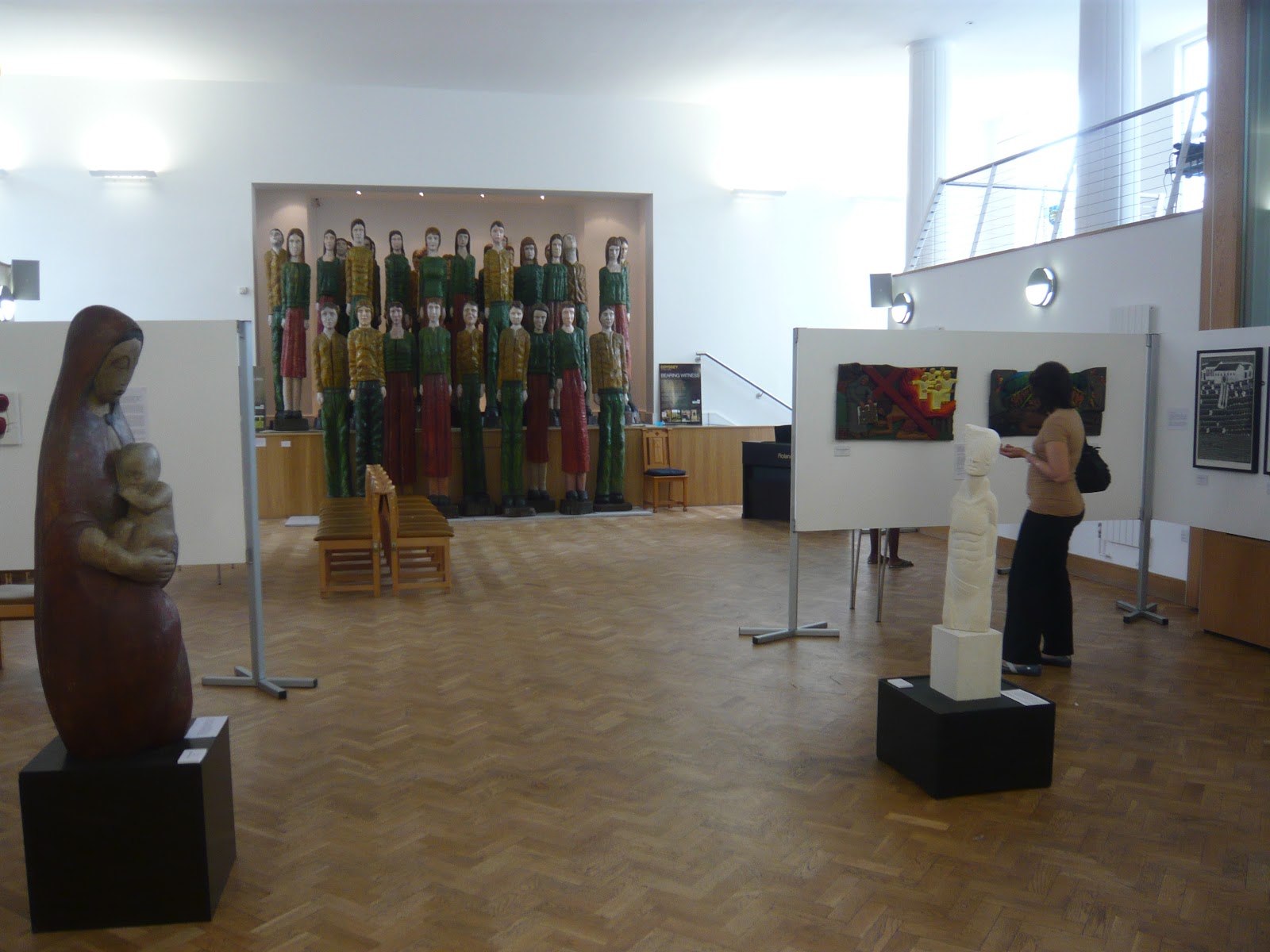


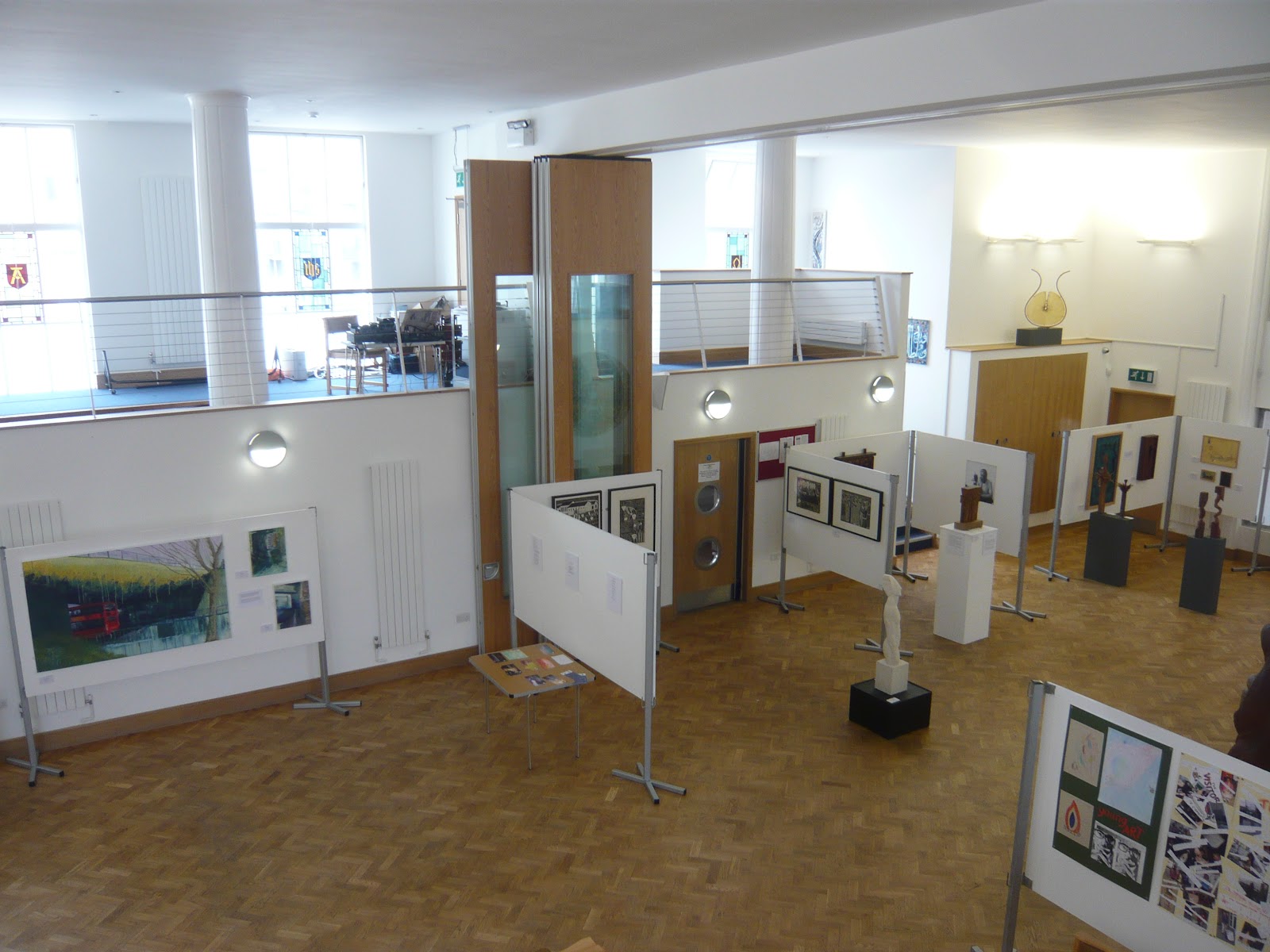


Today I visited the Reaching Beyond exhibition at Bow Road Methodist Church and met Richard Smith, one of the artists and organisers.
Reaching Beyond is an exhibition celebrating the human spirit reaching beyond the mundane both through endeavour and an openness to something transcendent. The exhibition's title is intentionally open to a wide range of interpretation and the work shown by the 19 artists included invites those who see it to think afresh, and reach beyond their assumptions. The range of media and styles featured is also correspondingly broad with fabrics, icons, mosaics, paintings and sculptures all included. The recent renovation of the church makes it, among other things, an excellent exhibition space. The sculptures set on the exterior provide an arresting beginning to the show and certainly drew other visitors into the building over the course of my visit.
Richard Smith is one half of Smith and Moore (the other being David Moore). The pair have been friends and colleagues since 1966, and have been creating sculptures together since 1994. In their art they explore/question/challenge serious matters with humour, levity and a touch of incredulity. They bring to this their experience of living and working within poor communities, political and social engagement, and reflection on theology. David is a Methodist minister and runs Colloquy, an art and theology project which is part of the Methodist Church, from which the idea for the exhibition grew. Richard has had a varied career, ranging from research in physical chemistry to community development and management, with illustrating having been taken in along the way.
From early 2012 Smith and Moore sent their small, sturdy sculpture, the Visitor, on an uncharted journey via churches and other organisations through five London boroughs (Greenwich, Hackney, Newham, Tower Hamlets and Waltham Forest). People seeing the Visitor on its journey sent in photographs and notes of what happen, all of which are posted on the project's website and have been used in the exhibition along with the Visitor itself.
Other particularly strong work in the exhibition includes: Aaron Distler's abstract ‘Fire Drawings’ (using paper which has been treated and burnt to create extraordinary effects contained within frames which are themselves part of the work); Robert Koenig's monumental wood figures symbolising the artist’s ancestors as part of a search for ancestral and sculptural roots; Jean Lamb, an Anglican Priest living in Nottingham, who is a woodcarver in the storytelling tradition and is showing two casts from Stations of the Holocaust which follow the path of Christ to the Cross, each one including in the background images from the record of the Jewish holocaust during the Second World War; and Santiago Bell, a brilliant artist, educator, political activist and thinker imprisoned and tortured by the Pinochet regime in the 1970s, who expressed his insights and reflected on his experience in finely carved, imaginative, wooden constructions, such as Age of Emptiness.
-----------------------------------------------------------------------------------
After The Fire - Joy.
Wednesday, 7 April 2010
Norman Adams @ Marle Place Gardens & Gallery


In Brenchley, near Tonbridge in Kent, Marle Place is a peaceful, privately owned Wealden garden, ten acres of formal planting and many more acres of woodland and orchard. It is a plantman and artist's garden, featuring a Victorian gazebo, Edwardian rockery and walled fragrant garden. A restored 19th century greenhouse with orchid collection, a mosaic terrace and ornamental ponds. The 17th century house with a massive chimney is of architectural interest, but not open.
The Gallery houses varied exhibitions throughout the season by contemporary painters, sculptors, potters and makers, on show and for sale. The current exhibition is Norman Adams RA: Spirit in the Garden. The exhibition consists of nine large watercolours all painted in the last 15 years of Adams' life. The exhibition examines the symbolism of Adams' abstract works and the origin of these forms in the emotional intensity of these religious and spiritual paintings. Adams' vast watercolours are alive, saturated, even baptised, with colour and passion.
This exhibition is part of a larger group of exhibitions called Cross Purposes and instigated by Mascalls Gallery, which includes Santiago Bell, Susan Shaw, Maggie Hambling and Craigie Aitchison. Centering on Chagall's drawings for the windows of nearby Tudeley which are coming to the UK for the first time, this exhibition explores the uses of the crucifixion by a broad range of artists featuring the work of many artists including Stanley Spencer, Graham Sutherland, and Eric Gill. The exhibition addresses both meditative religious works as well as more horrific secular works. The exhibition tours to Ben Uri Gallery, London's Jewish Museum of Art. To listen to a review of this on Radio 3's Night Waves click here to go to http://www.bbc.co.uk/iplayer/episode/b00rpwkh/Night_Waves_Ideas_Election_Maggi_Hambling/
----------------------------------------------------------------------------------
Brian Kennedy - Hollow.
Friday, 26 February 2010
Cross Purposes
The Cross Purposes exhibition at Mascalls Gallery in Kent and then in June at Ben Uri examines how and why artists of different religions, or of none, use the crucifixion as a central motif in modern and contemporary practice.
Only five miles away from Mascalls Gallery is one of the UK’s finest examples of religious art and a moving example of the crucifixion as a 'conduit' for a very personal tragedy. The church in Tudeley is renowned internationally as the only church to have all its windows decorated by Marc Chagall which fulfilled a long term ambition of the artist. The windows were commissioned by the family of Sarah d'Avigdor-Goldsmid as a commemoration of her tragic and untimely death. Chagall’s drawings for Tudeley Church are being seen for the first time in Britain at Mascalls Gallery courtesy of Centre Pompidou. Chagall’s previously unpublished and haunting ‘Apocalypse en Lilas, Capriccio’, will also be shown at both Mascalls and Ben Uri.
The 20th century has seen some of the most important and interesting depictions of the crucifixion interestingly in a time when the church’s influence waned measurably. One of the best known religious artists of our time was Graham Sutherland. Images from the concentration camps proved to be a catalyst for some of the most powerful depictions of the crucifixion. This exhibition shows a bloody and haggard Christ whose body bears witness to the “continuing beastliness and cruelty of mankind.”
The two world wars are represented in a number of works within the exhibition as artists look towards one of the few symbols that could contain the potency of their emotions. The 20 artists represented in the exhibition create narratives both of the artistic traditions of the time from Eric Gill to Maggie Hambling, Norman Adams and Tracey Emin and by doing so navigate a way through the major events of the century. The works show the crucifixion as both a symbol of shock and also as an object of contemplation: from the hollowed out scarecrow figure of Christ on the battlefield of Europe by Scottish artist R Hamilton Blyth to a rarely seen, life-size drawing of Duncan Grant’s crucifixion for Berwick Church in East Sussex.
The exhibition is curated by Nathaniel Hepburn. 5 March to 29 May 2010 at Mascalls Gallery, Maidstone Road, Paddock Wood, Kent. 15 June to 19 September at Ben Uri Gallery, The London Jewish Museum of Art. Other related exhibitions include: Easter Images: Maggi Hambling & Craigie Aitchison, 27 March - 6 April, The Kentish Barn, International Study Centre, Canterbury Cathedral; 1st April to 29th May, Norman Adams RA: Spirit in the Garden at Marle Place Gardens and Gallery; Susan Shaw - Dispersal, 5 March - 25 May, St Thomas a Becket, Capel, Tonbridge, Kent, TN12 6SX; Santiago Bell: Chilean woodcarver in exile, 5 March - 29 May, St Andrews Paddock Wood; From the Darkness ... light in contemporary art at St Peter's Church, Preston Park, Brighton, 1 May – 23 May.
--------------------------------------------------------------------------------
Sam Phillips - Where the Colours Don't Go.
Subscribe to:
Posts (Atom)