Wikio - Top Blogs - Religion and belief
Showing posts with label morris and co. Show all posts

Tuesday, 19 January 2016

Sabbatical Art Pilgrimage: Latest ArtWay report

My latest Church of the Month report for ArtWay focuses on St Paul's Goodmayes. 

'St. Paul’s Goodmayes has been a prolific and generous patron of the arts. It contains a vast array of artwork reflecting the movement in church art from the medievalism of the Arts and Crafts movement through the angular, Cubist influences of Leonard Evetts to the semiabstract work of contemporary artist Henry Shelton, as well as a range of materials, including stained glass, silver, brass, copper, stone, wood, oil, watercolors, wrought iron, gilding, and ceramics. Contributing studios include Fullers, Morris & Co., Whitefriars, and the Faith Craft Company, with designs from artists such as Sir Edward Burne-Jones, J. H. Dearle, Leonard Evetts, Alfred Fisher, Jane Quail, and Henry Shelton..'

This Church of the Month report follows on from others about Aylesford Priory, Canterbury Cathedral, Chapel of St. Thérèse of the Child Jesus and the Holy Face, Hem, Chelmsford Cathedral, Église de Saint-Paul à Grange-Canal, Lumen, Notre Dame du Léman, Notre-Dame de Toute Grâce, Plateau d’Assy,Romont, Sint Martinuskerk Latem, St Aidan of Lindisfarne, St Alban Romford, St. Andrew Bobola Polish RC Church and St Mary the Virgin, Downe, as well as earlier reports of visits to sites associated with Marian Bohusz-Szyszko, Marc Chagall, Jean Cocteau, Antoni Gaudi and Henri Matisse.

--------------------------------------------------------------------------------------

Leonard Cohen and The Webb Sisters - If it Be Your Will.

Tuesday, 9 June 2015

St Margaret's Barking


George Jack (1855-1931) architect, furniture-designer, wood carver, stained glass artist, and teacher, was an important contributor to the Arts and Crafts Movement. He trained as an architect in Scotland, and became a full-time assistant to Philip Webb in 1882. Through Webb, Jack was introduced to William Morris and from 1885 began to design furniture for Morris & Co. Subsequently he took up wood carving and plaster moulding.

From 1929-1936, the architect Charles Canning Winmill involved Jack in the repair and renovation of St Margaret’s Barking. By the time he worked on St Margaret’s, Jack was in his 70s and was quite ill. Despite this fact, his work for the church was admirable and included: the memorial window to the Hewitt family in the Lady Chapel, a pair of tall candelabra, decoration of the Chancel roof, a carved memorial tablet, eight carved figures on the Youth Chapel screen (Captain Cook, Elisabeth Fry, St Ethelburga, two Barking fishermen, Saint James, Saint John and Saint Nicholas), and the Fisherman’s window in the Youth Chapel.

Jack also enlisted the help of his daughter Jessie in painting the font cover at St Margaret’s. Jessie painted the existing wooden cover to a design by her father. The lettering around the rim says, ‘God hath given to us eternal life and this life is in his son’. Each segment is painted with a bird or butterfly on a mid-blue ground with gilding. This is the only known example of Jack’s daughter helping him with his decorative schemes. Sadly, his work at St Margaret’s was one of Jack’s last commissions, he died in December 1931.

From 29th April to 29th July 2006, the William Morris Gallery held the first exhibition solely devoted to George Jack. His name is familiar to many who are interested in Morris but most are not fully aware of the extent of his output. The exhibition aimed to bring this important artist to greater prominence and explored all aspects of his work. Exhibits were drawn from the archive held at the Gallery, which contains designs for work in plaster, furniture, woodcarvings, embroidery, letters and photographs, and from other collections. It is also brought to light the contribution of his wife and daughters.

St Margaret’s loaned three key works for the exhibition – two of the carved wooden figures from the Youth Chapel screen (Captain Cook and Elizabeth Fry) and the Font cover. As curate at St Margaret’s at that time, I liaised with the William Morris Gallery over these loans and said that: “George Jack’s work at St Margaret’s has been much loved since Charles Winmill’s renovation at the turn of the last century which introduced many artefacts from the Arts and Crafts movement into the church. Jack’s work here demonstrates his versatility and skill as a craftsman and has great local significance as memorials to Barking’s fishing industry and links with Captain Cook and Elizabeth Fry. This exhibition will highlight an under-appreciated aspect of the significant history that can be found at St Margaret’s.”

I also arranged that, during the Barking Festival, Amy Clarke (Curator, William Morris Gallery) gave a short illustrated talk on George Jack and tour of the church showing Jack’s work at St Margaret’s.

2005/06 was a year at St Margaret's where there was a particular focus on the arts. The year began with a Christmas gift from a local artist. For some years George Emmerson had been painting the church, churchyard and the ruins of Barking Abbey and, as he left the borough, presented the church with a book of these paintings. The book is filled with watercolours set in intricately painted borders and complemented by historical information and personal reflections. It is a beautiful reminder of the history of the Abbey Green site in which St Margaret’s is located and a record of one person’s response to that history.

Lent 2005 saw the unveiling of an original painting commissioned for the Youth Chapel at St Margaret’s. Early in the morning was unveiled by the artist Alan Stewart and dedicated by the Bishop of Barking. The painting depicts Christ cooking breakfast for his disciples by Lake Galilee after his resurrection, as told in John's Gospel chapter 21. Stewart has painted a black Christ surrounded by disciples of every ethnic origin to reflect the diverse congregation that currently worships at St Margaret's. Through its lakeside setting the pastel painting also links to the stained glass window in the Youth Chapel commemorating the fishing industry in Barking.

Early in the morning was joined in the Youth Chapel by the second artistic gift St Margaret’s received in 2005/06. During a study visit to their link parish of Kristinehamn in Sweden the Church was presented with an icon of Christ blessing the children by the Norwegian painter Kjellaug Nordsjö, who is widely considered the best contemporary icon painter in Scandinavia. This icon is a window into Christ’s inclusivity and gentleness and a sign of the welcome that the Church seeks to give to all who come to St Margaret’s.

----------------------------------------------------------------------------------------------------

Arvo Pärt - Silentium.

Wednesday, 21 January 2015

Sabbatical art pilgrimage: St Paul's Goodmayes


From 1898–9 local developer Cameron Corbett laid out an estate of good quality houses that clerks and lower grade civil servants could afford. As a result, this development in Seven Kings extending to Goodmayes has been called “the town built in a year.” Corbett added the Mayfield estate to the south and Downshall to the north meaning that the area quickly had 10,000 inhabitants (http://hidden-london.com/gazetteer/seven-kings/).

Several churches were built as a result including St Paul’s Goodmayes built in response to the development of the Mayfield Estate. When the decision was made, in 1901, to build St Paul’s this estate had 420 houses, built in the preceding eighteen months, 300 of which were occupied, representing perhaps 1,500 people. More were to be built on the south side of the railway line, meaning that a clear need for a church was established.

The Church which was built is in the style of Gothic architecture, that had been popularised by A.W.N. Pugin and which characterised church building by the Arts & Crafts Movement. The materials used are red brick with stone dressing. Messrs. Chancellor & Son of Chelmsford and London were the architects and the contractors for the first portion of the building were Messrs. Brown & Son of Braintree. The building was completed by additions in 1905, 1917 and 1929. The completed church was consecrated by the Lord Bishop of Chelmsford, The Right Reverend John Edwin on Thursday 22nd March 1917, when St Paul's became the independent parish church of Goodmayes.

St Paul’s Goodmayes has been a prolific and generous patron of the arts since the church was originally built and now has a vast array of artwork reflecting the movement in Church Art from the medievalism of the Arts & Crafts Movement through the angular, cubist influences of Leonard Evetts to the semi-abstract work of contemporary artist Henry Shelton. The materials used include stained glass, silver, brass, copper, oil on canvas, watercolour, carvings (in both stone and wood), wrought iron work, gilding work and ceramics. There is work from the studios of Fullers, Morris & Co., Whitefriars and the Faith Craft Company, with designs from artists such as Sir Edward Burne-Jones, J.H. Dearle, Evetts, Alfred Fisher, Jane Quail, and Shelton.

The Church website documents the many commissions revealing the value of memorial bequests for the commissioning of much Church Art. The first stained-glass in St. Paul`s was the East Window of the Lady Chapel which was made by the Fullers Studio (by which the work of Geoffrey Fuller Webb may be indicated). At the end of July 1944, this window was almost completely destroyed by a flying bomb, leaving only the tracery (small upper windows) intact. These show the Arms of Canterbury and Chelmsford, flanked by St. Paul, the Patron of the church and St. Cedd the 7th century missionary Bishop in Essex.

The original main lights of the window showed Our Lady and the Infant Christ, flanked by Wise Men and Shepherds. The replacement, from 1957, is an entirely new design depicting the same scene. The three lights now show Our Lady and the Infant Christ with the kings and shepherds to left and right respectively. The replacement window came from the Whitefriars Studio and contains their mark, a White Friar, in the bottom right-hand corner, while the artist has signed it off with his normal signature, the trilby he wore in his workshop.

Like the Lady Chapel window the East Window was severely damaged in July 1944 by a flying bomb landing on the East side of the church: only one-seventh of the original remained, (to judge by the insurance valuation before and after). The original had been donated by Leonard Randall, a generous benefactor of St. Paul`s, and had been dedicated on 15th September 1929. A design by Sir Edward Burne-Jones was used for this window which was created and installed twice by Morris & Co., firstly in 1929 and again in 1954.

As Morris & Co. note on their website (https://www.william-morris.co.uk/), William Morris is regarded as the greatest designer and one of the most outstanding figures of the Arts & Crafts Movement: ‘In 1861, with a group of friends, he started the decorating business Morris, Marshall, Faulkner & Co. which provided beautiful, hand-crafted products and furnishings for the home. This was highly controversial at the time as it denounced the ‘progress’ of the machine age by rejecting unnecessary mechanical intervention. Influenced by the ideas and writings of Thomas Carlyle and John Ruskin, who sought to re-dress class inequality and improve society by reinstating the values of the past, Morris was motivated by the desire to provide affordable ‘art for all.’

Driven by his boundless enthusiasm, the output of the company was prolific and encompassed all the decorative arts. He is perhaps best known for his wallpaper and fabric designs but he also designed and made embroideries, tapestries and stained-glass, reviving many of the traditional arts which had been swept away by industrialisation. Before he mastered each craft, he learnt every stage of the hand making process and understood his materials thoroughly so that he could get the best results and teach others.’

Burne-Jones became the chief designer of stained glass (creating over 100 drawings throughout his lifetime) and a separate area at Merton Abbey, where Morris’ workshops were located from 1881 onwards, was allocated to his glass workshops. Morris & Co. dominated British stained glass production during the 1870s and 1880s.

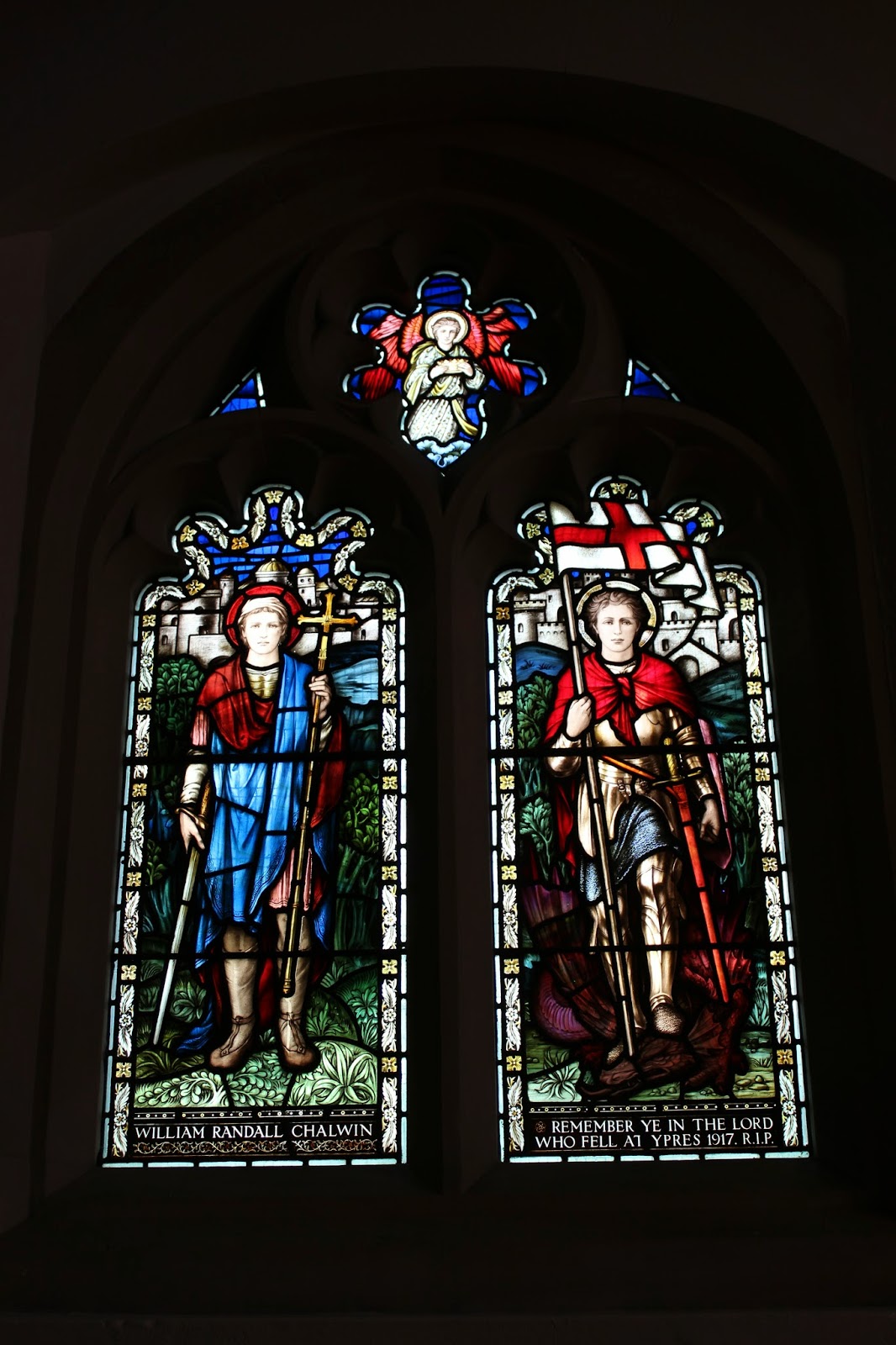
The St. Alban and St. George window was donated by Leonard Randall in 1929 in memory of his nephew killed in World War I, and had been installed at the same time as the East Window. Also made by Morris & Co., this window was not a 19th century Burne-Jones design but instead a contemporary design by J.H. Dearle, who was then designing for the firm. Dearle also designed the figure of St. Peter for another West end window installed in 1933, which was complemented by a figure of St. Paul to a design by Burne-Jones. 

In between these two smaller windows is the main West Window which was made, like the previous ones, by Morris & Co (again from a design by Burne-Jones) and was dedicated on 18th December 1932. Leonard Randall, the donor of several earlier windows, died in 1932 leaving a large sum to St. Paul`s, including £400 for a window in the new Baptistry, which had been built into the West End of the church in 1929. The window depicts a well-known scene from the Gospels, where women were bringing their children to Jesus and He was blessing them. The text below (Luke 18.16) reads: ‘Suffer little children to come unto Me.’

The last of the Morris & Co. windows in St. Paul`s depicts David and Jonathan and was designed (in a rather different style from the others) by D.W.Dearle (not J. H.). This window cost £96.15s. in memory of Mr. A. E. Godfrey, and was dedicated on 4th September 1949. Today it is the ‘odd-man-out’ in the Lady Chapel as the three surrounding windows all feature Our Lady and the events of Christ`s birth. In 1949, however, it was the only stained-glass in the Chapel, (apart from the tracery over the East Window); the rest being added later. 

The surrounding windows are the most recent at St Paul’s being created in 1975 and 1980 by the prolific stained glass artist, Leonard Evetts. On 1st June 1973 Walter Tolbart died leaving a substantial bequest to the Church. He had expressed a wish that part of this money should be used for a proposed window and approaches were made to various artists, as a result, in 1974. Finally, in April 1975, the PCC approved a design by Leonard Evetts, depicting the Annunciation; and the window was dedicated in memory of both Doreen and Walter Tolbart on 30th November of that year.

In the left-hand light, the archangel Gabriel “is drawn to give the impression that on wing he has silently entered the drama, barely touching the earth” to quote the artist`s own account. Our Lady is depicted on the right; she wears the traditional blue robe, which is decorated with a Madonna Lily. Gabriel`s salutation is written across the centre in Latin: ‘Ave Maria, gratia plena, Dominus tecum’ – Hail Mary, full of grace, the Lord is with thee.’ Gabriel went on to say that Mary would conceive by the Holy Spirit, and the Spirit appears in symbolic form represented by a Dove in the tracery, from where shafts of light can be seen descending onto the figure of our Lady.

Then, when Miss Norah Sherren died on 17th March 1977 at the age of 82, she was described as ‘the senior member of the congregation’, having been present at the laying of the Foundation Stone of St. Paul`s. Miss Sherren left a considerable sum to the Church, including £1,000 for a memorial window. This forms a pair with the Annunciation Window: both being designed by Leonard Evetts, and with the new window telling the next episode in the life of Our Lady.

Immediately after the Annunciation, Mary spent three months at the home of her cousin Elizabeth, soon to be the mother of John the Baptist, and the two women rejoiced together over the sons they were to bear; Mary`s words of celebration included the ‘Magnificat’. This story, generally called the ‘Visitation’, took place in the hill-country of Judea, which is represented by the rocky scenery in the background of the window. Elizabeth is shown on the left, Mary on the right – notice the blue robe and lilies once again. As with the Annunciation Window, Evett’s signature is just visible: ‘L.C. Evetts fecit. 1980.’ The window was installed and dedicated on the Feast of Christ the King, 26th October 1980, and was the last stained glass window to be installed in St Paul's to date.

Prior to the Evetts’ windows two other modern windows had been commissioned. The Jesus the Carpenter Window was made by the Faith Craft Company, and was installed in 1963. The Faith Craft Company was a studio set up through the Society of the Faith, which grew from vestment manufacture to encompass various aspects of church furniture such as joinery, stained glass and statues. The Company was in operation from 1921 to 1972.

The centre section of the window shows Jesus in the carpenter`s shop at Nazareth, surrounded by the tools of His trade. On the left, there is a roundel depicting the Sower (the subject of our Lord`s famous parable); while a similar roundel on the right shows St. Paul working as a tentmaker. This unusual combination of images commemorates the longest-serving Churchwarden of St. Paul`s, Foster Threadgold, who had died at the beginning of 1959, in his 29th year of office. Well over 100 people contributed towards the memorial which was located on the North side of the Church, as near as possible to the churchwarden`s seat which he had occupied for so many years.

Finally, the St. Timothy Window comes from the Whitefriars Studio and the hand of Alfred Fisher.
The Whitefriars Company was a successful British glasshouse closely associated with leading architects and designers from the later portion of the 19th century onwards including Philip Webb who designed glass for Morris & Co.

This is a lovely bright window with vivid colours achieved by the use of hand-made ‘Norman slab’ glass, which retains its lustre even in dull conditions. The window shows Timothy as a youthful figure, staff in hand, presumably engaged on some missionary journey. In the two small tracery lights above, there are symbols of the activities for which Frank Hills, in whose memory the window was given, is remembered: he was a member of the Choir for some 40 years, which explains the page of music, and the words ‘O Sing unto the Lord’; he was also at one point Churchwarden here and was also involved in the Scout Movement – hence the Churchwarden`s staff and the Scout emblem. But the words ‘Honour thy God’ have a double significance: as well as being appropriate to Frank Hills’ life, they are also a play on the name ‘Timothy’, which is derived from two Greek words meaning ‘honour’ and ‘God’.

Fr. Benjamin Rutt-Field, who oversaw the addition to St Paul's Goodmayes of a Madonna and Child by the contemporary Roman Catholic sculptor Jane Quail and Shelton’s Stations of the Crown of Thorns has said that all too “often people walk past churches and think it is just a plain building - they aren't aware of the beauty inside.”

It was Fr Rutt-Field’s belief that “for Christian art to have any significance and empathy it must be Spirit-driven, Spirit-imprinted; it should stimulate both our imaginations and our prayers.” With this in mind, he wrote an original set of meditations to accompany the new set of
Stations of the Cross commissioned from noted religious artist, Henry Shelton, through commission4mission.

The seed for this commission was sown by an elderly parishioner who gifted a generous sum for a new set of Stations and whose memory lives on in the dedication of the tryptich, incorporating Stations XI, XII and XIII, which, as altarpiece, forms the central focus of the scheme. This tryptich has inventively incorporated an existing metal crucifix into its design to form Station XII; 'Jesus dies on the cross'. There are 15 paintings in all, as the scheme includes a resurrection 'Station' depicting Christ present in the Eucharistic elements.

These, though, are not the only unusual elements of these Stations, in that, as part of its semi-abstract imagery, Christ is depicted throughout only by the Crown of Thorns. Fr. Rutt-Field notes that, “these Stations are known as the ‘Crown of Thorns’, rather than ‘The Cross’, because Jesus is depicted in each one as a simple, humble crown of thorns.”

Shelton says of his semi-abstract style and minimal flowing lines, that, “as I’ve got older I’ve learnt that ‘less is more’ and through the development of my work I’ve learnt to express emotion in a semi-abstract form.” This is why he paints; “it all goes back to feeling; the pathos of suffering.”

The power of art to evoke emotion is what originally inspired Shelton and which has sustained his work throughout his career: “When I first saw the great 
Rembrandt’s in the Rijksmuseum in Amsterdam, the power of his images seemed to transcend time. The same thing attracted me to Christian Art as a choirboy at All Saints West Ham; the art spoke to me. I used to look at the altar and see images that were just so powerful. The images seemed to bring the past into the present and to form a profound link with the lineage of the past. I see myself as an artist trying in my small way to continue that lineage and my passion as a Christian artist is to keep that lineage alive in my generation as a witness.”

However, as an artist who often paints with the tones and harmonies of the Dutch Masters, this commission represents a considerable lightening of Shelton’s palette in order that the colour scheme of these 'Stations' harmonizes with the existing stained glass. At St Paul’s Goodmayes, Shelton's 'Stations' complement the existing works to create a feast of visual art for worshipper and visitor alike.

The commission was only the second to be completed by commission4mission, of which Shelton is both a founder member and the current Chairman. Shelton says, of commission4mission, “I want us to be offering quality work and craftsmanship, rather than mass-produced work, to continue the legacy of the Church as a great commissioner of art. The Church has, in fact, commissioned some of the greatest works of art ever produced.”

To have his work in churches, Shelton says, “really is the fulfilment of my life’s work.” He doesn’t have much ambition to show in galleries and says that, “the whole point for me is to create reaction and engage people; for people to enjoy and be moved by my work, just as I’ve been engaged by the work of other artists.”

His most recent pictures have all come to him in prayer as he has been meditating on particular Bible passages. Most of his work now comes through a meditational process and it is, perhaps, this quality of Shelton’s work to which Fr. Rutt-Field is responding when he says: “I firmly believe that these new Stations of the Crown of Thorns, painted by a deeply committed Christian artist, are indeed both Spirit-driven and Spirit imprinted. They will greatly enhance and beautify the simple form and architectural lines of our parish church, as well as our worship.”

As St Paul’s Goodmayes is a neighbouring parish to my own, I have had the opportunity to undertake ministry in partnership with Fr Rutt-Field and his congregation which has often made significant use of art and the artworks at St Paul’s Goodmayes. Art competitions and workshops have led to exhibitions timed to feature as part of community festivals, while the local cluster of Anglican churches created an Art Trail with a route for visiting each church in turn and highlighting artworks of interest in the four churches. The creation of the Art Trail was a recommendation in the report produced following a
Community Street Audit of Aldborough Road South by the Seven Kings & Newbury Park Resident's Association and the Fitter for Walking project of Living Streets. Printing of the Art Trail leaflets was funded by Living Streets as part of the Fitter for Walking project and copies of the leaflets can now be found in the four churches. Fitter for Walking helped residents create streets they can be proud of and was funded by the Big Lottery Fund, along with contributions from local authorities, to work in five areas of England.

Churches have for many years been significant patrons of the visual arts and contain important and interesting works of art. The local Anglican churches in Aldborough Hatch, Goodmayes and Seven Kings are no exception with works of art by excellent local and national artists from the 19th, 20th and 21st centuries. The significant works of art in these churches, taken collectively, represent a major contribution to the legacy of the church as an important commissioner of art. The rich and diverse range of work found at St Paul’s Goodmayes provides a demonstration of ways in which the visual arts enhance worship and mission. The story of their commissions reveals the significance of memorial donations and the journey that Church commissions made in the twentieth century from the medievalism of the Arts & Crafts movement to the semi-abstract styles of contemporary artists.  

-----------------------------------------------------------------------------------------

Larry Norman - Country Church, Country People.

Sunday, 10 August 2014

Out and about


In the final weeks of my sabbatical I've enjoyed seeing the following:

  • Monument at the Sainsbury Centre for Visual Arts is an exhibition which draws together works by artists who address the idea of the monument in a great variety of ways. This exhibition is part of an EU Interreg funded, cross-channel collaboration between galleries in England, Normandy and the Pas de Calais. These regions have in common 20th century war memorials that are a feature of nearly all towns and villages. While on the European leg of my sabbatical art pilgrimage, I saw the section of Monument which is at the Musée de Beaux-arts in Calais.
  • John Virtue: The Sea at the Sainsbury Centre is a body of new work based on Virtue’s time on Blakeney Point, North Norfolk, walking and drawing this stretch of coast each week, immersed in the sea and sky in all seasons and in all weather. From this part of the coast the uninterrupted panoramic views across the salt marshes and shingle beaches lead directly to the horizon. The artist’s connection with this place is communicated through the encompassing scale of these canvases. His expansive gestures, the bold handling of paint, draw the viewer in to the image and the environment he captures, the intensity and turbulence of the sea.
  • Sense and Sensuality at the Sainsbury Centre presents some 65 works drawn from the Arwas Collection, the Anderson Collection of Art Nouveau (already in the Sainsbury Centre holdings), and from various other private collections. This exhibition looks at those Art Nouveau designers who were interested in the darker, more complex side of life. The show embraces the sensuality of Art Nouveau, which at times is risqué, and features a wide range of works from sculpture, graphics, and books to ceramics, glass and furniture.
  • All Saints Selsey was an early commission for G. F. Bodley, a young architect who had got to know the Pre-Raphaelite brotherhood in 1858, and it was his promise of commissions that contributed to the establishment of a fine arts design firm by William Morris that included Edward Burne-Jones, Dante Gabriel Rossetti, Ford Madox Brown, and Philip Webb. This remarkable partnership of artists and intellectuals was called upon to design stained glass windows for the new Church. The distinctive saddleback tower of All Saints rises over a hundred feet to catch the changing Cotswold light on its French Gothic gables; it is the last of the great Cotswold wool churches, and the first to exhibit work of the English Arts & Crafts Movement.
  • Holy Trinity Slad is a small country church in the village made famous by Laurie Lee's "Cider with Rosie" - he now lies in the churchyard and this has become a place of pilgrimage for many admirers of his writings. The church has recently had a new stained glass window installed to commemorate Laurie Lee. The Museum in the Park at Stroud has also been celebrating Laurie Lee's centenary.
  • Gerardo Dottori: The Futurist View is the current exhibition at the Estorick Collection of Modern Italian Art. Dottori was one of the pivotal figures of Italian Futurism during the inter-war years. His expansive and intensely poetic visions of the Umbrian landscape, viewed from above, were among the earliest and most striking examples of ‘aeropainting’ – the dominant trend within Futurist art throughout the 1930s, exploring the dynamic perspectives offered by flight.
  • To Be or not To Be at the Whitechapel Gallery features Italian artist Giulio Paolini who immerses us in elegant installations of canvases, windows, fragments of statuary and checkerboards – sometimes presented by 18th century footmen. Believing that every work of art embodies earlier traditions, Paolini pays tribute to artists such as Chardin, Lotto and Velazquez. His own face, hands and eyes reappear throughout the show, as he asks Hamlet’s question of the artist. From To Be or Not to Be (1994–95) where canvases radiate across the floor into infinity to the existential drama of The Author Who Thought He Existed… (2013).
  • Continuum of Repair: The Light of Jacobs Ladder is an installation by Kader Attia at the Whitechapel Gallery. A series of marble busts of wounded soldiers from World War I and repaired North African wooden learning boards (ketab) observe a towering structure of bookshelves filled with centuries of accumulated human knowledge. The process of repair is central to Attia's work, which he sees as an underlying principle of development in nature as in culture, and a motive to re-invigorate his extraordinary library. Inside the structure of books lies a warmly-lit cabinet of curiosities above which a vast mirror reflects a horizontal beam of light, transforming it into rungs of a ladder to infinity. This commission is inspired by Jacob’s vision of angels ascending to heaven, as well as by the space itself which is steeped in history as a former library reading room.
----------------------------------------------------------------------------------

Lone Justice - Shelter.

Monday, 10 February 2014

Church engagement with the Arts: Good practice

The William Morris Gallery currently has a small display of work by George Jack. Jack (1855-1931) architect, furniture-designer, wood carver, stained glass artist, and teacher, was an important contributor to the Arts and Crafts Movement. He trained as an architect in Scotland, and became a full-time assistant to Philip Webb in 1882. Through Webb, Jack was introduced to William Morris and from 1885 began to design furniture for Morris & Co. Subsequently he took up wood carving and plaster moulding.

From 1929-1936, the architect Charles Canning Winmill involved Jack in the repair and renovation of St Margaret’s Barking. By the time he worked on St Margaret’s, Jack was in his 70s and was quite ill. Despite this fact, his work for the church was admirable and included: the memorial window to the Hewitt family in the Lady Chapel, a pair of tall candelabra, decoration of the Chancel roof, a carved memorial tablet, eight carved figures on the Youth Chapel screen (Captain Cook, Elisabeth Fry, St Ethelburga, two Barking fishermen, Saint James, Saint John and Saint Nicholas), and the Fisherman’s window in the Youth Chapel.


Jack also enlisted the help of his daughter Jessie in painting the font cover at St Margaret’s. Jessie painted the existing wooden cover to a design by her father. The lettering around the rim says, ‘God hath given to us eternal life and this life is in his son’. Each segment is painted with a bird or butterfly on a mid-blue ground with gilding. This is the only known example of Jack’s daughter helping him with his decorative schemes. Sadly, his work at St Margaret’s was one of Jack’s last commissions, he died in December 1931.

From 29th April to 29th July 2006, the William Morris Gallery held the first exhibition solely devoted to George Jack. His name is familiar to many who are interested in Morris but most are not fully aware of the extent of his output. The exhibition aimed to bring this important artist to greater prominence and explored all aspects of his work. Exhibits were drawn from the archive held at the Gallery, which contains designs for work in plaster, furniture, woodcarvings, embroidery, letters and photographs, and from other collections. It is also brought to light the contribution of his wife and daughters.

St Margaret’s loaned three key works for the exhibition – two of the carved wooden figures from the Youth Chapel screen (Captain Cook and Elizabeth Fry) and the Font cover. As curate at St Margaret’s at that time, I liaised with the William Morris Gallery over these loans and said that:

“George Jack’s work at St Margaret’s has been much loved since Charles Winmill’s renovation at the turn of the last century which introduced many artefacts from the Arts and Crafts movement into the church. Jack’s work here demonstrates his versatility and skill as a craftsman and has great local significance as memorials to Barking’s fishing industry and links with Captain Cook and Elizabeth Fry. This exhibition will highlight an under-appreciated aspect of the significant history that can be found at St Margaret’s.”

I also arranged that, during the Barking Festival, Amy Clarke (Curator, William Morris Gallery) gave a short illustrated talk on George Jack and tour of the church showing Jack’s work at St Margaret’s. 

2005/06 was a year at St Margaret's where there was a particular focus on the arts. Here is a press release which we issued at the time summarising the different projects which provide an example of good practice in church engagement with the Arts: 

'St Margaret’s Barking has had a year of involvement in the Arts which began with a Christmas gift from a local artist.

For some years George Emmerson had been painting the church, churchyard and the ruins of Barking Abbey and, as he left the borough, presented the church with a book of these paintings. The book is filled with watercolours set in intricately painted borders and complemented by historical information and personal reflections. It is a beautiful reminder of the history of the Abbey Green site in which St Margaret’s is located and a record of one person’s response to that history.

During the year the Church has worked together with the Arts services department of the London Borough of Barking and Dagenham. Led by Tracey McNulty and Catherine Miller, this team has been responsible for the A13 Artscape project, one of the most ambitious public arts projects in the UK.


St Margaret’s first collaboration with them was Love& Light in which VJs and digital artists from plugfish filmed and digitally animated both members of the congregation and the surrounding flora and wildlife, setting them within delicate moving imagery before projecting them onto the windows, walls, roof and tower of the church. Projected onto the clear windows of the church were moving images of the local body of Christ at St Margaret's - dancing mums, waving ladies, an eight piece dance group, the verger and curate racing each other up the Church Tower, an imaginary teenage rock band, and a number of other spinning, walking, waving, smiling members of the congregation. This piece, rightly entitled Abbey Happy, was the church at play.

Studding this celebration of the congregation were reminders of Barking's past which drew on memorials contained within the church. Captain Cook's ship, The Endeavour, sailed again next to the stained glass window commemorating Barking's fishing heritage. This window then provided motifs of sea horses, shells and water that featured in several other projections. The whole was a joyful celebration, not just of St Margaret's special history, but also of its lively and diverse present. In it the church was truly seen as a place of love, light and laughter.

Over the course of the year St Margaret’s has also collaborated with Arts Services on two concerts for Refugee Week and the Molten Festival featuring concert pianist Manuel Villet, world music star Jide Chord and the children’s choirs from St Margaret’s School and Watoto Childcare. Music also featured in a taster workshop at the St Margaret’s Centre for the Sonic Spin course which provides training in Music Technology. Through a printmaking and design workshop we arranged for young people from local churches to contribute designs to the Making Barking Brilliant project which will see these and other designs turned by the artist Dale Devereux Barker into enamel panels and etched slabs located on walls and streets in Barking.


Finally, in January 2006 we will provide a venue for RE:Generation, a film and photographic project by Michael Cousin which explores local people’s memories of Barking’s past, their feelings about its present and their hopes and fears for the future. People from St Margaret’s feature in the film and have contributed their photographs and memories to the project. Community involvement has therefore been a major feature of these projects which attempt to contribute to the regeneration of the Town Centre and the well-being of its people.

Anthony Shapland has said of Michael Cousin that, “He successfully combines the naivety of a child, seeing the world afresh with a grown-up, stubborn belief that things could be different. He … [creates] a space for contemplation … He is … willing the viewer to look at something with new eyes, to experience reality refreshed.” This could well have been a manifesto for St Margaret’s year in the Arts and for the Lent course which explored images of salvation from conceptual art, figurative paintings, and feature films. Discovering spirituality in works such as Tracy Emin’s Bed, AndresSerrano’s Piss Christ, Abel Ferrara’s Bad Lieutenant and uncovering models of salvation in paintings from different periods of Art history was certainly eye-opening for many.


The Lent course culminated with the unveiling of an original painting commissioned for the Youth Chapel at St Margaret’s. Early in the morning was unveiled by the artist Alan Stewart and dedicated by the Bishop of Barking. The painting depicts Christ cooking breakfast for his disciples by Lake Galilee after his resurrection, as told in John's Gospel chapter 21. Stewart has painted a black Christ surrounded by disciples of every ethnic origin to reflect the diverse congregation that currently worships at St Margaret's. Through its lakeside setting the pastel painting also links to the stained glass window in the Youth Chapel commemorating the fishing industry in Barking. 

Early in the morning has been joined in the Youth Chapel by the second artistic gift St Margaret’s received this year. During a study visit to their link parish of Kristinehamn in Sweden the Church was presented with an icon of Christ blessing the children by the Norwegian painter Kjellaug Nordsjö, who is widely considered the best contemporary icon painter in Scandinavia. This icon is a window into Christ’s inclusivity and gentleness and a sign of the welcome that the Church seeks to give to all who come to St Margaret’s.

Revd. Jonathan Evens, Curate at St Margaret’s, says:

“Our year in the Arts has refreshed our memory of our history, celebrated the present diversity of our congregation and community, contributed towards the future regeneration of our town centre, and created spaces for seeing the world, reality and our faith afresh. The value of the Arts for us and our community therefore speak for themselves.”'

-----------------------------------------------------------------------------------------

Arvo Pärt- Spiegel im Spiegel.