Wikio - Top Blogs - Religion and belief
Showing posts with label law. Show all posts

Wednesday, 10 June 2026

I have come to fulfil the Law

Here's the sermon I shared this morning at St Andrew's Wickford:

In The Lion, the Witch and the Wardrobe the Deep Magic “was a set of laws placed into Narnia by the Emperor-beyond-the-Sea at the time of its creation. It was written on the Stone Table, the firestones on the Secret Hill, and the sceptre of the Emperor-beyond-the-Sea.

This law stated that the White Witch, Jadis, was entitled to kill every traitor, and if someone denied her this right then all of Narnia would be overturned and perish in fire and water. However, unknown to Jadis, a deeper magic from before the dawn of Time existed, which said that if a willing victim who had committed no treachery was killed in a traitor's stead, the Stone Table would crack, and Death would start working backwards.”

So in this story, there is a Law which is about actions and consequences and there is a deeper Law which is about love. C. S. Lewis, who wrote the Narnia stories, was a Christian who drew on his understanding of Christian faith in writing his stories. It may be that he had passages like today's Gospel reading (Matthew 5. 20 – 26) in mind when he wrote about the deeper magic from before the dawn of Time.

Jesus is saying in his teaching from Matthew 5 about the Law that it is not enough simply to keep the Law. He wants us to go deeper than simple obedience of the Law and the deeper place into which he wants us to go is Love.

Most of us actually keep the laws of this land most of the time. On the whole, because the laws are prohibitions – do not’s, like do not murder or do not steal – and because we live in a time of relative wealth, our laws are not that difficult to keep.

But prohibitions simply keep us from doing harm to others. They don’t enable us to love others. Simply refraining from murdering others or stealing from others is enough to keep the Law (we call it keeping the peace) but doing these things doesn’t mean that I am actively loving anyone at all.

To love means that I have to do something more that simply keep the Law. That is what Jesus is teaching and illustrating here and it is what C. S. Lewis shows us in Narnia through his imaginative story.

Let’s think briefly about the way laws and love work together. Parents teach their children the rules of the road. To begin with, when children are very young, the rules of the road are very restrictive i.e. the child must never cross a road without a parent and must always cross at a crossing with the parent and while holding the parents hand. As the child grows, they are taught new rules for crossing the road; for me, that was the Green Cross Code - stop, look and listen. Now, the aim is that the child learns to judge for him or herself when it is safe to cross the road.

Eventually, the rules with which we began – don’t cross on your own, don’t cross unless you are at a crossing – are left behind because the child has learnt how to cross the road safely using their own initiative. Elbert Hubbard has said, “Initiative is doing the right things without being told.” We are able to use initiative because we have not only learnt the rules but have learnt to apply in our lives and situations. At this point, we are no longer restricted just to crossing the road at specific crossing places but can cross wherever we judge it to be safe to do so.

So, we have gone beyond the rules by learning and applying the rules. In other words, we have found the true purpose of those rules which our parents enforced when we were young; which is that we learn to cross the road safely by ourselves wherever we are.

Jesus is saying the same thing. The Law starts by keeping us safe – do not murder, do not steal. If we all abide by the Law then we do not harm each other. That is good, but it is not enough. We also need to learn to love one another. That means doing more than the Law requires but to do that is also the fulfilling of the Law. If the Law is about maintaining good relations between us, then love is the fulfilment of the Law’s intent.

Jesus said: “Do not think that I have come to abolish the Law or the Prophets; I have not come to abolish them but to fulfil them.” (Matthew 5. 17) and he commended, as being the heart or summary of the Law, these words: “‘Love the Lord your God with all your heart and with all your soul and with all your strength and with all your mind’; and, ‘Love your neighbour as yourself.’” As Paul writes, “Love is the fulfilment of the law.” (Romans 13. 10)

So, in order to fulfil the Law and these teachings we are to love as Jesus loved: “Love is patient, love is kind. It does not envy, it does not boast, it is not proud. It does not dishonour others, it is not self-seeking, it is not easily angered, it keeps no record of wrongs. Love does not delight in evil but rejoices with the truth. It always protects, always trusts, always hopes, always perseveres.” (1 Corinthians 13. 4 – 7).

-----------------------------------------------------------------------------------------------------------

Randy Stonehill - Strong Hand Of Love.

Wednesday, 2 October 2024

A real relationship and conversation with God

Here's the sermon I shared at St Andrew’s Wickford this morning:

Although he doesn’t deserve it, Job is a man on whom all the troubles of the world have come (Job 9.1-12, 14-16). In rapid succession he loses all his livestock, servants and children. Then sores break out all over his body and his wife tells him to curse God and die. If we think life is hard for us, we might want to look at the story of Job and think again.

The book of Job is told as a series of conversations. It begins with a conversation between God and Satan about Job, continues with a conversation between Job and his friends about God and his response to suffering and ends with a conversation between Job and God himself. 

Job asks in 9.14-16:

“How then can I answer him,
choosing my words with him?
… If I summoned him and he answered me,
I do not believe that he would listen to my voice.”

However, Job’s experience, as the story progresses, is that it is possible for him to discuss and debate with God and what changes Job in this story is not the arguments and words of other human beings but the experience of genuinely meeting and speaking with God himself. Job asks why good people suffer and his friends reply that people suffer because of their wickedness, because they have not helped others and that we are punished in order to repent and be healed. Job knows in his heart and in his conscience that he has helped others and has not done wrong. Job’s friends are only able to tell Job what they think about God what they aren’t able to do is to help him encounter God himself. The story is told as a series of conversation because Job entering in to a conversation with God himself is what the book is all about.

Job’s friends - and, to begin with, Job, himself - think that being in relationship with God is primarily to do with our keeping a set of rules and regulations. If we do the right things then we will have God’s favour. The problem with this view is that we can look around the world and see wicked people who seem to prosper and good people who experience tragedy. This problem is acute for Job because he is one of those good people who experience tragedy. This view is still apparent in many churches today despite our knowledge of God’s grace and forgiveness in Jesus. Yet, when we act like that we are, like Job’s friends, setting up a series of standards which we believe come from God, and saying that if you don’t meet those standards or don’t repent, then you are outside of God’s will and no longer a follower of God.

But at the end of this story, it is Job’s friends with whom God is angry, not Job. In fact, Job himself has to pray for his friends so that they are not disgraced by God. The problem God has with Job’s friends is that they have not spoken the truth about God, as Job did. And yet much of what they had to say about God is standard theology about God. So, what is the difference between Job’s friends and Job? The difference is that Job wants to speak with God while his friends want to speak about God.

Job’s friends have a black and white view of God with no shades of grey and this is actually a way of avoiding encounter with God. In this way of thinking if life is going well then you know you must be keeping the rules because you have God’s favour and if life is not going well then you know you must have done something wrong and need to repent. Life is very simple and when you understand life like that you can keep God at arms length and don’t need to talk with him because you know what you have to do and all that matters is doing it right.

Job, however, knows that life is not as simple as that and, as a result, he wants to ask God about it direct. And when he starts talking to God, God starts talking to him. And what God has to say isn’t about giving Job rules and regulations to follow; it isn’t even about answering Job’s questions. It is simply about allowing Job to experience the magnitude of being in a real relationship and conversation with God. May it be so for each one of us. Amen.

--------------------------------------------------------------------------------------------------

Midnight Oil - World That I See.

Sunday, 1 September 2024

A mirror in which to see ourselves as we really are

Here's the sermon that I shared this morning at St Catherine’s Wickford:

“Do you like American music?” That’s a question that one of my favourite bands, the Violent Femmes, ask in a song which as you might expect is called American Music. American music is songs that derive from the ancient ballads of mountain music. Songs, as Bob Dylan has said, that come from legends, Bibles and plagues and that are concerned with mystery and death. The Violent Femmes say that yes, they like American music because it is like an ugly lake that reminds them of themselves.

It might seem a strange reason to give for liking a style of music but it is pertinent to today’s reading from James which says that we need mirrors in which to see ourselves as we really are. Too often we live life, James says, like people who look in the mirror and then immediately forget what we are actually like. Music can be one mirror in which we can sometimes be brought up short and see ourselves as we really are but James says that the best mirror for us is God’s perfect law.

Our NT and Gospel readings today are to do with God’s Law, the commands that God gave to the people of Israel and that are recorded for us in what we now call the Old Testament (Mark 7: 1 - 8, 14 & 15, 21 – 23 & James 1: 17 – end). How can that Law be like a mirror to our lives?

The Law shows us two things. First, it shows us what sin is and that we are sinful people. Paul says in both his letters to the Romans and Galatians that the purpose of the Law is to show what wrongdoing is and, by that, to let us know that we are sinners. This is because the standard set in the Law is the standard of God’s holiness and glory and we all fall short of that. Jesus says in the Sermon on the Mount that whoever disobeys even the least important commandment and teaches others to do the same will be least in the Kingdom of Heaven and James says that whoever breaks one commandment is guilty of breaking them all. The standard set is God’s perfection and we all fall short. We see that in the Gospel reading in that the Pharisees who accuse the disciples of sin are shown by Jesus to be guilty of sin themselves.

But if this is all that we see in the mirror of God’s Law then it is profoundly distressing and depressing. If this is all then the mirror of God’s Law is like the ugly lake that the Violent Femmes say that American music is; something in which all you can see is your own ugliness reflected.

David Runcorn argues that if “we define sin solely in terms of wrong actions or thoughts, we trivialise it [and] our diagnosis does not go deep enough.” He says that the Pharisees trivialised sin in this way by being pedantically obsessed “with external standards of behaviour” and that that is why “Jesus furiously castigated and mocked the religion of his day.”

Runcorn says that “who we are always comes before what we do” and that “our choices, desires and actions … always flow from our sense of personal identity.” This means that “our deepest need is not primarily to stop doing or saying bad things” because the power and significance of sin “lies not so much in what we are doing or saying, but in who we think we are.” Real sin, Runcorn argues, is insisting on being what we are not; the desire for a life other than the one God intended human beings to live. As James puts it, looking in the mirror and then forgetting who we are by being the people we want to be, not the people God wants us to be.

God wants us to be different from the sinful people that we are and so in the mirror of God’s Law we can also see all that God thinks we can be and longs for us to become. James summarises it by saying that “what God the Father considers to be pure and genuine religion is this; to take care of widows and orphans in their suffering and to keep oneself from being corrupted by the world.” God’s vision for human beings is that we become holy servants.

But this is not something that we can do by ourselves. It is something that happens together with God. It is God who has provided the mirror and God who has come into our world to show us in Jesus what living as a holy servant looks like. We see in Jesus’ life what that way of being human looks like in practice. But more than that, in Jesus, God is reaching out to us to show us that we are loved by him and that he sees our potential for change and for beauty. In Jesus’ story of the Prodigal Son, the son rejects his identity as a child of his Father and leaves home to waste his life. Finally, when he is eating the food of pigs the son looks in the mirror to see himself as he actually is and decides to return home to his father and ask to become one of his servants. But the Father rejoices at his return and welcomes him home as the son he has always been although for a time he rejected that identity. This is a story about us and God. We reject our rightful identity as children of God living as holy servants. We forget what we really look like in the mirror and live as we choose. But when we come to see ourselves as we truly are and return to God we are welcomed as God’s children with all of our potential for becoming the people that he wants us to be.

David Runcorn says that “the deepest awakening of all is to the discovery that we are loved with a wild, prodigal love – without condition.” We are then able to become all that God’s Law says we can be – those who love God with all their being and who love their neighbours as ourselves – because God has first loved us.

When I go away on holiday one of the things I like to do is to visit art galleries in the area where I am staying. One of the artists that I found out about when staying in the Vendée was Charles Milcendeau.

Milcendeau grew up in the Northern Vendée at a village called Soullans surrounded by marshes. He was the son of the innkeeper at Soullans but his artistic talents took him to Paris to study in the same class as Georges Rouault and Henri Matisse. Rouault went on to generally be reckoned as the greatest religious artist of the Twentieth Century while Matisse (together with Picasso) was one of the greatest artists per se of that century. Both Rouault and Matisse came to prominence through the Fauve movement which used strong, emotional colours in paintings at the same time as the Expressionists in Germany were doing the same.

Milcendeau would have had the opportunity to have gone in the same direction as his friends but he chose not to. Instead, inspired by Dutch and Flemish art, he returned to his own people, to the Northern Vendée to paint the people of the marsh. His painting of the flagellation of Christ still hangs in his home Church at Soullans and is one of the first paintings in which he modelled the figures in the painting on local people. This painting, which I went to see, is therefore a major milestone in his journey towards his art in which he shows a sustained and loving attention to a poor and unregarded community. His masterpieces not only capture the physical and cultural settings of his day but bring alive to us today the characters and personalities of the ordinary and unregarded people that he painted. To do this he had to pay attention not just to what those people looked like but also to what they were like and then identify how to convey what they were like as he painted what they looked like. Doing this involved sustained and loving attention to them as people.

Milcendeau’s story seems like a parable to me because his encounter with Christ (in the painting of the flagellation) leads on to him showing a sustained and loving attention to others in his paintings.

It maybe that for Milcendeau painting the people around him as the crowd abusing Jesus was his way of looking in the mirror and seeing himself for what he was; a sinner, an abuser of God. But he was also painting Jesus enduring that abuse in order to show God’s love for those who abuse him. After encountering Jesus in this way in his painting his life purpose clarified and he spent his life paying loving attention to his poor and disregarded community in his paintings of their lives and characters.

James says that if we look closely at ourselves in the mirror of God’s perfect law, paying attention and knowing ourselves to be sinners loved by God then we will go on to become the holy servants that God intended all human beings to become. May it be so for each one of us. Amen

---------------------------------------------------------------------------------------------------------

Violent Femmes - American Music.

Sunday, 7 July 2024

Fulfilling the Law

Here's the sermon I shared this morning at St Mary Magdalene Great Burstead:

In The Lion, the Witch and the Wardrobe the Deep Magic “was a set of laws placed into Narnia by the Emperor-beyond-the-Sea at the time of its creation. It was written on the Stone Table, the firestones on the Secret Hill, and the sceptre of the Emperor-beyond-the-Sea.

This law stated that the White Witch, Jadis, was entitled to kill every traitor, and if someone denied her this right then all of Narnia would be overturned and perish in fire and water. However, unknown to Jadis, a deeper magic from before the dawn of Time existed, which said that if a willing victim who had committed no treachery was killed in a traitor's stead, the Stone Table would crack, and Death would start working backwards.”

So in this story, there is a Law which is about actions and consequences and there is a deeper Law which is about love. C. S. Lewis, who wrote the Narnia stories, was a Christian who drew on his understanding of Christian faith in writing his stories. It may be that he had passages like today's Gospel reading (Matthew 5. 20 – 26) in mind when he wrote about the deeper magic from before the dawn of Time.

Jesus is saying in his teaching from Matthew 5 about the Law that it is not enough simply to keep the Law. He wants us to go deeper than simple obedience of the Law and the deeper place into which he wants us to go is Love.

Most of us actually keep the laws of this land most of the time. On the whole, because the laws are prohibitions – do not’s, like do not murder or do not steal – and because we live in a time of relative wealth, our laws are not that difficult to keep.

But prohibitions simply keep us from doing harm to others. They don’t enable us to love others. Simply refraining from murdering others or stealing from others is enough to keep the Law (we call it keeping the peace) but doing these things doesn’t mean that I am actively loving anyone at all.

To love means that I have to do something more that simply keep the Law. That is what Jesus is teaching and illustrating here and it is what C. S. Lewis shows us in Narnia through his imaginative story.

Let’s think briefly about the way laws and love work together. Parents teach their children the rules of the road. To begin with, when children are very young, the rules of the road are very restrictive i.e. the child must never cross a road without a parent and must always cross at a crossing with the parent and while holding the parents hand. As the child grows, they are taught new rules for crossing the road; for me, that was the Green Cross Code - stop, look and listen. Now, the aim is that the child learns to judge for him or herself when it is safe to cross the road.

Eventually, the rules with which we began – don’t cross on your own, don’t cross unless you are at a crossing – are left behind because the child has learnt how to cross the road safely using their own initiative. Elbert Hubbard has said, “Initiative is doing the right things without being told.” We are able to use initiative because we have not only learnt the rules but have learnt to apply in our lives and situations. At this point, we are no longer restricted just to crossing the road at specific crossing places but can cross wherever we judge it to be safe to do so.

So, we have gone beyond the rules by learning and applying the rules. In other words, we have found the true purpose of those rules which our parents enforced when we were young; which is that we learn to cross the road safely by ourselves wherever we are.

Jesus is saying the same thing. The Law starts by keeping us safe – do not murder, do not steal. If we all abide by the Law then we do not harm each other. That is good, but it is not enough. We also need to learn to love one another. That means doing more than the Law requires but to do that is also the fulfilling of the Law. If the Law is about maintaining good relations between us, then love is the fulfilment of the Law’s intent.

Jesus said: “Do not think that I have come to abolish the Law or the Prophets; I have not come to abolish them but to fulfil them.” (Matthew 5. 17) and he commended, as being the heart or summary of the Law, these words: “‘Love the Lord your God with all your heart and with all your soul and with all your strength and with all your mind’; and, ‘Love your neighbour as yourself.’” As Paul writes, “Love is the fulfilment of the law.” (Romans 13. 10)

So, in order to fulfil the Law and these teachings we are to love as Jesus loved: “Love is patient, love is kind. It does not envy, it does not boast, it is not proud. It does not dishonour others, it is not self-seeking, it is not easily angered, it keeps no record of wrongs. Love does not delight in evil but rejoices with the truth. It always protects, always trusts, always hopes, always perseveres.” (1 Corinthians 13. 4 – 7).

----------------------------------------------------------------------------------------------------

Queen - Jesus.

Thursday, 6 June 2024

Unveiled: Simon Law in concert


Our next Unveiled event is:

Simon Law in concert
Friday 14 June, 7.00 pm
St Andrew’s Church, 11 London Road, Wickford SS12 0AN


Prior to Ordination in 1996, Simon had spent 20+ years playing in Christian bands and working for an evangelistic charity, “The Wavelength Trust”. He has fronted: “Sea Stone”, “INTRANSIT” and “Fresh Claim”; doing hundreds of gigs across the UK and Europe. All of his musical output is published by Sea Dream Music and released through Plankton Records. Simon has played solo in Wickford (sometimes joined by his son on a few songs) several times and we look forward to this return gig.

Other upcoming Unveiled events include:
  • Soothe (with Dance21) - A thoughtful and rambunctious exploration of the three modes of emotional regulation: threat, drive, soothe. Off-balance, emotive dance theatre embodying the hormones that push, pull and drag us through life. The performance is at 7pm, on Friday 28th June, at St Andrews Church, 11 London Road, Wickford. Tickets - £5. Book at https://www.nextstepcreative.co.uk/asp-products/sooth-with-dance21-wickford/
  • Depeche Mode: Songs of Faith & Devotion - Friday 12 July, 7.00 pm, St Andrew's Wickford. Jonathan Evens talks about Christian influences in the music of Basildon band, Depeche Mode.
-----------------------------------------------------------------------------------------------------

Simon Law - God Cares For YouGod Cares For You.

Thursday, 23 May 2024

Soothe (with Dance21) - Wickford


Soothe (with Dance21) - Wickford

A thoughtful and rambunctious exploration of the three modes of emotional regulation: threat, drive, soothe. Off-balance, emotive dance theatre embodying the hormones that push, pull and drag us through life.

The performance is at 7pm, on Friday 28th June, at St Andrews Church, 11 London Road, Wickford.
Tickets - £5. Book at https://www.nextstepcreative.co.uk/asp-products/sooth-with-dance21-wickford/.

This event is part of Unveiled, a regular Friday night arts and performance event at St Andrew’s Church, 7.00 – 9.00 pm, 11 London Road, Wickford, Essex SS12 0AN

See below for the remainder of our Summer programme and http://wickfordandrunwellparish.org.uk/whats-on.html for more information
  • Exhibitions, open mic nights, performances, talks and more!
  • Unveiled – a wide range of artist and performers from Essex and wider, including Open Mic nights (come and have a go!).
  • Unveiled – view our hidden painting by acclaimed artist David Folley, plus a range of other exhibitions.
Summer Programme 2024
  • 31 May – Poets Tim Harrold & Jonathan Evens share a selection of poetry and prose from their own collections & those of their favourite poets. Tim is a poet who creates images of profound challenge and change. Jonathan’s poems & stories have been published by Amethyst Review, International Times & Stride.
  • 14 June – Simon Law in concert. Simon has fronted the rock bands Fresh Claim, Sea Stone and Intransit, as well as being a founder of Plankton Records and becoming an Anglican Vicar.
  • 28 June – Infusion Physical Theatre with Dance 21 perform a curtain raiser to ‘Soothe’, a thoughtful and rambunctious exploration of the three modes of emotional regulation: threat, drive, soothe. This is off-balance, emotive dance theatre embodying the hormones that push, pull and drag us through life.
  • 12 July – Depeche Mode: Songs of Faith & Devotion. Jonathan Evens talks about Christian influences in the music of Basildon band, Depeche Mode.
These events do not require tickets (just turn up on the night). There will be a retiring collection to cover artist and church costs.


See http://wickfordandrunwellparish.org.uk/whats-on.html for fuller information.


----------------------------------------------------------------------------------------------------------

Simon Law - The Haven.

Wednesday, 8 May 2024

Julian of Norwich: An inspiration in love and prayer

Here's the reflection that I shared at St Andrew's Wickford this morning and, in which, I used material from Dan Graves to reflect on Julian of Norwich as an example to inspire us on her feast day:

"On 8th May in the year 1373, when Julian of Norwich was thirty years old and suffering from what was considered to be a terminal illness, she experienced a series of sixteen visions, which revealed aspects of the love of God. Following her recovery, she spent the next twenty years of her life pondering their meaning and recorded her conclusions in what became the first book written by a woman in English, The Revelations of Divine Love. At an unknown point in her life, she became an anchoress attached to the Church of St Julian in Norwich. She died around the year 1417."

"As an anchoress, she was a woman who had set herself apart for God and lived isolated in a cell. Recognizing her need for a deeper love of Christ, she appealed to God for three things: a stronger understanding of Christ’s passion; a sickness unto death while still young, allowing her to experience all that a body and soul experience in death but without actual death—so that she might learn to live more mindful of God; three “wounds:” absolute contrition, kind compassion, and steadfast longing toward God.

It seemed her unusual prayer was being answered, as Julian became deathly ill. Everyone around her despaired of her life. She also believed she was dying. The last rites were administered to her. Then a wonderful thing happened: Julian experienced what a future generation might describe as a near-death experience. At the crisis of her sickness, between four and nine one afternoon, she received fifteen “showings,” or revelations. She reported that heaven opened to her, she beheld Christ in his glory, and she saw the meaning and power of his sufferings. She also saw Christ’s mother, Mary, exalted and beloved.

In her thirteenth showing, Julian received a comforting answer to a question that had long troubled her: “In my folly, before this time I often wondered why, by the great foreseeing wisdom of God, the onset of sin was not prevented: for then, I thought, all should have been well. This impulse [of thought] was much to be avoided, but nevertheless I mourned and sorrowed because of it, without reason and discretion.

“But Jesus, who in this vision informed me of all that is needed by me, answered with these words and said: ‘It was necessary that there should be sin; but all shall be well, and all shall be well, and all manner of thing shall be well.'

“These words were said most tenderly, showing no manner of blame to me nor to any who shall be saved.”

In this she recognized the compassion she had prayed for. She was impressed with her need to be joyful in all circumstances, however adverse, and for no particular reason, except this: that all things will ultimately be put right by Christ.

The following night Julian received a final, sixteenth showing while she slept. In it Satan and his hosts assailed her, but God gave her grace, and she fixed her eyes on the crucified Christ and trusted that because of his suffering and victory over sin he could protect her, and he delivered her from the demonic jeers and mutterings."

"This week is the fourth consecutive Week of Prayer in the Diocese of London in preparation for the great Feast of Pentecost. This year we join with Christians around the country, responding to the encouragement of the Archbishops of Canterbury and York to spend focused and dedicated time in prayer for all Christians to deepen our relationship with Jesus so that we may have confidence to share our faith that all may respond to the call of Jesus Christ to follow Him."

Julian of Norwich is a wonderful example to us of prayer leading to revelation and understanding. She says to us: “Our Lord is most glad and joyful because of our prayer; and he expects it, and he wants to have it, for with his grace it makes us like to himself in condition as we are in nature, and such is his blessed will. For he says: Pray wholeheartedly, though it seems to you that this has no savour to you; still it is profitable enough, though you may not feel that. Pray wholeheartedly, though you may feel nothing, though you may see nothing, yes, though you think that you could not, for in dryness and in barrenness, in sickness and in weakness, then is your prayer most pleasing to me, though you think it almost tasteless to you. And so is all your living prayer in my sight.” (14th Revelation, p. 249)

Julian encourages us to persevere in prayer because: "Prayer unites the soul to God, for though the soul may always be like God in nature and in substance restored by grace, it is often unlike him in condition, through sin on our part. Then prayer is a witness that the soul wills as God wills, and it eases the conscience and fits us for grace. And so he teaches us to pray and to have firm trust that we shall have it; for he beholds us in love, and wants to make us partners in his good will and work." (14th Revelation, p. 253)

Here are prayers that I used in Morning Prayer this morning:

Triune God, Father and Mother to us all, who showed your servant Julian revelations of your nurturing and sustaining love: Move our hearts, like hers, to seek you above all things, for in giving us yourself you give us all. God of everything, both great and small, we praise you for the rich variety of your creation and for the love and care you lavish on all that you have made. Help us to appreciate your world, to care for it properly and not to damage it. We thank you for the wisdom of the Bible and for the works of Christian thinkers such as Julian of Norwich. Help us to pay attention, to understand and to follow. We praise and thank you for the knowledge that, despite all the sin and suffering humankind has caused, you are always with us ready to support and encourage us and that all shall be well, and all shall be well, and all manner of thing shall be well. Lord, in your mercy, hear our prayer.

Awareness of the presence of God fills Julian of Norwich with joy, desire, hope and love. Lord, we pray that, seeking wisdom from her we may make your presence in our daily lives more conscious and vibrant so that we may be responsive to the graces, blessings and opportunities you offer at each moment of the day. Blessed Julian our Mother, speak of us to the Father. Blessed Julian our Sister, speak of us to the Son. Blessed Julian our Friend, speak of us to the Spirit. That we may know what it means to pray: God of Thy goodness, give me Thyself, for Thou art enough to me. And I can ask nothing that is less that can be full honour to Thee. And if I ask anything that is less, ever shall I be in want, for only in Thee have I all. Lord, in your mercy, hear our prayer.

In you, Father all-mighty, we have our preservation and our bliss. In you, Christ, we have our restoring and our saving. You are our mother, brother, and Saviour. In you, our Lord the Holy Spirit, is marvellous and plenteous grace. You are our clothing; for love you wrap us and embrace us. You are our maker, our lover, our keeper. Teach us to believe that by your grace all shall be well, and all shall be well, and all manner of things shall be well. Lord, in your mercy, hear our prayer.

Last year I had a poem included in All Shall Be Well: Poems for Julian of Norwich, the first Amethyst Press anthology of new poems. 'All Shall Be Well' is an anthology of new poems for Mother Julian, medieval mystic, anchoress, and the first woman to write a book in English. Lyrical, prayerful, vivid and insightful, these poems offer a poetic testament to Julian's enduring legacy of prayer and confidence in a merciful God who assured her that 'All Shall Be Well, and All Shall Be Well, and All Manner of Thing Shall Be Well.' The anthology has been edited by and comes with an introduction by Sarah Law, editor of Amethyst Review.

My poem for the anthology is based on a large painting 'The Revelations of Julian of Norwich' by Australian artist Alan Oldfield which is to be found at the Belsey Bridge Conference Centre in Ditchingham, Norfolk.

Amethyst Review is a publication for readers and writers who are interested in creative exploration of spirituality and the sacred. Readers and writers of all religions and none are most welcome. All work published engages in some way with spirituality or the sacred in a spirit of thoughtful and respectful inquiry, rather than proselytizing.

The Editor-in-chief is Sarah Law – poet (mainly), tutor, occasional critic, sometime fiction writer. She has published five poetry collections, the latest of which is 'Ink’s Wish'. She set up Amethyst Review feeling the lack of a UK-based platform for the sharing and readership of new literary writing that engages in some way with spirituality and the sacred.

Foue of my poems have appeared in Amethyst Review. They are: 'Runwell', 'Are/Are Not', 'Attend, attend' and 'Maritain, Green, Beckett and Anderson in conversation down through the ages'.

Check back at Amethyst Review for more details, including a publication date in July and an online launch and reading in September, of Thin Place & Sacred Spaces, a new anthology from Amethyst Press in which I will also have work included.

----------------------------------------------------------------------------------------------------

Jonathan Evens - 'Meditation on Alan Oldfield's Revelations of Divine Love of Julian of Norwich'.

Sunday, 5 May 2024

All you need is love

Here's the sermon that I shared at St Catherine's and St Mary's this morning:

The Beatles famously sang, “All you need is love.” It sounds trite but it is not so very far from what Jesus says here and what is at the heart of the Gospel (John 15: 9-17).

Jesus says in verse 12 of this passage that his commandment is simply that we love one another. And this commandment is taken up and repeated throughout the New Testament. In the first letter of John we read: “The command that Christ has given us is this: whoever loves God must love his brother also.” (1 John 4: 21) Similarly, Saint Paul talks about obeying the law of Christ. How does he describe the law of Christ - “the whole Law he says is summed up in one commandment: ‘Love your neighbour as you love yourself’ (Galatians 5.14). He goes on to say that we obey the law of Christ by bearing one another’s burdens (Galatians 6.2).

Christianity then has a simple core, which is love. It is not about a lengthy list of do’s and dont’s. It is not about a detailed set of laws covering each and every eventuality. It is not about rules and regulations. It is not about those things but it is about love. At the heart of all the laws and commandments which the Bible contains there is love and if we are not loving in the way in which we understand and apply those laws and commandments then we work against the thing which is at their heart, which is their spirit, which is love.

The love that we are talking about here is not just any old kind of love and is not what is often portrayed as being love within the media. There the words ‘I love you’ might actually mean ‘I lust after you’ or ‘You make me feel good’ or ‘You make me look cool when I go out with you’ or ‘We have lots in common’ or just ‘We’re good friends’.

What is at the heart of the Bible is a very particular kind of love because it is a love that is based on the way in which God loves us. Jesus said, in our passage, “love one another, just as I love you.” John, in his letter says, “This is what love is: it is not that we have loved God, but that he loved us and sent his Son to be the means by which our sins are forgiven. Dear friends, if this is how God loved us, then we should love one another.” (1 John 4: 11 & 12)

So, our love is to be like Jesus’ love for us. And what was Jesus’ love like? Jesus summarised what love was all about when he answered a Pharisee’s question about the greatest commandment: “Love the Lord your God with all your heart, with all your soul, and with all your mind … Love your neighbour as you love yourself.”

Jesus was saying that there are three loves; love of God, love of neighbours (by which he meant particularly those in need and those who are our enemies) and love of self. All three are legitimate but all three are not equal. The greatest commandment is to love God with all that we have and are. The second is to love ourselves and to love others in the same way that we love and accept ourselves. The second follows from the first because it is only in a love relationship with God that we are able to accept ourselves as we really are and therefore to accept and love others as we accept and love ourselves.

As ever, we see this lived out by Jesus. In John chapter 13 we read about the occasion on which Jesus demonstrated his service of his disciples by washing their feet. John tells us that: “Jesus knew that the Father had given him complete power; he knew that he had come from God and was going to God. So he rose from the table … and began to wash the disciples’ feet.” It was because Jesus knew and accepted who he was that he was then able to love and serve his disciples. When we know that we are unconditionally loved by God then we are set free for the risk of loving others in the same way.

The particular kind of love that is at the heart of Jesus’ life and which is at the heart of the Bible is a love that serves. Jesus said: “The greatest love a person can have for his friends is to give his life for them.” Likewise, Paul says to the Galatians: “let love make you serve one another.”

Supremely, Jesus lays down his life for us on the cross but his whole life was lived in a spirit of service as Paul makes clear in the letter to the Philippians where he says:

“The attitude you should have is the one that Christ Jesus had:

He always had the nature of God,
but he did not think that by force
he should try to become equal with God.
Instead of this, of his own free will he gave up all he had,
and took the nature of a servant.
He became like man
and appeared in human likeness.
He was humble and walked the path
of obedience all the way to death -
his death on the cross.”

We, then, are to be like Jesus loving others by laying down our own lives in the service of others. This is a risky way of life which as Jesus says in the remainder of John 15 will lead to opposition and hatred. Even, as in the case of Jesus himself, to death.

Why should that be the case? Isn’t love a positive force for good? Shouldn’t expect people to respond with open arms and thankfulness to this particular kind of love which expresses itself in acts of service? The answer, often, is no, and for two reasons.

First, to live in this way shows up the inadequacies of love in the lives of others. As I said earlier much of what gets called ‘love’ in the media and in our own communities by the standards of God’s love is not love at all. So, sometimes, when people see real love they respond by becoming ashamed of what they have previously called love and, in their shame, strike out against this new understanding of love which disturbs their current way of life. Second, others will seek to exploit and use for their own selfish ends the unselfish love that they are being shown. Both are forms of opposition to God’s love and both can lead to those who seek to love coming under attack as Jesus experienced and predicted.

Martin Luther King faced huge and violent opposition to his Civil Rights campaign but recognised the necessity of following Jesus’ command to love our enemies. “Love, he wrote, is the only force capable of transforming an enemy into a friend. We never get rid of an enemy by meeting hate with hate; we get rid of an enemy by getting rid of enmity. By its very nature, hate destroys and tears down; by its very nature, love creates and builds up. Love transforms with redemptive power.”

Many of those who marched with and supported the Civil Rights movement in America lived out this teaching. Ruby Bridges was a six year old black child at a school in New Orleans. At the time white parents objected to black children attending schools by withdrawing their children from, and picketing, those schools. So, for a time, Ruby was the only child attending her school and had to be escorted to school every day by Federal Marshals. As she passed the lines of angry white parents hurling abuse at her she would mouth words herself. When she was asked what it was she had been saying, she said that she had been praying for those white parents. When asked why, she said, “Because they need praying for.” She explained that she had heard in church about Jesus’ dying words, “Father, forgive them, for they know not what they do,” and had taken them to heart.

Martin Luther King, Ruby Bridges and many others provide us with contemporary examples of living lives of love, often in the face of opposition and hardship. This is what Jesus calls us to in this passage from John’s Gospel. This is what lies at the heart of the Bible. This is what Jesus did for us. This is what we are called to do for others. This is what love is all about. Amen.

-------------------------------------------------------------------------------------------------

The Beatles - All You Need Is Love.

Wednesday, 6 March 2024

Fulfilling the Law

Here's the sermon I shared at St Andrew's Wickford this morning:

Jesus said, ‘Do not think that I have come to abolish the law or the prophets; I have come not to abolish but to fulfil’ (Matthew 5.17-20). What did it mean for Jesus to fulfil the Law? After all, he debated aspects of the Law, criticised the Pharisees for their interpretation, and excused his disciples from certain aspects of the Law.

The Law received by Moses introduced a system for the sacrifice of animals but also did two other things. First, in the Ten Commandments, it gave minimum standards for the maintenance of good relations within society – do not murder, do not steal, do not covet etc. Second, in the greatest commandment, it set love for God, others and oneself as the goal to which all the other laws, including those concerning sacrifices, pointed. The Law was given not that people became of obsessed with the keeping of its minutiae but that people moved from the base point of not harming others to the point or goal of the Law, to love God, others and oneself.

A helpful illustration for the way in which he wanted his disciples to learn to use the commandments is that of learning to drive a car. As part of learning to drive, we should quickly come to do most things ‘automatically’; changing gear, using the brakes, etc., and also develop the “virtues” of a good driver; looking out for other road users, not allowing ourselves to be distracted, etc. This equates to taking on board and applying the positive commandments (the ‘thou shalts’ which are primarily to do with respect for others). These are virtues for us to learn and practice in order that they then become second nature.

Then, continuing our driving analogy further, the Highways Agency also construct crash barriers which, if we don’t drive appropriately, ensure that damage is limited; and rumble strips, which make a loud noise on the tyre if we drift to the edge of the roadway. The negative commandment (the ‘Thou shalt nots’) are like those crash barriers and rumble strips. Ideally, we won’t need them because we will have learned to develop the virtues commanded by the Law and will drive down the moral highway appropriately. But the rules are there so that when we start to drift, we are at once alerted and can take appropriate action.

The Law, then, is there to keep us safe. The ‘Thou shalt not’s’ of the Ten Commandments are all to do with limiting the harm we do to others; do not murder, commit adultery, steal, bear false witness or covet. These are minimum standards of behaviour which enable society to function because respect and toleration exist. If we all abide by the Law, then we do not harm each other. That is good, but, by itself, it is not enough because the Law also wants us to learn to love one another. That’s where our learning the virtues – the positive commandments – comes in; but that can’t be simply about learning by rote or following the letter of the Law. To genuinely love we need to obey the spirit of the Law, not simply the letter of the Law.

Jesus taught that the heart of the Law is found in words from the Book of Deuteronomy: ‘Love the Lord your God with all your heart and with all your soul and with all your strength and with all your mind’ and, ‘Love your neighbour as yourself.’ The intent of the law is that we live well together. The best way in which to live well together is that we love; therefore love fulfils the intent of the law. But the law cannot legislate for love therefore we must go beyond the strict letter of the law in order that we truly love. On the basis of Jesus’ liberating teaching, St Augustine was able to write: ‘Love, and do what you will’ because when the ‘root of love be within’ there is nothing that can spring from that root, but that which is good.

To understand the way this model of learning and law works, another road based illustration is helpful; that of parents teaching their children the rules of the road. Take a moment to think back to when you were a very young child. To begin with the rules of the road are very restrictive; we would never cross a road without a responsible adult and would always cross at a crossing while holding someone’s hand. As we grew, however, we were taught new rules for crossing the road; for me, that was the Green Cross Code with Tufty – which taught us to stop, look and listen. Now, the aim was that I would begin to judge for myself when it was safe to cross the road. Eventually, the rules with which we began – don’t cross on your own, don’t cross unless you are at a crossing – are left behind because we have learnt how to cross the road safely using our own initiative; initiative meaning that we do ‘the right things without being told’.

We learnt to use initiative because we not only learnt the rules but also learnt to apply them in our lives and situations. From that point onwards, we are no longer restricted just to crossing the road at specific crossing places but can cross wherever we judge it to be safe to do so. So, we have gone beyond the rules by learning and applying the rules. In other words, we have found the true purpose of those rules which our parents enforced when we were young. In the same way, we need the Law to prevent harm but prevention of harm, by itself, does not guarantee good relations. For that, we need to genuinely love others and love takes us beyond the laws which prevent harm.

When we understand the purpose of the Law in this way, we are then able to improvise responses to situations not specifically covered by the Law on the basis of the virtues we have practised and the parameters which the Law sets.

Jesus is the supreme example of someone faithfully improvising on the basis of the true purpose of the Law. When the practices of his day would have prevented him from healing on the Sabbath, he went ahead and healed anyway. When the practices of his day discriminated in favour of husbands over wives, he taught a tightening of the Law in order to give added protection to women. When he was asked, ‘Who is my neighbour’, he told a story about love for those who are our enemies.

As we have heard, he was clear that he had not come to abolish the Law or the Prophets; instead he had come to fulfil them by enabling us to live according to the spirit of the Law, rather than the letter of the Law. He embodied everything the Law of Moses was designed to do, by embodying love in all its forms and depth; even to the extent of sacrificing his own life that we might live and love. As Jesus embodied the law of love himself, it is as we come close to him, loving him and learning from him, that we too can embody the law of love. Jesus is a person and a relationship and any law that doesn’t have that will end up becoming arbitrary but, with Jesus, the Law becomes truly loving and truly lively.

----------------------------------------------------------------------------------------------------------

Mike Scott - Bring 'Em All In.

Friday, 15 September 2023

St Mary's Live and St Gabriel's 60th Anniversary


Great to see our colleagues and friends in the Basildon Deanery organising cultural and heritage events: 

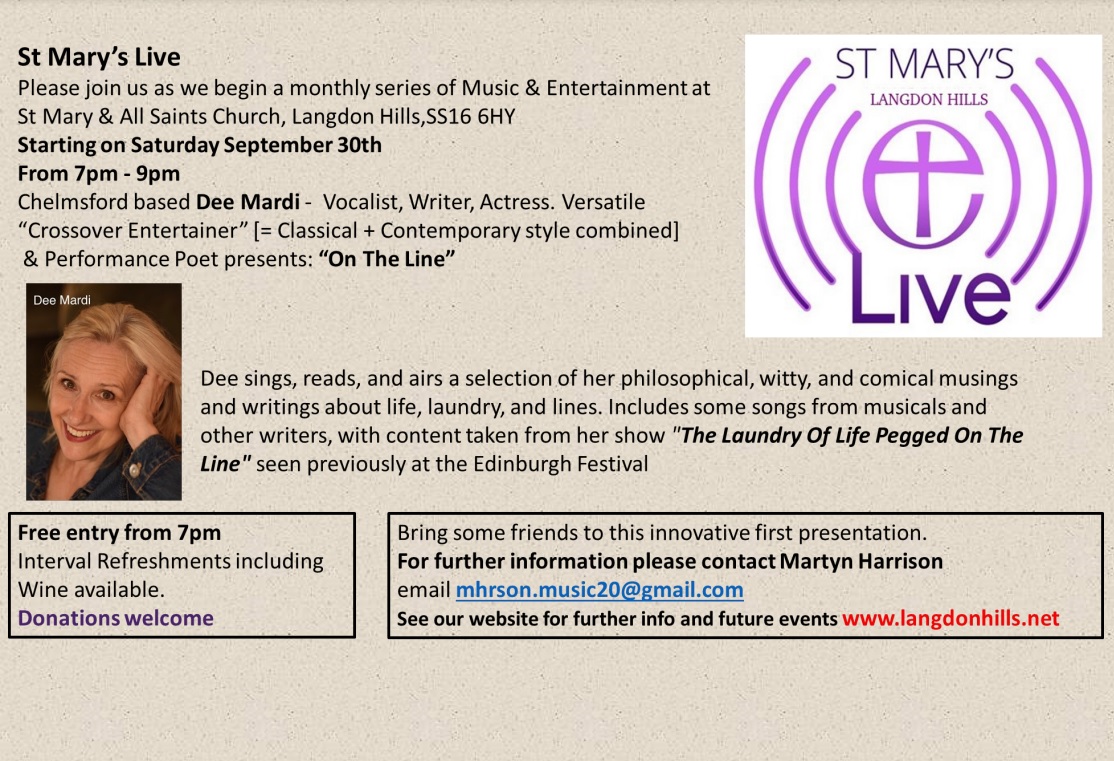
St Mary’s Live

Please join us as we begin a monthly series of Music & Entertainment at St Mary & All Saints Church, Langdon Hills, SS16 6HY

Starting on Saturday September 30th

From 7pm - 9pm

Chelmsford based Dee Mardi - Vocalist, Writer, Actress. Versatile “Crossover Entertainer” [= Classical + Contemporary style combined] & Performance Poet presents: “On The Line”


Dee sings, reads, and airs a selection of her philosophical, witty, and comical musings and writings about life, laundry, and lines. Includes some songs from musicals and other writers, with content taken from her show "The Laundry Of Life Pegged On The Line" seen previously at the Edinburgh Festival

Interval Refreshments including Wine available. Donations welcome.

Bring some friends to this innovative first presentation.

For further information please contact Martyn Harrison - Email mhrson.music20@gmail.com

** There will be lighting provided on the path from the Car Park to the Church **

Further dates for your diary
  • Saturday October 28th Lady and the Scamp - Lady & the Scamp are a talented music duo, specialising in Jazz and their own arrangements of popular ballads
  • Saturday November 25th “Musical Fireworks” - Anne & Andrew Liddell with friends – instrumental extravaganza - Xmas early!
  • Saturday December 9th “Christmas Waits” - A light hearted look at Christmas traditions and music from around the world plus seasonal favourites. Martyn Harrison and Contemporary vocalist Anne Sherwood.
St. Gabriel Pitsea 
1963-2023 
60th Anniversary 
Diamond Jubilee 
Celebration Services & Events 
  • Thursday 21st September 5pm By the Foundation Stone Open air service on the Actual Day - 60 years on 
  • Friday 29th September St. Michael & All Angels’ Day 6.30pm Evening Prayer 
  • Sunday 1st October St. Gabriel’s Patronal Festival & Diamond Jubilee Celebration: 9.30am Holy Communion;  11.15am “For all the Church Family” (See what is happening in St. Gabriel’s Church now!); 6.30pm Evensong (As it would have been in 1963 - if you wish, come dressed accordingly!) 
There will be an exhibition of the building of St. Gabriel’s in 1963 running in the Church throughout September. 

Please ask for details of opening times. 

The Reverend Simon Law 01268 556874 Rector of the Parish of Pitsea with Nevendon.

-------------------------------------------------------------------------------------------------------------

Simon Law - The Haven. 

Sunday, 10 September 2023

Online launch for All Shall Be Well: Poems for Julian of Norwich


The online launch for the anthology of poems for Julian of Norwich is on Wednesday 20 September 2023, 19:00 - 20:00 BST. The launch features new poems read by contributors. Register at https://www.eventbrite.co.uk/e/all-shall-be-well-poems-for-julian-of-norwich-online-launch-tickets-527733122977

All Shall Be Well: Poems for Julian of Norwich, the Amethyst Press anthology of new poems for Julian of Norwich is now available in print and as an e-book!

To celebrate the 650th anniversary of Julian of Norwich's visionary 'Shewings', here is 'All Shall Be Well', an anthology of new poems for Mother Julian, medieval mystic, anchoress, and the first woman to write a book in English. Lyrical, prayerful, vivid and insightful, these poems offer a poetic testament to Julian's enduring legacy of prayer and confidence in a merciful God who assured her that 'All Shall Be Well, and All Shall Be Well, and All Manner of Thing Shall Be Well.' The anthology has been edited by and comes with an introduction by Sarah Law, editor of Amethyst Review.

With contributions from: Susan Brice, Mark S. Burrows, Lance Carden, Carol Casey, Johanna Caton, O.S.B.. Sarah Cave, Ann Cefola, Jennifer Clark, Linda Collins, Jonathan Cooper, Scott Dalgarno, Keren Dibbens-Wyatt, Diana Durham, Jeffrey Essmann, Jonathan Evens, Ruth Gilchrist, Maryanne Hannan, James Harpur, Maura H. Harrison, Kale Hensley, Terry E. Hill, Angela Hoffman, Laura Reece Hogan, Erich von Hungen, Rosie Jackson, Elisabeth Engell Jessen, Sylvia Karman, Jane Keenan, Adrienne Keller, Desmond Kon, Irina Kuzminsky, Sarah Law, Tim Lenton, Shannon Lippert, Viv Longley, Rupert M. Loydell, Hannah Lucas, Tony Lucas, Marjorie Maddox, Marda Messick, Jennifer Davis Michael, Nessa O’Mahony, Tory V. Pearman, Ann Power, Frances Presley, Patrick T. Reardon, Merryn Rutledge, Deborah W. Sage, Maha Salih, Steven Searcy, Kathryn Simmonds, Susan Delaney Spear, Mark Tulin, Laura Varnam, Gail White, Martin Willitts Jr and Mike Wilson.

My poem for the anthology is based on a large painting 'The Revelations of Julian of Norwich' by Australian artist Alan Oldfield which is to be found at the Belsey Bridge Conference Centre in Ditchingham, Norfolk.

Amazon US
Amazon UK
Amazon AU
(plus other Amazon platforms)

To learn more about Julian of Norwich, please visit the Friends of Julian and consider supporting their work.

Amethyst Review is a publication for readers and writers who are interested in creative exploration of spirituality and the sacred. Readers and writers of all religions and none are most welcome. All work published engages in some way with spirituality or the sacred in a spirit of thoughtful and respectful inquiry, rather than proselytizing.

The Editor-in-chief is Sarah Law – poet (mainly), tutor, occasional critic, sometime fiction writer. She has published five poetry collections, the latest of which is 'Ink’s Wish'. She set up Amethyst Review feeling the lack of a UK-based platform for the sharing and readership of new literary writing that engages in some way with spirituality and the sacred.

Foue of my poems have appeared in Amethyst Review. They are: 'Runwell', 'Are/Are Not', 'Attend, attend' and 'Maritain, Green, Beckett and Anderson in conversation down through the ages'. I have also had several poems in Stride magazine, including several reflecting on other poets, beginning with the artist-poet David Jones, continuing with Dylan Thomas and ending with Jack Clemo. To read my poems published by Stride, click here, here, here, here, and here.

Additionally, several of my short stories have been published by International Times, the Magazine of Resistance, including three about Nicola Ravenscroft's mudcub sculptures (now known as Earth Angels), which we exhibited at St Andrew's Wickford last Autumn. The first story in the series is 'The Mudcubs and the O Zone holes'. The second is 'The Mudcubs and the Clean-Up King', and the third is 'The mudcubs and the Wall'. My other short stories to have been published by International Times are 'The Black Rain', a story about the impact of violence in our media, 'The New Dark Ages', a story about principles and understandings that are gradually fading away from our modern societies, and 'The curious glasses', a story based on the butterfly effect.

--------------------------------------------------------------------------------------------------------------

Gordon Bok, Ann Mayo Muir, Ed Trickett - All Shall Be Well Again.

Sunday, 9 July 2023

Restful service

Here's the sermon I shared at St Catherine's Wickford this morning:  

A yoke is a wooden crosspiece that is fastened over the necks of two animals and attached to the plough or cart that they are to pull. It doesn’t sound like something which is light or easy to wear, so in what sense might Jesus be using this farming image to talk about rest for those who come to him (Matthew 11. 28 – 30)?

Jesus would have been very familiar with ploughs and yokes as both are implements made by carpenters. Two animals, usually either oxen or donkeys, would wear the yoke and pull the plough guided from behind by the farmer. Their task was to break up the ground for sowing.

Jesus was speaking in a context where the Pharisees took the 613 commandments in the Torah – the Law of Moses – which were to do with all aspects of life - shaving, tattoos, clothing, work, food and drink, farming, money and so on – and multiplied these commandments by creating detailed instructions about the ways in which each of these commandments was to be kept. Keeping all of these additional rules was indeed a heavy burden for all who tried to do so.

Jesus, by contrast, taught that love was the fulfilling of the Law. Instead of keeping the endless detail of the regulations created by the Pharisees, Jesus said that we should simply love God, ourselves and our neighbours and that all the Law of Moses is actually designed to that end. This was liberating teaching which brought rest for those weighed down by the burden of trying to keep hundreds of commandments and thousands of additional regulations. On the basis of Jesus’ liberating teaching, St Augustine was able to write: ‘Love, and do what you will’ because when the ‘root of love be within’ there is nothing that can spring from that root, but that which is good.

I wonder whether you are ready to leave behind the heavy burden of rules and regulations in order to be accepted or justified and instead open your life to the liberating and restful law of love.

The oxen or donkeys undertaking the ploughing were guided by the farmer using the yoke. As they followed that guidance the yoke sat lightly on their shoulders and the ploughing proceeded apace. If they ignored the guidance of the farmer and pulled in different directions then the yoke would feel heavy and would chafe the neck causing sores or other injuries.

By using this image Jesus is arguing that we have choices about the way in which we live life. We can go off in our own direction pulling away from other people and from God but, when we do so, we are pulling against the way of life for which we have been designed and created. It is when we submit to God’s way of life – the law of love - that we find rest through being in the right place at the right time and living in the right way. When this happens we have a sense of everything coming together and fitting into place which is both profoundly satisfying and restful.

I wonder whether you are prepared to surrender control of your life to the one who created you in all your uniqueness and explore instead how to live in the way for which human beings were created; to live according to the law of love.

Finally, there is the task to which we are called. This image of pairs of oxen ploughing with the use of a yoke fits closely with the task Jesus gave to his disciples when he sent them out in pairs to go to villages and towns ahead of him in order to prepare people for his arrival when he would sow among them the seed of the Word of God.

He said, therefore, that this task - the role of a disciple – although it seems challenging to take up, is actually hugely rewarding as well as being restful in the sense that we are doing God’s will and it is God who does the work, not us. We read in Luke 10, for example, that the seventy disciples Jesus sent out in pairs returned from their mission with joy, saying, “Lord, in your name even the demons submit to us!”

I wonder whether you are prepared to undertake the challenging, yet strangely restful, task of a disciple of Jesus; that of preparing the ground by sharing the message of love, so that others might receive the Word of God?

Jesus said: “Come to me, all you that are weary and are carrying heavy burdens, and I will give you rest. Take my yoke upon you, and learn from me; for I am gentle and humble in heart, and you will find rest for your souls. For my yoke is easy, and my burden is light.” 

-------------------------------------------------------------------------------------------------------------

Andre Crouch - The Promise.

Monday, 19 June 2023

All Shall Be Well: Poems for Julian of Norwich


To celebrate the 650th anniversary of Julian of Norwich's visionary 'Shewings', here is 'All Shall Be Well', an anthology of new poems for Mother Julian, medieval mystic, anchoress, and the first woman to write a book in English. Lyrical, prayerful, vivid and insightful, these poems offer a poetic testament to Julian's enduring legacy of prayer and confidence in a merciful God who assured her that 'All Shall Be Well, and All Shall Be Well, and All Manner of Thing Shall Be Well.' The anthology has been edited by and comes with an introduction by Sarah Law, editor of Amethyst Review.

The anthology has contributions from: Susan Brice, Mark S. Burrows, Lance Carden, Carol Casey, Johanna Caton, O.S.B.. Sarah Cave, Ann Cefola, Jennifer Clark, Linda Collins, Jonathan Cooper, Scott Dalgarno, Keren Dibbens-Wyatt, Jeffrey Essmann, Jonathan Evens, Ruth Gilchrist, Maryanne Hannan, James Harpur, Maura H. Harrison, Kale Hensley, Terry E. Hill, Angela Hoffman, Laura Reece Hogan, Erich von Hungen, Rosie Jackson, Elisabeth Engell Jessen, Sylvia Karman, Jane Keenan, Adrienne Keller, Desmond Kon, Irina Kuzminsky, Sarah Law, Tim Lenton, Shannon Lippert, Viv Longley, Rupert M. Loydell, Hannah Lucas, Tony Lucas, Marjorie Maddox, Marda Messick, Jennifer Davis Michael, Nessa O’Mahony, Tory V. Pearman, Ann Power, Frances Presley, Patrick T. Reardon, Merryn Rutledge, Deborah W. Sage, Maha Salih, Steven Searcy, Kathryn Simmonds, Susan Delaney Spear, Mark Tulin, Laura Varnam, Gail White, Martin Willitts Jr and Mike Wilson.

My poem for the anthology is based on a large painting 'The Revelations of Julian of Norwich' by Australian artist Alan Oldfield which is to be found at the Belsey Bridge Conference Centre in Ditchingham, Norfolk.

The online launch of the anthology is to be held on September 20th. To learn more about Julian of Norwich, please visit the Friends of Julian and consider supporting their work.

---------------------------------------------------------------------------------------------------------

The Albion Christmas Band - Julian Of Norwich.

Wednesday, 7 June 2023

A changing understanding of God’s revelation

Here's the reflection that I shared this morning at St Andrew's Wickford:

This is a story (Mark 12.18-27) about interpretation of scripture, which is possibly as important for our understanding for what it reveals about ways of interpreting scripture, as for what it says about resurrection.

The Biblical scholar Tom Wright has noted that: ‘Resurrection was a late arrival on the scene in classic biblical writing … Much of the Hebrew Bible assumes that the dead are in Sheol …“The dead do not praise the Lord, nor do any that go down into silence” (Psalm 115:17). Clear statements of resurrection are extremely rare. Daniel 12 is the most blatant, and remembered as such for centuries afterwards: “Many of those who sleep in the dust of the earth shall awake, some to everlasting life, and some to shame and everlasting contempt” (Daniel 12:2). Daniel is, however, the latest book of the Hebrew Bible.’

In Jesus’ day: ‘There was within Judaism a considerable spectrum of belief and speculation about what happened to dead people in general, and to dead Jews in particular. At one end were the Sadducees, who seem to have denied any doctrine of post-mortem existence (Mark 12:18; Josephus, War 2:165). At the other were the Pharisees, who affirmed a future embodied existence, and who seem to have at least begun to develop theories about how people continued to exist in the timelag between physical death and physical resurrection. And there are further options. Some writings speak of souls in disembodied bliss, some speculate about souls as angelic or astral beings, and so forth.‘

‘The Sadducees rejected the Oral Law as proposed by the Pharisees’ and ‘saw the written Torah as the sole source of divine authority.’ They insisted that the traditions did not contain this newfangled doctrine and that resurrection was not taught in the Torah itself. Their question to Jesus was based on the literal application of a commandment from the Torah and was ‘designed to make belief in a resurrection look foolish by proposing a dilemma it might entail.’ (Timothy J. Geddert, Mark, Herald Press)

In his reply to the Sadducees’ question Jesus goes back to the Torah itself (the five books of Moses) which were the only ones the very conservative Sadducees regarded as really authoritative, and stated that ‘God defines himself there in terms of his relationship to Abraham, Isaac, and Jacob.’ The underlying point was that ‘God would not define himself in relationship to people who were now non-existent.’ Therefore, Jesus implies or leaves unstated the remaining move in the argument that ‘if they are alive this must be because God will in fact raise them from the dead.’

Jesus therefore disagrees with a literal argument about scripture based on the earliest texts and affirms an emerging doctrine which only appears clearly in the last book of the Hebrew Bible. What he is affirming is an evolving revelation from God in scripture which develops or adds to or changes earlier interpretations and understandings.

The extent to which God’s revelation is fixed or emerging is one which continues to be debated within the Church and is a key ground on which debates about women’s ordination and human sexuality take place. What rarely seems to feature in these debates are the approaches to interpretation of scripture used by Jesus, the disciples and the Early Church, which are often very different from standard ways of interpreting scripture used today, particularly those which attempt to fix understandings of scripture for all time through literal interpretations. Here Jesus clearly teaches a later, newer doctrine which does not appear in the Torah and was not part of early Judaism. This emerging understanding, however, becomes central to Jesus’ mission and to Christian belief as Jesus’ resurrection and the teachings of the Early Church based on it are entirely new in the history of Judaism.

Tom Wright says: ‘The early Christian hope for bodily resurrection is clearly Jewish in origin, there being no possible pagan antecedent. Here, however, there is no spectrum of opinion: Earliest Christianity simply believed in resurrection, that is, the overcoming of death by the justice bringing power of the creator God … This is a radical mutation from within Jewish belief.’

Our core hope as Christians derives from a changing understanding of God’s revelation which Jesus taught and experienced. The literal interpretations of the Sadducees meant that they could not see or receive the new thing that God was doing in their midst. May God keep us open to receive the new things he is doing in our world through his Holy Spirit and prevent us from rejecting the unexpected moves of his Spirit because our rigidity in our own understandings of scripture. Amen.

--------------------------------------------------------------------------------------------------------

Paul Simon - Seven Psalms.

Wednesday, 7 December 2022

Take my yoke upon you

Here's the reflection that I shared at St Andrew’s Wickford this morning:

A yoke is a wooden crosspiece that is fastened over the necks of two animals and attached to the plough or cart that they are to pull. It doesn’t sound like something which is light or easy to wear, so in what sense might Jesus be using this farming image to talk about rest for those who come to him (Matthew 11. 28 – 30)?

Jesus would have been very familiar with ploughs and yokes as both are implements made by carpenters. Two animals, usually either oxen or donkeys, would wear the yoke and pull the plough guided from behind by the farmer. Their task was to break up the ground for sowing.

Jesus was speaking in a context where the Pharisees took the 613 commandments in the Torah – the Law of Moses – which were to do with all aspects of life - shaving, tattoos, clothing, work, food and drink, farming, money and so on – and multiplied these commandments by creating detailed instructions about the ways in which each of these commandments was to be kept. Keeping all of these additional rules was indeed a heavy burden for all who tried to do so.

Jesus, by contrast, taught that love was the fulfilling of the Law. Instead of keeping the endless detail of the regulations created by the Pharisees, Jesus said that we should simply love God, ourselves and our neighbours and that all the Law of Moses is actually designed to that end. This was liberating teaching which brought rest for those weighed down by the burden of trying to keep hundreds of commandments and thousands of additional regulations. On the basis of Jesus’ liberating teaching, St Augustine was able to write: ‘Love, and do what you will’ because when the ‘root of love be within’ there is nothing that can spring from that root, but that which is good.

I wonder whether you are ready to leave behind the heavy burden of rules and regulations in order to be accepted or justified and instead open your life to the liberating and restful law of love.

The oxen or donkeys undertaking the ploughing were guided by the farmer using the yoke. As they followed that guidance the yoke sat lightly on their shoulders and the ploughing proceeded apace. If they ignored the guidance of the farmer and pulled in different directions then the yoke would feel heavy and would chafe the neck causing sores or other injuries.

By using this image Jesus is arguing that we have choices about the way in which we live life. We can go off in our own direction pulling away from other people and from God but, when we do so, we are pulling against the way of life for which we have been designed and created. It is when we submit to God’s way of life – the law of love - that we find rest through being in the right place at the right time and living in the right way. When this happens we have a sense of everything coming together and fitting into place which is both profoundly satisfying and restful.

I wonder whether you are prepared to surrender control of your life to the one who created you in all your uniqueness and explore instead how to live in the way for which human beings were created; to live according to the law of love.

Finally, there is the task to which we are called. This image of pairs of oxen ploughing with the use of a yoke fits closely with the task Jesus gave to his disciples when he sent them out in pairs to go to villages and towns ahead of him in order to prepare people for his arrival when he would sow among them the seed of the Word of God.

He said, therefore, that this task - the role of a disciple – although it seems challenging to take up, is actually hugely rewarding as well as being restful in the sense that we are doing God’s will and it is God who does the work, not us. We read in Luke 10, for example, that the seventy disciples Jesus sent out in pairs returned from their mission with joy, saying, “Lord, in your name even the demons submit to us!”

I wonder whether you are prepared to undertake the challenging, yet strangely restful, task of a disciple of Jesus; that of preparing the ground by sharing the message of love, so that others might receive the Word of God?

Jesus said: “Come to me, all you that are weary and are carrying heavy burdens, and I will give you rest. Take my yoke upon you, and learn from me; for I am gentle and humble in heart, and you will find rest for your souls. For my yoke is easy, and my burden is light.”

--------------------------------------------------------------------------------------------------------

Blessid Union of Souls - Lucky To Be Here.