Teresa Smith, Kate Coxon and George Smith have written a comprehensive report on The Barton Project which was set up by my father, Phil Evens, in 1974. The Barton Neighbourhood Community Project: Barton, Oxford City and Oxfordshire is published by Oxford Social Research Ltd and the introduction to the report outlines its scope:
'The Barton Neighbourhood Community Project was first established on the Barton estate,
Oxford in 1974. The initiative for the project came from a lecturer, Phil Evens, in the
University of Oxford’s Department of Social and Administrative Studies (known as ‘Barnett
House’) which had a long history of local research and local involvement, and was in the late
1960s and early 1970s closely involved in major national government programmes targeted at
disadvantaged areas in the UK. Evens persuaded his Department that they should also support
a local initiative and selected the Barton estate as an area that had been neglected (A
‘Forgotten Community’ was the title of his 1976 book). Barton is a small social housing
estate on the eastern edge of Oxford city, outside the main city ring road, that cut it off from
the rest of the city.
It can be argued that in one form or other the Barton Project has existed ever since, though
the University passed on the direct link in the 1990s to Ruskin College when the project’s
community work student training unit was transferred; the project’s welfare rights work,
Oxfordshire Welfare Rights, is now funded and managed by a local community work agency.
While this report focuses on the community work on Barton now and the current social and
economic conditions on the Barton estate, the study also covers some of the changes and
developments that have occurred both in the area and in the way community work has
operated in disadvantaged areas like the Barton estate.
In the opening section we cover some of the wider background to the development of
neighbourhood community work in the UK and analyse the social and economic conditions
in the Barton area in comparison to Oxford, Oxfordshire and England as a whole. The second
section focuses on the Barton Neighbourhood Project in terms of its development over time
and its current programme of work. Further case studies of particular schemes are also
covered. Finally we ask whether the Barton Estate is any longer a ‘forgotten community’, and
draw out lessons and conclusions that may be relevant to other areas in the UK and elsewhere.'
Dad's experiences and other contributions to the development of community work were published in Community Work: Theory and practice (1974) and The Barton Project (1976). Both books applied his Christian faith to his work, and called for the active involvement of Christians in community work and other public services. My other posts about Dad and his work can be found by clicking here.
-------------------------------------------------------------------------------------------------
U2 - Bad.

Showing posts with label g. smith. Show all posts
Showing posts with label g. smith. Show all posts
Friday, 4 August 2017


Thursday, 18 June 2015
Modern art in City churches


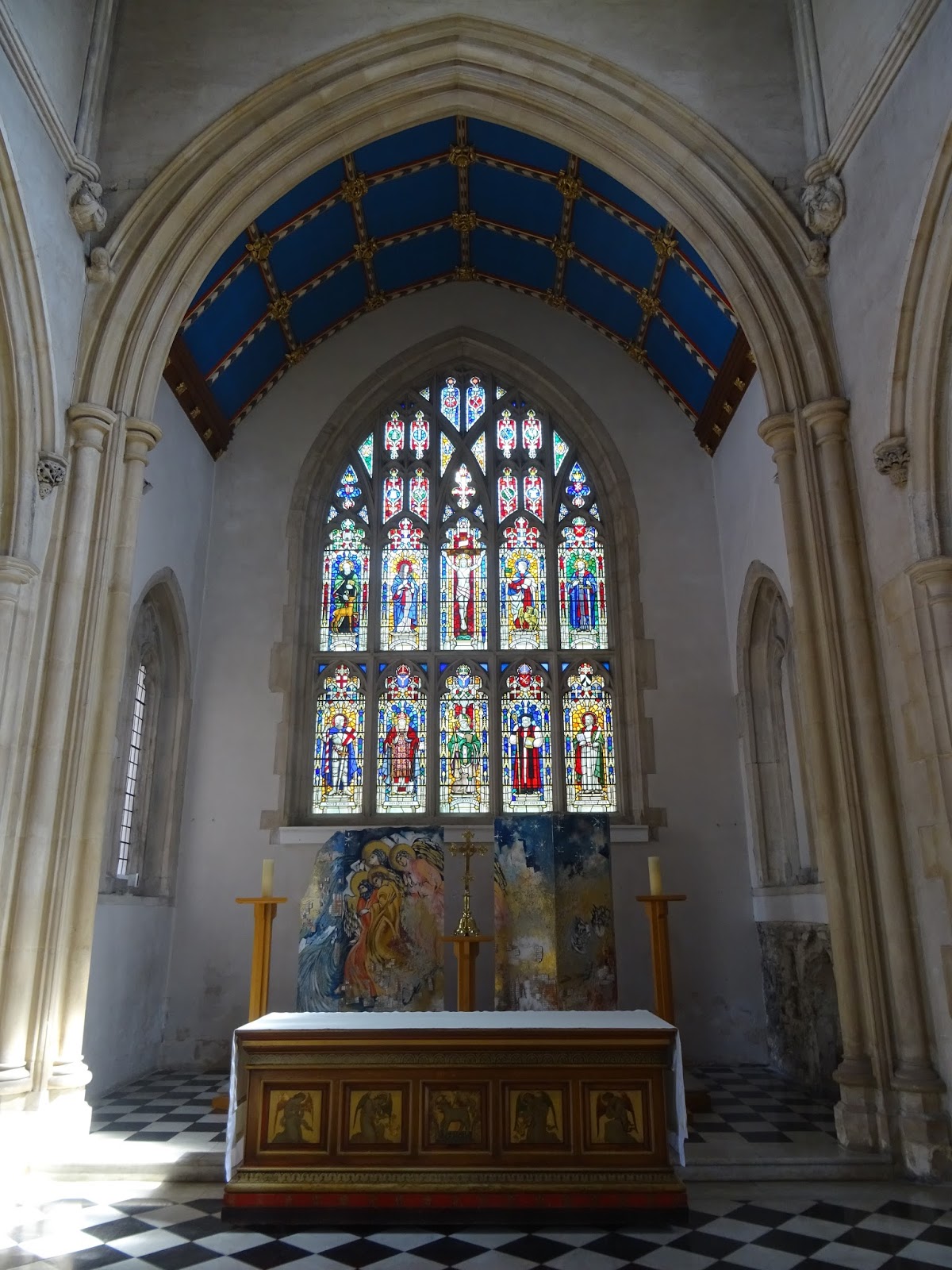


The East Window was designed by Gerald Smith of the Nicholson Studios, a London-based stained glass studio, which made the window in 1960. The firm's output covered the years of restoration following both World Wars. After the medievalism of the Gothic Revival and the intense spirituality of the Arts and Crafts movement, Nicholson and Smith's inventive, light, plain windows were much appreciated. The East Window follows the pattern of the medieval window, of which traces came to light as a result of war damage. The design incorporates many figures of historical significance to the church, as well as the instruments of the crucifixion at the top.
The West Window was designed by the Faircraft Studios and installed in 1968. In the centre is the coat-of-arms of the City of London, which is flanked on its left by the coat-of-arms of the Archbishop of Canterbury, and on its right by that of the Bishop of London. In the lower frame, from left to right, are the coats-of-arms of Robert Glover, Somerset Herald of Arms in the reign of Henry VIII, who was buried in the church; of John Milton; of the Earls of Bridgewater; Oliver Cromwell, and Sir Martin Frobisher. There were ten Earls of Bridgewater and three Earls of Kent buried in the church.
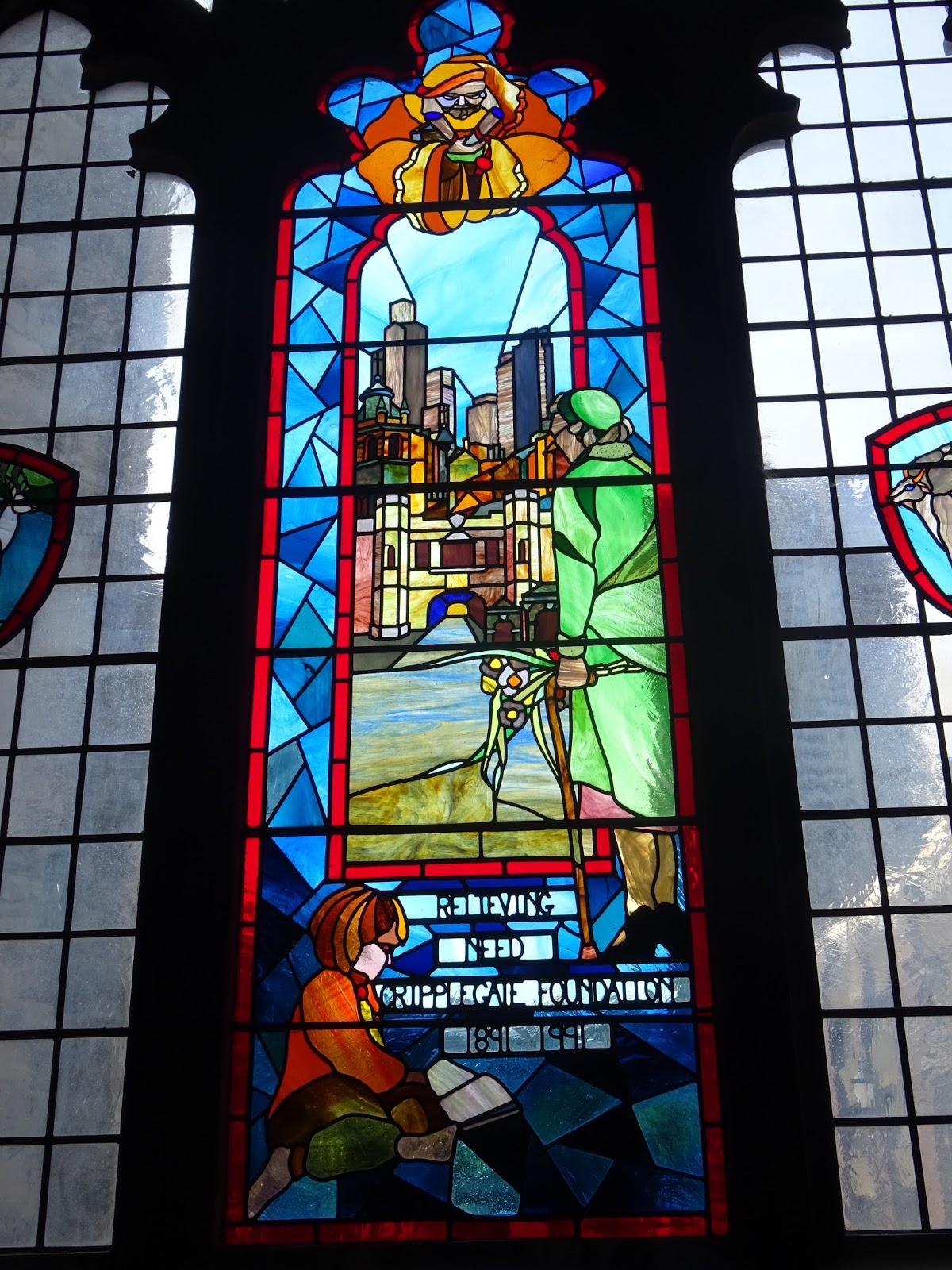
There are two modern stained glass windows on the north side of the church. In the baptistery is the Cripplegate Window, which celebrates the centenary of the Cripplegate Foundation which gives grants, advice and support to local organisations. The Foundation was formally established in 1891 but its origins lie in gifts made to St Giles' for the poor and the needy dating back centuries: John Sworder made the first recorded gift in his will, dated 2 April 1500, and the head at the top of the window represents Sworder, the first of the pious donors of the parish that we know by name. The window, erected by the stained glass studio Goddard & Gibbs and designed by Sheelagh McKinlay from Bow, East London, also shows other beneficiaries of the Foundation, and the buildings in the middle ground represent St Giles' and St Luke's churches and the Barbican development.
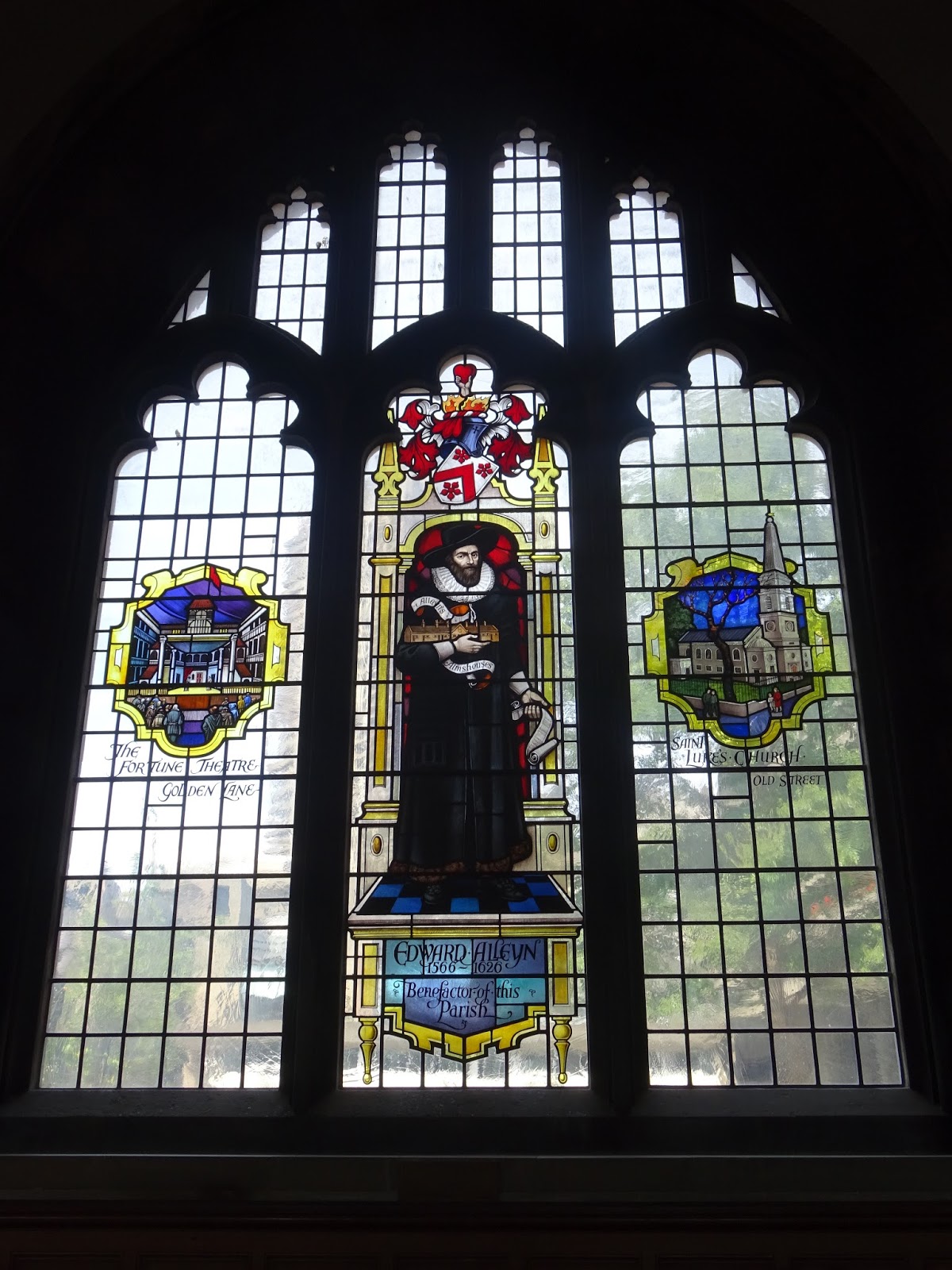
On the north wall of the church is a memorial window to Edward Alleyn, the parish's generous benefactor. The design is the work of John Lawson of stained glass studio Goddard & Gibbs and depicts Alleyn in the centre, as well as the Fortune Theatre (which he founded), almshouses (which he built in the parish and which were destroyed in the Second World War), and St Luke's Church, Old Street.
Under the organ gallery are four busts of famous parishioners, on loan to St Giles' from the Cripplegate Foundation. They were modelled by the sculptor George Frampton, whose most famous statue is that of Peter Pan in Kensington Gardens. On the left as you enter the space under the gallery is the bust of Daniel Defoe, author of Robinson Crusoe, who was also a government agent, pamphleteer, and brick-maker amongst other roles. The next bust is of the author John Milton, perhaps the most famous resident to be buried at St Giles'. He is also commemorated with a bust and a statue in the south aisle, and his burial place is marked by a stone on the floor near the pulpit. On the other side of the glass doors are busts of Oliver Cromwell, who ruled England during the Protectorate in the 1650s, and the non-conformist John Bunyan, author of Pilgrim's Progress, who is buried in the dissenter's graveyard of Bunhill Fields, a short walk from St Giles'.
Under the organ gallery are four busts of famous parishioners, on loan to St Giles' from the Cripplegate Foundation. They were modelled by the sculptor George Frampton, whose most famous statue is that of Peter Pan in Kensington Gardens. On the left as you enter the space under the gallery is the bust of Daniel Defoe, author of Robinson Crusoe, who was also a government agent, pamphleteer, and brick-maker amongst other roles. The next bust is of the author John Milton, perhaps the most famous resident to be buried at St Giles'. He is also commemorated with a bust and a statue in the south aisle, and his burial place is marked by a stone on the floor near the pulpit. On the other side of the glass doors are busts of Oliver Cromwell, who ruled England during the Protectorate in the 1650s, and the non-conformist John Bunyan, author of Pilgrim's Progress, who is buried in the dissenter's graveyard of Bunhill Fields, a short walk from St Giles'.
-----------------------------------------------------------------------------------------------
Benjamin Britten - Curlew River.
Subscribe to:
Posts (Atom)