Four days spent with some of my best friends among some great art, wonderful music and stimulating seminars;
Greenbelt 2011 was a little taste of heaven.
They say many of the best Greenbelt moments are unplanned - when you stumble upon something extraordinary or inspiring on your way to somewhere else - and that was true for me this year in discovering the multi-talented Canadian band,
The Geese, and hearing the exquisite acoustic set by
Lisa Gungor.
The Geese performed 'The Voyage of St Brendan' on the first night in their
The Filid format; "a
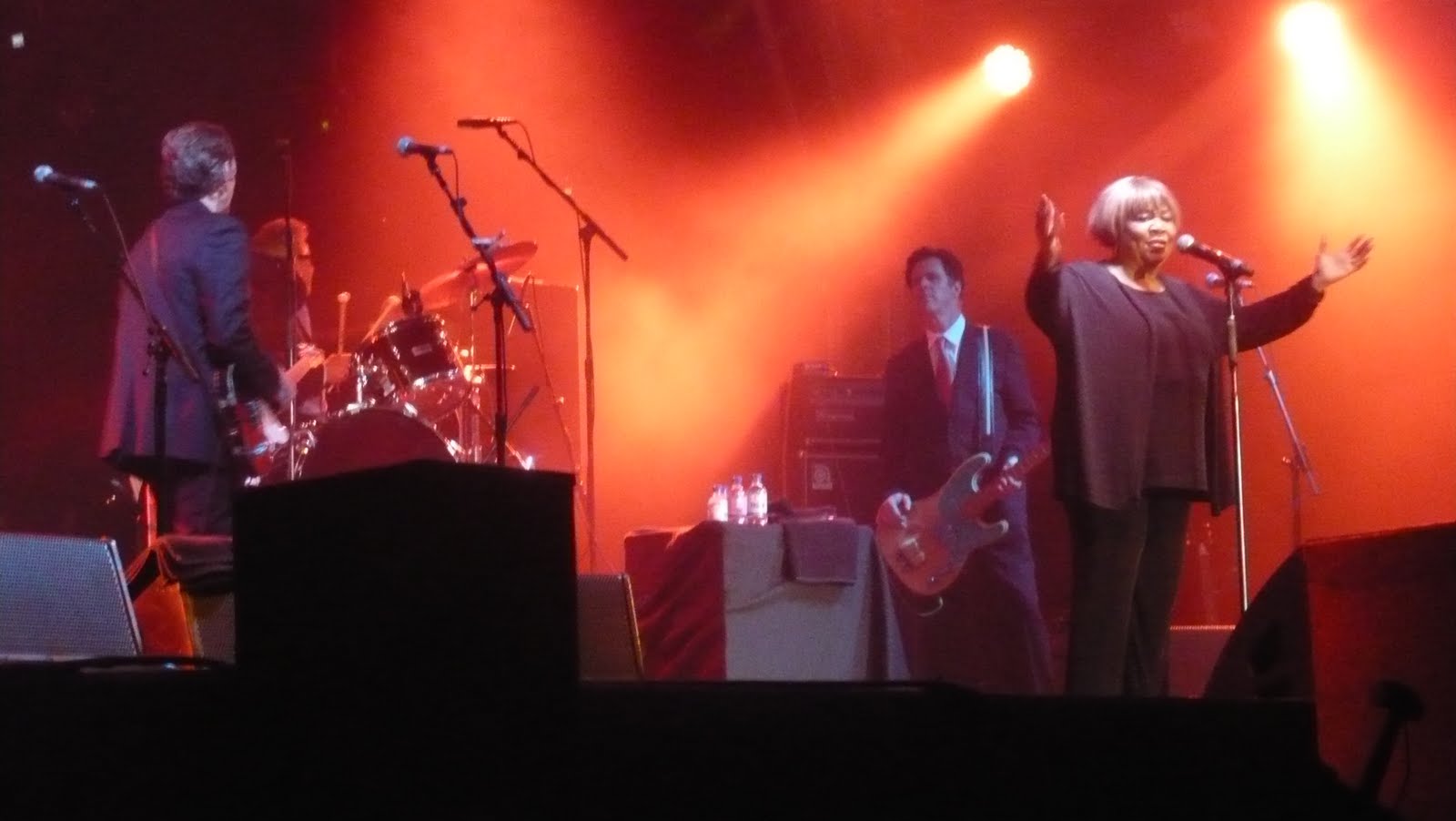
dynamic service of original music, liturgy, poetry, and images designed to facilitate contemplative prayer and openness to God." In line with their subtitle of "apophatic performance for aesthetic contemplation," the show dealt with the darkness and mystery of faith in a world of too much certainty. Later in the Festival, the band played a second set with each band member taking turns to lead the group, seamlessly trading instruments and roles between songs. In drawing on a range of folk stylings and in the changing leads, with each band member being a songwriter and multi-instrumentalist, they remind of the ultimate band, The Band. Mavis Staples also recalled The Band during her set, thanking them for involving the Staple Singers in The Last Waltz, after singing 'The Weight'.
Lisa Gungor performed together with her husband Michael, who leads the band
Gungor (of which she is also part), but performed songs from her
solo albums together with some Gungor material. Gungor had played mainstage earlier in the day, a set I hadn't gone to see. I hadn't planned to go to Lisa's set either but was very glad I did catch it and bought the current Gungor album as a result. The title track 'Beautiful Things' was what really attracted my attention:
"You make beautiful things
You make beautiful things out of the dust
You
make beautiful things
You make beautiful things out of us"
Michael Gungor says, “This album is an expression of hope that God will make beautiful
things out of the dust in our lives, that God will somehow use us, use our
obedience and love, our feeble human effort, and build Himself a kingdom.”
For me, this was essentially the theme which seemed to emerge from the Festival as a whole.
Rob Bell's mainstage talk was on the theme of being fully ourselves; owning who we are - creativity and failures - and throwing ourselves into doing the next right thing. His talk seemed primarily anecdote based and often felt like that which might be given by a motivational speaker.
Nadia Bolz-Weber's sermon at the excellent Communion Service was, by contrast, grounded in both her text (John 1. 1-5, 9-14) and her personal experience of significant back pain. She attacked the botox culture of idealised bodies and argued that the incarnation leads to the acceptance and valuing of our human flesh.
Michael Mitton quoted
John O'Donohue and
Sister Stan saying similar things as part of his talk on 'The Homing Instinct':
"Home is where the heart is. It stands for the sure centre where individual life is shaped and from where it journeys forth. What it ultimately intends is that each of its individuals would develop the capacity to be at home in themselves." (O'Donoghue)
"Home is the place where we discover who we are, where we are coming from and where we are going to. It is where we are helped to establish our own identity." (Sister Stan)
Interestingly and surprisingly,
Peter Rollins arrived at a similar place albeit without Mitton's confidence that home forms our real identity. By contrast he began on a tack that mirrored
Philip Larkin's, "they fuck you up, your Mum and Dad." He argued that we are imprisoned by separation, alienation, and misrecognition. Separation, through the sense of loss that we feel at three months old as we begin to develop a sense of self. Alienation, as we respond to this sense of loss by trying to possess our primary care giver while being aware that we cannot do so. Misrecognition, as we take on the alterego that our parent(s) want to give to inhabit. These three, Rollins argued, form the walls of the prison in which we are trapped; a prison where we endlessly seek idols to fill the existential void that we think is fundamental to our existence. The Church is part of the problem is that by offering God as the solution to our angst, it delivers a purified version of this false life structure and makes God a product among other products.
Christianity in its purest form, he argued, is the alternative to this imprisonment, rather than being the answer to it. Jesus did not experience this sense of separation being without sin and without idolatry. In this, he shows what it is like to be fully human. On the cross he became sin - became the concrete manifestation of our idolatry - revealing the falsity of the three walls to our prison. In the resurrection, he becomes present in the act of our loving others. Love is not an object to be sought but is what enables existence and meaning. As we lay down our desire to be fulfilled and embrace those around us - accepting their brokenness and ours - we find God in community. The role of the Church, therefore, is not to say this is how you can be fulfilled but instead to be the place where we go to experience and accept ourselves as broken, as outsiders, so that we can then find God in the service we do. The truth of who we are is found in what we do.
Generational conflict also formed the theme of
Ann Morisey's session on 'Borrowing from the future' in which she described the perfect storm approaching us as a result of the disadvantaging of younger generations and asked, as a baby boomer, how those who have 'had it good' could act imaginatively to lessen the resentment that will be felt by future generations.
Luke Bretherton went back to the medieval period to suggest that differing approaches to current government policies derive from medieval debates about limits and freedom. Voluntarism prioritises freedom of choice for the individual and favours marketisation, while Communion emphasises our participation with God working in creation and favours mutualism and cooperatives.
Billy Bragg's Friday night headlining set unsuprisingly also dealt dealt with political issues and conflicts. I arrived at the set appropriately as he was singing 'The Battle of Barking,' covering
the fight against the BNP in Barking and Dagenham to which I and others in the Chelmsford Diocese successfully contributed during the last General Election. He spoke movingly about being inspired by the Rock against Racism movement to become a political songwriter and in terms of his belief in people like us to stand up and be counted in the ongoing fight against discrimation.
The wonderful closing set by Mavis Staples was an object lesson in overcoming generational barriers. The 72 year old needed a rest and a cup of tea midway through her high energy set but either side of this instrumental break shared a lifetime's faith and commitment to Christ and civil rights through the blend of gospel, soul and social action which characterised the oeuvre of the Staple Singers from their links with
Dr Martin Luther King to their
Stax classics and beyond. The celebration and challenge of her set and songs was summed up in the closing 'Eyes on the Prize' from her classic album
We'll Never Turn Back, which uses the story of Paul and Silas' miraculous release from prison as enouragement to hold on in our search for freedom now:
"Well, the only chains that we can stand
Are the chains of hand in hand
Keep your eyes on the prize, hold on
Got my hand on the freedom plow
Wouldn't take nothing for my journey now
Keep your eyes on the prize, hold on!"
In between all this, I also: took part in the
Photo Flash Swap; viewed the
Angels of the North,
Lumia Domestica, and
Methodist Art Collection exhibitions; discovered the poetry of
Padraig O'Tuama; listened to
Phyllis Tickle on Emerging Church,
Jari Moate on his
Paradise Now novel,
Meryl Doney on curating exhibitions,
Mark Pierson on curating services, and
Luke Walton and
Nick Park on film; saw the
Ikon performance 'based on a true story'; and saw stellar sets from
Milton Jones,
Rob Halligan,
Gordon Gano and the Ryans,
Duke Special,
Beth Rowley,
Kate Rusby and
The Unthanks.
The thoughts and reflections of some of my friends who were also there can be found
here,
here and
here.
-----------------------------------------------------------------------------------------
The Geese -
Cola Cans.