Wikio - Top Blogs - Religion and belief
Showing posts with label h. clarke. Show all posts

Monday, 7 April 2025

Dublin - Evie Hone and Patrick Pye


I'm in Dublin to see and review Mainie Jellett and Evie Hone. The Art of Friendship at National Gallery of Ireland. Coming to Dublin has provided an opportunity to see other work by Evie Hone elsewhere in the city, plus some work by the artist Patrick Pye.

Evie Hone was an Irish painter and stained glass artist. She is considered to be an early pioneer of cubism, although her best known works are stained glass. Her most notable pieces are the East Window in the Chapel at Eton College, which depicts the Crucifixion, and My Four Green Fields, which is now in the Government Building in Dublin.

Patrick Pye was a sculptor, painter and stained glass artist, resident in County Dublin. Major commissions can be seen across Ireland. In 1999 a retrospective of his work was exhibited by the Royal Hibernian Academy. He was a founding member of Aosdána and has been described as "the most important creative artist in the sphere of religious thought in Ireland in our time".

For more on Mainie Jellett and Evie Hone see here, here, here, here, and here; for more on Patrick Pye see here and here.

Five Evie Hone stained glass windows are to be found in the Ignatian Room at St. Francis Xavier Church having been relocated from the former student residency University Hall. Frank Rogers, author and historian says the windows are some of the best examples in Ireland of religious icons in stained glass. Hone's great gift was in illustrating a Bible story so simply and clearly that it could be understood by anyone who saw it. Nowhere is this more apparent than in the five symbolical windows from University Hall, representing the Lamb the Fish, the Pelican ,the Dove and the Alpha and Omega, all symbols of the persons of the Trinity.

St. Michael Dun Laoghaire was destroyed by a disastrous fire in 1965 and rebuilt in 1973 to a design by Pierce McKenna, with Sean Rothery and Naois O’Dowd. The great tower and spire, which survived the fire, now stands alongside the new Church, thus amalgamating the old with the new (as also at Coventry Cathedral). Responding to changes in the liturgy dictated by Vatican II, the sanctuary of the new church was also in the centre of the church, surrounded by the congregation. The design was strikingly modern for its day. The large glass here is by the Murphy Devitt Studios, Patrick Pye also contributed several stained glass windows, while Yvonne Jammet carved the wooden stations. Michael Biggs, the leading stone sculptor of the time, created sinuous and monumental granite blocks shaped as baptismal font, altar, lectern and tabernacle column (these remind one of the Henry Moore altar at St Stephen Walbrook). The extraordinary tabernacle is the work of Richard Enda King, who also made the crucifix.

At St John the Baptist, Blackrock, in 1925, Harry Clarke Studio was commissioned to create two stained glass windows. These can be seen as the third stained glass windows on both the west and east aisles.The windows portray, on the left hand side of the nave, Our Lady of Mount Carmel, St Sebastian and St Hubert, and, on the right hand side of the nave, the Crucifiction and St Francis. 1932 saw new stained glass windows installed in the Chapel dedicated to St. Anne, by Earley & Company, a Dublin-based stained glass studio. Scenes from the Life of St Anne, is one of William E. Earley's finest stained glass commissions. In 1955, stained glass windows by Evie Hone were presented by the McGuire family in memory of Brigid Patricia McGuire. These windows depicting Bridget, Mary and Jesus, and Patrick were among the last produced by Hone.

The Triptych of Pentecostal Windows for the Castle oratory of Blackrock College was commissioned from Evie Hone in 1941 by the Past Pupils Union in honour of former college President J.C. McQuaid's appointment as Archbishop of Dublin. It was at Blackrock College that Hone was received into the Catholic Church by McQuaid, when Head of College. The College Chapel has stained glass by William Dowling, Michael Healy, Evie Hone, and Hubert McGoldrick. Hone's Chapel Foyer windows exhibit the geometric abstract style associated with modernism. She also has a lunette above an entrance to the Chapel. The College also has a window on the theme of Seven Gifts of the Holy Spirit from the Harry Clarke Studios. For more on Harry Clarke see here and here.

The windows in the Manresa Jesuit Centre of Spirituality prayer room were Evie Hone’s first independent commission, executed in 1945 and 1946. The first windows she worked on depict the Nativity and the Sacred Heart (the windows on the left and right respectively in the current arrangement) and, in 1946, the Sermon on the Mount/Beatitudes, the Last Supper and Pentecost. The windows were made for the chapel of the Jesuit College, Rahan, Tullamore, County Offaly and, when that building was sold in 1991, they were removed and installed in the purpose-built room in Manresa in 1992. The art to be seen at Manresa also includes stations of the cross by Richard Enda King and images by Hone, Mainie Jellet, Patrick Pye and Georges Rouault.

---------------------------------------------------------------------------------------------------------

Van Morrison - Haunts Of Ancient Peace.

Wednesday, 29 May 2024

Harry Clarke and An Túr Gloine at St Eunan's Cathedral


'The 19th century Catholic revival in England influenced a renewed interest in the Gothic style and in the use of stained glass, while the Celtic revival in Ireland (19th/20th centuries) ushered in an interest in Celtic culture to be deployed, inter alia, in the visual arts. The languid mood and undulating lines of Art Nouveau also proved influential.

Harry Clarke (1889-1931) born in Dublin, is one of the finest exponents of stained glass design. Experimental and controversial at times, he received commissions from both the Catholic church and the Church of Ireland as well as for secular projects. Examples of his work are installed in buildings in Ireland, England, America and Australia. He was also an illustrator of books ...

he brought an imaginative and magical interpretation to the depiction of both religious and secular themes. His colours are varied and rich (variants of ruby reds and deep blues proliferate) and induce a kaleidoscopic interchange of colour and light. The luminous and shifting nature of his deployment of light contributes to the ‘becoming’ of his stained glass works. The composition of his panels can at times be crowded but more often he retains a harmonising integrity of lines, shapes, colours and forms to exquisite effect.'

There are decorative clerestory windows by him in St Eunan’s Cathedral, Letterkenny, as well as wall paintings. The Cathedral also has the finest collection of An Túr Gloine Stained Glass windows in Ireland.

The Cathedral has: 'windows to the transepts by Michael Healy (1873-1941) dated 1910-11 (five-light window depicting the Convention of Druceatt, St. Helena window, and the SS Dallan and Conan Maol window), work by Alfred Ernest Child (1869-1939) depicting St. Finan and St. Moibhi, work by Beatrice Elvery\Lady Glenavy (1881-1970) depicting St. Columbanus and St. Gall, work by Catherine O’Brien depicting St. Columba, work by Ethel Rhind (1878-1952) depicting St. Charles Borromeo, and work by Richard Joseph King (1907-74). Perhaps of most importance is the series of ten stained glass windows at clerestory level (dated 1928) by the celebrated artist Harry Clarke (1889-1931) who was also responsible for two wall paintings at this cathedral.'

'In the summer of 1928 Harry visited St. Eunan’s Cathedral in Letterkenny to inspect the area allocated for ten two-light clerestory windows. In July he sent several sketches for the Letterkenny project to the Bishop of Raphoe, Reverend William MacNeely.

Harry was awarded the commission in August. Despite Harry’s ill-health and his stay at the sanatorium in Davos, Switzerland, for most of 1929, the Letterkenny windows were completed by November 1929 (Bowe: 1994). Cut pieces of slab glass in diamond shapes were used to create each of the Letterkenny windows. Although similar in design, every window is unique.'

His wall paintings are located in Our Lady's Altar at the back of the cathedral's main altar. A painting of one angel was only uncovered and restored in 2012.

---------------------------------------------------------------------------------------------------------

Sunday, 13 July 2014

Sabbatical art pilgrimage: St Michael and All Angels Waterford


In 1919 designs by Harry Clarke for a two-light window, St Cecilia and a Listening Angel, commissioned for St Michael and All Angels Waterford were rejected by the Diocesan Advisory Committee (DAC) on the grounds that the design was out of keeping with the Pre-Raphaelite windows already in the church.

St Michael and All Angels is a minor gem of a Church which was consecrated in 1872, built in the style of Early English Gothic, and populated throughout with Pre-Raphaelite stained glass as well as mosaics from James Powell and Sons (the Whitefriars Studio). St Michael and All Angels, therefore, stands in a tradition which reflects a set of very English styles and influences.

Henry Woodyer, its architect, was a disciple of Augustus Pugin. Giles Worsley has written that Woodyer’s work is “predominantly muscular Gothic, in the spirit of A W N Pugin” and like Pugin “stems from his religious bent.” At its best, he argues, “there is an energetic vigour to his religious and secular work” and “a convincing vision of the Middle Ages, rich with colour and decoration.”

Augustus Welby Pugin - the architect, designer, writer, and theorist known as ‘God’s own architect’ - had a major influence on architecture and design throughout the English-speaking world well into the twentieth century. His importance lies both in his creation of the Neo-Gothic style and in his anticipation of many of the statements on design by John Ruskin which led to the formation of the Pre-Raphaelite Brotherhood, the work of Morris & Co., and the development of the Arts & Crafts Movement.

William Morris - poet, artist, philosopher, typographer and political theorist - was the greatest designer and one of the most outstanding figures of the Arts and Crafts Movement. In 1861, with a group of friends, he started the business Morris, Marshall, Faulkner & Co. which provided beautiful, hand-crafted products and furnishings for the home. Influenced by the ideas and writings of Thomas Carlyle and John Ruskin, the company revived many of the traditional arts which had been swept away by industrialisation including embroideries, tapestries and stained-glass.

In addition to the creation of new artefacts, Morris was also concerned about the preservation of art and architecture from earlier ages and so, in 1877, he and other notable members of the Pre Raphaelite brotherhood held the inaugural meeting of the Society for the Protection of Ancient Buildings (SPAB) in Bloomsbury. As founding members they were deeply concerned that well-meaning architects were scraping away the historic fabric of too many buildings in their zealous ‘restorations.’ When the DAC rejected Clarke’s design for St Michael and All Angels, they were in essence seeking to follow this strand of Morris’ thought; although whether he would have agreed with their decision is a moot point.

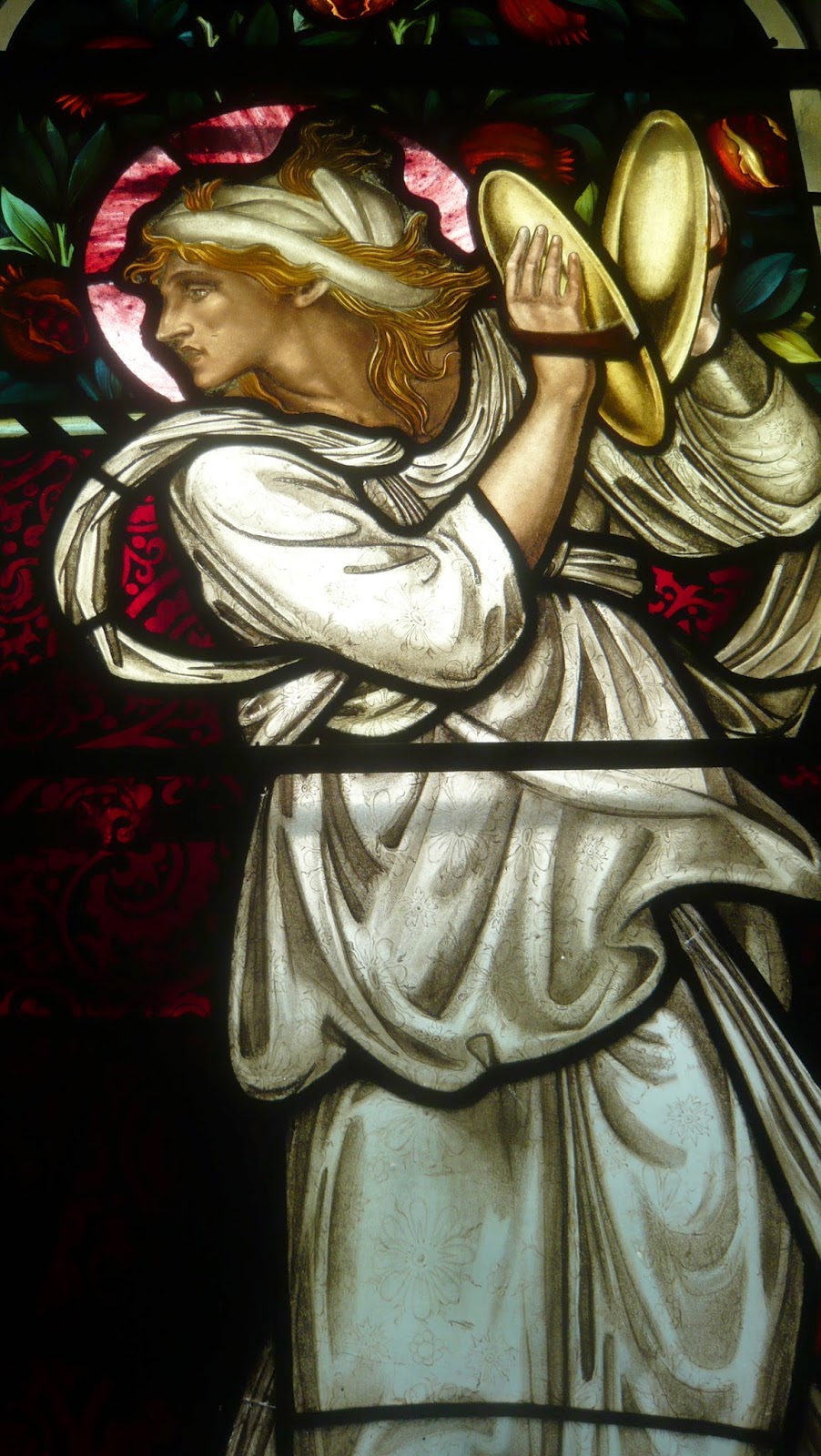
Many of the windows at St Michael and All Angels are by Morris & Co. and feature leading Pre-Raphaelites including Ford Madox Brown, Edward Burne-Jones, Morris, and, possibly, Dante Gabriel Rossetti. Later windows by Selwyn Image, Karl Parsons and Douglas Strachan are part of the same tradition and ensure that the feel of the building as a whole is cohesive. The third chancel window, which depicts the prophetess Miriam and was completed by Morris from a design by Burne-Jones, was included on a list of the 12 best stained glass windows in English churches as judged by photographer Lucinda Lambton.

The Whitefriars Company was a successful British glasshouse closely associated with leading architects and designers from the later portion of the 19th century onwards including Philip Webb who designed glass for William Morris. From 1876 James Crofts Powell ran the stained glass department which also developed mosaic techniques to the Byzantine standards of Ravenna. Powell’s opus sectile mosaics were tilted to deflect the light and gained sufficient credit to be used by William Blake Richmond in his work at St Paul’sCathedral. Whitefriars carried out the creation of the chancel mosaics at St Michael and All Angels to designs by J. P. Hutchinson.

Despite the beauty of the artwork and the building, it is not primarily the Pre-Raphaelite work that I have come to see here. The most recent of the windows, the 1929 St Cecilia and Angel by Karl Parsons, is described in the Church guide as being “especially beautiful when the summer evening sun shines through its vibrant colours.” Acid-etching and plating was used to create the enriched colour and texture found in this window. The window depicts St Cecilia, the Patron Saint of Music, and the music she has inspired on this occasion, which is included in the upper tracery section above the figures, is the fugue from Beethoven’s penultimate piano sonata.

Karl Parsons was pupil and assistant to Christopher Whall, who was an important member of the Arts and Crafts Movement, a leading designer of stained glass and a teacher at the Royal College of Art (RCA) and the Central School of Art and Design. In addition to his work in England, Whall also assisted in reviving the art of stained glass in Ireland. At the invitation of Edward Martyn, Whall, and his colleague Alfred Ernest Child, worked with Sarah Purser to set up a new school of stained glass in Dublin which was christened An Tύr Gloine (Tower of Glass), with a credo that “each window should be in all its artistic parts the work of one individual artist.’

Parsons, who also taught at the RCA and Central School was a craftsman of outstanding ability who worked from a studio at the Glass House Fulham; the centre for most stained glass designers during the first half of the twentieth century. He and Harry Clarke met in 1913, while Clarke was studying the craft and before he began work for his father’s glass workshop, the Clarke Studios, also based in Dublin. The two men remained close friends until Clarke’s death in 1931. The St Cecilia and Angel window at St Michael and All Angels, although “unmistakably by Parsons rather than Clarke” was based on Clarke’s rejected design and means that a trace of the rejected work is found in this church despite its perceived incongruity with the existing Pre-Raphaelite glass (Harry Clarke: The Life & Work, Nicola Gordon Bowe).

Among the many ironies of this story is the fact that Clarke has been described as “the last of the Pre-Raphaelites” and “played a major part in the Arts and Crafts movement in Ireland … as well as in the international stained glass revival which arose from the movement in England.” He “can also be seen as Ireland’s major Symbolist artist, whether in his illustrations or in his stained glass” (Gordon Bowe). Symbolism was also a wider international movement of which the Pre-Raphaelites were part. Therefore, the rejected design, while considered out of keeping with the Pre-Raphaelite windows already in the church, was actually part of a body of work that built on the foundation laid by the Pre-Raphaelites.

Clarke’s strange genius was to fuse “the Burne-Jones/Whall idiom” with “an eclectic and decadent Symbolism of medieval richness and Byzantine splendour” which was achieved by means of his having, as a young man, “absorbed Burne-Jones, [Aubrey] Beardsey, Charles Ricketts, Edmund Dulac, Kay Nielsen, the Glasgow School, [Gustave] Klimt, the Japanese print, the Symbolists, and the Russian ballet.” As a result, “his art displays a wilful decadence and an ambivalent religious mysticism of medieval intensity which ranges from the sublimely beautiful to the grotesquely macabre, rarely found in the work of his Celtic peers.” (Gordon Bowe).

Similarly, James White has noted that Clarke “always carried the sensual-mystical conflict with him” - viewing “his drawings as an outlet from the religious subjects with which he was daily involved in his stained glass work” – and that, as a result, “few artists have been more concerned with the conflict of religion and sensuality.” His works are “uniquely imaginative creations” undertaken with remarkable technical skill meaning that “when he applied his minute and precise line to his process of plating and aciding he achieved an art form of extraordinary perfection.” Peyton Skipwith has suggested that by means of Clarke’s work, alongside that of Evie Hone at An Tύr Gloine, it was Ireland which revived the art of stained glass in the twentieth century (Gordon Bowe).

During his short life Clarke created 160 stained glass windows for churches and private patrons in Ireland, England, the United States and Australia. His unique style and technique combined rich colours with elongated figures that exude poise and grace. Deep blues and ruby reds were the hallmark of his work. As an illustrator of books, his five books for Harrap and Co show his genius in the area of graphic art. In England, work by Clarke is most easily seen at the Victoria & Albert Museum in London and the Stained Glass Museum in Ely.

--------------------------------------------------------------------------------------

The Blue Aeroplanes - Colour Me.