Wikio - Top Blogs - Religion and belief
Showing posts with label birth. Show all posts

Monday, 25 December 2023

Where the body of Jesus Christ is, there we are

Here is the sermon I shared at Midnight Mass in St Catherine's Wickford tonight: 

Three miracles or wonders come together on Christmas night. First, the miracle of carrying a baby. The wonder of new life growing within the life and body of a mother. A shelter within the womb in which dependent life can grow towards independence, a life providing all that is necessary to nurture hidden growth and development.

Second, the miracle or wonder of birth itself. The contractions that signal the inevitable, shuddering and painful (for the mother) descent down the birth canal and out, gasping tiny lungfuls of air for the first time. Then the marvel for the parents of holding this tiny being who is flesh of their flesh, bone of their bone; wholly theirs and yet wholly itself.

Third, there is the reaction of others; friends, family, hospital staff, others on the maternity ward, all of whom gather round to share their congratulations and point out those features which confirm that this is a baby that is the child of these parents and these alone. As the saying goes, ‘It takes a village to raise a child’, and that village begins gathering from the moment of birth.

These three miracles or wonders were all present on Christmas night. The miraculous conception of Jesus led Mary from Joseph’s initial rejection and his dream-based acceptance, to the support of her cousin Elizabeth and the recognition of the Messiah by Jesus’ cousin John while still in Elizabeth’s womb, and on to the journey to Bethlehem because of the census, the lack of room for them to stay, with the stable at the inn becoming their resting place in preparation for the birth. Mary was the God-bearer, the one who carried Jesus through his nine-month gestation and who delivered him into a world that neither knew him or particularly wanted him.

That delivery happened on the night that we celebrate tonight. Without midwives and for the usual length of time involving all the usual birth pains, the birth took place of a child about whom prophecies had been spoken and through whom the world itself had come into being and yet he came into a world that did not know him and did not accept him. While born into obscurity, living and dying in obscurity, many, throughout time, have come to see this moment, the birth, as the central moment in human history, the moment around which our wellbeing, salvation and future happiness revolve.

And then others began arriving; first, the animals in the stall, then angels sending shepherds, then a star leading Magi to find the baby born Kings of the Jews. There was celebration and singing, wonder and awe, gift-giving and more dreams providing warnings and directions. A hastily assembled village bringing affirmation, guidance, and protection for the new family who were a long way from home and shortly to become refugees.

All these wonders occurred in less than ideal circumstances as God is always most fully experienced and encountered in adversity, rather than comfort!

Three Christmas wonders, but we have yet to experience the full wonder of Christmas night. There one more wonder, I want to share. I want to encourage you to look more closely into the manger. If you do, looking more intently and closely at the child lying in the manger like new parents seeing their new-born child for the first time and recognising their features in their child, you will see yourself looking back at you.

This insight was first expressed in 1939 by Dietrich Bonhoeffer, a Lutheran pastor who directed an underground seminary in Germany, an intentional Christian community that practised a new form of monasticism. The seminary was closed down in 1937 by the Gestapo and more than two dozen of its students were arrested. Bonhoeffer, too, was arrested in 1943 and executed in 1945, just weeks before the end of World War II. Earlier, while still at liberty, he wrote circular letters to his students encouraging them to pursue and maintain fellowship with one another in any and every way possible.

In his circular letter sent at Christmas in 1939 Bonhoeffer wrote this about the nativity:

‘The body of Jesus Christ is our flesh. He bears our flesh. Therefore, where Jesus Christ is, there we are, whether we know it or not; that is true because of the incarnation. What happens to Jesus Christ, happens to us. It really is all our "poor flesh and blood" which lies there in the crib; it is our flesh which dies with him on the cross and is buried with him. He took human nature so that we might be eternally with him. Where the body of Jesus Christ is, there we are; indeed, we are his body. So the Christmas message for all … runs: You are accepted. God has not despised you, but he bears in his body all your flesh and blood. Look at the cradle! In the body of the little child, in the incarnate son of God, your flesh, all your distress, anxiety, temptation, indeed all your sin, is borne, forgiven and healed.’

That is the great insight of Bonhoeffer’s letters; where Jesus Christ is, there we are, whether we know it or not; what happens to Jesus Christ, happens to us. He became a human being like us, so that we would become divine. He came to us so that we would come to him. He took human nature so that we might be eternally with him. Where the body of Jesus Christ is, there we are; indeed, we are his body. Like new parents seeing their new-born child for the first time and recognising their features in their child, so, when we look in the manger, we see ourselves looking back at us.

‘How shall we deal with such a child?’ Bonhoeffer asks. How shall we respond to so many Christmas wonders? These wonders, these miracles, are all wonderful points of connection with the God who connects with us in and through the Christ-child on Christmas night.

I wonder with which of the four wonders of Christmas night you most identify? I wonder how you will come and connect with the Christ-child this Christmas night? As one who has carried a baby and given birth, as one who has gathered in support of a new family, or as one who has seen something of yourself in the new-born child.

Bonhoeffer also asks us, ‘Have our hands, soiled with daily toil, become too hard and too proud to fold in prayer at the sight of this child? Has our head become too full of serious thoughts … that we cannot bow our head in humility at the wonder of this child? Can we not forget all our stress and struggles, our sense of importance, and for once worship the child, as did the shepherds and the wise men from the East, bowing before the divine child in the manger like children?’ Will you look in the manger this Christmas night to see not only Jesus, but also yourself, and bow your head in humility and worship at the wonder of this God-given child.

-------------------------------------------------------------------------------------------------------

Steve Bell - O Holy Night.

Sunday, 25 December 2022

The four wonders of Christmas

Here's the sermon that I preached at St Catherine’s Wickford this morning:

Three miracles or wonders come together on Christmas Day. First, the miracle of carrying a baby. The wonder of new life growing within the life and body of a mother. A shelter within the womb in which dependent life can grow towards independence, a life providing all that is necessary to nurture hidden growth and development.

Second, the miracle or wonder of birth itself. The contractions that signal the inevitable, shuddering and painful (for the mother) descent down the birth canal and out, gasping tiny lungfuls of air for the first time. Then the marvel for the parents of holding this tiny being who is flesh of their flesh, bone of their bone; wholly theirs and yet wholly itself.

Third, there is the reaction of others; friends, family, hospital staff, others on the maternity ward, all of whom gather round to share their congratulations and point out those features which confirm that this is a baby that is the child of these parents and these alone. As the saying goes, ‘It takes a village to raise a child’, and that village begins gathering from the moment of birth.

These three miracles or wonders were all present at the Nativity. The miraculous conception of Jesus led Mary from Joseph’s initial rejection and his dream-based acceptance, to the support of her cousin Elizabeth and the recognition of the Messiah by Jesus’ cousin John while still in Elizabeth’s womb, and on to the journey to Bethlehem because of the census, the lack of room for them to stay, with the stable at the inn becoming their resting place in preparation for the birth. Mary was the God-bearer, the one who carried Jesus through his nine-month gestation and who delivered him into a world that neither knew him or particularly wanted him.

That delivery happened on Christmas night. Without midwives and for the usual length of time involving all the usual birth pains, the birth took place of a child about whom prophecies had been spoken and through whom the world itself had come into being and yet he came into a world that did not know him and did not accept him. While born into obscurity, living and dying in obscurity, many, throughout time, have come to see this moment, the birth, as the central moment in human history, the moment around which our wellbeing, salvation and future happiness revolve.

And then others began arriving; first, the animals in the stall, then angels sending shepherds, then a star leading Magi to find the baby born Kings of the Jews. There was celebration and singing, wonder and awe, gift-giving and more dreams providing warnings and directions. A hastily assembled village bringing affirmation, guidance, and protection for the new family who were a long way from home and shortly to become refugees.

Three Christmas wonders, but we have yet to experience the full wonder of Christmas night. There one more wonder, I want to share. I want to encourage you to look more closely into the manger. If you do, looking more intently and closely at the child lying in the manger like new parents seeing their new-born child for the first time and recognising their features in their child, you will see yourself looking back at you.

This insight was first expressed in 1939 by Dietrich Bonhoeffer, a Lutheran pastor who directed an underground seminary in Germany, an intentional Christian community that practised a new form of monasticism. The seminary was closed down in 1937 by the Gestapo and more than two dozen of its students were arrested. Bonhoeffer, too, was arrested in 1943 and executed in 1945, just weeks before the end of World War II. Earlier, while still at liberty, he wrote circular letters to his students encouraging them to pursue and maintain fellowship with one another in any and every way possible.

In his circular letter sent at Christmas in 1939 Bonhoeffer wrote this about the nativity:

‘The body of Jesus Christ is our flesh. He bears our flesh. Therefore, where Jesus Christ is, there we are, whether we know it or not; that is true because of the incarnation. What happens to Jesus Christ, happens to us. It really is all our "poor flesh and blood" which lies there in the crib; it is our flesh which dies with him on the cross and is buried with him. He took human nature so that we might be eternally with him. Where the body of Jesus Christ is, there we are; indeed, we are his body. So the Christmas message for all … runs: You are accepted. God has not despised you, but he bears in his body all your flesh and blood. Look at the cradle! In the body of the little child, in the incarnate son of God, your flesh, all your distress, anxiety, temptation, indeed all your sin, is borne, forgiven and healed.’

That is the great insight of Bonhoeffer’s letters; where Jesus Christ is, there we are, whether we know it or not; what happens to Jesus Christ, happens to us. He became a human being like us, so that we would become divine. He came to us so that we would come to him. He took human nature so that we might be eternally with him. Where the body of Jesus Christ is, there we are; indeed, we are his body. Like new parents seeing their new-born child for the first time and recognising their features in their child, so, when we look in the manger, we see ourselves looking back at us.

‘How shall we deal with such a child?’ Bonhoeffer asks. How shall we respond to so many Christmas wonders? These wonders, these miracles, are all wonderful points of connection with the God who connects with us in and through the Christ-child on Christmas Day.

I wonder with which of the four wonders of Christmas you most identify? I wonder how you will come and connect with the Christ-child this Christmas Day? As one who has carried a baby and given birth, as one who has gathered in support of a new family, or as one who has seen something of yourself in the new-born child.

Bonhoeffer also asks us, ‘Have our hands, soiled with daily toil, become too hard and too proud to fold in prayer at the sight of this child? Has our head become too full of serious thoughts … that we cannot bow our head in humility at the wonder of this child? Can we not forget all our stress and struggles, our sense of importance, and for once worship the child, as did the shepherds and the wise men from the East, bowing before the divine child in the manger like children?’ Will you look in the manger this Christmas night to see not only Jesus, but also yourself, and bow your head in humility and worship at the wonder of this God-given child.

---------------------------------------------------------------------------------------------------------

Iona - Encircling.

Thursday, 6 January 2022

Epiphany: Exploration, kneeling and gift-giving

Here's the reflection I shared last night at Bread for the World at St Martin-in-the-Fields:

The Magi searched for a sign, then searched for the one to whom the sign pointed, and then gave gifts when they found the one for whom they were looking for. We think of them as being wise for doing all this. When we think about their story in these terms, it can give us a framework or a pattern for thinking about our own lives; perhaps then we will also find or know wisdom!

The Magi searched the stars looking for signs of divine communication; messages from the gods that could guide individuals and nations in the present. In other words they were seeking answers, by the best means they knew how, to the big questions in life:
  • Who are we or, in other words, what is the nature, task and significance of human beings?
  • Where are we or, in other words, what is the origin and nature of the reality in which human beings find themselves?
  • What's wrong or, in other words, how can we account for all that seems wrong or broken in the world?
  • What's the remedy or, in other words, how can we alleviate this brokenness, if at all?
These are questions that each of us, consciously or unconsciously, find answers to by the way that we live our lives but it is only when we consciously ask them and actively search for answers that we begin to leave behind our natural inclination to live life for our pleasure and convenience.

The sign which the Magi found through their searching was the star in the east which they thought was a sign that the king of the Jews had been born as a baby. This sign uprooted them from where they were. If they were to see and to worship the baby King then they had to leave where they were and travel not knowing for sure where their journey would take them. Their journey was probably inconvenient and uncomfortable for them but was the only way for them to find what they were seeking. It is similar for us as we consciously ask ourselves the big questions in life and seek answers; asking questions and seeking answers is uncomfortable and often means making changes to the way that we are currently living which are inconvenient and disruptive, yet necessary, if we are to find any sort of answers at all.

T. S. Eliot writes, in his poem called ‘Little Gidding,’ “We shall not cease from exploration,” and that is right because if we stop searching, if we stop questioning, then we get stuck and stagnate. We only have to look at nature to see the way in which all growth involves change; the caterpillar and butterfly being one of the most dramatic examples. Our own bodies are constantly changing throughout our lives with many of our cells being replaced as we progress through life. Growth involves constant change and if we apply this same principle to our thought life, our emotional life and our spiritual life then, as Eliot wrote, we must not cease from exploration.

The Magi’s journey found its immediate conclusion when they knelt before the Christ-child and worshipped him. They had no independent verification that this child was the King that they were seeking; they simply had to trust that this was so because they had arrived at the place to which the star had led them. Once again, T. S. Eliot’s ‘Little Gidding’ describes this well:

“If you came this way,
Taking any route, starting from anywhere,
At any time or at any season,
It would always be the same: you would have to put off
Sense and notion. You are not here to verify,
Instruct yourself, or inform curiosity
Or carry report. You are here to kneel …”

The answer to our questions is a person, not a fact, and the person who is the answer to our questions turns out to be God himself. Because God is infinite, he cannot be fully known or understood by human beings. With God, there is always more for us to know and understand. Knowing God is like diving into the ocean and always being able to dive down deeper therefore are ultimately only three responses we can make to the wonder and majesty of God. The first is, as we have been saying, to keep exploring and the second is this, to express our sense of awe and wonder by kneeling in worship.

The third is to give gifts. The Magi gave gold, frankincense and myrrh; each being costly gifts expressing aspects of Christ’s nature and purpose. Christina Rossetti expressed the significance of the Magi’s gift-giving beautifully in her carol, ‘In the bleak midwinter’:

“What can I give Him, poor as I am?
If I were a shepherd, I would bring a lamb;
If I were a Wise Man, I would do my part;
Yet what I can I give Him: give my heart.”

She understood that the costliest gift we can give is our life and that our life is given to Jesus when we express through our lives and actions something of who Jesus is.

Kneeling in worship was the end of the journey that the Magi took when following the star but it was also the beginning of the new journey that they were now to make; the journey home. Eliot used the phase, ‘In my end is my beginning,’ at the end of his poem called ‘East Coker’ and, in ‘Little Gidding,’ he writes:

“We shall not cease from exploration
And the end of all our exploring
Will be to arrive where we started
And know the place for the first time.”

The Magi journeyed home, but their home was no longer what it once was because they had been changed by their journey. Eliot’s poem ‘The Journey of the Magi’ ends with these lines:

“were we led all that way for
Birth or Death? There was a Birth, certainly,
We had evidence and no doubt. I had seen birth and death,
But had thought they were different; this Birth was
Hard and bitter agony for us, like Death, our death.
We returned to our places, these Kingdoms,
But no longer at ease here, in the old dispensation,
With an alien people clutching their gods.
I should be glad of another death.”

The Magi are no longer at ease with their old way of life because they have been changed through their searching and journeying. Now they see life differently because of what they have seen and heard; the answers they give to life’s big questions are no longer the same as before – their worldview has changed.

Are we asking the big questions? Are we constantly questioning and exploring yet also kneeling in awe and wonder to worship? And are both our answers to life’s big questions and to the way we live our lives changing as a result? If we wish to be wise like the Magi then our answer to all those questions will be, “Yes.”

-----------------------------------------------------------------------------------------------------

T. S. Eliot - Little Gidding.

Saturday, 25 December 2021

The four wonders of Christmas

The four wonders of Christmas: A sermon preached at St Martin-in-the-Fields on December 24, 2021 at Midnight Mass

Three miracles or wonders come together on Christmas night. First, the miracle of carrying a baby. The wonder of new life growing within the life and body of a mother. A shelter within the womb in which dependent life can grow towards independence, a life providing all that is necessary to nurture hidden growth and development.

Second, the miracle or wonder of birth itself. The contractions that signal the inevitable, shuddering and painful (for the mother) descent down the birth canal and out, gasping tiny lungfuls of air for the first time. Then the marvel for the parents of holding this tiny being who is flesh of their flesh, bone of their bone; wholly theirs and yet wholly itself.

Third, there is the reaction of others; friends, family, hospital staff, others on the maternity ward, all of whom gather round to share their congratulations and point out those features which confirm that this is a baby that is the child of these parents and these alone. As the saying goes, ‘It takes a village to raise a child’, and that village begins gathering from the moment of birth.

These three miracles or wonders were all present on Christmas night. The miraculous conception of Jesus led Mary from Joseph’s initial rejection and his dream-based acceptance, to the support of her cousin Elizabeth and the recognition of the Messiah by Jesus’ cousin John while still in Elizabeth’s womb, and on to the journey to Bethlehem because of the census, the lack of room for them to stay, with the stable at the inn becoming their resting place in preparation for the birth. Mary was the God-bearer, the one who carried Jesus through his nine-month gestation and who delivered him into a world that neither knew him or particularly wanted him.

That delivery happened on the night that we celebrate tonight. Without midwives and for the usual length of time involving all the usual birth pains, the birth took place of a child about whom prophecies had been spoken and through whom the world itself had come into being and yet he came into a world that did not know him and did not accept him. While born into obscurity, living and dying in obscurity, many, throughout time, have come to see this moment, the birth, as the central moment in human history, the moment around which our wellbeing, salvation and future happiness revolve.

And then others began arriving; first, the animals in the stall, then angels sending shepherds, then a star leading Magi to find the baby born Kings of the Jews. There was celebration and singing, wonder and awe, gift-giving and more dreams providing warnings and directions. A hastily assembled village bringing affirmation, guidance, and protection for the new family who were a long way from home and shortly to become refugees.

All these wonders occurred in less than ideal circumstances, bringing into question our current yearning for Boris to ‘save’ Christmas. To save what and for what, when as we’ve already seen God is always most fully experienced and encountered in adversity, rather than comfort!

Three Christmas wonders, but we have yet to experience the full wonder of Christmas night. There one more wonder, I want to share. I want to encourage you to look more closely into the manger. If you do, looking more intently and closely at the child lying in the manger like new parents seeing their new-born child for the first time and recognising their features in their child, you will see yourself looking back at you.

This insight was first expressed in 1939 by Dietrich Bonhoeffer, a Lutheran pastor who directed an underground seminary in Germany, an intentional Christian community that practised a new form of monasticism. The seminary was closed down in 1937 by the Gestapo and more than two dozen of its students were arrested. Bonhoeffer, too, was arrested in 1943 and executed in 1945, just weeks before the end of World War II. Earlier, while still at liberty, he wrote circular letters to his students encouraging them to pursue and maintain fellowship with one another in any and every way possible.

In his circular letter sent at Christmas in 1939 Bonhoeffer wrote this about the nativity:

‘The body of Jesus Christ is our flesh. He bears our flesh. Therefore, where Jesus Christ is, there we are, whether we know it or not; that is true because of the incarnation. What happens to Jesus Christ, happens to us. It really is all our "poor flesh and blood" which lies there in the crib; it is our flesh which dies with him on the cross and is buried with him. He took human nature so that we might be eternally with him. Where the body of Jesus Christ is, there we are; indeed, we are his body. So the Christmas message for all … runs: You are accepted. God has not despised you, but he bears in his body all your flesh and blood. Look at the cradle! In the body of the little child, in the incarnate son of God, your flesh, all your distress, anxiety, temptation, indeed all your sin, is borne, forgiven and healed.’

That is the great insight of Bonhoeffer’s letters; where Jesus Christ is, there we are, whether we know it or not; what happens to Jesus Christ, happens to us. He became a human being like us, so that we would become divine. He came to us so that we would come to him. He took human nature so that we might be eternally with him. Where the body of Jesus Christ is, there we are; indeed, we are his body. Like new parents seeing their new-born child for the first time and recognising their features in their child, so, when we look in the manger, we see ourselves looking back at us.

‘How shall we deal with such a child?’ Bonhoeffer asks. How shall we respond to so many Christmas wonders? These wonders, these miracles, are all wonderful points of connection with the God who connects with us in and through the Christ-child on Christmas night.

I wonder with which of the four wonders of Christmas night you most identify? I wonder how you will come and connect with the Christ-child this Christmas night? As one who has carried a baby and given birth, as one who has gathered in support of a new family, or as one who has seen something of yourself in the new-born child.

Bonhoeffer also asks us, ‘Have our hands, soiled with daily toil, become too hard and too proud to fold in prayer at the sight of this child? Has our head become too full of serious thoughts … that we cannot bow our head in humility at the wonder of this child? Can we not forget all our stress and struggles, our sense of importance, and for once worship the child, as did the shepherds and the wise men from the East, bowing before the divine child in the manger like children?’ Will you look in the manger this Christmas night to see not only Jesus, but also yourself, and bow your head in humility and worship at the wonder of this God-given child.

---------------------------------------------------------------------------------------------------------

Jennifer Hudson - O Holy Night.  

Friday, 18 December 2020

Thought for the Week: Bringing new life to birth

Here's the Thought for the Week that I prepared for the community at St Martin-in-the-Fields:

Bringing new life to birth

Sam Wells has helpfully been encouraging us in his recent prayers to note synergies between the waiting which Advent entails and our current experiences in the pandemic. When I shared this in a recent HeartEdge gathering, one of those present suggested that our current experience may equate more closely to the experience of pregnancy. That experience is, of course, in the Advent frame of reference, especially on the fourth Sunday of Advent when the Gospel reading is the story of the Annunciation.

Some years ago Victoria Emily Jones, who writes on art and theology, prepared an Advent Art Devotional that focused on what it meant for Jesus to be born of woman by using a meditation that I had written. She writes that, in Advent, we await with aching intensity the fulfilled promise of a messiah alongside Mary, whose pregnancy made the expectation all the more palpable. She ponders the amazing truth of the Incarnation through Jesus coming as seed and foetus and birthed son; as well as how we are called to bear God into the world today.

One of the artworks she shares is by Janet McKenzie, who imagines a quiet moment of inner preparation that Mary might have shared with her two midwives on the night of Jesus’s coming. In Mary with the Midwives, Mary touches her belly and prays to God for calmness and strength—qualities she draws from the Spirit above and her helpers beside. She exhales, steadying herself for the adventure of motherhood. A shared womanhood, a shared faith, and a shared desire to welcome new life unite these three women in this most spectacular assignment: bringing God into the world.

How might we share in bringing God into the world anew at this time? What might it mean to view ourselves as midwives bringing new life into the world at this time?

Come, Lord Jesus, Come: Visual Devotions for Advent - https://victoriaemilyjones.files.wordpress.com/2016/11/advent-art-devotional.pdf.

---------------------------------------------------------------------------------------------------------

Ven Señor Jesús, Maranathá.

Saturday, 11 April 2020

Holy Saturday

Station 14 - Jesus is laid in the tomb*

still
be still
be still and know
God
born
still God
still man
still born
still born among us
God
in flesh appearing
defenceless
helpless
needing us
all-knowing
un-knowing
all present
confined in space
a child
God child
incarnate
incarnate still
be still
be still and know

still
be still
be still and know
God
dead
still God
still man
still buried
still buried in the ground
God
in flesh appearing
defenceless
helpless
killed by us
falling
buried
germinating
growing
a seed
God man
incarnate
incarnate still
be still
be still and know

* The first verse of this meditation is by Alan Stewart.


In between

Between the action and its consequence
Between knowledge and its understanding
Between the invitation and the party
Between the longest day and the last day

The stone not rolled away
The tomb still guarded
The friends still scattered
The promise known
but not understood
The body still still

The still time
The still waiting time
The time between times
The last times
In between

Between suffering, aloneness, unutterable waste
and the dream of liberation and rebirth,
ours is the long days journey of the Saturday

-----------------------------------------------------------------------------------------------

Mahalia Jackson - Were You There When They Crucified My Lord?

Monday, 30 December 2019

Profile: Centenary of Colin McCahon’s birth

This year New Zealand has been celebrating of the centenary of Colin McCahon’s birth. As befits one of the country’s most important and influential artists, the centenary has been marked by Government receptions, exhibitions and new publications. All this for an artist who began his career at the Auckland City Art Gallery as a cleaner but ended it as the Deputy Director.

Auckland Art Gallery Director Kirsten Paisley has said, ‘Colin McCahon’s contribution to art in New Zealand is immense. Not only was he a leading painter, but also an influential teacher, curator and critic. And he is a significant figure in Auckland Art Gallery’s history, serving as a Keeper and later Assistant Director over a period of almost a decade.’

A Place to Paint: Colin McCahon in Auckland featured 25 key paintings drawn from Auckland Art Gallery’s collection, as well as from private holdings, and included works that have rarely been seen. In particular, the exhibition marked the first public display of painted windows from the Convent Chapel of the Sisters of our Lady of the Missions, Remuera. Completed by McCahon in 1965, the 13 glass panels came from a period of figurative paintings based on Bible stories. This exhibition focused primarily, however, on McCahon’s move away from such figurative paintings towards an engagement with his immediate environment. This move occurred in parallel with his physical relocation in 1953, from Christchurch to Titirangi in West Auckland.

The house in Titirangi where he lived with his wife Anne and four children in the 1950s is now the McCahon House Museum Trust and Artist Residency. Nestled in towering native bush, this tiny, ochre-red bach or holiday home was the setting in which some of the country's most important paintings were created. To mark the centenary, four of his works were displayed there for the first time since they were painted.

It was here that he lived when he began working at the Auckland City Art Gallery; firstly as a cleaner (he had moved to Auckland on the promise of a job that didn’t materialise), then as a curator. His years as a curator were also celebrated with an exhibition at the Auckland City Art Gallery. From the Archive: Colin McCahon in Auckland utilised photographs, ephemera and publications from Auckland Art Gallery’s E H McCormick Research Library, to take visitors closer inside McCahon’s days as a curator, and later teacher, as he moved from a career at Auckland City Art Gallery to lecturing at Elam School of Fine Arts, before becoming a full-time painter in the early 1970s. This exhibition was co-curated by the artist’s grandson Finn McCahon-Jones and Gallery archivist Caroline McBride.

Other anniversary exhibitions sought to show other aspects to the breadth of McCahon’s work. The Te Manawa Museum of Art, Science and History in Palmerston North showed works that provided a cross-section of McCahon’s art practice and development over his career. The first of these works was collected in the 1960s, when McCahon was a rising star and not a household name. The last was acquisitioned in 1986, at the end of his career. The Gow Langsford Gallery celebrated the centenary with an exhibition of paintings on loose canvas. Across the Earth: 100 years of Colin McCahon was a collection of significant paintings that exemplified the artist’s distinctive treatment of the New Zealand landscape, and demonstrated the austere spiritualism endemic to his practice. The exhibition focused on loose canvases of McCahon’s Muriwai period exploring the immediacy of raw materials in his paintings.

Te Papa holds one of the largest collections of Colin McCahon’s work in New Zealand and nine of McCahon’s most important works were hung in Te Papa´s Toi Art galleries in August to celebrate the extensive artwork he created from the 1940s to 1970s. Focusing on three major moments in McCahon’s life, these three groups of paintings presented distinct phases in McCahon’s career. From early religious paintings, that experimented with landscape and figurative work, to the abstract paintings of the 1960s and huge word paintings of the 1970s. This group of works showed McCahon experimenting with different scale, materials and subjects.

Curator of Modern Art, Lizzie Bisley, described McCahon as ‘always technically daring, and open to challenging the boundaries of what a painting could be.’ The Rt Hon Dame Patsy Reddy in a speech at Government House said he, ‘helped shape the way that we have thought about art in this country’ wanting ‘his work to have a meaningful place in the contemporary world and to engage people with questions about life, faith, and place.’ Peter Simpson, who has chronicled forty-five years of painting by McCahon in a two-part work published this year, argues that through landscapes, biblical paintings and abstraction, the introduction of words and Māori motifs, McCahon’s work came to define a distinctly New Zealand modernist idiom.

In McCahon Country, another book published for the centenary, Justin Paton charts McCahon’s remarkable development as a painter and thinker, exploring his deepening engagement with Maori culture and environmental issues, and revealing his vision of the land as a source of light, peace and spiritual sustenance. Paton describes him in the book as one of the great religious artists. McCahon was raised in the shadow of Wesleyanism and was strongly informed by puritanism:

“But above all, above and beyond any given creed or faith, he’s an artist who’s obsessed with what we might call the crisis of art as public speech. There’s a wonderful, immortal phrase of his where he said, ‘once, the painter was making signs and symbols to live by. Now, he makes things to hang on walls and exhibitions.’

“It’s a wonderful, wry statement - there’s a certain quality of disappointment in it - because what he’s saying is that once, if you wanted to understand how to live your life, you wanted a code, you wanted an affix, you could go to art, you could go to a sacred space, a space of faith, and that is where you would see the images that might guide you. And he knew that all that had changed in the 20th century.”

For Paton, 'McCahon is not only New Zealand’s most significant or important artist. He is our most soulful artist, our most searching. He asks the most of art and the world it renders. One hundred years since his birth, he still wants to know what we should believe in and where we belong.'

--------------------------------------------------------------------------------------------------

James K. Baxter - Let Time Be Still.

Thursday, 19 December 2019

Jesus, the ending and beginning of all our journeying

Here's the reflection I shared earlier today in the Manchester Lawyers' Carol Service at St Ann's Church Manchester:

Journeys feature heavily in the Christmas story. There are the physical, geographical journeys of Mary and Joseph from Nazareth to Bethlehem to register in the census, the rather shorter journey of the Shepherd from the hills surrounding Bethlehem to the manger itself, the lengthy journey of the Magi following the star via Herod’s palace to the home of Jesus, and the journey of Mary, Joseph and Jesus to Egypt following the Magi’s visit.

Then there are the emotional and life journeys that the characters in the story make. For Mary the journey of pregnancy and birth following her submission to God’s will at the Annunciation; the journey of carrying God himself in her womb for nine months while enduring the disapproval of her community. For Joseph, there is the journey from what was considered right in the community of his day – a quiet divorce – to the realisation that to do God’s will meant standing by Mary despite the local disgrace and scandal.

All these journeys, and others, bring us to the birth of Jesus; the birth of the new thing that God was doing in the life of our world and the new thing that he was doing in the lives of these people. What can we learn from their journeys that will help us in our own life journeys?

None of their journeys were easy. Even those with shortest journey, such as the Shepherds, risked disapprobation and even the loss of their livelihood, for leaving their sheep to worship Jesus. The Magi, no doubt, had a lengthy and uncomfortable journey not knowing exactly where they were going and nearly being seduced by Herod into contributing to the death of the child they sought. But for Mary and Joseph their journey was most difficult; the worries of carrying a full-term baby in the full glare of public disapprobation, an uncomfortable journey just prior to birth, and the pain of birth in an unsuitable and uncomfortable environment far from home.

God does not promise us that the experience of being part of the new thing that he is doing is ever easy but imagine the joy and wonder of the moment that Jesus is born, when Mary holds this precious, promised child for the first time, when the Shepherds come bursting in with their tales of Angels singing glory to God and the Magi come bearing their gifts, and all who come, come to worship the child that she holds. No wonder the story tells us that she pondered or treasured these things in her heart.

This child, both God and human being, was born to save humanity for our sins. God’s new act to rescue a fallen humanity; God doing a new thing in our world to demonstrate his love for each one of us.

Like the shepherds and wise men, we have journeyed today to celebrate this birth. Our physical, geographical journeys may, like those of the Shepherds have been short, but the life journeys that have brought us here today may well have been lengthy and hard. Like Mary and Joseph, those journeys may have involved disapprobation or scandal, the worry and pain of birthing and caring for children, like the Shepherds our life journey may have risked our livelihoods or like the Magi have involved a lengthy search for truth that has included looking in and leaving the wrong places.

However we have come today, the possibility remains for us to experience the new thing that God has done in our world through the birth of his son, Jesus. The good news about which the Angels sang on that first Christmas night was peace on earth, goodwill among human being; a peace that comes as human beings receive forgiveness from God for all the wrong and torturous journeys we have had, the actions and decisions that have hurt us and hurt others. We know now that we can be forgiven because God has come, as a human being, to be with us, to experience all that human life involves and, ultimately to die to save us from our sins.

This is the new thing that God has done in our world. It is this that came to birth at Bethlehem. It is this to which all our journeys lead. Will we, with Mary, Joseph, the Shepherds and the Magi, this Christmas kneel and worship this child, Jesus, God with us, the Saviour of our world, the ending and beginning of all our journeying?

----------------------------------------------------------------------------------------------------

Friday, 8 December 2017

The ending and beginning of all our journeying

Here is my reflection from last night's Carol Service for Gallagher at St Stephen Walbrook:

Journeys feature heavily in the Christmas story. There are the physical, geographical journeys of Mary and Joseph from Nazareth to Bethlehem to register in the census, the rather shorter journey of the Shepherd from the hills surrounding Bethlehem to the manger itself, the lengthy journey of the Magi following the star via Herod’s palace to the home of Jesus, and the journey of Mary, Joseph and Jesus to Egypt following the Magi’s visit.

Then there are the emotional and life journeys that the characters in the story make. For Mary the journey of pregnancy and birth following her submission to God’s will at the Annunciation; the journey of carrying God himself in her womb for nine months while enduring the disapproval of her community. For Joseph, there is the journey from what was considered right in the community of his day – a quiet divorce – to the realisation that to do God’s will meant standing by Mary despite the local disgrace and scandal.

All these journey’s, and others, bring us to the birth of Jesus; the birth of the new thing that God was doing in the life of our world and the new thing that he was doing in the lives of these people. What can we learn from their journeys that will help us in our own life journeys?

None of their journeys were easy. Even those with shortest journey, such as the Shepherds, risked disapprobation and even the loss of their livelihood, for leaving their sheep to worship Jesus. The Magi, no doubt, had a lengthy and uncomfortable journey not knowing exactly where they were going and nearly being seduced by Herod into contributing to the death of the child they sought. But for Mary and Joseph their journey was most difficult; the worries of carrying a full-term baby in the full glare of public disapprobation, an uncomfortable journey just prior to birth, and the pain of birth in an unsuitable and uncomfortable environment far from home.

God does not promise us that the experience of being part of the new thing that he is doing is ever easy but imagine the joy and wonder of the moment that Jesus is born, when Mary holds this precious, promised child for the first time, when the Shepherds come bursting in with their tales of Angels singing glory to God and the Magi come bearing their gifts, and all who come, come to worship the child that she holds. No wonder the story tells us that she pondered or treasured these things in her heart. This child, both God and human being, was born to save humanity for our sins. God’s new act to rescue a fallen humanity; God doing a new thing in our world to demonstrate his love for each one of us.

Your journey tonight, like that of the Shepherds has been very short, but the life journeys that have brought us here tonight could well have been lengthy and hard. Like Mary and Joseph, those journeys might have involved disapprobation or scandal, the worry and pain of birthing and caring for children, like the Shepherds our life journey may have risked our livelihoods or like the Magi have involved a lengthy search for truth that has included looking in and leaving the wrong places.

However we have come tonight, the possibility remains for us to experience the new thing that God has done in our world through the birth of his son, Jesus. The good news about which the Angels sang on that first Christmas night was peace on earth, goodwill among human beings; a peace that comes as human beings receive forgiveness from God for all the wrong and torturous journeys we have had, the actions and decisions that have hurt us and hurt others. We know now that we can be forgiven because God has come, as a human being, to be with us, to experience all that human life involves and, ultimately to die to save us from our sins.

This is the new thing that God has done in our world. It is this that came to birth at Bethlehem. It is this to which all our journeys lead. Will we, with Mary, Joseph, the Shepherds and the Magi, this Christmas kneel and worship this child, Jesus, God with us, the Saviour of our world, the ending and beginning of all our journeying?

------------------------------------------------------------------------------------------------

Peter Warlock - Bethlehem Down.

Thursday, 10 November 2016

Come, Lord Jesus, Come: Visual Devotions for Advent

'Come, Lord Jesus, Come' is an Advent devotional (booklet & slideshow) by Victoria Emily Jones and based on an Advent meditation written by myself. Each line of the meditation focuses on one aspect of Christ’s coming. To promote deeper reflection on all these aspects, Victoria has selected twenty-four art images to lead the way in stoking our imaginations and to provide entry points into prayer. She has taken special care to present art from around the world and, where possible, by modern or contemporary artists so that we will be stretched beyond the familiar imagery of the season.

Victoria writes: 'Art is a great way to open yourself up to the mysteries of God, to sit in the pocket of them as you gaze and ponder. “Blessed are your eyes because they see,” Jesus said. Theologians in their own right, artists are committed to helping us see what was and what is and what could be. Here I’ve taken special care to select images by artists from around the world, not just the West, and ones that go beyond the familiar fare. You’ll see, for example, the Holy Spirit depositing the divine seed into Mary’s womb; Mary with a baby bump, and then with midwives; an outback birth with kangaroos, emus, and lizards in attendance; Jesus as a Filipino slum dweller; and Quaker history married to Isaiah’s vision of the Peaceable Kingdom.'

Through 'Come, Lord Jesus, Come' you are invited to consider what it meant for Jesus to be born of woman—coming as seed and fetus and birthed son; the poverty Jesus shared with children around the world; culturally specific bodies of Christ, like a dancing body and a yogic body; how we are called to bear God into the world today; and more.

Victoria writes: 'Advent takes us back and brings us forward. In preparing us to celebrate Christ’s first coming, it places us alongside the ancient prophets, who awaited with aching intensity the fulfilled promise of a messiah, and Joseph and Mary, whose pregnancy made the expectation all the more palpable; it also strengthens our longing for Christ’s second coming, when he will return to fully and finally establish his kingdom on earth ... May God bless you this Advent season as you ponder the amazing truth of the Incarnation.'

----------------------------------------------------------------------------------------

Malcolm Guite - O Emmanuel.

Friday, 25 December 2015

Christ, the ending and beginning of all our journeying

This is my sermon from Midnight Mass at St Stephen Walbrook:

Journeys feature heavily in the Christmas story. There are the physical, geographical journeys of Mary and Joseph from Nazareth to Bethlehem to register in the census, the rather shorter journey of the Shepherd from the hills surrounding Bethlehem to the manger itself, the lengthy journey of the Magi following the star via Herod’s palace to the home of Jesus, and the journey of Mary, Joseph and Jesus to Egypt following the Magi’s visit.

Then there are the emotional and life journeys that the characters in the story make. For Mary the journey of pregnancy and birth following her submission to God’s will at the Annunciation; the journey of carrying God himself in her womb for nine months while enduring the disapproval of her community. For Joseph, there is the journey from what was considered right in the community of his day – a quiet divorce – to the realisation that to do God’s will meant standing by Mary despite the local disgrace and scandal.

All these journey’s, and others, bring us to the birth of Jesus; the birth of the new thing that God was doing in the life of our world and the new thing that he was doing in the lives of these people. What can we learn from their journeys that will help us in our own life journeys?

None of their journeys were easy. Even those with shortest journey, such as the Shepherds, risked disapprobation and even the loss of their livelihood, for leaving their sheep to worship Jesus. The Magi, no doubt, had a lengthy and uncomfortable journey not knowing exactly where they were going and nearly being seduced by Herod into contributing to the death of the child they sought. But for Mary and Joseph their journey was most difficult; the worries of carrying a full-term baby in the full glare of public disapprobation, an uncomfortable journey just prior to birth, and the pain of birth in an unsuitable and uncomfortable environment far from home.

God does not promise us that the experience of being part of the new thing that he is doing is ever easy but imagine the joy and wonder of the moment that Jesus is born, when Mary holds this precious, promised child for the first time, when the Shepherds come bursting in with their tales of Angels singing glory to God and the Magi come bearing their gifts, and all who come, come to worship the child that she holds. No wonder the story tells us that she pondered or treasured these things in her heart.

This child, both God and human being, was born to save humanity for our sins. God’s new act to rescue a fallen humanity; God doing a new thing in our world to demonstrate his love for each one of us.

Like the shepherds and wise men, we have journeyed tonight to celebrate this birth. Our physical, geographical journeys may, like those of the Shepherds have been short, but the life journeys that have brought us here tonight may well have been lengthy and hard. Like Mary and Joseph, those journeys may have involved disapprobation or scandal, the worry and pain of birthing and caring for children, like the Shepherds our life journey may have risked our livelihoods or like the Magi have involved a lengthy search for truth that has included looking in and leaving the wrong places.

However we have come tonight, the possibility remains for us to experience the new thing that God has done in our world through the birth of his son, Jesus. The good news about which the Angels sang on that first Christmas night was peace on earth, goodwill among human being; a peace that comes as human beings receive forgiveness from God for all the wrong and torturous journeys we have had, the actions and decisions that have hurt us and hurt others. We know now that we can be forgiven because God has come, as a human being, to be with us, to experience all that human life involves and, ultimately to die to save us from our sins.

This is the new thing that God has done in our world. It is this that came to birth at Bethlehem. It is this to which all our journeys lead. Will we, with Mary, Joseph, the Shepherds and the Magi, this Christmas kneel and worship this child, Jesus, God with us, the Saviour of our world, the ending and beginning of all our journeying?

--------------------------------------------------------------------------------------

Franz Schubert - Mass No.3 in Bb Major, 2. Gloria.


Thursday, 17 December 2015

If Christ is born in you, the whole story will be transformed

At St Stephen Walbrook we have been hosting concerts, parties and services over the Advent and Christmas season for: Arthur J. Gallagher; Central London Samaritans; City of London Magistrates; Columbia Threadneedle; International Animal Rescue; Michael Varah Memorial Fund; Christ's Hospital Old Blues Association; Sir Robert McAlpine; and The Worshipful Company of Gardeners.

Tomorrow at 12.30pm our Organist, Joe Sentance will give an Organ Recital. On Christmas Eve (Thursday 24 December) at 11.30pm we will celebrate Midnight Mass by Candlelight with the Choir of St Stephen Walbrook with Organist, Joe Sentance. The setting will be Schubert in Bb and the Choir will sing 'The shepherd’s farewell' by Berlioz. The service will be followed by mince pies and hot drinks.

Here is the reflection I shared at tonight's Carol Service for Arthur J. Gallagher:

At the beginning of Monty Python’s Life of Brian there is a great scene where the Wise Men overlook Jesus’ birthplace and worship the baby Brian before, realising their mistake, they take back their gifts to give them to the actual baby Jesus. Although an amusing scene setting sketch for the rest of the movie, it is, nevertheless, based on the reality that, surprising as it seems, Jesus has always been overlooked at Christmas.

Think about the Christmas story for a moment; Jesus spent his first night sleeping in an animal’s feeding trough because there was no room for him in the guest room of the home in Bethlehem where his family were staying, the Shepherds needed a fanfare of angels before they knew of his birth, while the Wise Men looked for him in a palace when he was actually to be found in an ordinary home. So it is no surprise that today many people still overlook the person at the heart of Christmas in the busyness of life and Christmas preparations and others overlook him by creating supposedly PC festivals like Winterval.

Jesus has always been overlooked at Christmas and one of the reasons for that is that he came to be one of us, God with us, which is what the name Emmanuel means. Born in an obscure village, working in a carpenter’s shop, never writing a book, never holding an office, never having a family or owning a house, never going to college, never travelling two hundred miles from the place where he was born. He did none of the things we usually associate with greatness. He is God become an ordinary person just like us. And therefore he is easy to overlook.

But just as the Shepherds and Wise Men did seek him out and find him, those who genuinely look for Jesus this Christmas will find him. And if you are prepared to seek him out, I can guarantee that you will find he is the greatest gift that any of us can receive, both at Christmas and any other time in our lives.

As a result, the story of Jesus’ birth that you have listened to today will have real meaning as you take it to heart. The 17th century German mystic, Angelus Silesius, warns us:

Though Christ a thousand times
In Bethlehem be born
If he’s not born in thee,
Thou art still forlorn.

If Christ is not born in you as you listen and sing, this time together will be pleasant but not life changing. But if Christ is born in you then the whole story will be transformed. It will become your story. You will be able to say:

Christ born in a stable
is born in me.
Christ accepted by shepherds
accepts me.
Christ receiving the wise men
receives me.
Christ revealed to the nations
be revealed in me.
Christ dwelling in Nazareth
You dwell in me.

-----------------------------------------------------------------------------------------------

Thursday, 25 December 2014

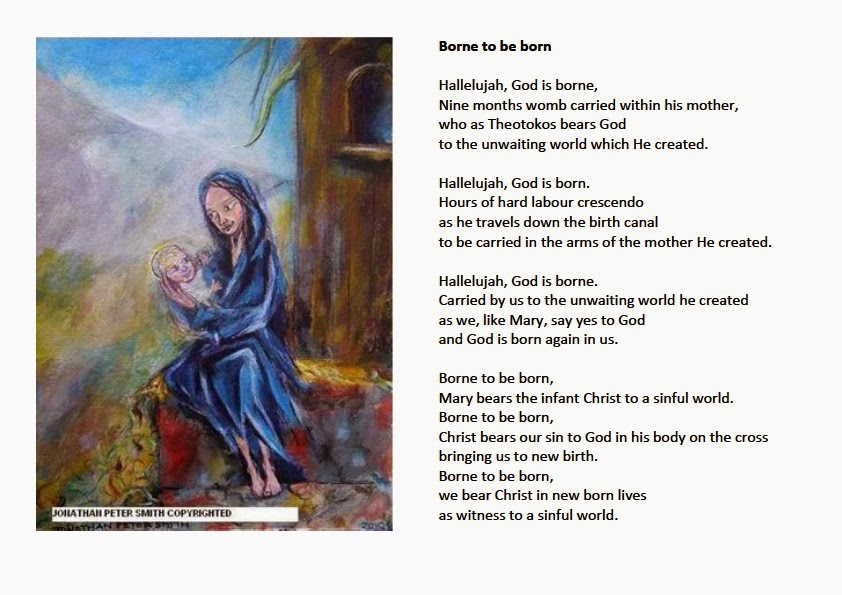
Borne to be born

'Borne to be born' handout with 'Mother and Child' by Jonathan Peter Smith - smithpeterjonathan@yahoo.co.uk

Ever since using a poem about Mary by Malcolm Guite while in Nazareth with the East London Three Faiths Forum, I have been reflecting on the first title given by the Church to Mary, ‘Theotokos,’ which means ‘God-bearer’.

Malcolm Guite says of Mary, ‘Mary has been given many titles down the ages and some Christians have disagreed with one another bitterly about her. But equally, in every age and every church she has been, for many Christians, a sign of hope and an inspiration. Her earliest ‘title’, agreed throughout the church in the first centuries of our faith, before the divisions of East and West, Catholic and Protestant, was Theotokos, which means God-Bearer. She is the prime God-Bearer, bearing for us in time the One who was begotten in eternity, and every Christian after her seeks to become in some small way a God-bearer, one whose ‘yes’ to God means that Christ is made alive and fruitful in the world through our flesh and our daily lives, is born and given to another.’

Mary bears or carries Jesus in her womb for nine months and is also borne or carried by her after his birth, as that is what mothers do with their new born children until they can crawl or walk. The idea that he is borne by her holds lots of potential for word play with the two meanings and spellings of the word. ‘Borne,’ as in carried, and ‘Born,’ as in giving birth. I’ve been trying to play with those words in writing a meditation on this theme which I’ll read to you later.

Once he becomes a man and can no longer be borne or carried himself, Jesus bears or carries us to God the Father by means of his sacrificial death on the cross. So, he is born(e) into the world in order to bear us to God.

In turn, we then bear him to others as he is born in each one of us as we open our lives to him and can then bear, carry or take him to others as our daily lives reveal aspects of his character and love to others. As Teresa of Avila said:

‘Christ has no body but yours,
No hands, no feet on earth but yours,
Yours are the eyes with which he looks
Compassion on this world,
Yours are the feet with which he walks to do good,
Yours are the hands, with which he blesses all the world.
Yours are the hands, yours are the feet,
Yours are the eyes, you are his body.
Christ has no body now but yours,
No hands, no feet on earth but yours,
Yours are the eyes with which he looks
compassion on this world.
Christ has no body now on earth but yours.’

In this way, we bear him to others.

So, Christ is carried by Mary, both in her womb and in her arms, in order that he can then carry us to God by means of his death of the cross. Finally, we carry him to others by means of our daily life and witness.

Here are those thoughts expressed in my meditation:

Borne to be born

Hallelujah, God is borne,
Nine months womb carried within his mother,
who as Theotokos bears God
to the unwaiting world which He created.

Hallelujah, God is born.
Hours of hard labour crescendo
as he travels down the birth canal
to be carried in the arms of the mother He created.

Hallelujah, God is borne.
Carried by us to the unwaiting world he created
as we, like Mary, say yes to God
and God is born again in us.

Borne to be born,
Mary bears the infant Christ to a sinful world.
Borne to be born,
Christ bears our sin to God in his body on the cross
bringing us to new birth.
Borne to be born,
we bear Christ in new born lives
as witness to a sinful world.

Are you humbled by the thought that God was born(e) by a human mother? Are you conscious of having been borne by Jesus to God? How are you bearing Christ to others, as his hands, feet, eyes and body in the world today? Are these responses something for which you pray and for which you are thankful today?

------------------------------------------------------------------------------------------

Malcolm Guite - Angels Unawares.

Sunday, 1 December 2013

Come, Lord Jesus, come

The Advent Reflections service at St John's Seven Kings this morning focused on perspectives on Christ's coming. Following a reading of Rowan Williams' 'Advent Calendar', we watched a visual meditation which set my most recent reflection with images by commission4mission artists:   

Coming as Word
Coming as Mary’s “Yes” to Gabriel
Coming as forced journey to Bethlehem
Coming as peace on earth
proclaimed by hymning angels singing
“Glory to God in the highest”

Come, Lord Jesus, come

Coming as nothing
Coming as sperm joins egg
Coming as growth
Coming as foetus
Coming as waters break
Coming down the birth canal
head covered with blood
Coming into light and air
Coming into vulnerability
Coming into poverty
A cold coming

Come, Lord Jesus, come

Coming as flesh
Coming in humility
Coming as servant
Coming in love
Coming through birth
Coming into death
Coming as child
 
Come, Lord Jesus, come

'BC:AD' by U.A. Fanthorpe was read as a reflection on the moment of Christ's coming and this time of reflection was completed with an attempt to sense the challenge and shock of his coming by listening to Jackson Browne's 'The Rebel Jesus', which articulates an understanding of the Christ who came as being at odds with much of our current practice in the Church as his people. 

------------------------------------------------------------------------------------------------------------

Enya - O Come, O Come Emmanuel.

Monday, 28 October 2013

The mystery of the resurrection body

still
be still
be still and know
God
born
still God
still man
still born
still born among us
God
in flesh appearing
defenceless
helpless
needing us
all-knowing
un-knowing
all present
confined in space
a child
God child
incarnate
incarnate still
be still
be still and know

still
be still
be still and know
God
dead
still God
still man
still buried
still buried in the ground
God
in flesh appearing
defenceless
helpless
killed by us
falling
buried
germinating
growing
a seed
God man
incarnate
incarnate still
be still
be still and know             

John 12:23-25
"Jesus answered them, “The hour has now come for the Son of Man to receive great glory. I am telling you the truth: a grain of wheat remains no more than a single grain unless it is dropped into the ground and dies. If it does die, then it produces many grains. Those who love their own life will lose it; those who hate their own life in this world will keep it for life eternal."

1 Corinthians 15. 35 - 44
"Some skeptic is sure to ask, “Show me how resurrection works. Give me a diagram; draw me a picture. What does this ‘resurrection body’ look like?” If you look at this question closely, you realize how absurd it is. There are no diagrams for this kind of thing. We do have a parallel experience in gardening. You plant a “dead” seed; soon there is a flourishing plant. There is no visual likeness between seed and plant. You could never guess what a tomato would look like by looking at a tomato seed. What we plant in the soil and what grows out of it don’t look anything alike. The dead body that we bury in the ground and the resurrection body that comes from it will be dramatically different.

You will notice that the variety of bodies is stunning. Just as there are different kinds of seeds, there are different kinds of bodies—humans, animals, birds, fish—each unprecedented in its form. You get a hint at the diversity of resurrection glory by looking at the diversity of bodies not only on earth but in the skies—sun, moon, stars—all these varieties of beauty and brightness. And we’re only looking at pre-resurrection “seeds”—who can imagine what the resurrection “plants” will be like!

This image of planting a dead seed and raising a live plant is a mere sketch at best, but perhaps it will help in approaching the mystery of the resurrection body—but only if you keep in mind that when we’re raised, we’re raised for good, alive forever! The corpse that’s planted is no beauty, but when it’s raised, it’s glorious. Put in the ground weak, it comes up powerful. The seed sown is natural; the seed grown is supernatural—same seed, same body, but what a difference from when it goes down in physical mortality to when it is raised up in spiritual immortality!"

Researchers at the University of Warwick have devised a novel way to recycle discarded mobile telephones - bury them and watch them transform into the flower of your choice.

They have designed a mobile phone case made of biodegradable polymer which breaks down on the compost heap into a pile of soil nutrients. And then, because the engineers have included a tiny transparent window in the case in which they embed a seed, the final touch is that the case flowers.

The seed lies dormant in its plastic window until the phone cover gets dug into the ground. The phone cover then breaks down allowing the seed to germinate and, as the flower grows‚ to get additional nutrients from the biodegrading phone cover.

This story reminded me of Jesus’ words from our Gospel reading: “a grain of wheat remains no more than a single grain unless it is dropped into the ground and dies. If it does die, then it produces many grains.”

Just like the mobile phone case which is hard but biodegradable and which contains a seed, “a grain of wheat has a hard, glossy husk within which its life is contained. But if it falls into the ground, then its husk softens and rots and breaks open, and from inside the seed the power of its life begins to push outwards, and the pattern of its life begins to unfold. Roots go down into the soil, and a shoot comes up into the light where it grows stronger and taller and produces an ear of corn.”

Jesus equates that picture of the hard outer husk which has to rot to release the life inside to our choice in life to be either people who love our own lives or people who hate, lose or give away our lives. Those of us who love our own lives reinforce our hard, outer husk. We put up barriers between ourselves and others in order to protect and enjoy what we have for ourselves.

Jesus says that when we live life selfishly, protecting ourselves and what we have, then we have actually lost the essence of life itself. We are dead to the world, its peoples and its wonders because we engage with what is other not for its own sake but only for our sake. When we cannot appreciate other people and God’s creation except in terms of what we can get for ourselves then we are dead to the world and all that is in it. Not only are we dead to the world and all that is in it but we are sterile as well. If we live just for ourselves; if we give nothing away to others but keep all for ourselves; then everything we have dies with us and what we have had is lost forever.

But says Jesus, if we are like the grain of wheat that dies, then we will know what it is like to really come alive and really live. If we allow our protective shell to rot and be removed; if we are focused not on ourselves but on others; if we disregard our own life in this world and follow Jesus in serving others; then we gain, then we come alive, then we see a single grain of wheat multiply and produce many grains.

And the same point is made by St Paul in 1 Corinthians 15 in relation to death itself. Death comes to all of us and to all things. It is part of the natural cycle of life that we need to accept and understand. Try as we might we cannot ultimately hold onto this life and so, ultimately, we must be ready to let go of this life in trust that death itself is the ground in which the seed of our life, and those we remember today, will grow into new life.

When my Dad slipped into a comatose state for several weeks at the end of his life, I found myself praying for his release from this life. I was reminded on DylanThomas’s poem - “Do not go gentle into that good night, / Old age should burn and rave at close of day; / Rage, rage against the dying of the light.” – and found myself praying for the exact opposite:

Go Gently

The lifeforce runs deep within our veins.
After conscious actions become involuntary,
after eyes become unfocused,
after hands become still and lifeless,
the heart still beats and lungs inhale,
breaths are snatched as something precious
and coughs battle secretions
to obtain air.
I pray, let go,
lose life to love life.
I pray, surrender,
from striving, for serving.
I pray, release,
returning, reviving, resting.
I pray, knowing that,
from fisticuffs at Grammar School,
you have been a fighter.
I pray, knowing that
throughout trials and tribulations,
your spirit has stayed strong.
I pray, knowing that
the lifeforce runs deep
in your veins.
I pray that,
you go gentle into that bright light. 

As Christians, we believe that we will grow into new life through death because of Jesus. Jesus was a seed sown into our world which died and was buried only to live again. As Paul puts it in 1 Corinthians 15,the truth is that Christ has been raised from death, as the guarantee that those who sleep in death will also be raised.” The tomb therefore becomes a womb, a place of new birth, not just for Jesus but, through Jesus, for each one of us as well.

So, let us in faith, conclude with St Paul that,  “This image of planting a dead seed and raising a live plant is a mere sketch at best, but perhaps it will help in approaching the mystery of the resurrection body—but only if you keep in mind that when we’re raised, we’re raised for good, alive forever! The corpse that’s planted is no beauty, but when it’s raised, it’s glorious. Put in the ground weak, it comes up powerful. The seed sown is natural; the seed grown is supernatural—same seed, same body, but what a difference from when it goes down in physical mortality to when it is raised up in spiritual immortality!”

Let us pray ...

Lord, we would grow with you
New shoots reaching out
Hands stretched upward
Like leaves newly formed
Soaking up your light and warmth
Lord, we would grow with you

Lord, we would grow with you
In sunshine and rain
In darkness and light
In cold days and summer days
From Springtime to Winter
Lord, we would grow with you

Lord, we would grow with you
And bring forth fruit
That is pleasing to you
Fed by your living water
Giving sustenance to others
Lord, we would grow with you

(John Birch)

------------------------------------------------------------------------------------------------- 

Sam Phillips - I Need Love.