Wikio - Top Blogs - Religion and belief
Showing posts with label nuttgens. Show all posts

Monday, 19 June 2023

St Martin of Tours, Basildon


St. Martin's of Tours Church in Basildon Town Centre was officially opened on 10th November, 1962 in a consecration service conducted by the Bishop of Chelmsford; Rt. Rev. John Gerhard Tiarks. Its design was the work of local architect Trena M. Cotton.

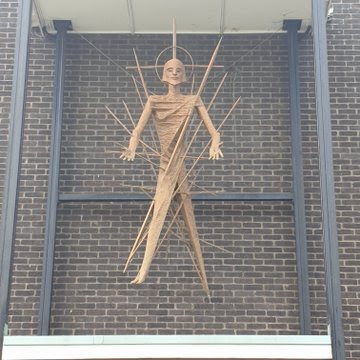
The Church received a royal visitor on October 9th, 1968 when Her Royal Highness The Duchess of Kent (Katharine Windsor) dedicated the new south porch and Christ sculpture. The 10-foot high Christ figure was designed by the artist Thomas Bayliss Huxley-Jones and completed in fibreglass at his studio in Broomfield near Chelmsford, Essex. It was to be his last completed work as a short time later he was admitted to St. John's Hospital in Chelmsford where he died on 10th December 1968. The fibreglass figure is of our Lord pierced by shafts of light with his hands outstretched towards the town in service of the people. It is an invitation of welcome to all to enter.

Huxley-Jones, F.R.B.S., was a Fellow of the Royal Society of British Sculptors and studied at the Wolverhampton School of Art (1924-1929) and from 1929-1933 at the Royal School of Art, South Kensington. For many years he was principal of the school of sculpture at Grays Art School, Aberdeen, Scotland. He was famed for his statue of Helios at BBC Television Centre and the Joy of Life Fountain in Hyde Park. He was married in 1934 to the artist and sculptress (Rose) Gwynneth Cobden Holt and they lived from around 1949 at High House, Broomfield in Essex. His grave, and that of his wife is in St. Mary churchyard at Broomfield.

The work of Huxley-Jones also features elsewhere within the Diocese. His Woman of Samaria is a fibreglass figure at St Peter's Aldborough Hatch, while at Chelmsford Cathedral, Huxley-Jones' work includes a Christus in St Cedd's Chapel, a carving of St Peter on the south-east corner of the South Transept and 16 stone carvings representing the history and concerns of Essex, Chelmsford, and the Church.

A Garden of Remembrance adjacent to the church opened on November 3rd, 1973, in a dedication service conducted by Rev. Peter Grimwood. Standing within the garden is a statue depicting St. Martin sharing his cloak with a beggar, which was created by notable sculptor and artist Peter Foster.

In 1989 the plain exterior glass was replaced with stained glass designed and made by Joseph Nuttgens. The North side windows from West to East tell the story of St Martin begining with the Cathedral of Tours then the River Loire and finally the Caves of Marmoutier and a Cross referring to St Martin's suffering. The South side windows East to West depict the Cross and Resurrection, colours and various designs to be found in the town centre and the flood barriers from the nearby river Thames. Finally a triangle an ancient representation of the Holy Trinity, the circle and rays depict an outburst of energy from God, which is love. His presence, open to all, flows as a river down through the Thames Barrier into the hustle and bustle of this modern town.

The magnificent stained glass window in the Lady Chapel by Nuttgens depicts in symbols the Blessed Virgin Mary in heaven. Within the window can be seen the signs of the universe, clouds, sky, stars, the sun and the moon.

Educated by Dominicans and brought up within a milieu of idealistic Catholicism, Nuttgens left to study at the Central School of Art and the Royal College of Art, completing his studies in 1964. He then worked experimentally, firstly with expanded plastics and metal sheet, exhibiting at the Camden Arts Centre, London in 1970; then making ‘light’ sculptures, incorporating steel sheet and coloured glass, transmitting colour from hidden light sources, which were exhibited at the Cochrane Gallery, London, and with AIM, at the CBX, in Milton Keynes, throughout the seventies. During this period he also taught at schools and art colleges and, for nine years, taught prisoners in Wormwood Scrubs Prison. Encouraged by Patrick Reyntiens, he returned to stained glass in 1978, becoming his assistant, working mainly on John Piper’s windows. On the death of his father in 1982 he re-established this studio and, since then, has designed and made stained glass windows for cathedrals, churches and many other venues. Throughout this time he has maintained an output of painting (complimentary and vital to his commissioned work) and, in recent years, has set up a relief print shop within his studio, producing woodcuts and linocuts.

A freestanding Bell Tower designed by Douglas Galloway RIBO and built in 1999 was opened by Her Majesty the Queen and dedicated by The Rt. Revd. John Perry The Lord Bishop of Chelmsford on Friday 12th March 1999. This special service marked the official opening of the Belltower and the first 50 years of Basildon new town.

-------------------------------------------------------------------------------------------------------

Soulsavers - Presence Of God.

Wednesday, 29 June 2022

St Martin of Tours, Basildon

St. Martin's of Tours Church in Basildon Town Centre was officially opened on 10th November, 1962 in a consecration service conducted by the Bishop of Chelmsford; Rt. Rev. John Gerhard Tiarks. Its design was the work of local architect Trena M. Cotton. 

The Church received a royal visitor on October 9th, 1968 when Her Royal Highness The Duchess of Kent (Katharine Windsor) dedicated the new south porch and Christ sculpture. The 10-foot high Christ figure was designed by the artist Thomas Bayliss Huxley-Jones and completed in fibreglass at his studio in Broomfield near Chelmsford, Essex. It was to be his last completed work as a short time later he was admitted to St. John's Hospital in Chelmsford where he died on 10th December 1968. The fibreglass figure is of our Lord pierced by shafts of light with his hands outstretched towards the town in service of the people. It is an invitation of welcome to all to enter.

Huxley-Jones, F.R.B.S., was a Fellow of the Royal Society of British Sculptors and studied at the Wolverhampton School of Art (1924-1929) and from 1929-1933 at the Royal School of Art, South Kensington. For many years he was principal of the school of sculpture at Grays Art School, Aberdeen, Scotland. He was famed for his statue of Helios at BBC Television Centre and the Joy of Life Fountain in Hyde Park. He was married in 1934 to the artist and sculptress (Rose) Gwynneth Cobden Holt and they lived from around 1949 at High House, Broomfield in Essex. His grave, and that of his wife is in St. Mary churchyard at Broomfield.

The work of Huxley-Jones also features elsewhere within the Diocese. His Woman of Samaria is a fibreglass figure at St Peter's Aldborough Hatch, while at Chelmsford Cathedral, Huxley-Jones' work includes a Christus in St Cedd's Chapel, a carving of St Peter on the south-east corner of the South Transept and 16 stone carvings representing the history and concerns of Essex, Chelmsford, and the Church.

A Garden of Remembrance adjacent to the church opened on November 3rd, 1973, in a dedication service conducted by Rev. Peter Grimwood. Standing within the garden is a statue depicting St. Martin sharing his cloak with a beggar, which was created by notable sculptor and artist Peter Foster.

In 1989 the plain exterior glass was replaced with stained glass designed and made by Joseph Nuttgens. The North side windows from West to East tell the story of St Martin begining with the Cathedral of Tours then the River Loire and finally the Caves of Marmoutier and a Cross referring to St Martin's suffering. The South side windows East to West depict the Cross and Resurrection, colours and various designs to be found in the town centre and the flood barriers from the nearby river Thames. Finally a triangle an ancient representation of the Holy Trinity, the circle and rays depict an outburst of energy from God, which is love. His presence, open to all, flows as a river down through the Thames Barrier into the hustle and bustle of this modern town.

The magnificent stained glass window in the Lady Chapel by Nuttgens depicts in symbols the Blessed Virgin Mary in heaven. Within the window can be seen the signs of the universe, clouds, sky, stars, the sun and the moon.

Educated by Dominicans and brought up within a milieu of idealistic Catholicism, Nuttgens left to study at the Central School of Art and the Royal College of Art, completing his studies in 1964. He then worked experimentally, firstly with expanded plastics and metal sheet, exhibiting at the Camden Arts Centre, London in 1970; then making ‘light’ sculptures, incorporating steel sheet and coloured glass, transmitting colour from hidden light sources, which were exhibited at the Cochrane Gallery, London, and with AIM, at the CBX, in Milton Keynes, throughout the seventies. During this period he also taught at schools and art colleges and, for nine years, taught prisoners in Wormwood Scrubs Prison. Encouraged by Patrick Reyntiens, he returned to stained glass in 1978, becoming his assistant, working mainly on John Piper’s windows. On the death of his father in 1982 he re-established this studio and, since then, has designed and made stained glass windows for cathedrals, churches and many other venues. Throughout this time he has maintained an output of painting (complimentary and vital to his commissioned work) and, in recent years, has set up a relief print shop within his studio, producing woodcuts and linocuts. 

A freestanding Bell Tower designed by Douglas Galloway RIBO and built in 1999 was opened by Her Majesty the Queen and dedicated by The Rt. Revd. John Perry The Lord Bishop of Chelmsford on Friday 12th March 1999. This special service marked the official opening of the Belltower and the first 50 years of Basildon new town.


--------------------------------------------------------------------------------------------------------------

Robert Levon Been - Mercy Of Man.

Sunday, 3 August 2014

Sabbatical art pilgrimage: St Peter Gorleston-on-Sea


St Peter Gorleston is, the words of Andrew Anderson writing in 1960 for the Eastern Daily Press, 'a simple church' with 'plain red brick walls and gables, steep curly tiled roofs with the neatest flashings, sturdy well-made buttresses, leaden downpipes and large wooden box gutters with sparrows chirping about.' The tower is 'capped by slanting gables, cross on top and with a steeply pointed three part window in each face of the tower.'

Bill Howell, long-time church member and author of the church guide, explained to me that that is precisely how its designer Eric Gill planned it should be; 'a plain building done by bricklayers and carpenters' without recourse to 'mechanical town methods.' All very much in line with Gill's lifelong belief that workers should be the owners of their own production and not slaves to the profits of others.

Gill's minimalism extended inside his design as well with his intent being 'no ornaments except perhaps a figure of St Peter on the outside and a large crucifix hanging over the altar';. 'the choir and the organ, the vestments and the stained glass windows, the paintings and the statues, all are so much frippery compared with the altar and the service of the altar' ('Mass for the Masses'). Accordingly, his design began with a centrally located altar and worked outwards from there using a cruciform plan. In his essay 'Plain Architecture' he stated that 'a church is there first and chiefly as a canopy over an altar.' Here the altar was 'placed centrally beneath the tower, which was supported on crossing arches; arches are used throughout the church, with little or no lintels spanning doors or windows.' 'Arcades and porch too are arches springing directly from the sub-floor, not supported on piers as is usual in churches' (Church Guide).

What arches they are too! 'Striding about the place,' as Anderson evocatively puts it, intersecting centrally in pleasing geometric interlacings to create the 'roomy space' needed for the altar and to bear on their shoulder the light well that is the tower. Rightly all in white, they remind the viewer of Antoni Gaudi's use of parabolic and catenary arches, particularly at the School of the Teresianas. Gill, despite his own architectural training in the office of W.D. Caröe from 1899 - 1903 and the support of High Wycombe architect Edmund Farrell, must have had concerns regarding the viability of these arches. During one visit he asked the builders to leave the wooden arch supports in place for longer to ensure they had set. When Gill left, the supports were immediately removed without any ill effect.

Gill was asked to undertake the design by his friend Fr. Thomas Walker, who he had got to know in High Wycombe. Gill had moved to Piggotts, near High Wycombe, in 1928: ‘Here he aimed to create a ‘cell of good living’ – a community centred on home and chapel, workshops, farm and a little school on the top of a Chiltern hill. Here he attracted followers: his apprentices, included David Kindersley, sculptor and engraver (and father of Peter Kindersley, co-founder of Dorling-Kindersley, the publishers); the Cribbs and Anthony Foster. Visiting friends included G.K. Chesterton, Stanley Spencer, David Jones and Peter Kapista. Amongst the best known work Gill produced at Piggotts are the figures of Prospero and Ariel on the front façade of the BBC in London (1932); the vast ‘Creation of Adam’ sculpture at the League of Nations building in Geneva (1938); and the large-scale East Wind sculpture that hovers over St James's Underground station’.

Walker had become parish priest to a congregation at Gorleston which had outgrown their original building, a converted malthouse. For Gill this was an opportunity to put his practical and theological ideas about church, which were ahead of their time, into bricks and mortar. Prior to Vatican II, St Peter's was only the second Roman Catholic Church in the country to have a central altar. We can imagine Gill’s excitement at the opportunity as he wrote to his friend George Carey, 'no sooner was the essay ('Mass for the Masses') published then I got a real job, to build a real church with a central altar and all.'

The radical minimalism and focus of Gill's design has been too much for the parish as a whole and some subsequent priests to manage. As he showed me around Bill sadly recounted a litany of changes made over the years to Gill's original design (some thankfully rectified) including the turning of the altar, raising of the crucifix, over painting of the tower mural, introduction of stained glass, hanging of a baldachin, and more. Some of the changes have been done sensitively and by using colleagues of Gill such as Denis Tegetmeier and Joseph Edward Nuttgens, while others were, as Howells makes scathingly clear in the Church Guide, simply crass. The church is now Grade II listed and, while Bill complains about the levels of bureaucracy this involves, the building is protected against the vagaries of individuals exercising their own personal and subjective 'good' taste.

Gill designed the rood, piscina, font, altars and holy water stoups. These were all made in his workshop. The foundation stone and altar inscription are good examples of Gill's lettering. Gill also designed the Entry into Jerusalem mural for the spandrel of the east arch and the low relief carving of St Peter casting his net for the porch. His son in law Tegetmeier painted the mural, while Anthony Foster carved St Peter. Tegetmeier also contributed a set of excellent and original 'Stations of the Cross' in 1962. The stained glass window designed by Nuttgens and representing Christ the King was installed in 1963. While a strong piece of work in its own right, its placement in this building goes counter to Gill's plain design with the window literally obscured by the focus on the central altar and its low slung crucifix.


Malcolm Yorke writes in 'Man of Flesh and Spirit' that today this church seems less remarkable then it once did but that, he concludes, 'is probably a tribute to Gill whose ideas on liturgy and plain architecture have come into their own.' Bill Howells notes several statements to do with more contemporary churches of which Gill would probably have approved. Cardinal Heenan writing about the Metropolitan Cathedral of Christ the King in Liverpool suggested that the 'attention of all who enter should be arrested and held by the altar.' That was because Sir Frederick Gibberd, the architect, realised the brief he was given, 'not to draw attention to the cathedral's own beauty; it was there to shelter the High Altar, which was to be the main focus.' 

Gill, sadly, did not live to see these ideas take hold; he died of cancer two after the completion of St Peter's. He would have been rather less enamoured of the difficulties that the parish currently face in maintaining this splendid and significant sacred space.

-------------------------------------------------------------------------------------------------

Moby - Hymn.