Wikio - Top Blogs - Religion and belief
Showing posts with label mene mene. Show all posts

Thursday, 8 August 2019

Selling Virtues, Marketing Civilization, People's Republic, Sparks & Mene Mene

Creative Boom have an excellent summary of Micah Purnell's Selling Virtues project:

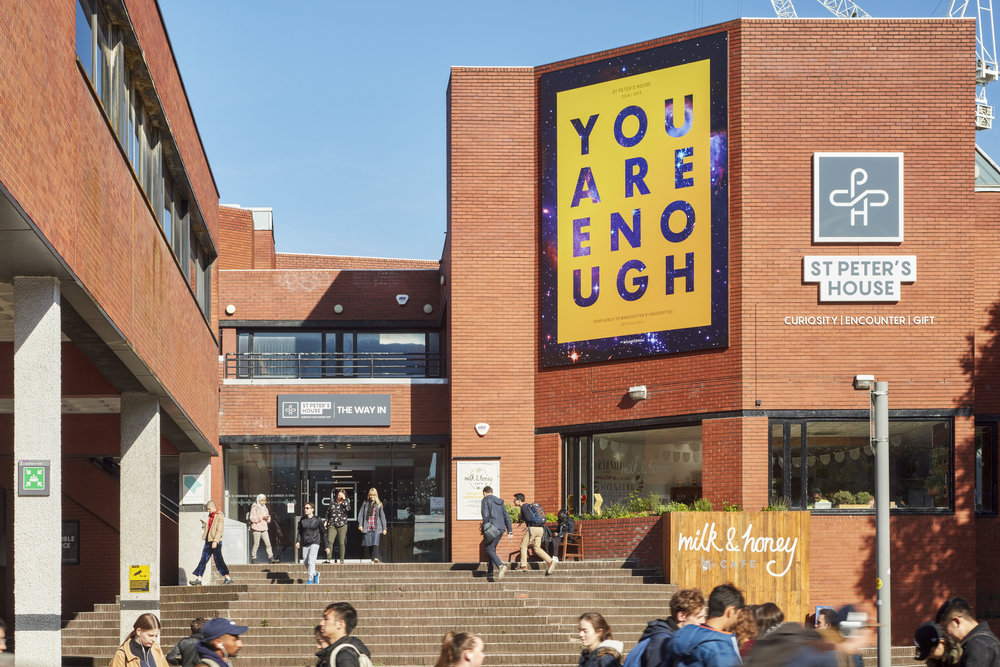
 photography by Adrian Lambert

'A giant billboard in the heart of Manchester celebrates its first anniversary amid evidence that national wellbeing is adversely affected by outdoor advertising.

Artist and designer Micah Purnell’s empowering ‘YOU ARE ENOUGH’ billboard offers a cleansing antidote to what he considers harmful advertising practice.

"Capitalist ideology imparts the idea that we are only worthy of love and belonging once we buy into their product or service," says Manchester-based Purnell. "Advertising reinforces this idea with the assumption that we are inadequate - essentially stealing our love of ourselves, and selling it back to us at a price."

Standing proud in the heart of Manchester’s university district, Purnell’s 22x13 foot installation towers above the streets below – giving a refreshingly affirming message to passing students and commuters. The design has enjoyed a full academic year aside St Peter’s House, and by popular demand is set to remain for a second year, and now, Purnell plans to spread more visually prominent empowerment messages throughout the wider boroughs of Manchester.

"The World Economic Forum has found evidence of negative links between national advertising and national wellbeing," notes Purnell, "moreover, research professor Brené Brown has found that the one thing keeping us from love and belonging is the fear that we are not worthy of love and belonging. She found that those who fully experience joy and live wholeheartedly have the courage to accept their imperfection – recognising and believing that they are enough. We are all enough, but sadly, it’s harder to believe this when we’re bombarded by toxic messages suggesting we’re not. Through my ‘Selling Virtues’ project, I invite everyone to hold these cynical commercial intrusions to account and play a bigger part in their own happiness and wellbeing."

Now seeking funding to expand his ‘Selling Virtues’ project, visit Micah Purnell’s campaign page at sellingvirtues.co.uk.'

Purnell's project is designed to stimulate debate partly through its use of the approaches of advertising and design to communicate its anti-consumerist message. As a contribution to this debate I want to also highlight four other people/projects engaging with similar issues.

The theme of Purnell's project chimes with the experience of Maciej Hoffman, who turned his back on advertising in order to paint. absolutearts.com report:  

'For fifteen years Maciej Hoffman worked for one of the biggest Polish advertisement agencies in the country, which after communism started with its capitalistic adventure. Providing conceptual and creative work in the planning of marketing campaigns, Hoffman participated in creating marketing spots, press and radio campaigns and outdoor advertisements. Several years ago Hoffman left the world of business and came back to his basic and important occupation, painting.

In his series "Marketing Civilization," are observations of the contemporary style and content of life looked at from the perspective of the necessity and omnipresence of consumption. Our needs were mostly reduced to intellectually comfortable and psychologically exhausting contenting ourselves with the consumption of the world instead of giving something from ourselves to create the world. Our everyday lives became dominated by work and pursuit of products attacking us from the store shelves and by the pictures that are generated for the needs of this invasion. The reality under the thumb of the economy gave birth to a culture which would rather sell images created by others than create its own ones.

Hoffman's paintings refer to the composition of press advertisements and to the search for a stronger influence on people. Thus the poster-like flatness of the background and the strong color which, in the marketing world, makes the message clearer and attractive to the product. It is Hoffman's attempt of drawing the attention to what the world looks like from this perspective.

"Marketing Civilization" touches on how the advertisements ruthlessly use the symbols and appropriate them for commercial needs. Symbols and authorities which are deeply rooted in our consciousness are a pretext for pushing you any product, a beverage, a screw or even "an independent opinion" just by putting in the ad a man dressed up in a white lab-coat or wearing a dog collar.

On the other hand, we all function in this reality, with relationships built by the marketing and advertisement world which can be brought down to the fact that you always find yourself in one of the roles, a buyer, a seller or a person being sold. You can indeed exist as a product. Your absence in this chain of relations condemns you to a kind of nonexistence.'

Rather than leave marketing for painting, plexiglass pop painter Clay Sinclair has recently launched his own range of ethical, sustainable and revolutionary fashion utilising the kind of provocative texts that characterise his paintings. 

Sinclair paints 'backwards', directly onto the reverse side of Perspex (or Plexiglass) giving his work of bright and strongly contrasting colours a luminous appearance. Often starting from pastiches of classic works, he incorporates provocative textual elements that use puns, flip old sayings on their head, or offer unexpected answers to rhetorical questions in order to challenge perceived orthodoxies. Others make heavy use of masking and scalpel work to form dense areas of vivid, alternating colour.

Sinclair's humorous, playful and gently mocking work reflect human and societal concerns regarding our relationships to one another and themes of wealth, power, and ego. Works by Lichtenstein, Hirst, Klimt, Da Vinci, Picasso and Michaelangelo and images of celebrities from Barack Obama to Elizabeth Taylor have all formed the basis for his paintings, subverted through cartoonish imagery and textual puns.

He has now launched The People’s Republic which believes that it is possible to live in this world without the need for violence towards each other and the earth. It believes we have the power to live engaged, healthy, passionate lives that have purpose and meaning which are not only good for ourselves but is good for all other life on this planet. The People’s Republic’s mission is to not only clothe the world with ethical, sustainable and revolutionary fashion, but also help facilitate the connection between ourselves, others and the planet.

Michael Gough is Strategy Director for Sparks, a brand and design agency that works best for ambitious organisations with rich histories and complexity helping them connect with a changing audience while discovering and expressing what matters now.

He says 'there are two aspects to good branding', 'brand promise is all about the client's shop window – what the world sees'. '"Brand promise is knowing who you are talking to and why you're relevant," whereas the experience is all about what the audience – the customers or the consumers – think of the brand.' '"Good brand communications bring brand promise in line with brand experience."'

'For Michael, listening is the first and most important part of his work with clients. Sparks identifies what the organisation does, and crucially why it does it, as it's usually the 'why' that helps to distinguish them from their competitors.' At a headline level, he says, 'what we're interested in is an honest, authentic representation of a particular client.' 'This honesty and transparency is rooted in the gospel, he says. "The gospel calls us to be real about ourselves and honest about ourselves. I think that's a direct extension of our business model. The client can be authoritative and genuine in what they stand for in their brand."'

'Michael believes the language used in the Christian context is inherent to the subculture, but doesn't translate well in the mainstream: "Our challenge always to our faith-based clients is to make them think about what the mainstream culture is. We think about how we can lift that from the assumptions of a Christian subculture, turning that into something meaningful, engaging and relevant to the mainstream culture."

For Sparks, it's all about helping clients see that opportunity to speak in a relevant way about an authentic Christian framework, but in a language that is engaging to a wider audience.

"The problem is the Church has an assumption about its culture, which sometimes gets in the way about people engaging and meeting with the true biblical expression of who Christ is. Lots of language we use in a church context is tied exclusively to this culture – it has little meaning outside."

I think the more we can do to help people outside of the Church to engage with the biblical text, the more we move away from this subcultural context and engage with the truth of the gospel."'

One project that did combine the approaches of art and advertising to help people outside of the Church engage with the biblical text was Mene Mene, a collaborative art project by Pippa Hale (artist), David Hawkins (artist and former Bishop of Barking) and Stuart Tarbuck (marketing and communications strategist) for Situation Leeds in 2005.

Mene Mene located 13 texts in various formats around Leeds city centre such as CELEBRATE WITH ME, MEN FAINTING WITH FEAR and GO THROW YOURSELF INTO THE SEA. The statements were drawn from New Testament texts and filtered throughout the city in a variety of formats from high profile banners and adverts on bus shelters, to more intimate plaques on benches and handwritten signs. Some were affirming and instructive, whilst others are more predictive and challenging.

This collaborative art project investigated the relevance of ancient biblical sayings in a contemporary city by recommitting words back into the public arena. Transferring texts out of church and back into everyday life, where they were first spoken, gave the words new resonance. Texts were abstracted from their original context and as they entered the public square evoked different responses as people brought their own reactions to the work: for some, the phrases were hardly noticeable – just more consumer targeted advertising, for others they were reflective and thought provoking.

Mene Mene embraced an open and diverse interpretation of phrases which have been subsumed into our everyday language, whilst at the same time prising open a local space usually dominated by global marketing to provide a place to think. 

That is one achievement common to all those highlighted in this post; they are prising open spaces usually dominated by global marketing to provide a place to think.

------------------------------------------------------------------------------------------

Thursday, 19 March 2009

commission4mission members & news

Peter Shorer
Harvey Bradley

Rosalind Hore

Joy Rousell Stone

Michael Creasey
commission4mission is growing following our launch at the beginning of March. Our artist members who are available for commissions are as follows:
  • Harvey Bradley: My creative work includes: Stoneware and Porcelain pottery (domestic with ecclesiastical commissions); Oil Paintings (reflective, figurative subjects that are open to prayerful interpretation); and Designs for banners (carried out by Emmanuel banner group).
  • Alexander Chaplin has been appointed Music Director of East London Chorus from April 2009. Educated as a chorister at Canterbury Cathedral, he held the organ scholarships at Lincoln Cathedral and Lincoln College, Oxford, where he read Music, before studying conducting and organ at the Royal College of Music under Neil Thomson, Edwin Roxburgh and Nicholas Danby; he participated in masterclasses with George Hurst, Paul Goodwin and Sir Peter Maxwell-Davies. He graduated from the RCM with distinction and as a major prize-winner. In February 2008 Alexander was invited to participate in a competitive masterclass in St Petersburg with Alexander Polishchuk, from which he emerged as one of the prizewinning conductors.
  • Anne Creasey: Textile artist and embroider working in a variety of styles from traditional to abstract and experimental. Also very interested in helping people discover their spirituality through the creative process.
  • Michael Creasey: A serious amateur painter who has sold a good amount of work over the years, including a number of commissions. I am not especially a religious painter, as I mainly paint portraits and figure studies, but I do also paint abstract works which tap into emotional and spiritual aspects of my life and reflect my Christianity.
  • Jonathan Evens paints in a symbolic expressionist style and has facilitated the involvement of churches in a range of public art projects. His arts journalism has featured in publications including 'Art & Christianity' and 'The Church Times'. He is also a creative writer (meditations, poetry, short stories, and a blog) and is the Vicar of St John the Evangelist Seven Kings. Jonathan is the Secretary for commission4mission.
  • David Hawkins: The Bishop of Barking is the Patron of commission4mission and a practising artist in his own right. Predominantly a landscape painter, he has also participated in a collaborative art project with Pippa Hale and Stuart Tarbuck for Situation Leeds. Mene Mene located 13 New Testament texts around Leeds city centre in a variety of formats from high profile banners and adverts on bus shelters, to more intimate plaques on benches and handwritten signs. Some were affirming and instructive, whilst others were more predictive and challenging.
  • Rosalind Hore: I am a sculptor and painter of Christian subject – Christ figures, nativity sets, Ecce Homo, Stations of the Cross etc. I work in clay, plaster, concrete (figures can also be bronze cast at the foundry). My paintings are mostly in acrylic of the events in the life of Christ. Rosalind’s Pieta is currently on display at St Laurence’s Upminster.
  • Mark Lewis: Mark is an artist, silversmith, Arts Lecturer at London Metropolitan University and Chair of Faith & Image. He has undertaken drawing and painting in a Christian context and has designed and made Church plate.
  • Henry Shelton is a noted painter of religious art in a contemporary style. He trained as an apprentice draughtsman in a London studio developing his drawing skills in lettering and fine art. After 15 years he set up his own studio receiving many commissions to design for such clients as the Science Museum, Borough Councils, private and corporate bodies. In recent years he has worked designing in studios across the world, including Hong Kong and the USA. Throughout this time he has painted Christian art and his commissions include an Ascension installed as an Altar piece in the Church of the Saviour, Chell Heath; the Millennium clock tower in Goodmayes and, most recently, the memorial etched glass windows in All Saints Church, Goodmayes, depicting events in the life of Jesus. Henry is the Chair of commission4mission.
  • Peter Shorer: Museum trained Conservator and Archeologist commissioned to mould original antiquities for reproduction in bronze, gold, silver and pewter.
  • Joy Rousell Stone: Studied under John Nash, Edward Bawden, Stanley Spencer, Edward Ardizzone at Royal College of Art. Many one man shows. Favourite subject matters: The Holy Land, Egypt, Greece, Italy (especially Assisi) and USA. All media. Retired Head of Art & Design at The Plume School, Maldon, Essex.
  • Martin Webster: I am interested in promoting Christian Art as a form of engaging with the gospel. I paint (oils and acrylics) particularly 'sacred spaces' usually forest/landscape views.

We are currently planning towards the following events:

  • Four commission4mission members will exhibit in the Pentecost Festival Art Exhibition (30th May at Central Hall Westminster).
  • An art workshop for the 'Fun in the Park' event being organised by Holy Trinity Barkingside on Saturday 13th June 2009. Workshop participants will be asked to create an artwork that says something about themselves. These will be hung on a large wooden cross which will be displayed at Holy Trinity Barkingside after the event.
  • An invitation to exhibit at All Saints West Ham for the West Ham Festival from 20th - 27th June 2009.
  • A concert given by the East London Chorus conducted by Alexander Chaplin at All Saints' Goodmayes on 17th October 2009. Artworks by commission4mission members will also be on display.
  • exhibition (2nd - 7th November) and Study Day (7th November) featuring the Bishop of Barking, Dean of Chelmsford Cathedral, DAC Chair and commission4mission artists at Chelmsford Cathedral.
We have recently been awarded a grant by the London Over The Border Council to produce a catalogue of commission4mission artists and activities to encourage Churches to commission contemporary Christian Art.
We have also been contacted by Wallspace, a gallery based in All Hallows on the Wall, as part of promoting networks and partnerships exploring the relationship between contemporary art and spirituality.
We have recently set up a website for commission4mission which can be viewed by clicking here.
---------------------------------------------------------------------------------
Maurice Durufle - Requiem, Op. 9, Agnus Dei.

Monday, 22 September 2008

Art interviews - Bishop of Barking (2)


JE. In 2005 you collaborated in a public art project in Leeds called Mene Mene and in your artist’s statement for that project you wrote about the style of Jesus' teaching which: “was the opposite of 'in your face' modern advertising or high pressure evangelism. His teaching was often deliberately whimsical, mysterious and oblique. New Testament scholars refer to it as the 'Messianic Secret'. There was something of the take-it-or-leave-it quality of post-modern communication which Mene Mene attempts to recreate.” Are you attempting to use that feature of Jesus’ teaching generally in your communication or was that something that you specifically wished to highlight through the Mene Mene project?

DH. Mene Mene grew out of my long interest in the style of Jesus’ teaching and the way in which he took that teaching into the public square. Mene Mene was an attempt to replicate in the 21st century, in some way, the sort of impact that Jesus’ teaching would have had when he first spoke it. He would have had no PA system meaning that only a small handful in the crowd would have heard him clearly. Snatches of sentences and stories and sayings would have been passed on through the crowds; like Chinese whispers. Jesus’ communication in streets and marketplaces has a post-modern feel to it. So much of our communication today is through clichés, slogans and sound bites which are juxtaposed with the clamour of our everyday lives.

JE. Could you say a little about the way in which the Mene Mene collaboration with Pippa Hale and Marketing Strategist Stuart Tarbuck came about?

DH. Stuart was a member of the congregation at St George’s Leeds where I was Rector and Pippa Hale was a freelance artist in Leeds and a Christian. They were both students together at Leeds College of Art and Design. I shared my idea with them and together we shaped and reshaped it until we had thirteen texts for display on hoardings, bus shelters and so on in Leeds Town Centre. It was an attempt to do something not dissimilar to graffiti but done in a variety of different media and with the public walking past, noticing or not noticing. We did what we could to make each saying a talking point and deliberately mixed affirming texts with challenging ones.

JE. Mene Mene saw a series of texts being abstracted from their original Biblical context and filtered throughout the city in a variety of formats; from high-profile banners and adverts on bus shelters to more intimate sayings on bench plaques and shop windows. What was the impact for people of seeing Biblical texts in such places?

DH. Inevitably this was hard to measure. There was considerable interest from Leeds City Council and three of our installations have been kept as permanent features in the City. The Yorkshire Evening Post highlighted the project; demonstrating that religious themes can be newsworthy. The project also attracted popular and artistic interest.

We had hoped to hold a photographic exhibition of the installations with people interacting with them and also to hold seminars. That didn’t happen but there was interest in a website and these ideas gave us the feeling that a project like this could be replicated elsewhere and in a way that enabled discussion about the texts and their relevance to contemporary life.

JE. Was Mene Mene a one-off for you or do you have ideas for other public art projects?
DH. There is more scope for us to be able to develop this particular project. Our original plans were more ambitious than we were able to realise. The project has scope for being re-run and developed in other locations.

We believe the project is an important statement because society has rejected so much of formal religion and yet, at the same time, is longing for greater spiritual fulfilment. I am fascinated by biblical phrases that are still in common use in our language such as, ‘shake the dust’ or ‘salt of the earth’. Very few now know where these sayings come from. We deliberately wanted the project to be a series of art installations in their own right but, at the same time as with the whole genre of religious paintings, they couldn’t help but also be a testimony to biblical faith.
The project also has an important message for the Church which uses these texts week after week. So much of the impact of the sayings of Jesus have been domesticated and emasculated by only being used in Church when, originally, they were spoken in the public realm. To encounter the words of Jesus at the hairdressers challenges us to take our faith into our everyday lives; not just to lock it up in Church. There is a double impact and, at its best, that would be understood by both the Art and Christian communities.

-------------------------------------------------------------------------------

Fleet Foxes - White Winter Hymnal.