Wikio - Top Blogs - Religion and belief
Showing posts with label hutton. Show all posts

Sunday, 19 March 2017

Learning from The Lives Of Others


My latest article for Artlyst uses exhibitions at Ben Uri Gallery and St Martin-in-the-Fields to explore the place of émigré artists in modern British art and then contrast their opportunities and impact with the current hostile environment being created towards refugees.

I end by quoting Will Hutton:

"'Over centuries ... it has been immigrants and refugees who have been part of the alchemy of any country’s success: they are driven, hungry and talented and add to the pool of entrepreneurs, innovators and risk-takers. The hundreds of thousands today who have trekked across continents and dangerous seas are by any standards unusually driven. They are also, as Angela Merkel says, fellow human beings. To receive them well is not only in our interests, it is fundamental to an idea of what it means to be human.’ These exhibitions and the history of émigré artists in the twentieth century reiterate and demonstrate the continuing relevance and significance of that message."
-----------------------------------------------------------------------------------------------------

Bloc Party - Virtue.

Sunday, 8 May 2016

The Dance of Love: Living the prayer of Jesus (2)

Angus Ritchie, Director of The Centre for Theology & Community preached at St Paul’s Cathedral this morning on a theme that had synergies with my sermon on 'The Dance of Love'; the calling of the Church to help us “learn together how to be more fully human, and how to make a more human world.”

Angus said:

"The Ascension is above all about hope. It marks the completion, of Jesus’ earthly work. In him, God has entered the human condition to heal and restore it. Jesus shows us what a truly human life should be. We could say, without exaggeration, that Jesus us the first fully human being since the Fall. Our lives are not fully human. We are only partly the creatures God made us to be, as his image in us is marred by sin and death.

This is reflected in our day-to-day speech. When we have had a refreshing holiday, or are enjoying glorious sunshine like today’s, we say: “I feel more human.” It’s a recognition that we spend most of our lives feeling less than fully human. We have a sense that there is something – a fullness of life, a generosity of heart, a deeper connection with others – something we’re made for, which is largely missing from our lives. We are not who we should be, who we were made to be.

What, then, were we made to be? That question is answered in today’s Gospel. Human beings are made in the image of God, a God who is love, fellowship, communion. When we love one another, we participate in the fellowship which is at the very heart of God. That is why Jesus prays:

As you, Father, are in me and I am in you, may they also be in us, … so that they may be one, as we are one, I in them and you in me, that they may become completely one.

That is the purpose of humanity, that is what we were made to be: made to share the very life of God, by living in his love."

Also of relevance from today's Observer:

"... happiness can never result from the exercise of choice alone: we are social beings, and the building blocks of happiness lie in looking out for each other, acting together, being in teams and pursuing common goals for the common good. Families, schools, colleges, unions, newspapers, sports clubs and even firms should all understand that such commonality should be part of their core DNA." (Will Hutton)

and

"The big issue for me concerns isolationism and the rise of rightwing extremism in Europe and beyond. The extremists are diametrically opposed to the EU’s founding values. We forget that this is something that binds us and protects us and that, as one of the posters puts it, is “the largest peace project in human history”." (Wolfgang Tillmans)

--------------------------------------------------------------------------------------------

Pierce Pettis - That Kind Of Love.

Thursday, 1 October 2015

Business Harvest Festival: What is your work for?


At St Stephen Walbrook in the City of London we have a tradition that companies in the parish designate someone to bring an object to represent their work and to place it on the altar as a symbol at the beginning of our Business Harvest Festival service. Businesses and organisations representing the work found in the Parish of St Stephen this year included: Arthur J Gallagher, The City of London Police, The Don Restaurant and ‘Sign of the Don’, Rynda Property Investors, Vestra Wealth LLP, The Friends of the City Churches, U3A, London Internet Church, City of London Corporation, Sir Robert McAlpine, Christian Aid, commission4mission, Walbrook Music Trust, Threadneedle Asset Management, Central London Samaritans, British Arab Commercial Bank and Coq d’Argent, among others.

Among the items placed on the Henry Moore designed altar this year were a PCSO's black bowler, bolts, bronze and glass from local construction sites, paintings and drawing, a variety of reports and brochures, bread, wine and fruit, a hi-vis jacket, and a telephone representing the work of Samaritans. Following the service, we heard from the City of London Police about #WeStandTogether, a National community led initiative to #celebrate our difference: promote #respect & tolerance; building a safer, stronger #UnitedKingdom.
Here is the sermon I preached at the service:

What is your work for? This is a question that I frequently use as an ice-breaker in sessions exploring the connections between faith and work. It is an interesting question to ask because you are likely to get a different answer depending on the person you ask. To your CEO, the answer may be about the overall profitability of the organisation. To your line manager, it may be about the achievement of targets, while for those you live with it may be about the salary you bring home and the way it enables you to live. Your customers will give a different answer again. For them, your work is likely to be about customer service; the service or product that you deliver to them.

What is your work for? The different answers we give can help us in identifying the harvest which results from our work. For most of us here the harvest resulting from our work won’t be the traditional harvest of food; something that we try to recognise here with our display of symbols of our work rather than the more traditional display of harvest food. The traditional timing of harvest represented a key moment in the agricultural cycle but the key moments in our work schedule are unlikely to fall at the same time of year, so, once you’ve answered the question, it might be more helpful for you to think of your harvest as falling at a key point in your working year – accountants at the end of the tax year, students and teachers when exam results are published, shop assistants during sales, and so on.

What is your work for and how might God answer that question? In thinking that through, we might consider what Jesus said in answer to the question about which is the greatest commandment. He spoke there about love for God, ourselves, and our neighbour. By including love of our neighbour in his answer he would almost certainly want us to focus our thinking on the ways in which our work benefits others, whether individually (as customers) or more broadly (as a society) and prioritise those things in the way that we work. We often describe this aspect of business purpose, impact or harvest in terms of Corporate Social Responsibility, whether that means volunteering, philanthropy, sustainability or other issues and impacts. Here, at St Stephen Walbrook, we will be exploring some aspects of Corporate Social Responsibility during November with a programme of exhibitions, events and services about Philanthropy in the City.

Research indicates that tackling Corporate Social Responsibility issues improves profitability. Will Hutton noted in a newspaper article, ‘recent work by a group of researchers at Harvard and the London Business School compared 90 American companies that took sustainability seriously with 90 who did not. Over 18 years the 90 committed to sustainability delivered annual financial returns 4.8% higher than the other 90. Today’s Guardian features the Open for Business report which claims that when companies address diversity issues, ‘you attract better people, it lowers costs … [and] makes [staff] more productive and more entrepreneurial and so the company has better output.’ That sounds like a Harvest for all!

One benefit that all businesses provide in society is the alleviation of poverty by the creation of jobs. Whatever other impacts your business may have on society, this will be an impact or harvest that is common to all our organisations, whether insurance, banking, hospitality, retail, tourism, law, emergency services, construction, property development, the City civic and other sectors and businesses. We can join together in thanking God for the harvest of jobs that businesses, shops, and other organisations here in the City deliver.

What is your work for? There are different answers depending on who we ask. None of them are wrong. They are all in the mix and we need to address them all as we go about our business. What is your work for? The different answers we give can help us in identifying the harvest which results from our work. What is your work for? God wants us to focus our thinking on the ways in which our work benefits others, whether individually (as customers) or more broadly (as a society) in order that we prioritise those things in the way that we work. That is a Harvest for all for which we can all be working all the time. Amen.

-----------------------------------------------------------------------------------------------

St George's Windsor - Come, Ye Thankful People, Come.

Sunday, 30 August 2015

Migration: This is a story about humanity

'Migration is what we have done since the earliest of times, triggering growth and enlarging our circles of possibility. Whether we’re discussing the Roman or British empires, 15th-century Venice or 20th-century New York or London today, great civilisations and dynamic cities have been defined by being open to immigrants and refugees.

They are, as migration specialist Ian Goldin characterises them, “exceptional people”. Over centuries, as he painstakingly details, it has been immigrants and refugees who have been part of the alchemy of any country’s success: they are driven, hungry and talented and add to the pool of entrepreneurs, innovators and risk-takers. The hundreds of thousands today who have trekked across continents and dangerous seas are by any standards unusually driven. They are also, as Angela Merkel says, fellow human beings. To receive them well is not only in our interests, it is fundamental to an idea of what it means to be human.' (Will Hutton)

'Other than a tiny proportion of sociopaths, our species is naturally empathetic. It is only when we strip the humanity from people – when we stop imagining them as being quite human like us – that our empathetic nature is eroded. That allows us either to accept the misery of others, or even to inflict it on them. Rightwing newspapers hunt down extreme and unsympathetic stories of refugees, and we fight back with statistics. Instead, we need to show the reality of refugees: their names, their faces, their ambitions and their fears, their loves, what they fled.' (Owen Jones)

'What do the following people have in common: Mark Carney, governor of the Bank of England; the former England cricketer Kevin Pietersen; Nigel Farage’s wife, Kirsten; Chelsea’s new striker, Pedro; and Sir Bradley Wiggins?

Yes, they are all migrants – or, if you prefer, immigrants. Having moved to the UK to further their careers, some of them might perhaps be described as “economic migrants”. Except that this term is reserved exclusively by politicians and the media to describe people who – unlike bankers or sports stars – they don’t like: people who, in the words of our foreign secretary, are “marauding” across Europe.

People from the UK moving abroad to pursue their career or financial interests, meanwhile, are “expats”, never emigrants or migrants.

The language we hear in what passes for a national conversation on migration has become as debased as most of the arguments, until the very word “migrants” is toxic, used to frighten us by conjuring up images of a “swarm” (as David Cameron put it) massing at our borders, threatening our way of life.

As Prof Alexander Betts, director of the refugee studies centre at Oxford University, says: “Words that convey an exaggerated sense of threat can fuel anti-immigration sentiment and a climate of intolerance and xenophobia.”'

'Another journalist says: “They are people – men, women and children, fathers and mothers, teachers and engineers, just like us – except they come from Syria, Eritrea, Afghanistan and elsewhere. Why not just call them ‘people’, then list any other information we know that is relevant?”'

'Politically charged expressions such as “economic migrants”, “genuine refugees” or “illegal asylum seekers” should have no part in our coverage. This is a story about humanity. Reporting it should be humane as well as accurate. Sadly, most of what we hear and read about “migrants” is neither.' (Dave Marsh)

----------------------------------------------------------------------------------------

Michael Kiwanuka - I Need Your Company.

Sunday, 22 February 2015

Insisting on the primacy of a public realm that serves the common good

Peter Wilby provides some apposite comment in his review of Will Hutton's How Good We Can Be:

'The trouble ... is that leaders of the corporate sector, particularly those providing “financial services” (services to whom?), are doing so well out of short-termist capitalism that they resist even modest attempts to ameliorate its negative long-term effects and portray such policies as “anti-business” ...

Increasingly, however, it is capitalism that needs structural reform, particularly in persuading private companies that, if they accept the state’s legal protection – in the form of limited liability, for example – they must accept reciprocal obligations to the wider community, not least the obligation to pay tax in full and on time. But reasonable as this sounds, the rich elite – who, as Hutton says, now regard avoiding taxes as a duty and evading them as morally understandable – will resist every inch of the way. Why wouldn’t they? They are sitting comfortably and will not risk their good fortune. Short-termist capitalism breeds short-term thinkers and they flourish in politics, industry and finance at the commanding heights of our society.'

Hutton himself makes a similar point in commenting with real understanding of and appreciation for the letter, Who is my neighbour?, from the Church of England’s bishops which was directed to the people and parishes of the Church of England:

'The bishops are a last redoubt of moral authority that insists on the primacy of a public realm that serves the common good – for all the pushback from Tory MPs and ministers mocking their emptying churches, accusing them of being left sympathisers or reminding them, as the prime minister did, that growth is bringing the jobs and job security they crave. None of these responses spoke the language of common good, or even accepted it as a premise for political action. We live in a world where the utterances of a Stuart Rose, former-chair of Marks and Spencers, or even private-equity magnate and tax exile Stefano Pessina, about what is good for business – good for mammon – have become the new moral authority.'

Hutton notes that the 'Church of England is one of the last few institutions in touch, through its parishes, with the entire country' and that what has moved 'Anglican leaders to write is the distressing condition of so many of the people that the church encounters in its daily ministry – living, increasingly, in a society of strangers, as the leaders would say, often lonely, uncertain about the prospects of a career or to what extent the social bargain will help them out.'

Hutton summarises the argument made by David Marquand in his important new book, Mammon’s Kingdom and concludes:

'Mammon now rules, declares Marquand. But he thinks that the rediscovery of a richer discourse of the common good will necessarily be drawn from religious traditions, even writing as he does as an unbeliever. The bishops have not let him down. They cite Saint Paul’s letter to the Philippians as an inspiration that should bind believers and non-believers. “Whatever is true, whatever is honourable, whatever is just, whatever is pure, whatever is pleasing, whatever is commendable, if there is any excellence and if there is anything worthy of praise, think about these things.” They long, they say, for a more humane society that reflects Saint Paul’s injunction – a better politics for a better nation. Amen, you might say, to that.'

-----------------------------------------------------------------------------

Delirious? - Kingdom Of Comfort.

Monday, 2 June 2014

Sabbatical art pilgrimage: Coventry Cathedral


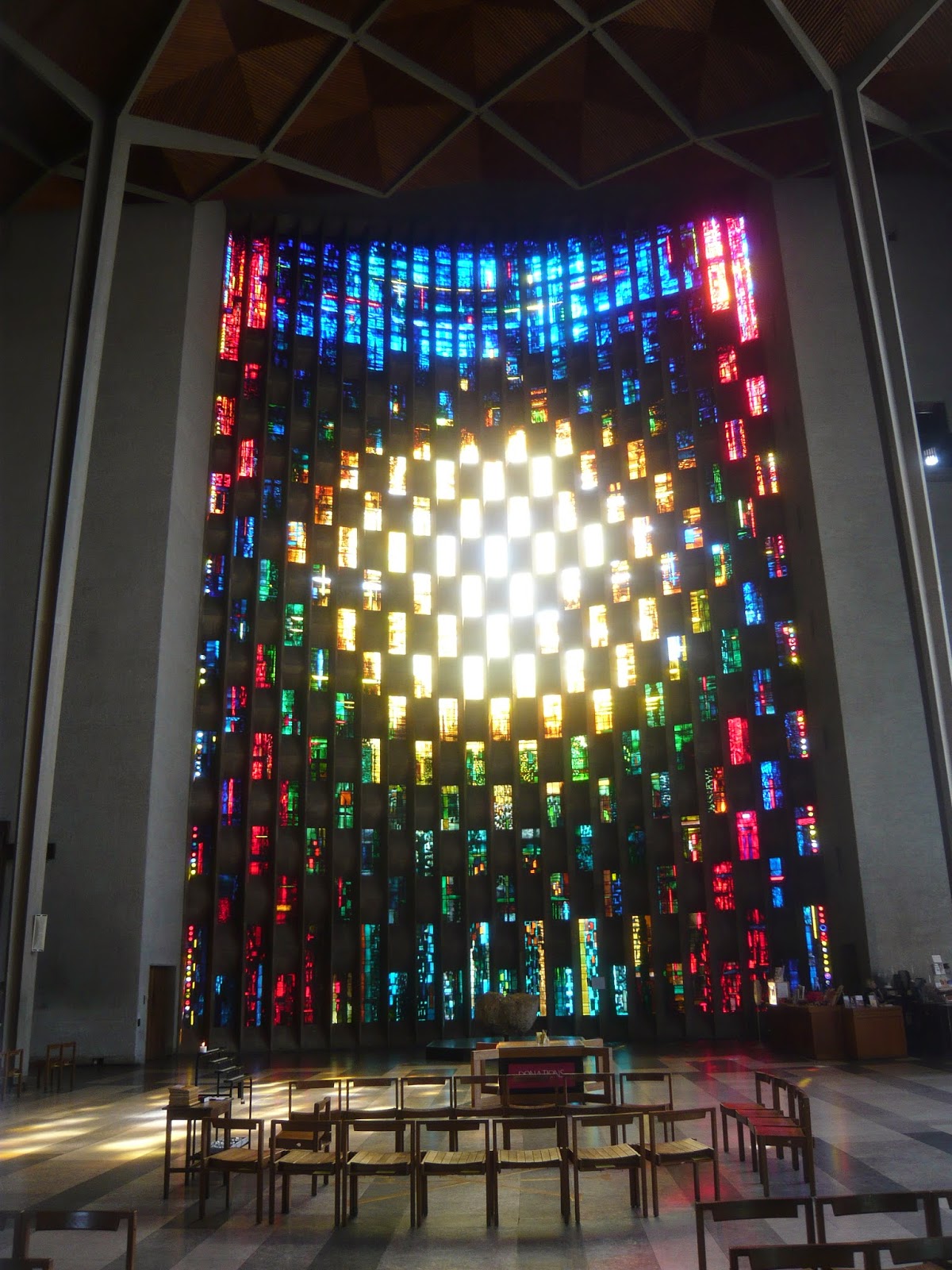
Basil Spence's Coventry Cathedral, built side by side with the ruins of the old Cathedral (bombed in 1940) and integrated with them has become an icon of God's power at work in the world to reconcile and renew. The current Dean, The Very Revd. John Witcombe, has written that, "The narrative of chaos and destruction being taken and offered back to God, issuing in resurrection and new life, is one that speaks into the reality of the lives of many of our visitors, and many of our communities.”

Spence was the only architect in the competition to design the new Cathedral to propose retaining the ruins of the old Cathedral and therefore create a literal and spiritual link between old and new. This is so right in terms of the ministry of reconciliation which Coventry has modelled that it seems inconceivable that any other design might have been possible. This design decision then dictated several of the other significant features of the building including its north-south axis, the concept of a vast translucent screen between old and new, and a dominant image behind the high altar visible from every point within the nave and setting the tone for the entire building.

Coventry Cathedral was the first major opportunity in Britain to combine contemporary religious art and architecture. Spence described his intention for the Cathedral as being "like a plain jewel-casket with many jewels." The artworks it contains are the jewels in the casket. In this respect, Spence was building on the commissioning undertaken by Canon Walter Hussey at St Matthew's Northampton and the style exemplified by the Festival of Britain. His approach was also synchronous with the work of the Dominican Friars, Marie-Alain Couturier and Pie-Raymond Régamey, as they sought to revive Christian art by appealing to the independent masters of their time.

Hussey controversially kick-started the commissioning of modern art by the Church in Britain with commissions for Henry Moore and Graham Sutherland. Both received further church commissions following their acceptance of Hussey's invitation to create work for St Matthews; Moore at St Paul's Cathedral and St Stephen Walbrook, Sutherland at St Aidan's East Acton plus Coventry and Chichester Cathedrals. Some of the artists Spence commissioned for Coventry had also featured in the Festival of Britain, where Spence had also been involved as an architect. As a result, Coventry Cathedral has been described as "the apotheosis of the Festival" and as "the Festival of Britain at prayer."

The task of reconstruction dominated the post-war years. The Festival of Britain showcased the drive for modernity in the rebuilding of Britain. New churches and commissions replacing what had been destroyed during the war were part of this process of transformation and Coventry came to stand as a symbol of what was being achieved. Scratch beneath the surface of both the Festival and Cathedral artists though and as well as their interest in modernity one can also quickly find a preoccupation with British tradition and a focus on the land. That many of the key Festival and Cathedral artists were neo-Romantics combining modernism with ruralism was symptomatic of this reality.

Benedict Read has written of an alternative artistic culture provided by church commissions as a result of an almost unprecedented campaign of church building and decoration throughout the thirty years after 1945. The commissions at Northampton and Coventry were not about engaging with an alternative culture but the mainstream of contemporary art; Moore, Sutherland, John Piper and Jacob Epstein were the independent masters of their time in Britain. What Hussey and Spence were doing was, in effect, the British equivalent of the approach that Couturier and Régamey were advocating in France.

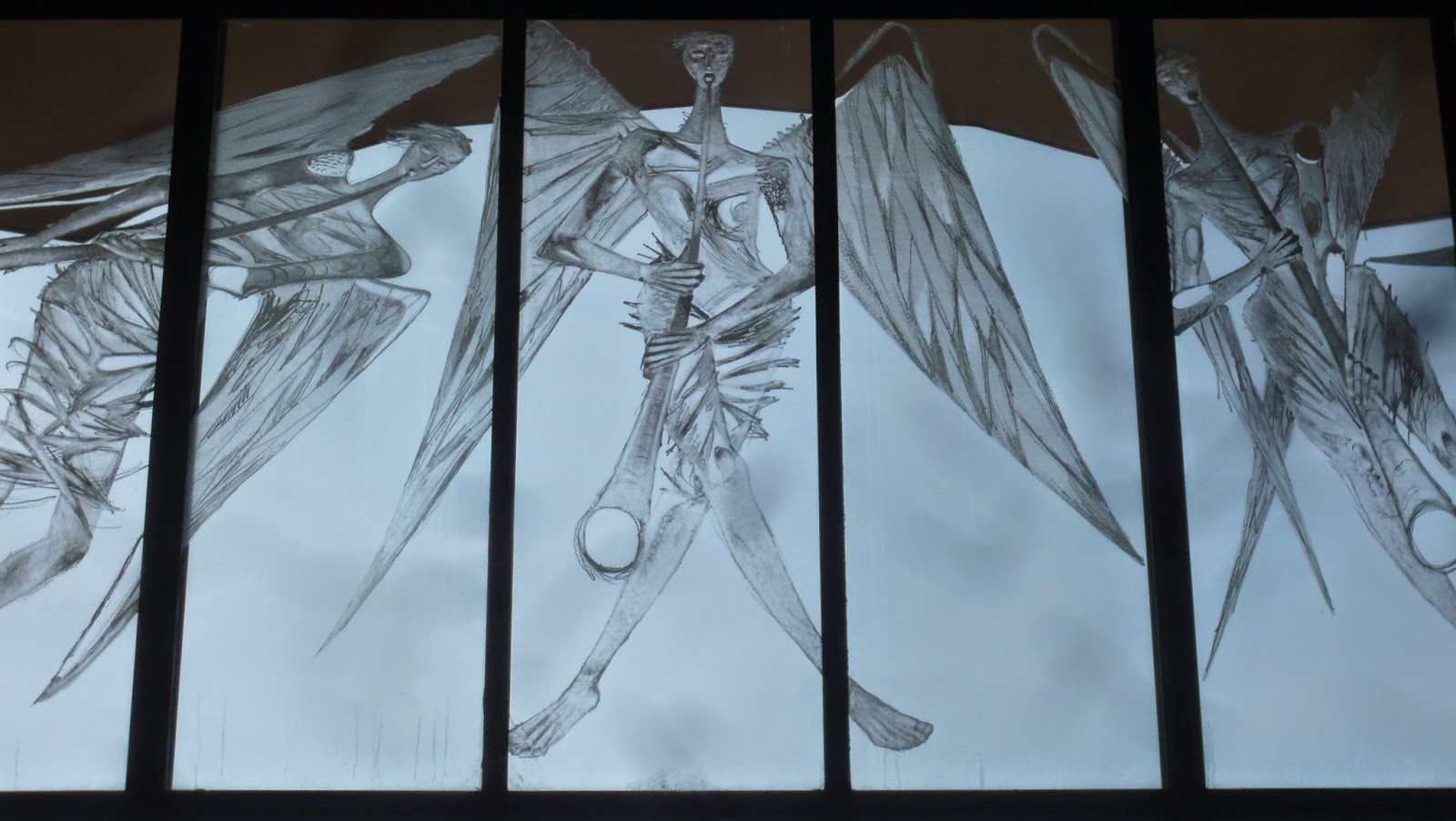
While the casket contains many jewels, those which shine most brightly are Sutherland's Christ in Glory in the Tetramorph (undoubtedly the largest tapestry in the world), the abstract baptistry window by Piper and Patrick Reyntiens, and John Hutton's Great West Screen. These are major statements and huge achievements both conceptually and technically. Yet the immensity of each is also managed through position and purpose to enable our scaled engagement. Hutton's screen can be viewed inside and out and from the steps leading to the old Cathedral as well as from the ground. While much of the screen can only be viewed from distance and at height, the lower panels can also be approached and appreciated close-up. Each abstract panel in the baptistry window is an abstract expressionist work in its own right enabling the window to be appreciated as a whole from distance and in part when close by. Sutherland's tapestry is designed to dominate from distance but reveals hidden depths of detail when near-by, including the hidden chapel with its own altarpiece formed by the lowest panel of the tapestry. To image the foundation for Christ's exaltation as being his suffering of the cross is to profoundly visualise the early Christian hymn quoted in Philippians 2.

While visiting I spoke to a churchwarden who had recently been in Rome. Despite the many jewels in its jewel-casket, when compared to St Peter's, Coventry seemed to him like minimal space. Similarly, Spence described the simple brick-built rectangle that is the nave in terms of the plainness of a jewel-casket. Both restraint and surprise are built into his clever design, as we have already seen in his engagement with and use of the creations of Hutton, Piper, Reyntiens and Sutherland.

Angling the nave's stained glass, as Spence does, ensures the primary focus looking down the nave is Sutherland's Christ in Glory. Continuing down the nave the eye is drawn to Ralph Beyer's carved textual panels, which, in their monochrome simplicity, would otherwise be overwhelmed and overlooked if bathed in coloured light. Relentlessly maintaining these foci then ensures surprise and delight as one turns to look back down the nave revealing sudden ruptures of colour in the plainness of the brick and concrete.

Among the many other jewels in the casket:

“The nave windows are the work of Geoffrey Clarke and Keith New, discovered at the Royal College of Art, with Lawrence Lee their teacher. Their skills combined to produce the modern windows with bright rich colours and strong design that Spence wanted. The Chapel of Unity glass is by Margaret Traherne whose thick abstract glass set in concrete impressed Spence.

There are many other inspired works. These include the lectern and pulpit designed in Spence’s office by Anthony Blee with the bronze eagle by Dame Elisabeth Frink and also tablets on the walls with lettering by Ralph Beyer.”

Sir Basil Spence was “the co-ordinator of the whole operation of commissioning artists and craftsmen with the skills to create a variety of elements, including glass, congenially juxtaposed and working together as a whole”:

“Spence believed that the architect, as leader of the team, should collaborate at the earliest possible stage with his engineers and artists. With the art in progress there was also a reduced risk of it being lost in any subsequent budget cut. He was therefore careful to commission work from the outset. Artists were sought to suit each project and the artist’s freedom was maintained.”

The result was, an “alchemy of art and architecture” which contains, as Spence stated, “understandable beauty to help the ordinary man to worship with sincerity.”


-----------------------------------------------------------------------------------

Graham Kendrick - For This I Have Jesus.

Saturday, 10 May 2014

Sabbatical Art Pilgrimage: Chelmsford Cathedral


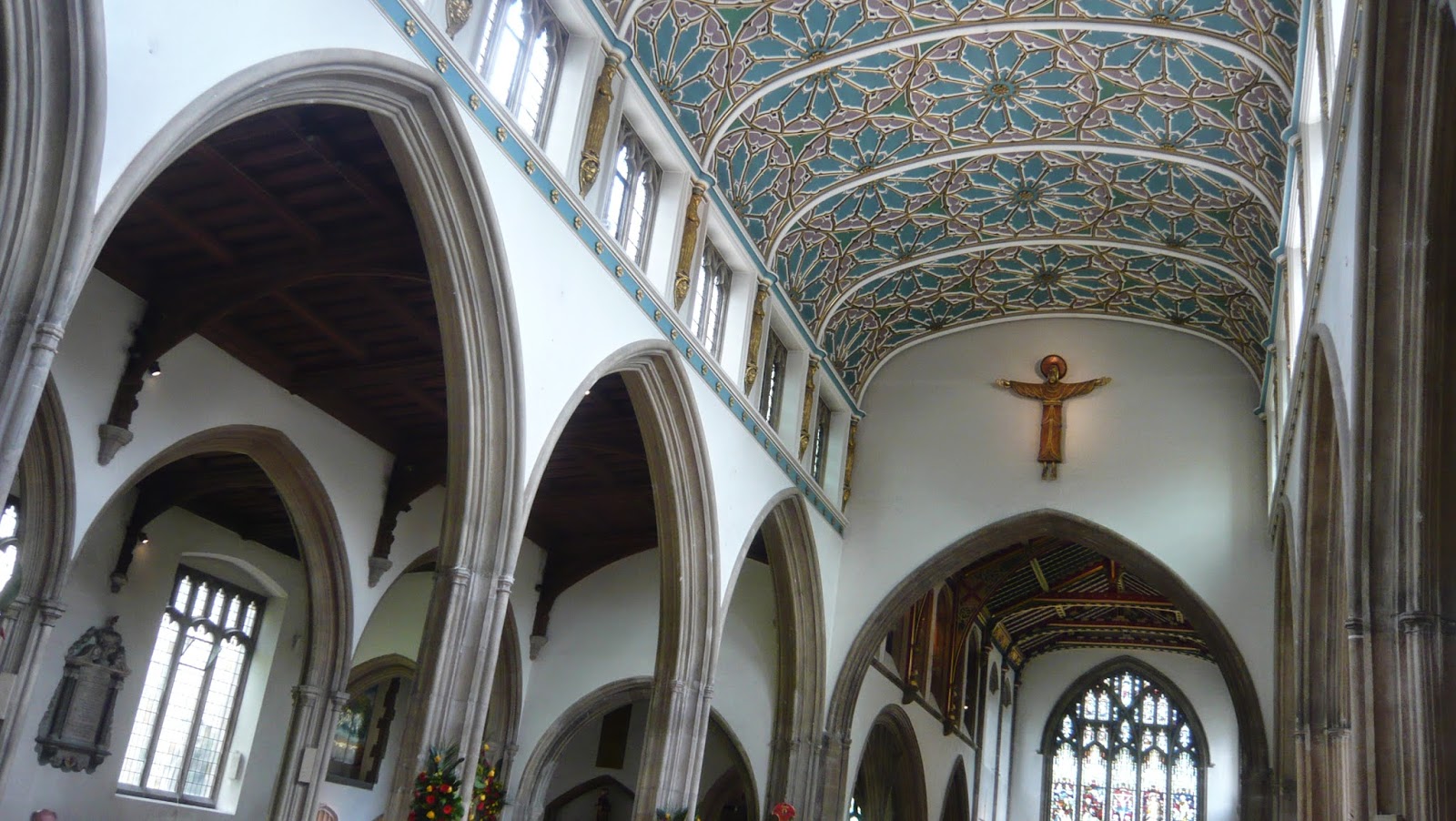
I began my sabbatical art pilgrimage in familiar territory as Chelmsford Cathedral is where I was ordained as a deacon. Since then I have attended many Diocesan services, organised exhibitions and events, and have also spoken in the Cathedral on several occasions. Despite its familiarity for me, Chelmsford Cathedral continues to surprise and entrance.

On this occasion I was one of nearly 700 worshippers from across Essex and East London communities who joined Her Majesty The Queen and HRH The Duke of Edinburgh for a service to celebrate the centenary of Chelmsford Diocese. The Rt. Revd. Stephen Cottrell, Bishop of Chelmsford, said in his sermon:

"We bring good news. We sing the song of him before whom every knee must bow, and yet whose
‘coming alongside us and moving ahead of us’ gospel means, paradoxically, that he is the one who
kneels before us, who comes, if you like, as a servant, a slave, washes our feet, offers broken
bread, wipes every tear from every eye, longs for us to know that we matter, that we are loved,
that we are precious to God. He is King of Kings and Lord of Lords, and yet, at the same time, he
is servant and shepherd. He is light in the darkest hour. Hope in the bleakest despair. A reason for

going forwards, when everyone else turns back. He is joy. He is peace. He is love itself."

Those paradoxes are imaged in the range of artwork commissioned for this church over the 100 years that it has been a Cathedral.


Peter Eugene Ball and Mark Cazalet are two names that we will encounter again on this sabbatical art pilgrimage as they are among those contemporary artists who have most frequently been commissioned by the Church in the UK. Ball is a sculptor who works with found objects, predominantly wood, which he then embellishes with beaten metals such as gold leaf. His Christ in Glory located high above the Nave with its outstretched arms is a welcoming image.


On a smaller scale and possessed of a still serenity are his cross and candlesticks for the Mildmay Chapel and his Mother and Child in St Cedd's Chapel. 


Cedd is the subject of Cazalet's engraved glass window in the St Cedd's Chapel and he also has a bit part in Cazalet's Tree of Life located in a blank window space within the North Transept and mimicking the mullions and tracery of the original window. The image of a single tree has been a recurring theme in Cazalet's work, influenced, as it is, by the sense of place found within the English Romantic landscape tradition. Cazalet's image of an Essex oak exemplifies lines written by his friend and fellow artist, Roger Wagner: "And that exulting love which made all things / Whose laughter is the ocean in a tree / That rustles like a thousand angels’ wings / Stirred by a wind no human eye can see."


Earlier commissions were no less significant however. Georg Ehrlich's sculpture The Bombed Child in St Peter's Chapel and his relief Christ the Healer are particularly affecting. The commissioning by the Church in the UK of work from artists who were refugees from the Nazi's will prove to be another recurring feature of this sabbatical art pilgrimage. Former Dean, The Very Revd. Peter Judd, said of The Bombed Child: "A mother holds her dead child across her lap, and the suffering and dignity of her bearing don’t need any words to describe them – that is communicated to anyone who looks at her."


John Hutton's Great West Screen at Coventry Cathedral is one of the most notable works of religious art of the 20th century in Britain. Here his etched window is an image of St Peter. Elsewhere in the Diocese Hutton's work can also be found at St Erkenwald's Barking and St George's Barkingside


The work of Thomas Bayliss Huxley-Jones also features elsewhere within the Diocese. His Woman of Samaria at St Peter's Aldborough Hatch and The Christ figure above the South Porch of St. Martin Le Tours church, Basildon are both fibreglass figures. At the Cathedral, Huxley-Jones' work includes a Christus in St Cedd's Chapel, a carving of St Peter on the south-east corner of the South Transept and 16 stone carvings representing the history and concerns of Essex, Chelmsford, and the Church. Similarly, in his sermon, Stephen Cottrell, spoke of "the faithful, tireless, tenacious, beautiful witness of Christian men and women continues to make a difference: in Chingford and Chelmsford, Harwich and Harlow, Becontree
and Basildon and Boxted, right across this complicated and glorious diocese."  


The number and variety of commissions which feature within this Cathedral mean that even in a packed service, such as that on May 6, when each worshipper will only see from their specific place within the space a very small proportion of the artworks within the building, they will, nevertheless, be able to view something of significance and depth to enhance their experience of worship. Among the range and variety of works to be seen - which include, among others, work in bronze, glass, steel, textiles, and wood - are finally a significant collection of contemporary icons many of which were created by nuns from the Community of St John the Baptist at Tolleshunt Knights.

Bishop Stephen concluded his sermon with these words: "In the midst of war, in the relative security of peace, in hardship and in plenty, in village, suburb and inner city, today we thank God for the church, which is the body of Christ, the sign of God’s loving presence and God’s eternal purposes for the world." The artworks found within this Cathedral Church are also signs of that loving presence and his eternal purposes for the world.

---------------------------------------------------------------------------------

John Ireland - Te Deum Laudamus. 

Tuesday, 16 April 2013

Windows and gardens: Chigwell and Capel Manor


I went with my Mum and youngest daughter today to see St Mary's Chigwell, as it is the church where my eldest daughter will be getting married this summer. The church has an engraved window of Christ and the Children by Jennifer Conway, who was a pupil of John Hutton. When Hutton's King Lear and Cordelia panel at the entrance to the Shakespeare Birthplace Trust Gallery at Stratford upon Avon was damaged, Conway made a copy. Her engraved windows can be found at St Mary Barcombe and St Nicholas Sandhurst, as well as St Mary Chigwell. St Mary's also have a Christ and the Magi window by Frederick Cole. Afterwards we went to see the interesting show gardens at Capel Manor.

----------------------------------------------------------------------------------------

Larry Norman - She's A Dancer.