Here's the sermon on Exodus 3.1-15 that I shared at St Andrew’s Wickford this morning:
"A man named Moses is tending his sheep in the land of Midian when he comes across a burning bush. He moves closer to see more and hears the voice of God, speaking to him about his people and their need to be delivered from the land of Egypt. God tells Moses to take off his sandals, for the ground he is standing on is holy.” (R. Bell, Velvet Elvis, Zondervan, 2005)
Holy Ground is an art installation by Paul Hobbs which includes a collection of shoes and stories from Christians all around the world. The stories are short statements about what it means for each person to believe in Christ in their particular situation. Among those represented are: a thief, a refugee, the despised, the rejected – people who Jesus specially sought out – as well as those who have known great opportunity, wealth and success. There are those who are beautiful, those who are disabled, those struggling to make a living and raise a family, those who have known great loss and tragedy, and those asking the deep questions of life. All have encountered the living God, arriving at a place of holy ground; where they must, metaphorically at least, remove their shoes in acknowledgement of God’s holiness.
For some the idea of giving up their shoes for this project seemed amusing and culturally odd. For others it was costly to give their only pair of shoes in exchange for another. For some it was an honour to be featured in this way, to have their story told to represent others from their situation. For many, it was an expression of thankfulness to be able to share their stories with others.
At the burning bush, God said to Moses, “Take off your sandals, for the place where you are standing is holy ground” (Exodus 3/2-5). Similarly, acknowledging God’s holiness is the beginning of life as a Christian. What, I wonder, would your story be of metaphorically taking off your sandals in acknowledgement of God’s holiness?
Here is a very different figure; this time a sculpture by the Canadian artist David Robinson. “Dressed in his finest uniform (suit, tie, pants perfectly pressed) the bronze figure would blend in well with the teeming businessmen of the city. He is tidy. His hair is groomed. Not too young, not too old, he is in his prime, at the top of his game. One expects his head to be held high and it is. Is he, like everyone else, focused on the horizon of his ambition?
Thousands might note in passing that this is no hero, no grand general and no great statesman; in fact the crowds of the morning rush might not find him notable at all. Yet, though in business there is never a minute to spare, allowing him even a moment’s notice would pay off a hundredfold. Would some turn aside and see that he is not rushing as they are? Would anyone take time to look at his hands, to look at his feet?
Bare feet. What has caused this perfectly dressed businessman to humbly remove his shoes? In the stillness of the erect figure, face looking upward, we do not see what he sees but we can perceive a heavenly and personal encounter. Perhaps it is a gesture of repentance that he holds his shoes so lightly?”
These details should bring to mind that “man of another era who similarly, while busy at his workday job, had an encounter which changed his life forever.” As we have heard, “while minding his father-in-law’s sheep in the desert, this man came upon a contradiction: a green bush aflame but not consumed. He could have hastened on his way but for some reason did not.”
“As the story goes, when the Lord saw that he turned aside to see, he called to him from out of the bush by name, saying, “Do not come near; take your sandals off your feet, for the place on which you are standing is holy ground.” David Robinson’s sculpture says that, under the bare feet of this everyday man, there is holy ground.
Reflecting on this sculpture Irena Tippett concludes, “So here is the truth: There is no time or place immune to the intrusion (if you will) of the living God. Even in a city strident with buying and selling, God is able to reveal himself to people.”
American Pastor Rob Bell makes a similar point: "Moses has been tending his sheep in this region for forty years. How many times has he passed by this spot? How many times has he stood in this exact place? And now God tells him the ground is holy?
Has the ground been holy the whole time and Moses is just becoming aware of it for the first time?
Do you and I walk on holy ground all the time, but we are moving so fast and returning so many calls and writing so many emails and having such long lists to get done that we miss it?" (R. Bell, Velvet Elvis, Zondervan, 2005)
So, in the words of Woody Guthrie:
“Take off, take off your shoes
This place you’re standing, it’s holy ground
Take off, take off your shoes
The spot you’re standing, its holy ground
Amen

Showing posts with label workplace. Show all posts
Showing posts with label workplace. Show all posts
Wednesday, 16 July 2025


Sunday, 4 May 2025
A God who entrusts us with things of enormous worth
Here's the Stewardship sermon that I shared at St Catherine's Wickford and St Mary's Runwell this morning:
Many of Jesus’ parables are set in the world of work. They concern masters, servants and slaves, as those were the primary work roles at the time and, because Israel was an agrarian culture, they often relate to farming. Ours is a very different context but, despite the many differences between the working life of Jesus’ day and time, the universal nature of the stories that he told, means that they still have much to say to the work practices of our own day and time.
One person who has specifically explored the implications of Jesus’ parables for the workplace is Will Morris who is both PwC’s Deputy Global Tax Policy Leader and a priest in the Episcopal Church. In his book ‘Where is God at Work?’ he devotes five chapters to exploring the Parable of the Talents or Pounds (Luke 19.11-28).
He notes firstly that this is story about workers and work. In the story people at work are ‘entrusted with vast sums of money and expected to use them in commercial ways’: ‘People are given assignments, they have responsibilities, and they have to report back to the boss, who then assesses them and rewards them with further work responsibility – or punishes them with demotion (or the sack). The relationships are business relationships. There is one worker who obviously has real commercial smarts, another who is not quite as high-powered but still does pretty well, and then there is the one who has no commercial savvy at all, and who lets his employer’s money sit in the ground doing nothing. So we have the successful risk-taker and the conservative, risk-adverse colleague who’d much rather do nothing than try anything. And there’s a hierarchy. It really is just like a workplace.’
He makes three key points. The first is that this is not directly a story about God-given abilities (a pound or talent was a measure of money, not a skill or gift). It is ‘rather a story about the entrustment of something of great price to various individuals.’
‘Second, the sums of money – the pounds or talents – are something given, entrusted by the master when he leaves and required to be turned back over when he returns.’ It is about ‘something entrusted to us which we are expected to work with – fruitfully – and then return to the person who gave it to us.’
Third, there is the size of the gifts. One talent is sixteen years’ wages, five is eighty years’ worth. ‘That’s a lot to entrust to a slave ... Slaves, those way down the pecking order, were here entrusted with huge wealth. The master didn’t entrust the talents to his fellow owners or to his friends, but to his slaves.’ In that sense, ‘this parable is more about equality, at least of opportunity, than it is about inequality. Slaves, if they can handle it, are as worthy of being trusted as the leaders of society.’
This parable ‘upholds commercial activity – even ... banking’ and, more specifically, ‘Jesus does indicate that – in the right settings – using money to make money is completely acceptable.’ ‘For Christians in the workplace that is welcome and affirming.’ Despite this, ‘the parable doesn’t tell us that money is good, or that we will be doing God’s work if we earn more talents for Him by any means we wish as long as we end up increasing the amount.’
However, ‘done well, done properly, these activities will validly contribute to the building up of the kingdom. As a result, we must be open to the possibility that God has placed them there for us to use in this way. If we approach the workplace with the idea, the preconception, that good cannot possibly be achieved there, then the chances are that it won’t be. But if, in part thanks to this parable, we are open to the possibility that God can work through instruments such as money and in the workplace, then who know what might happen? ... God can turn up and do amazing things in the most unlikely places.’
How will we respond to the challenge of Jesus’ parable? In the story, the faithful workers are those that accept responsibility and act on it. The unfaithful worker is the one who does nothing, who does not act. Are we faithful or unfaithful workers? Are our lives dedicated to working for the benefit of others and our world? It is important to also note that in the parable we have been given the resources needed for this responsibility. In the parable the master gave out resources (the ‘talents’) alongside responsibilities. In the same way, the Holy Spirit has come to empower all of Jesus’ disciples.
We are currently in Stewardship month, an annual reminder to us that that is so when it comes to the contribution we make as Christian disciples; when it comes to the money we give back to God, the talents we use in his service, the community contribution we make and the environmentally-friendly actions we take.
Our Parish needs a whole series of contributions at present as we need new volunteers across the whole range of our ministry. We are looking for a new PCC Treasurer, members of our District Church Councils (the DCCs) and Parochial Church Council (our PCC). We would value musicians and singers, people who could work with children when they come to our services, and people who can volunteer at the foodbank. We always value help with administration, pastoral visiting, prayer ministry and with our publicity (website, social media etc). The packs that you have been given include more information about Stewardship and response forms to help you think more about the ways you give currently and what might be possible in the future. The packs include a form you can fill in to offer your help.
The ‘parable of the talents is not about the unequal handing out of skills and about the punishment of the weak. It is about whether we try to be the best we can be, working with God to build His kingdom, heal His creation, including the workplace – which, like everything else, will be perfected at the end of time. It’s about being ourselves, not trying to be people we’re not. It’s about doing only what we are capable of doing, but doing it very well. It’s about a God who entrusts us with things of enormous worth – the possibilities of being His co-workers – and who will love us for what we have done unless (and only unless we hide the gift, don’t ask Him for help using it, and then turn around and tell Him it was all His own fault anyway). Our God loves us. He really does. And all we have to do is love him back.’ That’s what Stewardship is all about.
So, do we recognise that each of us has much that we can give; that we are all people with talents and possessions however lacking in confidence and means we may sometimes be? We all have something we can offer, so how can we, through our lives and work, benefit and develop the world for which God has given humanity responsibility? What resources - in terms of abilities, job, income and possessions - has God given to us in order to fulfil our responsibility to benefit and develop the world? These are questions that Stewardship month encourages us to ask.
As we ask those questions together, we also want to affirm all the many ways in which people here give to St Mary’s and to the Parish is many different ways. We are very grateful for all you do and for all that is done to maintain and grow this church and its ministry. Thank you for all your contributions currently and in the past. Will you continue making those contributions or will there be changes going forward. Stewardship month is the time to have that conversation with yourself and God.
Jesus challenges us as to whether we will be faithful or unfaithful servants? How will we respond? If we accept the responsibility we have been given, we should then pray for quiet courage to match this hour. We did not choose to be born or to live in such an age; but we ask that its problems challenge us, its discoveries exhilarate us, its injustices anger us, its possibilities inspire us and its vigour renew us for the sake of Christ’s kingdom come, on earth as in his heaven. Amen.
--------------------------------------------------------------------------------------------------------
David Ackles - Berry Tree.
Tuesday, 26 September 2023
How a generous God handles the utterly undeserving
Here's the sermon that I shared at St Catherine's Wickford on Sunday morning:
Chichele Road in Cricklewood has been known as Job Street, where economic migrants line up to be hired from the back of a van, no questions asked. Dozens of men in jeans and anoraks would be found hanging around from 6.30am to discover whether they will be working that day. A car would stop, a negotiation would take place, a deal might be struck. Typically, the men would be whisked off to a building site or a house in the process of renovation. They would be paid £20 to £40 for a long, arduous day's work: no tax, no national insurance, no questions asked.
That’s essentially the scenario for today’s Gospel reading (Matthew 20. 1 - 16). The social situation in Jesus’ day was that many small farmers were being forced off their land because of debt they incurred to pay Roman taxes. Consequently, large pools of unemployed men gathered each morning, hoping to be hired for the day. They were the displaced, unemployed, and underemployed workers of their day. Those still waiting at five o'clock would have had little chance of earning enough to buy food for their families that day. Yet the vineyard owner pays even them a full day’s wage. The owner in the parable ensures that all the workers are paid enough to support their families, as a denarius was a full day’s pay for a skilled worker.
So, unlike those exploited illegal workers or gig economy workers earning less than the minimum wage, the employer in this story is concerned that those he employs are paid a living wage. The standard thing for an employer in Jesus’ day to do would be to send one of his employees to the marketplace to pick up a few extra workers for the day. But this employer goes to the marketplace himself. In fact, he goes repeatedly to seek workers and clearly cares about their predicament seeking to lift them out of their despair by providing work that meets their needs and the needs of those who depend on them. If God is like the owner of the vineyard then he cares about our hopeless situation as human beings. He comes looking for us. He goes on an all-out search to find workers for his vineyard. He longs to provide us with a life of significance in his kingdom work.
As N. T. Wright has said, God’s grace, in short, is not the sort of thing you can bargain with or try to store up. It isn’t the sort of thing that one person can have a lot of and someone else only a little. The point of the story is that what people get from having served God and his kingdom is not, actually, a ‘wage’ at all. It’s not, strictly, a reward for work done. God doesn’t make contracts with us, as if we could bargain or negotiate for a better deal. He makes covenants, in which he promises us everything and asks of us everything in return. When he keeps his promises, he is not rewarding us for effort, but doing what comes naturally to his overflowingly generous nature.
Michael Green says of this story: Length of service and long hours of toil in the heat of the day constitute no claim on God and provide no reason why he should not be generous to those who have done less. All human merit shrivels before his burning, self-giving love. Grace, amazing grace, is the burden of this story. All are equally undeserving of so large a sum as a denarius a day. All are given it by the generosity of the employer. All are on the same level. The poor disciples, fishermen and tax collectors as they are, are welcomed by God along with Abraham, Isaac and Jacob. There are no rankings in the kingdom of God. Nobody can claim deserved membership of the kingdom. There is no place for personal pride, for contempt or jealousy, for there is no ground for any to question how this generous God handles the utterly undeserving. He is good. He sees that the one-hour workers would have no money for supper if they got paid for only one hour. In generosity he gives them what they need. Who is to complain at that?
Yet there is always a danger that we do get cross with God over this. People who work or move in church circles can easily assume that they are the special ones, God’s inner circle. In reality, as we have seen, God is out in the marketplace, looking for the people everybody else tried to ignore, welcoming them on the same terms, surprising them (and everybody else) with his generous grace. In Ephesians 2:8-10 Paul says, For it is by grace you have been saved, through faith—and this not from yourselves, it is the gift of God—not by works, so that no one can boast. For we are God’s workmanship, created in Christ Jesus to do good works, which God prepared in advance for us to do. Is there anywhere in today’s church, I wonder, that doesn’t need to be reminded of that message?
The parable is also a message of hope to everyone struggling to find adequate employment. In God’s kingdom, it suggests, we will all find work that meets our needs. The parable is, therefore, also a challenge to all those who have a hand in shaping the structures of work in today’s society. What can we do, as Christians, to advance this aspect of God’s kingdom right now?
-------------------------------------------------------------------------------------------------------------
Mark Heard - Strong Hand Of Love.
Sunday, 3 September 2023
The ground we are standing on is holy
Here's the sermon I shared at St Mary's Runwell this morning:
"A man named Moses is tending his sheep in the land of Midian when he comes across a burning bush. He moves closer to see more and hears the voice of God, speaking to him about his people and their need to be delivered from the land of Egypt. God tells Moses to take off his sandals, for the ground he is standing on is holy.” (R. Bell, Velvet Elvis, Zondervan, 2005)
Holy Ground is an art installation by Paul Hobbs which includes a collection of shoes and stories from Christians all around the world. The stories are short statements about what it means for each person to believe in Christ in their particular situation. Among those represented are: a thief, a refugee, the despised, the rejected – people who Jesus specially sought out – as well as those who have known great opportunity, wealth and success. There are those who are beautiful, those who are disabled, those struggling to make a living and raise a family, those who have known great loss and tragedy, and those asking the deep questions of life. All have encountered the living God, arriving at a place of holy ground; where they must, metaphorically at least, remove their shoes in acknowledgement of God’s holiness.
Some contributors are persecuted and despised for their faith, yet retain confidence in the living God. Several people need to be anonymous due to the lack of religious freedom in their lands. For others, anonymity allows them to speak more easily. Jesus said, “Blessed are those who are persecuted because of righteousness, for theirs is the kingdom of heaven” (Matt 5/10).
For some the idea of giving up their shoes for this project seemed amusing and culturally odd. For others it was costly to give their only pair of shoes in exchange for another. For some it was an honour to be featured in this way, to have their story told to represent others from their situation. For many, it was an expression of thankfulness to be able to share their stories with others.
At the burning bush, God said to Moses, “Take off your sandals, for the place where you are standing is holy ground” (Exodus 3/2-5). Similarly, acknowledging God’s holiness is the beginning of life as a Christian.
What would your story be of metaphorically taking off your sandals in acknowledgement of God’s holiness?
Hobbs goes on to say that “as a believer follows Jesus Christ, he or she finds that this holy God is also a servant king, humbly and lovingly attending to one’s needs, just as when he washed his disciples feet (John 13/3-5).
As testified in many of the stories, Christians are encouraged to bring this gospel to others with “feet fitted with the readiness that comes from the gospel of peace” (Ephesians 6/14-15) and thus they realise the prophecy of Isaiah, “How beautiful on the mountains are the feet of those who bring good news, who proclaim peace, who bring good tidings, who proclaim salvation” (Isaiah 52/7).”
So he “trusts that this collection of shoes and stories will show the rich variety of believers across the world, their strength of faith despite hardship, and their joy in knowing Christ. The collection also demonstrates God’s love to all types of people, and is a testimony of how the gospel has spread - often at great cost - throughout the world over the last two thousand years, and how it is reaching every part of the globe.
Please pray for people like these – many of whom make great sacrifices and take great risks to follow Christ where they live.” In this way he reminds us of those, such as Christians in North Iraq at present, who need our prayers, our giving and our action on their behalf. He says, “I am struck, in looking at these shoes, by Jesus’ words, “Many who are first will be last, and the last first” (Mark 10/31).”
Here is a very different figure; this time a sculpture by the Canadian artist David Robinson. Irena Tippett writes: “Dressed in his finest uniform (suit, tie, pants perfectly pressed) the bronze figure would blend in well with the teeming businessmen of the city. He is tidy. His hair is groomed. Not too young, not too old, he is in his prime, at the top of his game. One expects his head to be held high and it is. Is he, like everyone else, focused on the horizon of his ambition?
Thousands might note in passing that this is no hero, no grand general and no great statesman; in fact the crowds of the morning rush might not find him notable at all. Yet, though in business there is never a minute to spare, allowing him even a moment’s notice would pay off a hundredfold. Would some turn aside and see that he is not rushing as they are? Would anyone take time to look at his hands, to look at his feet?
Bare feet. What has caused this perfectly dressed businessman to humbly remove his shoes? In the stillness of the erect figure, face looking upward, we do not see what he sees but we can perceive a heavenly and personal encounter. Perhaps it is a gesture of repentance that he holds his shoes so lightly?”
These details should bring to mind that “man of another era who similarly, while busy at his workday job, had an encounter which changed his life forever.” As we have heard, “while minding his father-in-law’s sheep in the desert, this man came upon a contradiction: a green bush aflame but not consumed. He could have hastened on his way but for some reason did not.”
“As the story goes, when the Lord saw that he turned aside to see, he called to him from out of the bush by name, saying, “Do not come near; take your sandals off your feet, for the place on which you are standing is holy ground.”
It is by no means certain that everyone would catch the allusion to Moses’ powerful call in the wilderness or know how in that place he met the living God face to face. Nevertheless, David Robinson’s sculpture speaks clearly. Today, under the bare feet of his everyday man, there is holy ground.
Like Barbra Streisand in her song ‘On Holy Ground’ we’re much more comfortable with the concept of God’s being limited to churches or other sacred spaces. Yet the universal message of the sculpture is clear: the whole world is potentially holy ground. Look how the globe extends beneath those shoeless feet.”
Reflecting on this sculpture Irena Tippett concludes, “So here is the truth: There is no time or place immune to the intrusion (if you will) of the living God. Even in a city strident with buying and selling, God is able to reveal himself to people. And a corollary is this: There is no one immune to an encounter with him. Through Jesus Christ God’s great mercy extends to all who hear his voice.”
American Pastor Rob Bell makes a similar point: "Moses has been tending his sheep in this region for forty years. How many times has he passed by this spot? How many times has he stood in this exact place? And now God tells him the ground is holy?
Has the ground been holy the whole time and Moses is just becoming aware of it for the first time?
Do you and I walk on holy ground all the time, but we are moving so fast and returning so many calls and writing so many emails and having such long lists to get done that we miss it?" (R. Bell, Velvet Elvis, Zondervan, 2005)
One of my favourite quote comes from David Adam. You will no doubt have heard me use it before, but it bears repeating: “If our God is to be found only in our churches and our private prayers, we are denuding the world of His reality and our faith of credibility. We need to reveal that our God is in all the world and waits to be discovered there – or, to be more exact, the world is in Him, all is in the heart of God. Our work, our travels, our joys and our sorrows are enfolded in His loving care. We cannot for a moment fall out of the hands of God. Typing pool and workshop, office and factory are all as sacred as the church. The presence of God pervades the work place as much as He does a church sanctuary.” (Power Lines: Celtic Prayers about Work, SPCK, 1992)
So, in the words of Woody Guthrie:
“Take off, take off your shoes
This place you’re standing, it’s holy ground
Take off, take off your shoes
The spot you’re standing, its holy ground
These words I heard in my burning bush
This place you’re standing, it’s holy ground
I heard my fiery voice speak to me
This spot you’re standing, it’s holy ground
That spot is holy holy ground
That place you stand it’s holy ground
This place you tread, it’s holy ground
God made this place his holy ground
Take off your shoes and pray
The ground you walk it’s holy ground
Take off your shoes and pray
The ground you walk it’s holy ground
Every spot on earth I trapse around
Every spot I walk it’s holy ground
Every spot on earth I trapse around
Every spot I walk it’s holy ground
Every spot it’s holy ground
Every little inch it’s holy ground
Every grain of dirt it’s holy ground
Every spot I walk it’s holy ground”
----------------------------------------------------------------------------------
The Klezmatics - Holy Ground.
Friday, 4 May 2018
HeartEdge - Start:Stop Workshop

Learn about the genesis of Start:Stop (10-minute work-based reflections for people on their way to work) together with Revd Jonathan Evens, Associate Vicar Partnership Development, St Martin-in-the-Fields.
An opportunity to discuss:
• growing a new congregation;
• engaging with working people;
• ministering in the workplace;
• communicating with busy people.
Free to HeartEdge members, £10 for others. Register with Revd Jonathan Evens at jonathan.evens@smitf.org or 020 7766 1127.
For more information, see www.stmartin-in-the-fields.org/life-stmartins/mission/heartedge/.
---------------------------------------------------------------------------------------------------
Al Green - Morningstar.
Wednesday, 24 January 2018
HeartEdge Mission Model workshops
HeartEdge is a growing ecumenical network which supports churches in blending their mission around four key areas:
Specific mission models have been identified which are being shared through HeartEdge. These include:
The next HeartEdge mission model workshops to be held are:

How to explore the Christian faith using a more open-ended approach? How to engage a more visually focused culture? ‘Inspired to Follow: Art and the Bible Story’ is one resource developed by
St Martin-in-the-Fields.
The discipleship course uses fine art paintings from the National Gallery, a Biblical story and a short theological reflection to help people explore the Christian faith today.
Free to HeartEdge members, £10 for others, Register with Revd Jonathan Evens at jonathan.evens@smitf.org or 020 7766 1127.

- Congregation – inclusive approaches to liturgy, worship and day-to-day communal life
- Community – models of outreach serving local need and addressing social justice
- Culture – art, music and ideas to re-imagine the Christian narrative for the present moment
- Commerce – commercial activities that generate finance, creatively extending and enhancing mission and ministry through social enterprise
Specific mission models have been identified which are being shared through HeartEdge. These include:
- Disability Advisory Groups - Ensuring disabled people can ‘join in’, not simply ‘get in’
- Great Sacred Music - Sharing faith insights with secular audiences
- Inspired to Follow - Enquirers’ course exploring the story of the Bible through works of art
- International Groups - Hospitality groups for those with no recourse to public funds
- Start:Stop – Early morning reflections for working people
The next HeartEdge mission model workshops to be held are:

Inspired to Follow workshop - Monday 5 February, 2.30 – 4.30pm, St Martin-in-the-Fields
St Martin-in-the-Fields.
The discipleship course uses fine art paintings from the National Gallery, a Biblical story and a short theological reflection to help people explore the Christian faith today.
Learn about the genesis of ‘Inspired to Follow’ and discuss its use with Revd Jonathan Evens, Associate Vicar Partnership Development, St Martin-in-the-Fields and course designer, Revd Dr Alastair McKay,
Curate, St Martn-in-the-Fields.
Free to HeartEdge members, £10 for others, Register with Revd Jonathan Evens at jonathan.evens@smitf.org or 020 7766 1127.

Start:Stop Workshop - Thursday 1 March, 2.00 - 4.00pm, St Martin-in-the-Fields
Learn about the genesis of Start:Stop (10-minute work-based reflections for people on their way to work) together with Revd Jonathan Evens, Associate Vicar Partnership Development, St Martin-in-the-Fields.
An opportunity to discuss:
• growing a new congregation;
• engaging with working people;
• ministering in the workplace;
• communicating with busy people.
Free to HeartEdge members, £10 for others. Register with Revd Jonathan Evens at jonathan.evens@smitf.org or 020 7766 1127.
-------------------------------------------------------------------------------------
Innocence Mission - Prayer Of St Francis.
Friday, 5 January 2018
24-hour parish people
In an article for today's Church Times entitled '24-hour parish people' John Cheek takes a look at churches that are open to people ‘out of hours’ in the context of a society that now functions around the clock,
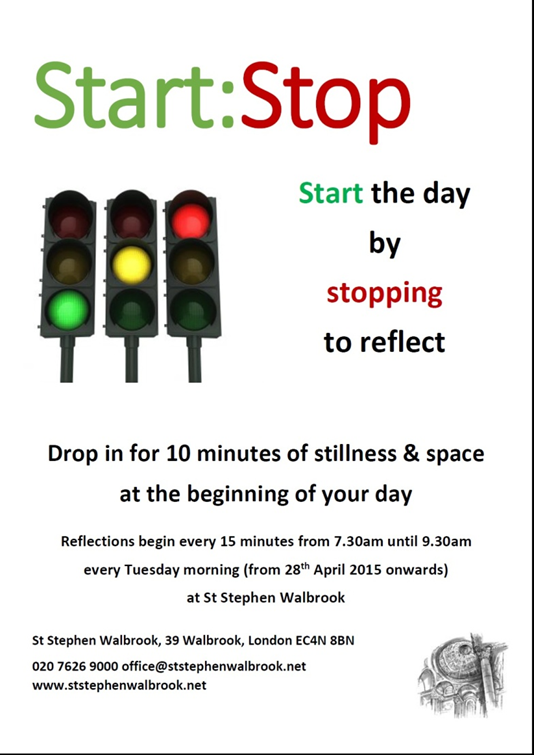
The article features Start:Stop at St Stephen Walbrook which enables working people to start their day by stopping to reflect for 10 minutes. Every Tuesday morning we have had a rolling programme of work-based reflections with a 10 minute session of reflection beginning every 15 minutes between 7.30am and 9.15am, These sessions have included bible passages, meditations, music, prayers, readings and silence enabling those attending to start their day by stopping to reflect for 10 minutes.
--------------------------------------------------------------------------------------------
The Housemartins - Think For A Minute.
Thursday, 28 September 2017
plus+ presentations: adding value to the City

This new ongoing series of events is entitled ‘plus+ presentations’, as the series is one part of the way in which St Stephen seeks to add value to the City.
The inaugural plus+ presentation was given by Douglas Board, founder of Maslow’s Attic, on 21 September. Douglas, who is a senior visiting fellow at Cass and also writes on management, faith, society and humour, as well as careers, share practical, intellectual and spiritual reflections on flourishing at work in a presentation entitled ‘In an open plan office, can anyone hear you scream?’
Douglas began by referencing a sense of loneliness versus connectivity as characteristic of digital age and workplaces. Managers have become attuned to giving pseudo-recognition but there are not often "authentic" connections between people as work. There is a sense of "investing in people" but the reality is usually different. This is often due to leaders lacking emotional intelligence. Loneliness in the workplace is a poverty of recognition. Genuine/authentic connections are needed, not the round-robin "well done" one-liner emails etc. Is there a role for church here? Listening, supporting? Outside of the politics of workplace and away from familiarity at home? He suggested the example of authentic listening as developed by Samaritans, as pioneered at St stephen Walbrook. Douglas talked about our "real" hierarchy of needs, not with individual/self at the peak - but relationships with each other: (Peak) Recognition (Mid Tier) Respect (Foundation Tier) Unconditional Love. What can we do to overcome the issues he addressed? More face to face contact, less reliance on email. More time to get to know people. Create space to talk.
The format for ‘plus+ presentations’ is:
- 6.15pm: Evening Prayer (optional)
- 6.30pm: plus+ presentation
- 7.00pm: Drinks reception & networking
- 7.30pm: Close
Going forward, we plan to run the plus+ presentations on the third Thursday of each month, although the remaining 2017 dates will be 19th October; 9th November:
- 19th October Revd Sally Muggeridge, Curate at St Stephen Walbrook, will speak from personal experience about campaigns to increase the numbers of women on Boards.
- 9th November Barbara Ridpath, Director of St Paul's Institute, will speak on Transitions: how to make life-changing career changes by choice or necessity.
- 18 January 2018, our presenter will be Professor Richard Higginson (Director of Faith in Business, Ridley Hall Cambridge) speaking about Christian entrepreneurs living out their faith.
- 15 February 2018 - Revd Dr Fiona Stewart-Darling, Canary Wharf MultiFaith Chaplaincy.
------------------------------------------------------------------------------------------
Peteris Vasks - Lord, Open Our Eyes.
Tuesday, 19 September 2017
plus+ presentations: adding value to the City of London


This new ongoing series of events is entitled ‘plus+ presentations’, as the series is one part of the way in which St Stephen seeks to add value to the City.
The inaugural plus+ presentation will be given by Douglas Board, founder of Maslow’s Attic, on 21 September (6.30pm). Douglas is a senior visiting fellow at Cass and also writes on management, faith, society and humour, as well as careers. Previously, he was consultant, director and then deputy chairman of Saxton Bampfylde, a top 10 UK search firm.
Douglas will share practical, intellectual and spiritual reflections on flourishing at work in a presentation entitled ‘In an open plan office, can anyone hear you scream?’
The format for ‘plus+ presentations’ is:
- 6.15pm: Evening Prayer (optional)
- 6.30pm: plus+ presentation
- 7.00pm: Drinks reception & networking
- 7.30pm: Close
On 19th October Revd Sally Muggeridge, Curate at St Stephen Walbrook, will speak from personal experience about campaigns to increase the numbers of women on Boards.
On 9th November Barbara Ridpath, Director of St Paul's Institute, will speak on Transitions: how to make life-changing career changes by choice or necessity.
On 18 January 2018, our presenter will be Professor Richard Higginson (Director of Faith in Business, Ridley Hall Cambridge) speaking about Christian entrepreneurs living out their faith.
--------------------------------------------------------------------------------------------------
Deacon Blue - Wages Day.
Friday, 8 September 2017
In an open plan office, can anyone hear you when you scream?

We are already marketing St Stephen Walbrook, and some specific business-related offers, using ‘plus+’ to talk about St Stephen Walbrook adding value to the City. As a result, this new ongoing series of events will be titled ‘plus+ presentations’.
The inaugural presentation in our new series of plus+ presentations will be given by Douglas Board, founder of Maslow’s Attic, on 21 September, 6.30pm, at St Stephen Walbrook
Douglas Board is a senior visiting fellow at Cass and also writes on management, faith, society and humour, as well as careers. Previously, he was consultant, director and then deputy chairman of Saxton Bampfylde, a top 10 UK search firm. Douglas will share practical, intellectual and spiritual reflections on flourishing at work in a presentation entitled ‘In an open plan office, can anyone hear you scream?’
The format for ‘plus+ presentations’ is:
- 6.15pm: Evening Prayer (optional);
- 6.30pm: plus+
 Presentation;
- 7.00pm: Drinks reception & networking;
- 7.30pm: Close.
There is no charge for the presentation/reception and no need to book. All are welcome – just come on the day.
Going forward, we plan to run the plus+ presentations on the third Thursday of each month, although the remaining 2017 dates will be 19th October; 9th November. On 18 January 2018, our presenter will be Professor Richard Higginson speaking about Christian entrepreneurs living out their faith.
-----------------------------------------------------------------------------------------------
Tuesday, 22 August 2017
Start:Stop - Praise the Lord

Bible reading
‘… whatever is true, whatever is honourable, whatever is just, whatever is pure, whatever is pleasing, whatever is commendable, if there is any excellence and if there is anything worthy of praise, think about these things.’ Philippians 4. 8
Meditation
The artist Paul Thek once wrote 96 Sacraments in one of his notebooks. By doing so, he celebrated everything around him and everything that was present to him, especially the small and everyday things.
‘To wake up. Praise the Lord
To breathe. Praise the Lord.
To touch the earth. Praise the Lord
To wash. To comb your hair. Praise the Lord.
To prepare breakfast. Praise the Lord.
To eat breakfast. Praise the Lord
To do the dishes. Praise the Lord.
To clean up. Praise the Lord
To write a letter. Praise the Lord.
To mail a letter. Praise the Lord.
To go out. Praise the Lord
To see the sun. Praise the Lord’
The things he celebrated can seem banal but, as our reading, suggests it is a godly thing to do to develop an attitude or habit of looking for the good in what is around us, the people we meet and the things we do. As the Carmelite lay brother, Br Lawrence stated: 'we need only to recognize God intimately present with us, to address ourselves to Him every moment.'
Nor need we worry if the things we celebrate are small or mundane. Again, Brother Lawrence has a helpful reminder for us when he says: 'We ought not to be weary of doing little things for the love of God, who regards not the greatness of the work, but the love with which it is performed.'
I wonder whether our view of our day and those we are with would change at all if we were able to simply say ‘Praise the Lord’ in respect of each thing we do, each person we meet and each place we go to.
Prayer
Walk to work. Praise the Lord.
Greet the receptionist. Praise the Lord.
Get in the lift. Praise the Lord.
Acknowledge others in the lift. Praise the Lord.
Exit the lift. Praise the Lord.
Greet colleagues. Praise the Lord.
Find our desk. Praise the Lord.
Sit at our desk. Praise the Lord.
Turn on the computer. Praise the Lord.
Open emails. Praise the Lord.
Read emails. Praise the Lord.
Compose and send emails. Praise the Lord.
Answer the phone. Praise the Lord.
Attend meetings. Praise the Lord.
Begin tasks. Praise the Lord.
Complete tasks. Praise the Lord.
As we praise you, Lord, this morning,
We recognise that the world you created
contains much that is true, honourable, just,
pure, pleasing and commendable.
Keep us looking for these things
in the ordinariness of life
and praising you when they are found.
And may that blessing of God almighty,
Father, Son and Holy Spirit,
Rest upon you and remain with you always.
Amen.
--------------------------------------------------------------------------------------------------
Morten Lauridsen - Prayer.
Wednesday, 14 June 2017
Start:Stop - Exchanges of Love

Bible reading
As you, Father, are in me and I am in you, may they also be in us, so that the world may believe that you have sent me. The glory that you have given me I have given them, so that they may be one, as we are one, I in them and you in me, that they may become completely one, so that the world may know that you have sent me and have loved them even as you have loved me.
“Righteous Father, the world does not know you, but I know you; and these know that you have sent me. I made your name known to them, and I will make it known, so that the love with which you have loved me may be in them, and I in them.” (John 17. 21 – 26)
Reflection
At several points in John’s Gospel we hear Jesus speaking about his relationship with God the Father and with God the Holy Spirit. When he speaks in this way it is as though Jesus is pulling back the veil which prevents us from seeing God and giving us, thereby, a glimpse of God as Trinity. For example, he says that God the Spirit takes what belongs to God the Son and declares it to us. All that belongs to God the Son, he says, also belongs to God the Father. So, all that Jesus has belongs equally to the Spirit and the Father. Therefore, we have a picture of God the Father giving to God the Son who gives to God the Holy Spirit who gives to us. What is being pictured for us is an exchange of love within the Godhead.
Similarly, when Jesus prayed that his followers might all be one, he prayed this on the basis that his followers might be in God as he is in the Father and the Father is in him. The united relationship of Father, Son and Holy Spirit means that, at the very heart of God is a dynamic relationship in which a constant exchange of love is underway. Jesus prayed that we, who follow in his footsteps, would experience the same oneness with God and each other that he enjoys with God, his Father. In essence, his prayer is that we will experience unity, because unity is what is at the very heart of God.
We can be part of the constant exchange of love in God; a love which involves the continual giving and receiving of affirmation and authority. If we live in God, we live in love and love lives in us. We become included in the constant exchange of love which exists in the Godhead and are, therefore, constantly loved no matter what else is going on in our lives.
The exchange of love at the heart of the Trinity creates an environment of acceptance and affirmation in which authority is constantly shared by being given and received. Our participation in that exchange, as God’s children, then compels us, to make the attempt to create similar exchanges within the communities, organisations and networks of which we are part; whether that is family, workplace, church or community.
How might that work in practice? We could think briefly of the contrast between places where co-operation exists and those where it does not. I can think of one person I know who was recently working in an environment where self-promotion and active criticism of those with whom they worked seemed to be rewarded and the experience of being in that workplace was one of tension, strained relationships, walking on eggshells. Conversely, I know someone who has doubts and questions about the existence of God but whose experience of the quality of relationships in the church she attends has been such a positive contrast with her experience of relationships in society generally that she has found God in her experience of being welcomed, accepted and affirmed for the person that she is. Her experience has been of an exchange of love which connects to that occurring in the Godhead, while the other person’s experience was of a workplace full of suspicion and tension because what was exchanged was gossip and critique rather than love.
I wonder to what extent we can create everyday exchanges of love as a result of our encounter with the love that is constantly being exchanged by God the Father, God the Son and God the Holy Spirit.
Prayer
Holy Trinity, as we enter our workplaces may we bring your presence with us. May we speak your peace, your grace, your mercy, and your perfect order in our offices. May the work that we do and the way we do it bring faith, joy, and a smile to all that we come into contact with today. May everything we do today bring hope, life, and encouragement to those around us.
In our everyday exchanges, may we know and share your exchange of love.
Enable us to maintain good relations within our workplaces by minimising scope for conflict or blame and by promoting respect for others. Enable us to go beyond minimum standards of behaviour by showing love to those with which we work.
In our everyday exchanges, may we know and share your exchange of love.
Loving God, you showed us what all-out love looks like when you sacrificed yourself for others. Enable us to love you and others with all our being and in word and deed. Help us to explore what that might mean in our workplaces.
In our everyday exchanges, may we know and share your exchange of love.
Blessing
Bring the presence of God, maintaining good relations, minimising scope for conflict, promoting respect, loving in word and deed, speaking peace, bring hope, life, and encouragement, sharing exchanges of love. May all those blessings of almighty God, Father, Son and Holy Spirit, rest upon you and remain with you always. Amen.
---------------------------------------------------------------------------------------------
Van Morrison - Street Choir.
Monday, 15 May 2017
HeartEdge seminars


It helps churches deepen and integrate their cultural, commercial and community reach while building association and learning with those on the edge
HeartEdge will organise useful workshops and events across the UK tailored to your priorities. The next events are:
Start:Stop seminar
Wednesday 31 May, 1 – 4pm, St Stephen Walbrook. Learn about the genesis of Start:Stop (10-minute work-based reflections for people on their way to work) together with Revd Jonathan Evens, Associate Vicar Partnership, St Martin-in-the-Fields, and Priest-in-charge, St Stephen Walbrook.
An opportunity to discuss:
Thursday 8 June, 12.50 – 4pm, St Martin-in-the-Fields. Learn about the genesis of Great Sacred Music (a 35-minute lunchtime sequence of words and music speaking to heart, head and soul) together with Revd Dr Sam Wells, Vicar of St Martin-in-the-Fields and Andrew Earis, Director of Music, St Martin-in-the-Fields.
An opportunity to discuss:
Start:Stop seminar
Wednesday 31 May, 1 – 4pm, St Stephen Walbrook. Learn about the genesis of Start:Stop (10-minute work-based reflections for people on their way to work) together with Revd Jonathan Evens, Associate Vicar Partnership, St Martin-in-the-Fields, and Priest-in-charge, St Stephen Walbrook.
An opportunity to discuss:
- growing a new congregation;
- engaging with working people;
- ministering in the workplace;
- communicating with busy people.
Thursday 8 June, 12.50 – 4pm, St Martin-in-the-Fields. Learn about the genesis of Great Sacred Music (a 35-minute lunchtime sequence of words and music speaking to heart, head and soul) together with Revd Dr Sam Wells, Vicar of St Martin-in-the-Fields and Andrew Earis, Director of Music, St Martin-in-the-Fields.
An opportunity to discuss:
- growing a new congregation;
- engaging with music lovers;
- using music in mission;
- sharing faith insights with secular audiences.
For more information, see http://www.stmartin-in-the-fields.org/church/worship/partnerships/
---------------------------------------------------------------------------------------
St Martin-in-the-Fields - Great Sacred Music.
Saturday, 1 April 2017
HeartEdge Start:Stop Seminar

Learn about the genesis of Start:Stop (10-minute work-based reflections for people on their way to work) together with Revd Jonathan Evens, Associate Vicar Partnership, St Martin-in-the-Fields, and Priest-in-charge, St Stephen Walbrook.
An opportunity to discuss:
• growing a new congregation;
• engaging with working people;
• ministering in the workplace;
• communicating with busy people.
Free to HeartEdge members, £10 for others. Register with Revd Jonathan Evens at jonathan.evens@smitf.org or 020 7766 1127.
For more information, see
http://www.stmartin-in-the-fields.org/church/worship/partnerships/.
------------------------------------------------------------------------------------------------
Duke Special - Something Might Happen.
Tuesday, 15 November 2016
Start:Stop - prayer and religion rank high among the best stress busters

Bible reading
… while the promise of entering his rest is still open, let us take care that none of you should seem to have failed to reach it … a sabbath rest still remains for the people of God; for those who enter God’s rest also cease from their labours as God did from his. Let us therefore make every effort to enter that rest, so that no one may fall through such disobedience as theirs. (Hebrews 4. 1, 9 – 11)
Meditation
There is a growing body of research which suggests that prayer and religion rank high among the best stress busters. Use of a prayer/quiet room for meditation, reflection or prayer on a regular basis can assist greatly in the management of stress. “It is now widely accepted that those organisations which have a ‘spiritually-friendly’ culture, show universally lower than average rates of absenteeism, workplace stress and staff turnover” (Source: Spiritual Care Matters NHS Scotland, 2009).
This is significant because workers in the UK took an average of 5.3 days off work in 2012, according to the 2013 CBI/Pfizer Fit for Purpose survey, with stress, anxiety and depression given as the main causes of absence. Research undertaken by Roffey Park in the past, has indicated that nearly three-quarters of workers are interested in "learning to live the spiritual side of their values" and 53% are experiencing tensions between "the spiritual side of their values and their work".
By running Start:Stop once a week we are seeking to suggest that even a little rest or short breaks on a regular basis can be a life-saver in a frantic world where our endless tasks can easily consume us 24-7. Those of you who start your day by stopping for ten minutes of quiet reflection once a week tell us that these brief moments of reflection at the beginning of the day set you up for the busyness and business of the rest of your day. We all urgently need to learn to slow down and stop … and breathe. As Isaiah 30:15 says, ‘In return and rest you shall be saved.’ When we do slow down, stop and breathe for a moment, we are practising the fourth commandment in our contemporary age.
So, here, at St Stephen Walbrook, we want to take our experience of providing Start:Stop out of this church building and into the City’s workplaces to make a difference to the way people work here in the City by offering Start:Stop and other provision to businesses locally. For example, we recently hosted ‘Women in the City,’ an event which highlighted women’s involvement in the civic, cultural, charitable and social opportunities in the City of London and argued that gender balance on boards encourages better leadership and governance. We wish to work more fully with a range of organisations in the City to celebrate and encourage greater diversity. We wish to offer the best from our heritage of wisdom and spirituality in a way which can impact businesses through cultural understanding, diversity and openness, workplace spirituality, pastoral care and stress management. The leaflet entitled plus+ that we have given you today explains what we are offering and we would be grateful if you could consider whether it is something that could be shared with your organisation.
Roffey Park’s research indicated that 70% of managers are looking for more meaning in their work. Our lives are not simply about having enough to survive; the meeting of our basic needs. God wants us to see a deeper level of meaning, significance, shape and purpose to our lives. That includes sufficient rest and return. As the letter to the Hebrews reminds us, the promise of entering God’s rest is still open - a sabbath rest still remains for the people of God – so let us therefore make every effort to enter that rest.
Prayers
Lord God, we ask you to be our Pace Setter, enabling us not to rush. Make us stop and rest for quiet intervals and provide us with images of stillness which restore our serenity. Lead us in ways of efficiency, through calmness of mind; for your guidance is peace. Even though we have a great many things to accomplish each day, enable us not to fret for your presence is with us; your timelessness and all-importance will keep us in balance.
O Lord, you know how busy I must be this day. If I forget you, do not forget me.
Prepare refreshment and renewal in the midst of our activity, by anointing our heads with your oils of tranquillity. May our cup of joyous energy overflow, as harmony and effectiveness become the fruit of our hours, as we walk in the pace of our Lord and dwell in your house for ever.
O Lord, you know how busy I must be this day. If I forget you, do not forget me.
Reveal and bring meaning, purpose, shape and significance to our lives. Keep us alert to this deeper level of life and not solely focused on the meeting of our basic needs. Ensure that a focus of getting will not prevent us from seeing and receiving what you are already giving to us. Inspire us to seek meaning and shape within our lives. Help us recognise the significance and purpose that you bring.
O Lord, you know how busy I must be this day. If I forget you, do not forget me.
Blessing
The Spirit of truth lead you into all truth, give you grace to confess that Jesus Christ is Lord, and strengthen you to proclaim the word and works of God; and the blessing of God almighty, the Father, the Son, and the Holy Spirit, be among you and remain with you always. Amen.
------------------------------------------------------------------------------------------------
Riyad Nicolas - Paganini-Liszt Etude No. 6.
Tuesday, 18 October 2016
Start:Stop - A prayer for our busy working lives

Bible reading
The Lord is my shepherd, I shall not want. He makes me
lie down in green pastures; he leads me beside still waters; he restores my
soul. He leads me in right paths for his name’s sake. Even though I walk
through the darkest valley, I fear no evil; for you are with me; your rod and
your staff — they comfort me. You prepare a table before me in the presence of
my enemies; you anoint my head with oil; my cup overflows. Surely goodness and
mercy shall follow me all the days of my life, and I shall dwell in the house
of the Lord my whole life long. [Psalm 23]
Meditation
In reflecting on this Psalm I simply want to share with
you two rewritings of the Psalm. The first, by Marcia K. Hornok, is the antithesis of Psalm 23 outlining all
the ways in which our working lives do not align with the Psalm. The second,
which was composed by Toki Miyashina and broadcast by Rev. Eric Frost on 4th
May 1965, which re-translates the Psalm as a prayer for our busy working lives.
As we think about both, may we reflect on ways to draw on the wisdom of this
Psalm in the midst of our busy working lives.
The clock is my dictator, I shall not rest.
It makes me lie down only when exhausted.
It leads me to deep depression. It hounds my soul.
It leads me in circles of frenzy for activity’s sake.
Even though I run frantically from task to task,
I will never get it done,
For my “ideal” is with me.
Deadlines and my need for approval, they drive me.
They demand performance from me,
beyond the limits of my schedule.
They anoint my head with migraines.
My in-box overflows.
Surely fatigue and time pressure shall follow me all the
days of my life,
And I will dwell in the bonds of frustration forever.
Psalm 23 - Japanese version
The Lord is my Pace-setter, I shall not rush;
He makes me stop and rest for quiet intervals.
He provides me with images of stillness, which restore my
serenity;
He leads me in ways of efficiency through calmness of
mind,
And His guidance is peace.
Even though I have a great many things to accomplish each
day,
I will not fret, for His presence is here.
His timelessness, His all importance, will keep me in
balance.
He prepares refreshment and renewal in the midst of my
activity
By anointing my mind with His oils of tranquillity.
Surely harmony and effectiveness shall be the fruits of
my hours,
For I shall walk in the peace of my Lord, and dwell in
His house for ever.
Prayer
The Lord is our shepherd. We have all that we need. We
pray for those who feel overwhelmed and alone in the darkness of depression,
illness, loss or anxiety. Lord, in your mercy, hear our prayer.
He lets us rest in green meadows. We pray for refugees
and asylum seekers who have given up everything, for survivors of natural disasters
who have nothing left, and for all who are homeless. Lord, in your mercy, hear our prayer.
He leads us beside peaceful streams. We pray for people
who have only dirty water to drink, and those for whom hunger is not a choice. Lord,
in your mercy, hear our prayer.
He renews our strength. He guides us along right paths,
bringing honour to his name. We pray for those whose faith is new or fragile,
for those burdened by doubts. Lord, in your mercy, hear our prayer.
Even when we walk through the darkest valley, we will not
be afraid, for you are close beside us.
We pray for those who struggle with temptation or
addiction, for those who feel invisible or
voiceless. Lord, in your mercy, hear our prayer.
You prepare a feast for us in the presence of our
enemies. We pray for Christians who live in countries where it is dangerous or
illegal be a Christian. For those who face persecution, imprisonment, and
death, as a direct consequence of their faith. Lord, in your mercy, hear our prayer.
Our cup overflows with blessings. We pray for people who
have hurt us, for people we find it hard to forgive, for people we find it difficult
to love. Lord, in your mercy, hear our
prayer.
Surely, your goodness and unfailing love will pursue us
all the days of our lives, and we will live in your house for ever. We pray
that the time will not be far off when your Kingdom will come, and the earth
will be filled with the knowledge of your glory. Lord, in your mercy, hear our prayer.
Blessing
Go now with your trust in the good shepherd, and let us
love, not just in words, but in truth and action. Believe in the name of Jesus
Christ, and love one another, just as he has commanded us.
And may God be at your side, even in valleys of death. May
Christ Jesus be the cornerstone of your life. And may the Holy Spirit abide in
you and tend you with love and mercy all the days of your life. Amen.
(http://laughingbird.net/LectionTexts/B35.html)
--------------------------------------------------------------------------------------
11:59 - To Thy Holy Name.
Thursday, 28 July 2016
The Parable of the Dishonest Manager
Here is my sermon from today's Eucharist at St Stephen Walbrook:
Often working people (usually rightly) say that work barely gets a mention in Church but that is actually surprising because, when you look at the stories Jesus told, large numbers of them are to do with work. This is one of those stories and it may well be the one that it is most difficult to understand (Luke 16. 1 - 13). The story and the teaching based on it seem contradictory and it doesn’t seem to fit with other things that Jesus said and taught.
A manager is wasting his employer’s money. He is found out and fired. The beginning of the story makes sense to us. It’s what happens next that causes a problem. The manager then reduces the debts that various people owe to his employer in order to get on good terms with them before he leaves his master’s employment. Although he is again wasting his master’s money, this time the master praises what he has done.
Jesus goes on to say that we should use our money to make friends and that this will help us to be welcomed into eternity. That seems almost the reverse of his saying to store up treasures in heaven rather than treasures on earth. Then to compound all the complications he commends faithfulness after having told a story in which the dishonest manager is praised for his dishonesty.
How can we find a way in to a set of teaching that seems contradictory and confused? It may be that the key is Jesus’ statement that we should make friends for ourselves. Although the dishonest manager remains dishonest there is a change that occurs in the story. And we can see that change most clearly if we think about the manager’s work-life balance.
At the beginning of the story, friendships and responsibility seem low on his list of priorities. He is managing his employer’s property but wasting his employer’s money. It is likely then that his life is focused around work and money. However, when his job comes under threat, he suddenly realises that relationships – friendships – are actually more important than work and money and figures out a quick way of building friendships. At the end of the story, if we return to his work-life balance, work will have decreased in importance to him while friendship and responsibility for his own future will have increased.
The teaching that follows the story makes it clear that Jesus does not condone dishonesty; if this manager is dishonest in small matters then he will also be dishonest in large ones. The manager’s fundamental dishonesty does not change but the priority he places on relationships does. In other teaching Jesus sometimes uses the formula; if someone who is bad can do X then how much more should you or how much more will God do X. He uses it, for example, when he talks about God giving the Holy Spirit: if father’s who are bad, he says, know how to give good gifts to their children, how much more will God give the Holy Spirit to those who ask him.
What Jesus does in this story is similar. He is saying that if shrewd, worldly people, like the dishonest manager, can come to see the importance of relationships, then how much more should we do the same. Not following the example of the manager in using dishonesty to build relationships but following his example of learning to prioritise relationships in life and in work.
The Relationships Foundation sounds like it is likely to be a dating agency but is actually an organisation founded and run by Christians that believes that a good society is built on good relationships, from family and community to public service and business. They study the effect that culture, business and government have on relationships, create new ideas for strengthening social connections, campaign on issues where relationships are being undermined and train and equip people to think relationally for themselves. They are one example of an organisation that is seeking to prioritise relationships in life and in work as Jesus encouraged us to do.
Why is this so important? Jesus throws out a hint when he says “make friends for yourself … so that … you will be welcomed in the eternal home.” Jesus seems to be hinting that the relationships we form now in some way continue into eternity. Paul says something similar in 1 Corinthians 13 when he writes that faith, hope and love remain using a word for ‘remain’ which suggests that acts of faith, hope and love continue into eternity. Building relationships Jesus and Paul suggest may not just be good for the here and now but may also have eternal implications. All the more reason then for us to learn from this story and, whether we are at home, at work, or in our community, to prioritise the building of good relationships with those around us.
-------------------------------------------------------------------------------------------
Blessid Union of Souls - My Friend.
Tuesday, 5 January 2016
Start:Stop - Working in the Spirit
Bible reading
Then God said, “Let us make humankind in our image, according to our likeness; and let them have dominion over the fish of the sea, and over the birds of the air, and over the cattle, and over all the wild animals of the earth, and over every creeping thing that creeps upon the earth.”
So God created humankind in his image, in the image of God he created them; male and female he created them.
God blessed them, and God said to them, “Be fruitful and multiply, and fill the earth and subdue it; and have dominion over the fish of the sea and over the birds of the air and over every living thing that moves upon the earth.” (Genesis 1. 26 - 28)
Meditation
Today's meditation used reflections from UCB's Word for Today - click here and here to read the meditation.
Prayer
Creator God, we thank you for those moments when we experience flow: when we’re immersed in a significant task that’s challenging, which matches up well to our highest abilities; when we’re so caught up in an activity that time somehow seems to be altered; when our attention is fully focused without our having to work at it; when we’re deeply aware, without being self-conscious; when we’re being stretched and challenged, but without a sense of stress or worry; when we have a sense of engagement or oneness with what we are doing; when we’re swept up by something outside ourselves. We pray for more of these moments and for more of these moments this week.
May we experience flow in our work this week and know that we are being swept up by your Spirit.
We pray that the work we do this week will in some way create value on the earth. Show us how to invest our abilities to plant and build and write and organise and heal and invent ways that bless people and cause God’s kingdom to flourish here on earth. May we also share this great spiritual act of service by asking those with whom we work whether they are experiencing flow in their work, and by helping them experience it even more.
May we experience flow in our work this week and know that we are being swept up by your Spirit.
Give us the attitude that whatever we do, we do it with a thankful heart, as though You were our boss. Bring us alive, as we work with that attitude. May we recognise that when each of us is doing what You designed and called us to do, the world around us is enriched. May we acknowledge that all skill is God-given, and that you invite us to live in conscious interaction with the Holy Spirit as we work, so that we can develop the skills You give us.
May we experience flow in our work this week and know that we are being swept up by your Spirit.
Blessing
Planting, building, writing, organising, healing, inventing ways that bless people and cause God’s kingdom to flourish here on earth. May those blessings of almighty God, Father, Son and Holy Spirit, rest upon you and remain with you always. Amen.
---------------------------------------------------------------------------------------
Moby - Saints.
Tuesday, 27 October 2015
Start:Stop - How the light gets in

Bible reading
“… it is the God who said, “Let light shine out of darkness,” who has shone in our hearts to give the light of the knowledge of the glory of God in the face of Jesus Christ.
But we have this treasure in clay jars, so that it may be made clear that this extraordinary power belongs to God and does not come from us. We are afflicted in every way, but not crushed; perplexed, but not driven to despair; persecuted, but not forsaken; struck down, but not destroyed; always carrying in the body the death of Jesus, so that the life of Jesus may also be made visible in our bodies.” (2 Corinthians 4. 6 - 10)
Meditation
‘Ring the bells that still can ring
Forget your perfect offering
There is a crack, a crack
In everything
That's how the light gets in,
That's how the light gets in’
I don’t know how the image of a crack letting in light came into the mind of Leonard Cohen, who wrote those lines I've just quoted, but they fit really well with our reading from Corinthians.
St Paul uses this image to assure us that we have the light of God in our lives, despite the fallibility and fraility of our lives. He pictures our lives as being like cracked clay jars. He is suggesting that there are fractures and flaws running through each of our lives but that these imperfections actually enable the light of Christ to be seen more clearly in our lives. If a clay jar were to contain a light but also be perfectly formed then the light inside would not be seen from the outside. The light of Christ would effectively be hidden. People would look at our perfect life and not Christ, because they would only see us.
Instead, Paul says, because we are not perfect and have difficulties and flaws, it is then clear that where we act or speak with love and compassion, this is because of Christ in us, rather than being something which innate to us or simply our decision alone. As Christ says, let your light so shine before others that they might see your good deeds and glorify your Father in heaven (Matthew 5. 16).
These reflections may well have particular relevance in our workplaces, where it may well be difficult to consistently act perfectly as a Christian before of the pressures and issues found there. We may well be among the 53% of managers that Roffey Park identified as experiencing tensions between "the spiritual side of their values and their work". St Paul and Leonard Cohen both encourage us with the thought that perfection in us would actually prevent the light of God from being seen, while it is the lines of stress in our lives which enable that light to be clearly seen for what it is.
Prayer
Lord Jesus, in your face we see the light of the knowledge of the glory of God. Your light in our lives is like a flame inside a cracked clay jar, with your light seen through the lines of stress and tension that characterise our lives. As flawed people in a fragile world, we recognise that there is a crack in everything. We recognise, too, that it is through the cracks in our existence that your light gets in and shines out. We share in the vulnerability and suffering that was your experience of death in order that your life is also seen as being our strength in weakness. May we not be crushed, driven to despair, forsaken or destroyed, but in the stresses and tensions of our lives know your power loving and sustaining us. May we no longer strive after perfect offerings and pray instead that every heart to love will come, but as a refugee. Lord, in your strength and vulnerability, hear our prayer.
Lord Jesus, you are the light of the world and the light in our darkness. May your light be a flame to build warmth in our hearts towards family, neighbours and all those we meet. We place in your care all those we come to remember today. Give us, we pray, comfort in our anxiety and fear, courage and strength in our suffering, patience and compassion in our caring, consolation in our grieving. But above all, give us hope now and always. Lord, in your strength and vulnerability, hear our prayer.
Lord, may your light enlighten us in our decisions and be a fire to purify us from all pride and selfishness. Set our hearts on fire with love for you, so that we may love you with all our heart, with all our mind, with all our soul, and with all our strength, and our neighbours as ourselves. So that by keeping your commandments we may glorify you, the giver of all good gifts. Lord, in your strength and vulnerability, hear our prayer.
Blessing
Enlightenment in our decisions, purification from pride and selfishness, strength in weakness, God’s power loving and sustaining us. May those blessings of almighty God, Father, Son and Holy Spirit, rest upon you and remain with you always. Amen.
---------------------------------------------------------------------------------------------
Leonard Cohen - Anthem.
Subscribe to:
Posts (Atom)