Wikio - Top Blogs - Religion and belief
Showing posts with label jeremiah. Show all posts

Sunday, 4 September 2022

Creative shaping and co-operation with God

Here's my sermon from today's Eucharist at St Catherine's Wickford: 

I wonder how many of you have watched 'The Great Pottery Throw Down', a reality TV, Bake-Off style competition between potters to see who can perform the best in as many different styles of pottery as possible.

The show has had some great presenters who have been amusing, engaged and empathetic, the judges – rather than being catty and critical – are affirming – with expert ceramicist Keith Brymer Jones famously crying with pleasure whenever one of the competitors exceeds expectations. The competitors, as well as being talented potters, are always fascinating people with interesting back stories, but the ultimate star of the show, and the thing that keeps viewers tuning in, is the clay and the amazing range of artefacts that can be fashioned from it.

Clay that has been dampened and kneaded is a malleable, flexible substance that can be formed into elegant tall shapes, expansive wide forms, or moulded, pinched, cut and patted to form detailed figures or structures. It is only once the work of shaping and moulding is complete that it is fired to become hard and set in its final, finished form. Up until that point, however far the formation process has gone, it can always be returned to a lump or ball of clay and the process begun again.

That is what Jeremiah saw happening when God told him to go and view the local potter at work (Jeremiah 18: 1-11). What he saw was an initial attempt to form a pot that was unsuccessful. As a result, the potter ended his first attempt, returned the clay to its initial form and began the process again, creating a different pot from the same lump of clay.

In Jeremiah’s prophecy, the people of Israel are the clay and God is the potter shaping the people into the people of God. The people, like the clay, don’t always form in the way the potter intends and so, God returns the people to the beginning of the formation process and starts again, shaping them differently as a result of the flaw that developed and the change that resulted. The implication is that God works in a similar way in our lives and wants to do the same with us as a church and team, not just as individuals.

There are two key reflections that emerge from this image for us. Firstly, it is always possible for God to begin again with us. Second, we need to be as supple and flexible as possible in order that God can work as effectively with us as possible.

Jeremiah saw the vessel that the potter was making being spoiled in the potter’s hand, and him reworking it into another vessel, as seemed good to him. This was God’s way of showing us that it is always possible to begin again. Within all of our lives, we can go down tracks or paths in life that aren’t helpful to us and that ultimately do us harm as well as perhaps to others. We can easily think we are stuck in those ways of acting and behaving. This image or vision is God’s way of showing us that that isn’t so. There is always the opportunity for a fresh start and a new beginning. That is what Jesus offers to us through his death on the cross because there he shows us that there are no depths to which God will not go to draw us back to him and give us a new beginning. That’s what forgiveness is all about, turning around and starting again. Jesus, through his death on the cross, shows us that that opportunity is always there for us.

Kneading or wedging involves the potter in throwing the clay down and rolling it into a tight spiral before working the clay into a uniform mixture by pressing, folding, and stretching. This makes the clay more pliable, ensures a uniform consistency, and removes air pockets as well as small hard spots in the clay before you use or reuse the clay. Air added to clay bodies, can cause cracks and breaks when pots are fired in the kiln. Kneading or wedging is used to remove air from clay before it is used in hand building or wheel throwing.

Jeremiah’s image of the potter and the clay can appear to be one in which God is active and we are entirely passive. However, that is not how Jeremiah ends his reflection. He ends by calling on Israel to turn back to God. He is, therefore, looking for active co-operation with God from us. We are not inert like the clay and God can only do his creative shaping work in us, if we co-operate with him.

Unlike the inert clay, we can actively co-operate with God to enhance our flexibility and malleability by being open to change and development. Change is often what worries churches most and can be something that is resisted. For many the Church is the one unchanging element in their world and, as a result, change is resisted in order to provide the sense of security that people think they need in an ever-changing world. Yet, the reality is that change is natural and something that is always occurring throughout our lives. The cells in our bodies - trillions of them - are not all the exact same cells that we had yesterday; our body's cells are constantly replicating, creating their own replacements.

If change is natural and if change is God’s plan, then, like the clay becoming pliable enough to be shaped and moulded, we also need to develop a similar pliability in order that God can achieve a process of change in us. We can do this by pro-actively seeking change or by co-operating with change, rather than resisting it.

In 2006, the artist Theaster Gates made his home in a former confectionery store on South Dorchester Avenue in the heart of Greater Grand Crossing, one of Chicago’s most deprived areas. In 2009 he purchased the neighbouring building, which became known as the Archive House, home to 14,000 books from the former Prairie Avenue Bookshop. Reconstructed using discarded resources from across the city, it fulfils his Rebuild Foundation’s remit of regeneration via “individual empowerment and community engagement.” His most ambitious projects are those which use abandoned buildings in Chicago as sites of community transformation and gathering in a bid to reverse the trends of social and economic fragmentation in the city.

Before developing these projects, Gates was first a potter. He says: “Clay made me and is forever the root of my artistic interest.” Clay feels to him like “a philosophy,” as potters “learn how to shape the world.” He has then gone on to apply that philosophy more widely recognising that all his starting points for inspiration - blackness, clay, immateriality, and space – “are all launch pads that encourage advanced practice, reflection, trial, and iteration” and, as a result, he is constantly “practising acts of creation.” As someone who, as a youth, joined the New Cedar Grove Missionary Baptist Church choir, Gates sees this philosophy as one that connects with the Bible. The first words in his film called ‘A Clay Sermon’ are: “In the beginning, there was clay. Clay was without form.” This echo of the Book of Genesis comes at the beginning of a film that combines music, images, and words to paint a picture of the limitless potential of clay and working with clay. 

Theaster Gates is, therefore, a contemporary example of what God is calling us to be through Jeremiah’s prophecy, a people who are open to change, pro-active about change, and creatively enabling change to occur in ways that reflect God’s kingdom and its values. That is what God is calling us to be and do in the Wickford and Runwell Team Ministry, as that this the call that God is continually sharing with his people, just as was the case when he told Jeremiah to visit his local potter. We are more likely today to watch ‘The Great Pottery Throw Down’ that we are to visit a local potter. However, may we be inspired, as was Jeremiah, to see ourselves as a constantly evolving work of art and also to become those who initiate new projects that bring change within our communities, as Theaster Gates has done in his.

----------------------------------------------------------------------------------------------------------

Sunday, 21 August 2022

Vocation: interests, insecurities and arenas

Here's the sermon I preached today at St Catherine's Wickford:

In the film ‘Chariots of Fire’, Eric Liddell says “God made me fast. And when I run, I feel his pleasure.” Liddell was one of the most famous athletes of modern times and the Olympic glory of Scotland. He was also a Christian who refused to compete on Sunday and refused to compromise. And yet, more than anything else, Eric Liddell believed that “God made me for China.” After the Olympics in 1924 Liddell went to China to serve as a missionary teacher. He remained in China until his death in a Japanese civilian internment camp in 1945. In the Weihsien Internment Camp he was forced into a foretaste of hell itself but there he became legendary and his witness for Christ astounded even many of his fellow Christians.

We currently have another 100 metres runner who feels free when he runs, just as he does when he sings for God in church. Jeremiah Azu, bronze medallist in the 100 metres at the European Championships, puts his sporting success down to his faith in God. “My faith is massive for me. For me, it means athletics isn’t the be all and end all. It helps me take the pressure off myself by knowing I’ve got God on my side. I know there’s nothing to worry about.” The prophet Jeremiah is someone he says he would have liked to have met as he has his name, but also thinks there’s a lot of stuff in that book that relates to him. He says he prays most that God’s will is done in his life.

So, here are two people who believe, like Jeremiah, that they were born to do what they do for God, in their case to run. How do they know that? As the appropriately named Jeremiah Aze says, there is much in the Book of Jeremiah with which we can identify, not least the story of his calling. Let's look at that story now to see three ways in which we can identify our own individual callings and be confident that, like Jeremiah, we, too, are born to do the things we do for God (Jeremiah 1:4-10).

First, our calling is to be found in the unique people we are. Jeremiah was told by God, “Before I formed you in the womb I knew you, and before you were born I consecrated you; I appointed you a prophet to the nations.” Now, we might think that God has never said anything similar to us. If that is so, then I suggest reading Psalm 139 which begins: “O Lord, you have searched me and known me. / You know when I sit down and when I rise up; / you discern my thoughts from far away. / You search out my path and my lying down / and are acquainted with all my ways. / Even before a word is on my tongue, / O Lord, you know it completely.” The Psalmist continues: “it was you who formed my inward parts; / you knit me together in my mother’s womb. / I praise you, for I am fearfully and wonderfully made. / Wonderful are your works; / that I know very well. / My frame was not hidden from you, / when I was being made in secret, / intricately woven in the depths of the earth. / Your eyes beheld my unformed substance. / In your book were written / all the days that were formed for me, / when none of them as yet existed.”

God knows each one of us intimately and prepares us for our calling before we are born, so we need to trust that our interests, skills and talents are gifts from God to be used for his glory. Then, as St Paul wrote to the Colossians, “whatever you do, in word or deed, do everything in the name of the Lord Jesus, giving thanks to God the Father through him” (Colossians 3.17). Whatever our task, he wrote, we are to put ourselves into it, as done for the Lord (Colossians 3.23). The poet George Herbert wrote that this way of thinking is the “famous stone / That turneth all to gold.” So, this is where we begin with our calling, looking carefully at our natural interests, abilities and talents and putting them to use where we are doing what we do in the name of the Lord Jesus and for his glory.

Second, we consider our insecurities and look to increase our trust in God to resource as we need it. Like many of us and, like Moses before him, Jeremiah lacked confidence in his ability to speak publicly. He said, “Ah, Lord God! Truly I do not know how to speak, for I am only a boy.” God responds, “I have put my words in your mouth.” So, God promises to give him the words to speak. We see the same happening with Moses when he is called. Moses has at least four objections based on his insecurities, including being “slow of speech and slow of tongue.” Again, God promises, “I will be with your mouth and will teach you what you shall do” (Exodus 3 & 4). Jesus makes the same promise to his disciples, including us, when he says to them: “When they bring you before the synagogues, the rulers, and the authorities, do not worry about how or what you will answer or what you are to say, for the Holy Spirit will teach you at that very hour what you ought to say.” (Luke 12.11-12) So, God promises to give us resources that we don’t think we have in the moment as we step out in faith by using the gifts and talents we have in God’s service and to God’s glory.

I’ve certainly found this to be true in relation to my ministry. As I went through training, I wondered how I would continually find new things to say in sermons about the same passages. I thought I would at some stage need to get up in the pulpit and say, well, I’ve got nothing new to say about this particular passage. That hasn’t happened yet. In practice, have found that God always provides new thoughts and insights as they are needed.

Finally, God gives Jeremiah a task to perform using the gifts and talents with which he was born and the insights and resources that God provides along the way. That task is to “pluck up and to pull down, to destroy and to overthrow, to build and to plant.” It sounds dramatic but it’s primarily about discerning what needs to stop and what needs to start; a task which is ever new and always relevant. Jeremiah took on that role for a whole people which made him a prophet but we can all contribute in someway to reflection on what has reached the end of its useful life and what needs to begin as a replacement.

So, ask yourself what you are able to see in regard to those two things? Are you someone with the courage to say that something has come to its natural end? Are you someone with the vision to start something new? Then, ask yourself whether there is an arena in which you can see or sense these things more readily. If that’s in relation to your own life and family, then your ministry will be primarily around home-making. If in relation to the church, then church leadership, whether lay or ordained. If in relation to your work, then you should probably be looking for some kind of managerial role. If in relation to the wider community, then you’re likely to be an effective community activist, and, if in relation to the wider society, then politics is going to be your sphere.

So, Jeremiah’s call provides us with some areas for reflection and questions that we can all explore including: identification of our natural interests, gifts and talents; insecurities that can hold us back from realising our God-given potential; and those arenas in which can discern most clearly what needs to be started and what needs to stop. I invite you to think about those three areas for reflection in the course of this week and then fill in our church questionnaire which in many respects is asking for your views on these things, including ways in which you can contribute to the ongoing mission and ministry of our Team Ministry.

Once you find your answers to these three aspects of calling, you will be able to say, with Jeremiah, Eric Liddell and Jeremiah Azu, I was born to do this and, when I do it well, I feel God’s pleasure.

--------------------------------------------------------------------------------------------------

Delerious? - Find Me In The River.

Tuesday, 9 May 2017

Start:Stop - Rising from the ruins of exile


Bible reading

These are the words of the letter that the prophet Jeremiah sent from Jerusalem to the remaining elders among the exiles, and to the priests, the prophets, and all the people, whom Nebuchadnezzar had taken into exile from Jerusalem to Babylon … It said: Thus says the Lord of hosts, the God of Israel, to all the exiles whom I have sent into exile from Jerusalem to Babylon: Build houses and live in them; plant gardens and eat what they produce. Take wives and have sons and daughters; take wives for your sons, and give your daughters in marriage, that they may bear sons and daughters; multiply there, and do not decrease. But seek the welfare of the city where I have sent you into exile, and pray to the Lord on its behalf, for in its welfare you will find your welfare. (Jeremiah 29. 1 – 7)

Meditation

The Israelite Exile had several phases. In 721 BC the Assyrians conquered the Northern Israelite kingdom. Assyrian policy was to stamp out national identities by mixing up populations. Therefore the 10 tribes of that Kingdom disappeared. The Southern kingdom, Judah, was not conquered until 597. By this time the dominant power was Babylon, whose policy was deportation. So, when Jerusalem was captured, the leading citizens were taken to Babylon. Then, in 587, Jerusalem and the temple were destroyed and all but the poorest were taken.

Walter Brueggemann writes that “Jerusalem was burned and its temple destroyed, the king was exiled, the leading citizens were deported and public life ended. For ancient Israel, it was the end of privilege, certitude, domination, viable public institutions and a sustaining social fabric. It was the end of life with God, which Israel had taken for granted. In that wrenching time, ancient Israel faced the temptation of denial—the pretence that there had been no loss—and it faced the temptation of despair—the inability to see any way out.” This was a crisis of faith, not simply defeat in war and separation from homeland, but the loss of every reference point that explained who they were as a people and the failure of their God to protect them. They had believed they were a people chosen out of all the nations to be in a special relationship with the one true God who created, sustained and controlled the cosmos. This testimony developed as God made covenants about their land, city, and kings. All were lost and this normative testimony was fundamentally threatened.

The Exile was a crisis to which the Israelites responded initially with grief and anger, but, as the Exile continued, they reacted, or were asked by God to react, in terms of reflection and reinterpretation. David Sceats has noted that “all the evidence points to the fact that the Old Testament came into existence in substantially its present form in and immediately after this period of defeat, exile and religious disintegration.” The purpose of both collating and organising older material, and of writing new material, was reflection. Those who put together the Old Testament in this way were reflecting on Israel’s past to “remind the nation of its identity, to help it understand its place in God’s purposes, and its responsibility as the covenant people, and, above all, to remember the universal claims of Yahweh, and his authority over all nations, including Babylon.” Sceats argues that the act of reflection undertaken by the Israelites was also about reinterpretation. God was, through the exile, revealing himself in a new way and therefore, in organising the religious literature of Israel, it was also necessary to reinterpret that literature “in such a way as to make religious sense of the crisis of faith it had gone through.”

As Western Christians in the twenty-first century, we have faced a crisis of exilic proportions. An increasing process of secularization has occurred within the West with Christianity being dethroned from the dominant position that it held at the end of the Medieval period. From the Reformation through the Enlightenment to Modernism, Christendom came under increasing threat and has now been gradually dismantled. Enlightenment thinking questioned the historical validity of central Christian doctrines, developed alternative ‘scientifically verifiable’ means of explaining the origins of species, positioned Government as the central means of meeting social/welfare needs, and created a consumer culture of aspiration and progress. The result is that for many in the West “God is dead”, “Man has come of age” and Christianity is dead in the water.

The theologians of the exile can help us in hearing and responding to the call of God in our day and time. Their pattern of reflection and re-interpretation based on the tradition gives a biblical means of reviving our roots and re-claiming our disputed lineage. We need to dream up what Church is and can be for future generations all over again. We should not expect to have all the answers to hand but should engage in a re-examination of our roots in order to imagine our future on a scale that is at least equal to that of the theologians of the exile. Our God is a God of new beginnings, of fresh starts. He is the resurrection God and, therefore, the one who gives hope that we can rise from the ruins.

Prayer

God of all times and all places, as we gather this day, we are mindful of the many who are in exile, living in temporary shelters as a result of war, poverty or extremes of weather. We pray for those who have been in exile for long years, those who are trying to make a life and care for their children, planting gardens and seeds of hope and survival in refugee camps with scarce resources. For all those without the comfort and safety of home, we pray rest and respite, courage and comfort. For all who are afraid and wonder if their exile will ever end, grant the peace that passes understanding. May we recount your promises, your provisions, your power and encourage hope in those longing for healing and home.

Thank you for seeing us, claiming us, healing us, making your home in us, so that no matter where we are, we are never alone. Thank you for the people on the journey with us, the ones who’ve opened their homes to us, those who have called us family, friends who have loved us, strangers who have cared for us, all who have been the hands and feet of Christ to us. Thank you for those who right this very moment are feeding the hungry, healing the sick, tending the dying, and in countless ways serving for the sake of others. May we recount your promises, your provisions, your power and encourage hope in those longing for healing and home.

(https://pres-outlook.org/2016/10/pastoral-prayer-storm-exile-hurricane-matthew/)

O God, the Creator and Preserver of all humankind: we humbly pray that it may please you to reveal your ways to all people and your saving power to all nations. In particular we pray for your church that it may be guided and governed by your Spirit in such a way that all who profess and call themselves Christians may be led into the way of truth and hold the faith in unity of spirit, in the bond of peace, and in righteousness of life. May we recount your promises, your provisions, your power and encourage hope in those longing for healing and home.

(http://www.churchsociety.org/publications/englishprayerbook/EPB_Prayers.asp)

The Blessing

May Christ, who makes saints of sinners, who has transformed those we remember today, raise and strengthen you that you may transform the world; and the blessing of God almighty, the Father, the Son, and the Holy Spirit, be among you and remain with you always. Amen.

--------------------------------------------------------------------------------------------

The Brilliance - Brother.

Sunday, 21 September 2014

Harvest Festival


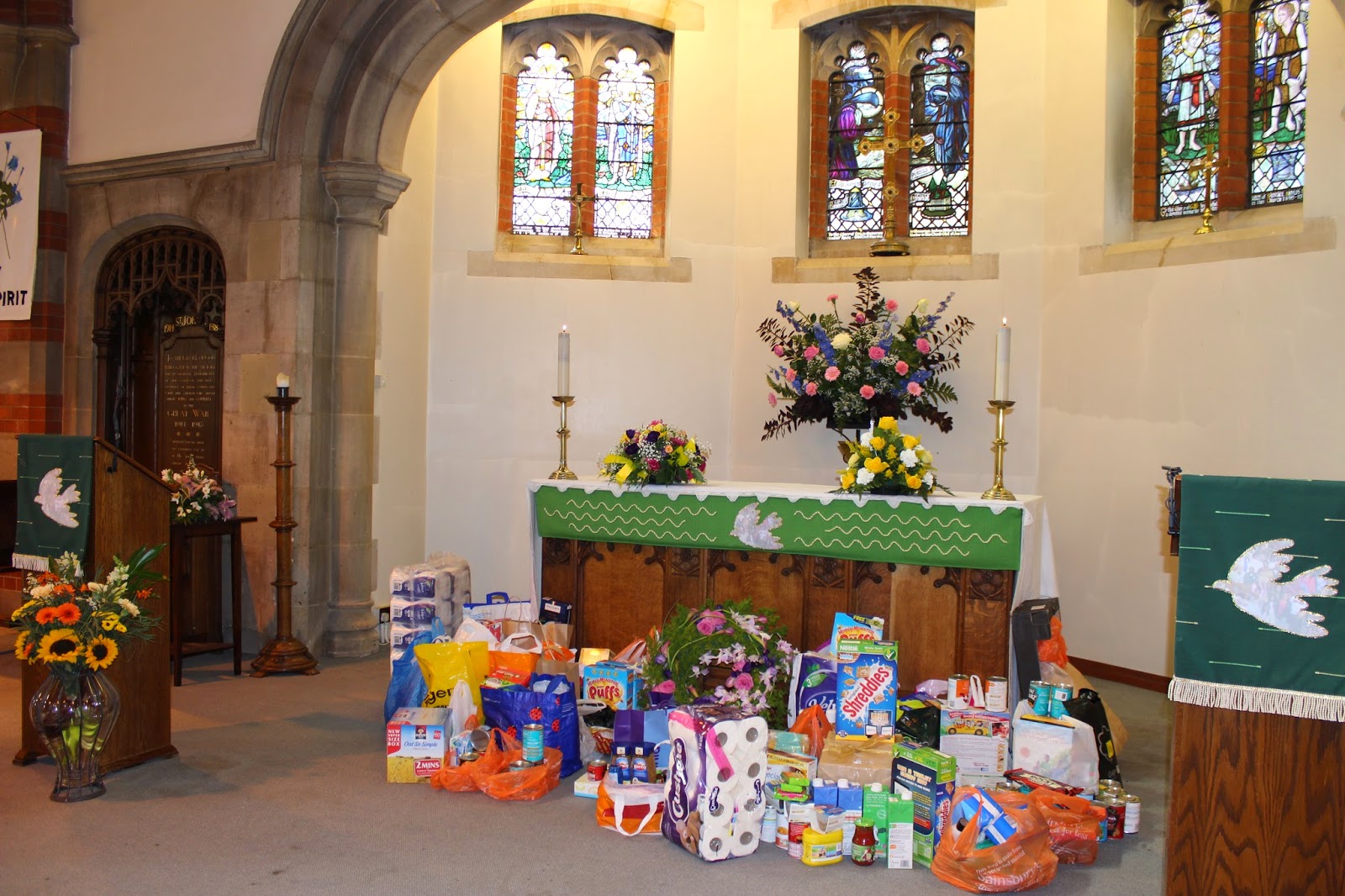
The Harvest Festival at St John's Seven Kings had the theme of 'reduce, recycle and reuse' and included our children and young people performing a poem and song as well as making a green heart sculpture using junk items. Our music group led the singing of contemporary and traditional Harvest songs in a service that also featured The Lord's Prayer being read in old English. We collected Harvest goods for the Redbridge foodbank and were thrilled with the genorosity of those who came. We explored our theme with projected information on green initiatives as well as thinking through Bible passages about reducing the yield from the harvest in order to leave grain for others (Leviticus 23. 22), recycling by remaking failed pots (Jeremiah 18. 1 - 6), and minimising waste by reusing leftover food (John 6. 12).
Reduce, re-use and re-cycle isn’t a message that is very obviously found in the Bible – certainly not as a punchy slogan! However, we’ve found three examples to share with you briefly today of those three things as found in different parts of the Bible.

Leviticus 23 v 22

We don’t often read Leviticus, as it is a book filled with rules and regulations for the People of Israel rather than stories about them. However, this passage is actually well known to because of a story found in another book of the Bible; the book of Ruth. When Ruth and Naomi return to Israel they are very poor and a local farmer, Boaz, takes pity on Ruth and allows her to do what is described in this passage; to leave the grain at the edges of the fields so that poor people like Ruth can harvest it and make food to survive. Boaz could harvest the whole of his fields and keep all the grain for himself but doesn’t. Instead he deliberately reduces what he harvests for himself in order to ensure that there is something left over for those less well off than himself. In doing so, he is following a specific instruction from God, which is not directly applicable to us today because we are not farmers harvesting fields, but can still apply if we reduce what we have for ourselves in order that we share something of what we have with others less well off than ourselves.

Jeremiah 18. 1 – 6

This is a well known passage to do with God shaping and moulding our lives. It is a passage that we often sing in church through songs like ‘Spirit of the Living God’ and ‘Jesus, you are changing me’. In the passage, God as the potter recycles the clay. When it does turn out well on the wheel, he doesn’t simply throw away the clay with which the mistake was made. Instead he reworks and recycles it turns it into something new. The green heart which our children have made today is intended to symbolise the same thing. Often things which we ordinarily throw away can be recycled, whether through the Council’s recycling service or because we turn junk into something useful. Monica Abdala, who some of you will know as heading up Redbridge Street Pastors, is currently setting up a social enterprise to make new products from old pieces of material in order to raise funds to help street girls leave the streets. By doing that, she is putting into practice what this passage teaches.

John 6. 12

One of the interesting points about the feeding of the 5,000 which we often overlook is that the disciples cleared up after the people and kept, presumably to reuse, all the leftover food – 12 baskets full. We live in a culture which is incredibly wasteful. Last year a report called ‘Waste Not, Want Not’ estimated that as much as half of all the food produced in the world – equivalent to 2bn tonnes – ends up as waste every year. Tim Fox, head of energy and environment at the Institution of Mechanical Engineers who produced the report, said: "The amount of food wasted and lost around the world is staggering. This is food that could be used to feed the world's growing population – as well as those in hunger today. It is also an unnecessary waste of the land, water and energy resources that were used in the production, processing and distribution of this food." What has to change, they said, are people's mindsets on waste in order to discourage wasteful practices by farmers, food producers, supermarkets and consumers. In this passage, we see Jesus and his disciples modelling that kind of change.

Reduce, re-use and re-cycle isn’t a slogan that is found in the Bible but it is a message that these passages from the Bible endorse and commend.

--------------------------------------------------------------------------------------

We Plough The Fields And Scatter.