




Re-reading parts of William S. Rubin’s ‘Modern Sacred Art and the Church of Assy’ (Columbia University Press, New York & London,
1961).while on my sabbatical art pilgrimage I noticed his reference to Notre-Dame-des-Alpes
in Le Fayet, a church which is very close to Assy itself. Notre-Dame-des-Alpes
was mentioned because it was the church which made the priest at Assy, Fr. Jean
Devamey, aware of Maurice Novarina as an innovative church architect. The
church has rightly been described as an essential stage in understanding the revival of sacred art in the twentieth century but is overshadowed by the fame and significance of the church at Assy. On the
ground, this is apparent through the ease with which the church of Assy can be
found compared with the relative difficulty I encountered in identifying where
the church at Le Fayet is located.
There are at least two reasons for the significance of Notre-Dame-des-Alpes;
first, the architecture of the church was the inspiration for Notre-Dame-de-Toute-Grâce
Plateau d’Assy with Novarina being the architect for both churches, while
second, the decoration of the Le Fayet church represents the first stage in the
revival of sacred art which Pére Maire-Alain Couturier sought to move beyond at
the church of Assy.
The area of Passy, Pays de Mt Blanc, has shown an openness
to contemporary sacred art which culminated in the consecration of the church
of Assy in 1950. The chapels of St. Francis de Sales Praz-Coutant (1928), the Most Holy Redeemer Guébriant (1933), St-Anselme Sancellemoz (1934), MartelJanville (1937) and the churches of St. Joseph Chedde (1934) and Notre Dame DesAlpes Le Fayet (1938) are testament to that openness and interest.
The decoration of St. Paul Grange-Canal in Geneva by Maurice Denis, Alexandre Cingria and others in 1913 – 1915 had served as a manifesto
for modern sacred art and had led on to the founding in 1919 of the Ateliers d’Art Sacré by Denis and Georges Desvallières as well the Group of St Luke and St Maurice by François Baud, Cingria, Marcel Feuillat, Marcel Poncet
and Georges de Traz. Both groups produced significant work for a significant
number of churches in subsequent years.
While these developments generally remained controversy
free, the publication of a 'Manifesto of Futurist Sacred Art' in 1931 led to a
censure from Pope Pius XI in a speech given in October 1932 at the inauguration
of a new Vatican Art Gallery. The rationalist design by Alberto Sartoris (who
had strong links to the Futurists) for Notre-Dame du Bon Conseil in the Swiss
Alps at Lourtier also created a scandal in the Swiss press in the same year.
This then was the background to the design, construction and decoration of Notre-Dame-des-Alpes from 1935 – 1938. The decoration of the
church was put out to tender in July 1936 with the competition being open to
‘French and foreign artists approved by the architect.’ The invitation to tender was addressed to French and Swiss artists of renown in the field of
religious art and the panel assessing the responses included the philosopher
Jacques Maritain, the Catholic art critic Maurice Brillant and the director of
the Ecole des Beaux Arts in Geneva Adrien Bovy.
The process and the resulting work was therefore set up to be a showcase for
the revival of sacred art in France and Switzerland during the first half of
the twentieth century in which Denis, Maritain and Cingria had played key
roles. It was this stage of the revival that Couturier challenged and sought to
move beyond in the commissioning he later undertook for Notre-Dame-de-Toute-Grâce.
With his first church at Vongy, Novarina had used the hull shape
of boats from nearby Lake Geneva to form the roof. Here his roof evokes the
double sloping roof of a local cottage or chalet (as he was to repeat at Assy)
which extends far beyond the walls in order to be ready to shrug off the
extremes of the Alpine weather. Low walls and a sweeping roof can withstand the
weight of winter snow, while ‘the sharp pitch … encourages the heavy deposits
to slide off’ and the overhanging eaves ‘protect the walls from the piling up
of drifts’. The low roof also ‘reduces the internal volume, making comfortable
heating possible’. The double sloping roof also creates, as at Vongy, a
triangular grid containing stained glass at the west end of the church. As part
of his regional style, Novarina made significant use of local materials;
granite for the walls, oak for the frame and the roof. In 1938 Couturier spoke
of this type of religious architecture which built on regional traditions as ‘a
signal example of what sacred art should be … an art common to the time and
place in which one lives’ (Modern Sacred
Art and the Church of Assy).
The low roof combined with oak carved Stations of the Cross
by Constant Demaison, located where the beams join the walls, create a Nordic
feel to the building which reminded me of Trinity Church in Arvika, Sweden,
where the wooden ceiling is painted in a Nordic ornamental style. Again, a
similar effect is also found at Assy where the same low roof is combined with
carved beams by Demaison. A self-taught sculptor, Demaison undertook many
sacred art commissions in the Haute Savoie.
Three artists from the Society of St Luke were selected for
commissions; Baud for sculptures, Cingria for stained glass and Paul Monnier
for the sanctuary mural. Other artists used included Paul Bony, Demaison and JeanHebert-Stevens.
Bony and Hebert-Stevens were both active in modernist circles of Church
decoration with Bony having created windows (later removed), with Couturier,
for Notre Dame de Paris and Hebert-Stevens being part of the L’Arche group
which was founded in 1917 and included the Benedictine architect Dom Bellot,
Fernand Py, Henri Charlier and Pauline Peugniez.
Baud’s stone reliefs on the exterior of the building depict
scenes which form transitions or show links between the prophecies and prophets
of the Old Testament (Isaiah, Moses, Daniel) and the events of the New (Joachim
and Anna, Mary’s childhood and the Annunciation). Baud’s work featured in other
churches decorated by the Group of St Luke such as Notre-Dame de l’Assomption Finhaut
where he contributed a ‘Last Supper’ carving for the communion table and a
‘Christ in Glory’ for the pulpit.
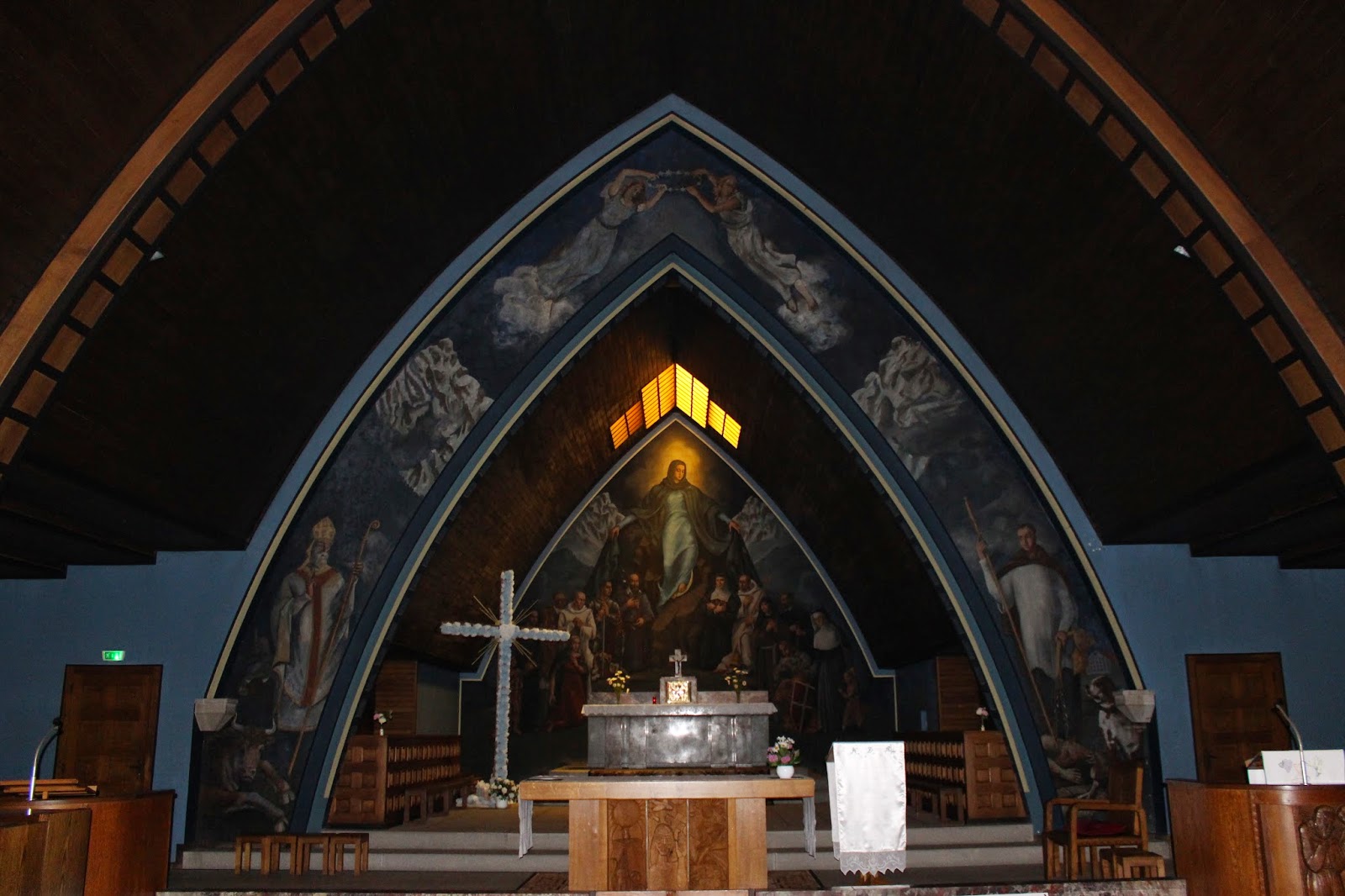
For the sanctuary fresco Monnier depicted the Assumption of
Our Lady of the Alps sheltering under her cloak the saints of Savoy. It was Gino Severini who introduced Monnier to mural painting and, as a result, he decorated many churches producing numerous mosaics, stained glass and antique glass tiles.
Novarina imposed considerable constraints (possibly related
to cost) on Cingria in relation to the windows, with 36 windows requested for
the gable of the façade, six each for both side altars and 80 in eight bays for
the nave. Cingria chose to use slab glass or dalles de verre, where thick glass
pieces are embedded in a sturdy matrix of concrete or cement. This technique was
spoken of as glass or transparent mosaics and Cingria was one of the first in
Switzerland to use this style.
For the nave Cingria used the format of three central
narrative panels in the bottom row with three equivalent symbolic panels above.
These central panels are framed by brighter, more decorative panels. The
windows above the side altars are centred on a single portrait (St. Teresa and
St. Anthony of Padua) surrounded by abstract decorative windows.
Cingria also innovated with the west window where he created
a circular ‘Eucharistic Sun’ as a counterpoint to the triangular trellis
Novarina had designed above the front porch within the frame of the pitched
roof. The Eucharistic sun appears near the top of the triangle surrounded by
its rays while the lower levels of the triangle darken into the night sky where
stars appear.
Cingria had, together with Maurice Denis, dreamed of ‘creating
a movement of rebirth of religious art in France and in all Catholic countries.’
His dream became reality through collaborations with Denis and Severini,
support from Maritain, the publication in 1917 of ‘La Décadence de l’art sacré’
which elicited considerable interest throughout Catholic intellectual and
artistic circles, and the Group of St Luke and St Maurice which he founded, and
through which he was involved in the building, restoration and decoration of
more than 70 churches in Switzerland during the interwar years. Notre Dame des
Alpes, the only church outside Switzerland decorated by the Group, represented
he culmination of this significant body of work, which was then to be
superceded by the commissioning of Couturier and the writings in ‘l’Art sacré’ of
Couturier’s colleague Pére Pie Raymond Régamey.
------------------------------------------------------------------------------
Martyn Joseph - Have An Angel Walk With Her.
Martyn Joseph - Have An Angel Walk With Her.


