Wikio - Top Blogs - Religion and belief
Showing posts with label faith craft. Show all posts

Tuesday, 24 September 2019

St Martin-in-the-Fields, HeartEdge & St Mary the Virgin Cathedral, Johannesburg (4)


Here's the sermon that I preached at The Cathedral of St Mary the Virgin, Johannesburg, for their 90th Anniversary Celebration Service:

I bring greetings and congratulations from St Martin-in-the-Fields on your 90th Anniversary. It is a joy to us that we have shared in partnership during the latter period of those 90 years and a pleasure that the partnership has been revived and renewed since Dean Xolani began his ministry here. I am thrilled personally to have this opportunity to visit and learn from you and those you have given me the opportunity to meet in Johannesburg, here at the Cathedral and in Alexandra, Sophiatown and Soweto.

For my curacy, I was at a church in East London (UK, not South Africa!) which, because of its history, was full of images of white people although it had a large black majority congregation. The historical development of the church had created a disconnect between its past heritage, which was mono-cultural, and its current congregation, which was diverse. We realised that this disconnect couldn’t continue and had to be addressed. So, we commissioned an artist to create a painting as an altarpiece in one of the side chapels and took Jesus’ post-resurrection appearance cooking breakfast for his disciples beside Lake Galilee as the image for this painting. We stipulated that Jesus should be black and his disciples’ multi-ethnic. When the image was unveiled Eileen, our black churchwarden, shed tears of joy that the diversity of our congregation was now reflected to some degree in the imagery and story of the church and that she and others from the Black and Minority Ethnic communities in that place could see themselves in the story of faith depicted within that church.

I learned that this image became a sign of the kingdom in the church and changed our culture for the better. Signs show what is in front of us, so reflect where we are and direct us somewhere else, so point us to the future. The creation of this image revealed our lack of diversity in the past and created a greater appreciation for the diversity we had found in the present. The image provided a way of affirming that such diversity is our future in God’s kingdom. Similarly, the visual art which is here in St Mary’s or which has been here over the years provides one way to tell the story of your 90 years as the Cathedral for Johannesburg, as well as indicating possible areas of development as you begin your next 90 years.

In 1936 Ernest Mancoba’s African Madonna, which is now held by the Johannesburg Art Gallery, was displayed here to raise funds for those in need in the drought-stricken Limpopo. This sculpture seems to be the earliest South African interpretation of the Holy Virgin that is not European in appearance. Unlike most church sculptures in South Africa for which imported oak or teak was favoured, Mancoba carved his figure of indigenous yellowwood. Mancoba’s ‘sculptures Africanized the prevailing Western norms of iconography and aesthetics.’ (Elza Miles)

So, here at an early stage in the life of the Cathedral was a black artist using indigenous materials to create a genuinely African image of a central figure in the Christian faith. Mancoba trained as a sculptor at the Grace Dieu Mission near Polokwane, where artists such as Gerard Sekoto and Job Kekana also trained. Grace Dieu Mission was Africa’s first modern art workshop and developed a trademark style of wood carving that won considerable critical acclaim in the 1930s and allowed the school, through commercial activity, to support and promote the first professional black artists in South Africa.

Job Kekana carved relief panels of the lives of the saints for your pulpit in the 1940s. He was a skilled sculptor who undertook all manner of carvings for churches, from pews to pulpits. He spoke of wanting his religious carvings to be ‘true’ historically, and therefore usually only depicted Biblical figures as Africans in African settings if specifically requested to do so. His relief panels here were designed by Martinus Moolman, a teacher at Grace Dieu, and depict European figures in traditional drapery. Those depicting St Ambrose, Thomas Aquinas and St Chrysostom show these saints in architectural settings which required Kekana to use elaborate perspective. So, under the influence of Grace Dieu’s teachers, Kekana’s work primarily followed the conventions of European church art.

Above the chancel steps and dominating the whole church is your famous hanging rood, an almost life-size wood-carving of the Crucifixion that was hung in 1957 as a memorial to William Palmer, Dean from 1924 to 1951. Palmer had been part of the Campaign for Right and Justice which called for full and direct representation of all sections of the community, irrespective of race. By the 1950s, the Cathedral had become one of the few racially integrated churches in downtown Johannesburg, yet it was decided that your rood should be made in England. The artist was George Baden-Beadle, who was Secretary, then Managing Director of Faith Craft; a business, set up through The Society of the Faith, that successfully and creatively produced church furnishings, vestments and other ecclesiastical artefacts from 1921 – 1972.

In this same period the artist Cecil Skotnes was employed as the cultural Recreation Officer at the Polly Street Recreational Centre here in Johannesburg. Under his guidance Polly Street came to be identified as an Art Centre and a significant training ground for a new generation of artists who were able to experiment and make work, developing and honing their skills to the point where they too were recognized as professional career artists. Skotnes was able to put the Centre and the students in touch with an array of contacts including many foreign visitors and dealers, as well as acquiring commissions from churches and the City Council. This continued until the apartheid authorities effectively shut down Polly Street. Skotnes also undertook commissions himself and, in 1983, created Stations of the Cross for this Cathedral in memory of Fr. Neville Jarvis Palmer. With his woodcuts, in particular, Skotnes is reckoned to have developed a genre and a style that was uniquely South African.

More recently the sculpture 'Sinethemba' by Chaim Stephenson was installed in 2015. This was almost twenty-one years after the arrival of democracy in South Africa and the dedication by Archbishop Desmond Tutu at St Martin-in-the-Fields of the sculpture of which 'Sinethemba' is a twin, our ‘Living South Africa Memorial’ to victims of injustice and violence. The sculptures were inspired, as you know better than I, by the iconic image of the shooting of Hector Pieterson in Soweto in 1976. Sam Wells, the vicar of St Martin’s, said, in a sermon here, that, ‘In 1976, [this] was a picture of the brutality and injustice of the apartheid regime, and the solidarity and resilience of the struggle to bring democracy and the rule of law to South Africa’. By 1994, the sculpture portrayed the burden the anti-apartheid movement had carried for so long. Then, in 2013, ‘when we at St Martin’s gathered with so many South African friends to mark the passing of Nelson Mandela, the image asked a question: Mandela had carried South Africa in his arms for so long; who would carry South Africa now?’ Now, he suggests, ‘it may be that this statue is a declaration of faith that the God who in Christ has brought forgiveness, is in the business of bringing resurrection too’. All this Christian reflection initiated by a Jewish artist was was inspired by stories from the bible, despite not practicing religion himself.

The story told by your artworks demonstrates the power that the visual arts possess in reflecting and shaping culture. Culture is a key aspect of the model of mission – culture, compassion, commerce and congregation - with which St Martin’s has worked over the past 30 years and which we have made the basis of HeartEdge, the international ecumenical movement of churches of which St Martin’s and St Mary’s are both part. That is because, as human beings made in the image of God, we are culture-making people who create communities, fashion environments and shape societies.

Our Bible readings today (Genesis 2. 4b-8, 15, 18-23; Philippians 4. 4-9; Matthew 13. 31 & 32) begin with God’s creativity in fashioning our world and our own creativity experienced because we are made in God’s image. The world that was fashioned through creativity God called good, and God gave to us, as human beings, the task of caring for and cultivating this world using our own creativity. Adam and Eve’s task of tending the garden, the primary task of agriculture, represents the beginnings of cultural life on earth.
One of the formative aspects of this creative culture-making is to name the good that we see in the created world - the creatures, people, artefacts and cultures around us - and, by naming these things, to increase our understanding of the world and cultures that we inhabit. Of course, our creative culture-making can be used both for good and ill, as you know only too well in this country. Indeed, this passage from Genesis has been used to justify the oppression of patriarchy. God’s intent, however, is that we use our creative abilities to see and name the essence of all that is around us and use that knowledge to support our mutual flourishing. St Paul, in his letter to the Philippians, revived this understanding with his injunction to look for what is true, honourable, just, pure, pleasing, commendable, excellent and praiseworthy in that which is around us. Jesus called us to use our creativity in creating signs of the kingdom of God which start small and then grow in ways that provide shelter and support to others.

So, we have been formed by God to be creative culture makers seeing and naming the good in order that we create signs of the kingdom of God. That is what you have done here over your first 90 years in creating an inclusive community that has supported social justice and engaged with culture, commerce, compassion and congregation in order to be a sign of the kingdom of God here in Johannesburg. That was what was happening when, for example, several of your deans were deported for challenging aspects of apartheid, when the first black Dean was appointed, when land and property were developed to provide financial support for the Cathedral, and when visual art was created for or brought into this space.

Your artworks are also signs of the kingdom of God as it has been expressed here in St Mary’s. Signs, as we noted earlier, show what is before us and aspects of these artworks reflect the time in which they were made and the issues current at that time. Your art is by a diverse group of artists and shows a diversity of approaches which sometimes engage with contemporary issues and sometimes seek to show that the Christian story is for all times and all cultures. In this way a diverse set of answers have emerged to the questions of who creates, what is created, and of how cultures change depending on the answers given to those questions. Similar dilemmas were also experienced in my curacy where the image of the black Christ in our Youth Chapel was created by a white artist.

So I wonder how will these same questions be answered here in the future? Who are the artists that could create images for this Cathedral in the future? What images would create signs of welcome, community and inclusion in these times of when around our world particular groups in society are being scapegoated, targeted and attacked? Many of the artworks here come from initiatives that combined culture and commerce to provide routes out of poverty and oppression. What equivalent initiatives are needed today to provide similar opportunities in different ways? Could initiatives like that be part of your plans for the Archbishop Desmond Tutu Precinct? How can we, as inclusive Christian communities, create signs of God's kingdom today in the midst of the scapegoating and violence that surrounds us?

Signs also point forward towards a place we have yet to reach. Jesus spoke about the kingdom of God as something small in the here and now which then grows to become large in the future. What are the small seeds that you can plant in the here and now that may have similar impact in the future to that which was achieved by Grace Dieu Mission, Faith Works and the Polly Street Art Centre? Each of these began as something small but grew to have significant impact.

Speaking of the need for HeartEdge as a movement for renewal in the Church, Sam Wells has said: ‘The church … has to let its financial needs and the material poverty of many it encounters become entry-points to new adventures, new relationships, new discoveries in God’s kingdom. What are needed now are communities of ordinary virtues, but ones infused with grace: thus trust, honesty, politeness, forbearance, and respect are the bedrock of such communities, while tolerance, forgiveness, reconciliation, and resilience are among its abiding graces.’ As an inclusive community with a commitment to the Arts, a commercial basis to your financial sustainability, and a compassionate commitment to engaging with the pressing issues of your time, over the past 90 years this Cathedral has been an example of the HeartEdge mission model lived out in practice. That is one of many reasons why we, at St Martin’s, are so proud to be in partnership with you and so pleased that you are using the HeartEdge framework of compassion, culture, commerce and congregation to review your current mission and ministry.

Christ calls us to create signs of the kingdom of God in each generation. Those signs cannot simply repeat what has gone before. They need to be creative re-imaginings of the kingdom for the present time? So I wonder, where are the artists, the dreamers, the ideas people and creatives in this congregation and community? Where are energy, inspiration and initiative to be found in the wider community, beyond the congregation, with which you can partner for the future?

As we look back to celebrate what this Cathedral has been and has enabled over the past 90 years, including its art and culture, we also need to look forward and take inspiration to go on new adventures, develop new relationships and make new discoveries which will enable us to be and become signs of the kingdom of God for this time and this day here in South Africa, here in Johannesburg. What are needed now are congregations that combine creativity with commercial acumen and compassion. Communities of ordinary virtues infused with grace; with trust, honesty, politeness, forbearance, and respect as their bedrock and tolerance, forgiveness, reconciliation, and resilience among their abiding graces.

Let us pray: We pray for the dreamers of this life, O God, for those persons who imagine new possibilities, who long for what others cannot perceive, who spin dreams of wonder and majesty in their minds. Defend them from ridicule and harsh criticism, from self-doubt and lack of faith in their dreams, and from abandonment of this call to make things new. Grant that from their dreams may come forth blessings for humankind to enrich the quality of life and the wonderment of us all. Amen (Ashley Marinaccio)

Click here to view the sermon.

----------------------------------------------------------------------------------------------------

Amadodana ka Eliya.

Sunday, 26 May 2019

Sabbatical Art Pilgrimage: Latest ArtWay report

My latest Church of the Month report for ArtWay focuses on churches in Little Walsingham:

'The Guild Chantry Chapel of St. Michael and the Holy Souls, designed by Laurence King in 1965, is the most modern of the worship spaces at the Anglican Shrine. The chapel has abstract glass, a crucifix carved in wood by Siegfried Pietsch, and a low-relief fibreglass sculpture by John Hayward depicting St. Michael defeating Satan. Both Pietsch and Hayward worked with the Faith Craft organization, which was based at one time in the Abbey Mill in the city of St. Albans. “For over 50 years Faith Craft artists and designers produced stained glass, vestments, statues and other carvings, liturgical furniture, sacred vessels and other ornaments for the beautification of God’s worship”.

Hayward also designed and executed the east window at St. Mary and All Saints Little Walsingham. His complex design includes saints to which the church is dedicated, other sites of pilgrimage, founders of monastic orders associated with Walsingham, the story of Walsingham, and the fire that devastated this church in 1961. The window was installed for the re-consecration of the church in 1964.'

This Church of the Month report follows on from others about Aylesford Priory, Canterbury Cathedral, Chapel of St. Thérèse of the Child Jesus and the Holy Face, Hem, Chelmsford Cathedral, Coventry Cathedral, Église de Saint-Paul à Grange-Canal, Eton College Chapel, Lumen, Notre Dame du Léman, Notre-Dame de Toute Grâce, Plateau d’Assy,Romont, Sint Martinuskerk Latem, St Aidan of Lindisfarne, St Alban Romford, St. Andrew Bobola Polish RC Church, St. Margaret’s Church, Ditchling, and Ditchling Museum of Art + Craft, St Mary the Virgin, Downe, and St Paul Goodmayes, as well as earlier reports of visits to sites associated with Marian Bohusz-Szyszko, Marc Chagall, Jean Cocteau, Antoni Gaudi and Henri Matisse.

-------------------------------------------------------------------------------------------------

Van Morrison - Hymns To The Silence. 

Tuesday, 19 January 2016

Sabbatical Art Pilgrimage: Latest ArtWay report

My latest Church of the Month report for ArtWay focuses on St Paul's Goodmayes. 

'St. Paul’s Goodmayes has been a prolific and generous patron of the arts. It contains a vast array of artwork reflecting the movement in church art from the medievalism of the Arts and Crafts movement through the angular, Cubist influences of Leonard Evetts to the semiabstract work of contemporary artist Henry Shelton, as well as a range of materials, including stained glass, silver, brass, copper, stone, wood, oil, watercolors, wrought iron, gilding, and ceramics. Contributing studios include Fullers, Morris & Co., Whitefriars, and the Faith Craft Company, with designs from artists such as Sir Edward Burne-Jones, J. H. Dearle, Leonard Evetts, Alfred Fisher, Jane Quail, and Henry Shelton..'

This Church of the Month report follows on from others about Aylesford Priory, Canterbury Cathedral, Chapel of St. Thérèse of the Child Jesus and the Holy Face, Hem, Chelmsford Cathedral, Église de Saint-Paul à Grange-Canal, Lumen, Notre Dame du Léman, Notre-Dame de Toute Grâce, Plateau d’Assy,Romont, Sint Martinuskerk Latem, St Aidan of Lindisfarne, St Alban Romford, St. Andrew Bobola Polish RC Church and St Mary the Virgin, Downe, as well as earlier reports of visits to sites associated with Marian Bohusz-Szyszko, Marc Chagall, Jean Cocteau, Antoni Gaudi and Henri Matisse.

--------------------------------------------------------------------------------------

Leonard Cohen and The Webb Sisters - If it Be Your Will.

Wednesday, 21 January 2015

Sabbatical art pilgrimage: St Paul's Goodmayes


From 1898–9 local developer Cameron Corbett laid out an estate of good quality houses that clerks and lower grade civil servants could afford. As a result, this development in Seven Kings extending to Goodmayes has been called “the town built in a year.” Corbett added the Mayfield estate to the south and Downshall to the north meaning that the area quickly had 10,000 inhabitants (http://hidden-london.com/gazetteer/seven-kings/).

Several churches were built as a result including St Paul’s Goodmayes built in response to the development of the Mayfield Estate. When the decision was made, in 1901, to build St Paul’s this estate had 420 houses, built in the preceding eighteen months, 300 of which were occupied, representing perhaps 1,500 people. More were to be built on the south side of the railway line, meaning that a clear need for a church was established.

The Church which was built is in the style of Gothic architecture, that had been popularised by A.W.N. Pugin and which characterised church building by the Arts & Crafts Movement. The materials used are red brick with stone dressing. Messrs. Chancellor & Son of Chelmsford and London were the architects and the contractors for the first portion of the building were Messrs. Brown & Son of Braintree. The building was completed by additions in 1905, 1917 and 1929. The completed church was consecrated by the Lord Bishop of Chelmsford, The Right Reverend John Edwin on Thursday 22nd March 1917, when St Paul's became the independent parish church of Goodmayes.

St Paul’s Goodmayes has been a prolific and generous patron of the arts since the church was originally built and now has a vast array of artwork reflecting the movement in Church Art from the medievalism of the Arts & Crafts Movement through the angular, cubist influences of Leonard Evetts to the semi-abstract work of contemporary artist Henry Shelton. The materials used include stained glass, silver, brass, copper, oil on canvas, watercolour, carvings (in both stone and wood), wrought iron work, gilding work and ceramics. There is work from the studios of Fullers, Morris & Co., Whitefriars and the Faith Craft Company, with designs from artists such as Sir Edward Burne-Jones, J.H. Dearle, Evetts, Alfred Fisher, Jane Quail, and Shelton.

The Church website documents the many commissions revealing the value of memorial bequests for the commissioning of much Church Art. The first stained-glass in St. Paul`s was the East Window of the Lady Chapel which was made by the Fullers Studio (by which the work of Geoffrey Fuller Webb may be indicated). At the end of July 1944, this window was almost completely destroyed by a flying bomb, leaving only the tracery (small upper windows) intact. These show the Arms of Canterbury and Chelmsford, flanked by St. Paul, the Patron of the church and St. Cedd the 7th century missionary Bishop in Essex.

The original main lights of the window showed Our Lady and the Infant Christ, flanked by Wise Men and Shepherds. The replacement, from 1957, is an entirely new design depicting the same scene. The three lights now show Our Lady and the Infant Christ with the kings and shepherds to left and right respectively. The replacement window came from the Whitefriars Studio and contains their mark, a White Friar, in the bottom right-hand corner, while the artist has signed it off with his normal signature, the trilby he wore in his workshop.

Like the Lady Chapel window the East Window was severely damaged in July 1944 by a flying bomb landing on the East side of the church: only one-seventh of the original remained, (to judge by the insurance valuation before and after). The original had been donated by Leonard Randall, a generous benefactor of St. Paul`s, and had been dedicated on 15th September 1929. A design by Sir Edward Burne-Jones was used for this window which was created and installed twice by Morris & Co., firstly in 1929 and again in 1954.

As Morris & Co. note on their website (https://www.william-morris.co.uk/), William Morris is regarded as the greatest designer and one of the most outstanding figures of the Arts & Crafts Movement: ‘In 1861, with a group of friends, he started the decorating business Morris, Marshall, Faulkner & Co. which provided beautiful, hand-crafted products and furnishings for the home. This was highly controversial at the time as it denounced the ‘progress’ of the machine age by rejecting unnecessary mechanical intervention. Influenced by the ideas and writings of Thomas Carlyle and John Ruskin, who sought to re-dress class inequality and improve society by reinstating the values of the past, Morris was motivated by the desire to provide affordable ‘art for all.’

Driven by his boundless enthusiasm, the output of the company was prolific and encompassed all the decorative arts. He is perhaps best known for his wallpaper and fabric designs but he also designed and made embroideries, tapestries and stained-glass, reviving many of the traditional arts which had been swept away by industrialisation. Before he mastered each craft, he learnt every stage of the hand making process and understood his materials thoroughly so that he could get the best results and teach others.’

Burne-Jones became the chief designer of stained glass (creating over 100 drawings throughout his lifetime) and a separate area at Merton Abbey, where Morris’ workshops were located from 1881 onwards, was allocated to his glass workshops. Morris & Co. dominated British stained glass production during the 1870s and 1880s.

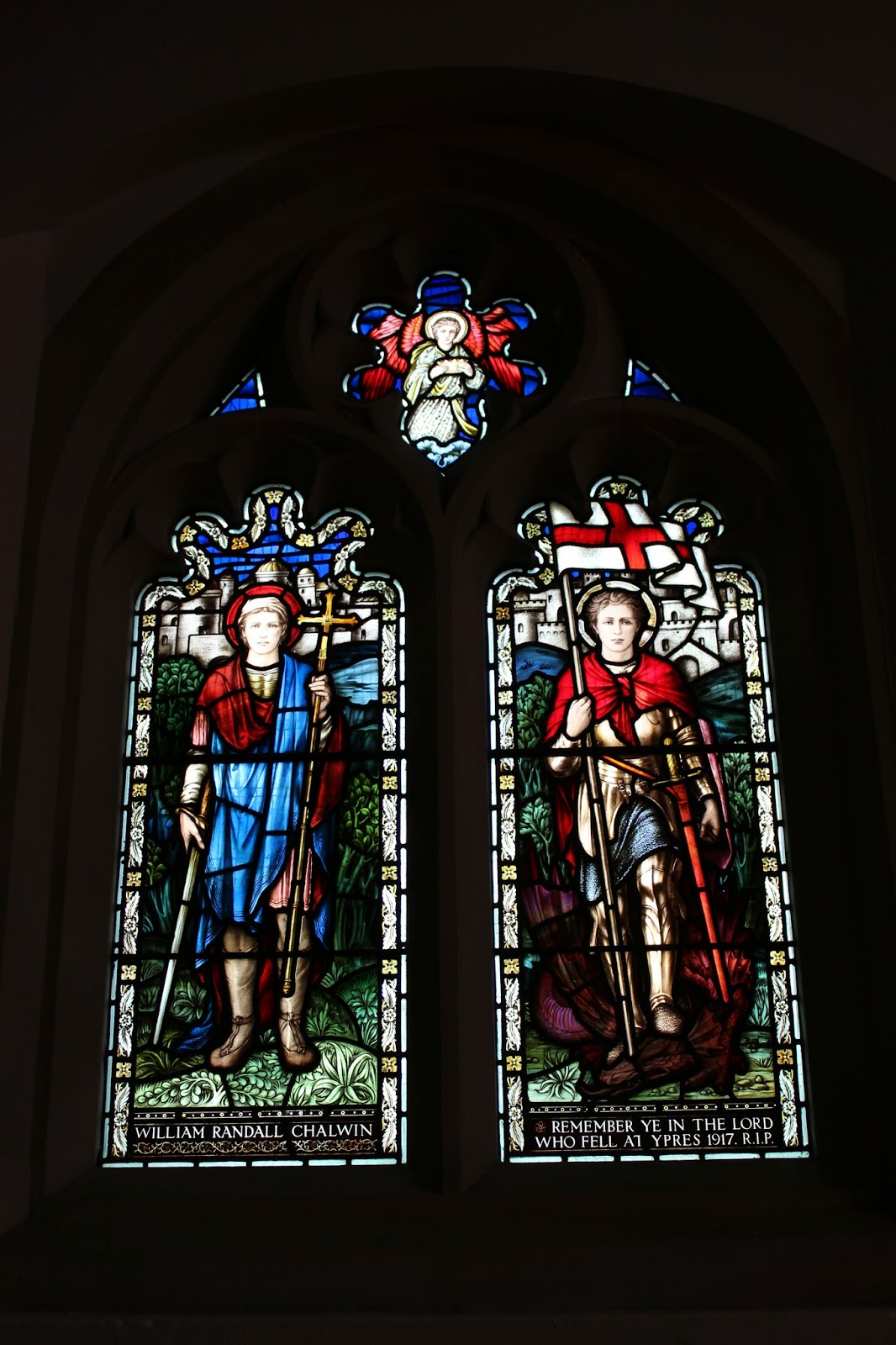
The St. Alban and St. George window was donated by Leonard Randall in 1929 in memory of his nephew killed in World War I, and had been installed at the same time as the East Window. Also made by Morris & Co., this window was not a 19th century Burne-Jones design but instead a contemporary design by J.H. Dearle, who was then designing for the firm. Dearle also designed the figure of St. Peter for another West end window installed in 1933, which was complemented by a figure of St. Paul to a design by Burne-Jones. 

In between these two smaller windows is the main West Window which was made, like the previous ones, by Morris & Co (again from a design by Burne-Jones) and was dedicated on 18th December 1932. Leonard Randall, the donor of several earlier windows, died in 1932 leaving a large sum to St. Paul`s, including £400 for a window in the new Baptistry, which had been built into the West End of the church in 1929. The window depicts a well-known scene from the Gospels, where women were bringing their children to Jesus and He was blessing them. The text below (Luke 18.16) reads: ‘Suffer little children to come unto Me.’

The last of the Morris & Co. windows in St. Paul`s depicts David and Jonathan and was designed (in a rather different style from the others) by D.W.Dearle (not J. H.). This window cost £96.15s. in memory of Mr. A. E. Godfrey, and was dedicated on 4th September 1949. Today it is the ‘odd-man-out’ in the Lady Chapel as the three surrounding windows all feature Our Lady and the events of Christ`s birth. In 1949, however, it was the only stained-glass in the Chapel, (apart from the tracery over the East Window); the rest being added later. 

The surrounding windows are the most recent at St Paul’s being created in 1975 and 1980 by the prolific stained glass artist, Leonard Evetts. On 1st June 1973 Walter Tolbart died leaving a substantial bequest to the Church. He had expressed a wish that part of this money should be used for a proposed window and approaches were made to various artists, as a result, in 1974. Finally, in April 1975, the PCC approved a design by Leonard Evetts, depicting the Annunciation; and the window was dedicated in memory of both Doreen and Walter Tolbart on 30th November of that year.

In the left-hand light, the archangel Gabriel “is drawn to give the impression that on wing he has silently entered the drama, barely touching the earth” to quote the artist`s own account. Our Lady is depicted on the right; she wears the traditional blue robe, which is decorated with a Madonna Lily. Gabriel`s salutation is written across the centre in Latin: ‘Ave Maria, gratia plena, Dominus tecum’ – Hail Mary, full of grace, the Lord is with thee.’ Gabriel went on to say that Mary would conceive by the Holy Spirit, and the Spirit appears in symbolic form represented by a Dove in the tracery, from where shafts of light can be seen descending onto the figure of our Lady.

Then, when Miss Norah Sherren died on 17th March 1977 at the age of 82, she was described as ‘the senior member of the congregation’, having been present at the laying of the Foundation Stone of St. Paul`s. Miss Sherren left a considerable sum to the Church, including £1,000 for a memorial window. This forms a pair with the Annunciation Window: both being designed by Leonard Evetts, and with the new window telling the next episode in the life of Our Lady.

Immediately after the Annunciation, Mary spent three months at the home of her cousin Elizabeth, soon to be the mother of John the Baptist, and the two women rejoiced together over the sons they were to bear; Mary`s words of celebration included the ‘Magnificat’. This story, generally called the ‘Visitation’, took place in the hill-country of Judea, which is represented by the rocky scenery in the background of the window. Elizabeth is shown on the left, Mary on the right – notice the blue robe and lilies once again. As with the Annunciation Window, Evett’s signature is just visible: ‘L.C. Evetts fecit. 1980.’ The window was installed and dedicated on the Feast of Christ the King, 26th October 1980, and was the last stained glass window to be installed in St Paul's to date.

Prior to the Evetts’ windows two other modern windows had been commissioned. The Jesus the Carpenter Window was made by the Faith Craft Company, and was installed in 1963. The Faith Craft Company was a studio set up through the Society of the Faith, which grew from vestment manufacture to encompass various aspects of church furniture such as joinery, stained glass and statues. The Company was in operation from 1921 to 1972.

The centre section of the window shows Jesus in the carpenter`s shop at Nazareth, surrounded by the tools of His trade. On the left, there is a roundel depicting the Sower (the subject of our Lord`s famous parable); while a similar roundel on the right shows St. Paul working as a tentmaker. This unusual combination of images commemorates the longest-serving Churchwarden of St. Paul`s, Foster Threadgold, who had died at the beginning of 1959, in his 29th year of office. Well over 100 people contributed towards the memorial which was located on the North side of the Church, as near as possible to the churchwarden`s seat which he had occupied for so many years.

Finally, the St. Timothy Window comes from the Whitefriars Studio and the hand of Alfred Fisher.
The Whitefriars Company was a successful British glasshouse closely associated with leading architects and designers from the later portion of the 19th century onwards including Philip Webb who designed glass for Morris & Co.

This is a lovely bright window with vivid colours achieved by the use of hand-made ‘Norman slab’ glass, which retains its lustre even in dull conditions. The window shows Timothy as a youthful figure, staff in hand, presumably engaged on some missionary journey. In the two small tracery lights above, there are symbols of the activities for which Frank Hills, in whose memory the window was given, is remembered: he was a member of the Choir for some 40 years, which explains the page of music, and the words ‘O Sing unto the Lord’; he was also at one point Churchwarden here and was also involved in the Scout Movement – hence the Churchwarden`s staff and the Scout emblem. But the words ‘Honour thy God’ have a double significance: as well as being appropriate to Frank Hills’ life, they are also a play on the name ‘Timothy’, which is derived from two Greek words meaning ‘honour’ and ‘God’.

Fr. Benjamin Rutt-Field, who oversaw the addition to St Paul's Goodmayes of a Madonna and Child by the contemporary Roman Catholic sculptor Jane Quail and Shelton’s Stations of the Crown of Thorns has said that all too “often people walk past churches and think it is just a plain building - they aren't aware of the beauty inside.”

It was Fr Rutt-Field’s belief that “for Christian art to have any significance and empathy it must be Spirit-driven, Spirit-imprinted; it should stimulate both our imaginations and our prayers.” With this in mind, he wrote an original set of meditations to accompany the new set of
Stations of the Cross commissioned from noted religious artist, Henry Shelton, through commission4mission.

The seed for this commission was sown by an elderly parishioner who gifted a generous sum for a new set of Stations and whose memory lives on in the dedication of the tryptich, incorporating Stations XI, XII and XIII, which, as altarpiece, forms the central focus of the scheme. This tryptich has inventively incorporated an existing metal crucifix into its design to form Station XII; 'Jesus dies on the cross'. There are 15 paintings in all, as the scheme includes a resurrection 'Station' depicting Christ present in the Eucharistic elements.

These, though, are not the only unusual elements of these Stations, in that, as part of its semi-abstract imagery, Christ is depicted throughout only by the Crown of Thorns. Fr. Rutt-Field notes that, “these Stations are known as the ‘Crown of Thorns’, rather than ‘The Cross’, because Jesus is depicted in each one as a simple, humble crown of thorns.”

Shelton says of his semi-abstract style and minimal flowing lines, that, “as I’ve got older I’ve learnt that ‘less is more’ and through the development of my work I’ve learnt to express emotion in a semi-abstract form.” This is why he paints; “it all goes back to feeling; the pathos of suffering.”

The power of art to evoke emotion is what originally inspired Shelton and which has sustained his work throughout his career: “When I first saw the great 
Rembrandt’s in the Rijksmuseum in Amsterdam, the power of his images seemed to transcend time. The same thing attracted me to Christian Art as a choirboy at All Saints West Ham; the art spoke to me. I used to look at the altar and see images that were just so powerful. The images seemed to bring the past into the present and to form a profound link with the lineage of the past. I see myself as an artist trying in my small way to continue that lineage and my passion as a Christian artist is to keep that lineage alive in my generation as a witness.”

However, as an artist who often paints with the tones and harmonies of the Dutch Masters, this commission represents a considerable lightening of Shelton’s palette in order that the colour scheme of these 'Stations' harmonizes with the existing stained glass. At St Paul’s Goodmayes, Shelton's 'Stations' complement the existing works to create a feast of visual art for worshipper and visitor alike.

The commission was only the second to be completed by commission4mission, of which Shelton is both a founder member and the current Chairman. Shelton says, of commission4mission, “I want us to be offering quality work and craftsmanship, rather than mass-produced work, to continue the legacy of the Church as a great commissioner of art. The Church has, in fact, commissioned some of the greatest works of art ever produced.”

To have his work in churches, Shelton says, “really is the fulfilment of my life’s work.” He doesn’t have much ambition to show in galleries and says that, “the whole point for me is to create reaction and engage people; for people to enjoy and be moved by my work, just as I’ve been engaged by the work of other artists.”

His most recent pictures have all come to him in prayer as he has been meditating on particular Bible passages. Most of his work now comes through a meditational process and it is, perhaps, this quality of Shelton’s work to which Fr. Rutt-Field is responding when he says: “I firmly believe that these new Stations of the Crown of Thorns, painted by a deeply committed Christian artist, are indeed both Spirit-driven and Spirit imprinted. They will greatly enhance and beautify the simple form and architectural lines of our parish church, as well as our worship.”

As St Paul’s Goodmayes is a neighbouring parish to my own, I have had the opportunity to undertake ministry in partnership with Fr Rutt-Field and his congregation which has often made significant use of art and the artworks at St Paul’s Goodmayes. Art competitions and workshops have led to exhibitions timed to feature as part of community festivals, while the local cluster of Anglican churches created an Art Trail with a route for visiting each church in turn and highlighting artworks of interest in the four churches. The creation of the Art Trail was a recommendation in the report produced following a
Community Street Audit of Aldborough Road South by the Seven Kings & Newbury Park Resident's Association and the Fitter for Walking project of Living Streets. Printing of the Art Trail leaflets was funded by Living Streets as part of the Fitter for Walking project and copies of the leaflets can now be found in the four churches. Fitter for Walking helped residents create streets they can be proud of and was funded by the Big Lottery Fund, along with contributions from local authorities, to work in five areas of England.

Churches have for many years been significant patrons of the visual arts and contain important and interesting works of art. The local Anglican churches in Aldborough Hatch, Goodmayes and Seven Kings are no exception with works of art by excellent local and national artists from the 19th, 20th and 21st centuries. The significant works of art in these churches, taken collectively, represent a major contribution to the legacy of the church as an important commissioner of art. The rich and diverse range of work found at St Paul’s Goodmayes provides a demonstration of ways in which the visual arts enhance worship and mission. The story of their commissions reveals the significance of memorial donations and the journey that Church commissions made in the twentieth century from the medievalism of the Arts & Crafts movement to the semi-abstract styles of contemporary artists.  

-----------------------------------------------------------------------------------------

Larry Norman - Country Church, Country People.

Monday, 11 August 2014

Sabbatical art pilgrimage: Walsingham


The Anglican Shrine of Our Lady of Walsingham ‘occupies an island site in Walsingham, close to the ruins of the original medieval Priory.’ The present-day Shrine ‘was gradually created in 1931 from derelict farm buildings and cottages, with a brand new Shrine Church in the south-east corner of the site.’ The Shrine, established by Fr. Alfred Hope Patten, has continued to be developed with modern accommodation blocks, refectory, visitors centre, gardens and chapels.

Jane Quail's beautiful Stations of the Cross based on the Beatitudes were installed in the grounds in 2001 and are much loved by pilgrims. As with the Stations of the Cross by Irene Ogden at St Julian's Church in Norwich, this imaginative artwork makes creative textual and visual connections between the events of the 14 Stations and scriptures not normally associated with those events. These are artworks which integrate scriptures creating a harmonious whole and opening up the scriptures to other interpretations and connections.

Quail is a sculptor in wood and stone who was born in India, where she admired a great deal of sculpture at an early age. She attended an art course in Durban, Natal, and then worked for a time with Canon Ned Paterson, founder of the Cyrene Mission School in Zimbabwe where he taught painting and sculpture. Sharing a studio with her husband Paul Quail, her ecclesiastical work began in earnest in the early 1980s. She has carved figures or relief panels in stone and wood for many churches throughout the British Isles and also for churches abroad. Among these commissions are reliefs for the fountain of the Roman Catholic Shrine at Walsingham and sculptures at St Margaret Cley and St Paul Goodmayes.

The Guild Chantry Chapel of St Michael and the Holy Souls, designed by Laurence King in 1965, is the most modern of the worship spaces at the Anglican Shrine. The chapel has abstract glass, a crucifix carved in wood by Siegfried Pietsch and a low relief fibre-glass sculpture by John Hayward depicting St Michael defeating Satan. Both worked with the Faith Craft organisation, which was based at one time in the Abbey Mill in St. Albans. ‘For over 50 years Faith Craft artists and designers produced stained glass, vestments, statues and other carvings, liturgical furniture, sacred vessels and other ornaments for the beautification of God’s worship.’


Hayward also designed and executed the east window at St Mary and All Saints Little Walsingham. His complex design includes saints to which the church is dedicated, other sites of pilgrimage, founders of monastic orders associated with Walsingham, the story of Walsingham and the fire which in 1961 devastated this church. The window was installed for the re-consecration of the church in 1964.

Hayward is famous for his distinctive stained glass windows such as the Great West Window in Sherborne Abbey, Dorset, and the Millennium Windows at Norwich Cathedral. In the early 1960s, however, he was interested in creating ‘whole interiors’ of church, including wall paintings, furnishings and stained glass. St. Michael’s London Fields is a good example of a church where Hayward had the opportunity to do this. His art is integral to the fabric of the building in the basilican style, and includes the Apostles’ Windows on the east side of the church, nine murals depicting scenes of the ministry of angels throughout the Bible, an aluminium sculpture of St. Michael slaying the dragon at the entrance of the church and the Christus Rex hanging over the altar. Like Nugent F. Cachmaille-Day, he drew inspiration from the Liturgical Movement, believing that art could be the ‘handmaid of liturgy’.

Following exhibitions in the church and with the support of Art in Churches, three works of contemporary art were added to the church (all grouped at the entrance to the Lady Chapel) between 1985 and 1988. 'Spring Carpet' is a painting by John Riches who derives from Norwich returning in 1972 to teach at the Norwich School of Art. His interest in church iconography and mediaeval decoration has strongly influenced his later work. 'Spring Carpet' speaks of new life by means of light filtered through branches speckling the earth which harbours the new buds of life. 'Genesis' is a sculpture in resin bronze by Naomi Blake which is dedicated to the sanctity of life and depicts a mother and child. Blake is a Jewish sculptor, born in Czechoslovakia, whose work can also be seen at Bristol and Norwich Cathedrals. Ruth Duckworth's untitled ceramic relief was installed in 1988 with the support of Art in Churches. The coloured folds which emerge from the alcove in two distinct sections suggest, on some interpretations, this present life and that to come.


The Roman Catholic Church of the Annunciation is a beautiful new church in the Norfolk round tower tradition, which was designed by local architect and parishioner, Anthony Rossi. It is the first carbon-neutral church in the UK being built with solar panels for electricity and a deep-bore heat exchange system. Located within the heart of historic Walsingham, it was dedicated on the Feast of the Annunciation in 2007. This ‘new church has taken traditional forms and materials and repackaged them in a fresh and innovative way to create a locally distinctive building’.

‘The west and east windows have simple patterns of leads of varying widths, with accents of colour produced by handmade glass. They were designed by the architect and made by M C Lead Glaziers from near Norwich. The same firm fitted the dominant north window designed and made by the artist Paul San Casciani of Oxford. Hung against it is a powerful bronze corpus of the dead Christ by the artist Mark Coreth from near Salisbury. Other decorative glass in the aumbry, font and entrance screen is by Jane Charles of Newcastle, supplied through the Bircham Gallery at Holt.’

‘Best known for his wonderful portrayal of the wildlife of Africa Mark Coreth has that rare ability to capture the unique wild spirit of a creature without descending to kitsch. He is self taught, relying on his very perceptive eye and instinctive understanding of animals.’ Jane Charles is one of the leading contemporary glassmakers in the UK. 'Her inspiration comes from working with molten glass together with the shapes, colours and moods of the natural world.' Paul San Casciani is a specialist glass painter who has worked on commissions for notable buildings such as Liverpool's Anglican Cathedral and who likes to explore the decorative possibilities of stained glass, combining traditional and modern techniques in novel ways. While at the Whitefriars Studio, he worked with Ervin Bossanyi. His book, The Technique of Decorative Stained Glass, is a project-based guide and reference explains traditional and modern techniques of stained glass.

‘The combination of the powerful sculpture of the dead Christ and the light radiating from the centre of the window is designed to represent Christ’s crucifixion followed by his Resurrection, and the redemption and transfiguration of the human race through Christ’s sacrifice on Calvary. The design is based on the early Christian sign of the fish. The hill of Calvary is represented by the green tones at the base of the window and the red areas, with enlarged blood corpuscles, represent Christ’s Precious Blood. The deep blue glass suggests the darkened sky of Good Friday being dispersed by the radiating light of the Resurrection.

The sculptor wished to show Christ at the point of death and the wound in His side, which followed His death, is therefore omitted. The figure was initially modeled in clay and subsequently cast in bronze, and was exhibited in London with other sculptures by the same artist before being brought to Walsingham and installed in the church’ (Parish Guide).


Finally, ‘the inspiration for establishing an Orthodox church presence in Walsingham began with the building of the Anglican Shrine in 1931. Inspired by one of the Guardians of the Shrine, Fr Hope Patten invited the Orthodox to take part in the venture. Archbishop Seraphim of the Russian Orthodox Church in Exile in Paris came to bless a plot of land to the south of the restored Holy House, with the intention of building an Orthodox chapel.

Though this plan was never carried out, a small Orthodox chapel was included in the Shrine, furnished with an icon screen and all the features necessary for Orthodox worship. In 1966 the Administrator of the Shrine asked the Orthodox to take responsibility for the care of the chapel. A missionary Brotherhood of St Seraphim was formed to establish a permanent presence in Walsingham. Its task was to include iconography, printing English texts of Orthodox services, missionary activity, and work with the poor and homeless.  From here, the Orthodox presence really took off .'

‘St. Seraphim’s story really begins in 1966 when Fr. Mark (later to become Fr. David) and Leon Liddament came to Walsingham as part of the newly formed Brotherhood of St. Seraphim. Their role at the time was to look after the little Orthodox Chapel that had been built in the Anglican Shrine; however, they soon felt that the local Orthodox needed a larger church. Looking around, the only buildings that were available at the time were the old prison and the old railway station. Finding the station a better option, they set about converting the building to its current form, which, as the building was being rented from the council, left it practically the same as the railway days with the addition of an onion dome and cross. While in the beginning they had planned to live and work in the rooms adjoining the chapel, events led to the establishment of a monastery in Dunton and a parish church in Great Walsingham, the Church of the Holy Transfiguration. However, St. Seraphim’s has remained a pilgrim chapel open to all who visit Walsingham since its establishment. St. Seraphim’s Trust was formed in 2005 and the building was finally purchased in 2008. Throughout its history, St. Seraphim’s has been a centre for the creation of Orthodox Icons with both Leon and Fr. David earning their livings as full time iconographers. While both have sadly passed away, Fr. David in 1993 and Leon in 2010, the Trust aims to build on their legacy and make St. Seraphim’s a space for the study and practice of iconography once again, reflecting the life and work of St Seraphim of Sarov through publications, literature and icons.

The next part of the project will involve informing people about the role of icons in Orthodox worship, private prayer and the traditional methods for their creation. As an important part of Walsingham’s history the station platform will be restored and the Chapel garden is being developed as a community garden. This will be a natural space to complement the spirituality of the Chapel and provide a calming and natural reflective space for use by pilgrims and the whole community locally.

Both iconographers used traditional methods of egg tempera painting and developed their own distinct styles. They drew their inspiration from both Greek and Russian sources, as well as Celtic ornamentation. This allowed them to develop an iconography which satisfied their own simple spirituality as well as those who bought their icons. The commitment of Leon Liddament and Father David  to painting Icons of local and British Saints is of particular importance, and their Icons can be found all over the world as well as the British Isles’.

‘The icon of our Lord in Glory, commissioned by St John the Divine Church, Kennington, London, is an example of a commission carried out by the Walsingham iconographers.’

‘The current icon screen (Iconostasis) in St Seraphim’s Chapel dates from 1975. On the right of the Royal Doors is the icon of Christ and on the left is the Mother of God. The Evangelists, Matthew, Mark, Luke and John are on the Royal Doors, below the Annunciation. The screen separates the altar, where the priest serves, from the people in the chapel.

At the top of the screen below the Cross is the last Supper. St Seraphim, Patron Saint of the Chapel, is on the right side of the screen and St Nicholas is on the left. In the centre of the ceiling under the dome is Christ Pantocrator, the Heavenly, looking down on he people. The icons of the Saints around the wall are venerated by the people.

The blessing prayer for an icon is: ‘O Lord God, You created man in Your image, but the Fall darkened its brilliance. By the incarnation of Your Christ become Man, You restored the image and thus re-established Your Saints in their first dignity. In venerating Your Saints we venerate Your image and likeness. Through them, we glorify You as their archetype’ (Praying with Icons, St Seraphim’s Trust & Norwich Cathedral, 2014).  

------------------------------------------------------------------------------

Fr. Wealands Bell - Annunciation Ballad.