Wikio - Top Blogs - Religion and belief
Showing posts with label carmelites. Show all posts

Tuesday, 14 July 2015

Start:Stop - We can do little things for God


Start your day by stopping to reflect for 10 minutes. Every Tuesday morning there is a rolling programme of work-based reflections at St Stephen Walbrook (39 Walbrook, London EC4N 8BN). Every 15 minutes between 7.30am and 9.15am, a 10 minute session of reflection begins. These sessions include bible passages, meditations, music, prayers, readings and silence. Drop in on your way into work to start your day by stopping to reflect for 10 minutes.

Here is today's reflection:

Bible reading

‘Rejoice always, pray without ceasing, give thanks in all circumstances; for this is the will of God in Christ Jesus for you.’ (1 Thessalonians 5:16-18)

Meditation

Brother Lawrence was a member of the Carmelite Order in France during the 17th Century. He spent most of his life in the kitchen or mending shoes, but became a great spiritual guide. He saw God in the mundane tasks he carried out in the priory kitchen. Daily life for him was an ongoing conversation with God. He wrote: 'we need only to recognize God intimately present with us, to address ourselves to Him every moment.'

Brother Lawrence said:

‘Men invent means and methods of coming at God's love, they learn rules and set up devices to remind them of that love, and it seems like a world of trouble to bring oneself into the consciousness of God's presence. Yet it might be so simple. Is it not quicker and easier just to do our common business wholly for the love of him?’

‘The time of business does not with me differ from the time of prayer; and in the noise and clatter of my kitchen, while several persons are at the same time calling for different things, I possess God in as great tranquillity as if I were upon my knees at the blessed sacrament.’

‘Nor is it needful that we should have great things to do. . . We can do little things for God; I turn the cake that is frying on the pan for love of him, and that done, if there is nothing else to call me, I prostrate myself in worship before him, who has given me grace to work; afterwards I rise happier than a king. It is enough for me to pick up but a straw from the ground for the love of God.’

'We ought not to be weary of doing little things for the love of God, who regards not the greatness of the work, but the love with which it is performed.'

George Herbert’s poem ‘The Elixir’ (also sung as the hymn ‘Teach me my God and king in all things thee to see’) teaches us that, with these attitudes, drudgery is made divine. A servant who sweeps a room for love of God ‘makes that and the action fine.’ He claims that this attitude and approach:

‘is the famous stone
That turneth all to gold:
For that which God doth touch and own
Cannot for less be told.’

Prayer
Lord God, steer us away from means, methods, rules and devices for reminding us of Your love and presence with us. Instead, give us a simple desire to do our common business wholly for love of You.

Bring us into a consciousness of Your presence, as we do our common business wholly for the love of You.

May we see that times of business need not differ from times of prayer, as we need only to recognize God intimately present with us to address ourselves to Him every moment.

Bring us into a consciousness of Your presence, as we do our common business wholly for the love of You.

May we not become weary of doing little things for the love of You, recognizing that You regard not the greatness of the work, but the love with which it is performed.

Bring us into a consciousness of Your presence, as we do our common business wholly for the love of You.

Teach us to see You in all things, give thanks in all circumstances and rejoice at all times, as we pray constantly through the actions of our common business.

Bring us into a consciousness of Your presence, as we do our common business wholly for the love of You.

Rejoicing always, praying without ceasing, giving thanks in all circumstances. Doing little things and our common business for love of God. Recognising God in every moment and seeing Him in all things. May those blessings of God, Father, Son and Holy Spirit, rest upon us and remain with us always. Amen.

--------------------------------------------------------------------------------------------------

Monday, 24 November 2014

East London Three Faiths Forum Tour of the Holy Land: Day 6 (1)


During our visit to Mount Carmel I shared the following with the East London Three Faiths Forum group:

The Carmelite Order was founded by St Berthold in Palestine around 1154. Hermits, following the example of Elijah, adopted a solitary lifestyle on Mount Carmel. They lived in small cells near the spring called Elijah's fountain and practised shared solitude. After 1206 they asked the Patriarch of Jerusalem to draw up their way of life in a rule. This directs that they celebrate the eucharist daily and gather weekly to encourage and correct each other. Soon after they received their rule Jerusalem fell and they migrated to the West settling in Sicily, Italy, Spain, France and England.

Elijah was an inspiration to them as he was solitary figure on Mount Carmel, who challenged his people to chose one God. Elijah heard God as an unexpected whisper while on Mount Horeb and, as a result, what the Carmelites call Carmel is a way of life in which they try to be aware of the presence of God in the most ordinary, everyday things. Elijah also said, 'God lives in whose presence I stand', so Carmelites seek to recognise God in everyone they meet and serve.

St Teresa of Avila, who reformed the Carmelite Order in Spain in the late 1500's, said this, 'But here the Lord asks only two things of us: love of His Majesty and love of our neighbor. It is for these two virtues that we must strive, and if we attain them perfectly we are doing His will and so shall be united with Him. But, as I have said, how far we are from doing these two things in the way we ought for a God Who is great! May His Majesty be pleased to give us grace so that we may deserve to reach this state, as it is in our power to do if we wish. The surest sign that we are keeping these two commandments is, I think, that we should really be loving our neighbor; for we cannot be sure if we are loving God, although we may have good reasons for believing that we are, but we can know quite well if we are loving our neighbor.'

St Teresa spoke of prayer as sharing friendship with God. Their emphasis was on intimate communion with God as in this poem by St John of the Cross:

The Living Flame Of Love

Songs of the soul in the intimate communication of loving union with God.
O living flame of love that tenderly wounds my soul in its deepest center! Since now you are not oppressive, now consummate! if it be your will: tear through the veil of this sweet encounter!

O sweet cautery, O delightful wound! O gentle hand! O delicate touch that tastes of eternal life and pays every debt! In killing you changed death to life.

O lamps of fire! in whose splendors the deep caverns of feeling, once obscure and blind, now give forth, so rarely, so exquisitely, both warmth and light to their Beloved.

How gently and lovingly you wake in my heart, where in secret you dwell alone; and in your sweet breathing, filled with good and glory, how tenderly you swell my heart with love.

--------------------------------------------------------------------------------------

U2 - The Ground Beneath Her Feet.

Wednesday, 29 October 2014

East London Three Faiths Forum trip to the Holy Land (7)

We've had another excellent day which began by going to Haifa where we travelled along Mount Carmel seeing Stella Maris (the headquarters of the Carmelites), the Baha'i botanical gardens, and the Carmelite Chapel at El-Murakah which enabled us to view the sight of Elijah's confrontation with the prophets of Baal. Rabbi David Hulbert read the account of Elijah on Mount Carmel and I spoke briefly about Carmelite spirituality.

From there we went to have a delicious lunch with a Druze family and heard a little about the Druze faith and way of life. Our final stop was at Caesarea where we saw the remains of Herod's Palace including the theatre, hippodrome and aqueduct. There, I read from the account in Acts of Peter's meeting with Cornelius highlighting its significance for the growth of Christianity.

--------------------------------------------------------------------------------------------------

Mendelssohn - Elijah.

Wednesday, 9 July 2014

Sabbatical art pilgrimage: Sint Martinuskerk Latem


1919 was a significant year in the twentieth century revival of sacred art. Alexandre Cingria and others formed the Society of Saint Luc andSaint Maurice which went on to decorate hundreds of churches in Switzerland and elsewhere. In that same year, Maurice Denis and Georges Desvallières also set up the Ateliers d’Art Sacre in Paris that was to play a similar role in France. Yet, unlike these positive developments, 1919 also saw the beginnings of the first significant controversy arising from the revival.  

In 1919 a set of Stations of the Cross and an altarpiece, The Death of St Teresa, were commissioned from the Flemish artist Albert Servaes for the church of the Discalced Carmelites in Luithagen, a suburb of Antwerp. From the point that the Stations were exhibited in Ghent prior to being placed in the chapel at Luithagen they attracted criticism as well as praise on account of their use of deformation in service to expression; as Lydia Schoonbaert has noted emaciated bodies, sunken features and incomplete execution offended against classical aestheticism (Ecce Homo, ed. Jos Huls). In 1921 a decree from the Holy Office based on Canon 1399.12, which states that images may not be ‘unusual’, resulted in first the Stations and then the altarpiece being removed from the chapel.

Servaes had moved to Sint-Martens-Latem in 1905 where he became part of what is now known as the Second Group of Sint-Martens-Latem which also included Frits van den Berghe, Constant Permeke, Léon de Smet and Gustave de Smet. Gustave van de Woestyne, Valerius de Saedeleer, George Minne and Alfons Dessenis formed the first 'generation' of the Latem School. Robert Hoozee writes in Belgian Art 1880 - 1914 that the "central idea of the little artists' colony was to search for a meaningful, spiritual art."

Examples of work by these artists can be found at the Gemeentelijk Museum Gevaert-Minne (as well as at other museums in Deinze, Ghent and Latem). This museum is the former home and studio of the painter Edgar Gevaert (1891-1965) who married Marie Minne, the eldest daughter of George Minne. In the early 1920s Gevaert build this house and studio, in a style that combines monastic and Gothic influences with those of cottages. The museum opened in 1994 and houses, in addition to the work by Gevaert enthusiast, pictures and sculptures by George Minne, Xavier de Cock, Albert Servaes, Gustave van de Woestyne, Valerius de Saedeleer, Frits Van den Berghe, Gustave and Leon De Smet, and Constant Permeke, among others.

Servaes moved to Sint-Martens-Latem in 1905 and the depth of spirituality among both the artists and the local farmers stimulated his own faith leading to his taking the discalced Carmelite, Father Jerome of the Mother of God, in Ghent as his spiritual director. Schoonbaert has noted that “Neo-Thomism was the basis for the spiritual affinity that Father Jerome had with Cardinal Mercier in Belgium, with Titus Brandsma, his fellow Carmelite in Holland, and with Garrigou-Lagrange O.P., Jacques Maritain, Pieter van de Meer de Walcheren, and later with Raymond Régamy O.P., editor-in-chief of Art Sacré in France.”

Under Father Jerome’s direction Servaes explored Carmelite spirituality including those mystics who visualised the crucifixion during their prayers. Servaes linked this spirituality with the sense of suffering which still resonated in society following the First World War and, as a result, was a pioneer in the creation of images of the crucifixion for the context of churches which viewed Christ’s sacrifice as emblematic of human suffering in conflict and persecution. Maritain accurately wrote that the Stations were conceived as “a pure vertigo of grief.”

Brandsma and Maritain were amongst those who sought to support Servaes in the controversy which arose from the Luithagen commission, although Servaes ultimately felt betrayed when Maritain, advised throughout the controversy by van de Meer de Walcheren, distanced himself from Servaes by writing in the second edition of Art and Scholasticism that the Stations were “false to certain theological truths of capital importance.” While Maritain pushed the boundaries in his friendships with artists and in the ideas which he explored as a result, he also understood Church politics and knew when to rein back in order to keep his wider programme on track.

Despite the controversy Servaes continued to receive and create commissions for churches. During the Second World War, however, he was caught in another controversy as he was lured into the cultural activities of the Nazi occupiers. As a result, after the War, he moved to Switzerland where he continued to undertake church commissions. Father Jerome was initially moved from Ghent to Bruges. In 1946 he was sent to Les Méjades where he prepared Albert Gleizes for his first communion. The propensity for controversy that existed within the revival of sacred art is indicated by the fact that relations between the two soured as a result of disagreements over Neo-Thomism. Gleizes distrusted Thomism, which he saw as the beginning of Humanism, and instead wanted to return to the thinking of St Augustine. This aligned him more with the Benedictines than with the Dominicans and, in 1948, resulted in a further quarrel over sacred art; on this occasion with Father Régamy through articles in the journals Arts and Art Sacré.

My day in Sint-Martens-Latem was free from controversy, however, and began in the most leisurely way of my entire Sabbatical art pilgrimage. After a lengthy drive from Lyon and a late arrival in Latem, breakfast was a relaxing affair in a room overlooking the River Leie. Cattle grazed and rabbits played in the fields stretching into the distance where the roofs of houses in the next village could just be seen. The scene was exactly as would have been painted by artists from the Sint-Martens-Latem artist's colony were it not for the presence of a large, lurid red sculpture of what appeared to be a pitbull terrier on the river bank.

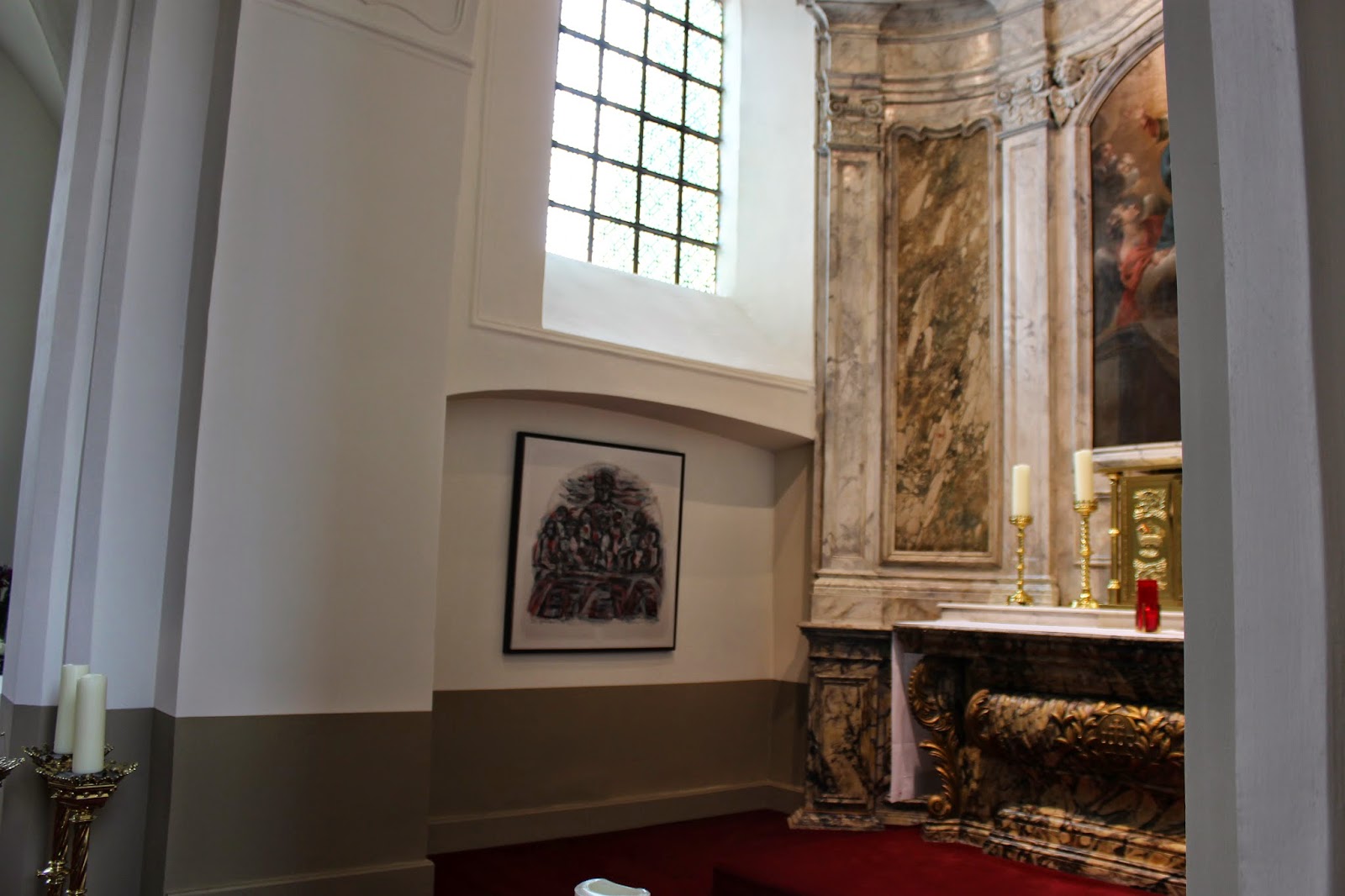
On entering Sint Martinuskerk I see that the baptistery contains a Passion charcoal by Servaes. Given all that he experienced in the controversy over the Luithagen Stations, including the removal of work which was a genuine expression of his faith by the Church of which he was part, I found it profoundly moving that a work of his, in the same vein as the Luithagen Stations, should be displayed here in the church and area where his faith and art first fused.

Other work in the church by the Latem School includes a painting above the left side altar by Gustave Van de Woestijne which represents Mary giving the rosary to St. Dominic and a Sacred Heart statue in the front right aisle by George Minne. Minne’s grave with a sculpture of a grieving woman, can also be found in the churchyard.

The church has continued to commission new work and accept gifts of art. The stained glass in the church was designed by Harold Van de Perre (1978 and 1993) and includes a sequence of scenes from the Annunciation to Pentecost. The rear windows depict the glorification of Sint-Martens-Latem and the heavenly Jerusalem with the apocalyptic vision of St John, while the baptistery contains images of Mary, St Joseph; the Nativity, the Sacraments; the Eucharist, Alpha and Omega. Van de Perre’s stained glass can be found at churches or chapels in Oudenaarde, Diksmuide, Bruges, Ghent, Dendermonde, Tongeren, Nederboelare, Antwerp, Lille, Aarschot, Zwijndrecht, the Abbey of Königsmünster, Meschede (Germany) and Pietermaai Cathedral, Willemstad (Curaçao).

In 1966 the painter Maurice Schelck donated a painting, which is now above the right side altar, showing St. Martin sharing his cloak with a beggar. Stations of the Cross from 1983 are the work of ceramist Paul de Bruyne. Other contemporary work is by Omer Gielliet, Erna Roelens and Dick de Gryse

As in many Belgian churches, contemporary art is integrated with the artwork of the past in a melange of different styles which, while not specifically harmonised, nevertheless possesses integrity. It is a great encouragement to see churches, already rich in heritage, wishing to continue to develop and add to that tradition from the work of their own day and time. Here this can be seen as a continuation of the legacy created by the Latem School of artists.

-----------------------------------------------------------------------------------------------------

Julie Miller - Jesus In Your Eyes.