Wikio - Top Blogs - Religion and belief
Showing posts with label surrealism. Show all posts

Friday, 2 May 2025

Max Blake: Adventures in Joy


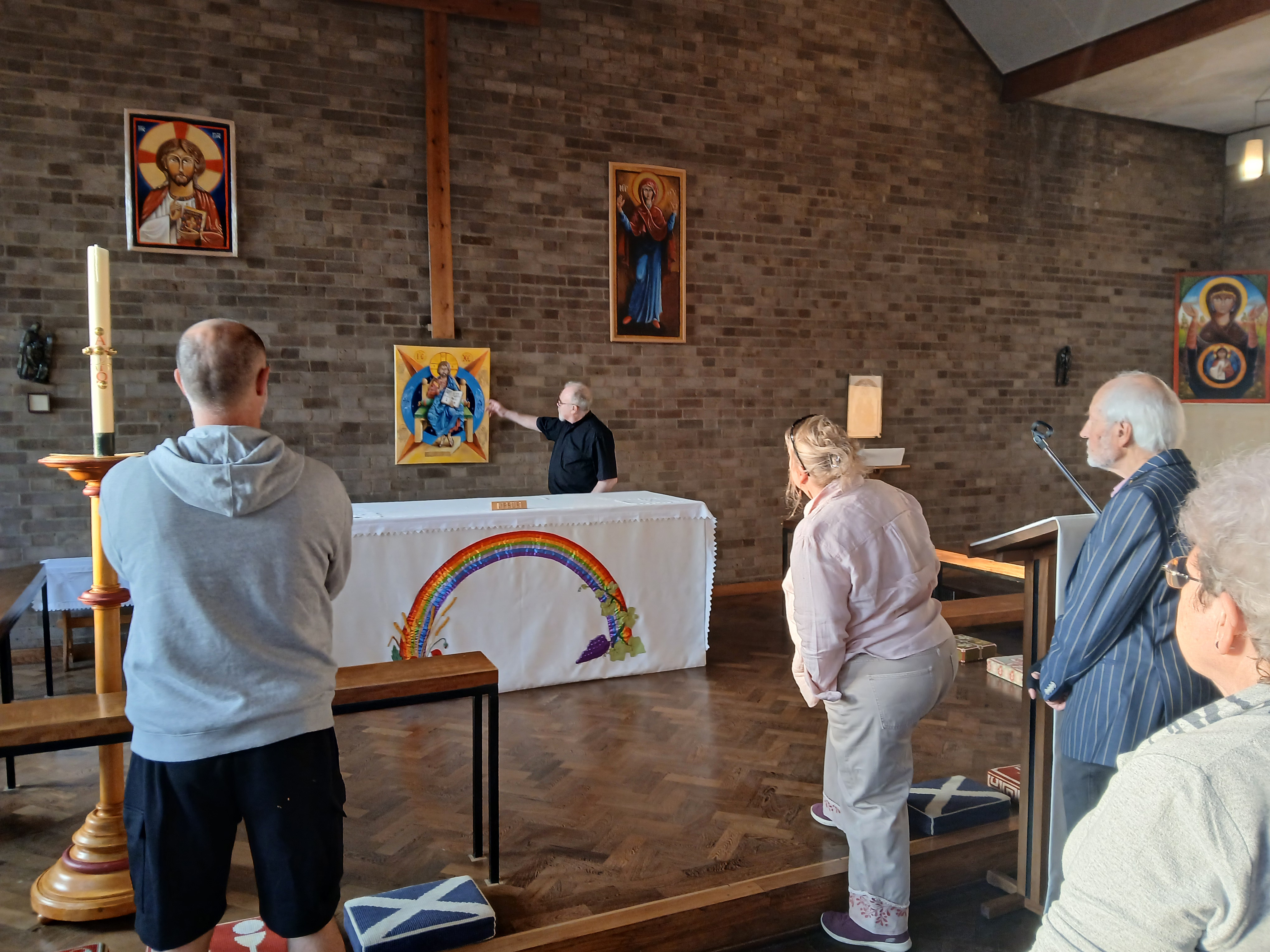
At tonight's Unveiled, our fortnightly Friday night arts & performance event at St Andrew's Wickford, we heard Max Blake talk about his wonderful exhibition 'Adventures in Joy'.

Adventures in Joy: An exhibition by Max Blake
2 May – 25 July 2025
St Andrew’s Church, 11 London Road, Wickford SS12 0AN


St Andrew’s is usually open: Sat 9am-12.30pm; Sun 9.30am-12 noon; Mon 2-3.45pm; Tue 1-4.30pm; Wed 10am-12 noon; Fri 10am-1pm. https://wickfordandrunwellparish.org.uk/whats-on.html

“Adventures in Joy” presents the most recent work produced by artist and cleric Max Blake. It includes some of the work he has developed though his studies of Icons, as well as his experiments in a more abstract and surreal direction. Max explores his own deep imagination, which is fed by his wide knowledge of religion and reflections amongst other things.

As a man of faith, much of his work expresses an exploration of the Christian faith. Over recent years, Max has studied Byzantine and Coptic Iconography and he has used this study to develop his own interpretations of the icon. Much of Max’s work is highly detailed and the viewer can find many hidden details, people, faces and shapes in his work. This creates a joyful adventure for the eye through bright and vivid worlds. Max uses a range of media including oil paints, inks and coloured pencils.

Max Blake was born in East London in the early 50s and then grew up in Basildon. After graduating as a teacher, Max taught art in secondary schools across south Essex. He also worked with children with anxiety and children with special needs. He was ordained deacon followed by priesting in the early 2000s. Although he is now retired, Max still works as a retired priest with Permission to Officiate in the United Benefice of Horndon, Orsett and Bulphan.

As well as artwork Max has also illustrated book covers and books for children. He continues to exhibit his vibrant work in various locations, including the Well House Gallery in Horndon on the Hill and St Catherine’s Church in East Tilbury. https://www.wellhousegallery.co.uk/art/max-blake

--------------------------------------------------------------------------------------------------------

Methuselah - My Poor Mary.

Wednesday, 30 October 2024

Artlyst: Leonora Carrington Still Relevant - Firstsite Colchester

My latest exhibition review for Artlyst is on ‘Leonora Carrington: Avatars & Alliances’ at Firstsite Gallery:

'As is clear from this exhibition, the many visionary elements of her work, including her feminism, ecological awareness, interest in spirituality outside of organized religion, and understanding of a world without boundaries, not only result in the creation of extraordinary artistic and personal worlds but connect to key themes and challenges in contemporary society. Her cousin and friend, Joanna Moorhead, has said “The themes that were important to her, as long ago as the 1940s, are the themes that are important to all of us today – especially the natural world, our place in it, and the interconnectedness of everyone and everything.” By offering us a holistic view of Carrington’s life and work, this exhibition fully demonstrates the truth of that statement.'

Interviews -
Monthly diary articles -

Articles/Reviews -

--------------------------------------------------------------------------------------------------------

Tuesday, 1 March 2022

Artlyst: Surrealism Outside The Usual Story – Tate Modern

My latest review for Artlyst is on Surrealism Beyond Borders at Tate Modern:

'Surrealism rejects oppressive rationalism by seeking to liberate the mind from outdated modes of thought and behaviour. As poet Urkhan Muyassar explained, the Surrealists sought to free the ‘mysterious moments’ of human creativity from a ‘superimposed’ reasoning to reach repressed thoughts, or ‘what lies behind reality. Surrealism aims to travel beyond reason and therefore contains a substantive body of work exploring spirituality, mysticism and religion in all their many and varied forms ...

These works – fascinating in their own right and profoundly absorbing when brought together – demonstrate that a deep dive into the spirituality of Surrealism would prove to be a revelatory exhibition, particularly when one also remembers the spiritual imagery and influences in the work of others included here, such Jean Arp, Joseph Cornell and Salvador Dalí.'

Check out also my Artlyst piece on Salvador Dalí The Enigma of Faith.

My other pieces for Artlyst are:

Interviews -
Articles -
-----------------------------------------------------------------------------------------------------------

Francis Poulenc - 5 poèmes de Max Jacob.

Sunday, 19 April 2020

Ernst Fuchs: Catholicism, Chapels and Bible

'The paintings and writings of Ernst Fuchs, co-founder of the Vienna School of Fantastic Realism, helped inspire the global visionary art movement. Fuchs directly influenced H.R. Giger, Mati Klarwein, Robert Venosa, Brigit Marlin, and dozens of others, but even if they never studied with him, all visionary artists – those who aspire to portray dimensions of visionary inner space - look to him as a superlative master.'

‘He is known mainly for his dazzling draughtsmanship and paintings of psychedelic cherubs or biblical scenes, such as Moses and the Burning Bush, and numerous portraits of Christ. He was also an internationally recognized sculptor, stage designer and print maker, composer and poet. Fuchs was the one of the first contemporary artists able to evoke multidimensional luminous worlds of psychedelics.’ ‘Paintings by Fuchs include bizarre, exquisite, uncanny beings, esoteric religious symbolism and detail comparable to Van Eyck. He revived the traditional mixed (mische) technique, using egg tempera to build forms in grisaille then glaze with oils for luminous depth.’

Fuchs inspired the founding of the Vienna Academy of Visionary Art to train artists of the future. The artist’s villa in Vienna, designed by 19th-century Austrian architect Otto Wagner, is now a museum displaying a vast treasury of his masterworks.

‘In 1947, Fuchs attended an exhibition where he was able to examine Surrealist paintings up close for the first time. Among them was The Lugubrious Game by Salvador Dali - and it had the seventeen year old painter enthralled:

"That was the first Dali - one of the best - so small in scale, but we could all see, from the first, how well these people could draw and paint. This precision, I decided, is something I must have. In Dali I found a confirmation of what I wanted to achieve."

This was the opening of the eye: the desire to portray the inner world of dreams and fantasms with a refined technique. But something more had happened: Fuchs had found in Dali's vision something recognizable, something undefineable, yet betokening kinship and affinity - the tacit recognition of shared vision.’

Ramon Kubicek writes that Fuchs and the Vienna School of Fantastic Realism were the principal exponents of ‘a small tradition of “veristic surrealism,” interested in visionary subjects’ that has continued to this day. The artist Johfra described his works as ‘Surrealism based on studies of psychology, religion, the bible, astrology, antiquity, magic, witchcraft, mythology and occultism’; a description that may have relevance to the broader movement. Although this movement today is primarily representative of esoteric, new age or occult spiritualities, in Fuchs’ work it has a significant Catholic wellspring. For Fuchs, this was another point of synergy with his friend Dali who, he said, ‘always was in a Catholic period.’ Dali and Fuchs became close friends with Fuchs stating that when they met they did not discuss painting, but physics and theology.

Fuchs was born in 1930 in Vienna. His father, Maximilian Fuchs, son of an orthodox Jewish family, had turned down a career as a Rabbi, leaving his theological studies uncompleted. He married Leopoldine, a Christian. When the Nazis occupied Austria in March 1938, Maximilian Fuchs emigrated to Shanghai. His son remained in Vienna together with his mother. Nazi legislation made it illegal for Leopoldine to raise her son. He was deported to a transit camp for children of mixed racial origin and Leopoldine Fuchs then agreed to a formal divorce from her husband, thus saving her son from the extermination camp. In 1942 he was baptised, an event of the utmost significance for him that determined his future life and work.

Fuchs began to draw from an early age. In 1945, after the end of the war and aged 15, he enrolled in painting at the Vienna Academy of Fine Arts where his first meeting with Arik Brauer, Rudolf Hausner, Wolfgang Hutter and Anton Lehmden took place in the class of Professor Albert Paris von Gütersloh. In 1948, together with Brauer, Hutter, Hausner and Lehmden, Fuchs founded the Vienna School of Fantastic Realism. Renaissance painting - especially the Danube school - was to be redefined. Alchemy, Christian and Jewish mysticism, but also deep psychology, such as dealing with the pain and suffering of the world wars, determined the thematic worlds of this young artist group. It was an Apocalyptic art, ‘full of grotesque monsters rendered in bright, bold colours,’ with ‘architecture from different periods, from the Tower of Babel to Renaissance palaces and modern cities.’

Johann Muschik later coined the term Vienna School of Fantastic Realism, under which these artists became known worldwide: ‘These Painters are Realists for their attention to detail, fantastic is the juxtaposition, the scene. One cannot call them Surrealists, though they evolved out of Surrealism, because missing is the absurd, the preference for paranoia, trance and hallucination.’

An early painting, the 1945 'Crucifixion and Self Portrait with Inge beside the Cross,' includes fellow artist Inge Pace, whose strong Christian religious devotion made an impact on Fuchs. In 1946 some of this small group held an exhibition in the foyer of the Vienna Concert Hall. Their works, thought of as a branch of surrealism, were removed after a public outcry. ‘Teaching at the Academy focused on the techniques of the Old Masters. Fuchs revived the old mixed technique of underpainting in tempera then adding glazes of oil paint on top. This produced a luminosity to his paintings and also allowed very detailed imagery.’ The lack of any positive response from the Vienna art world and his inability to earn a living from his art led him to follow his friend Friedensreich Hundertwasser - then Fritz Stowasser - to Paris in 1949. He was to spend twelve of his most important creative years there.

In 1956 he was accepted into the Catholic Dormition Monastery in Jerusalem, where he worked for one year on his largest painting, the ‘Last Supper’, in the refectory. He devoted all his energies in this period to furthering Jewish-Christian understanding and to working as a church painter gaining a commission to paint the Drei Mysterien des heiligen Rosenkranzes (Three Mysteries of the Sacred Rosary) for a newly-built church in Vienna.

This triptych, painted between 1958 and 1960, caused a storm of protest. Some of his most vehement detractors demanded that the pictures be removed from the church. Each of the parts measures three times three metres; they are painted on 12 goatskins that were sewn together but left uncut at the edges, and executed in the artist´s special mixed technique. A kind of large-scale parchment painting hung on light metal rods by means of loops and looking like banners floating in free space, they remind the congregation of the central events in the story of Redemption representing the joyful, sorrowful and glorious mysteries of the rosary.

Fuchs returned to Vienna and subsequent international recognition, opening a gallery that became a meeting point for the supporters of Fantastic Realism. Together with Hundertwasser and Arnulf Rainer, in 1959 he founds the "Pintorarium", a universal academy of all creative fields. The Pintorarium was concieved ‘not only a school of painting, but also a school of thought and life.’ It was intended as ‘a home for all creative persons without discrimination regarding the arts, art movements and philosophies, architecture, poetry, film, music, etc.’ The key principle was individual autonomy. Emulation was prohibited and there were no role models.

Fuchs ‘drew inspiration for his extravagant imagery from visionary experiences, which he sought to convey in his iconographic works’ ‘laced with religious symbolism and mystical allusions.’ His work over the course of his career increasingly focused on religious symbolism with biblical works including Psalm 69 (1960) and Adam and Eve in front of the Tree of Knowledge (1984). ‘His paintings from the late 50s to the present day have extraordinary visionary power. Babylonian Cherubs, visions of Christ and other mythological subjects explore the roots of middle-eastern religious experience.’

In 1990 he began work on the Apocalypse Chapel at Klagenfurt in Austria. He created oil paintings covering the entire interior of the chapel of parish church St. Egid creating monumental frescos to the Apocalypse of John which took him about 20 years to complete. The Apocalypse Chapel was originally commissioned by Monseignor Marcus Mairitsch. Although the chapel is no more than 40 sq. metres, its arched ceilings and many walls are covered with visions of 'the last days' from Fuchs’attempt to depict the 12th chapter of John's Book of Revelation. It is his Sistine Chapel.

K. Ziegler notes that, with architect Manfred Fuchsbichler, from 1992 to 1994, Fuchs constructed and decorated an extension to the Parish church of St James in Thal. Fuchs wanted to portray the Paradise, the Heavenly Jerusalem, saying: ‘You have to recognize from a distance: this is a sacred place. Wherever the eyes look, there has to be something to see.’

The design of the entire complex combines impressive lighting effects with a fantastic variety of colours and shapes. The exterior of the church was completely redesigned as the church expanded. A pebble path leads around the church and into the building to the altar. It is designed as a pilgrimage route and commemorates St. James, the patron saint of pilgrims. The building is covered with three different-sized gable roof structures that span a trapezoidal plan. The entire building has the character of a pointed crystal, which has been adapted to the roof shapes of the old building. The facade of the new church building is made of hard fire bricks and patinated copper sheets. The walls of the old building are plastered, painted turquoise and partly decorated with gravel applications. On the facade of the apse of the old church there are monograms made of pebbles of Maria (the heart), Jesus Christ (the tree of life), and Joseph (the house).

A canopy with a red beam structure dominates the entrance area. The thick glass doors at the entrance are opened with handles made from ram's horn, the favourite sacrificial animal of the biblical people of Israel. The symbols Alpha and Omega as well as crossed keys and the Christ monogram are attached to the glass doors. Inside you can see an open roof structure painted in rainbow colours that is reminiscent of the desert tent that the Israelites erected in the wilderness. The rainbow symbolises the covenant that Noah made with God. Daylight comes in through seventeen triangular dormer windows of different sizes and over vertical pilaster strips mirrored with crystal glass elements. The rows of seats are wavy and add to the special atmosphere.

A glass window in the apse shows a picture of Maria Hilf, a copy of the famous painting by Lukas Cranach in Innsbruck Cathedral. Images of the calling of the disciples and the Transfiguration can also be found in the apse; both include St James. The symbol of the apostle James, the scallop, can be found on the walls, the holy water basin is shaped as a scallop shell, the backrests of the plastic benches show the same motif. A fossil of a scallop shell, which was found in a quarry in Retznei, is in a glass stele behind the priest's seat. A crystal cross with Svarovski crystals and Murano glass elements draws attention to the central altar, which is also made of crystal glass.

Finally, published in 1996 in an edition of only 20,000 copies, Fuchs considered his leather-bound and gilded Bible, richly illustrated by over 80 colour plates of his paintings, to be his crowning achievement. With his first illustrations of the Bible, he hoped to surpass the heretofore best-known Bible illustrators of this century: his friend Salvador Dali, and painter Marc Chagall. He wanted to create a gold ingot and, in accordance with this design, the Bible was bound in calfskin and covered with a gold folium. This was to emphasize the value of this ‘most valuable treasure of humanity.’ ‘With this, I am transforming the profane covetousness of men for gold into a yearning for what is holy, into reverence for the great Mystery,’ Fuchs explained.

‘Art is nearness to God received without effort,’ he wrote: ‘This is the concise meaning and basis of a theology of art that is age old and has maintained again and again that jubilation erupts when God is near. Through that jubilation, the artist’s nearness to God was brought through creative service without sweat or torment.’ ‘What is religion,’ he asks, ‘if not the relationship of the now to its beginnings?’ As a result, the work of art ‘has its source in the desire to create a means of transcending time, entering eternity.’ ‘Thus the artist, in contemplation, creates both history and eternity.’ (‘One Source: Sacred Journeys – A celebration of Spirit & Art’)

--------------------------------------------------------------------------------------------------

Larry Norman - Nightmare #71.