Wikio - Top Blogs - Religion and belief
Showing posts with label general synod. Show all posts

Friday, 11 March 2022

Something Worth Sharing


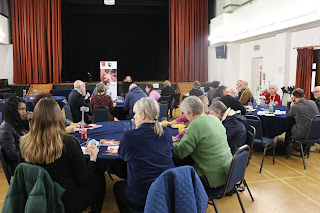
Together with Inclusive Church, St Martin-in-the-Fields and Accessible Synod, HeartEdge supported the launch during General Synod of 'Something Worth Sharing', a booklet sharing the fruit of an annual conference on disability and church.

Talks from the launch event by Fiona MacMillan, Emily Richardson and Tim Goode can be read here.

Read more about the conference, its approaches and learning from it in recent articles for anglican focus and The Plough:
  • anglican focus: “If the Church is to be renewed from the edge it must make space for the edge to come to the centre. That space needs to be open to disruptive prophets and uncomfortable conversations – and accessible.”
  • The Plough: Disability asks us questions that only more questions can answer.
----------------------------------------------------------------------------------------------------------

St Martin's Voices - A New Commandment.

Saturday, 15 February 2020

Beyond Words: A response to the apology at General Synod

Azariah France-Williams, who is currently on placement at St Martin-in-the-Fields preparing for a new mission initiative with HeartEdge, has offered his thoughts on the Church of England General Synod's apology for racism in the church.

In his post for the SCM blog he asks:

'What are the thoughts of the church and its senior members in regard to race and ethnicity - that of themselves, as well as that of others? We are used to words, and I now want to know what the deeds of the church might be?'

Read his post here. His book Ghost Ship: Institutional Racism in the Church of England is published this summer.

-------------------------------------------------------------------------------------------------------

Eric Bibb - Migration Blues

Friday, 17 August 2018

The gifts that those with autism are bringing to the Church

Read the Church Times' article "Once we connect on to something, that’s it" on autism and Church, which features the Disability Advisory Group at St Martin-in-the-Fields with words from Fiona MacMillan.

The article says:

"There are estimated to be nearly a million people with a form of autism in the UK. It is likely that there are 80 in the average parish. Not all will be in church, but, like everyone else, they will be attending weddings, funerals, and other offices. Autism is not a mental-health condition, but a physical brain-wiring difference that, in the context of church worship, means, “Our brain wiring can literally overheat as it tries to handle too much input at once. We try very hard to avoid an overload of sensory or social situations.”

That explanation comes from the words of the C of E’s guidelines on autism, “Welcoming Those on the Autistic Spectrum”, which were created for Oxford diocese and formed part of the report Opening Doors, affirmed by the Synod in February.

[...]

Good practice can address all these things with what the guidelines say requires “nothing other than a bit of time and thought” — always in partnership with the people concerned. Fiona MacMillan chairs the Disability Advisory Group that works at St Martin-in-the-Fields, in London, which, in partnership with Inclusive Church, puts on an annual conference on disability and church. It is an opportunity to share learning and resources more widely, particularly evident in the booklet Calling From the Edge, launched at the General Synod in February.

“St Martin’s is a learning organisation,” she emphasises. “All our work is centred on lived experience: the experts are people who know, who encounter barriers and discrimination in daily life and in this place. We create change by understanding our different perspectives and working together to make things better.”

Whether characteristics associated with people with autism are perceived as positive or negative depends on context. “Understanding language literally is a challenge for those who don’t, but may encourage a clarity of thought which benefits all,” she reflects. “Wanting to know how things work doesn’t necessarily mean not appreciating mystery, or not being transfixed with wonder and delight at how things are.”

She lists among the characteristics of people with autism: “Honesty, integrity, directness, openness, creativity, different ways of perceiving, not being part of hierarchy and bureaucracy, not able to manipulate or discriminate. . . Loyalty, trust. Many autistic people have an inbuilt faith, unquestioning knowledge of the existence or presence of God.

“Having a passion for justice, spotting patterns, and noticing gaps or anomalies — including those who are left out or facing barriers to participation — are gospel values. Every church will have autistic people: some will have found their niche; others may not be open. It’s about acceptance of each other, openness to difference, acknowledging that one size doesn’t fit all, but we are all fearfully and wonderfully made in the image of God.”

Book a place to attend 'Something Worth Sharing', the 2018 conference on Disability and Church organised in partnership by Inclusive Church and St Martin-in-the-Field's, in October.

------------------------------------------------------------------------------------------------

Gungor - Beautiful Things.

Sunday, 29 July 2018

Gather us in ...

Here's my sermon from this morning's Eucharist at St Martin-in-the-Fields:

Jesus takes the child’s five loaves of bread and two fish, blesses them by giving thanks for them, breaks them for distribution by his disciples to the crowd, then asks his disciples to gather up the broken fragments of the meal in baskets so that none is wasted (John 6. 1 - 21). Jesus has yet to institute the Eucharist at the Last Supper, but we recognise the basic elements of the Eucharist in this story; bread that is blessed and broken before distribution in order that those receiving the broken body of Jesus are gathered up and formed into the whole Body of Christ, which is the Church.


Could you look for a moment at the leaflet you have been given for ‘Something Worth Sharing’, our annual conference on disability and Church, as there you will see an image which has the same elements included? There in the centre is bread that is broken; a priest’s wafer broken into seven pieces each held by a diverse group of people. Are they taking the broken pieces of the host to themselves or are they reforming the host into a whole? We do not know from this image, which was the inspiration of Fiona MacMillan. The image encompasses both the breaking apart and the bringing together and that is significant as both feature in the pattern of the Eucharist which we see enacted here in the feeding of the 5,000.

At the beginning of June Carol Ashby spoke at our Bread for the World service on this passage, the feeding of the 5,000, reflecting particularly on the fact that Jesus told his disciples, ‘Gather up the fragments left over, so that nothing may be lost.’ She said that, just as Jesus needed helpers and just as all the leftovers were gathered up and kept, so each one of us is needed here at St Martin's and in God's kingdom and nothing we offer or give is wasted or goes unused. I want to build on the inspiration that Carol provided by suggesting three further ways in which to think about the gathering up of fragments so that nothing may be lost. The first concerns the gathering up of food waste, second, the gathering up of the fragments of our lives and third, the gathering up that is the kingdom of God. All these relate to our being gathered up and gathered in today at this Eucharist.

So, my first reflection is very literal and concerns food waste. In 2016 the Archbishop of Canterbury welcomed ‘the Evening Standard’s campaign on tackling food poverty and waste,’ by saying that as ‘hunger is a complex, widespread and shocking blight on our country and more needs to be done to highlight this issue.’ In commenting on this statement, the paper noted that the Archbishop had good scriptural reasons to join the Food for London campaign. They noted that after ‘feeding the five thousand, Christ instructed the waste to be gathered up afterwards’ and said that it was in that spirit that the Archbishop had supported this campaign.

It was positive to see a major newspaper quoting scripture and doing so with some understanding. This contemporary reminder of the feeding of the five thousand and the 12 baskets of fragments that were gathered up afterwards give us one way of reflecting on Jesus’ words. In the UK we throw away edible food worth £470 per household each year and a third of perfectly edible vegetable crops are discarded from our fields due to supermarkets’ strict cosmetic standards. This wasteful food cycle has a big carbon footprint, making climate change worse.

Earlier this year, the Church of England’s General Synod backed a motion calling upon the Government to tackle food poverty and take steps to minimise waste throughout the supply chain. The motion outlined ways in which retailers and Church of England members can attempt to tackle food poverty in Britain. The motion called for the Government to consider steps to reduce waste in the food supply chain, urged parishes to help lobby retailers on food waste and stressed the need for church members to reduce waste in their own homes.

Following that literal application of Jesus’ teaching, we can also think in terms of a metaphorical understanding of the fragments as representing the disparate elements of our own lives. The catalyst for the feeding of the 5,000 was the offering up of his lunch by the young boy. His offering was offered to God, multiplied and the result was that there were 12 baskets of fragments to be gathered, so as not to be wasted. This suggests that our offering of ourselves to God provides a means by which what is disparate and fragmented within our lives can gathered up and unified.

That was certainly my experience in offering for ordained ministry. In my working life I had experience of partnership working to create employment opportunities, with a particular focus on assisting disabled people in finding and keeping work. In my church life I had involvement in setting up a church-based day care business and a detached youth work project reaching out to disaffected young people. In my personal life I was writing and painting and finding a limited range of opportunities to share my creative work.

I realised, as I went through the selection process for ordination and then my ministerial training, that ordained ministry could hold and utilise all these disparate experiences and, as a result, could provide a frame within which all these disparate fragments of my life could be gathered up, held together and unified. And so it has proved, as each context for my ministry to date has provided unique opportunities to make connections between faith, work, art and social action through partnerships and projects. That has, of course, never been more so than here where our mission model and HeartEdge, our growing ecumenical network of churches, integrates congregation, culture, commerce and compassion.

Mission and ministry in, from and outside the church provides a framework, forum or context in which all of our skills, experiences, interests and failures can be gathered up, integrated and used for God’s glory and in God’s service. My personal experience of this reality has been in relation to ordained ministry but, the model of mission that we use here is clear that this gathering up of all that we offer applies to us all, whether lay or ordained.

Later in John 6, Jesus gives a cosmic or eschatological twist to this phrase we are considering when he says it ‘is the will of him who sent me, that I should lose nothing of all that he has given me, but raise it up on the last day’ (John 6. 37 – 40). These words come in the middle of Jesus’ teaching about being the Bread of Life which followed the feeding of the 5,000. When Jesus gave thanks over the bread, the word used is ‘eucharistesas’, the word which gives us ‘Eucharist’. Jesus shared the bread around in communion, then, when everyone was satisfied, he instructed his disciples to pick up the fragments using that same phrase, ‘so that nothing may be lost.’ Just as none of this ‘eucharisticized’ bread was lost after the feeding, so, because ‘Jesus is the bread of life, [those who] see and believe in him … receive eternal life [and] become a fragment which he will gather up on the last day.’ (John, Richard Burridge, BRF 1998)

This is the reason why Christ came, which he revealed both here and in the parables he told about things that were lost; the lost sheep and coin (Luke 15. 1 - 10). The shepherd and woman in those two stories are exactly the same; because of their concern for the sheep and coin which are lost, they will not give up searching until these have been found. The sheep and the coin are loved and this love is revealed or proved through the search.

The point of those parables is for us to know that we are similarly loved by God because he also searches for us until we are found. That search is the story told in the Gospels; that Christ Jesus, who, though he was in the form of God, did not regard equality with God as something to be exploited, but emptied himself, taking the form of a slave, being born in human likeness. And being found in human form, he laid down his own life for us becoming obedient to the point of death — even death on a cross – in order that all might be safely gathered in as those who are gathered in rise with him and return to God. Christ went on that search to seek and save those who are lost and thereby to ensure that none shall be lost and all shall be safely gathered in.

Those who are lost almost universally consider themselves worthless but these parables and this story of the fragments gathered up specifically deny that assumption. What is lost is actually the most precious thing or person of all; the person or thing for which everything else will be given up or set aside. What is lost and found, discarded but then gathered up, is us. We are the ones for whom Christ searches at the expense of all that he has, including, in the end, his own life. We are the most precious lost person for whom he searches, the discarded fragment that will not be overlooked and will not be wasted. We are precious, we are loved. As a result, we have a basis for saying with the poet Walt Whitman that: ‘Nothing is ever really lost, or can be lost, / No birth, identity, form — no object of the world, / Nor life, nor force, nor any visible thing.’

And so we can pray, in words from a call to worship by the Wild Goose Resource Group that we used regularly in my previous parish: ‘Gather us in, the lost and lonely, the broken and breaking, the tired and aching who long for the nourishment found at your feast. Gather us in, the done and the doubting, the wishing and wondering, the puzzled and pondering who long for the company found at your feast. Gather us in, the proud and pretentious, the sure and superior, the never inferior, who long for the levelling found at your feast. Gather us in, the bright and the bustling, the stirrers, the shakers, the kind laughter makers who long for the deeper joys found at your feast. Gather us in, from corner or limelight, from mansion or campsite, from fears and obsession, from tears and depression, from untold excesses, from treasured successes, to meet, to eat, be given a seat, be joined to the vine, be offered new wine, become like the least, be found at the feast. Amen.

-----------------------------------------------------------------------------------------------------

Marty Haugen - Gather Us In.

Thursday, 22 February 2018

Calling from the Edge presentation


Calling from the Edge was a fringe event held alongside the recent General Synod meeting on 9 February. This was a partnership between St Martin in the Fields and Inclusive Church

The text of one of the presentations that was given by Fiona MacMilllan (a Trustee of Inclusive Church and Chair of the Disability Advisory Group at St Martin in the Fields) can be downloaded from this link -.http://www.thinkinganglicans.org.uk/archives/007809.html.

Fiona says, "The church of the 21st century often fails disabled people, bringing echoes of an understanding that links sickness with sinfulness, mental health issues with possession, and disability as brokenness in need of cure..."

----------------------------------------------------------------------------------------------------------

The Staple Singers - Be What You Are.

Thursday, 3 January 2013

Prayer for mission and unity


Following the recent vote in General Synod on ‘Women Bishops’ in November the Bishop of Chelmsford, Rt. Revd Stephen Cottrell is calling the Diocese of Chelmsford together for a Day of Prayer on Thursday 10 January 2013 for the Mission and Unity of God’s Church.

Bishop Stephen says, “There are important lessons to learn from what has happened and the first of these is trust. We must trust God; he loves his church and will lead us to find the right way forward. And we must trust each other, looking for ways to live together with our disagreement. Jesus prayed for unity so that the world may believe”.

Bishop Stephen invites the whole diocese to join together for this Day of Prayer; whether it is praying in the Cathedral, in our parishes, or at our places of work, the invitation is to stand together in prayerful solidarity.


Bishop Stephen says, “I hope many people will come to the Cathedral to pray, but of course many won’t be able to, and so I am also issuing a prayer, and asking everyone in the diocese to say it at least once on the day wherever they are”.

O Holy Trinity,
three persons but One God,
open our minds to know your will;
open our hearts to receive your peace;
open our hands to do your work;
give your church the unity which was Christ’s prayer;
help us live with conscientious difference;
forgive us when we gain the world and put our souls in danger.
You know what is good for us:
come by your Spirit and change us,
let your church reflect the beauty, diversity and
hospitality that we see in you,
lead us to a place of graceful concord:
a self-forgetful love,
a turning back to Christ:
for with your grace to help we can be one,
and in your strength can strive to serve and bless,
and by your will can see your kingdom come.
Use us to the full;
and when we are empty, fill us afresh.
We know you love your church,
help us to love each other.
Unite us in the effervescent joy of your declaring,
but not just us – we ask it so the world may believe.
And in these days of uncertainty, we ask it in the name of him
who is our foundation, our salvation and our end,
even Jesus Christ our Lord. Amen.

At St John's Seven Kings we will be having two hours of prayer from 12 noon to 2.00pm. We will organise this time in half hour blocks with a variety of prayer styles and opportunities so people can come and go for as short or long a time as they can manage. We also intend going to the Eucharist that Bishop Stephen will celebrate at 7.30pm in St Margaret's Barking.


Other Deanery Eucharists and Prayer Gatherings in the Barking Episcopal Area include:
-------------------------------------------------------------------------------

Mark Heard - Rise From The Ruins.


Thursday, 22 November 2012

The 11th Commandment: Thou shalt not shoot thy self in thy foot

Allison Pearson's satire in this comment piece from The Telegraph is acute and deserved after Tuesday's Synod debate and vote:

"Like most woolly Anglicans, I assumed that, after an interminable period of reflection, the C of E would muddle its way to the right decision. For heaven’s sake, if Swaziland has a woman bishop, surely Suffolk should be allowed one? A great religion should not be in the business of causing disbelief. But that’s precisely what the Church of England did on Tuesday."

As a complete contrast, in that it is non-satirical and straight out sincere, try this post from 'The Year':

"I know it is not my responsibility to defend the Church of England and actually that’s pretty difficult right now anyway, but please don’t judge those within it by the decisions being made at the moment.

Be assured that those who are not looking forward, are in a minority in the church. Be assured that there are good, faithful, Priests out there who love their communities and their parishioners. Be assured that whilst it may seem otherwise, God is completely relevant in our society today. Perhaps more so now than ever before. Be assured that the church is full of people who love not hate. Be assured."

---------------------------------------------------------------------------

Victoria Williams and Dave Pirner - My Ally.
.

Thursday, 12 March 2009

Responding to the BNP

The Chelmsford Diocesan Synod overwhelming passed a resolution on 7 March 2009 responding to the British National Party (BNP). The resolution can be read by clicking here.

The Synod was attended by members of Redbridge and Epping Forest Together and HOPE not hate. They ran a bookstall and members from the Christian community took part in the debate.

This Diocesan resolution follows the General Synod vote to ask for a ban to stop clergy and church staff members joining the BNP.

Such resolutions have their critics within the Church of England but why some clergy would want to give publicity to "a political party whose racist foundation is incompatible with Christian discipleship" is beyond me.

----------------------------------------------------------------------------------

SLF - Doesn't Make It Alright.