Wikio - Top Blogs - Religion and belief
Showing posts with label the hythe. Show all posts

Monday, 22 July 2024

St Mary the Virgin, Maldon, and Mark Angus


St Mary’s Church, Maldon is now and has been throughout its history a beacon for the town’s community and visitors. Known as the Fishermen’s Church its tower guides many sailors and their craft into the Hythe.

Maldon, an ancient and historic town lying at the head of the Blackwater Estuary, is a small market town 40 miles east of London and a short distance from the cathedral city of Chelmsford. St. Mary’s parish covers the southern and eastern part of the town. St Mary’s Church is an 11th century Grade 1 listed building with a closed churchyard. The fishermen’s church stands above The Hythe overlooking the River Blackwater acting as a beacon to incoming shipping.

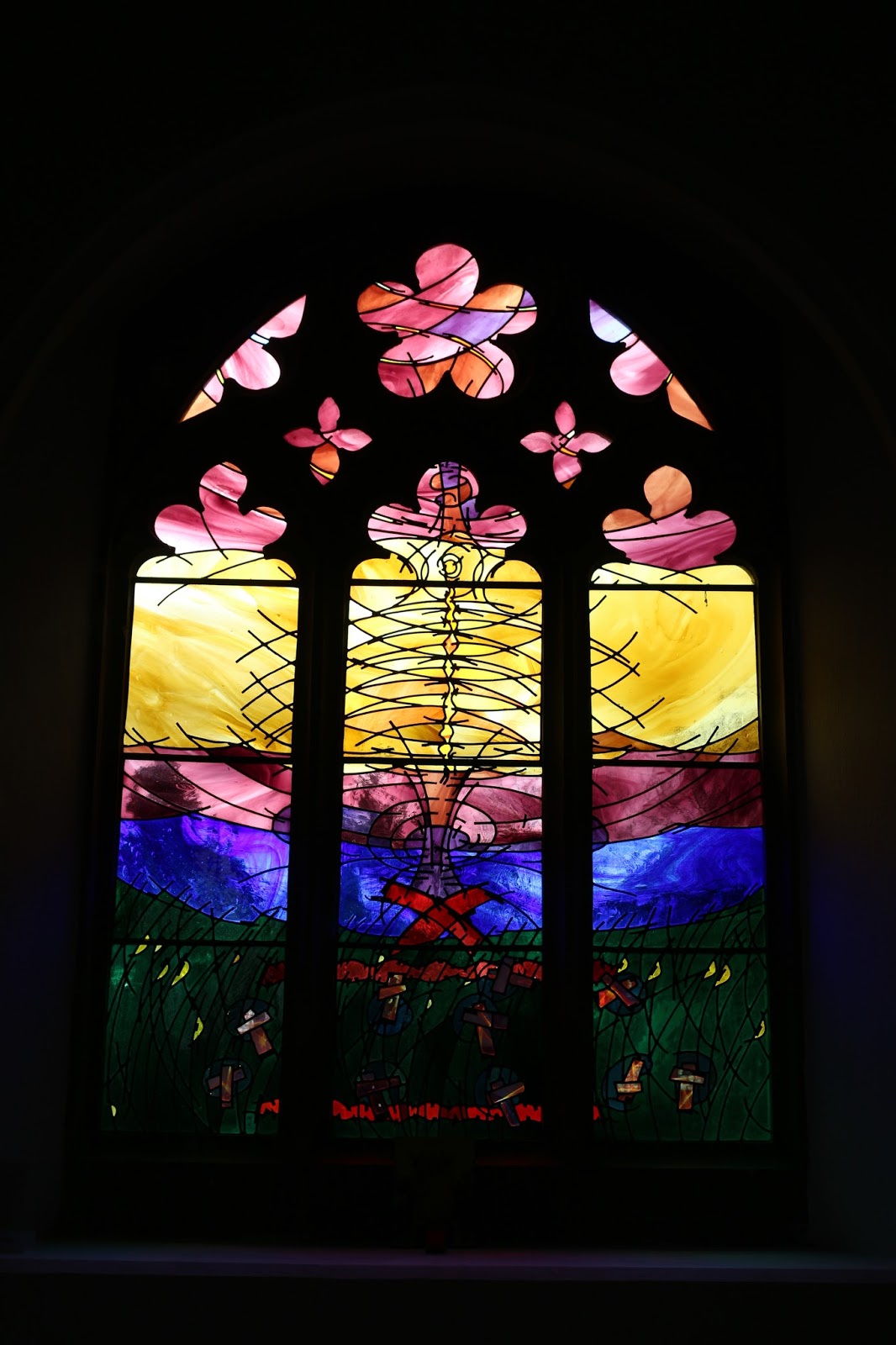
With its flint-rubble walls and impressive tower, it remains an interesting and attractive landmark in Maldon. A stained glass window by Mark Angus was installed in the south wall of the church for the 8th August 1991 to commemorate the Battle of Maldon in AD 991. A statue of the defeated Saxon leader Byrhtnoth stands at the end of the Promenade over the River Blackwater, where he lost his life in an attempt to stop the Viking invasion.

Since 1978 Mark Angus has gained his reputation in Britain and Europe for his expressive stained glass art, and especially in architecture, with windows for churches and cathedrals as well as for other public and private spaces. Important examples include complete schemes for Oundle School, Spinkhill Parish Church, Berkhampstead School, and Perth Baptist Church (all UK), and St. Raymund Parish Church in Breitenberg near Passau (Germany), and windows for the cathedrals of Durham and Guildford (UK). More recently comprehensive schemes for St. Fintan’s Church, Raheen (Ireland), St. Mary’s Church, Sheffield (UK), and for St. Ursula’s Hospice, Niederalteich (Germany).

Whilst retaining an interest in church stained glass, and in glass painting generally, present interests move towards acrylic painting, and printmaking, especially vitreography, together with artist’s books. Vitreography is a technique where prints are created from glass sheets, resulting in images of great light and subtlety. Predominant in Mark Angus’ imaginative narratives are the figure, dialogue and interaction, and the human self in space. Combined with letterpress Mark Angus is working on making unique artist’s books and prints.

--------------------------------------------------------------------------------------------------------

Deacon Blue - Dignity.

Tuesday, 3 April 2018

The Hythe and Maldon


Maldon's Hythe Quay is home to the largest collection of East Coast barges, which would transport hay and straw up the Thames to feed London's large number of horses. These barges ceased to carry cargo many years ago and the survivors are now lovingly preserved by their owners and used as pleasure craft carrying passengers on day trips and charters. The Hythe was originally a separate hamlet serving Maldon as a port and the most popular image of Maldon is now one that captures the scene at The Hythe with it's collection of barges and other craft tied up at the quay and the old church of St Mary the Virgin dominating the skyline.

In more recent years the church was enhanced by the addition of a new window in the south wall commemorating the battle of Maldon in 991. Nothing befits religious stained glasswork more than the dramatic interplay of light and dark – it seems to embody the very forces of good and evil that underpins the Christian faith. Mark Angus’s 1992 Battle of Malden millennium window exploits this tension, creating a dark mass at the bottom of the window that disperses and changes to light – and by implication, hope – at the top. Angus’s expressive painting with glass and coloured light searches for the questions and significances of our time, whilst opening the view towards the unknown and ambivalent. For these reasons he feels closest to working for churches, with their multitude and depth of cultural contents. The traditions of the stained glass artists of the past, who created spiritual spaces through light and meaning and through narrative images, is carried on by Angus in his own, modern way. Between abstraction and figurative depictions his windows challenge interpretation without abandoning mystery, wonder and awe.

On the wall of the Maeldune Heritage Centre you will find the Maldon Embroidery, which was made to celebrate the 100th anniversary of the Battle of Maldon. Designed by Humphrey Spender, it illustrates Maldon's history from the Battle in 991 to its anniversary in 1991. This work measuring 42 feet in length, took three years to complete and involved the work of over one hundred people. Spender insisted that it should not be called "a tapestry" as this was associated with something "faded and dun-coloured". Indeed, the embroidery is the complete opposite of that. It is alive with vibrant colour and originality of design.
Photographer, painter, printmaker, textile designer and teacher, Humphrey Spender, the artist and younger brother of the poet Stephen Spender, was best known for his photographs of life in working class Britain from the Depression through to the 1950s, first for the archive Mass-Observation and then for Picture Post. But he had always painted, and from the mid-1950s he abandoned photography to devote his full attention to what he considered a superior fine art, supplementing his income by working as a tutor in the textile school at the Royal College of Art from 1953 until his retirement in 1975. In 1968 he commissioned the then unknown Richard Rogers to build him a house and studio near Maldon. The main building, a glass cube framed with canary yellow I-beams, is Rogers's first and a rare example in England of a hard-line modernist rural retreat.

-------------------------------------------------------------------------------------------------

Bettye Lavette - In My Secret Life.