Wikio - Top Blogs - Religion and belief
Showing posts with label laird. Show all posts

Friday, 3 July 2020

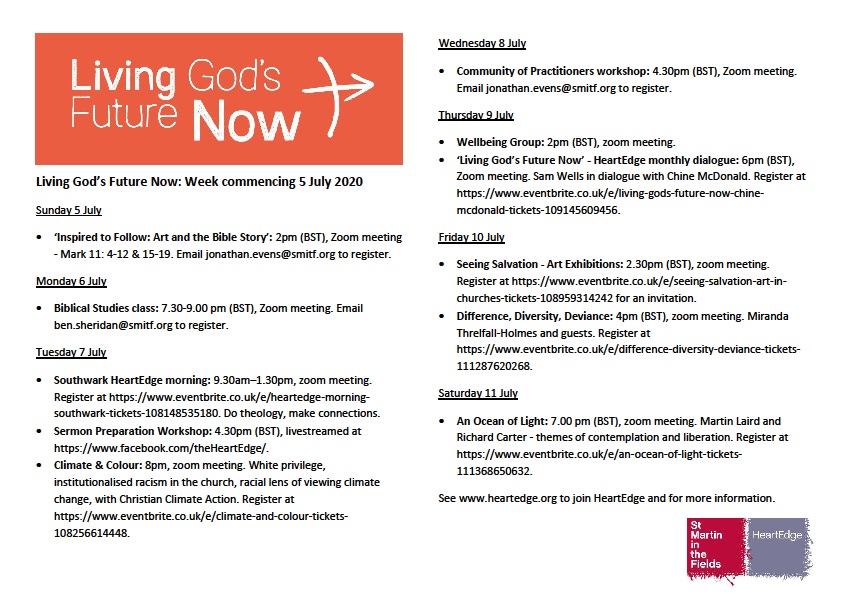
Living God's Future Now - w/c 5 July 2020


Living God’s Future Now is a series of online seminars, discussions and presentations hosted by HeartEdge. They are designed to equip, encourage and energise church leaders, laypeople and enquirers alike.

'Thank you for all you are supporting and enabling - I absolutely love everything that comes out of HeartEdge.' The Rt Revd Rachel Treweek, Bishop of Gloucester

Living God’s Future Now: Week commencing 5 July 2020

Sunday 5 July
  • ‘Inspired to Follow: Art and the Bible Story’: 2pm (BST), Zoom meeting - Mark 11: 4-12 & 15-19. Email jonathan.evens@smitf.org to register.

Monday 6 July


Tuesday 7 July

Wednesday 8 July


Thursday 9 July

Friday 10 July

Saturday 11 July

See www.heartedge.org to join HeartEdge and for more information.

------------------------------------------------------------------------------------------------------

Tide Lines - Far Side Of The World.

Sunday, 28 June 2020

Living God's Future Now - July 2020


‘Living God’s Future Now’ is a series of online seminars, discussions and presentations hosted by HeartEdge. They are designed to equip, encourage and energise church leaders, laypeople and enquirers in areas such as preaching, growing a church, shifting online, deepening spirituality and responding to social need.

The focal event in ‘Living God’s Future Now’ is a monthly conversation where Sam Wells explores what it means to improvise on God’s kingdom with a leading theologian or practitioner.

The online programme includes:
  • Regular weekly workshops: Biblical Studies (Mondays), Sermon Preparation (Tuesdays) and Community of Practitioners (Wednesdays)
  • One-off workshops on topics relevant to lockdown such as ‘Growing online communities’ and ‘Grief, Loss & Remembering’
  • Monthly HeartEdge dialogue featuring Sam Wells in conversation with a noted theologian or practitioner
Find earlier Living God’s Future Now sessions at https://www.facebook.com/pg/theHeartEdge/videos/?ref=page_internal.

'Thank you for all you are supporting and enabling - I absolutely love everything that comes out of HeartEdge.' The Rt Revd Rachel Treweek, Bishop of Gloucester

Living God’s Future Now: Week commencing 21 June 2020

Sunday 28 June
  • ‘Inspired to Follow: Art and the Bible Story’: Sunday, 28 June, 2pm (BST), Zoom meeting - To receive a zoom invite email jonathan.evens@smitf.org. Topic: Mark 1: 1-12 / ‘The Baptism of Christ’; predella panel, Giovanni di Paolo, 1454, NG5451.
  • St Martin’s, HeartEdge and Friends Theology Group: 6-7pm (BST), Zoom meeting - Register at https://www.eventbrite.co.uk/e/theology-group-tickets-111280242200. This Sunday at 6.00 pm, Sam Wells will be responding to questions on “Cafeteria Christianity, Biblical Interpretation and negotiables/non-negotiables.Billy Cometti, from the congregation of St Martin's will be chairing the session and encouraging your comments and questions.
Monday 29 June
Tuesday 30 June
  • Sermon Preparation Workshop: 4.30pm (BST) - livestreamed on the HeartEdge Facebook page (https://www.facebook.com/theHeartEdge/). Sam Wells and Sally Hitchner explore the weeks lectionary readings and how they could be used in a sermon, with a chance to ask questions.
Wednesday 1 July
  • Community of Practitioners workshop: 4.30pm (BST), Zoom meeting - Email jonathan.evens@smitf.org for an invitation. Church leaders join in community to explore a text, and to share and reflect together on their recent experiences.
Thursday 2 July
Friday 3 July
Living God’s Future Now | July 2020
-------------------------------------------------------------------------------------------------------

Friday, 20 December 2019

HeartEdge Mailer | December 2019

HeartEdge is an international ecumenical movement initiated by St Martin-in-the-Fields, London.
  • We are churches and other organisations developing mission.
  • We focus on 4 wide-ranging areas - commercial activity, compassion, cultural engagement and congregational development.
The mailer is our monthly compilation of stories, web links and original writing, related to our 4 key areas.

This month:
  • A focus on intentional communities and new monastic communities
  • Banksy at Christmas in Birmingham,, plus how to curate art in churches
  • Martin Laird on silence and spirituality and Hannah Malcolm on realism and Sami Award on being light in dark times.
  • 'Grandad's Front Room' plus Social enterprise tips, and social investment - leveraging in funding from repayable finance
  • Plus Jess Foster learning from the Little Town of Bethlehem.
-----------------------------------------------------------------------------------------------

Saturday, 28 January 2012

Airbrushed from Art History (12b)

Here's a little addendum to my 'Airbrushed from Art History' series of posts because the current edition of the Church Times has an interesting feature in which Stephen Laird uncovers the artist’s little-known fascination with the writings of Jacques Maritain.

Laird says that Sutherland had a well-thumbed copy of Maritain's Art and Scholasticism which influenced his 1936 essay 'A Trend in English Draughtsmanship' and Sutherland's Welsh landscapes of the 1930s, well before Sutherland's later 'religious' work for St Matthews Northampton and Coventry Cathedral:

"Visually, Sutherland's Welsh landscapes from the '30s are most reminiscent of some of William Blake's more haunting imaginative illustrations. Intellectually, they are a fully fledged expression of Maritain's theological programme ...

Sutherland borrows Maritain's words to describe how the artist's part is to create something truly inspired and "poetic", and how this cannot be achieved "ex nihilo", as it must be "gathered from the world of created things" ...

discovering one thing with the help of another, and by their resemblance making the unknown known."

This is of interest as it indicates a degree of influence by Maritain on a generation of British painters and sculptors in the immediate post-war years who were known collectively as ‘the neo-romantics’ (Paul Nash, Henry Moore sometimes, Sutherland, John Piper, John Minton, Keith Vaughan, Ceri Richards and others). This movement, as Christopher Frayling has noted, "sometimes chimed with the aspirations of the post-war Church of England" as they "searched for a lost Eden amid the ruins of the contemporary landscape: who wanted to depict its desolation while striving to reach beyond it; who felt it might soon be closing time in the gardens of the West, and who thought of the pastoral as one of the few remaining symbolic ideas in the culture from which to draw hope."

----------------------------------------------------------------------------------------

Jonathan Harvey - Speakings.

Saturday, 12 September 2009

Airbrushed from Art History (12) An addendum

Last weeks Church Times had an interesting article highlighting the support of Anglican clergy other than Walter Hussey for contemporary art over a similar period to that of Hussey.

The article focused primarily on the friendship between John Piper and Revd. Dr. Victor Kenna but also mentioned the role of Moelwyn Mer­chant, a parish priest, academic, and sculptor. Piper wrote that “Kenna . . . had a lasting and import­ant influence on my life, combining as he did (and alas so few clergymen do) an understanding of the author­ity of the Church and the authority of form in paintings and sculpture.”

Stephen Laird writes in the article that "Kenna’s influential association with John Piper was to span 50 years. Nevertheless, the significance of their friendship has never been in­vestigated fully by art historians, or recognised by the Church." It has only now come to light as a result of Frances Spalding’s biography of John and Myfanwy Piper (John Piper, Myfanwy Piper: Lives in art) which is being published this month.

From his obituary in The Independent comes the following about Moelwyn Merchant: "Having achieved an international reputation as Shakespeare scholar and art critic, he became Chancellor of Salisbury. There he caused a stir in the Close by accepting from his friend Barbara Hepworth the gift of a large bronze Crucifixion which he controversially had placed near the door of the cathedral. To him it was an important expression of faith by a major contemporary artist; to some conservative Salisbury residents, it was threatening and sacrilegious. Again, he relished the debate.

He took up sculpture himself in his sixties and demonstrated an instinctive sense of form which was the envy of many a trained artist. He had some 30 one-man exhibitions, dominated by his trademark challenging figures precariously balanced. In his sculpture, as in other aspects of his life, he delighted in living near the edge, in querying received wisdom, in elegantly probing the limits of orthodoxy.

As his physical strength began to wane, Merchant returned to creative writing and published no fewer than 11 volumes of prose and poetry over his final decade. Full of energy and endlessly creative, he was a constant source of ideas and insights, one of those enriching beings who make you see things in a different, clearer light."

To these can also be added Bernard Walke for his relationship with the Newlyn Artists. He persuaded Harold Knight, Norman and Alethea Garstin, Gladys Hynes, Ernest and Dod Procter and others to decorate St Hilarys Marazion.

Entering by the south door and turning eastwards, one comes to a picture of St Joan of Arc, painted by Annie Walke, which formed the reredos to an Altar to St Joan. The pictures on the chancel stalls either side were painted by Harold Knight, Gladys Hynes, Ernest Procter, Dod Procter, and Annie Walke and depict scenes from the lives of Cornish Saints. Those on the priest's stalls represent, on the south St Hilery, and on the north the dedication of the church by the Abbot and monks of St Michael's Mount. The pictures on the pulpit, the work of Ernest Procter, represent legends connected with St Neot, St Kevin and St Mawes. The reredos of The Lady Chapel represents the house of the Visitation and was painted by Ernest Proctor. A large crucifix on the north wall is the work of Phyllis Yglesias, a memorial to Canon F Rogers of Truro Cathedral who died in the parish in 1928. West of the crucifix there used to be an altar to St Francis. The reredos, still in position was painted by Roger Fry. In the south west corner of the church there is the reredos, painted by Ernest Procter, of an Altar of the Dead, built in memory of Gerard Collier who during world was one sought to find a way of peace for the world.

Walke faced opposition both for the way in which he went about this redecoration of the church and for his Catholicism. Complaints were made, court action taken, and finally the church was despoiled by protesters, who smashed the altars and other ornaments and left the church in a sad and barren state.

-----------------------------------------------------------------------------------

Beach Boys - I Just Wasn't Made For These Times.