Wikio - Top Blogs - Religion and belief
Showing posts with label gaeng. Show all posts

Sunday, 13 March 2016

10 best places for reflection

In today's Observer Aaron Rosen chooses his 10 best places for reflection. From Reykjavik to Tate Modern, he looks at spaces to inspire contemplation during Lent.

Aaron has some great choices but his choices are clearly intended to prompt reflection among his readers on the choices they would make, so here is my top 10:

l’Abbaye de la Fille Dieu, Romont


Brian Clarke says that stained glass ‘can transform the way you feel when you enter abuilding in a way that nothing else can!’ I would concur, especially after arriving at l’Abbaye de la Fille Dieu in time for a memorable service of Vespers followed by silent contemplation in the still onset of darkness falling.Tomas Mikulas, the architect on the restoration of this Cistercian Abbey, has stated that the overall goal of the restoration was to offer both nuns and visitors an ‘atmosphere conducive to meditation and prayer.’ Mikulas suggests that it is the ‘warm and vibrant atmosphere’ created by Clarke’s windows ‘with the changing light of day’ that ‘makes a decisive contribution’ to the space and to the restoration as a whole.

Chapelle Sainte-Thérèse-de-l'Enfant-Jésus et de laSainte-Face, Hem


Alfred Manessier was a lyrical abstractionist who thought of stained glass less as a design than as “the simultaneous creation of a light-filled architectural unit, thought-out and created by the painter at one go.” In this way he wanted "to express man’s inner prayer.” Chapelle Sainte-Thérèse-de-l'Enfant-Jésus et de laSainte-Face in Hem is an attempt to create spiritual space - a sense of prayer and a glimpse of heaven – through the play of light and colour within the building.


Pleshey was the first Diocesan Retreat House to be established in the country. Amongst the list of Retreat conductors is Evelyn Underhill. Arguably the most distinguished Conductor of that time, it is largely due to Underhill that the Retreat house became so popular. When you come to the Retreat House in Pleshey you sense an atmosphere created by six hundred years of prayer. For me, it is a special place because of ordination and cell group retreats.


Down dimly-lit stairwells / into a cavernous immensity / of curved brick, concrete and darkness / to stand still, transfixed, / in silent expanse / focused on the glow / and gleam / of the white stone table / over which / the crucified Christ hangs / from concrete cross-beams. / Morning light softly infiltrates, / casting shadows, / bringing the dawn ... The space and acoustic / act and appear as /
the inside of a hi-fi speaker; / the lantern, like an industrial chimney, / funnels the aromatic incense /
of prayer and praise / to tease and to please / the senses of God.

St Benet's Chapel


Adam Kossowski's murals at St Benet's Chapel fill the entire wallspace of this circular chapel surrounding and enveloping worshippers with their imagery. When services are held, however, the altar table is located in front of the panel depicting worship in heaven of the lamb that was slain. In this way, worship on earth is conducted in the context of worship in heaven. This work is about rescue, redemption and salvation. Fr. Edward Maguire has written, 'From clay and fire he forged a vision of the past, present and future to lift up and inspire countless others ... May we be inspired by him to use our gifts as he used his."

Notre-Dame du Bon Conseil, Lourtier


Lourtier is to be found among the imposing alpine architecture of snow-capped peaks in the Val de Bagnes, one of Switzerland's largest nature reserves. I arrived at the end of the afternoon to find the mountain sunshine flooding the empty church. Alberto Sartoris’ design for Notre-Dame du Bon Conseil is clean, spare and minimalist. Internally, the church is a simple white rectangle with a sleek arched wooden roof. Both the ceiling’s planks and the grey-painted wooden pews draw the eye to the sanctuary wall containing two large stained glass windows by Albert Gaeng. The triumph of Lourtier is an influential design coupled with a dramatically beautiful building that is well suited to the liturgy and well used by its people.

The Crypt of Colònia Güell


The Crypt of Colònia Güell is a warm, womb-like enclosure; intimate yet archetypal. It is real and usable communal space while also being of great architectural worth, innovation and beauty. Here the ‘heaven in ordinarie’ of the Eucharist is celebrated in the surround of natural forms recreated by man-made means. 'Gaudí based his buildings on a simple premise: If nature is the work of God, and if architectural forms are derived from nature, then the best way to honor God is to design buildings based on his work. As the Barcelona scholar Joan Bassegoda Nonell notes, "Gaudí's famous phrase, 'originality is returning to the origin,' means that the origin of all things is nature, created by God."'

Chapelle du Rosaire, Vence


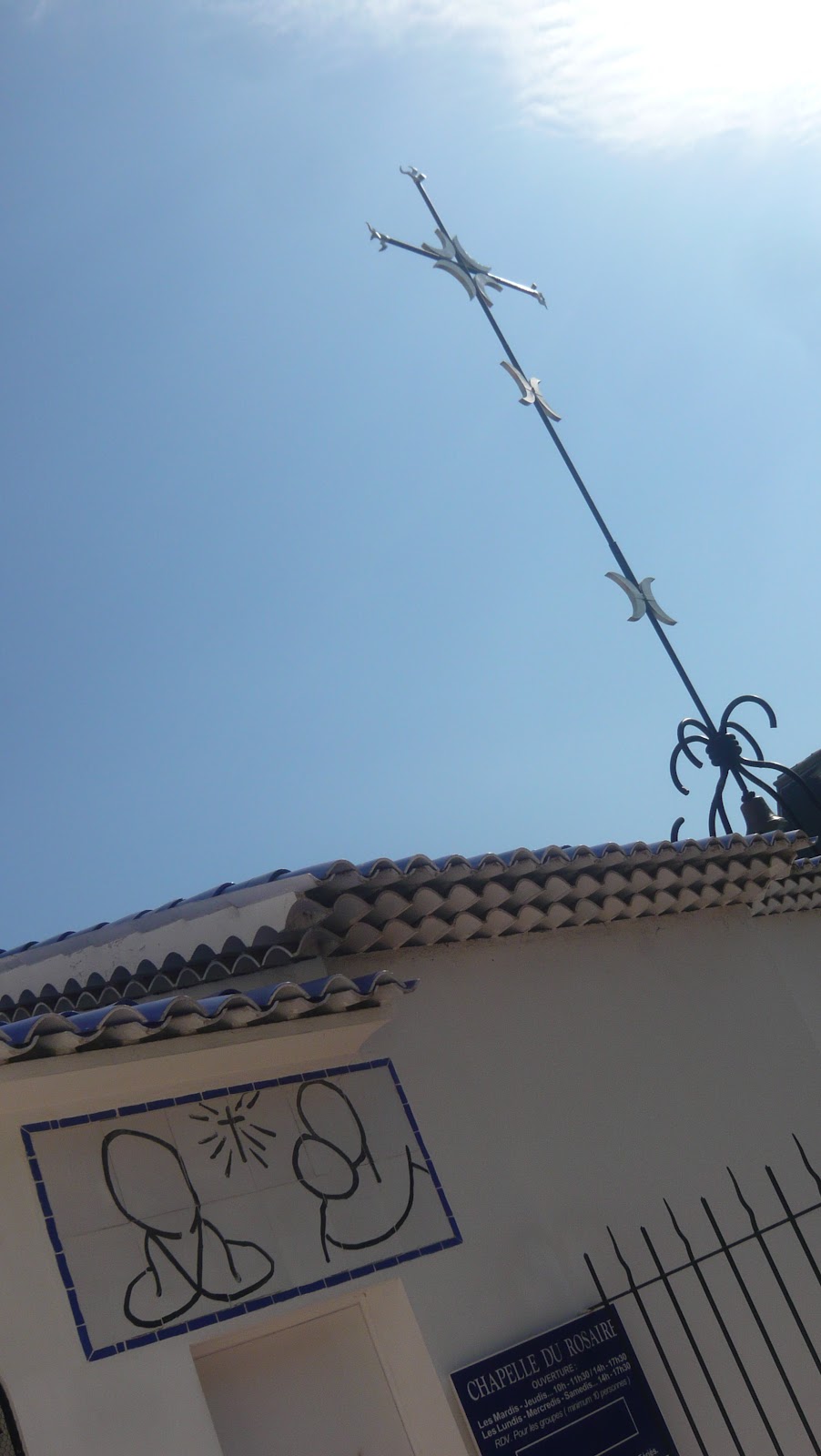
‘Simple colours,’ Henri Matisse wrote, ‘can affect the innermost feelings, their impact being all the more forceful through their simplicity.’ The spiritual expression of the blues, greens and yellows he used in the stained glass of the chapel struck him as unquestionable. His goal ‘was to find a balance between a light surface and colour with a solid wall of black-on-white line drawing.’ The line drawings on ceramic tiles of both St Dominic and the Virgin and Child he thought to have a ‘tranquil reverent nature all their own,’ while the great drama of Christ in the Stations of the Cross had made ‘his impassioned spirit overflow within the Chapel.’

Musée Chagall, Nice


On entering the rooms of the Message Biblique - first the room of Genesis and Exodus, then the Song of Songs - one is struck by the colours of the works before their content. Chagall viewed painting as the reflection of his inner self and therefore colour contained his character and message. In his museum inauguration speech he said, ‘If all life moves inevitably towards its end, then we must, during our own, colour it with our colours of love and hope.’ These are paintings which seek to dream by their colours and lines an ideal of fraternity and love. To be surrounded by these massive statements demonstrating - through content and construction - the potential of religion for reconciliation, was a wonderful and moving experience.


A stunning blend of old and new art and architecture is to be found at St Stephen Walbrook, Sir Christopher Wren’s masterpiece. Bombed in the Second World War and restored to its present magnificent state in 1981, twentieth century artists and craftsmen have adorned its interior. Henry Moore’s travertine marble altar now stands at the centre under Wren’s dome surrounded by dazzling kneelers from Patrick Heron. Moore’s altar design was intended for people to gather as a community around the altar where God could be found at the centre. Currently contemplation is aided by 'Lamentation for the Forsaken, 2016’, a digital art installation by Michael Takeo Magruder which evokes the memory of Syrians who have passed away in the present conflict by weaving their names and images into a contemporary Shroud of Turin.

What would your 10 choices be?

----------------------------------------------------------------------------------------------

Lavine Hudson - Flesh Of My Flesh.

Monday, 4 August 2014

Sabbatical art pilgrimage: Notre-Dame du Bon Conseil Lourtier


A chapel set on a mountainous site, ‘with a campanile that is slim, tall,rounded in plan and rendered, distinct from the main body of the church’; it has been suggested that this could be a description of Notre Dame du Haut in Ronchamp, the chapel famously built by Le Corbusier in 1954. Instead, this is a description of Notre-Dame du Bon Conseil at Lourtier in Switzerland built by the Italian architect Alberto Sartoris in 1932.

Dennis Sharp writes: ‘Born in Turin, Sartoris trained as an architect in Switzerland and became one of the leading theorists and writers of the Modern Movement. Sartoris was the man who put the word “functionalist” into the architectural vocabulary …

"Our” movement in this context means the modern tendency started by the group of architects under Le Corbusier. The Functionalist Group was officially founded at La Sarraz in 1928 and called CIAM (Congrés Internationaux d’Architecture Moderne) …

Alberto Sartoris was Le Corbusier’s choice as the Italian representative to CIAM.’


Prior to Maurice Novarina’s Church of Notre-Dame de Toute Grâce du Plateau d'Assy and more radical in design, this was the first modern church in an Alpine setting. As a young architect, Sartoris agreed to rebuild, for a modest sum, the original church which had been destroyed by fire. He had the support of the villagers and the clergy but, once consecrated, his design was attacked in the Gazette de Lausanne under the title of ‘The scandal Lourtier’.

This attack on Sartoris’ design would have been because of the factors which Thomas Muirhead has identified as characterizing his work: ‘Sartoris believed that modernist architecture must be based on a renunciation of useless and superfluous elements, a respect for true tradition, an harmonious distribution of line and colour, a rhythmical mastery of contrast and assonance, and the investigation of a specific style.’ Accordingly Sartoris’ design for Notre-Dame du Bon Conseil is clean, spare and minimalist. Internally, the church is a simple white rectangle with a sleek arched wooden roof. Both the ceiling’s planks and the grey-painted wooden pews draw the eye to the sanctuary wall containing two large stained glass windows by Albert Gaeng.

The Futurist painter Fillia wrote that Sartoris’ plans for a Cathedral in Fribourg showed the direction that modern sacred architecture should take. His description of these plans as ‘a play of volumes that define an absolutely original rhythm and achieve a result of constructive severity that is of the greatest significance’ could equally apply to Sartoris’ achievement at Lourtier. Fillia and Sartoris collaborated on publications to do with futurism and architecture. In one such article, published in November 1932, Fillia gave notice that Sartoris had selected one of his ‘religious works to decorate a new Rationalist church he has constructed’. This was a mural based on Fillia’s painting Nativity-Mystical-Motherhood of 1932 which was originally in the sanctuary recess between Gaeng’s two windows. The mural has since been painted over and replaced by a small sculpture.

Between 1928 and 1930 the futurist artist Fillia spent time in Paris with Gino Severini. During this time he also saw Severini's work in the Swiss churches of Semsales and La Roche. The end of 1930 then saw a decisive reorientation of Fillia's work towards sacred art which culminated in 1931 with the publication of the 'Manifesto of Futurist Sacred Art' on the occasion of the International Exhibition of Modern Christian Sacred Art in Padua, which had a Futurist section of twenty two works by thirteen artists.
 
By these means the anti-clerical art of the Futurists inspired a flowering of religious painting that constitutes one of the most unexpected episodes in the history of that movement. Futurism eulogised the beauty of speed and the energies and machines that produced it. Futurists saw themselves as “immersed in the chaos of an old, crumbling era” but “partaking of the vibrations of a new epoch in the process of formation.” They embraced continual progress and viewed Catholic priests as fatally associated with old order hating “the fleeting, the momentary, speed, energy and passion.” Not fertile ground for a flowering of religious art, one would have thought.

Yet Marinetti, the great theorist of Futurism, maintained a significant distinction between Christ and the Catholic Church that led to the explosion of Futurist religious art which appeared in the 1930s. The “precious essence of Christ’s morals,” he argued, “accorded every right, every pardon and every sympathy to the impassioned fervour, to the fickle flame of the heart.”

Marinetti’s ‘Manifesto of Futurist Sacred Art’ appeared in 1931 and further exacerbated the movement’s conflict with the Catholic Church by stating that “only Futurist artists … are able to express clearly … the simultaneous dogmas of the Catholic faith, such as the Holy Trinity, the Immaculate Conception and Christ’s Calvary.” Pope Pius XI responded in a speech of 1932 by saying that ”Our hope, Our ardent wish, Our will can only be … that such art will never be admitted into our churches …”

Marinetti had argued that only Futurists could express the simultaneous dogmas of the Catholic faith because only they had “addressed the complex matter of simultaneity” in their art. 

Accordingly, a key feature of Futurist sacred art is the bringing together within the same picture frame of key events from the life of Christ. The convoluted titles of many of these works, such as Fillia’s 'Madonna and Child / Nativity / Nativity-Death-Eternity', indicate clearly the telescoping of events that can be found in these works. This work sets an semi-abstract/cubist Madonna and Child in front of a sky-filled cross in front of a mountain in front of a rock in front of a globe ringed by the outlines of churches as seen through the ages. Marinetti described this work as “an impressive amalgamation of the concrete and the abstract; a synthesis of the long development of Catholicism through the centuries.”

It is, when set alongside other works by Fillia, an example of a set of identikit symbols – saint, cross, globe, mountain, churches – that several Futurists juggle in works that sit uncomfortably between the later cubism of Gleizes and the surrealism of Giorgio de Chirico. Not all Futurist sacred art is of the poster book style and imagery of Fillia however. Giuseppe Preziosi, for example, also used simultaneity in his Annunciation-Nativity-Death but here the subtler harmonies of his colours combine with the interpenetrating planes of his subjects to integrate Christ’s birth and death within the work.

Gerardo Dottori, known as the ‘mystic’ Futurist, made use of similar techniques to create in his 'Crucifixion' of 1928 one of the genuine masterpieces of Futurist sacred art. His crucified Christ is picked out in a heavenly spotlight which also surrounds the two Mary’s grieving at his feet. Light also emanates from the upper half of Christ’s body and outstretched arms illuminating the darkened sky that has thrown the landscape of Calvary into turmoil. Dottori’s stylistic use of light symbolises both Christ’s obedience to God’s will and the light of salvation that his death brings into a world darkened by sin.

Dottori also makes use of a second key theme in Futurist sacred art; that of flight as a symbol of transcendence. His Annunciation in an Aerial Temple sees Mary literally caught up in her spirit by the news that Gabriel brings (an anticipation of her own Assumption, perhaps) and gives us an angelic perspective on the event. Aeropainting was a major strand of Futurist art and this interest in flight became a symbol firstly of physical liberation from the earth and then of spiritual ascent. The Trinity, the Madonna, as well as the expected Angels, all appear winged and in flight within these works.

One of the most striking of all the flight images is Nino Vatali’s Ascension where Christ ascends on the cross in stop-frame images that build a Jacob’s ladder ascending to the heavens. Whether the imagery of the cross as a ladder from earth to heaven was consciously in Vitali’s mind as he painted or whether he was simply transposing a Futurist technique with a sacred theme, the image and imagery remain powerful.

Only Futurist aeropainters, Marinetti argued, “are able to express in plastic terms the abyssal charm and heavenly transparencies of infinity.” Again, his rhetoric tends to exceed the resulting works but, for all that, their Futurist sacred art forms a fascinating subject that extends our understanding of the influence of sacred themes and imagery in early twentieth century European art even where artists and the Church were conflicted.

Gaeng, by contrast with these artists, was part of the St Luc Group which had been founded by Alexandre Cingria. Sartoris knew Cingria but said in one interview that, when he saw Cingria’s work at St-Martin de Lutry-Paudex, he felt no religious feeling, making the choice of Gaeng, for Lourtier, a surprising one. After completing at the Ecole des Beaux Arts in Geneva he went to Paris to study at the Atelier de l’Art Sacré set up by Maurice Denis and Georges Desvalliéres. After meeting Antoine Bourdelle and Gino Severini, he assisted Severini with the decoration of St Nicholas Semsales. The St Luc Group also contributed to the decoration of Semsales. From 1926 to 1936 Gaeng was almost entirely devoted to the decoration of churches (stained glass, mosaics and frescos) in the cantons of Vaud, Valais, Fribourg and Jura.

Gaeng’s sanctuary windows, which depict St George on the left and St John the Evangelist before the Porta Latina on the right, are dark, dramatic and dense in detail. Coloured lines of force and movement cross rectangles constructed without significant use of lead lines. His later windows from 1956 which depict the Litany of the Blessed Virgin Mary are, by contrast, lighter, brighter and with a futurist energy and aspect. Gaeng then supplements the figurative windows with purely abstract designs that draw on the coloured grids of Mondrian.

Lourtier is to be found among the imposing alpine architecture of snow-capped peaks in the Val de Bagnes, one of Switzerland's largest nature reserves. Opposite Notre-Dame du Bon Conseil is a viewing area with panoramic views looking down the valley, the river falling steeply away under the bridge connecting two halves of the village. Erratic roofs straddle narrow switchback roads surrounded by kush terraced pastures; old traditions and untamed nature living side by side.

I arrived at the end of the afternoon to find the mountain sunshine flooding the empty church; then drove further on and further up to find a hotel so I could return for Mass on Sunday morning. Here, the simplicity of the Mass which impressed itself on me. The liturgy spoke for itself; no incense, no choir, just a priest speaking conversationally to his people and responses from the 70 strong congregation. There is no scandal of Lourtier; instead the triumph of Lourtier is an influential design coupled with a dramatically beautiful building that is well suited to the liturgy and well used by its people.

----------------------------------------------------------------------------------------------

Bill Fay - This World.