Wikio - Top Blogs - Religion and belief
Showing posts with label wren. Show all posts

Friday, 15 September 2017

The shaping of space and time by music, instruments and architecture

Rehearsal-Photo Malene Skaerved

Peter Sheppard-Skaerved reflects on the first event of ‘Preludes & Vollenteries’, which took place last night at St Stephen Walbrook:

"An inspiring start to this exploration of 17th Century music, architecture and instruments. There’s so much to discover, but what strikes me most of all, the morning after the event, is the shaping of space and time, that the music, the instruments and the building, in combination demands; and, perhaps most of all, how that develops, deepens, when the space is a listening space-when we (performer and audience) listen to each other, listening to each other, listening to the space. Even in the very centre of London, there’s no limit to how quiet this listening can take the music. For me, a revelation."

‘Preludes & Vollenteries’ is a series of salons inspired by the architecture of the Square Mile, the astonishing churches built and restored in the years after the Great Fire of 1666. Yesterday’s concert brought together music by musicians whose careers flowered in London and works by composer/violinists published in the ‘Square Mile’ at the end of the 17th Century.

Listen to last night's concert by clicking here. The next concert will be 6pm on the 29th September at St Margaret Lothbury.

--------------------------------------------------------------------------------------------------

Peter Sheppard-Skaerved - Voil Qe'm Digaz Cals Mais Vos Plaz.

Tuesday, 17 January 2017

Discover & explore: Sir Christopher Wren (Architecture)


Yesterday's Discover & explore service at St Stephen Walbrook, led by Revd Sally Muggeridge, explored architecture and the achievements of Sir Christopher Wren. The service featured the Choral Scholars of St Martin-in-the-Fields singing Blessed is the man by Stainer, Cantate domino by Monteverdi, Locus iste by Bruckner and Nolo mortem peccatoris by Morley.

Next week's Discover & explore service is on Monday 23 January at 1.10pm when I, together with the Choral Scholars, will explore the theme of preaching through the teachings of the Puritan cleric, Thomas Watson.

Sally introduced yesterday's service by saying:

'It is perhaps understandable that buildings, and indeed cities, play a prominent role in the Bible. Indeed they play an important part in human development. Long before the industrial revolution, the invention of the internal combustion and jet engine, the motor car, the airplane and space travel building was the principal focus of man’s creativity. And not just two thousand years ago at the time of Jesus Christ, but right back in the book of Genesis we read ‘come let us make bricks and burn them thoroughly’. Even today a badly baked brick has no durability and strength. And buildings by their nature need careful planning, and must adhere to certain principles to ensure the safety of their occupants, and they must resist the extremes and variations of weather. So architecture, the planning and specification of buildings, is perhaps as old as man’s wish to build. But we also know we cannot look to any building, however majestic, for permanence. Buildings are by nature, like us, transitory, here today and gone tomorrow. In the search for true permanence and stability, in wishing to build Jerusalem in England’s green and pleasant land, we must look to God.'

The Service included a bible reading from 1 Kings 6:

Now it came about in the four hundred and eightieth year after the sons of Israel came out of the land of Egypt, in the fourth year of Solomon's reign over Israel, in the month of Ziv which is the second month, that he began to build the house of the LORD. The porch in front of the nave of the house was twenty cubits in length, corresponding to the width of the house, and its depth along the front of the house was ten cubits. Now these are the foundations which Solomon laid for building the house of God. The length in cubits, according to the old standard was sixty cubits, and the width twenty cubits. The width of the entrance was ten cubits and the sides of the entrance were five cubits on each side. And he measured the length of the nave, forty cubits, and the width, twenty cubits. And the house which King Solomon built for the LORD, the length thereof was three score cubits, and the breadth thereof twenty cubits, and the height thereof thirty cubits.

and the following extract from the acceptance speech of Thom Mayne as winner of the PritzkerPrize for Architecture:

'Architecture is a way of seeing, thinking and questioning our world and our place in it. It requires a natural inquisitiveness, an openess in our observations, and a will to act in affirmation. Like life, it is evolutionary, adapting, transforming, growing out of, but not enslaved by an over-investment in history.

The City is the most profound creation of humanity, continuously changing, evolving, mysterious and therefore in important ways unknowable - in its lack of fixity; in the unthinkable number of its random interactions, exchanges, encounters… in the sheer magnitude of the variety of intelligences. Here rests the potential of a true creativity where serendipity and spontaneous combustion take place. Our cities are the location of continuous regeneration, places of infinite possibilities, demanding from us an attitude of expansiveness. Yet we seem to find ourselves in this twenty-first century, infused by fear, immobilised by the complexity of the realities that come with living in the present… the now ... insisting instead on seeing our diverse society through a simplistic lens ... resistive to reality, demanding uniformity in the face of diversity.

And the refuge, as it has always been within these cycles, is in nostalgia—a desire for an illusion of order, consistency and safety, qualities we last enjoyed in childhood. But this is temporary. I’ve felt the intoxication that happens when an entire generation decides to stop looking backward for its direction. One needs to look to artists to remind us that we are all moving forward, empowered and able. I’m chasing an architecture that engages and demands inquiry. Architecture is not passive, not decorative. It is essential, it affects us directly and profoundly—it has the potential to impact behaviour and the quality of our everyday life.'

----------------------------------------------------------------------------------------------

Locus iste - Anton Bruckner.

Thursday, 15 December 2016

Discover & explore services: Spring 2017 series


Discover & explore services at St Stephen Walbrook feature music and liturgy with the Choral Scholars of St Martin-in-the-Fields. These services explore their themes through a thoughtful mix of music, prayers, readings and reflections:
  • “A perfect service of peace in our busy lives.”
  • “Spiritual food in the middle of the day.”
  • “Beautifully and intelligently done.”
The next series of these services of musical discovery will explore significant figures in the history of St Stephen Walbrook.

All Discover & explore services begin at 1.10pm:
  • 9 January – John Dunstable (Music) 
  • 16 January - Sir Christopher Wren (Architecture) 
  • 23 January – Thomas Watson (Preaching) 
  • 30 January – Sir John Vanbrugh (Drama) 
  • 6 February - Thomas Wilson (Patronage) 
  • 13 February – Half Term break 
  • 20 February – George Croly (Poetry) 
  • 27 February – George Griffin Stonestreet (Insurance) 
  • 6 March – Robert S. de Courcey Laffan (Sport) 
  • 13 March – Chad Varah (Charity) 
  • 20 March – Henry Moore (Sculpture) 
  • 27 March – Lanning Roper (Gardening) 
  • 3 April - Patrick Heron (Art) 
  • 10 April – Peter Delaney (Internet)
Discover & explore is “like a little jewel with a number of facets drawing us in and lighting our path.”

----------------------------------------------------------------------------------------

John Dunstable - Quam Pulchra Est.

Thursday, 24 November 2016

International Animal Rescue - winners of the JustGiving ‘Charity of the Year’ award


Many congratulations to International Animal Rescue who have won the JustGiving ‘Charity of the Year’ award.

You can join International Animal Rescue in a celebration for all the animals at Christmas. Traditional carols, music from the fabulous Massive Violins, mulled wine and mince pies plus readings by special guests including actor Peter Egan - will all make for a wonderful Christmas evening. Set in St Stephen Walbrook, one of Sir Christopher Wren's most stunning churches, the evening is a chance to celebrate Christmas and the animal kingdom. Sing your heart out this Christmas whilst raising money for the work of International Animal Rescue which rescues animals from cruelty and suffering around the world.

----------------------------------------------------------------------------------------------

Wednesday, 23 November 2016

Fire & Phoenix


"In this captivating drama, playwright Kate Glover has brought back the time and place, capturing not only the immensity of the event, but also the sometimes shocking human dramas it produced ... The company of 8 talented actors essay a total of 18 characters, a complex director’s juggling act, expertly handled ... The sparingly used, but threatening sound of the fire was a leitmotif I found very powerful. Beautifully costumed and lit, and with some lovely artwork by Sharon Lovett Lampi on the backcloth, the company are to be congratulated on this showing. It augurs well for their onward itinerary which includes the ‘fire churches’, surely to be one of the events of the season." (Saul Reichlin)

Fire & Phoenix is at St Stephen Walbrook on Wednesday 23 November, 7.30pm. Tickets £15 (£12 concessions) available on the door.

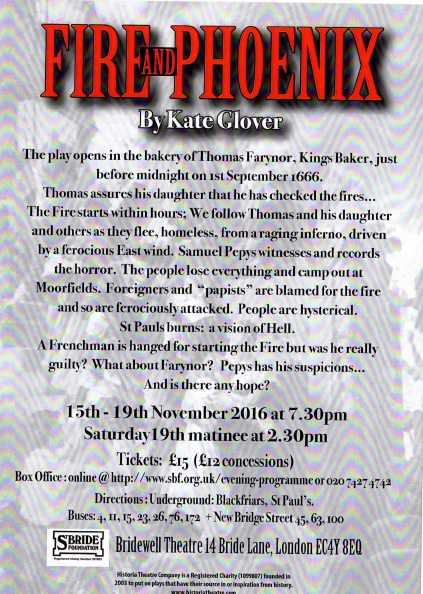
Fire & Phoenix is a new play to mark the 350th anniversary of the Great Fire of London. The play opens in the bakery of Thomas Farynor, King's Baker, just before midnight on 1 September 1666. It's a swelteringly hot night. There has been no rain for months. Thomas assures his daughter that he has checked the fires...

The fire starts within hours; for three days it rages terrifyingly, helped by a ferocious East wind. Lord Mayor Bludworth is useless. Samuel Pepys takes practical measures, and liaises with the King, Charles II. The people lose everything and camp out at Moorfields. Foreigners and 'papists' are blamed for the fire and so are ferociously attacked. People are hysterical. St Paul's burns: a vision of Hell.

A Frenchman is hanged for starting the fire, but was he really guilty? What about Farynor? Pepys has his suspicions...

Despite the toll of 89 churches, 1300 houses and 200,000 people made homeless, Christopher Wren, in a moving final scene with Pepys, has a strong sense of hope, and believes that London, like the Phoenix, will rise from the ashes.

Historia Theatre Company is Registered Charity 1099807, founded in 2003 to put on plays that have their source in or inspiration from history. Previous productions include Evelina (2004), Five Eleven (2005), An African’s Blood (2007-8), Judenfrei: Love and Death in Hitler’s Germany (2010-11), The Sound of Breaking Glass (2012-13), Queen Anne (2014), Magna Carta (2015).

-------------------------------------------------------------------------------------------

Ralph McTell - Streets of London.

Monday, 7 November 2016

London's Burning and Fire & Phoenix


London's Burning is a Great Fire 350th Anniversary Concert on 12th November 2016 at 7.30pm in St Stephen Walbrook. Join the Myriad Singers “at the scene” to commemorate the Great Fire of London 1666. Hear John Tavener's stunning but rarely-heard piece 'The World is Burning' for choir and tam-tam. Music contemporary with the Great Fire from Tomkins, Locke and Blow and pieces by Monteverdi, Gesualdo and Lauridsen, interspersed with readings of eye-witness accounts of the Great Fire.

Fire & Phoenix is a new play to mark the 350th anniversary of the Great Fire of London.

The play opens in the bakery of Thomas Farynor, King's Baker, just before midnight on 1 September 1666. It's a swelteringly hot night. There has been no rain for months. Thomas assures his daughter that he has checked the fires...

The fire starts within hours; for three days it rages terrifyingly, helped by a ferocious East wind. Lord Mayor Bludworth is useless. Samuel Pepys takes practical measures, and liaises with the King, Charles II. The people lose everything and camp out at Moorfields. Foreigners and 'papists' are blamed for the fire and so are ferociously attacked. People are hysterical. St Paul's burns: a vision of Hell.

A Frenchman is hanged for starting the fire, but was he really guilty? What about Farynor? Pepys has his suspicions...

Despite the toll of 89 churches, 1300 houses and 200,000 people made homeless, Christopher Wren, in a moving final scene with Pepys, has a strong sense of hope, and believes that London, like the Phoenix, will rise from the ashes.

Historia Theatre Company is Registered Charity 1099807, founded in 2003 to put on plays that have their source in or inspiration from history. Previous productions include Evelina (2004), Five Eleven (2005), An African’s Blood (2007-8), Judenfrei: Love and Death in Hitler’s Germany (2010-11), The Sound of Breaking Glass (2012-13), Queen Anne (2014), Magna Carta (2015).

Fire & Phoenix is at the Bridewell Theatre from 15 - 19 November, then tours 'Fire' Churches including St Stephen Walbrook on Wednesday 23 November, 7.30pm. Tickets £15 (£12 concessions) available on the door. To reserve places, email priest@ststephenwalbrook.net.

----------------------------------------------------------------------------------------------

Morten Lauridsen - Sure on this Shining Night.

Saturday, 29 October 2016

Fire & Phoenix


Fire & Phoenix is a new play to mark the 350th anniversary of the Great Fire of London.

The play opens in the bakery of Thomas Farynor, King's Baker, just before midnight on 1 September 1666. It's a swelteringly hot night. There has been no rain for months. Thomas assures his daughter that he has checked the fires...

The fire starts within hours; for three days it rages terrifyingly, helped by a ferocious East wind. Lord Mayor Bludworth is useless. Samuel Pepys takes practical measures, and liaises with the King, Charles II. The people lose everything and camp out at Moorfields. Foreigners and 'papists' are blamed for the fire and so are ferociously attacked. People are hysterical. St Paul's burns: a vision of Hell.

A Frenchman is hanged for starting the fire, but was he really guilty? What about Farynor? Pepys has his suspicions...

Despite the toll of 89 churches, 1300 houses and 200,000 people made homeless, Christopher Wren, in a moving final scene with Pepys, has a strong sense of hope, and believes that London, like the Phoenix, will rise from the ashes.

Historia Theatre Company is Registered Charity 1099807, founded in 2003 to put on plays that have their source in or inspiration from history. Previous productions include Evelina (2004), Five Eleven (2005), An African’s Blood (2007-8), Judenfrei: Love and Death in Hitler’s Germany (2010-11), The Sound of Breaking Glass (2012-13), Queen Anne (2014), Magna Carta (2015).

Fire & Phoenix is at the Bridewell Theatre from 15 - 19 November, then tours 'Fire' Churches including St Stephen Walbrook on Wednesday 23 November, 7.30pm. Tickets £15 (£12 concessions) available on the door. To reserve places, email priest@ststephenwalbrook.net.

-----------------------------------------------------------------------------------

The Crazy World of Arthur Brown - Fire.

Friday, 16 September 2016

Great Fire 350: Radio 4 Sunday Worship & Songs of Praise


It's not too late to listen to 'Phoenix from the Ashes', the BBC Radio 4 Sunday Worship service that I led at St Stephen Walbrook to mark the 350th anniversary of the Great Fire. The service features the Bishop of London Richard Chartres preaching on the theme of the Great Fire.
The BBC were back at St Stephen Walbrook this morning to record material for the edition of Songs of Praise which will also mark Great Fire 350. The Great Fire of London in 1666 was described as an act of God and in this edition Pam Rhodes will explore why and discovers the new city churches that formed the heart of the city that rose from the ashes.

Early on Sunday, 2nd September 1666, a fire in a bakery near London Bridge became out of control and a strong wind fanned the flames westward. Not only the wooden houses, but warehouses, public buildings and churches were consumed in the fierce heat - molten lead running in the gutters, while stone was burnt to lime. The Great Fire destroyed over three quarters of the City.

A large number of the City Churches were rebuilt, many designed by Sir Christopher Wren, including one of his most famous, St Stephen Walbrook.

The ever increasing range and diversity of Christian worship in the City Churches today was celebrated in the Radio 4 service by including contributions from some of the newer priests in the City, including Rev David Ingall from St Sepulchre's, and Revd Sally Muggeridge from St Stephen's.

--------------------------------------------------------------------------------------

Illuminare Choir - Ubi Caritas.

Sunday, 13 March 2016

10 best places for reflection

In today's Observer Aaron Rosen chooses his 10 best places for reflection. From Reykjavik to Tate Modern, he looks at spaces to inspire contemplation during Lent.

Aaron has some great choices but his choices are clearly intended to prompt reflection among his readers on the choices they would make, so here is my top 10:

l’Abbaye de la Fille Dieu, Romont


Brian Clarke says that stained glass ‘can transform the way you feel when you enter abuilding in a way that nothing else can!’ I would concur, especially after arriving at l’Abbaye de la Fille Dieu in time for a memorable service of Vespers followed by silent contemplation in the still onset of darkness falling.Tomas Mikulas, the architect on the restoration of this Cistercian Abbey, has stated that the overall goal of the restoration was to offer both nuns and visitors an ‘atmosphere conducive to meditation and prayer.’ Mikulas suggests that it is the ‘warm and vibrant atmosphere’ created by Clarke’s windows ‘with the changing light of day’ that ‘makes a decisive contribution’ to the space and to the restoration as a whole.

Chapelle Sainte-Thérèse-de-l'Enfant-Jésus et de laSainte-Face, Hem


Alfred Manessier was a lyrical abstractionist who thought of stained glass less as a design than as “the simultaneous creation of a light-filled architectural unit, thought-out and created by the painter at one go.” In this way he wanted "to express man’s inner prayer.” Chapelle Sainte-Thérèse-de-l'Enfant-Jésus et de laSainte-Face in Hem is an attempt to create spiritual space - a sense of prayer and a glimpse of heaven – through the play of light and colour within the building.


Pleshey was the first Diocesan Retreat House to be established in the country. Amongst the list of Retreat conductors is Evelyn Underhill. Arguably the most distinguished Conductor of that time, it is largely due to Underhill that the Retreat house became so popular. When you come to the Retreat House in Pleshey you sense an atmosphere created by six hundred years of prayer. For me, it is a special place because of ordination and cell group retreats.


Down dimly-lit stairwells / into a cavernous immensity / of curved brick, concrete and darkness / to stand still, transfixed, / in silent expanse / focused on the glow / and gleam / of the white stone table / over which / the crucified Christ hangs / from concrete cross-beams. / Morning light softly infiltrates, / casting shadows, / bringing the dawn ... The space and acoustic / act and appear as /
the inside of a hi-fi speaker; / the lantern, like an industrial chimney, / funnels the aromatic incense /
of prayer and praise / to tease and to please / the senses of God.

St Benet's Chapel


Adam Kossowski's murals at St Benet's Chapel fill the entire wallspace of this circular chapel surrounding and enveloping worshippers with their imagery. When services are held, however, the altar table is located in front of the panel depicting worship in heaven of the lamb that was slain. In this way, worship on earth is conducted in the context of worship in heaven. This work is about rescue, redemption and salvation. Fr. Edward Maguire has written, 'From clay and fire he forged a vision of the past, present and future to lift up and inspire countless others ... May we be inspired by him to use our gifts as he used his."

Notre-Dame du Bon Conseil, Lourtier


Lourtier is to be found among the imposing alpine architecture of snow-capped peaks in the Val de Bagnes, one of Switzerland's largest nature reserves. I arrived at the end of the afternoon to find the mountain sunshine flooding the empty church. Alberto Sartoris’ design for Notre-Dame du Bon Conseil is clean, spare and minimalist. Internally, the church is a simple white rectangle with a sleek arched wooden roof. Both the ceiling’s planks and the grey-painted wooden pews draw the eye to the sanctuary wall containing two large stained glass windows by Albert Gaeng. The triumph of Lourtier is an influential design coupled with a dramatically beautiful building that is well suited to the liturgy and well used by its people.

The Crypt of Colònia Güell


The Crypt of Colònia Güell is a warm, womb-like enclosure; intimate yet archetypal. It is real and usable communal space while also being of great architectural worth, innovation and beauty. Here the ‘heaven in ordinarie’ of the Eucharist is celebrated in the surround of natural forms recreated by man-made means. 'Gaudí based his buildings on a simple premise: If nature is the work of God, and if architectural forms are derived from nature, then the best way to honor God is to design buildings based on his work. As the Barcelona scholar Joan Bassegoda Nonell notes, "Gaudí's famous phrase, 'originality is returning to the origin,' means that the origin of all things is nature, created by God."'

Chapelle du Rosaire, Vence


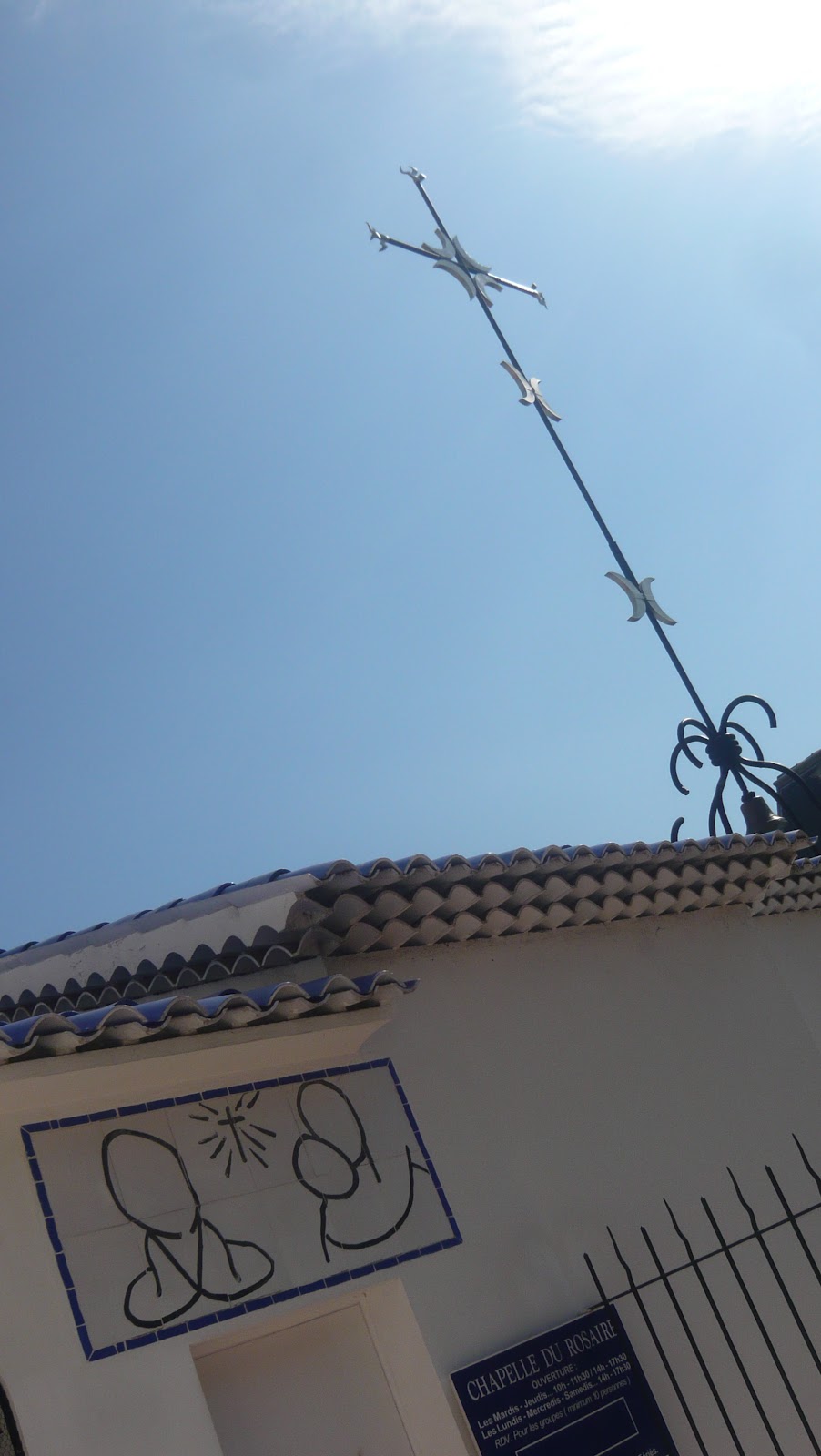
‘Simple colours,’ Henri Matisse wrote, ‘can affect the innermost feelings, their impact being all the more forceful through their simplicity.’ The spiritual expression of the blues, greens and yellows he used in the stained glass of the chapel struck him as unquestionable. His goal ‘was to find a balance between a light surface and colour with a solid wall of black-on-white line drawing.’ The line drawings on ceramic tiles of both St Dominic and the Virgin and Child he thought to have a ‘tranquil reverent nature all their own,’ while the great drama of Christ in the Stations of the Cross had made ‘his impassioned spirit overflow within the Chapel.’

Musée Chagall, Nice


On entering the rooms of the Message Biblique - first the room of Genesis and Exodus, then the Song of Songs - one is struck by the colours of the works before their content. Chagall viewed painting as the reflection of his inner self and therefore colour contained his character and message. In his museum inauguration speech he said, ‘If all life moves inevitably towards its end, then we must, during our own, colour it with our colours of love and hope.’ These are paintings which seek to dream by their colours and lines an ideal of fraternity and love. To be surrounded by these massive statements demonstrating - through content and construction - the potential of religion for reconciliation, was a wonderful and moving experience.


A stunning blend of old and new art and architecture is to be found at St Stephen Walbrook, Sir Christopher Wren’s masterpiece. Bombed in the Second World War and restored to its present magnificent state in 1981, twentieth century artists and craftsmen have adorned its interior. Henry Moore’s travertine marble altar now stands at the centre under Wren’s dome surrounded by dazzling kneelers from Patrick Heron. Moore’s altar design was intended for people to gather as a community around the altar where God could be found at the centre. Currently contemplation is aided by 'Lamentation for the Forsaken, 2016’, a digital art installation by Michael Takeo Magruder which evokes the memory of Syrians who have passed away in the present conflict by weaving their names and images into a contemporary Shroud of Turin.

What would your 10 choices be?

----------------------------------------------------------------------------------------------

Lavine Hudson - Flesh Of My Flesh.

Monday, 8 February 2016

Foundations of the City: Exhibition reception


The opening night reception for Alan Everett's exhibition 'Foundations of the City' was held tonight at St Stephen Walbrook.

Sam Wells, Vicar of St Martin-in-the-Fields, was the main speaker at the reception. He spoke about the six pieces in the show which depict the cross referring to The Dream of the Rood, which was the original inspiration for three of these works.

The phrase 'The Dream of the Rood', he said, has "a double meaning: on the one hand it's an account of a person dreaming about the personified cross; on the other, we are all part of the rood's dream - we are all companions of Christ, bearing his scars and sorrows."

He explored Alan's work in terms of:

  • the cross, for all its gruesome pain and agony, as depiction of "a realm of existence more textured, more interwoven, than the dullness of a regular life";
  • the cross as "a victory won at a terrible price";
  • "a cross in the heart of God since the foundation of the world";
  • the cross as "the ruin of sin, the ugliness of evil, the destruction of creation";
  • the cross as "salvaging true faith from doubt, true identity from obscurity, true Christianity from the accretions of history, tradition or culture"; and
  • the cross become "a new creation". 

By way of introducing the evening I said the following:

For over eight hundred years a place of worship has stood on this site witnessing to the power of God in people’s lives. Sir Christopher Wren’s masterpiece, the present church is the fourth to have stood here. Bombed in the Second World War and restored to its present magnificent state in 1981, twentieth century artists and craftsmen have adorned its interior. That is why Henry Moore’s travertine marble altar now stands at the centre under Wren’s dome usually surrounded by dazzling kneelers by Patrick Heron (although those are currently away undergoing repair and restoration).

Henry Moore’s altar design was intended, as you can see, for people to gather as a community around the altar where God could be found at the centre. God at the centre of our lives and communities is what we seek to celebrate through all that we do here at St Stephen Walbrook.

The stunning blend of old and new art and architecture to be found at St Stephen Walbrook draws significant numbers of tourists and other visitors’ year in and year out. William Newman’s dark wood panelling provides a dramatic backdrop to the regular programme of contemporary art exhibitions that the church hosts. The temporary exhibitions that we host add to the experience enjoyed by those who visit and aid the prayer and reflection for those of us who frequent this space regularly.

For these exhibitions, we partner with established art societies (such as the National Society of Painters, Sculptors & Printmakers or the Society of Catholic Artists) or artists with an interest in St Stephen Walbrook and our spirituality. In 2016 our programme begins with this show and will also feature solo shows by the stuckist artist Joe Machine, Brazilian artist Kim Poor, and group shows by the National Society and commission4mission.

In addition, during Lent, we will host the 13th Station in an exhibition of Stations of the Cross at 14 iconic locations in Central London. ‘Lamentation for the Forsaken, 2016’ is a digital art installation by Michael Takeo Magruder which evokes the memory of Syrians who have passed away in the present conflict, by weaving this names and images into a contemporary Shroud of Turin. Stations of the Cross 2016 will be launched tomorrow at Kings College Chapel Strand Campus and begins on Ash Wednesday. As part of Stations of the Cross 2016, we will hold an event discussing the current refugee crisis next Monday at which the artist will speak alongside Dionne Gravesande, Head of Church Advocacy at Christian Aid.

Alan Everett’s work, as you will see, also engages with current events by addressing experiences of persecution and martyrdom in our own time whilst also relating these current experiences to the foundational event for Christians of Christ’s crucifixion. In inviting Alan to exhibit here I was engaged by the organic nature of his work as he combines the deliberation of his rhythmic mark marking with the more random effects of drips and splashes; all cohering through his overall perception of the evolving work. This way of working is ideally suited to the exploration of construction and destruction, layering and fragmentation, life and death which is to be found in these works and this exhibition.

As a result, these paintings are a welcome and contemplative addition to the reflective and prayerful nature of this sacred space and will guide us in our meditation during Lent. Alan will share something of his inspiration and the motivations behind these works when he speaks about them here on Wednesday 4th March at 1.00pm. We will also explore their themes in worship through one of our Discover & explore services next Monday at 1.10pm.

-----------------------------------------------------------------------------------------------


Monday, 1 February 2016

Discover & explore: Hope


The first in a new series of Discover & explore services was held at St Stephen Walbrook today. These services, which feature the Choral Scholars of St Martin-in-the-Fields, explore their themes through a thoughtful mix of music, prayers, readings and reflections. Themes for the current series are based on Eric Whitacre's anthem 'Hope, Faith, Life, Love' and, as a result, this series of musical discovery explores the themes of hope, faith , life, love, dreams, joy, truth and soul.

Today's theme was Hope. Next week (Monday 8th February, 1.10pm) we will explore the theme of Faith in a service led by Revd Sally Muggeridge.

Here is the liturgy and reflection from today's service:

Opening responses

Truly the eye of the Lord is on those who fear him, on those who hope in his steadfast love. (Psalm 33:18)
Let your steadfast love, O Lord, be upon us, even as we hope in you. (Psalm 33:22)
For God alone my soul waits in silence, for my hope is from him. (Psalm 62:5)

Happy are those whose help is the God of Jacob, whose hope is in the Lord their God. (Psalm 146:5)

Reflection

Five sixths of the medieval part of the city of London, including 13,000 houses and 84 churches, were destroyed by the Great Fire of London that lasted 4 days in total. This was a disaster zone where everything was lost and people were in despair. Where is hope to be found in such a situation?

Of course, we know what happened. King Charles II invited architects, surveyors and engineers to present alternative plans. Although many of his plans were unrealised, Christopher Wren and others then rebuilt the City in a new way using better materials.

This is the starting point for an exhibition at the Royal Institute of British Architects entitled Creation from Catastrophe: How architecture rebuilds communities, which explores the varying ways that cities and communities have been re-imagined in the aftermath of natural or man-made disasters.

Disasters are frequent occurrences, “some natural, many more due to man’s ham-fisted neglect of the planet or our inability to get by without recourse to violence.” “The result is always the need for a new start, and how we respond and rebuild colours an uncertain future more than ever. Yet, for all the carnage and chaos that catastrophes bring, an odd truth is apparent: disasters do give us the chance to shape things differently.”

As a result, as Terry Eagleton writes in Hope without Optimism, “the most authentic hope is whatever can be salvaged, stripped of guarantees from a general dissolution.” It is whatever survives a general ruin. This is where we find the writer of Lamentations; bowed down with the reality of exile, yet trusting that it is in the nature of God to bring a new beginning from this disastrous affliction which is “wormwood and gall” to him. Similarly, Emily Dickinson claims that, hope is heard most sweetly in the Gale, “the chillest land” and “on the strangest Sea”.

The Palestinian poet Mourid Barghouti, reflecting on the Arab Spring, recently wrote: “Today, many see “hope” and “optimism” as obscene words.” Nevertheless he still finds “reasons to feel encouraged” despite the fact that, “the physical causes of the revolution on 25 January 2011 – corruption, tyranny and poverty – still exist, and have an uglier face.” In fact, the situation is so dire, he says, “that it is not sustainable; the revolution is still possible because nothing else is.”

Eagleton finds hope in the same place. Hope, he writes, “is to be found in the unfinished nature of the actual, discernible as a hollow at its heart.” “Potentiality is what articulates the present with the future, and thus lays down the material infrastructure of hope.” Hope is about a vision for a future that is different from the present; one which therefore requires imagination and vision. For Christians that vision is of the kingdom of God; which has begun to be realised but is still to come in its full reality.

As a result, in Theology of Hope Jurgen Moltmann argues that “Those who hope in Christ can no longer put up with reality as it is, but begin to suffer under it, to contradict it. Peace with God means conflict with the world, for the goad of the promised future stabs inexorably into the flesh of every unfulfilled present. If we had before our eyes only what we see, then we should cheerfully or reluctantly reconcile ourselves with things as they happen to be. That we do not reconcile ourselves, that there is no pleasant harmony between us and reality, is due to our unquenchable hope. This hope keeps man unreconciled, until the great day of the fulfillment of all the promises of God.

The Church, then, is intended to be “the source of continual new impulses towards the realization of righteousness, freedom and humanity here in the light of the promised future that is to come.” Our hope should “provide inexhaustible resources for the creative, inventive imagination of love.” It should constantly provoke and produce thinking of an anticipatory kind in love to humanity and the world, “in order to give shape to the newly dawning possibilities in the light of the promised future, in order as far as possible to create here the best that is possible, because what is promised is within the bounds of possibility.” “Thus it will constantly arouse the ‘passion for the possible’, inventiveness and elasticity in self-transformation, in breaking with the old and coming to terms with the new.” The Christian hope should always have “a revolutionary effect in this sense on the intellectual history of the society affected by it.”

“Wherever that happens, Christianity embraces its true nature and becomes a witness of the future of Christ.”

Intercessions


We pray for all those currently experiencing natural or man-made disasters and for whom life is wormwood and gall. By living all the way through these experiences of vulnerability may they find their way to a place of new beginning in which power can be plucked from weakness and life made fruitful once again. Lord, in your mercy, hear our prayer.

May we find in the unfinished nature of the present, a vision of a better future; a vision of the kingdom of God. Give us the imagination and vision we need to shape things differently and rebuild colours in an uncertain future. Lord, in your mercy, hear our prayer.

May your Church be a source of continual new impulses towards the realization of righteousness, freedom and humanity here in the light of the promised future that is to come. May we see the inexhaustible resources for the creative, inventive imagination of love that hope in you provides. Constantly arouse in us a ‘passion for the possible’, inventiveness and elasticity in self-transformation, by breaking with the old and coming to terms with the new. May this hope continue to have a revolutionary effect on the intellectual history of our society. Lord, in your mercy, hear our prayer.

Blessing

Places of new beginning, power plucked from weakness, life made fruitful once again, the realization of righteousness, freedom and humanity, resources for the creative, inventive imagination of love, visions of a better future, visions of the kingdom of God; and may those blessings of God almighty, the Father, the Son, and the Holy Spirit, be among you and remain with you always. Amen.

-------------------------------------------------------------------------------------------

Bob Chilcott - Even Such Is Time.

Friday, 15 January 2016

New doors at St Stephen Walbrook


This week St Stephen Walbrook has had new glass doors installed at the top of the stairs in its main entrance. These enable views from the street of our marvellous Wren interior which were not visible previously.

-------------------------------------------------------------------------------------

David Bowie - Changes.

Tuesday, 15 December 2015

Legal Aesthetics and the Architectural Ambiguities of St Stephen Walbrook


The Henry Moore altar at St Stephen Walbrook continues to prove controversial, if the description of a forthcoming Modernities: Architecture, Design, Theory Research Seminar in the Courtauld Institute of Art is an accurate reflection of the argument which Timothy Hyde (Massachusetts Institute of Technology) will make.

Hyde's seminar is entitled Legal Aesthetics and the Architectural Ambiguities of St Stephen Walbrook and will take place at 4.30pm on Friday 15 January 2016 in the Sackler Research Forum Seminar Room, The Courtauld Institute of Art, Somerset House, Strand, London WC2R 0RN.

Hyde will address the theme of incongruity in modern architecture through an examination of a significant but largely unrecognized act of postmodernism: the installation of an altar sculpted by Henry Moore in 1972 into a church designed by Christopher Wren in 1672. The implications of this installation test and exceed conventional frameworks of explication such as intentionality or style, and in so doing open a view onto intricate exchanges between otherwise incommensurable registers of judgment. Unfolding the complicated legal and aesthetic history of this particular architectural, sculptural, and theological act suggests possibilities for considering facets of architectural postmodernity outside of the disciplinary frameworks of architecture itself.

If Hyde genuinely believes Moore's altar to be incongruous in the context of one of Sir Christopher's Wren's masterpiece then he is at odds with the response of most people when they visit St Stephen Walbrook itself. The overwhelming majority of people I speak with at the church find the combination of modern and traditional art and architecture to be a stunning and sensitive harmonization of old and new.

Dr. Timothy Hyde is Clarence H. Blackall Associate Professor in Architectural History at the Massachusetts Institute of Technology. He is the author of Constitutional Modernism: Architecture and Civil Society in Cuba, 1933-1959, and is the chair of the Aggregate Architectural History Collaborative. Hyde’s work focuses on intersections of architecture and politics, with a particular attention to entanglements between architecture and law in the modern period. His current research project, “Dread of Beauty,” examines aesthetic debates on ugliness in Great Britain from the 17th
to the 20th century. His talk on St Stephen Walbrook is part of this research, which also includes his essay “Some Evidence of Libel, Criticism, and Publicity in the Architectural Career of Sir John Soane,” published in Perspecta. Hyde’s writings on modern architecture and architectural theory have also appeared in journals such as Log, Praxis, the Journal of Architectural Education (JAE), and Thresholds. Hyde has been a MacDowell Colony Fellow and his work has been supported by grants from the Graham Foundation. He received his BA from Yale University, MArch from Princeton University, and PhD from Harvard University.

The seminar has been organised by Dr Robin Schuldenfrei (Katja and Nicolai Tangen Lecturer in 20th Century Modernism, The Courtauld Institute of Art) and is open to all, Admission is free.

------------------------------------------------------------------------------------------

James MacMillan - A New Song.

Saturday, 14 November 2015

Society of Catholic Artists Private View


The Private View for the Society of Catholic Artist's 'Care of Creation' exhibition was held tonight at St Stephen Walbrook. I made the following remarks during the evening (using material from our website):

Welcome to St Stephen Walbrook in the City of London. For over a thousand years a place of worship has stood on this site. Sir Christopher Wren’s masterpiece, the present church is the fourth to have stood here. At the time of its building the great dome was unique in England and it was from this church that Wren developed his plans for St Paul’s Cathedral.

Here Sir John Vanbrugh is buried and many distinguished men of letters and of the arts have graced the life of this place. John Dunstable the composer and past merchants and Lord Mayors have been a part of its life.

There is a plaque to the Rev’d Robert Stuart de Courcey Laffan, who with Baron Pierre de Coubertin revived the Olympic Games in 1890. Bombed in the Second World War and restored to its present magnificent state in 1981, twentieth century artists and craftsmen have adorned its interior. Henry Moore’s travertine marble altar now stands at the centre under Wren’s dome surrounded by dazzling kneelers by Patrick Heron.

With an almost perfect acoustic for choral singing and a renowned organ famed for its regular recitals on Fridays at 12.30 pm for City workers, St Stephen stands witness next to the Lord Mayor’s residence and at the heart of the City it was built to serve. We seek to do this in a range of different ways, so, for example, on Tuesdays, between 7.30 and 9.30 am, there are ten minute reflections on work-based themes repeated every 15 minutes while, on Thursdays, the community gathers for a Sung Eucharist at 12.45 pm with mass settings designed to blend with its traditional liturgy and architectural environment. We also organise programmes exploring contemporary issues such as our current ‘Philanthropy in the City’ programme, a series of events including exhibitions, services and talks exploring both the history of philanthropy in the City and current opportunities for philanthropic activity. St Stephen is also the home of the London Internet Church and its ministry of prayer and praise.

The damaged St Stephen Walbrook needed repair after the war and until then the interior was filled with pews in dark stained wood and the conventional east end altar table with the reredos containing the Ten Commandments and paintings of the Old Testament figures of Moses and Abraham. The windows had been filled with stained glass and the pristine feeling of Christopher Wren’s classical building had become dark and Victorianised. The original clear glass windows reflecting the light had been lost and filled with stained glass.

In taking the controversial step of commissioning one of the world’s most original artists to devise a statement about belief as seen in the Walbrook altar was taking a risk. Dr Chad Varah and the people of St Stephens were engaged in a major social outreach programme in founding the Samaritans in 1953, a telephone ministry for those in serious trouble and they now wanted this iconic Wren building to express a theology of how they saw the gospel in relation to the workplace.

This meant that the 17th century placing of the altar away from the people with the priest standing with his back to the congregation no longer expressed what they felt to be the immanent nature of the God they worshipped and served. Thus Henry Moore conceived a centrally placed altar made of travertine marble cut from the very quarry which provided the marble for Michelangelo’s work.

By carving a round altar table with forms cut into the circular sides Moore suggested that the centre of the church reflected the Dome of the Rock in Jerusalem commemorating the sacrifice of Abraham and Isaac as a prefiguring of the sacrifice of Jesus Christ on the cross and the place for the offering of the Eucharist at the heart of Christian worship. This place was designed for people to gather as a community around the altar where God could be found at the centre.

This changed the way that Walbrook was to develop for the future, if you want to know what a community believe see how they worship. The restoration itself cost £1. 3. Million. The altar measuring 8ft across and weighing several tons was at the centre of a controversy and court case as a result of objections and eventually was resolved by going to the highest ecclesiastical court of the land, the Court of Ecclesiastical Cases Reserved where the judges ruled that the Moore altar was acceptable as an altar for the Church of England!

So, classical, modern and contemporary art and architecture beautifully combine at St Stephen Walbrook with significant examples of modern art within Sir Christopher Wren’s perfectly proportioned masterpiece, where the woodwork and carvings by William Newman lead to wonderful contrasts between dark and light. Newman’s dark wood panelling provides a dramatic backdrop to the regular programme of contemporary art exhibitions that the church now hosts. This marvellous blend of old and new provides a richly contemplative space in which to display and view art.

For these, we partner with either established art societies (such as the National Society of Painters, Sculptors & Printmakers or the Society of Catholic Artists) or significant art historians such Edward Lucie-Smith. In 2016 our programme will feature solo shows by the stuckist artist Joe Machine, artist-priest Alan Everett, Brazilian artist Kim Poor, and group shows by the National Society and commission4mission.

In putting together an exhibition programme of this kind, we are seeking to work across the primary debate that has occurred in the C20 and contemporary Church in relation to the engagement of the Church with the Arts. The call from Marie-Alain Couturier in France and Walter Hussey in Britain was to commission the best artists of the day regardless of faith commitment, as Couturier phrased it the ‘secular masters’ of the day. Their call resulted in challenging and exciting commissions by artists such as Pierre Bonnard, Marc Chagall, Cecil Collins, le Corbusier, Fernand Léger, Henri Matisse, Henry Moore, Graham Sutherland, and others. Theirs is a legacy which continues to this day in a significant number of church commissions.

But it is not the only legacy of commissioning from that period. Last year I used my sabbatical to visit churches in Britain, Belgium, France and Switzerland that had commissioned modern art, so saw for myself work by groups of artists founded by the likes of Maurice Denis, Alexandre Cingria and Eric Gill, among others, which primarily undertook church commissions. At the same time that Couturier and Hussey were commissioning, another equally valid and creative approach to church commissions was happening which resulted in commissions which, though different in style, were equality in creativity and liturgical value.

As a result, there remains a valid and creative place in the Church for groups such as the Society of Catholic Artists or commission4mission, the artists group of which I am part. The variety and verve of the work included in this exhibition is again a clear demonstration of our need in the Church for groups such the Society of Catholic Artists. Here at St Stephen Walbrook we want, in our exhibition programme, to work both with the ‘secular masters’ of our day and with groups like your own and commission4mission, among others. The vibrancy of the Churches engagement with the Arts, in my view, depends on encouragement and support for both. So, for these reasons, I want to welcome you warmly to St Stephen Walbrook and congratulate you on the strength of the exhibition that you have shared with us.

-------------------------------------------------------------------------------------------

Felix Mendelssohn - Verleih uns Frieden.