Wikio - Top Blogs - Religion and belief
Showing posts with label londinium. Show all posts

Monday, 20 November 2017

Discover & explore: St Mellitus


Discover & explore: St Mellitus at St Stephen Walbrook with the Choral Scholars of St Martin-in-the-Fields featured music sung by ‪the Choral Scholars of St Martin in the Fields including: Come, holy Ghost - Attwood; Christus est stella - Will Todd; Listen, sweet dove - Grayston Ives; and Ev'ry time I feel the Spirit - Spiritual arr. Moses Hogan.

‪Next Monday "Discover & Explore" at 1.10pm will explore St Erkenwald and St Ethelberga in the final service of our #Londinium series - https://ssw.churchsuite.co.uk/events/oyczm38g‬.

In my reflection I said:

Christianity reached Roman Britain in the second-century AD. The official withdrawal of Roman administration in 410 AD did not end Christian belief in England but it was to be almost two hundred years before the next significant phase of expansion. It was in this phase of expansion that St Paul’s Cathedral was founded and the two names most associated with the establishment of the first St Paul’s are Saint Mellitus (our focus this week) and Saint Erkenwald (our focus next week). St Mellitus was a monk who arrived in Britain with Saint Augustine on a mission from Rome instigated by Pope Gregory the Great (https://www.stpauls.co.uk/history-collections/history/cathedral-history-timeline). 

The anniversary of his death in 624 is remembered on 24 April and, by the time of his death, Mellitus had become the first Bishop of London in the Anglo-Saxon period and the third Archbishop of Canterbury. Augustine arrived in 597, sent by Pope Gregory the Great to convert the Saxons, and was followed in 601 by a group of monks that included Mellitus. http://www.thehistoryoflondon.co.uk/the-founding-of-st-pauls-cathedral/

Mellitus seems to have been the most senior of the party, since he is the addressee of the famous papal letter in which Gregory told the missionaries not to destroy the Anglo-Saxons' pagan temples, customs and sacrifices, but to replace them. In writing in this way Gregory would seem to have been applying St Paul’s instructions to the Corinthian Christians to act for the welfare of the church. Their object was to save souls. Anything that would promote that object was proper; anything which would hinder it, though in itself it might not be strictly unlawful, was improper. This is a simple rule, and might be easily applied by all. If we have our heart on the conversion of people and the salvation of the world, it will go far to regulate our conduct in reference to many things concerning which there may be no exact and positive law. It will do much to regulate our style of living and modes of contact with the world. We may not be able to fix our finger on any positive law, and to say that this or that manner of life is contrary to any explicit law of Yahweh; but we may see that it will interfere with his great and main purpose, "to do good on the widest scale possible;" and therefore to us it will be inexpedient and improper. Such a grand leading purpose is a much better guide to direct our lives than would be exact positive statutes to regulate everything, even if such minute statutes were possible. (http://biblehub.com/commentaries/1_corinthians/10-23.htm)

We can see something of this lived out by St Mellitus and, thanks to Bede, we have a detailed account of his activities once he arrived in Kent, and of the many trials and tribulations of the new church. We begin in Book II of the Historia Ecclesiastica (quotations are taken from A History of the English Church and People, trans. Leo Sherley-Price (Penguin, 1974), ch.3-7): In the year of our Lord 604, Augustine, Archbishop of Britain, consecrated two bishops, Mellitus and Justus. Mellitus was appointed to preach in the province of the East Saxons, which is separated from Kent by the river Thames, and bounded on the east by the sea. Its capital is the city of London, which stands on the banks of the Thames, and is a trading centre for many nations who visit it by land and sea. At this time Sabert, Ethelbert's nephew through his sister Ricula, ruled the province under the suzerainty of Ethelbert, who, as already stated, governed all the English peoples as far north as the Humber. When this province too had received the faith through the preaching of Mellitus, King Ethelbert built a church dedicated to the holy Apostle Paul in the city of London, which he appointed as the episcopal see of Mellitus and his successors.

Augustine also consecrated Justus as bishop of a Kentish city which the English call Hrofescaestir after an early chieftain named Hrof. This lies nearly twenty-four miles west of Canterbury, and a church in honour of St. Andrew the Apostle was built here by King Ethelbert, who made many gifts to the bishops of both these churches as well as to Canterbury; he later added lands and property for the maintenance of the bishop's household.”

So far, so good for the new church, with Augustine established in Canterbury, Mellitus in London and Justus in Rochester. The church founded for Mellitus has since been rebuilt many times over, of course, but it still bears the name by which its first bishop knew it: St Paul's.

Augustine died in 604 (the year that St Pauls was founded) and was buried at what is now St Augustine's Abbey in Canterbury: “He was succeeded by Laurence, a member of the original Augustinian mission, who not only sought to consolidate the new faith's position in England but also tried to extend it to Scotland, writing to the bishops of the British church to urge them to 'maintain the unity of the universal church' by following Roman practice.”

But the new church in England was not secure, and was dangerously dependent on the personal support of King Ethelbert - which became a problem when Ethelbert died in 616 as the accession of his son Eadbald proved to be a severe setback to the growth of the young church. Eadbald refused to accept the faith of Christ. The death of the Christian King Sabert of the East Saxons aggravated the upheaval; for when he departed for the heavenly kingdom he left three sons, all pagans, to inherit his earthly kingdom. These were quick to profess idolatry, which they had pretended to abandon during the lifetime of their father, and encouraged the people to return to the old gods. It is told that when they saw Bishop Mellitus offering solemn Mass in church, they said with barbarous presumption: "Why do you not offer us the white bread which you used to give to our father Saba (for so they used to call him), while you continue to give it to the people in church?" The bishop answered, "If you will be washed in the waters of salvation as your father was, you may share in the consecrated bread, as he did; but so long as you reject the water of life, you are quite unfit to receive the Bread of Life." They retorted, "We refuse to enter that font and see no need for it; but we want to be strengthened with this bread." The bishop then carefully and repeatedly explained that this was forbidden, and that no one was admitted to receive the most holy communion without the most holy cleansing of baptism. At last they grew very angry, and said, "If you will not oblige us by granting such an easy request, you shall no longer remain in our kingdom." And they drove him into exile, and ordered all his followers to leave their borders.

After his expulsion, Mellitus came to Kent to consult with his fellow-bishops Laurence and Justus on the best course of action; and they decided it would be better for all of them to return to their own country and serve God in freedom, rather than to remain impotently among heathens who had rejected the faith. Mellitus and Justus left first and settled in Gaul to await the outcome of events. But the kings who had driven out the herald of truth and their army fell in battle against the West Saxons. Nevertheless, the fate of the instigators did not cause their people to abandon their evil practices, or to return to the simple faith and love to be found in Christ alone.

This was a tipping-point for the new church, and could have been the end of Augustine's mission - but for a miraculous dream: On the very night before Laurence too was to follow Mellitus and Justus from Britain, he ordered his bed to be placed in the church of the blessed Apostles, Peter and Paul, of which we have spoken several times. Here after long and fervent prayers for the sadly afflicted church he lay down and fell asleep. At dead of night, blessed Peter, Prince of the Apostles, appeared to him, and set about him for a long time with a heavy scourge, demanding with apostolic sternness why he was abandoning the flock entrusted to his care, and to which of the shepherds he would commit Christ's sheep left among the wolves when he fled. "Have you forgotten my example?" asked Peter. "For the sake of the little ones whom Christ entrusted to me as proof of his love, I suffered chains, blows, imprisonment, and pain. Finally I endured death, the death of crucifixion, at the hands of unbelievers and enemies of Christ, so that at last I might be crowned with him." Deeply moved by the words and scourging of blessed Peter, Christ's servant Laurence sought audience with the king [Eadbald] early next morning, and removing his garment, showed him the marks of the lash. The king was astounded, and enquired who had dared to scourge so eminent a man; and when he learned that it was for his own salvation that the archbishop had suffered so severely at the hands of Christ's own Apostle, he was greatly alarmed. He renounced idolatry, gave up his unlawful wife, accepted the Christian faith, and was baptised, henceforward promoting the welfare of the church with every means at his disposal.

The king also sent to Gaul and recalled Mellitus and Justus, giving them free permission to return and set their churches in order; so, the year after they left, they returned. Justus came back to his own city of Rochester, but the people of London preferred their own idolatrous priests, and refused to accept Mellitus as bishop. And since the king's authority in the realm was not so effective as that of his father, he was powerless to restore the bishop to his see against the refusal and resistance of the pagans.

Bede makes it clear that the new church could do nothing without the support of the king, and that where the king's authority stopped, there was nothing the bishops could do. Laurence died in 619 and was buried near Augustine, and Mellitus, unable to return to London, succeeded him as Archbishop of Canterbury. Bede tells us: Although Mellitus became crippled with the gout, his sound and ardent mind overcame his troublesome infirmity, ever reaching above earthly things to those that are heavenly in love and devotion. Noble by birth, he was even nobler in mind.

Bede concludes: Having ruled the church five years, Mellitus likewise departed to the heavenly kingdom in the reign of King Eadbald, and was laid to rest with his predecessors in the same monastery church of the holy Apostle Peter on the twenty-fourth day of April, in the year of our Lord 624.

That is, he was buried at what later became known as St Augustine's Abbey, where his two predecessors and King Ethelbert were also buried. The sites of the archbishops' tombs can still be seen amid the ruins of the abbey: These brick foundations (protected by a modern canopy) are believed to be the only visible remains of Augustine's original church. This was where the tombs of Augustine, Laurence, Mellitus and Justus stood until the end of the eleventh century, when the Norman rebuilding of the monastery meant that their bodies had to be moved. By this time, all were regarded as the abbey's saints (along with St Mildred of Thanet) and the translation of their bodies into the new Norman church in September 1091 was a splendid occasion; it was commemorated by a series of Lives of the early archbishops composed by Goscelin, which were recorded in several beautiful manuscripts. (http://aclerkofoxford.blogspot.co.uk/2014/04/the-story-of-st-mellitus.html)

Prayers

Eternal God, you called St Mellitus to proclaim your glory in a life of prayer and pastoral zeal: keep the leaders of your Church faithful and bless your people through their ministry, that the Church may grow into the full stature of your Son Jesus Christ our Lord.

Almighty God, the light of the faithful and shepherd of souls, who set your servant Mellitus to be a bishop in the Church, to feed your sheep by the word of Christ and to guide them by good example: give us grace to keep the faith of the Church and to follow in the footsteps of Jesus Christ your Son our Lord.

God, shepherd of your people, whose servant Mellitus revealed the loving service of Christ in his ministry as a pastor of your people: awaken within us the love of Christ and keep us faithful to our Christian calling.

God of grace and wisdom, who called your servant Mellitus to leave his home and proclaim your Word: grant to all diligence for study, fervour for mission, and perseverance for ministry, that they might shine with your love and truth, for the sake of your Son, our Saviour, Jesus Christ.

Blessing

Grant, we pray, almighty God, that the example of your Saints may spur us on to a better life, so that we, who celebrate the memory of blessed Mellitus, may also imitate without ceasing his deeds. And the blessing of God almighty, Father, Son and Holy Spirit, rest upon you and remain with you now and always. Amen.

-------------------------------------------------------------------------------------------------

Sally Muggeridge - St Augustine of Canterbury.

Tuesday, 10 October 2017

Discover & explore: The Early Church in Rome


Discover & explore: The Early Church in Rome at St Stephen Walbrook with the Choral Scholars of St Martin-in-the-Fields began in the round. The music sung by ‪the wonderful Choral Scholars of St Martin in the Fields included Cantate Domino by Monteverdi & a Te Deum by Scarlatti. We also heard an extract from a book by George Edmundson, painting a picture of Rome in the 1st century.

‪Next Monday at 1.10pm "Discover & Explore" St Alban as the #Londinium series continues - https://ssw.churchapp.co.uk/events/p8gmbsfw‬.

In my reflection I said:

The Roman Empire was the dominant political and military force during the early days of Christianity, with the city of Rome as its foundation. Therefore, it's helpful to know something of the Roman Empire at that time in order to gain a better understanding of the Christians and churches who lived and ministered in Rome during the first century A.D.

At the time Paul wrote the Book of Romans, the total population of that city was around 1 million people. This made Rome one of the largest Mediterranean cities of the ancient world, along with Alexandria in Egypt, Antioch in Syria, and Corinth in Greece. Rome was the hub of the Roman Empire, which made it the centre of politics and government. It was a relatively wealthy city and included several economic classes -- including slaves, free individuals, official Roman citizens, and nobles of different kinds (political and military). First-century Rome was filled with all kinds of decadence, from the brutal practices of the arena to sexual immorality of all kinds.

During the first century, Rome was heavily influenced by Greek Mythology and the practice of Emperor worship (also known as the Imperial Cult). Thus, most inhabitants of Rome were polytheistic -- they worshiped several different gods and demigods depending on their own situations and preferences. For this reason, Rome contained many temples, shrines, and places of worship without a centralized ritual or practice. Most forms of worship were tolerated and Rome was also a home to "outsiders" of many different cultures, including Christians and Jews.

Nobody is certain who founded the Christian movement in Rome and developed the earliest churches within the city. Many scholars believe the earliest Roman Christians were Jewish inhabitants of Rome who were exposed to Christianity while visiting Jerusalem - perhaps even during the Day of Pentecost when the church was first established (see Acts 2:1-12).

What we do know is that Christianity had become a major presence in the city of Rome by the late 40s A.D. Like most Christians in the ancient world, the Roman Christians were not collected into a single congregation. Instead, small groups of Christ-followers gathered regularly in house churches to worship, fellowship, and study the Scriptures together. As an example, Paul mentioned a specific house church that was led by married converts to Christ named Priscilla and Aquilla (see Romans 16:3-5). Priscilla and Aquila first appear in Acts of the Apostles when Paul arrives in Corinth during his second missionary journey (18:1-2). Tentmakers by trade, this Jewish-Christian couple had recently left Rome after Emperor Claudius expelled Jews from the city. Settling in Corinth, they allowed Paul, a fellow tentmaker, to stay at their home and assisted in his ministry. When Paul went to Ephesus, this holy couple accompanied him. When Paul decided to move on again, Priscilla and Aquilla remained in Ephesus and let their home be used as a church (1 Corinthians 16:19). Paul’s Letter to the Romans indicates that Priscilla and Aquilla later returned to that city and established yet another house church there. (https://www.franciscanmedia.org/house-churches-in-the-new-testament/)

The story of Priscilla and Aquilla demonstrates ease of movement throughout the Roman Empire. Roads were the lifeblood of Ancient Rome. Over the course of 700 years, the Romans built more than 55,000 miles of paved highways throughout Europe—enough to encircle the globe. These engineering marvels ensured the swift movement of goods, soldiers and information across the Empire, including the ability for the Gospel of Christ to spread rapidly and widely.

From Paul’s greetings in Romans 16, we can discern the existence of several other gatherings of Christians in the city. As well as the house church of Priscilla and Aquilla, two more groupings of Christians surface in verses 14 and 15. So, the evidence points to the existence of at least three house churches, with the possibility of even more (https://bible.org/article/origins-church-rome). According to Yale University archaeologists, “The first Christian congregations worshipped in private houses, meeting at the homes of wealthier members on a rotating basis . . . Worship was generally conducted in the atrium, or central courtyard of the house.” (https://ntrf.org/index.php/2016/08/03/first-century-house-churches/) From the New Testament, we learn that house church gatherings included the singing of Psalms, hymns and spiritual songs, teaching (including the telling of stories about Jesus) and sharing in the Lord’s Supper.

While the people of Rome were tolerant of most religious expressions, that tolerance was largely limited to religions that were polytheistic - meaning, the Roman authorities didn't care who you worshiped as long as you included the emperor and didn't create problems with other religious systems. That was a problem for both Christians and Jews during the middle of the first century as both were fiercely monotheistic; proclaiming the unpopular doctrine that there is only one God and refusing to worship the emperor or acknowledge him as any kind of deity.

For these reasons, Christians and Jews began to experience intense persecution. The Emperor Claudius banished all Jews from the city of Rome in 49 A.D.; this decree lasted until Claudius's death 5 years later. Christians began to experience greater persecution under the rule of Emperor Nero. Paul wrote the Book of Romans during the early reign of Nero, when Christian persecution was just beginning. Persecution became worse near the end of the first century under Emperor Domitian.

The earliest Christian converts in Rome were of Jewish origin and the early Roman churches were dominated and led by Jewish disciples of Jesus. When Claudius expelled all Jews from the city of Rome, however, only the Gentile Christians remained. Therefore, the church grew and expanded as a largely Gentile community from 49 - 54 A.D. When Claudius perished and Jews were allowed back in Rome, the returning Jewish Christians came home to find a church that was much different from the one they had left. This resulted in disagreements about how to incorporate the Old Testament law into following Christ, including rituals such as circumcision.

For these reasons, much of Paul's letter to the Romans includes instructions for Jewish and Gentile Christians on how to live in harmony and properly worship God as a new culture - a new church. For example, Romans 14 offers strong advice on settling disagreements between Jewish and Gentile Christians in connection with eating meat sacrificed to idols and observing the different holy days of the Old Testament law. Despite these many obstacles, the church at Rome experienced healthy growth throughout the first century which explains why Paul was so eager to visit the Christians in Rome and provide additional leadership during their struggles.

Paul, as we heard in our first service in this series, was so desperate to see the Christians in Rome that he used his rights as a Roman citizen to appeal to Caesar after being arrested by Roman officials in Jerusalem (see Acts 25:8-12). He was sent to Rome and spent several years in a house prison - years he used to train church leaders and Christians within the city. Although eventually released, he was arrested again for preaching the gospel under renewed persecution from Nero. Church tradition holds that Paul was beheaded as a martyr in Rome -- a fitting place for his final act of service to the church and expression of worship to God. (https://www.thoughtco.com/the-early-church-at-rome-363409)

So, to sum up, non-apostolic Jewish Christians brought the faith of Christ to Rome in the early decades of the church. After generating both interest and controversy within the synagogues, Christianity was forced to reorganize in the wake of Claudius’s edict against the Jews. The resulting Gentile-dominated church that received Paul’s letter in the late 50’s met in small groups around the city of Rome but maintained communication and held onto a common identity and mission. Paul and Peter left their mark on these believers, though they merely strengthened the work that had already begun to flourish in the capital city. (https://bible.org/article/origins-church-rome)

Prayers

O Educator, be gracious to thy children, O Educator, Father, Guide of Israel, Son and Father, both one, Lord. Give to us, who follow thy command, to fulfill the likeness of thy image, and to see, according to our strength, the God who is both a good God and a Judge who is not harsh. Do thou thyself bestow all things on us who dwell in thy peace, who have been placed in thy city, who sail the sea of sin unruffled, that we may be made tranquil and supported by the Holy Spirit, the unutterable Wisdom, by night and day, unto the perfect day, to sing eternal thanksgiving to the one only Father and Son, Son and Father, Educator and Teacher with the Holy Spirit. Lord, in your mercy, hear our prayer.

—Clement of Alexandria (c. 150–215)

We ask you, Master, be our helper and defender. Rescue those of our number in distress; raise up the fallen; assist the needy; heal the sick; turn back those of your people who stray; feed the hungry; release our captives; revive the weak; encourage those who lose heart. Let all the nations realize that you are the only God, that Jesus Christ is your Child, and that we are your people and the sheep of your pasture. Lord, in your mercy, hear our prayer.

—1 Clement (c. 96)

O Lord God, your Son Jesus Christ suffered and died for us. In his resurrection he restores life and peace in all creation. Comfort, we pray, all victims of intolerance and those oppressed by their fellow humans. Remember in your kingdom those who have died. Lead the oppressors towards compassion and give hope to the suffering. Lord, in your mercy, hear our prayer.

Blessing

Bless your servants, whose trust is all in you; bless all Christian souls, the sick, those tormented by evil spirits, and those who have asked us to pray for them. Show yourself as merciful as you are rich in grace; save and preserve us; enable us to obtain those good things to come which will never know an end. And the blessing of God almighty, the Father, the Son, and the Holy Spirit, be among you and remain with you always. Amen.

—A Syriac Christmas liturgy (late third or early fourth century)

---------------------------------------------------------------------------------------------

Domenico Scarlatti - Te Deum.

Tuesday, 3 October 2017

Discover & explore: St Peter in Rome


The new group of Choral Scholars of St Martin-in-the-Fields are singing at St Stephen Walbrook in latest series of Discover & explore services. The theme for this series of Discover & explore services is 'Rome, London & Christianity'. The series features as part of the 'Londinium' season organised by the City of London. 

At the second service in the series I spoke about the experiences and martyrdom of St Peter in Rome. The Choral Scholars sang 'Tu es Petrus' – Maurice Durufle, 'James and Andrew, Peter and John' – arr. Stephen Jackson, 'Will you come and follow me' – arr. James Whitbourn and 'A Prayer of St Patrick' – Rutter. Philip Dawson has summarised this service in a facebook post - click here for Philip's summary.

On Monday 9 October at 1.10pm our theme will be 'The Early Church in Rome'. All are most welcome.

At Monday's service I shared the following reflection:

St Peter is a key figure in the Gospels and in the first half of the Acts of the Apostles which documents the story of the Early Church. When we consider the prominence of St Peter in the first half of Acts of the Apostles, it seems remarkable that he then completely disappears from the narrative halfway through. So what happened to Peter, where did he go and where did he die? There are a few clues from Paul's letters which suggest that Peter did travel and he did so together with his wife. (http://www.bbc.co.uk/religion/religions/christianity/history/disciples_1.shtml)

In the greeting at the end of Peter’s first epistle we read: “The Church here in Babylon, united with you by God’s election, sends you her greeting, and so does my son, Mark” (1 Pet. 5:13, Knox). ‘Babylon is a code-word for Rome … Eusebius Pamphilius, in The Chronicle, composed about A.D. 303, noted that “It is said that Peter’s first epistle, in which he makes mention of Mark, was composed at Rome itself; and that he himself indicates this, referring to the city figuratively as Babylon.”’ (https://www.catholic.com/tract/was-peter-in-rome)

‘However, the details of Peter's later life cannot be found in the Bible: one must look elsewhere.’ (http://www.bbc.co.uk/religion/religions/christianity/history/disciples_1.shtml)

‘William A. Jurgens, in his three-volume set The Faith of the Early Fathers, a masterly compendium that cites at length everything from the Didache to John Damascene, includes thirty references to this question, divided, in the index, about evenly between the statements that “Peter came to Rome and died there” and that “Peter established his See at Rome and made the bishop of Rome his successor in the primacy.”’ (https://www.catholic.com/tract/was-peter-in-rome)

So what do these sources tell us? ‘The earliest testimony to … Peter’s presence in Rome is a letter from a Christian deacon named Gaius. Writing probably toward the end of the second century C.E.—so, around 170 or 180 C.E.—Gaius tells about the wondrous things in Rome, including something called a tropaion where Peter established a church—in fact, the Church, the Roman Catholic church at the site where St. Peter’s Basilica is today. But there are other traditions besides Peter’s tropaion. One early Christian text, the Apocryphal Acts of Peter, recounts many things that Peter did in the city. At one point in Acts of Peter, Peter is taunted by a flamboyant heretic, Simon Magus. Simon challenges Peter to a flying contest around the Roman Forum, but Peter’s prayers make Simon crash to the ground, proving that Simon’s powers are not as great as his own. At the end of this text, Peter, not wishing to be martyred for his faith, flees from Roman authorities on the Via Appia leading out of the city. Rather unexpectedly, Peter meets Jesus, who is traveling in the opposite direction. He asks Jesus, “Where are you going?” Jesus tells Peter that he is going to Rome “to be crucified again.” Peter realizes, from this, that he cannot flee from his fate. “Where are you going?” in Latin is “Quo Vadis?” and there’s a medieval church in Rome called the Church of Quo Vadis at the spot where Peter met Jesus. (https://www.biblicalarchaeology.org/daily/people-cultures-in-the-bible/people-in-the-bible/the-apostle-peter-in-rome/)

‘The tradition that Peter was executed began with the reference to the form of his death in John chapter 21, in which Jesus told Peter, "I assure you: When you were young, you would tie your belt and walk wherever you wanted. But when you grow older, you will stretch out your hands and someone else will tie you and carry you where you don’t want to go." John reported, (probably after Peter died) "He said this to signify by what kind of death he would glorify God." So the idea that Peter was crucified (stretch out your hands) came from John, but this does not include the location or the physical position of his crucifixion …

The early church fathers are unanimous in claiming that Peter died in Rome, by crucifixion, during the persecution of Nero in AD 64.” It is traditionally held that he was crucified upside down at his own request, since he saw himself unworthy to be crucified in the same way as Jesus. That is also testified to by the early church fathers, but the evidence for this is weaker. ‘The apocryphal Acts of Peter is the earliest reference to crucifixion of Peter upside down. The earliest reference to the martyrdom of Peter comes from the letter of Clement of Rome (about AD 90). He said, in his Letter to the Corinthians, "Let us take the noble examples of our own generation. Through jealousy and envy the greatest and most just pillars of the Church were persecuted, and came even unto death… Peter, through unjust envy, endured not one or two but many labours, and at last, having delivered his testimony, departed unto the place of glory due to him." (https://www.catholic.com/tract/was-peter-in-rome)

‘The magnificent basilica that now stands in the centre of Vatican City was built to replace the original structure built by Constantine, the first Christian emperor. Constantine's basilica was a remarkable engineering feat: his men moved a million tonnes of earth in order to create a platform for the structure and yet there was a flat plot just yards away. Constantine went to such lengths because he believed that this was the very spot where Peter was buried, on the side of the Vatican Hill …

In 1939 routine alterations under the floor of St Peter's unearthed an incredible find. Archaeologists discovered a whole street of Roman mausoleums, highly decorated family tombs of both pagans and Christians dating to the early centuries AD … towards the high altar … they found a simple, shallow grave … [and] … bones from a niche above the grave … These bones were then analysed and the tests showed they were the remains of a man in his 60s or 70s and of stocky build. Yet perhaps even more revealing was the fragment of graffiti-covered plaster discovered next to the bones. The words were incomplete but could read petros emi, which means 'Peter is within'. It could be that the remains of Peter the apostle had finally been found.’ (http://www.bbc.co.uk/religion/religions/christianity/history/disciples_1.shtml)

How much of this is historical fact we don’t know for sure, but we can say, with Clement of Rome, that Peter endured many labours, and at last, having delivered his testimony, departed unto the place of glory due to him. Therefore, we can pray: Almighty Father, who inspired Simon Peter, first among the apostles, to confess Jesus as Messiah and Son of the living God: Keep the Church steadfast upon the rock of this faith, so that in unity and peace we may proclaim the one truth and follow the one Lord, our Saviour Jesus Christ; who lives and reigns with you and the Holy Spirit, one God, now and for ever. Amen.

Prayers

Almighty God, who inspired your apostle Saint Peter to confess Jesus as Christ and Son of the living God: build up your Church upon this rock, that in unity and peace it may proclaim one truth and follow one Lord, your Son our Saviour Christ. Lord, in your mercy, hear our prayer.

Almighty God, who by your Son Jesus Christ did give to your Apostle Saint Peter many excellent gifts, and commanded him earnestly to feed your flock: make, we beseech thee, all Bishops and Pastors diligently to preach your holy Word, and the people obediently to follow the same, that they may receive the crown of everlasting glory; through Jesus Christ our Lord. Lord, in your mercy, hear our prayer.

Almighty God, who on the day of Pentecost sent your Holy Spirit to Peter and the apostles with the wind from heaven and in tongues of flame, filling them with joy and boldness to preach the gospel: by the power of the same Spirit strengthen us to witness to your truth and to draw everyone to the fire of your love. Lord, in your mercy, hear our prayer.

Almighty God, whose blessèd apostle Peter glorified you in his death as in his life: grant that your Church, inspired by his teaching and example, and made one by your Spirit, may ever stand firm upon the one foundation, Jesus Christ your Son our Lord, who is alive and reigns with you, in the unity of the Holy Spirit, one God, now and for ever. Lord, in your mercy, hear our prayer.

Blessing

May God, who kindled the fire of his love in the hearts of the saints, pour upon you the riches of his grace. May he give you joy in their fellowship and a share in their praises. May he strengthen you to follow them in the way of holiness and to come to the full radiance of glory. blessing of God almighty, the Father, the Son, and the Holy Spirit, be among you and remain with you always. Amen.

----------------------------------------------------------------------------------------------

Giovanni Palestrina - Tu Es Petrus.

Friday, 29 September 2017

Discover & explore: Paul in Rome


The new group of Choral Scholars of St Martin-in-the-Fields sang for the first time at St Stephen Walbrook last Monday in the first of our new series of Discover & explore services. They sang 'May the grace of Christ our Saviour' – Caesar, 'I know that my redeemer liveth' – Jeffrey-Gray, How lovely are the messengers from ‘St Paul’ – Mendelssohn and Amen from ‘Lo, the full final sacrifice’ – Finzi.

The theme for this series of Discover & explore services is 'Rome, London & Christianity'. The series features as part of the 'Londinium' season organised by the City of London. At this opening service in the series Revd Sally Muggeridge spoke about the experiences and martyrdom of St Paul in Rome.

On Monday 1st October at 1.10pm the series continues with 'St Peter in Rome' when the Choral Scholars will sing 'Tu es Petrus' – Maurice Durufle, 'James and Andrew, Peter and John' – arr. Stephen Jackson, 'Will you come and follow me' – arr. James Whitbourn and 'A Prayer of St Patrick' – Rutter.

-----------------------------------------------------------------------------------------------

Gerald Finzi - Lo, The Final Sacrifice.

Monday, 25 September 2017

Discover & explore: Rome, London & Christianity


Today we have the first service in the exciting new series of Discover & explore services at St Stephen Walbrook.

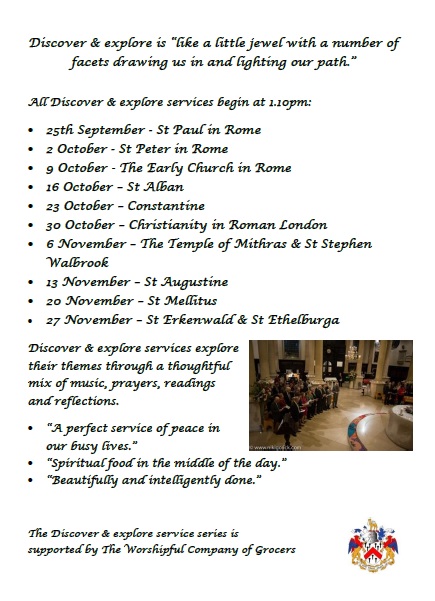
The autumn Discover & explore series is part of the ‘Londinium’ programme organised by the City of London and will explore Rome, London & Christianity through music, prayers, readings and reflections.

Highlights of this series, which features music from the Choral Scholars of St Martin-in-the-Fields includes: 'St Paul in Rome', 'Constantine' and 'The Temple of Mithras & St Stephen Walbrook':
  • 25th September - St Paul in Rome
  • 2 October - St Peter in Rome
  • 9 October - The Early Church in Rome
  • 16 October – St Alban
  • 23 October – Constantine
  • 30 October – Christianity in Roman London
  • 6 November – The Temple of Mithras & St Stephen Walbrook
  • 13 November – St Augustine
  • 20 November – St Mellitus
  • 27 November – St Erkenwald & St Ethelburga
Discover & explore has been described as "A really wonderful series of services; intelligent, thought provoking and hopeful - the perfect way to start your working week!"

----------------------------------------------------------------------------------------------

Felix Mendelssohn - How Lovely Are The Messengers.

Saturday, 29 July 2017

Londinium - The City's Roman Story


Author and historian, Tom Holland, and Chairman of Culture, Heritage and Libraries, Graham Packham, launched Londinium - The City's Roman Story on Thursday at London's Roman Amphitheatre.

The Londinium season of events enables visitors to enjoy a spectacular variety of events and activities as the City celebrates its Roman heritage. Explore the City of London’s Roman heritage with gladiator games, 3D animated projections, talks by leading historians including Mary Beard, outdoor films and archaeological tours in historic London sites.

The City of London is located on the original Roman settlement of Londinium. Founded around AD 50, Londinium grew to become a thriving town bustling with traders and people from every corner of the empire. This summer, 2,000 years on, the Romans return to the City with the Londinium season of events. Unearth the lost history and buried secrets of Roman London that lie beneath the City; explore London’s Roman baths, amphitheatre, Mithraeum and the Roman wall; and learn more about the history of London with a packed programme of interactive activities for all the family. Follow the City of London on Facebook, Twitter and Instagram to see the history unfold, and share your own experience using #RomanLondon.


The autumn Discover & explore series at St Stephen Walbrook will be part of the ‘Londinium’ programme and will explore Rome, London & Christianity through music, prayers, readings and reflections. Highlights include St Paul in Rome, Constantine, and The Temple of Mithras and St Stephen Walbrook:
  • 25th September - St Paul in Rome
  • 2 October - St Peter in Rome
  • 9 October - The Early Church in Rome
  • 16 October – St Alban
  • 23 October – Constantine
  • 30 October – Christianity in Roman London
  • 6 November – The Temple of Mithras & St Stephen Walbrook
  • 13 November – St Augustine
  • 20 November – St Mellitus
  • 27 November – St Erkenwald & St Ethelburga
Discover & explore has been described as "A really wonderful series of services; intelligent, thought provoking and hopeful - the perfect way to start your working week!"

------------------------------------------------------------------------------------------------

Nickel Creek - When In Rome.

Saturday, 22 July 2017

Londinium and Discover & explore


From gladiator games to Boudica’s revenge, the Romans return to the City of London this summer with the Londinium season of events. Choose from family activities, themed performances, guided tours of Roman London and many more things to do during Londinium.

The autumn Discover & explore series at St Stephen Walbrook will be part of the ‘Londinium’ programme organised by the City of London and will explore Rome, London & Christianity through music, prayers, readings and reflections. 

Highlights include St Paul in Rome, Constantine, and The Temple of Mithras & St Stephen Walbrook:
  • 25th September - St Paul in Rome
  • 2 October - St Peter in Rome
  • 9 October - The Early Church in Rome
  • 16 October – St Alban
  • 23 October – Constantine
  • 30 October – Christianity in Roman London
  • 6 November – The Temple of Mithras & St Stephen Walbrook
  • 13 November – St Augustine
  • 20 November – St Mellitus
  • 27 November – St Erkenwald & St Ethelburga
Discover & explore has been described as "A really wonderful series of services; intelligent, thought provoking and hopeful - the perfect way to start your working week!"

----------------------------------------------------------------------------------------

Christopher Walker - Mass of St Paul.

Monday, 3 July 2017

Discover & explore:Life is repentance


Discover & explore services at St Stephen Walbrook feature music and liturgy with the Choral Scholars of St Martin-in-the-Fields. The current series of these services of musical discovery has explored Reformation 500 themes and came to an end today by exploring the theme of 'Life of Repentance.' The Choral Scholars sang: Ach, arme Welt – Brahms; The Lord's Prayer – Joshua Pacey; Anthem – Leonard Cohen; and Beati quorum via – Stanford.

Philip Dawson writes:

'The last Discover & Explore service on the theme of the Reformation - services start again on 25th September and then each Monday at 1.10pm. A huge thank you to Reverend Jonathan Evens and his colleagues for all the work that goes into preparing these services which combine fantastic music with inspirational reflections and prayers.

In today's service we said Bonhoeffer's prayers and sang one of his hymns and in the reflection Jonathan cleverly used the example of Grayson Perry's Chris Hulme case (which was purposely cracked and repaired) to illustrate the reading from 2 Corinthians. (https://www.theguardian.com/…/grayson-perry-chris-huhne-def…)

Every part of the service from the opening responses to the beautiful closing anthem worked so well together. We said farewell to the current Choral Scholars of St Martin in the Fields who lead the music at the service - and also the the fantastic Jeremy Cole who is leaving to a new post at Wells Cathedral. Everyone I know seems to be moving to Wells these days!

A really wonderful series of services; intelligent, thought provoking and hopeful - the perfect way to start your working week!'


Our autumn Discover & explore series will be part of the ‘Londinium’ programme organised by the City of London and will explore Rome, London & Christianity through music, prayers, readings and reflections. Highlights include St Paul in Rome, Constantine and The Temple of Mithras & St Stephen Walbrook:
  • 25th September - St Paul in Rome 
  • 2 October - St Peter in Rome 
  • 9 October - The Early Church in Rome 
  • 16 October – St Alban 
  • 23 October – Constantine 
  • 30 October – Christianity in Roman London 
  • 6 November – The Temple of Mithras & St Stephen Walbrook 
  • 13 November – St Augustine 
  • 20 November – St Mellitus 
  • 27 November – St Erkenwald & St Ethelburga
In today's service I gave the following reflection:

Today’s Reformation 500 reading states that dying daily to our sinful nature doesn’t sound very exciting but our Bible reading (2 Corinthians 4. 6 - 12) suggested that it is our fallibility and failings (the effects of our sinful nature) that actually enable the light of Christ to be seen most clearly in our lives. It maybe that if we understand Luther and St Paul together we can view Luther’s insistence that we live a life of repentance, a daily awareness of our fallibility and failings, more positively.

In 2014 the artist Grayson Perry made a vase as a portrait of Chris Huhne, the Liberal politician who fell from grace when his wife, Vicky Pryce, revealed that he had asked her to take the blame for his speeding offence and the speeding points incurred. He resigned from the cabinet and was subsequently jailed for perverting the course of justice. Perry thought that Huhne was unchanged by his prison experience and, therefore, represented powerful white males with a kind of bullet-proof, Teflon, confidence and chutzpah that was unaffected by wrongdoing and failure. As a result, Perry purposefully smashed the finished vase and then had it repaired using an ancient Chinese technique which involves lacquer resin dusted or mixed with gold, saying, “I have smashed the pot and had it repaired with gold to symbolise that vulnerability might be an asset in relationships to such a person.”

St Paul told the Christians in Corinth that they had the light of the knowledge of the glory of God in the face of Jesus Christ in their hearts, but that this treasure was in clay jars, so that it might be made clear that this extraordinary power belongs to God and did not come from them. If the clay jar, the container of the light, were to be perfectly formed, then the light inside would not be seen from the outside. The light of Christ would effectively be hidden. Like people looking at the confidence and chutzpah of the Teflon-coated Chris Huhne, people would look at our perfect life and not Christ, because they would only see us.

Instead, St Paul says, because we are not perfect and have difficulties and flaws we are like cracked clay jars, meaning that it is then clear that where we act or speak with love and compassion, this is because of Christ in us, rather than being something which is innate to us or simply our decision alone. He used this image of light in containers seen through cracks, or thin translucent clay, to assure the Corinthian Christians that they had the light of God in their lives, despite the fallibility and frailty of those lives. Similarly, Leonard Cohen sings: ‘Ring the bells that still can ring / Forget your perfect offering / There is a crack, a crack / In everything / That's how the light gets in, / That's how the light gets in’.

Paul wrote that ‘We are afflicted in every way, but not crushed; perplexed, but not driven to despair; persecuted, but not forsaken; struck down, but not destroyed; always carrying in the body the death of Jesus, so that the life of Jesus may also be made visible in our bodies.’ Paul wrote of us in the plural. We are afflicted, but not crushed. We are perplexed, but not driven to despair. It is as we come together to engage with affliction, perplexity, forsakenness, and being struck down that we carry in our body the death of Jesus and show the life of Jesus. It is as we come together, linked, like the lanterns, by the light of Christ that we become the Body of Christ.

I don’t know how the image of a crack letting in light came into the mind of Leonard Cohen but it fits really well with St Paul suggesting that there are fractures and flaws running through each of our lives and that these imperfections actually enable the light within to be seen more clearly. I don’t suppose that Grayson Perry had this passage in mind when he smashed the Chris Huhne vase and had the resulting cracks gilded with gold, but, like St Paul, he suggests that our vulnerabilities are the most precious aspect of our lives; of more significance than a confident pride in ourselves that will not acknowledge weakness.

The Lutheran Pastor Dietrich Bonhoeffer connected Luther's theology of the cross – our need to die daily to our sinful nature – ‘with the lived reality of Christian discipleship in a threatened world.’ ‘In phrases that echo his theological ancestry,’ he ‘claimed that God is revealed in the world precisely in those places that the world is most prone to ignore: in suffering, rejection, and scorn.’ ‘The God of Jesus Christ takes these anathemas, makes them God's own, and invites all disciples to participate in them.’

Bonhoeffer wrote that to ‘be a Christian does not mean to be religious in a particular way, to make something of oneself ... on the basis of some method or other, but to be ... the [person] that Christ creates in us. It is not the religious act that makes the Christian, but participation in the sufferings of God in the secular life …

following Christ results in the liberation of the self to exist for and with others .. "The Christian ... must drink the earthly cup to the dregs, and only in his doing so is the crucified and risen Lord with him, and he crucified and risen with Christ." Bonhoeffer could thus say that Christ takes hold of Christians at the centre of their lives, while at the same time recognizing that it also Christ who launches Christians into a world of suffering and difference. Hurled into the midst of this world, Christians are not to assume a sense of privilege but are to relinquish privilege for the sake of others …

To be claimed by others is … to participate in the vulnerable God's existence for us. In contrast to a "religion" that can only offer smug reassurance, bourgeois comfort, and pious quietism, the "new life" to which Jesus calls his followers is fraught with risk.

Each of us are like cracked or translucent clay jars because of our flaws and vulnerabilities. It is through these lines of stress – the suffering, rejection and scorn with which we engage - that the light of Christ is seen. It is as we join together in living for the sake of others that we become the Body of Christ and reveal him most fully in the world.

Intercessions:

O God, early in the morning I cry to you. Help me to pray, and to concentrate my thoughts on you: I cannot do this alone. In me there is darkness, But with you there is light; I am lonely, but you do not leave me; I am feeble in heart, but with you there is help; I am restless, but with you there is peace. In me there is bitterness, but with you there is patience; I do not understand your ways, but you know the way for me … Restore me to liberty, And enable me so to live now that I may answer before you and before me, Lord, whatever this day may bring, Your name be praised. Lord, in your mercy, hear our prayer.

O Lord God, Great is the misery that has come upon me; My cares would overwhelm me, I know not what to do. 0 God, be gracious unto me and help me. Grant me strength to bear what thou dost send) and let not fear rule over me. 0 merciful God, forgive me all the sins I have committed against thee, and against my fellows. I trust in thy grace, and commit my life wholly into thy hands, Do with me as seemeth best to thee, and as is best for me. Whether I live or die, I am with thee) and thou art with me, my God. Lord, I wait for thy salvation, and for thy Kingdom. Lord, in your mercy, hear our prayer.

Every Christian in his place should be brave and free, with the world face to face, Though death strikes, his spirit should persevere, without fear, calm and good. For death cannot destroy but from grief brings relief and opens gates to joy. Closed the door of bitter pain, bright the way where we may all heaven gain. Lord, in your mercy, hear our prayer.

The Blessing

Go in peace. Mend what is broken; unite what is divided; live the gospel; and the blessing of God almighty, the Father, the Son, and the Holy Spirit, be among you and remain with you always. Amen.

------------------------------------------------------------------------------------------------

Charles Villiers Stanford - Beati Quorum Via.

Thursday, 29 June 2017

Discover & explore: Reformation 500 & Londinium

Discover & explore services at St Stephen Walbrook feature music and liturgy with the Choral Scholars of St Martin-in-the-Fields. These services explore their themes through a thoughtful mix of music, prayers, readings and reflections:
  • “A perfect service of peace in our busy lives.”
  • “Spiritual food in the middle of the day.”
  • “Beautifully and intelligently done.”
The current series of these services of musical discovery has explored Reformation 500 themes and comes to an end on Monday 3 July at 1.10pm by exploring the theme of 'Life of Repentance.' The Choral Scholars will sing: Ach, arme Welt – Brahms; The Lord's Prayer – Joshua Pacey; Anthem – Leonard Cohen; and Beati quorum via – Stanford.


Our autumn Discover & explore series will be part of the ‘Londinium’ programme organised by the City of London and will explore Rome, London & Christianity through music, prayers, readings and reflections. Highlights include St Paul in Rome, Constantine and The Temple of Mithras & St Stephen Walbrook:
  • 25th September - St Paul in Rome 
  • 2 October - St Peter in Rome 
  • 9 October - The Early Church in Rome 
  • 16 October – St Alban 
  • 23 October – Constantine 
  • 30 October – Christianity in Roman London 
  • 6 November – The Temple of Mithras & St Stephen Walbrook 
  • 13 November – St Augustine 
  • 20 November – St Mellitus 
  • 27 November – St Erkenwald & St Ethelburga
--------------------------------------------------------------------------------------