Wikio - Top Blogs - Religion and belief
Showing posts with label cohen. Show all posts

Wednesday, 9 July 2025

The Secret Chord

Here's the reflection that I shared at St Andrew’s Wickford this morning:

In Psalm 33. 1-4, 18-end, the Psalmist encourages us to:

Praise the Lord with the lyre;
make melody to him with the harp of ten strings.
Sing to him a new song;
play skilfully on the strings, with loud shouts.

When Peter Banks and I wrote our book ‘The Secret Chord’ we took the title phrase from the song “Hallelujah” which is now one of the most-performed rock songs in history. Leonard Cohen's song ‘Hallelujah’ makes the claim that the Biblical King David had found a secret chord which, when played, pleased even God himself.

The opening words to Cohen's song are extrapolated from the account in 1 Samuel 16: 14-23 of how King Saul asked for a skillful musician to be found so they could come and play to soothe Saul's troubled soul. It is clear that David was both a competent musician and also a prolific composer. According to the Scriptures, he would go on to curate and compose many of the 150 Psalms found in the Bible which survive in multiple translations as part of religious worship today. What Cohen surmises is that whatever David played, or, most likely, improvised, would have also pleased the Lord and the children of Israel's God, as well as calming down King Saul.

Cohen's romantic hypothesis is that David had actually stumbled across and therefore deliberately employed a particular chord that has this mysterious power. A chord is a group of (typically three or more) notes sounded together, as a basis of harmony. Arthur Sullivan in a song called ‘The Lost Chord’ wrote: ‘It seemed the harmonious echo / From our discordant life. / It linked all perplexèd meanings / Into one perfect peace.’

Music is a performance in which harmonies echoing from our discordant lives link all perplexèd meanings into one perfect peace. Music, in performance, is an unrepeatable moment in in which all things come together enabling us to feel God's pleasure. In this sense the Secret Chord, about which Cohen writes, is indeed pleasing to the Lord.

Peter Banks remembers this occurring for him on 15th September 2001 when American conductor Leonard Slatkin led the BBC Orchestra in a dramatic rendition of Samuel Barber's Adagio for Strings at the BBC Proms. This was a change added to the usual program of jingoistic ditties that is regularly played at the Last Night of The Proms. Proximity to the tragedy of 9/11 helped to make it spine tingling for those present in the Royal Albert Hall at the time, as well as those viewing on TV. This was not an aggressive response to 9/11, but a truly spiritual one, with everyone experiencing something of God through the pain and suffering. There was a coming together of music and context which created a performance that took on greater significance after the actual event as time passed and as its cache built through word of mouth.

As a result of this linking of the echoes from our discordant lives, Cohen’s Hallelujah includes both the sacred and the sinful – the holy and the broken Hallelujah. It doesn’t matter which you heard, he suggests, because a blaze of light is found in every word and he will be able to stand before God – the Lord of Song – presumably at the Last Judgement and simply sing Hallelujah itself because both the holy and the broken are encapsulated in the one word and one chord.

This is to say that distinctions between sacred and secular are false divides as all of life and all music is holy. Cohen once said, 'This world is full of conflicts and full of things that cannot be reconciled, but there are moments when we can transcend the dualistic system and reconcile and embrace the whole mess, and that's what I mean by "Hallelujah".'

That’s also why Arthur Sullivan could write:

‘I struck one chord of music,
Like the sound of a great Amen.

It flooded the crimson twilight,
Like the close of an angel's psalm,
And it lay on my fevered spirit
With a touch of infinite calm.

It quieted pain and sorrow,
Like love overcoming strife;
It seemed the harmonious echo
From our discordant life.

It linked all perplexèd meanings
Into one perfect peace,
And trembled away into silence
As if it were loth to cease.’

Ultimately, music is a symbol of the means by which God created, and the musician is a partner with God in the creative process. Therefore, we can pray, with the singer-songwriter Bruce Cockburn, to be a little of God’s creative breath as it moves over the waters of chaos to bring all things into being. In other words, to see and hear life as God sees and hears it and to articulate something of that unitive vision. Amen.

------------------------------------------------------------------------------------------------------

Jeff Buckley - Hallelujah.

Sunday, 2 June 2024

A crack in everything, that’s how the light gets in


Here's the sermon that I shared this morning at St Margaret Bowers Gifford and St Chad's Vange:

St Paul told the Christians in Corinth that they had the light of the knowledge of the glory of God in the face of Jesus Christ in their hearts, but that this treasure was in clay jars, so that it might be made clear that this extraordinary power belongs to God and did not come from them (2 Corinthians 4. 6 - 12).

If the clay jar, the container of the light, were to be perfectly formed, then the light inside would not be seen from the outside. The light of Christ would effectively be hidden as people would look at our perfect life and not Christ, because they would only see us.

Instead, St Paul says, because we are not perfect and have difficulties and flaws, we are like cracked clay jars, meaning that it is then clear that where we act or speak with love and compassion, this is because of Christ in us, rather than being something which is innate to us or simply our decision alone. He used this image of light in containers seen through cracks, or thin translucent clay, to assure the Corinthian Christians that they had the light of God in their lives, despite the fallibility and frailty of those lives.

The artist Anna Sikorska helped the congregation at St Martin-in-the-Fields reflect on these themes through ‘Light the Well’, a community art project which she is undertook together with the congregation, wider community and artists and craftspeoples group. Her installation was set in the Light Well of St Martin’s during November and December 2017 (see images above). It was the culmination of a community art project in which individuals from across St Martin’s – church congregation, Chinese community, clergy, staff and members of the International Group – gathered together over time and tables of clay to carefully form the porcelain lanterns which filled the Light Well. Each porcelain lantern was filled with light from a simple string of lamps.

Conversations around the tables when making the lanterns touched on ‘cracked pots’, the continental tradition of ‘St Martin’s day’ paper lanterns, networks of sea buoys, St Paul describing light inside clay vessels, the fragility of our lives and bodies, ‘broken but not crushed’ and Leonard Cohen’s lines: ‘Forget your perfect offering / There is a crack in everything / That’s how the light gets in.’

The project involved a large number of porcelain lanterns (glazed ceramic globes) made by laying strips of porcelain onto a round support. The size, surface decoration and character of each lantern differed, although the base material - and overall look - was consistent white ceramic, roughly made.

Porcelain clay glows with a transparency individual to itself but those who made lanterns realised that, in order to be as translucent as possible, the strips of porcelain needed to be as thin as possible. Once made, they were fired and the lanterns were then suitable for being outside. They developed cracks in the firing, through which the light inside was seen. In the Light Well at St Martin’s, these lanterns were joined together with cord covering the stone floor in a random constellation. The cord also connected a light bulb within each lantern, so each one shone from within.

These cracked translucent lanterns lit from within were a visible realisation of St Paul’s image of light in clay jars. By linking the lanterns together, this installation also highlighted another aspect of this passage.

St Paul writes that ‘We are afflicted in every way, but not crushed; perplexed, but not driven to despair; persecuted, but not forsaken; struck down, but not destroyed; always carrying in the body the death of Jesus, so that the life of Jesus may also be made visible in our bodies.’ He writes of us in the plural. We are afflicted, but not crushed. We are perplexed, but not driven to despair. It is as we come together to engage with affliction, perplexity, forsakenness, and being struck down that we carry in our body the death of Jesus and show the life of Jesus. It is as we come together, linked, like the lanterns, by the light of Christ that we become the Body of Christ.

So, in this passage, St Paul suggests that there are fractures and flaws running through each of our lives and that these imperfections actually enable the light within to be seen more clearly. As a result, he suggests that our vulnerabilities are the most precious aspect of our lives; of more significance than a confident pride in ourselves that will not acknowledge weakness.

Dietrich Bonhoeffer wrote that to ‘be a Christian does not mean to be religious in a particular way, to make something of oneself ... on the basis of some method or other, but to be ... the [person] that Christ creates in us. It is not the religious act that makes the Christian, but participation in the sufferings of God in the secular life …

following Christ results in the liberation of the self to exist for and with others .. "The Christian ... must drink the earthly cup to the dregs, and only in his doing so is the crucified and risen Lord with him, and he crucified and risen with Christ." Bonhoeffer could thus say that Christ takes hold of Christians at the centre of their lives, while at the same time recognizing that it also Christ who launches Christians into a world of suffering and difference. Hurled into the midst of this world, Christians are not to assume a sense of privilege but are to relinquish privilege for the sake of others …

To be claimed by others is … to participate in the vulnerable God's existence for us. In contrast to a "religion" that can only offer smug reassurance, bourgeois comfort, and pious quietism, the "new life" to which Jesus calls his followers is fraught with risk.

Bonhoeffer … claimed that God is revealed in the world precisely in those places that the world is most prone to ignore: in suffering, rejection, and scorn. The God of Jesus Christ takes these anathemas, makes them God's own, and invites all disciples to participate in them.’

(https://www.thefreelibrary.com/Religionless+Christianity+and+vulnerable+discipleship%3A+The+interfaith...-a098313403)

Bonhoeffer was saying and seeing what St Paul says and sees in today’s Epistle; each of us are like cracked or translucent clay jars because of our flaws and vulnerabilities. It is through these lines of stress – the suffering, rejection and scorn with which we engage - that the light of Christ is seen. It is as we join together in living for the sake of others – linked together as the lanterns were linked in the Light the Well installation – that we become the Body of Christ and reveal him most fully in the world. In this way, the Light the Well community art project and installation showed what it means to be the Body of Christ – the Church – in the world today. May we also see that for ourselves today. Amen.

Lord Jesus, in your face we see the light of the knowledge of the glory of God. Your light in our lives is like a flame inside a cracked clay jar, with your light seen through the lines of stress and tension that characterise our lives. As flawed people in a fragile world, we recognise that there is a crack in everything. We recognise, too, that it is through the cracks in our existence that your light gets in and shines out. We share in the vulnerability and suffering that was your experience of death in order that your life is also seen as being our strength in weakness. May we not be crushed, driven to despair, forsaken or destroyed, but in the stresses and tensions of our lives know your power loving and sustaining us. May we no longer strive after perfect offerings and pray instead that every heart to love with come, but as a refugee. Lord, in your mercy, hear our prayer.

Lord Jesus, in this wilderness before the promised land, we pray for all who are dispossessed and homeless. In their wilderness wanderings may they seek rest not only in a material land of promise but also in the one who left all he had to serve humanity, die and be raised to glory. In the tension of the now and the not yet, we pray for all who have asked for healing or release and to whom it has not been granted. In the depths of their loss may they encounter one whose preaching released long dead imprisoned souls. In these times between times, may we fully utilise the gifts of your Spirit - gifts of community and relationship, gifts of forgiveness and life-giving – to imagine new possibilities in the midst of the old problems of our world. Lord, in your mercy, hear our prayer.

Lord Jesus, who in suffering and then death was made nothing, we bring to you those who are experiencing loss through suffering and bereavement. We ask that nothing and no-one will trivialise their loss and that in the heart of their loss they will experience rebirth and resurrection. Lord, in your mercy, hear our prayer.

Lord Jesus, you are the light of the world and the light in our darkness. May your light be a flame to build warmth in our hearts towards family, neighbours and all those we meet. We place in your care all those we come to remember today. Give us, we pray, comfort in our anxiety and fear, courage and strength in our suffering, patience and compassion in our caring, consolation in our grieving. But above all, give us hope now and always. Lord, in your strength and vulnerability, hear our prayer.

Lord Jesus, through your rising from the grave, you broke the power of the grave, you broke the power of death and condemned death itself to die. As we celebrate this great triumph may we also make it a model for our living. Help us to identify in our lives all that should rightly die - redundant relationships, tired habits, fruitless longings. Resurrect in our lives faith, hope and love as surely as you raised Jesus Christ from the grave. Lord, in your mercy, hear our prayer.

Lord, may your light enlighten us in our decisions and be a fire to purify us from all pride and selfishness. Set our hearts on fire with love for you, so that we may love you with all our heart, with all our mind, with all our soul, and with all our strength, and our neighbours as ourselves. So that by keeping your commandments we may glorify you, the giver of all good gifts. Lord, in your strength and vulnerability, hear our prayer.

Blessing

Enlightenment in our decisions, purification from pride and selfishness, strength in weakness, God’s power loving and sustaining us. May those blessings of almighty God, Father, Son and Holy Spirit, rest upon you and remain with you always. Amen.


-----------------------------------------------------------------------------------------------------

Leonard Cohen - Anthem.

Sunday, 10 September 2023

Forgiveness - the only way to experience healing and peace

Here the sermon I shared at St Mary's Runwell this morning:

The rock band Good Charlotte have a song called The Story of My Old Man. It begins like this:

‘I don’t know too much, too much of my old man.
I know he walked right out the door and we never saw him again.
Last I heard he was at the bar doing himself in.
I know I got that same disease, I guess I got that from him.

This is the story of my old man,
just like his father before him.
I’m telling you do anything you can,
so you don't end up just like them.’

In today’s Gospel reading (Matthew 18: 15-20), Jesus says the church is like a family and he is realistic and recognises that, in a family, brothers (and sisters and parents will fall out). The song was about a real family and in the song, it is the Dad who has broken up the family. In all these situations there is real hurt and when people are in these sorts of situation, they react with anger saying “don’t end up just like them” or treat them “as though they were pagans or tax collectors.” In other words, don’t have anything to do with them because of the hurt they have caused.

Good Charlotte have a second song on this same theme which is called Emotionless:

'Hey Dad, I'm writing to you
not to tell you, that I still hate you
just to ask you how you feel
and how we fell apart, how this fell apart …

I remember the days, you were a hero in my eyes
but those were just a long lost memory of mine
I spent so many years learning how to survive
Now, I'm writing just to let you know that I'm still alive
And sometimes I forgive.
Yeah, this time I’ll admit that I miss you.
I miss you. Hey Dad.'

You see the difference between the two songs? They’re both about the singer’s Old Man. In both he’s been hurt by the things that his Old Man has done. But in the second song, he’s writing to try to restore the relationship, even, at the end, to say that he forgives and misses his Dad. It’s clearly not easy because of the hurt but it’s also very much what he needs to do.

And it’s a similar story in our Gospel reading. Jesus is not giving the disciples these instructions so that they can reject those brothers and sisters in the Church who do something wrong. He is giving these instructions so that these brothers and sisters can be won back; so that the relationship can be restored. When Jesus says treat people like pagans and tax collectors, he doesn’t mean reject them. Matthew was a tax collector. He knew from personal experience how Jesus treated tax collectors and outcasts. He went to their homes, ate meals with them and said that he had not come to call respectable people, but outcasts. He did all he could to restore the relationship and heal the wounds.

And that is also what we see in the parables before and after these instructions. In the parable of the lost sheep, the point is that we do everything possible to find those who are lost and the parable of the unforgiving servant was told to illustrate the point that we should not put limits on forgiveness but forgive again and again, just as God forgives us.

This is not easy. Another songwriter, Leonard Cohen, has said that, “Of all the people who left their names behind, I don’t think there’s a figure of Christ’s moral stature. A man who declared himself to stand among the thieves, the prostitutes, the homeless. His position cannot be comprehended. It is an inhuman generosity … (which) would overthrow the world if it was embraced.”

There is a divine generosity in Jesus which we are called to emulate. We will find it hard to forgive, just as the person in the two Good Charlotte songs found it hard to forgive his Dad. But that is where Jesus wants us to do and that is the point of these instructions that he gave to the disciples. They are about restoring relationships not about rejecting those we think are in the wrong. When we struggle to forgive, struggle to restore, struggle to reconcile then we are coming together in the name of Jesus and he is right there with us.

So, forgiveness takes practice, honesty, open-mindedness and a willingness (even if it is a weary willingness) to try. It isn't easy. Perhaps you have already tried to forgive someone and just couldn't do it. Perhaps you have forgiven and the person did not show remorse or change his or her behaviour or own up to his or her offences – and you find yourself unforgiving all over again. It is perfectly normal to want to hurt back when you have been hurt. But hurting back rarely satisfies. We think it will, but it doesn't. If I slap you after you slap me, it does not lessen the sting I feel on my own face, nor does it diminish my sadness over the fact that you have struck me. Retaliation gives, at best, only momentary respite from our pain. The only way to experience healing and peace is to forgive.

Until we can forgive, we remain locked in our pain and locked out of the possibility of experiencing healing and freedom, locked out of the possibility of being at peace. So, to forgive is not just to be altruistic. It is the best form of self-interest. It is also a process that does not exclude hatred and anger. These emotions are all part of being human. You should never hate yourself for hating others who do terrible things: the depth of your love is shown by the extent of your anger.

When I talk of forgiveness, what I mean is the belief that you can come out the other side a better person. A better person than the one being consumed by anger and hatred. Remaining in that state locks you in a state of victimhood, making you almost dependent on the perpetrator. If you can find it in yourself to forgive then you are no longer chained to the perpetrator. You can move on, and you can even help the perpetrator to become a better person too.

The simple truth is, we all make mistakes, and we all need forgiveness. There is no magic wand we can wave to go back in time and change what has happened or undo the harm that has been done, but we can do everything in our power to set right what has been made wrong. We can endeavour to make sure the harm never happens again.

There are times when all of us have been thoughtless, selfish or cruel. But no act is unforgivable; no person is beyond redemption. Yet, it is not easy to admit one's wrongdoing and ask for forgiveness. "I am sorry" are perhaps the three hardest words to say. We can come up with all manner of justifications to excuse what we have done. When we are willing to let down our defences and look honestly at our actions, we find there is a great freedom in asking for forgiveness and great strength in admitting the wrong. It is how we free ourselves from our past errors. It is how we are able to move forward into our future, unfettered by the mistakes we have made. 

--------------------------------------------------------------------------------------------------------------

Good Charlotte - We Believe.

Saturday, 9 September 2023

A future in which every tear will be wiped away


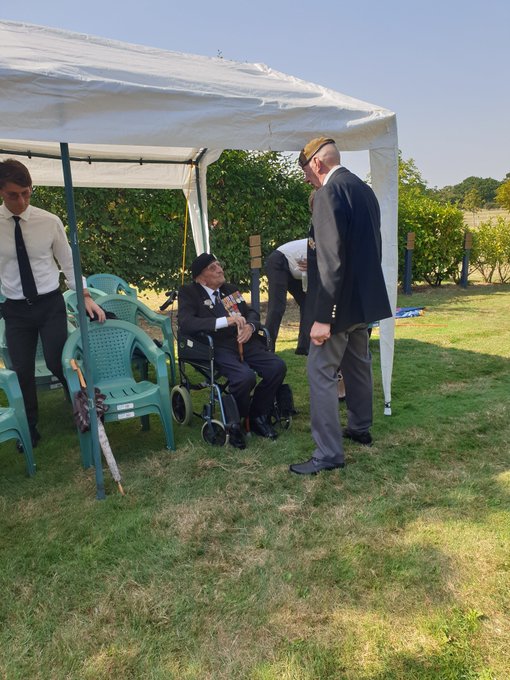
A privilege to lead today's Aden memorial service at the Living Memorial, Rettendon. Lt.Co Hugh Toler spoke during the service about the Aden campaign. Rettendon Living Memorial is a memorial garden with several small museums and covered seating areas. The Living Garden was set up by the landowners Peter and Fran Theobald in 2009 and now contains dedicatory plaques to a number of post 1945 conflicts including Korea, Suez, Northern Ireland and Afghanistan.

Here is the Address that I shared during the service:

These words of the prophet Isaiah (Isaiah 2.1-4) were the inspiration for the well-known spiritual ‘Down by the riverside’ in which we sing: “Gonna lay down my sword and shield” and “I ain't gonna study war no more”.

There are two keys to understanding this passage. The first, is to notice that it is a vision of the future. In days to come, Isaiah prophesies, the nations “shall beat their swords into ploughshares, and their spears into pruning-hooks; nation shall not lift up sword against nation, neither shall they learn war any more.” The same vision is repeated at the end of the Bible in the Book of Revelation where the prophet John sees “a new heaven and a new earth,” and hears “a loud voice from the throne saying, “Look! God’s dwelling place is now among the people, and he will dwell with them. They will be his people, and God himself will be with them and be their God. He will wipe every tear from their eyes. There will be no more death or mourning or crying or pain, for the old order of things has passed away.”

When we are in midst of war, conflict, or any kind of difficulty, as many of you have been, this is a vision of the future to look forward to; a vision of peace and wellbeing to enable us to look up from the troubles of today and pray for the coming of God’s kingdom, as we do when we pray “Thy kingdom come, on earth as it is in heaven.” It is also a picture of the peace which those we know who have already lost their lives now experience in the presence of God; and for that we can also give thanks.

The second key to understanding this passage is that it begins to be realised when many peoples say, “Come, let us go up to the mountain of the Lord, to the house of the God of Jacob; that he may teach us his ways and that we may walk in his paths.” Learning the ways of God and walking in his paths, that is the way to experiencing a taste in the here and now of the kingdom of God which is still to come. The Canadian singer-songwriter, Leonard Cohen, said that, “Of all the people who left their names behind, I don’t think there’s a figure of Christ’s moral stature. A man who declared himself to stand among the thieves, the prostitutes, the homeless. His position cannot be comprehended. It is an inhuman generosity … (which) would overthrow the world if it was embraced.” It is as we begin to embrace Christ and follow in his footsteps that the world changes and nations begin to lay down their swords and shields and not study war no more.

Until that day comes, we will continue to need and honour those, like yourselves, who are prepared to follow the example of Christ by laying down your lives for others, but we should never lose sight of the vision of God’s kingdom which calls us into a future in which every tear will be wiped away and there will be no more death or mourning or crying or pain, for the old order of things has passed away.

---------------------------------------------------------------------------------------------------------

Shona McGarty - Hallelujah.

Sunday, 27 March 2022

A covenant of fruitfulness


Here's my last Sunday sermon for St Martin-in-the-Fields in my current role, for this morning's Mothering Sunday Eucharist: 

'Anna Tymchenko was scared. She had been in labour for hours, but her hometown was being bombed and her apartment was shaking. She and her husband were trapped with no electricity, running water or doctor. The small town of Bucha, 18 miles from Kyiv, had come under relentless bombardment since the start of the war. Twenty-one-year-old Anna, along with her husband and brother, had previously taken refuge in the basement of their block of flats. But when the electricity was cut off and the heating stopped working, the basement was plunged into darkness, and it was bitterly cold. Anna's husband Volodymyr was torn between remaining in Bucha or trying to flee. When they did finally try to escape by car, they had to turn back when they heard that a column of Russian military vehicles was heading their way.

They then decided to stay in the apartment and when Anna went into labour late on 7 March, she called her neighbours for help. Anna's neighbours had to deliver the baby themselves. Only one of them – Irina - had had any medical expertise. "When the baby's head came out, we got scared," Viktoria, one of the neighbours, said. "She was blue and we didn't know what to do. Then Irina gently turned the baby's head and she came out. She didn't cry at first … but then she cried and we all cheered." Volodymyr cried tears of relief for baby Alisa, who was born on 8 March - International Women's Day.'

The natural cycle of birth, with its inherent generativity and creativity, continues, even in the extreme circumstances of war, through the resilience of all involved in this story. Today is a day for celebrating both the vital role of mothers and the wider village needed through which we nurture and bring up children, the fruit of our fertility and creativity as humans.

The experience of childbearing and of childbirth is one that is used through the Bible as a metaphor for the creativity and generativity of God, who is also endlessly creative and fertile even in the most difficult of circumstances. In Isaiah 42:14 God is pictured as a woman in labour crying out, gasping and panting, as new things spring forth in our world. In Deuteronomy 32:18 we read of Israel as the people that God brought to birth, while in Isaiah 49:15 God is compared to a nursing mother and then in Psalm 131:2 to a mother who has weaned her child.

I have been at St Martin’s for seven years and today is the last sermon I will preach here on a Sunday, at least in my current role. In that time St Martin’s has seen God bring many new things to birth in and through us and so, on this day when we celebrate the ongoing generativity of God, Mother Church, human beings, and, especially, mothers themselves, I want to reflect on three things that have come to birth over that seven year period; one in me, one in this church, and one in the wider church.

So, beginning with myself, one of many blessings for me personally in being at St Martin’s over this period of time has been the involvement that I have had with the disability work that happens here through the Disability Advisory Group led by Fiona MacMillan. That includes the annual conference on Disability and Church organised through a partnership between St Martin’s and Inclusive Church and hosted, in more recent years, by HeartEdge. Although I had previous experience of being with disabled people in addressing access issues through my time as civil servant, I nevertheless found I had a huge amount to learn through being at St Martin’s. What has come to birth in me in this time is a greater understanding - not simply of access as joining in not just getting in - but of disability at the heart of God and as a key to understanding the nature of God and the incarnation.

God experiences brokenness on the cross, a brokenness that leaves physical scars on his body, but then, in the words of Donald Eadie, a disabled Methodist minister, his “world cracked open and life broke through.” It wasn’t just Jesus’ world that cracked open in that moment but ours as well, because as we follow him into that experience of brokenness leading to new life we also share in that same experience. Singer-songwriter Leonard Cohen encourages us to forget our ‘perfect offerings’ because there is ‘a crack in everything’ and ‘that's how the light gets in’. Jesus, the Disabled God, reveals the necessity of brokenness in order that life and light can be received and experienced.

Then, in regard to this church, another new thing to have come to birth in this time has been our artists’ and craftspeople’s group. This group is what its prosaic name describes: a group for any artists or craftspeople in the St Martin’s community. There are many such in our community but there wasn’t originally a forum in which the gifts of those people could be engaged and, more than that, the important programme of art commissions from artists outside the community had created a perception that the gifts of those within the community weren’t valued.

The artists’ and craftspeople’s group organizes a range of participatory activities and opportunities to make and create. These are open to participants of all abilities. There have been periodic opportunities for participants to show their work, including a monthly drawing group, art workshops in Advent and Lent, a monthly rota for displaying work, and an annual group exhibition. Significant creative energy has been released within our community as a result. Those with established creative gifts have been affirmed and those beginning to explore their gifts have been encouraged. Many have been blessed by the displays, exhibitions and installations that have resulted. God is the ultimate creator and this new creative energy that has been set free within St Martin’s is an expression of the image of God in our community.

Thirdly, the new thing that has come to birth in the wider church with which I have primarily been involved is HeartEdge. HeartEdge is an international, ecumenical movement galvanising churches to be at the heart of their communities whilst being with those on the edge. Its 1,500+ partners can be found on four different continents, but its growth was seeded here, and its development has been supported from here.

What is new about HeartEdge is not primarily its network of partners, but the new language being coined that is transforming discourse within the Church around mission. HeartEdge is expanding the imagination of a church captivated by scarcity and enabling churches to receive the abundance that God is continually sharing and thereby become fully alive. HeartEdge seeks to transform church and society through the 4 Cs of commerce, culture, compassion and congregational life which, through their interdependence, provide a model of what a renewed society might look like. The 4 Cs, as they inter-connect, create a new model of mission that sustains itself, is open to the gifts of strangers, and exhibits the life of faith.

God is the one who says: “Do not remember the former things, or consider the things of old. I am about to do a new thing; now it springs forth, do you not perceive it? I will make a way in the wilderness and rivers in the desert … I give water in the wilderness, rivers in the desert, to give drink to my chosen people, the people whom I formed for myself so that they might declare my praise” (Isaiah 43.18-21). Then, in Jesus, God becomes the new thing that is brought to birth by Mary, the God-bearer and Mother of our Lord. God becomes both creator and created, the nurturer and the nurtured, the sower and the seed, the chicken and the egg.

It should come as no surprise then, that God longs to create communities that are fruitful and generative. Here at St Martin’s, we have a history of seeding new initiatives that are cultural, compassionate or commercial including St Martin’s School of Art, the Social Care Unit that has now become The Connection at St Martin-in-the-Fields, the Academy of St Martin-in-the-Fields, St Martin-in-the-Fields Limited, Liberty, Shelter, Amnesty International, and The Big Issue.

As a result, it should also come as no surprise that in more recent years, in addition to HeartEdge, we have seen the creation of the Frontline Network, the Nazareth Community, the Companions of Nazareth, and the Being With Courses. God has created here a community that is consistently fruitful, creative and generative even in times of difficulty and challenge, as has also been the case during the pandemic. We called the book about our ministry during the pandemic ‘Finding Abundance in Scarcity’ because that was our experience as we looked together for the opportunities to find God’s abundance in the midst of the pandemic’s scarcity.

Our experience in that regard has been similar to that of Anna and Volodymyr in Bucha; that there is no let up in the flow of abundant creativity from God especially in times of trial and difficulty. It has been a privilege and pleasure for me to be a part of this community for the past seven years to learn more of God’s abundant goodness and to be, with you, a midwife in bringing some of these new initiatives to birth. Just as Anna and Volodymyr needed their neighbours to bring Alisa into the world, so HeartEdge, the Disability Advisory Group, the artists’ and craftspeople’s group, the Frontline Network, the Nazareth Community, the Companions of Nazareth, and the Being With Courses need the village that is this community to continue to nurture what has been brought to birth here.

On the day I was licensed here, Sam Wells said we were ‘looking to establish a covenant of fruitfulness with partners and friends all around the country and beyond.’ He said: ‘We could settle for enhancing our resources, developing our programmes, and deepening our common life. Those are all fine and demanding things, and most churches in the country would be overjoyed to have such an aspiration. But we’re being called beyond that. We’re being called to share our message and to influence the wider church and world. And right now the way we’re seeking to do that is by making mutually-enriching partnerships and working with other institutions to help them better realise their vocations. Why? Because we believe that’s God’s way. God in Christ didn’t shout from afar or keep a light hidden on a hill far away. God in Christ made relationships one by one, some close and constant, some occasional and passing, and came alongside people of all kinds, opening up their hearts, setting their souls on fire, and lifting from them the burden of oppression or pain or guilt. That’s what a covenant of fruitfulness looks like.’

That’s what we have seen and heard and experienced over the past seven years. That’s what God has brought to birth and to which we have been midwives. It’s what we can pray for the people of Ukraine and for Anna, Vlodymyr and their neighbours as they bring up Alisa in the midst of war. It’s also what we can celebrate together this Mothering Sunday as we celebrate the ongoing generativity of Mother God, Mother Church, human beings, and, especially, mothers themselves. It’s what we continue to be called to nurture, grow and develop both here at St Martin’s and also for me, shortly, in the Wickford and Runwell Team Ministry. I go to become one of the partners and friends that you have around the country and beyond, so this Covenant of Fruitfulness will remain a bond between us, a covenant in which we continue to share even as I leave the role I have had among you here. So, let us commit to pray for fruitfulness and new life, creativity and generativity, to characterise all our contacts, friendships and partnerships as we go from this place today. Amen.

----------------------------------------------------------------------------------------------------------

Thursday, 8 July 2021

'Art in Worship' and 'The Secret Chord'

Art in Worship is a lecture I have recorded which explores approaches to and understanding of the relationship between art and faith. The lecture highlights different facets to this relationship from the fourth century to the present demonstrating ways in which the intimate linkage which exists between the visual arts and Christianity was forged and sustained. Within this story, I explore the sacramental nature of art in worship over the years.

'The Secret Chord', my co-authored book with Peter Banks, is now available from the online shop at St Martin-in-the-Fields. The book asks is there really a 'Secret Chord' that would both please the Lord and nearly everybody else as described in Leonard Cohen's popular song 'Hallelujah'? The book is an accessible exploration of artistic dilemmas from a range of different perspectives which seeks to draw the reader into a place of appreciation for what makes a moment in a 'performance' timeless and special.

----------------------------------------------------------------------------------------------------------

John Rutter - Five Meditations for orchestra, arranged from sacred choral works.

Monday, 30 December 2019

Top Ten 2019

This is the music, in no particular order, that I've most enjoyed listening to in 2019:

Kiwanuka by Michael Kiwanuka - 'Kiwanuka is a contemplative song cycle intended to be listened to in one extended sitting ... At the core is Kiwanuka’s inner battle between anxiety, self-doubt, spirituality and wisdom, which is then set against racism and rueful glances at the state of the world ... for all its melancholy, Kiwanuka is never downbeat. There are moments – such as the “Time is the healer” gospel choir in I’ve Been Dazed, or hopeful closer Light – when positivity bursts through with such dazzling effect you want to cheer. Kiwanuka is a bold, expansive, heartfelt, sublime album. He’s snuck in at the final whistle, but surely this is among the decade’s best.'

Ghosteen by Nick Cave and the Bad Seeds - 'Ghosteen drips melody like the permanent rain. It oozes emotion from a heavy heart. It embraces the frailty of the human soul. It’s full of poetry and images that switch sometimes from the time honoured embrace of Elvis and Jesus and the icons and articles of faith whether they are god or rock n roll to a yearning deeply soulful of a very personal heartbreak with a powerful honesty and lyrical nakedness reflecting a genuine darkness and intimate honesty that is a step deeper into the personal and the intimate that is compelling and hypnotic and with an almost ambient atmospheric music to match.'

Thanks for the Dance by Leonard Cohen - Thanks for the Dance 'Opener Happens to the Heart reflects on [Leonard Cohen's] career with trademark humility: “I was always working steady, I never called it art. I got my shit together, meeting Christ and reading Marx” ... Like those of Marvin Gaye and Prince, Cohen’s oeuvre sought to reconcile the spiritual and the sensual, which both feature heavily again ... As the pace slows to a transcendent crawl and backing vocals form a heavenly choir, The Hills mocks his ageing body (“The system is shot / I’m living on pills”) and the stunning The Goal finds him “almost alive” and “settling accounts of the soul”. The last poem he recorded, Listen to the Hummingbird, implores us to find beauty in God and butterflies: “Don’t listen to me.” And, finally, there is a vast, empty silence, and he is gone.'

We Get By by Mavis Staples - 'Over half a century after her voice was at the forefront of America’s civil rights era, Mavis Staples is still crying out for Change. The bluesy backbeat opening track of her 12th studio album confronts recent shootings in the US before she concludes, brilliantly, “What good is freedom if we haven’t learned to be free?”... It’s not hard to guess the subject of such pointed lines such as “Trouble in the land. We can’t trust that man.” Elsewhere, there are songs of loss, need, faith and devotion.'

Hotel Last Resort by Violent Femmes - 'More than three decades on from their 1983 debut, Violent Femmes have dished up another audio delight of front-porch folk ... The band’s juvenile charisma imbues every lyric, from a biblical satire in Adam Was a Man to humble love song Everlasting You, but Paris to Sleep is the heartbreaking hero: “Losing lost love is not worth losing for.” Deeply intuitive with a sprinkle of absurdity, the Violent Femmes’ new recipe is pure joy.'

Jaimie by Brittany Howard - 'Jaime is named after Howard’s sister, who taught her to play piano and died of cancer when she was eight years old – but “the record is not about her”, she said in a recent interview. “It’s about me.” A platter of psychy soul, gospel and funk, with melodies that tap and jitter like Morse code or pour out like silky caramel, Jaime is about tragedy, sexuality, religion, racism and poverty – all things with which Howard is uncomfortably familiar.'

Love & Revelation by Over The Rhine - 'Love & Revelation, an album of loping ballads and probing lyricism that addresses grief, loss and what it means to be an American in a conflicted country. “Let You Down” is a devastating promise to never abandon someone, with the understanding that inevitably they will do just that. “Betting on the Muse,” inspired by the writer Charles Bukowski, wrestles with finding a life’s second act after a person peaks. And “Los Lunas” is a haunting poem about a tearful drive to reckon with saying goodbye ... “The very first words you hear on the project are ‘I cried,'” says Detweiler, citing the opening lyric. “When I told my 87-year-old mother about it, she said that sounds like the Psalms.” But Love & Revelation, and the band itself, is ultimately about restoration and perseverance.'

High as Hope by Florence + the Machine - 'Welch reinforces her magnificent emoting with contemplative, intimate lyrics; the musician beckons people into her interior world with no hesitation and no cushion. “The show was ending, and I had started to crack,” Welch trills to open the album, her voice dominant above barely perceptible chords. “Woke up in Chicago and the sky turned black.” Despite that initial ominous note, High As Hope soon evolves into a treatise on what it means to embrace second chances, while trusting other people—and, more important, yourself. The cello-burnished “100 Years” exhibits a healthier approach to love and faith (“Give me arms to pray with instead of ones that hold too tightly”) while “Grace,” written as a mea culpa to Welch’s younger sister, asks forgiveness for youthful indiscretions.'

Western Skies by Bruce Springsteen - 'Western Stars ... is populated by characters past their best – the title track’s fading actor, reduced to hawking Viagra on TV and retelling his stories for anyone who’ll buy him a drink; Drive Fast’s injured stuntman recalling his youthful recklessness, the failed songwriter of Somewhere North of Nashville and the guy glumly surveying the boarded-up site of an old tryst on Moonlight Motel – all of them ruminating on how things have changed, not just for the worse, but in ways none of them anticipated.'

Three Chords and the Truth by Van Morrison - 'There’s a warmth here that recalls his ’90s highwater marks, Hymns to the Silence and The Healing Game, and connects even farther back in time to 1971’s Tupelo Honey, which balanced the charms of domesticity with R&B raves ... “It’s called ‘the flow,’” Morrison said in a recent interview, detailing his optimal conditions for making music. “I don’t know the mechanics of how that works. I just know when I’m in it.” “The flow” makes Three Chords and The Truth a deeply pleasurable listen, but it’s the moments where Morrison sounds less settled that carry the most weight. The album’s third song, “Dark Night of the Soul,” never wanders as far out as epics like “Madame George” and “Listen to the Lion,” nor does it match spaced-out gloss of his ’80s albums with trumpeter Mark Isham, but it’s gripped by the same existential fervor. Its mellow heat has a lot in common with 1997’s “Rough God Goes Riding,” a gentle midtempo cut with apocalyptic visions hiding in plain sight. Revisiting the 16th-century Christian mystic St. John of the Cross’ poem about the unknowability of God, one he’s sung about a number of times before, Morrison showcases the way his twilight years haven’t dimmed his yearning for growth, his desire for a deeper understanding.'

My previous Top Ten's can be found here - 2018, 2017, 2016, 2015, 2014, 2013 and 2012.

------------------------------------------------------------------------------------------------

Violent Femmes - Everlasting You.

Saturday, 7 December 2019

Culture Review

There has been much released recently that should be of interest to any exploring or living out their faith. New work I have noted recently includes:
 
The Other Name: Septology I-II by Jon Fosse – the beginning of a septet, this darkly ecstatic Norwegian story of art and God is relentlessly consuming.

'It is late autumn, close to Advent. Two older men, painters, live near each other on the south-west coast of Norway, one in the city of Bjørgvin (a thinly disguised Bergen), the other in remote Dylgja overlooking the sea. Both men are called Asle ...

The version of Asle who has found God (which he gently insists is “knowledge” not “belief”) provides some of the book’s most ecstatic, probing scenes. In one passage Christ’s nativity is alluded to almost in passing; a well-worn story, yet one which Fosse somehow makes refreshingly original. Similarly, his descriptions of young Asle’s growing awareness of colour and its endless variations prefigure Asle the mature artist. The overall theme of a “shining darkness”, referring to Asle’s painting, his losses and his faith, is used to illuminate the fugue state of being.'

'Karen Solie’s TS Eliot prize-shortlisted The Caiplie Caves is one of the more unusual poetry collections of recent years. It is many things at once: a vision of insular Celtic Christianity in its early medieval heyday; a juxtaposition of this with a more elliptic modern narrative; and a meditation on literary form, and how the modernist long poem might look through a contemporary lens ...

Another writer with a keen insight into insular Celtic Christianity is Eiléan Ní Chuilleanáin. In The Mother House, Ní Chuilleanáin’s established preoccupations – allegorical journeys, the ghosts of the past, religious life – are copiously on show, but with a newly sharpened elegiac edge.'

'Mutual Admiration Society is a group biography of a circle of ... women who became pals at Oxford, including [Dorothy L.] Sayers; the cheekily named society of the title was a real club, whose members composed poetry and prose for each other’s delight.'

What faith Celia Paul has herself, she expresses on canvas:'“From the earliest memory every day started with prayer and ended with prayer,” she says. “And it is still in my bloodstream, even though I am not conventionally religious. I am not good at belonging to groups. But doesn’t everyone think about God?”

That tendency, her memoir [Self Portrait] suggests, was one reason Lucian Freud was drawn to her, and one of her own means of keeping herself apart.'

The Observer’s comic-strip artist Simone Lia on her new children’s book, her obsession with invertebrates, and how a prayer for a superior hotel room transformed her life: 'I am so diverted by her, I forget to ask where God fits in nowadays and pursue the subject by email. She replies in full. She explains she needs to “come out” as a Catholic because “our culture is not set up for a relationship that takes place in silence and solitude”. '

'“We believe because she believes,” says [Cynthia] Erivo. The actor describes herself as a person of faith. She prayed before going on to set every day – for guidance, to lose her own vanity, for energy on days she was tired and “to make the space safe and open for her because I feel as if Harriet [Tubman] is complicit in this storytelling [Harriet]. I feel that she’s around. It’s comforting to be able to reach into your faith to tell the story of somebody who has faith.”'

'Everyday Life is wildly uneven, held together only by its thematic obsession with religion: disc one (Sunrise) literally ends with a hymn, disc two (Sunset) with Chris Martin singing “Alleluia, alleluia”. You lose count of the references to God, church and prayer in between. What this signifies remains a mystery: has Chris Martin, a lapsed Christian, rediscovered his faith? Is it intended more in the vein of Nick Cave’s recent line about how “it doesn’t matter whether God exists or not – we must reach as if he does”? The answer remains elusive.'

'Ghosteen drips melody like the permanent rain. It oozes emotion from a heavy heart. It embraces the frailty of the human soul. It’s full of poetry and images that switch sometimes from the time honoured embrace of Elvis and Jesus and the icons and articles of faith whether they are god or rock n roll to a yearning deeply soulful of a very personal heartbreak with a powerful honesty and lyrical nakedness reflecting a genuine darkness and intimate honesty that is a step deeper into the personal and the intimate that is compelling and hypnotic and with an almost ambient atmospheric music to match.'

Thanks for the Dance 'Opener Happens to the Heart reflects on [Leonard Cohen's] career with trademark humility: “I was always working steady, I never called it art. I got my shit together, meeting Christ and reading Marx” ... Like those of Marvin Gaye and Prince, Cohen’s oeuvre sought to reconcile the spiritual and the sensual, which both feature heavily again ... As the pace slows to a transcendent crawl and backing vocals form a heavenly choir, The Hills mocks his ageing body (“The system is shot / I’m living on pills”) and the stunning The Goal finds him “almost alive” and “settling accounts of the soul”. The last poem he recorded, Listen to the Hummingbird, implores us to find beauty in God and butterflies: “Don’t listen to me.” And, finally, there is a vast, empty silence, and he is gone.'

'Kiwanuka is a contemplative song cycle intended to be listened to in one extended sitting ... At the core is Kiwanuka’s inner battle between anxiety, self-doubt, spirituality and wisdom, which is then set against racism and rueful glances at the state of the world ... for all its melancholy, Kiwanuka is never downbeat. There are moments – such as the “Time is the healer” gospel choir in I’ve Been Dazed, or hopeful closer Light – when positivity bursts through with such dazzling effect you want to cheer. Kiwanuka is a bold, expansive, heartfelt, sublime album. He’s snuck in at the final whistle, but surely this is among the decade’s best.'

-----------------------------------------------------------------------------------------------------

Coldplay - Everyday Life.

Saturday, 18 November 2017

Light the Well project: SALT installation extension


Anna Sikorska's SALT installation set in the Light Well of St Martin-in-the-Fields is the culmination of the Light the Well community art project and its stay at St Martin's has been extended until 14 December. The installation features in the current edition of Church Times as a photo story.

This installation set in the Light Well has been made by the hands of people at St Martin-in-the-Fields. Individuals from across our shared life – Church congregation, Chinese community, clergy, staff, clients from the Connection and members of our International Group – have, over some time, gathered together over tables of clay and carefully formed the pieces which fill the Light Well. Each porcelain ‘lantern’ is filled with light from a simple string of lamps. They will sit together in-situ for one week, during which we celebrate the Feast of St Martin and also the 30th anniversaries of St Martin-in-the-Fields Limited and the Bishop Ho Ming Wah Community Centre.

Conversations around the tables when making the lanterns touched on ‘cracked pots’, Jesus’ story of searching for the 100th sheep, the continental tradition of ‘St Martin’s day’ paper lanterns, networks of sea buoys, St Paul describing light inside clay vessels, faces, the fragility of our lives and bodies, ‘broken but not crushed’, and Leonard Cohen: ‘Forget your perfect offering / There is a crack in everything / That’s how the light gets in.’ This installation has been the work of Anna Sikorska, Jonathan Evens, Katja Werne, Jim and Sarah Sikorski and everyone who accepted a lump of porcelain and gave it a form. Thank you.

From the 19th November you are invited to be part of changing the gathered constellation into an expanded field, dispersing the pots/lanterns amongst our community and beyond. You will be able to buy a piece to take away and light a small candle inside. Proceeds to the New Art Studio and Art Refuge UK, both charities working with art therapy in the context of migration and displacement. Each lantern costs £10 (cash only) and must be collected on the morning of Sunday 17 December. To reserve a lantern go to the Box Office.

St Martin-in-the-Fields is home to several commissions and permanent installations by contemporary artists. We also have an exciting programme of temporary exhibitions, as well as a group of artists and craftspeople from the St Martin’s community who show artwork and organise art projects on a temporary basis.

The artists and craftspeoples group is organising an Advent Oasis on Sunday 3 December from 2-4 pm in the George Richards & Austen Williams Rooms. This will be another ‘Oasis’ time of quiet scripture reflection, prayer and practical art. Art materials will be available for you to explore, play with colour and be creative through collage, painting, drawing or writing. All are very welcome – please let Helena Tarrant know if you wish to come – tel: 020 7766 1100 or email: helana.tarrant@smitf.org.

Then in January the group are involved in the organisation of an Art Talk on Chinese Textiles - 6.30pm, Monday 15 January 2018, St Martin's Hall. This talk by Jacqueline Simcox will be on Silks From Imperial China: Ming and Qing dynasty costumes and textiles 1368-1911. Free tickets from https://www.eventbrite.com/e/lecture-chinese-textilestickets-38247649750. It is the first in an occasional series of art talks focusing on aspects of Chinese Art and organised with the Chinese Speaking Congregations of St Martin's.

Jacqueline Simcox, who has written numerous articles on Chinese textiles, will talk about some of the Ming dynasty (1368-1644) textiles and some of the imperial costumes and festivals and show how they changed when the Machu from the north took over the country from 1644-1911 (Qing dynasty).

-------------------------------------------------------------------------------------

T Bone Burnett - Everything Is Free.

Sunday, 12 November 2017

Light the Well project: SALT installation - night time images


Anna Sikorska's SALT installation set in the Light Well of St Martin-in-the-Fields from 11 – 18 November is the culmination of the Light the Well community art project.

This installation has been made by the hands of people at St Martin-in-the-Fields. Individuals from across our shared life - Church congregation, Chinese community, clergy, staff, clients from the Connection and members of our International Group - have, over some time, gathered together over tables of clay and carefully formed the pieces which fill the Light Well.

Each porcelain ‘lantern’ is filled with light from a simple string of lamps. They will sit together in-situ for one week, during which we celebrate the Feast of St. Martin and also the 30th anniversaries of St Martin-in-the-Fields Limited and the Bishop Ho Ming Wah Community Centre.

Conversations around the tables touched on “cracked pots”, Jesus’ story of searching for the 100th sheep, the continental tradition of “St Martin’s day” paper lanterns, networks of sea buoys, St Paul describing light inside clay vessels, faces, the fragility of our lives and bodies, “broken but not crushed”, and Leonard Cohen: “Forget your perfect offering / There is a crack in everything / That's how the light gets in.”

This installation has been the work of Anna Sikorska, Jonathan Evens, Katja Werne, Jim and Sarah Sikorski and everyone who accepted a lump of porcelain and gave it a form. Thank you.

From the 19th November you are invited to be part of changing the gathered constellation into an expanded field, dispersing the pots/lanterns amongst our community and beyond. You will be able to buy a piece to take away and light a small candle inside. Proceeds to the New Art Studio and Art Refuge UK, both charities working with art therapy in the context of migration and displacement. Each lantern costs £10 (cash only) and must be collected on the morning of Sunday 19 November. To reserve a lantern go to the Box Office.

Anna Sikorska lives and works in London. She studied for a BA in Fine Art at the Slade School of Fine Art, UCL, London and completed an MA in Sculpture at the Royal College of Art, London. She has exhibited in many group and solo exhibitions. Anna has work permanently sited at Marusici Sculpture Park, Croatia.

----------------------------------------------------------------------------------------

The Innocence Mission - O Lord Of Light.

Light the Well project: SALT installation - day time images


Anna Sikorska's SALT installation set in the Light Well of St Martin-in-the-Fields from 11 – 18 November is the culmination of the Light the Well community art project.

This installation has been made by the hands of people at St Martin-in-the-Fields. Individuals from across our shared life - Church congregation, Chinese community, clergy, staff, clients from the Connection and members of our International Group - have, over some time, gathered together over tables of clay and carefully formed the pieces which fill the Light Well.

Each porcelain ‘lantern’ is filled with light from a simple string of lamps. They will sit together in-situ for one week, during which we celebrate the Feast of St. Martin and also the 30th anniversaries of St Martin-in-the-Fields Limited and the Bishop Ho Ming Wah Community Centre.

Conversations around the tables touched on “cracked pots”, Jesus’ story of searching for the 100th sheep, the continental tradition of “St Martin’s day” paper lanterns, networks of sea buoys, St Paul describing light inside clay vessels, faces, the fragility of our lives and bodies, “broken but not crushed”, and Leonard Cohen: “Forget your perfect offering / There is a crack in everything / That's how the light gets in.”

This installation has been the work of Anna Sikorska, Jonathan Evens, Katja Werne, Jim and Sarah Sikorski and everyone who accepted a lump of porcelain and gave it a form. Thank you.

From the 19th November you are invited to be part of changing the gathered constellation into an expanded field, dispersing the pots/lanterns amongst our community and beyond. You will be able to buy a piece to take away and light a small candle inside. Proceeds to the New Art Studio and Art Refuge UK, both charities working with art therapy in the context of migration and displacement. Each lantern costs £10 (cash only) and must be collected on the morning of Sunday 19 November. To reserve a lantern go to the Box Office.

Anna Sikorska lives and works in London. She studied for a BA in Fine Art at the Slade School of Fine Art, UCL, London and completed an MA in Sculpture at the Royal College of Art, London. She has exhibited in many group and solo exhibitions. Anna has work permanently sited at Marusici Sculpture Park, Croatia.

----------------------------------------------------------------------------------------

Black Rebel Motorcycle Club - Let The Day Begin.