Wikio - Top Blogs - Religion and belief
Showing posts with label gothic. Show all posts

Sunday, 14 October 2018

The Life, Art and Legacy of Charles Eamer Kempe


My most recent book review has been published by ArtWay and is of Adrian Barlow's Kempe: The Life, Art and Legacy of Charles Eamer Kempe (Lutterworth Press 2018).

'Kempe offers a radical revaluation of the life, work and reputation of Charles Eamer Kempe (1837–1907), one of the most remarkable and influential figures in late Victorian and Edwardian church art. Kempe's name became synonymous with a distinctive style of stained glass, furnishing and decoration deriving from late mediaeval and early Renaissance models. To this day, his hand can be seen in churches and cathedrals worldwide.

Drawing on newly available archive material, Adrian Barlow evaluates Kempe's achievement in creating a Studio or School of artists and craftsmen who interpreted his designs and remained fiercely loyal to his aesthetic and religious ideals. He assesses his legacy and reputation today, as well as exploring his networks of patrons and influence, which stretched from the Royal Family and the Church of England hierarchy to the literary and artistic beau monde. These networks intersected at Kempe's stunning Sussex country house, Old Place, his 'Palace of Art'. Created to embody his ideals of beauty and history, it holds the key to understanding his contradictory personality, his public and private faces.'

In the review, I state that: 'Kempe’s is a fascinating story of a self-made man in tune with his own era who built a brand able to endure for sixty years. In common with A.W.N. Pugin, William Morris and G.F. Watts, he also created a home which fully expressed his personal inspiration and vision and was considered a masterpiece in its day. In one volume Barlow tells Kempe’s story and that of his collaborators, assesses key works and considers Kempe’s legacy and reputation. He brings Kempe’s faith-full practice to life while arguing for the ongoing significance of work based on an unchanging belief that past styles of faith were the best expression for contemporary faith.'

------------------------------------------------------------------------------------------------

Edward Elgar - The Spirit Of The Lord.

Friday, 4 September 2015

C20 Society Churches Database

A database of C20th churches in the UK has been compiled by the C20 Society, with the aid of a grant from Historic England, to help in their casework and in planning trips to visit C20 buildings in different areas of the country.

C20th churches are incredibly varied and interesting, ranging from the traditionally Gothic to innovative designs with features like concrete hyperbolic paraboloid roofs. Many also have wonderful fittings, including stained glass, fonts, C20th sculpture, murals, tilework, mosaics and tapestry in every C20th style. Yet these inspirational and significant buildings are under-represented in Historic England’s designation list.

In 2013 the C20 Society participated in the awards organised by the National Churches Trust to recognise the best modern churches of the last 60 years, and this database should help draw attention to our incredibly rich heritage of C20th churches.

They hope that it will also be useful for anyone interested in church architecture. You can browse or search the list of churches here. You can search on any individual search term – name, architect, location, denomination, listing grade or date of completion – or on any combination of them. You can also choose whether to display the results in date or alphabetical order. The listing grade search includes both the English Grade I, II & II* and the equivalent grades in Scotland (A, B and C) and Northern Ireland (A, B+ and B). So you can find out about a particular church or, say, all the C20th Roman Catholic churches in Liverpool or Grade I listed churches in London.

They hope to expand the database to include more information about church architects.

--------------------------------------------------------------------------------------------

William Walton - Set Me As A Seal.

Thursday, 18 December 2014

I find men and women struggling to answer the deepest questions we can ask freeing

'I find men and women struggling to answer the deepest questions we can ask freeing.' So said Bruce Springsteen when interviewed about his tastes in literature. I found this interview via 'The Imaginative Conservative'.

Springsteen spoke about the way that Flannery O’Connor, James M. Cain, John Cheever, Sherwood Anderson and Jim Thompson contributed greatly to the turn his music took around 1978-82:

'They brought out a sense of geography and the dark strain in my writing, broadened my horizons about what might be accomplished with a pop song and are still the cornerstone literally for what I try to accomplish today ... the short stories of Flannery O’Connor landed hard on me. You could feel within them the unknowability of God, the intangible mysteries of life that confounded her characters, and which I find by my side every day. They contained the dark Gothicness of my childhood and yet made me feel fortunate to sit at the center of this swirling black puzzle, stars reeling overhead, the earth barely beneath us.'

-------------------------------------------------------------------------

Bruce Springsteen - Reason To Believe.

Sunday, 13 July 2014

Sabbatical art pilgrimage: St Michael and All Angels Waterford


In 1919 designs by Harry Clarke for a two-light window, St Cecilia and a Listening Angel, commissioned for St Michael and All Angels Waterford were rejected by the Diocesan Advisory Committee (DAC) on the grounds that the design was out of keeping with the Pre-Raphaelite windows already in the church.

St Michael and All Angels is a minor gem of a Church which was consecrated in 1872, built in the style of Early English Gothic, and populated throughout with Pre-Raphaelite stained glass as well as mosaics from James Powell and Sons (the Whitefriars Studio). St Michael and All Angels, therefore, stands in a tradition which reflects a set of very English styles and influences.

Henry Woodyer, its architect, was a disciple of Augustus Pugin. Giles Worsley has written that Woodyer’s work is “predominantly muscular Gothic, in the spirit of A W N Pugin” and like Pugin “stems from his religious bent.” At its best, he argues, “there is an energetic vigour to his religious and secular work” and “a convincing vision of the Middle Ages, rich with colour and decoration.”

Augustus Welby Pugin - the architect, designer, writer, and theorist known as ‘God’s own architect’ - had a major influence on architecture and design throughout the English-speaking world well into the twentieth century. His importance lies both in his creation of the Neo-Gothic style and in his anticipation of many of the statements on design by John Ruskin which led to the formation of the Pre-Raphaelite Brotherhood, the work of Morris & Co., and the development of the Arts & Crafts Movement.

William Morris - poet, artist, philosopher, typographer and political theorist - was the greatest designer and one of the most outstanding figures of the Arts and Crafts Movement. In 1861, with a group of friends, he started the business Morris, Marshall, Faulkner & Co. which provided beautiful, hand-crafted products and furnishings for the home. Influenced by the ideas and writings of Thomas Carlyle and John Ruskin, the company revived many of the traditional arts which had been swept away by industrialisation including embroideries, tapestries and stained-glass.

In addition to the creation of new artefacts, Morris was also concerned about the preservation of art and architecture from earlier ages and so, in 1877, he and other notable members of the Pre Raphaelite brotherhood held the inaugural meeting of the Society for the Protection of Ancient Buildings (SPAB) in Bloomsbury. As founding members they were deeply concerned that well-meaning architects were scraping away the historic fabric of too many buildings in their zealous ‘restorations.’ When the DAC rejected Clarke’s design for St Michael and All Angels, they were in essence seeking to follow this strand of Morris’ thought; although whether he would have agreed with their decision is a moot point.

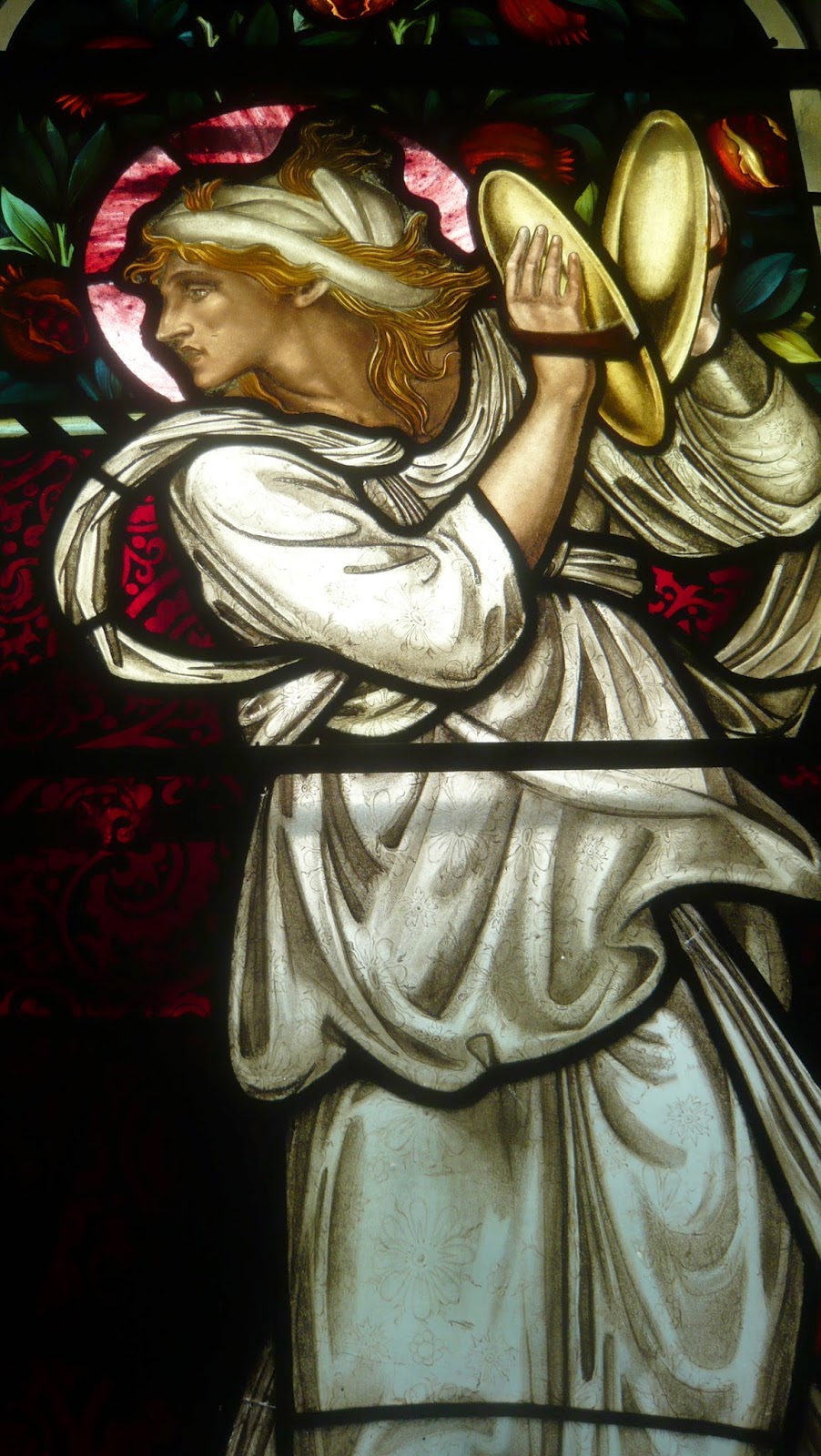
Many of the windows at St Michael and All Angels are by Morris & Co. and feature leading Pre-Raphaelites including Ford Madox Brown, Edward Burne-Jones, Morris, and, possibly, Dante Gabriel Rossetti. Later windows by Selwyn Image, Karl Parsons and Douglas Strachan are part of the same tradition and ensure that the feel of the building as a whole is cohesive. The third chancel window, which depicts the prophetess Miriam and was completed by Morris from a design by Burne-Jones, was included on a list of the 12 best stained glass windows in English churches as judged by photographer Lucinda Lambton.

The Whitefriars Company was a successful British glasshouse closely associated with leading architects and designers from the later portion of the 19th century onwards including Philip Webb who designed glass for William Morris. From 1876 James Crofts Powell ran the stained glass department which also developed mosaic techniques to the Byzantine standards of Ravenna. Powell’s opus sectile mosaics were tilted to deflect the light and gained sufficient credit to be used by William Blake Richmond in his work at St Paul’sCathedral. Whitefriars carried out the creation of the chancel mosaics at St Michael and All Angels to designs by J. P. Hutchinson.

Despite the beauty of the artwork and the building, it is not primarily the Pre-Raphaelite work that I have come to see here. The most recent of the windows, the 1929 St Cecilia and Angel by Karl Parsons, is described in the Church guide as being “especially beautiful when the summer evening sun shines through its vibrant colours.” Acid-etching and plating was used to create the enriched colour and texture found in this window. The window depicts St Cecilia, the Patron Saint of Music, and the music she has inspired on this occasion, which is included in the upper tracery section above the figures, is the fugue from Beethoven’s penultimate piano sonata.

Karl Parsons was pupil and assistant to Christopher Whall, who was an important member of the Arts and Crafts Movement, a leading designer of stained glass and a teacher at the Royal College of Art (RCA) and the Central School of Art and Design. In addition to his work in England, Whall also assisted in reviving the art of stained glass in Ireland. At the invitation of Edward Martyn, Whall, and his colleague Alfred Ernest Child, worked with Sarah Purser to set up a new school of stained glass in Dublin which was christened An Tύr Gloine (Tower of Glass), with a credo that “each window should be in all its artistic parts the work of one individual artist.’

Parsons, who also taught at the RCA and Central School was a craftsman of outstanding ability who worked from a studio at the Glass House Fulham; the centre for most stained glass designers during the first half of the twentieth century. He and Harry Clarke met in 1913, while Clarke was studying the craft and before he began work for his father’s glass workshop, the Clarke Studios, also based in Dublin. The two men remained close friends until Clarke’s death in 1931. The St Cecilia and Angel window at St Michael and All Angels, although “unmistakably by Parsons rather than Clarke” was based on Clarke’s rejected design and means that a trace of the rejected work is found in this church despite its perceived incongruity with the existing Pre-Raphaelite glass (Harry Clarke: The Life & Work, Nicola Gordon Bowe).

Among the many ironies of this story is the fact that Clarke has been described as “the last of the Pre-Raphaelites” and “played a major part in the Arts and Crafts movement in Ireland … as well as in the international stained glass revival which arose from the movement in England.” He “can also be seen as Ireland’s major Symbolist artist, whether in his illustrations or in his stained glass” (Gordon Bowe). Symbolism was also a wider international movement of which the Pre-Raphaelites were part. Therefore, the rejected design, while considered out of keeping with the Pre-Raphaelite windows already in the church, was actually part of a body of work that built on the foundation laid by the Pre-Raphaelites.

Clarke’s strange genius was to fuse “the Burne-Jones/Whall idiom” with “an eclectic and decadent Symbolism of medieval richness and Byzantine splendour” which was achieved by means of his having, as a young man, “absorbed Burne-Jones, [Aubrey] Beardsey, Charles Ricketts, Edmund Dulac, Kay Nielsen, the Glasgow School, [Gustave] Klimt, the Japanese print, the Symbolists, and the Russian ballet.” As a result, “his art displays a wilful decadence and an ambivalent religious mysticism of medieval intensity which ranges from the sublimely beautiful to the grotesquely macabre, rarely found in the work of his Celtic peers.” (Gordon Bowe).

Similarly, James White has noted that Clarke “always carried the sensual-mystical conflict with him” - viewing “his drawings as an outlet from the religious subjects with which he was daily involved in his stained glass work” – and that, as a result, “few artists have been more concerned with the conflict of religion and sensuality.” His works are “uniquely imaginative creations” undertaken with remarkable technical skill meaning that “when he applied his minute and precise line to his process of plating and aciding he achieved an art form of extraordinary perfection.” Peyton Skipwith has suggested that by means of Clarke’s work, alongside that of Evie Hone at An Tύr Gloine, it was Ireland which revived the art of stained glass in the twentieth century (Gordon Bowe).

During his short life Clarke created 160 stained glass windows for churches and private patrons in Ireland, England, the United States and Australia. His unique style and technique combined rich colours with elongated figures that exude poise and grace. Deep blues and ruby reds were the hallmark of his work. As an illustrator of books, his five books for Harrap and Co show his genius in the area of graphic art. In England, work by Clarke is most easily seen at the Victoria & Albert Museum in London and the Stained Glass Museum in Ely.

--------------------------------------------------------------------------------------

The Blue Aeroplanes - Colour Me.

Sunday, 3 October 2010

Science, faith and flamingo

Brandon Flowers (of The Killers) recently spoke about the influence of his faith on his writing. Flowers regularly uses religious references in his lyrics and the new album Flamingo is suffused with religious imagery. In speaking about his latest single 'Crossfire' he said: "[My religion] always comes out, it's inevitable. There's a lot of imagery in the songs... I don't think about it, it's not a real conscious decisive thing that I'm trying to get into the songs; it just creeps its way in. Being a religious person living in Las Vegas, I definitely have been caught in that crossfire."

What Flowers is saying seems to be encapsulated in some lines from the title track of the latest album by The Script:

"Having heavy conversations
About the furthest constellations of our souls
We're just trying to find some meaning
In the things that we believe in"

'Science & Faith' has a chorus with which many people of faith can no doubt identify:

"You won't find faith or hope down a telescope
You won't find heart and soul in the stars
You can break everything down to the chemicals
But you can't explain a love like ours"

These are not songs about faith however, instead what Flowers and The Script do in songs like 'Crossfire' and 'Science and Faith' is to spiritualise the standard rock fare of boy girl relationships. They are therefore reversing the original basis of much rock 'n' roll and soul which saw gospel songs, styles, mannerisms and lyrics being secularised in order to sing about boy/girl relationships rather than love of God.

When this is combined with aging rock stars such as Tom Jones and Robert Plant re-energising and re-invigorating their careers and creativity by tapping into the songs of the American South, with its significant vein of gospel being particularly prominent, plus authentic gospel stars such as Mavis Staples releasing new material and the emo and goth bands with Christian members and themes, then there is much in mainstream music currently to demonstrate the continuing influence of Christian imagery and themes. 

---------------------------------------------------------------------------------

Brandon Flowers - Magdalena.

Saturday, 8 May 2010

Seeing spirituality from a gothic perspective

It was probably inevitable that after Fallen, their major-label debut, propelled Evanescence to sales of nearly 14 million albums worldwide, that a series of other bands would emerge cut from essentially the same template of female-fronted metallic power pop combining spiritual lyrics with gothic imagery.

The inherent drama in Evanescence’s music which derives from their marriage of rock, goth and classical is also clearly apparent in the music made by Flyleaf, where dual guitars trade orchestral riffs that seesaw from soaring to searing and singer Lacey’s vocals build into beauty from pain. Their second album, Memento Mori, links together 13 tracks to form a sort of parable:

"Every track is like another chapter of the story. In my head it feels like a movie. The story becomes a parable for important life lessons we’ve learned over the years. After coming through these life and death experiences, we have learned to be more grateful and purposeful with the time we are given. We want to pass the torch at the end during ‘Arise.’ Perhaps someone will come away from the story and be more grateful and purposeful with their own life and the world will change for the better."

Emo band Paramore have more of a pop-punk sound but have increasingly taken their imagery into similar territory to Evanescence and Flyleaf. Lead singer, Hayley Williams, has said of the songs on their most recent album:

"I was like, 'This isn't a feel-good song, because I'm writing about something I'm going through right now, and it's still painful.' And I confused that with actually not liking the songs, when actually I was prouder of them than I've ever been before. They're heavier emotions for me... I'm still going through some of this stuff, and these songs are really healing to me."

Paramore decided to name the record brand new eyes because of the allusion to seeing things from a whole new perspective, "Just trying to let go of whatever we might have struggled with the past and just see each other in a new way," explained Williams.

The newest band in this vein take us right back to the beginning. We Are The Fallen is comprised of the original members of multi-platinum trailblazing band Evanescence, guitarists Ben Moody and John LeCompt along with drummer Rocky Gray, with enigmatic American Idol finalist Carly Smithson powering the vocal reins of the new group. Respected touring and studio bassist Marty O’Brien (Disturbed and Static-X, among others) rounds out the iconic five-some.

The energetic creative engine behind the launch of Evanescence, Moody and the other members of We Are The Fallen found a true partner in Smithson, who always envisioned a band environment as her dream move following Idol. Ben Moody who co-founded the band, was a principal writer of the 15-million selling debut, Fallen, departed Evanescence in 2003. Since that time, he has enjoyed a prolific career as a producer and songwriter. When asked about the formation of We Are The Fallen, he shared, “I am finally home.” Singer Smithson added, “As an artist I have never been happer. Creatively, musically visually, and on a comedic level we are united and together on the same page. We are a family.”

-----------------------------------------------------------------------------------

We Are The Fallen - Bury Me Alive.