Wikio - Top Blogs - Religion and belief
Showing posts with label judaism. Show all posts

Tuesday, 15 July 2025

Unique musical event combined performances of new compositions with Interfaith conversation

This evening, the Woolf Institute at the University of Cambridge presented a unique musical event that used music as a springboard for interfaith dialogue.

Entitled “Creation: A World-Premiere Event”, it featured live performances of new compositions written by musicians from Jewish, Christian, and Muslim backgrounds expressly for this project. The musical offerings were followed by an engaging roundtable discussion featuring an interfaith collection of scholars affiliated with Cambridge University.

“I envisioned this event as an opportunity to explore the unique the arts can contribute to interfaith dialogue”, says Delvyn Case, an American musician and scholar who curated the project as part of his Visiting Fellowship at the Woolf Institute. “Listening to music reminds us of all the things we have in common with each other, no matter who we are or what we believe: the love of beauty, the value of human connection, and our need to explore the deepest questions life poses to us. Using music to help us consider questions of faith and spirituality will be a one-of-a-kind experience for all who attend.”

The event featured new compositions for voice and piano by Ari Ben-Shabetai, an internationally-prominent composer now based in the UK, as well as Case, who serves as Professor of Music at Wheaton College in Massachusetts. These works were performed by baritone Robert Rice, a member of The Cardinall’s Musick, and Calvin Leung, one the UK’s most accomplished young pianists. The third piece, a new song based on an original text, was performed by Samia Malik, a singer-songwriter, workshop leader, and activist known for her emotionally-riveting bilingual Urdu/English songs.

“Each of us has created a new piece of music that explores the theme of ‘creation’ from a religious or spiritual perspective,” says Case. “It’s fascinating to see the unique ways each of us has approached the challenge. Some of us have focused on the ways the theme relates to the basic human urge to create – and how that helps us understand the spiritual dimension of human experience. Others have expressly connected it to the issue of environmental crisis that we all face. Altogether, these pieces demonstrate the unique power of the arts to bring people together in conversation about themes that are relevant to all of us today.”

The performances of the pieces was followed by an informal panel discussion featuring scholars representing each of the three Abrahamic faiths. Cambridge Faculty of Divinity members Prof. Giles Waller and Prof. Timothy Winter (Abdal Hakim Murad) were joined by Dr. Danielle Padley, a Research Fellow at the Woolf Institute. Each of the composers was also present for the event and shared their own thoughts about their music. 

Musician biographies:

Born in Jerusalem, Ari Ben-Shabetai studied composition with Mark Kopytman at the Jerusalem Rubin Academy of Music, and with George Crumb and Richard Wernick at the University of Pennsylvania,U.S.A., where he received a Ph.D. in Composition. Now residing in the UK, for many years he served as head of the Composition, Conducting and Theory Department at the Jerusalem Rubin Academy of Music. His Sinfonia Cromatica won the first prize in the 1994 Israel Philharmonic Orchestra composition competition, and was subsequently performed on tour to Germany, France, Italy, and the U.S.A. with Maestro Zubin Mehta conducting. In 1995 his work Magreffa was commissioned by Maestro Lorin Maazel for the Pittsburgh Symphony Orchestra and was performed both in Pittsburgh and in Jerusalem. A winner of numerous international awards, Dr. Ben-Shabetai was Chairman of the Israel Composer's League for four years, during which period he founded the Israeli Music Center (IMC) publishing house and produced "Psanterin" - a 9 CD Anthology of Israeli piano music.

Born in Saudi Arabia to Pakistani parents, Samia Malik has lived in the UK since she was a child. For over 30 years she has written, performed and produced bilingual Urdu and English songs based on traditional Urdu Ghazal (a highly refined union of poetry with music) extending and subverting the form to explore contemporary issues around identity, race and gender. She has collaborated and toured nationally and internationally with acclaimed world-class musicians, writers and artists including Baluji Shrivastav OBE, Dr Mallika Sarabhai, Giuliano Modarelli, Seemab Gul, Al MacSween, Sukhdeep Dhanjal, Sianed Jones and Cris Cheek. Samia has released five albums: 'The Colour of the Heart' (1998 rereleased 2023), Jaago – Wake Up (2004), Azaadi: Freedom (2017), 'Samia Malik Live at Norwich Arts Centre' (2019), and 'Songs to Heal and Empower' (2023). She also delivers highly successful and popular workshops and performances directly in the community, including to vulnerable groups such as refugees and asylum seekers, women and families being supported by domestic violence organisations, and isolated rural groups.

Delvyn Case is an American musician, scholar, writer, speaker, and educator. He has spent 25 years developing projects for secular and religious audiences that explore music’s unique power to explore questions of spirituality in the contemporary world. His writings on music, faith, and theology have appeared in The Christian Century, Sojourners, Books and Culture, and his work has been featured in Time Magazine, on BBC4’s “Sunday Morning” broadcast, and in the Boston Globe. He has collaborated on projects with the Yale Institute for Sacred Music, the Boston College Centre for Christian-Jewish Learning, the American Academy of Religion, Hebrew College, and many churches and organizations in the UK. He is the founder and executive director of Deus Ex Musca, an international organization that promotes the use of sacred music as a resource for spiritual formation, ecumenism, and interfaith dialogue. In 2024 he spent two terms as a Visiting Fellow at Exeter College, Oxford, and is currently a Visiting Fellow at the Woolf Institute. His music has been performed by over 100 orchestras across the world, including the BBC Scottish Symphony, the Royal Liverpool Philharmonic, and the HallĂ© Orchestra, as well as by Grammy-winning artists including Richard Stoltzman and the Chestnut Brass Company. A graduate of Yale University and the University of Pennsylvania, Dr. Case currently holds the A. Howard Meneely Endowed Professorship at Wheaton College in Massachusetts, where he conducts the Great Woods Symphony Orchestra.

---------------------------------------------------------------------------------------------------------

Samia Malik - Like A Gift.

Sunday, 13 July 2025

True love of our neighbour means that we receive as well as give

Here's the sermon that I have shared at St Mary's Runwell and St Peter's Nevendon today:

We all know the story of the Good Samaritan (Luke 10. 25 - 37), don’t we? And we all know what the story is about? It’s very clear, isn’t it? It’s a call to kindness, a call to care, a call to help others, unlike those who passed by on the other side. We know all that, don’t we? So, there’s really no point in my reiterating what we already know and therefore I can just leave you to reflect on the calls to kindness that you experience in your daily life. How do you meet those? How do you respond?

There isn’t really anymore to say, so I’ll just leave it at that for today. Or, is that actually the case? Is there perhaps something more to this parable that isn’t generally spoken about? Might there actually be an aspect to this parable that is generally overlooked?

Let’s think for a moment about the hero of the parable – a Samaritan. Samaritans were contemptible people, as far as the Jews of Jesus’ day were concerned, considered as social outcasts, untouchables, racially inferior, practicing a false religion. While Samaritans claimed that they were the true Israel who were descendants of the "lost" tribes taken into Assyrian captivity. The Samaritan’s had their own temple on Mount Gerizim and claimed that it was the original sanctuary. They also claimed that their version of the Pentateuch was the original and that the Jews had a falsified text produced by Ezra during the Babylonian exile.

Samaritans were of mixed Jewish and Gentile ancestry, claimed descent from Jacob and worshipped the God of Israel. So, Samaritans were close to the Jews in their birth and beliefs but they were also different in significant ways, a volatile combination in any era. As a result, Samaritans and Jews engaged in bitter rivalries, which in Jesus’ day could lead to political hostilities that, sometimes, required intervention from the Romans.

Both Jewish and Samaritan religious leaders seem to have taught that it was wrong to have any contact with the opposite group, and neither was to enter each other's territories or even to speak to one another. Jews avoided any association with Samaritans, travelling long distances out of their way to avoid passing through a Samaritan area. Any close physical contact, drinking water from a common bucket, eating a meal with a Samaritan, would make a Jew ceremonially unclean - unable to participate in temple worship for a period of time – this may be part of the reason why the priest and Levite don’t stop to help.

The artist Dinah Roe Kendall painted a version of the parable of the Good Samaritan which set the story in South Africa at the time of apartheid. Doing so, seems to me, to be an accurate parallel with the kinds of emotions and cultural practices that were at play in the relationship between Jews and Samaritans and it shows up clearly the twist in the tail of Jesus’ story.

Jesus, as a Jew, didn’t illustrate his point - that people of every race, colour, class, creed, faith, sexuality, and level of ability are our neighbours – by telling a story in which a Jew was kind to someone else. Instead, he told a story in which a Jew receives help from a person who was perceived to be his enemy. The equivalent in Kendall’s painting is of the black man helping the white man, who represents the people that have oppressed him and his people.

So, Kendall’s version of the story brings out part of the twist in the tail that Jesus gives this story; the sense of receiving help from the person who is your enemy. What her version doesn’t deal with, however, is the idea that the enemy who helps is someone of another faith. The Jews were God’s chosen people and a light to the other nations and faith, so what would have been expected from this story would have been for the Jew in the story to bring the light of faith to the Samaritan. But that is not how Jesus’ story unfolds. Instead, the person who is one of God’s chosen people receives help from the person of another faith.

For Jesus to tell a story in which a Samaritan was the neighbour to a Jew was, for the reasons we have been considering, deeply shocking. We can sense this in the story as recorded for us by Luke, as the lawyer in the story is unable to bring himself to utter the word ‘Samaritan’ in answering Jesus’ question. The story is doubly shocking because the Jews in the story, the Priest and Levite, do not act as neighbours to the man. And trebly shocking, because it was probably their expression of devotion to God that prevented them from being neighbours. Priests were supposed to avoid impurity from a corpse and Pharisees thought that one would contract impurity if even one’s shadow touched the corpse. It was safer, therefore, not to check than to risk impurity.

Perhaps we can get a sense of how shocking this was by asking ourselves who, in our own day, are we least likely to think of as neighbours? Who do we think of as those least like us? Who do we think of as enemies? Who do we think of as contemptible? The point of the story is that Jesus says our neighbour is not our own people but those we think of as enemies or as contemptible because of their birth or beliefs. The least likely people, the people least like us, these are the people that Jesus calls our neighbours.

To find a contemporary equivalent for this aspect of the story, we have, perhaps, to think about relationships in this country between Christians and those of other faiths, and within those relationships, recognise that relationships between Christians and Muslims are often those which are currently most conflicted, with some Christians believing that Islam represents a threat to the Church and Western civilization. Within this context, the parable of the Good Samaritan challenges Christians as to what we can receive from those of other faiths and, particularly, those who we might view as enemies. Jesus says to us, through this parable, that loving our neighbours is not simply about what we can give to others but also about what we receive from others.

Our neighbours, understood in this way, are those to whom we should give – “go and do likewise”, Jesus said to the lawyer - and they are those that we should love as we love ourselves. They are also those from whom we should receive because it was the Samaritan in the story who provided help, not any of the Jewish characters. So, we need to ask ourselves how we can receive, grow, learn from and be blessed by those we think of as enemies or as beneath contempt because of their birth or beliefs.

You see, if our focus is just on what we can give, then we are in a paternalistic relationship with our neighbours or enemies. If our focus is just on what we can give, then what we are saying is that we hold all the aces and we will generously share some of them with you. In other words, we remain in a position of power and influence. Immediately we acknowledge that we can receive from our neighbours or enemies, then the balance of power shifts and we make ourselves vulnerable. In this parable, Jesus says that that is where true love is to be found and it is something that he went on to demonstrate by making himself vulnerable through death on the cross.

We often protect ourselves from the need to engage with, learn from or show love to those who are different from us by using aspects of the Bible to justify our lack of contact or compassion. But Jesus rules this approach out for his followers by giving us the examples of the priest and Levite. George Caird has written that “It is essential to the point of the story that the traveller was left half-dead. The priest and the Levite could not tell without touching him whether he was dead or alive; and it weighed more with them that he might be dead or defiling to the touch of those whose business was with holy things than that he might be alive and in need of care.”

This is religious rule-making justifying a lack of compassion. Caird says that, “Jesus deliberately shocks the lawyer by forcing him to consider the possibility that a semi-pagan foreigner might know more about the love of God than a devout Jew blinded by preoccupation with pettifogging rules.” Who do we, as the Church, stay away from because we are afraid of contamination or defilement? What aspects of scripture do we use to justify our lack of contact?

Jesus told this story in order that we reach out across the divides and barriers that people and groups and communities and nations construct between each other. He told this story so that Christians would be in the forefront of those who look to tear down the barriers and cross the divides. To the extent, that we fail to do this we are more like the priest and Levite in this story that the Samaritan who was a neighbour to the person in need.

In the parable of the Good Samaritan, where the sting is in the tail, the deepest point is that one of God’s chosen people receives help from his enemy who is of another faith. Jesus is taking us deep into the heart of love and saying that we will not truly love our neighbour until we understand and accept that we have much to receive from those that we perceive to be our enemies. In other words, true love of our neighbour means that we receive as well as give.

----------------------------------------------------------------------------------------------------------


Saturday, 14 June 2025

Unique Musical Event Combines Performances of New Compositions with Interfaith Conversation

On July 1 at 6 pm, the Woolf Institute at the University of Cambridge will present a unique musical event that will use music as a springboard for interfaith dialogue.

Entitled “Creation: A World-Premiere Event”, it will feature live performances of new compositions written by musicians from Jewish, Christian, and Muslim backgrounds expressly for this project. The musical offerings will be followed by an engaging roundtable discussion featuring an interfaith collection of scholars and clergy affiliated with Cambridge University. The event is open to all members of the public.

The event will take place at Westminster College in Cambridge. Tickets are available at https://www.woolf.cam.ac.uk/whats-on/events/concert-creation-a-world-premiere-event

“I envisioned this event as an opportunity to explore the unique the arts can contribute to interfaith dialogue”, says Delvyn Case, an American musician and scholar who curated the project as part of his Visiting Fellowship at the Woolf Institute. “Listening to music reminds us of all the things we have in common with each other, no matter who we are or what we believe: the love of beauty, the value of human connection, and our need to explore the deepest questions life poses to us. Using music to help us consider questions of faith and spirituality will be a one-of-a-kind experience for all who attend.”

The event will feature new compositions for voice and piano by Ari Ben-Shabetai, an internationally-prominent composer now based in the UK, as well as Case, who serves as Professor of Music at Wheaton College in Massachusetts. These works will be performed by baritone Robert Rice, a member of The Cardinall’s Musick, and Calvin Leung, one the UK’s most accomplished young pianists. The third piece, a new song based on an original text, will be performed by Samia Malik, a singer-songwriter, workshop leader, and activist known for her emotionally-riveting bilingual Urdu/English songs.

“Each of us has created a new piece of music that explores the theme of ‘creation’ from a religious or spiritual perspective,” says Case. “It’s fascinating to see the unique ways each of us has approached the challenge. Some of us have focused on the ways the theme relates to the basic human urge to create – and how that helps us understand the spiritual dimension of human experience. Others have expressly connected it to the issue of environmental crisis that we all face. Altogether, these pieces demonstrate the unique power of the arts to bring people together in conversation about themes that are relevant to all of us today. This should make for a vibrant conversation.”

The performances of the pieces will be followed by an informal panel discussion featuring scholars representing each of the three Abrahamic faiths. Cambridge Faculty of Divinity members Prof. Giles Waller and Prof. Timothy Winter (Abdal Hakim Murad) will be joined by Dr. Danielle Padley, a Research Fellow at the Woolf Institute.

Each of the composers will also be present for the event and will share their own thoughts about their music.

The event will be followed by a drinks reception open to all. This event is being presented by the Woolf Institute and is co-sponsored by Westminster College, and The Spalding Trust.

------------------------------------------------------------------------------------------------------

John Pfumojena & Delvyn Case - Come Thou Fount of Every Blessing.

Friday, 26 January 2024

Seen and Unseen: How the incomer’s eye sees identity

My latest article for Seen & Unseen is 'How the incomer’s eye sees identity' in which I explain how curating an exhibition for Ben Uri Online gave me the chance to highlight synergies between ancient texts and current issues:

'The combination of images and texts I selected from the Ben Uri Collection enabled a range of different reflections, relationships and disjunctions to be explored. These include the aesthetic, anthropological, devotional, historical, sociological and theological. The result is that significant synergies can be found between the ancient texts and current issues. In this way, stories and images which may, at first, appear to be describing or defining specific religious doctrines can be seen to take on a shared applicability by exploring or revealing the challenges and changes bound up in the age-old experience of migration. This was important in writing for an audience including people of all faiths and none, and in writing for an organisation which seeks to surpass ethnic, cultural and religious obstacles to engagement within the arts sector.'

To see 'Exodus & Exile: Migration Themes in Biblical Images' click here, to read my related essay 'Debt Owed to Jewish Refugee Art' click here, for my post about the exhibition and essay click here, and for more on the Ben Uri Gallery click here.

My first article for Seen and Unseen was 'Life is more important than art' which reviews the themes of recent art exhibitions that tackle life’s big questions and the roles creators take.

My second article 'Corinne Bailey Rae’s energised and anguished creative journey' explores inspirations in Detroit, Leeds and Ethiopia for Corinne Bailey Rae’s latest album, Black Rainbows, which is an atlas of capacious faith.

My third article was an interview with musician and priest Rev Simpkins in which we discussed how music is an expression of humanity and his faith.

My fourth article was a guide to the Christmas season’s art, past and present. Traditionally at this time of year “great art comes tumbling through your letterbox” so, in this article, I explore the historic and contemporary art of Christmas.

My fifth article was 'Finding the human amid the wreckage of migration'. In this article I interviewed Shezad Dawood about his multimedia Leviathan exhibition at Salisbury Cathedral where personal objects recovered from ocean depths tell a story of modern and ancient migrations.

My sixth article was 'The visionary artists finding heaven down here' in which I explored a tradition of visionary artists whose works shed light on the material and spiritual worlds.

---------------------------------------------------------------------------------------------------------

Thursday, 16 November 2023

Inter Faith Week activities

This week is is Inter Faith Week which has the aim of: strengthening good inter faith relations at all levels; increasing awareness of the different and distinct faith communities in the UK, in particular celebrating and building on the contribution which their members make to their neighbourhoods and to wider society; and increasing understanding between people of religious and non-religious beliefs. This year I am having the opportunity to be part of several initiatives/activities that either connect with or are part of Inter Faith Week.

My week began with the opening the online exhibition, Exodus & Exile: Migration Themes in Biblical Images, that I have curated for The Ben Uri Gallery and a related essay entitled Debt Owed to Jewish Refugee Art.

The exhibition, which is currently Exhibition of the Week, includes a range of Biblical images from the Ben Uri Collection in order to explore migration themes through consideration of the images, the Bible passages which inspired them and the relationship between the two. This is because themes of identity and migration feature significantly in both the Hebrew and Christian Bibles and images from these Bibles are a substantive element of the Ben Uri Collection.

The combination of images and texts enables a range of different reflections, relationships and disjunctions to be explored. The result is that significant synergies can be found between the ancient texts and current issues. In this way, stories and images which may, at first, appear to be describing or defining specific religious doctrines can be seen to take on a shared applicability by exploring or revealing the challenges and changes bound up in the age-old experience of migration.

My essay Debt Owed to Jewish Refugee Art is an updated version of an article I originally wrote for Church Times looking at influential works by émigré Jewish artists that were under threat. The article mentions Ervin Bossanyi, Naomi Blake, Ernst Müller-Blensdorf, Hans Feibusch, and George Mayer-Marton, telling stories of the impact of migration on the work and reputations of these artists.

Yesterday, I spent the day at Beauchamps High School and Sixth Form College in Wickford taking part in their Inter Faith Week activities with a group representing Buddhism, Hinduism, Humanism, Islam, and Judaism. We each made presentations and took questions regarding our faiths and beliefs with four different classes in the morning before then taking part in a panel discussion in the afternoon with the whole of the Sixth Form. This was the second time of involvement for me in these activities. It is always a fascinating and interesting day with insights from the other belief representatives and challenging but thoughtful questions from the students.

Today, I am at an Inter Faith Retreat with rabbis and Church of England priests. We are exploring similarities in our chosen vocations as religious leaders to our communities through scriptural encounters and discussions of both our respective histories and current issues. As a result, I have had the pleasure of reconnecting with Rabbi David Hulbert. Together with Imam Dr. Mohammed Fahim, Rabbi David and I led an East London Three Faiths Forum Tour of the Holy Land. My reports from this trip and some of my subsequent talks and sermons can be found here.

---------------------------------------------------------------------------------------------------------

Menachem Creditor - Olam Chesed Yibaneh.

Wednesday, 7 June 2023

A changing understanding of God’s revelation

Here's the reflection that I shared this morning at St Andrew's Wickford:

This is a story (Mark 12.18-27) about interpretation of scripture, which is possibly as important for our understanding for what it reveals about ways of interpreting scripture, as for what it says about resurrection.

The Biblical scholar Tom Wright has noted that: ‘Resurrection was a late arrival on the scene in classic biblical writing … Much of the Hebrew Bible assumes that the dead are in Sheol …“The dead do not praise the Lord, nor do any that go down into silence” (Psalm 115:17). Clear statements of resurrection are extremely rare. Daniel 12 is the most blatant, and remembered as such for centuries afterwards: “Many of those who sleep in the dust of the earth shall awake, some to everlasting life, and some to shame and everlasting contempt” (Daniel 12:2). Daniel is, however, the latest book of the Hebrew Bible.’

In Jesus’ day: ‘There was within Judaism a considerable spectrum of belief and speculation about what happened to dead people in general, and to dead Jews in particular. At one end were the Sadducees, who seem to have denied any doctrine of post-mortem existence (Mark 12:18; Josephus, War 2:165). At the other were the Pharisees, who affirmed a future embodied existence, and who seem to have at least begun to develop theories about how people continued to exist in the timelag between physical death and physical resurrection. And there are further options. Some writings speak of souls in disembodied bliss, some speculate about souls as angelic or astral beings, and so forth.‘

‘The Sadducees rejected the Oral Law as proposed by the Pharisees’ and ‘saw the written Torah as the sole source of divine authority.’ They insisted that the traditions did not contain this newfangled doctrine and that resurrection was not taught in the Torah itself. Their question to Jesus was based on the literal application of a commandment from the Torah and was ‘designed to make belief in a resurrection look foolish by proposing a dilemma it might entail.’ (Timothy J. Geddert, Mark, Herald Press)

In his reply to the Sadducees’ question Jesus goes back to the Torah itself (the five books of Moses) which were the only ones the very conservative Sadducees regarded as really authoritative, and stated that ‘God defines himself there in terms of his relationship to Abraham, Isaac, and Jacob.’ The underlying point was that ‘God would not define himself in relationship to people who were now non-existent.’ Therefore, Jesus implies or leaves unstated the remaining move in the argument that ‘if they are alive this must be because God will in fact raise them from the dead.’

Jesus therefore disagrees with a literal argument about scripture based on the earliest texts and affirms an emerging doctrine which only appears clearly in the last book of the Hebrew Bible. What he is affirming is an evolving revelation from God in scripture which develops or adds to or changes earlier interpretations and understandings.

The extent to which God’s revelation is fixed or emerging is one which continues to be debated within the Church and is a key ground on which debates about women’s ordination and human sexuality take place. What rarely seems to feature in these debates are the approaches to interpretation of scripture used by Jesus, the disciples and the Early Church, which are often very different from standard ways of interpreting scripture used today, particularly those which attempt to fix understandings of scripture for all time through literal interpretations. Here Jesus clearly teaches a later, newer doctrine which does not appear in the Torah and was not part of early Judaism. This emerging understanding, however, becomes central to Jesus’ mission and to Christian belief as Jesus’ resurrection and the teachings of the Early Church based on it are entirely new in the history of Judaism.

Tom Wright says: ‘The early Christian hope for bodily resurrection is clearly Jewish in origin, there being no possible pagan antecedent. Here, however, there is no spectrum of opinion: Earliest Christianity simply believed in resurrection, that is, the overcoming of death by the justice bringing power of the creator God … This is a radical mutation from within Jewish belief.’

Our core hope as Christians derives from a changing understanding of God’s revelation which Jesus taught and experienced. The literal interpretations of the Sadducees meant that they could not see or receive the new thing that God was doing in their midst. May God keep us open to receive the new things he is doing in our world through his Holy Spirit and prevent us from rejecting the unexpected moves of his Spirit because our rigidity in our own understandings of scripture. Amen.

--------------------------------------------------------------------------------------------------------

Paul Simon - Seven Psalms.

Sunday, 13 November 2022

How to live in wartime?

Here is the sermon I shared during Morning Praise at St Mary's Runwell this morning:

How to live in wartime? That is essentially the guidance that Jesus gives his disciples in the teachings recorded for us in Luke 21. 5-19. He was talking about a very specific conflict that would affect his disciples in the near future and which occurred in AD70 when the Roman army attacked Jerusalem and destroyed the temple there. When this happened, as Jesus prophesied, “not a single stone here will be left in its place; every one will be thrown down.”

The result of this conflict was twofold; the Jewish faith refocused its community life, teaching and worship around the synagogue (a pattern of faithful living which continues to this day); and Christianity, forced to abandon its early focus on the authority of the church in Jerusalem, stepped up its missionary encounter with the wider world to become a world religion. Both results are relevant to Jesus’ teaching here because the essence of his teaching comes in verse 19 when he says to “stand firm” in your faith.

The conflict he describes and prophesies will, he says, be an opportunity for his disciples to tell the Good News, if they stand firm: “Countries will fight each other; kingdoms will attack one another … you will be arrested and persecuted; you will be handed over to be tried in synagogues and be put in prison; you will be brought before kings and rulers for my sake. This will be your chance to tell the Good News.” (Luke 21. 10-13) 

That is what Jesus looks for from his followers in wartime and he promises his support and enabling in doing so: “Make up your minds beforehand not to worry about how you will defend yourselves, because I will give you such words and wisdom that none of your enemies will be able to refute or contradict what you say.” The situations in which we are called to do this change throughout history but what is unchanging is the call to tell the Good News, as here, in situations of military defeat, but also in times of victory, while the outcome is uncertain, and in times of peace.

On Remembrance Sunday we remember particular examples of telling the Good News in and through the wartime experiences which are within our cultural memory, most notably soldiers who fought and died in order to win peace within Europe such as Harry Patch, who was the last surviving British soldier to have fought in the trenches of the First World War. Patch, in the moment when he came face to face with a German soldier, recalled the story of Moses descending from Mount Sinai with the Ten Commandments, including "Thou shalt not kill", and could not bring himself to kill the German shooting him in the shoulder, above the knee, and in the ankle. Patch said, "I had about five seconds to make the decision. I brought him down, but I didn't kill him." 

We can also think of: civilians living through the Blitz and caring for neighbours while accepting the simple lifestyle imposed by rationing; Archbishop William Temple setting out an Anglican social theology and a vision for what would come to constitute a just post-war society in ‘Christianity and the Social Order’; and Bishop George Bell assisting refugees, arguing against the blanket-bombing of German cities and encouraging the role of the Church in the reconstruction of Europe after the war.

The German pastor, Dietrich Bonhoeffer, who took part in the plot to assassinate Hitler, was one of those who saw most clearly what was actually at stake in World War II, when he wrote at the beginning of the war: “Christians in Germany will face the terrible alternative of either willing the defeat of their nation in order that Christian civilisation may survive, or willing the victory of their nation and thereby destroying our civilisation.”

Our situation is different again, meaning that the ways in which we are called to stand firm and tell the Good News are also different. In our time, the battle is one of ideas, a battle which is explained well by the French philosopher Jean Luc Nancy:

“1968 led to a process of transformation that amounted to adapting society to something that was leaving it behind: a new techno-political-economic world. This adaptation has had many negative effects. It unleashed the spirit of consumerism and ... completed the destruction of the frameworks, or references, of religious and emancipatory politics ... The resulting society has fewer foundations that it did before 1968.”

In this changed and changing world, where, in the West, we are no longer part of a civilization which seeks to be built primarily on Christian principles, many people want to mount rear guard actions to retain as much of what they perceive to be the past as possible. So, for example, some seek to fight for a mythic mono-cultural white Britain which never actually existed, while others seek to maintain the privileges that Christians have enjoyed in this country in the past instead of accepting the justice of the equality of faiths which is now enshrined in the law of the land.

The situation in which we find ourselves now equates to that of the Jews and Jewish Christians after the destruction of the Temple in AD70. Then there was no going back and Jesus sought to prepare his disciples for that reality. Instead of calling for rear guard actions to preserve as much of what had been as possible, Jesus sought to prepare and enable his disciples to go out into their changed and changing world and tell the Good News by standing firm in their faith. This remains the call of God on our lives and it is a task which requires the same bravery and courage as was shown by the Early Church in its missionary activity and as continues to be shown by serving men and women in conflict situations around the world today.

Jesus gives us the same marching orders that he gave to his first disciples: “Make up your minds beforehand not to worry about how you will defend yourselves, because I will give you such words and wisdom that none of your enemies will be able to refute or contradict what you say.” We are to trust that Jesus, through his Spirit, will inspire and enable what we are to do and say in this changed and changing world (as happened for Harry Patch). Nancy argues that we should respond to our new techno-political-economic world: “not with politics or economics but with thinking, with imagination, with what I call worship: a relationship to the infinite. We must stop believing that economic measures or political models can respond to what is happening. What is happening ... is the spirit of the world being transformed.”

The Early Church saw the spirit of the world transformed by God as they stood firm in their faith and told the Good News. That is how we are called live in wartime - in the battle of ideas or clash of civilizations which we now face - to stand firm in our faith and tell the good news. The challenge of this passage is whether we can do and see that within our changed and changing world.

----------------------------------------------------------------------------------------------------------

Talking Heads - Life During Wartime. 

Friday, 4 November 2022

Church Times - Art review: Football and Religion: Tales of Hope, Passion and Play (Aga Khan Centre)

My latest review for Church Times is Football and Religion: Tales of Hope, Passion and Play by Ed Merlin Murray at the Aga Khan Centre Gallery:

'IF ONE were to be told of a current football exhibition with women footballers featuring as its main image, expectations would be high for an image of the Lionesses victorious at the Euros in the summer. The very different focus of this exhibition becomes apparent in that the key image features the Shimshali sisters — Sumaira Inayat and Karishma Inayat — who have, since 2018, run the Gilgit-Baltistan Girls Football League, Pakistan’s first women-led girls football tournament.

The sisters are Muslims, and this exhibition, as a whole, focuses primarily on the current contribution of Muslims and Christians to football, together with an archive display highlighting both Jewish and Christian contributions. The stories of Muslim women footballers included are one key aspect of an exhibition that challenges stereotypes on several levels. As Karishma says, “I am representing a region that lacks basic facilities yet encourages its daughters to play football and break the patriarchy.”

The exhibition features many stories of hope, passion, and play in the lives of players and professionals, both female and male. These stories are presented through a series of new artworks created by visual artist, illustrator, and animator, Ed Merlin Murray.'

Other of my pieces for Church Times can be found here. My writing for ArtWay can be found here. My pieces for Artlyst are here and those for Art+Christianity are here. See also Modern religious art: airbrushed from art history?

-----------------------------------------------------------------------------------------------------

New Order - World In Motion.

Sunday, 10 July 2022

True love of neighbour means we receive, as well as give

Here's my sermon from today's Communion Servive at St Catherine’s Wickford:

We all know the story of the Good Samaritan (Luke 10. 25 - 37), don’t we? And we all know what the story is about? It’s very clear, isn’t it? It’s a call to kindness, a call to care, a call to help others, unlike those who passed by on the other side. We know all that, don’t we? So, there’s really no point in my reiterating what we already know and therefore I can just leave you to reflect on the calls to kindness that you experience in your daily life. How do you meet those? How do you respond?

There isn’t really anymore to say, so I’ll just leave it at that for today. Or, is that actually the case? Is there perhaps something more to this parable that isn’t generally spoken about? Might there actually be an aspect to this parable that is generally overlooked?

Let’s think for a moment about the hero of the parable – a Samaritan. Samaritans were contemptible people, as far as the Jews of Jesus’ day were concerned, considered as social outcasts, untouchables, racially inferior, practicing a false religion. While Samaritans claimed that they were the true Israel who were descendants of the "lost" tribes taken into Assyrian captivity. The Samaritan’s had their own temple on Mount Gerizim and claimed that it was the original sanctuary. They also claimed that their version of the Pentateuch was the original and that the Jews had a falsified text produced by Ezra during the Babylonian exile.

Samaritans were of mixed Jewish and Gentile ancestry, claimed descent from Jacob and worshipped the God of Israel. So, Samaritans were close to the Jews in their birth and beliefs but they were also different in significant ways, a volatile combination in any era. As a result, Samaritans and Jews engaged in bitter rivalries, which in Jesus’ day could lead to political hostilities that, sometimes, required intervention from the Romans.

Both Jewish and Samaritan religious leaders seem to have taught that it was wrong to have any contact with the opposite group, and neither was to enter each other's territories or even to speak to one another. Jews avoided any association with Samaritans, travelling long distances out of their way to avoid passing through a Samaritan area. Any close physical contact, drinking water from a common bucket, eating a meal with a Samaritan, would make a Jew ceremonially unclean - unable to participate in temple worship for a period of time – this may be part of the reason why the priest and Levite don’t stop to help.

The artist Dinah Roe Kendall painted a version of the parable of the Good Samaritan which set the story in South Africa at the time of apartheid. Doing so, seems to me, to be an accurate parallel with the kinds of emotions and cultural practices that were at play in the relationship between Jews and Samaritans and it shows up clearly the twist in the tail of Jesus’ story.

Jesus, as a Jew, didn’t illustrate his point - that people of every race, colour, class, creed, faith, sexuality, and level of ability are our neighbours – by telling a story in which a Jew was kind to someone else. Instead, he told a story in which a Jew receives help from a person who was perceived to be his enemy. The equivalent in Kendall’s painting is of the black man helping the white man, who represents the people that have oppressed him and his people.

So, Kendall’s version of the story brings out part of the twist in the tail that Jesus gives this story; the sense of receiving help from the person who is your enemy. What her version doesn’t deal with, however, is the idea that the enemy who helps is someone of another faith. The Jews were God’s chosen people and a light to the other nations and faith, so what would have been expected from this story would have been for the Jew in the story to bring the light of faith to the Samaritan. But that is not how Jesus’ story unfolds. Instead, the person who is one of God’s chosen people receives help from the person of another faith.

For Jesus to tell a story in which a Samaritan was the neighbour to a Jew was, for the reasons we have been considering, deeply shocking. We can sense this in the story as recorded for us by Luke, as the lawyer in the story is unable to bring himself to utter the word ‘Samaritan’ in answering Jesus’ question. The story is doubly shocking because the Jews in the story, the Priest and Levite, do not act as neighbours to the man. And trebly shocking, because it was probably their expression of devotion to God that prevented them from being neighbours. Priests were supposed to avoid impurity from a corpse and Pharisees thought that one would contract impurity if even one’s shadow touched the corpse. It was safer, therefore, not to check than to risk impurity.

Perhaps we can get a sense of how shocking this was by asking ourselves who, in our own day, are we least likely to think of as neighbours? Who do we think of as those least like us? Who do we think of as enemies? Who do we think of as contemptible? The point of the story is that Jesus says our neighbour is not our own people but those we think of as enemies or as contemptible because of their birth or beliefs. The least likely people, the people least like us, these are the people that Jesus calls our neighbours.

To find a contemporary equivalent for this aspect of the story, we have, perhaps, to think about relationships in this country between Christians and those of other faiths, and within those relationships, recognise that relationships between Christians and Muslims are often those which are currently most conflicted, with some Christians believing that Islam represents a threat to the Church and Western civilization. Within this context, the parable of the Good Samaritan challenges Christians as to what we can receive from those of other faiths and, particularly, those who we might view as enemies. Jesus says to us, through this parable, that loving our neighbours is not simply about what we can give to others but also about what we receive from others.

Our neighbours, understood in this way, are those to whom we should give – “go and do likewise”, Jesus said to the lawyer - and they are those that we should love as we love ourselves. They are also those from whom we should receive because it was the Samaritan in the story who provided help, not any of the Jewish characters. So, we need to ask ourselves how we can receive, grow, learn from and be blessed by those we think of as enemies or as beneath contempt because of their birth or beliefs.

You see, if our focus is just on what we can give, then we are in a paternalistic relationship with our neighbours or enemies. If our focus is just on what we can give, then what we are saying is that we hold all the aces and we will generously share some of them with you. In other words, we remain in a position of power and influence. Immediately we acknowledge that we can receive from our neighbours or enemies, then the balance of power shifts and we make ourselves vulnerable. In this parable, Jesus says that that is where true love is to be found and it is something that he went on to demonstrate by making himself vulnerable through death on the cross.

We often protect ourselves from the need to engage with, learn from or show love to those who are different from us by using aspects of the Bible to justify our lack of contact or compassion. But Jesus rules this approach out for his followers by giving us the examples of the priest and Levite. George Caird has written that “It is essential to the point of the story that the traveller was left half-dead. The priest and the Levite could not tell without touching him whether he was dead or alive; and it weighed more with them that he might be dead or defiling to the touch of those whose business was with holy things than that he might be alive and in need of care.”

This is religious rule-making justifying a lack of compassion. Caird says that, “Jesus deliberately shocks the lawyer by forcing him to consider the possibility that a semi-pagan foreigner might know more about the love of God than a devout Jew blinded by preoccupation with pettifogging rules.” Who do we, as the Church, stay away from because we are afraid of contamination or defilement? What aspects of scripture do we use to justify our lack of contact?

Jesus told this story in order that we reach out across the divides and barriers that people and groups and communities and nations construct between each other. He told this story so that Christians would be in the forefront of those who look to tear down the barriers and cross the divides. To the extent, that we fail to do this we are more like the priest and Levite in this story that the Samaritan who was a neighbour to the person in need.

In the parable of the Good Samaritan, where the sting is in the tail, the deepest point is that one of God’s chosen people receives help from his enemy who is of another faith. Jesus is taking us deep into the heart of love and saying that we will not truly love our neighbour until we understand and accept that we have much to receive from those that we perceive to be our enemies. In other words, true love of our neighbour means that we receive as well as give.

---------------------------------------------------------------------------------------------------------------

Ladysmith Black Mambazo - Homeless.

Saturday, 19 June 2021

Living God's Future Now: w/c 20 June 2021

'Living God’s Future Now’ is our mini online festival of theology, ideas and practice.

We’ve developed this in response to the pandemic and our changing world. The church is changing too, and - as we improvise and experiment - we can learn and support each other.

This is 'Living God’s Future Now’ - talks, workshops and discussion - hosted by HeartEdge. Created to equip, encourage and energise churches - from leaders to volunteers and enquirers - at the heart and on the edge.

The focal event in ‘Living God’s Future Now’ is a monthly conversation where Sam Wells explores what it means to improvise on God’s kingdom with a leading theologian or practitioner.

The online programme includes:
  • Regular weekly workshops: Biblical Studies (Mondays fortnightly), Sermon Preparation (Tuesdays) and Community of Practitioners (Wednesdays)
  • One-off workshops on topics relevant to lockdown such as ‘Growing online communities’ and ‘Grief, Loss & Remembering’
  • Monthly HeartEdge dialogue featuring Sam Wells in conversation with a noted theologian or practitioner
Find earlier Living God’s Future Now sessions at https://www.facebook.com/pg/theHeartEdge/videos/?ref=page_internal.

Regular – Weekly or Fortnightly

Tuesdays: Sermon Preparation Workshop, 16:30 (GMT), livestreamed at https://www.facebook.com/theHeartEdge/. Please note there will be no Sermon Preparation workshop on Tuesday 6 April.

Wednesdays: Community of Practitioners workshop, 16:30 (GMT), Zoom meeting. Email jonathan.evens@smitf.org to register.

Fortnightly on Mondays: Biblical Studies class, 19:30-21:00 (GMT), Zoom meeting. Register in advance: https://us02web.zoom.us/meeting/register/tZMrcOmgrTgsHt2ceY7LepLhQYqQxS1G1ix9 2021 dates - Gospels & Acts.

W/c 20 June 2021

Sunday

God’s Unfailing Word
Zoom
Sunday 20 June, 19:00 (GMT)
Register here.
A conversation between Rabbi Daniel Epstein and Revd Dr Sam Wells based on the recently (2019) published God’s Unfailing Word (https://www.churchofengland.org/sites/default/files/2019-11/godsunfailingwordweb.pdf).

Tuesday

Sermon Prep Sally Hitchiner and Sam Wells
Livestream
Tuesday 22 June, 16:30 (GMT)
Live streamed on the HeartEdge Facebook page here.
Discussion of preaching and the lectionary readings for the coming Sunday with Sam Wells and Sally Hitchiner.

Wednesday

Community of Practitioners
Zoom
Wednesday 23 June, 16:00 (GMT)
Email Jonathan Evens here to take part.
This is open to all, including ordinands and lay leaders. Church leaders join in community, share and reflect together on their recent experiences in the form of wonderings with one of the HeartEdge team and book discussions.

Thursday

Creation Care Course
Zoom
Thursday 24 June, 4.00-5.30 pm (GMT)
Register here.
In this 4-week Creation Care Course, we will provide you with vital information about climate change, its impacts on people, and reflect on our role as Christians in taking practical climate action. Week 2: Understanding Climate Change, we will look at climate change, its drivers and impacts from a scientific perspective.

Friday

Jesus Is Just Alright: What Pop Songs About Jesus Can Teach Christians Today (SESSION 4: If I Believe You)
Zoom
Friday 18 June, 16:30 (BST)
Register here.
For over fifty years, pop musicians in all genres have explored the meaning and significance of Jesus in their music. The result is a rich collection of songs that consider important spiritual questions like faith, doubt, and prayer in unique and often provocative ways. Through a combination of listening and discussion, this four-part series invites participants to explore a different spiritual topic each week. Join us to listen to great music that asks tough questions about our faith and our lives as Christians. SESSION 4: Whether they are doubting believers, faithful doubters, unwilling atheists, or simple humans hungering for meaning, pop musicians bring to life approaches to faith that rival the psalms in their depth and nuance. This session will use these songs to help us understand and articulate the various ways we consider “belief”, and how that relates to our identities as modern Christians.

Coming Up

Mission Summer School - 12 – 16 July 2021
Zoom
12-16 July 2021
For more details and to reg click here
An opportunity to engage more deeply with the theology of mission and to explore how it relates to your own practice.Input structured around the four Cs of Commerce, Culture, Congregation and Compassion. A mix of teaching and conversation with leading scholars and practitioners including the Revd Dr Sam Wells, Professor Anthony Reddie, Dr Cathy Ross, and Revd Heather Cracknell, among others. Workshops to engage with the themes and issues presented. Encounters with churches, organisations and projects (HeartEdge and Fresh Expressions) to get a hands-on feel for how it works out in practice.

For more information please have a look at this video of Sam Wells telling us more, here.


----------------------------------------------------------------------------------------------------------

Martyn Joseph - When We Get Through This.

Friday, 11 June 2021

Church Times: Debt owed to Jewish refugee art

My latest article for Church Times is about influential works by Ă©migrĂ© Jewish artists, now under threat, and our debt owed to Jewish refugee art:

'St John’s, Waterloo, is home to two murals by the Ă©migrĂ© artist Hans Feibusch. Its Vicar, Canon Giles Goddard, understands more than most the significance of this period, and the issues raised: “Our Feibusch murals have graced St John’s and focused our thoughts for almost 70 years.

“But it is only now that we, and other churches blessed with works of this period, are beginning to see the bigger picture. What did Feibusch and his fellow non-Christian artists bring to our faith and to our understanding of the post-war world? How can we save their legacy, so significant and yet so much at risk? And how can we respond to the art of refugees in Britain today?”

Nick Braithwaite, great-nephew of George Mayer-Marton, is campaigning to save his great-uncle’s vast 1955 Crucifixion mural — a rare combination of fresco and mosaic — at the Roman Catholic Church of the Holy Rosary, Oldham. He says that these artists brought an “infusion of Continental modernist energy into a conservative art scene in the UK”.'

The article is based on a conference to be held at St John's Waterloo on 16 June - https://www.eventbrite.co.uk/e/a-jewish-jesus-art-and-faith-in-the-shadow-of-world-war-ii-registration-128521672783. 

Other of my articles about the art of refugees can be found at:

------------------------------------------------------------------------------------------------------

Leonard Cohen - Born In Chains.

Friday, 4 June 2021

Living God's Future Now - W/c 6 June 2021

'Living God’s Future Now’ is our mini online festival of theology, ideas and practice.

We’ve developed this in response to the pandemic and our changing world. The church is changing too, and - as we improvise and experiment - we can learn and support each other.

This is 'Living God’s Future Now’ - talks, workshops and discussion - hosted by HeartEdge. Created to equip, encourage and energise churches - from leaders to volunteers and enquirers - at the heart and on the edge.

The focal event in ‘Living God’s Future Now’ is a monthly conversation where Sam Wells explores what it means to improvise on God’s kingdom with a leading theologian or practitioner.

The online programme includes:
  • Regular weekly workshops: Biblical Studies (Mondays fortnightly), Sermon Preparation (Tuesdays) and Community of Practitioners (Wednesdays)
  • One-off workshops on topics relevant to lockdown such as ‘Growing online communities’ and ‘Grief, Loss & Remembering’
  • Monthly HeartEdge dialogue featuring Sam Wells in conversation with a noted theologian or practitioner
Find earlier Living God’s Future Now sessions at https://www.facebook.com/pg/theHeartEdge/videos/?ref=page_internal.

Regular – Weekly or Fortnightly

Tuesdays: Sermon Preparation Workshop, 16:30 (GMT), livestreamed at https://www.facebook.com/theHeartEdge/. Please note there will be no Sermon Preparation workshop on Tuesday 6 April.

Wednesdays: Community of Practitioners workshop, 16:30 (GMT), Zoom meeting. Email jonathan.evens@smitf.org to register.

Fortnightly on Mondays: Biblical Studies class, 19:30-21:00 (GMT), Zoom meeting. Register in advance: https://us02web.zoom.us/meeting/register/tZMrcOmgrTgsHt2ceY7LepLhQYqQxS1G1ix9 2021 dates - Gospels & Acts:

• 7 Jun: Lecture 11 Luke-Acts
• 14 Jun: Lecture 12 Luke-Acts

W/c 6 June 2021

Sunday


Inspired to Follow
Zoom
Sunday 6 June, 14:00 (GMT)
Register here.
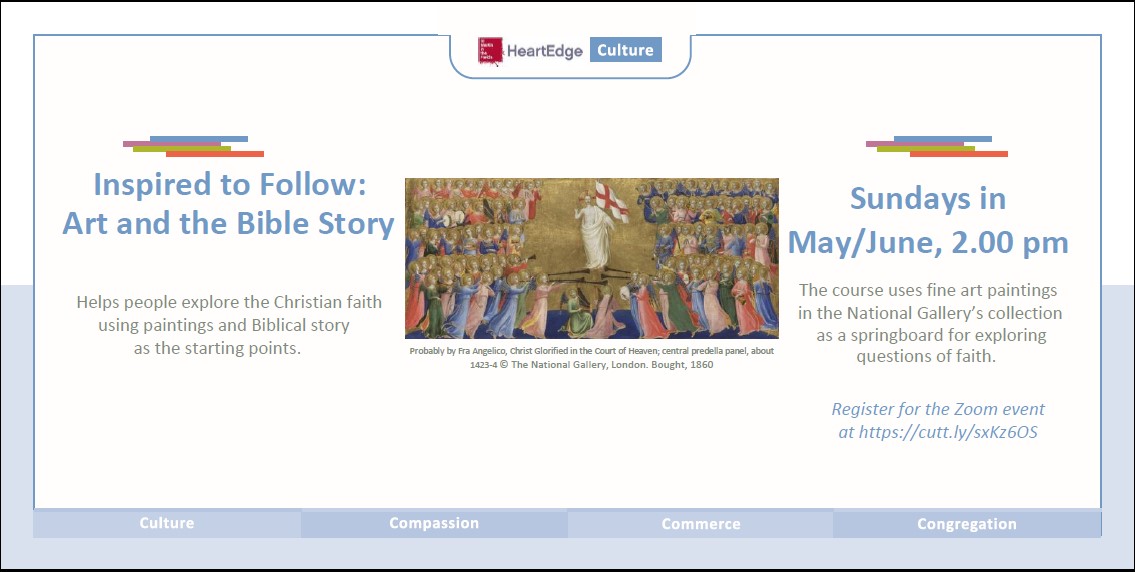
‘Inspired to Follow: Art and the Bible Story’ helps people explore the Christian faith, using paintings and Biblical story as the starting points. Session 21: Saint Paul. Text: Acts 9:1-19. Image: ‘The Conversion of Saint Paul’, Karel Dujardin, 1662, NG6296.

God’s Unfailing Word
Zoom
Sunday 6 June, 18:30 (GMT)
Register here.
A three-part series of conversations on the nature of Christian-Jewish relations in the 21st century. With Rabbi Daniel Epstein (Western Marble Arch Synagogue) and Revd Dr Sam Wells (St Martin-in-the-Fields). Based on the recently (2019) published God’s Unfailing Word (https://www.churchofengland.org/sites/default/files/2019-11/godsunfailingwordweb.pdf).

Monday

Biblical Studies class
Zoom
Monday 7 June, 19:30-21:00 (GMT)
Register here.
Lecture 11 Luke-Acts.

Tuesday

Sermon Prep Sally Hitchiner and Sam Wells
Livestream
Tuesday 8 June, 16:30 (GMT)
Live streamed on the HeartEdge Facebook page here.
A live preaching workshop focusing on the forthcoming Sunday's lectionary readings in the light of current events and sharing of thoughts on approaches to the passages.

Book Launch - A Theology of Disagreement: New Testament Ethics for Ecclesial Conflicts
Zoom
Tuesday 8 June, 19:00 (GMT)
Register here.
A Theology of Disagreement examines how New Testament texts inform Christian approaches to disagreement. Join author Revd Dr Christopher Landau and his guests, Revd Canon Dr Joanna Collicutt, Professor David Ford, Revd Selina Stone, and Dr Elaine Storkey, to explore the nature of an ethic of disagreement, and its practical implications for the church's public theological witness, as well as its liturgy.

Wednesday

Community of Practitioners
Zoom
Wednesday 9 June, 16:00 (GMT)
Email Jonathan Evens here to take part.
This is open to all, including ordinands and lay leaders. Church leaders join in community, share and reflect together on their recent experiences in the form of wonderings with one of the HeartEdge team and book discussions.

Thursday

Living God’s Future Now conversation - Revd Lucy Winkett
Zoom
Thursday 10 June, 6.00 pm (GMT)
Register here.
The focal event in 'Living God's future now' is a monthly conversation in which Sam Wells explores what it means to improvise on God’s kingdom with a leading theologian or practitioner. This Thursday Sam is in conversation with Lucy Winkett who is Rector of St James’s Church Piccadilly since 2010. Lucy was one of the first generation of women to be ordained in the Church of England, she served her title in Manor Park, Newham before becoming the first woman priest appointed at St Paul’s Cathedral, later becoming Canon Precentor. You may have heard her on Radio 4's Thought for the Day where she is a regular contributor.

Friday

Jesus Is Just Alright: What Pop Songs About Jesus Can Teach Christians Today (SESSION 2: Would Jesus Wear a Rolex?)
Zoom
Friday 11 June, 16:30 (BST)
Register here.
For over fifty years, pop musicians in all genres have explored the meaning and significance of Jesus in their music. The result is a rich collection of songs that consider important spiritual questions like faith, doubt, and prayer in unique and often provocative ways. Through a combination of listening and discussion, this four-part series invites participants to explore a different spiritual topic each week. Join us to listen to great music that asks tough questions about our faith and our lives as Christians. SESSION 2: Would Jesus Wear a Rolex? What would Jesus think if he came back today? That’s a question posed by artists working in genres as diverse as folk, hip-hop, punk, country, and heavy metal. Though written by non-Christians, most of these songs have no problem with Jesus, but instead with his followers, accusing them of sins including hypocrisy, judgmentalism, intolerance, and greed. Listening to these “prophetic” songs will challenge participants to consider how they can better follow Christ in their own lives and as representatives of the Church.

Coming Up

Mission Summer School - 12 – 16 July 2021
Zoom
12-16 July 2021
For more details and to reg click here
An opportunity to engage more deeply with the theology of mission and to explore how it relates to your own practice.Input structured around the four Cs of Commerce, Culture, Congregation and Compassion. A mix of teaching and conversation with leading scholars and practitioners including the Revd Dr Sam Wells, Professor Anthony Reddie, Dr Cathy Ross, and Revd Heather Cracknell, among others. Workshops to engage with the themes and issues presented. Encounters with churches, organisations and projects (HeartEdge and Fresh Expressions) to get a hands-on feel for how it works out in practice.

For more information please have a look at this video of Sam Wells telling us more, here.


---------------------------------------------------------------------------------------------------------

Alison Beck & Lucy Winkett - Where No-One Stands Alone.

Friday, 28 May 2021

Living God's Future Now - June 2021

'Living God’s Future Now’ is our mini online festival of theology, ideas and practice.

We’ve developed this in response to the pandemic and our changing world. The church is changing too, and - as we improvise and experiment - we can learn and support each other.

This is 'Living God’s Future Now’ - talks, workshops and discussion - hosted by HeartEdge. Created to equip, encourage and energise churches - from leaders to volunteers and enquirers - at the heart and on the edge.

The focal event in ‘Living God’s Future Now’ is a monthly conversation where Sam Wells explores what it means to improvise on God’s kingdom with a leading theologian or practitioner.

The online programme includes:
  • Regular weekly workshops: Biblical Studies (Mondays fortnightly), Sermon Preparation (Tuesdays) and Community of Practitioners (Wednesdays)
  • One-off workshops on topics relevant to lockdown such as ‘Growing online communities’ and ‘Grief, Loss & Remembering’
  • Monthly HeartEdge dialogue featuring Sam Wells in conversation with a noted theologian or practitioner
Find earlier Living God’s Future Now sessions at https://www.facebook.com/pg/theHeartEdge/videos/?ref=page_internal.

Regular – Weekly or Fortnightly

Tuesdays: Sermon Preparation Workshop, 16:30 (GMT), livestreamed at https://www.facebook.com/theHeartEdge/. Please note there will be no Sermon Preparation workshop on Tuesday 6 April.

Wednesdays: Community of Practitioners workshop, 16:30 (GMT), Zoom meeting. Email jonathan.evens@smitf.org to register.

Fortnightly on Mondays: Biblical Studies class, 19:30-21:00 (GMT), Zoom meeting. Register in advance: https://us02web.zoom.us/meeting/register/tZMrcOmgrTgsHt2ceY7LepLhQYqQxS1G1ix9 2021 dates - Gospels & Acts:

• 7 Jun: Lecture 11 Luke-Acts
• 14 Jun: Lecture 12 Luke-Acts

May

Shut In, Shut Out, Shut Up Season 4: Ableism, Faith & Church – Friday 28 May, 16:30-18:00 BST, Zoom. Register for a Zoom invite at https://www.eventbrite.co.uk/e/shut-in-shut-out-shut-up-ableism-faith-church-tickets-152921752077. Ableism is discrimination and social prejudice against disabled people. Like racism and sexism, it classifies entire groups of people as 'less than'. In this groundbreaking 4th series of Shut In, Shut Out, Shut Up we explore the context, culture and practice of ableism in faith and church. Since 2012 the Living Edge conference has held space for disabled and neurodivergent people to gather, to resource each other and the church. These HeartEdge Shut In Shut Out Shut Up series shares some of this experience, providing new space to ask challenging questions. Come and join the conversation with Fiona MacMillan and Rev Dr Hannah Lewis and Dr Rachel Holdforth (Practice). Fiona MacMillan (she/her) is a disability advocate, practitioner, speaker and writer. Fiona chairs the Disability Advisory Group at St Martin in the Fields and is a trustee of Inclusive Church. She leads the planning team for their annual disability conference, now in its 10th year.

Inspired to Follow: Sunday 30 May, 14:00 (GMT), zoom - https://www.eventbrite.co.uk/e/inspired-to-follow-art-and-the-bible-story-tickets-148401610211. ‘Inspired to Follow: Art and the Bible Story’ helps people explore the Christian faith, using paintings and Biblical story as the starting points. The course uses fine art paintings in the National Gallery’s collection as a springboard for exploring questions of faith. Session 20: Saint Peter. Text: Acts 10:30-48. Image: ‘Christ appearing to Saint Peter on the Appian Way (Domine, Quo Vadis?)’, Annibale Carracci, 1601-2, NG9.

Theology Group: Sunday, 30 May 2021, 19:00 – 20:00 BST, zoom - https://www.eventbrite.co.uk/e/theology-group-tickets-155514922319. The St Martin-in-the-Fields and HeartEdge Theology Group provides a monthly opportunity to reflect theologically on issues of today and questions of forever with Sam Wells. Each month Sam responds to questions from a member of the congregation of St Martin-in-the-Fields who also chairs the session and encourages your comments and questions.

June

Pilgrimage post-Pandemic: Tuesday 1 June, 19:00 BST, zoom. Register at https://www.eventbrite.co.uk/e/pilgrimage-post-pandemic-tickets-154148118171. How is Pilgrimage changed by pandemic? In this workshop we explore this question with those who organise Pilgrimages. How Pilgrimage organizers and hosts are building better, safe experiences for the present and future. How do virtual Pilgrimages work in practice? What will they feature outside of lockdown? Revd Dr Donald Fishburne regularly leads groups on faith pilgrimages and helps other Pilgrimage hosts plan and lead fruitful group travel and spiritual experiences, through www.EO.Travel/Episcopal. Rev. Heather Prince Doss is an owner of Progressive Pilgrimage and regularly leads spiritually-minded trips to the Holy Land, Ireland, Scotland, and Europe. Eugene Ling organises the annual Pilgrimage to Canterbury for The Connection at St Martin-in-the-Fields. Long-time Episcopal priest Donald Fishburne and his wife Sarah enjoy helping new Pilgrimage hosts design their group experience as part of the faith journeys of Christians and seekers. They also recruit hosts and speakers on a variety of Pilgrimages. Donald leads online spirituality small groups, such as “Our Lenten Journey through the Wilderness toward Resurrection,” which features virtual pilgrimage elements. Rev. Heather Prince Doss is the owner of Progressive Pilgrimage and pastor of Eliot Presbyterian Church, a multicultural congregation in Lowell, Massachusetts, USA. As a child of military parents, she has been traveling since birth and loves to help people experience God and deepen their faith by encountering new places, peoples, and cultures through travel. Eugene Ling has been the Annual Pilgrimage Coordinator for the Connection at St Martin’s since 2014 and is also a member of St Martin-in-the-Fields. This 4-day, 74 miles pilgrimage, from St. Martin’s to Canterbury Cathedral, normally involves about 120 pilgrims and volunteers each year. In 2020 it was replaced by a virtual Pilgrimage which involved 44 virtual pilgrims all over the world, walking for 2,833 miles. This Annual Pilgrimage is a fundraising event for the Connection at St Martin’s to support homeless people around London.

Poetry, Refuge, Exile: Voices of Migration - Thursday 3 June, 16:30-18:00 (BST), zoom. Register at https://www.eventbrite.co.uk/e/poetry-refuge-exile-voices-of-migration-tickets-153707195359. This is the third of a 4-part series on the themes of Migration, Theology and Community. Four poets – Amir Darwish, Jennifer Langer, Alison Phipps, Tawona SitholĂ© – and Lia Shimada (chair) will explore how poetry emerges from, and gives voice to, diverse experiences of exile, flight, abuse, hope, refuge and belonging. They will be joined by representatives from the Helen Bamber Foundation – a pioneering human rights charity supporting refugees and asylum seekers who are the survivors of extreme human cruelty. Mapping Faith: Theologies of Migration and Community (published by Jessica Kingsley, 2020) brings together over 35 writers, poets, artists and practitioners, from primarily Jewish, Muslim and Christian backgrounds. Royalties from book sales will be donated to the Helen Bamber Foundation, with whom HeartEdge has a longstanding relationship. This event is co-sponsored by the Susanna Wesley Foundation, which facilitated the production of the book. Alison Phipps holds the UNESCO Chair in Refugee Integration through Languages and the Arts at the University of Glasgow, where she is also Professor of Languages and Intercultural Studies, and Co-Convenor of the Glasgow Refugee, Asylum and Migration Network. Tawona SitholĂ© is Artist in Residence of the UNESCO Chair for Refugee Integration through Languages and the Arts at the University of Glasgow. He co-founded Seeds for Thought, an arts organization based in Glasgow. Amir Darwish is a poet and writer of Kurdish origin, whose work has been widely translated. Born in Aleppo, he came to Britain as an asylum seeker in 2003. Amir holds advanced degrees in History, International Relations, and Creative and Life Writing. He is currently working on his doctorate. Jennifer Langer is a poet and the founding director of Exiled Writers Ink. She has edited four anthologies of exiled literature and is a Research Associate at the School of Oriental and African Studies, University of London. Lia Shimada is a geographer and theologian based at the University of Roehampton, where she serves as Senior Researcher for the Susanna Wesley Foundation and Associate Chaplain of Whitelands College. She is the editor of Mapping Faith: Theologies of Migration and Community (Jessica Kingsley Publishers, 2020).

Jesus Is Just Alright: What Pop Songs About Jesus Can Teach Christians Today (SESSION 1: Beer With Jesus) – Friday 4 June, 16:30 BST, zoom - https://www.eventbrite.co.uk/e/jesus-is-just-alright-tickets-145857685263. For over fifty years, pop musicians in all genres have explored the meaning and significance of Jesus in their music. The result is a rich collection of songs that consider important spiritual questions like faith, doubt, and prayer in unique and often provocative ways. Through a combination of listening and discussion, this four-part series invites participants to explore a different spiritual topic each week. Join us to listen to great music that asks tough questions about our faith and our lives as Christians. SESSION 1: Beer With Jesus - Cowboy, soldier, friend, mother, gangsta: Jesus has appeared in all these guises – and many more – in pop songs over the past 50 years. By exploring what these different incarnations say about the ways modern Christians have imagined Jesus, this session will challenge us to consider how our own assumptions affect the way we relate to him. Do they help us to follow him – or are they a hindrance? And do we fall into the trap of recreating Jesus in our own image?

Inspired to Follow: Sunday 6 June, 14:00 (GMT), zoom - https://www.eventbrite.co.uk/e/inspired-to-follow-art-and-the-bible-story-tickets-148401610211. ‘Inspired to Follow: Art and the Bible Story’ helps people explore the Christian faith, using paintings and Biblical story as the starting points. The course uses fine art paintings in the National Gallery’s collection as a springboard for exploring questions of faith. Session 21: Saint Paul. Text: Acts 9:1-19. Image: ‘The Conversion of Saint Paul’, Karel Dujardin, 1662, NG6296.

God’s Unfailing Word: Sunday 6 June, 18:30 (BST), zoom. Register at https://www.eventbrite.co.uk/e/gods-unfailing-word-tickets-154549695299. A three-part series of conversations on the nature of Christian-Jewish relations in the 21st century. With Rabbi Daniel Epstein (Western Marble Arch Synagogue) and Revd Dr Sam Wells (St Martin-in-the-Fields). Based on the recently (2019) published God’s Unfailing Word (https://www.churchofengland.org/sites/default/files/2019-11/godsunfailingwordweb.pdf).

Book Launch - A Theology of Disagreement: New Testament Ethics for Ecclesial Conflicts – Tuesday 8 June, 19:00 BST, zoom. Register at https://www.eventbrite.co.uk/e/book-launch-theology-of-disagreement-tickets-154468153405. A Theology of Disagreement examines how New Testament texts inform Christian approaches to disagreement. Even the most casual contemporary observer of Christianity must recognise that the notion of Christian community being identifiable through the mutual love of its members (John 13:35) is difficult to reconcile with the schismatic reality of current ecclesial life. Nonetheless, disagreement remains an ethical subject neglected by theologians. Join author Revd Dr Christopher Landau and his guests, Revd Canon Dr Joanna Collicutt, Professor David Ford, Revd Selina Stone, and Dr Elaine Storkey, to explore the nature of an ethic of disagreement, and its practical implications for the church's public theological witness, as well as its liturgy.

Living God’s Future Now conversation – Lucy Winkett: Thursday 10 June, 6.00 pm, Zoom. Register at https://www.eventbrite.co.uk/e/living-gods-future-now-conversation-lucy-winkett-tickets-154136828403. ‘Living God’s Future Now’ describes a series of online seminars, discussions and presentations hosted by HeartEdge. They are designed to equip, encourage and energise church leaders, laypeople and enquirers alike, in areas such as preaching, growing a church, shifting online, deepening spirituality in a congregation and responding to social need. The focal event in 'Living God's future now' is a monthly conversation in which Sam Wells explores what it means to improvise on God’s kingdom with a leading theologian or practitioner. Earlier conversations have included Walter Brueggemann, John McKnight, Chine McDonald, +Rachel Treweek, Stanley Hauerwas, Barbara Brown Taylor, Kelly Brown Douglas, Steve Chalke, and Presiding Bishop Michael Curry, among others. At 6.10 pm (GMT) on Thursday 13 May 2021, Sam Wells and Lucy Winkett will be in conversation to discuss how to improvise on the kingdom. Lucy Winkett was ordained in 1995, having worked previously as a professional soprano. One of the first generation of women to be ordained in the Church of England, she served her title in Manor Park, Newham before becoming the first woman priest appointed at St Paul’s Cathedral, later becoming Canon Precentor. She has been Rector of St James’s Church, Piccadilly since 2010. With degrees in history and theology, she broadcasts regularly on religion, gender and contemporary culture and is a long-standing contributor to Radio 4’s Thought for the Day.

Jesus Is Just Alright: What Pop Songs About Jesus Can Teach Christians Today (SESSION 2: Would Jesus Wear a Rolex?) – Friday 11 June, 16:30 BST, zoom - https://www.eventbrite.co.uk/e/jesus-is-just-alright-tickets-145857685263. For over fifty years, pop musicians in all genres have explored the meaning and significance of Jesus in their music. The result is a rich collection of songs that consider important spiritual questions like faith, doubt, and prayer in unique and often provocative ways. Through a combination of listening and discussion, this four-part series invites participants to explore a different spiritual topic each week. Join us to listen to great music that asks tough questions about our faith and our lives as Christians. SESSION 2: Would Jesus Wear a Rolex? What would Jesus think if he came back today? That’s a question posed by artists working in genres as diverse as folk, hip-hop, punk, country, and heavy metal. Though written by non-Christians, most of these songs have no problem with Jesus, but instead with his followers, accusing them of sins including hypocrisy, judgmentalism, intolerance, and greed. Listening to these “prophetic” songs will challenge participants to consider how they can better follow Christ in their own lives and as representatives of the Church.

Inspired to Follow: Sunday 13 June, 14:00 (GMT), zoom - https://www.eventbrite.co.uk/e/inspired-to-follow-art-and-the-bible-story-tickets-148401610211. ‘Inspired to Follow: Art and the Bible Story’ helps people explore the Christian faith, using paintings and Biblical story as the starting points. The course uses fine art paintings in the National Gallery’s collection as a springboard for exploring questions of faith. Session 22: The New Jerusalem. Text: Revelation 21:1-5, 9-11, 22-27, & 22:1-5. Image: ‘Christ Glorified in the Court of Heaven’; central predella panel, probably by Fra Angelico, about 1423-4, NG663.1.

Creation Care Course: Thursday 17 June, 16:30-18:00 BST, zoom - https://www.eventbrite.co.uk/e/4-week-creation-care-course-tickets-145829458837?fbclid=IwAR0GX9eziBXIu-maafuP_nAMtoHRdbBthqoV9J-PI83mpQ_Yq46SftYMfb4. The environment is God’s gift to everyone. We have a responsibility towards each other to look after God’s Creation. Tackling climate change is a vital part of this responsibility. In a recent address to faith leaders on 4th February, ahead of the Glasgow conference on climate change in November 2021, the Archbishop of Canterbury said: “To think climate change is a problem of the future rather than a scourge of the present is the blind perspective of the privileged. We look around and see that Mozambique has been hit again by tropical storms. In Nigeria, desertification has contributed indirectly to conflict between people competing for dwindling resources. Floods and cyclones have devastated crops in Melanesia, risking poverty and food insecurity.” In this 4-week Creation Care Course, we will provide you with vital information about climate change, its impacts on people, and reflect on our role as Christians in taking practical climate action. Week 1: Caring for Creation, we will take a theological perspective on creation care and tackling climate change, using bible studies and a wide range of theological resources.'

Serving God and Mammon? Thursday 17 June, 17.30 pm (BST), zoom. Register at https://www.eventbrite.co.uk/e/serving-god-and-mammon-tickets-154144948691. Commerce affects culture, congregation and compassion in many ways. One is when business executives are brought into a faith or not-for-profit context in leadership roles. Sometimes these skills arrive as a bonus: for example the person specification for Archbishop of Canterbury doesn’t ask for a business background. When and how should we ask for those skills? What pitfalls should we avoid? Joanna Moriarty has worked in two very competitive marketplaces, first as a religious publisher and currently as a partner in the charities and social enterprise practice of the recruiter Green Park. Her trustee experience includes Feed the Minds, a charity focused on women’s literacy and social inclusion in the developing world, and she was a member of the Church of England Archbishops’ Anti-racism Task Force. She is designated a National Leader of Governance by the National College of Teaching and Leadership and works with boards to raise their effectiveness and impact. Joanna has recruited many business leaders for both executive and non-executive roles in faith and not-for-profit contexts. At 5.30pm on Thursday 17 June Douglas Board, who has many years’ experience of his own as a senior recruiter, will engage in conversation with Joanna to bring out many fascinating and practical insights which can help any values-driven organisation looking to add commercial skills. Then they will respond to your questions. Douglas initiated the HeartEdge discussion on 22 April on the human purpose of business; his current book ‘Elites: can you rise to the top without losing your soul?’ has been called ‘profound’ by the Financial Times. He is the external adviser to the Church of England’s renewal of its process of discernment for ordained ministry.

HeartEdge/CEEP transatlantic conversation – Big Tech, the Church & society: Thursday 17 June, 20.00 (GMT). Register at https://www.eventbrite.com/e/156567514651. The pandemic forced the Church to move online to a greater extent than ever before. Suddenly worship was moved from in-person to online. Fellowship, community-building, and Christian education all became hybrid experiences. Much was good in this forced evolution. Positivity and creativity emerged as experiments found success or failed to capture the needs of the moment. With the end of our current health pandemic in sight, questions remain about the relationship between the Church and technology (and, not just the technology tools but the companies that run these platforms as money-generating enterprises). During this panel, our participants will tackle questions like: Is ‘online church’ simply about accessing the tech needed for online services or are we baptizing Facebook, Instagram, whatever, and calling it 'church’? How do we avoid re-creating Christian subcultures online while imagining different and better futures in which all can contribute towards a new understanding? How can attention to relationship and a ‘beyond in the midst’ when online encourage us to pause and reflect? Underlying these questions are societal and ethical issues raised by the actions of Big Tech companies like Facebook, Google, and Twitter. As we think about using these platforms for the Church, how do we account for the business models of friendship platforms, the platforms’ monetization of data, and discerning approaches to free speech and taxation. Finally, with all this complexity, how can the Church be a counterpoint to the neglect that comes from both instant responses and an assumption of human control? Join our panel for this important discussion. Panelists include: Genelle Aldred - Head of Communications, The Pipeline, Owner, GA/C; London, United Kingdom; Stacy Williams Duncan - Founder, Learning & Change Strategist at Learning ForTE, Rector, Little Fork Episcopal Church; Charlottesville, Virginia; Mark Howe - CEO, MVH Solutions; Avignon, France; John Reader - Associate Researcher, William Temple Foundation, United Kingdom.

Jesus Is Just Alright: What Pop Songs About Jesus Can Teach Christians Today (SESSION 3: Jesus, Forgive Me for the Things I’m About to Do) – Friday 18 June, 16:30 BST, zoom - https://www.eventbrite.co.uk/e/jesus-is-just-alright-tickets-145857685263. For over fifty years, pop musicians in all genres have explored the meaning and significance of Jesus in their music. The result is a rich collection of songs that consider important spiritual questions like faith, doubt, and prayer in unique and often provocative ways. Through a combination of listening and discussion, this four-part series invites participants to explore a different spiritual topic each week. Join us to listen to great music that asks tough questions about our faith and our lives as Christians. SESSION 3: Jesus, Forgive Me for the Things I’m About to Do. Pop songs are full of prayers. But rather than relying on familiar words, musicians lift their voices to Jesus in ways that are often highly personal and heartbreakingly honest. This session explores what we can learn about prayer – and faith – from the pleas and tears of a wide variety of artists. What to do they pray for? Why and how? How do we see ourselves in these songs, and how might it affect the way we think about prayer?

God’s Unfailing Word: Sunday 20 June, 18:30 (BST), zoom. Register at https://www.eventbrite.co.uk/e/gods-unfailing-word-tickets-154549695299. A three-part series of conversations on the nature of Christian-Jewish relations in the 21st century. With Rabbi Daniel Epstein (Western Marble Arch Synagogue) and Revd Dr Sam Wells (St Martin-in-the-Fields). Based on the recently (2019) published God’s Unfailing Word (https://www.churchofengland.org/sites/default/files/2019-11/godsunfailingwordweb.pdf).

Creation Care Course: Thursday 24 June, 16:30-18:00 BST, zoom- https://www.eventbrite.co.uk/e/4-week-creation-care-course-tickets-145829458837?fbclid=IwAR0GX9eziBXIu-maafuP_nAMtoHRdbBthqoV9J-PI83mpQ_Yq46SftYMfb4. The environment is God’s gift to everyone. We have a responsibility towards each other to look after God’s Creation. Tackling climate change is a vital part of this responsibility. In a recent address to faith leaders on 4th February, ahead of the Glasgow conference on climate change in November 2021, the Archbishop of Canterbury said: “To think climate change is a problem of the future rather than a scourge of the present is the blind perspective of the privileged. We look around and see that Mozambique has been hit again by tropical storms. In Nigeria, desertification has contributed indirectly to conflict between people competing for dwindling resources. Floods and cyclones have devastated crops in Melanesia, risking poverty and food insecurity.” In this 4-week Creation Care Course, we will provide you with vital information about climate change, its impacts on people, and reflect on our role as Christians in taking practical climate action. Week 2: Understanding Climate Change, we will look at climate change, its drivers and impacts from a scientific perspective.

Jesus Is Just Alright: What Pop Songs About Jesus Can Teach Christians Today (SESSION 4: If I Believe You) – Friday 25 June, 16:30 BST, zoom - https://www.eventbrite.co.uk/e/jesus-is-just-alright-tickets-145857685263. For over fifty years, pop musicians in all genres have explored the meaning and significance of Jesus in their music. The result is a rich collection of songs that consider important spiritual questions like faith, doubt, and prayer in unique and often provocative ways. Through a combination of listening and discussion, this four-part series invites participants to explore a different spiritual topic each week. Join us to listen to great music that asks tough questions about our faith and our lives as Christians. SESSION 4: If I Believe You. Pop songs include some of the most honest and powerful examples of spiritual searching that you can find. Whether they are doubting believers, faithful doubters, unwilling atheists, or simple humans hungering for meaning, pop musicians bring to life approaches to faith that rival the psalms in their depth and nuance. This session will use these songs to help us understand and articulate the various ways we consider “belief”, and how that relates to our identities as modern Christians.

Theology Group: Sunday, 27 June 2021, 19:00 – 20:00 BST, zoom - https://www.eventbrite.co.uk/e/theology-group-tickets-155515644479. The St Martin-in-the-Fields and HeartEdge Theology Group provides a monthly opportunity to reflect theologically on issues of today and questions of forever with Sam Wells. Each month Sam responds to questions from a member of the congregation of St Martin-in-the-Fields who also chairs the session and encourages your comments and questions.

See www.heartedge.org to join HeartEdge and for more information.

Are we missing something? Be in touch with your ideas for development.

Want to run an online workshop or series with HeartEdge? Don't keep it too yourself. Be in touch and let's plan.


----------------------------------------------------------------------------------------------------------