Wikio - Top Blogs - Religion and belief
Showing posts with label portraits. Show all posts

Thursday, 4 September 2025

Seen and Unseen: Genesis Tramaine: the painter whose faces catch the spirit

My latest article for Seen and Unseen is a profile of New York's expressionist devotional artist, 'Genesis Tramaine: the painter whose faces catch the spirit':

'Genesis Tramaine begins her presentation as part of the McDonald Agape Lecture in Theology and the Visual Arts 2025 by singing ‘Amen’, a gospel song popularised by The Impressions in the 1960s. Her presentation about her art is essentially an act of testimony, such as might be given in a Southern Baptist Church in the USA.

Tramaine is an expressionist devotional painter from the US who is deeply inspired by biblical texts and whose work is held in permanent collections, including the National Gallery of Art in Washington DC. The large expressionist heads she paints are not representational portraits but expressions of spiritual energies and forces within the person, often inspired by and showing biblical figures and saints, as well as church people, family and friends.'

For more on Genesis Tramaine see my Artlyst interview with her and my exhibition review for Church Times. For more on those contributing to the McDonald Agape Lecture in Theology and the Visual Arts 2025 see my interview with sculptor Emily Young.

My first article for Seen and Unseen was 'Life is more important than art' which reviews the themes of recent art exhibitions that tackle life’s big questions and the roles creators take.

My second article 'Corinne Bailey Rae’s energised and anguished creative journey' explores inspirations in Detroit, Leeds and Ethiopia for Corinne Bailey Rae’s latest album, Black Rainbows, which is an atlas of capacious faith.

My third article was an interview with musician and priest Rev Simpkins in which we discussed how music is an expression of humanity and his faith.

My fourth article was a guide to the Christmas season’s art, past and present. Traditionally at this time of year “great art comes tumbling through your letterbox” so, in this article, I explore the historic and contemporary art of Christmas.

My fifth article was 'Finding the human amid the wreckage of migration'. In this article I interviewed Shezad Dawood about his multimedia Leviathan exhibition at Salisbury Cathedral where personal objects recovered from ocean depths tell a story of modern and ancient migrations.

My sixth article was 'The visionary artists finding heaven down here' in which I explored a tradition of visionary artists whose works shed light on the material and spiritual worlds.

My seventh article was 'How the incomer’s eye sees identity' in which I explain how curating an exhibition for Ben Uri Online gave me the chance to highlight synergies between ancient texts and current issues.

My eighth article was 'Infernal rebellion and the questions it asks' in which I interview the author Nicholas Papadopulos about his book The Infernal Word: Notes from a Rebel Angel.

My ninth article was 'A day, night and dawn with Nick Cave’s lyrics' in which I review Adam Steiner’s Darker With The Dawn — Nick Cave’s Songs Of Love And Death and explore whether Steiner's rappel into Cave’s art helps us understand its purpose.

My 10th article was 'Theresa Lola's poetical hope' about the death-haunted yet lyrical, joyful and moving poet for a new generation.

My 11th article was 'How to look at our world: Aaron Rosen interview', exploring themes from Rosen's book 'What Would Jesus See: Ways of Looking at a Disorienting World'.

My 12th article was 'Blake, imagination and the insight of God', exploring a new exhibition - 'William Blake's Universe at the Fitzwilliam Museum - which focuses on seekers of spiritual regeneration and national revival.

My 13th article 'Matthew Krishanu: painting childhood' was an interview with Matthew Krishanu on his exhibition 'The Bough Breaks' at Camden Art Centre.

My 14th article was entitled 'Art makes life worth living' and explored why society, and churches, need the Arts.

My 15th article was entitled 'The collective effervescence of sport's congregation' and explored some of the ways in which sport and religion have been intimately entwined throughout history

My 16th article was entitled 'Paradise cottage: Milton reimagin’d' and reviewed the ways in which artist Richard Kenton Webb is conversing with the blind poet in his former home (Milton's Cottage, Chalfont St Giles).

My 17th article was entitled 'Controversial art: how can the critic love their neighbour?'. It makes suggestions of what to do when confronted with contentious culture.

My 18th article was an interview entitled 'Art, AI and apocalypse: Michael Takeo Magruder addresses our fears and questions'. In the interview the digital artist talks about the possibilities and challenges of artificial intelligence.

My 19th article was entitled 'Dark, sweet and subtle: recovered music orientates us'. In the article I highlight alt-folk music seeking inspiration from forgotten hymns.

My 20th article was entitled 'Revisiting Amazing Grace inspires new songs'. In the article I highlight folk musicians capturing both the barbaric and the beautiful in the hymn Amazing Grace and Christianity's entanglement with the transatlantic slave trade more generally.

My 21st article was entitled 'James MacMillan’s music of tranquility and discord'. In the article I noted that the composer’s music contends both the secular and sacred.

My 22nd article was a book review on Nobody's Empire by Stuart Murdoch. 'Nobody's Empire: A Novel is the fictionalised account of how ... Murdoch, lead singer of indie band Belle and Sebastian, transfigured his experience of Myalgic encephalomyelitis/chronic fatigue syndrome (ME) through faith and music.'

My 23rd article was entitled 'Rock ‘n’ roll’s long dance with religion'. The article explores how popular music conjures sacred space.

My 24th article was an interview with Alastair Gordon on the artist’s attention which explores why the overlooked and everyday capture the creative gaze.

My 25th article was about Stanley Spencer’s seen and unseen world and the artist’s child-like sense of wonder as he saw heaven everywhere.

My 26th article was entitled 'The biblical undercurrent that the Bob Dylan biopics missed' and in it I argue that the best of Dylan’s work is a contemporary Pilgrim, Dante or Rimbaud on a compassionate journey.

My 27th article was entitled 'Heading Home: a pilgrimage that breaks out beauty along the way' and focuses on a film called 'Heading Home' which explores how we can learn a new language together as we travel.

My 28th article was entitled 'Annie Caldwell: “My family is my band”' and showcased a force of nature voice that comes from the soul.

My 29th article was entitled 'Why sculpt the face of Christ?' and explored how, in Nic Fiddian Green’s work, we feel pain, strength, fear and wisdom.

My 30th article was entitled 'How Mumford and friends explore life's instability' and explored how Mumford and Sons, together with similar bands, commune on fallibility, fear, grace, and love.

My 31st article was entitled 'The late Pope Francis was right – Antoni Gaudi truly was God’s architect' and explored how sanctity can indeed be found amongst scaffolding, as Gaudi’s Barcelona beauties amply demonstrate.

My 32nd article was entitled 'This gallery refresh adds drama to the story of art' and explored how rehanging the Sainsbury Wing at the National Gallery revives the emotion of great art.

My 33rd article was an interview with Jonathan A. Anderson about the themes of his latest book 'The Invisibility of Religion in Contemporary Art'.

My 34th article was an interview with 'Emily Young: the sculptor listening as the still stones speak'.

-------------------------------------------------------------------------------------------------------

Jonathan McReynolds - God Is Good.

Wednesday, 23 April 2025

Ingatestone Hall


"Sir William hath at his own great costs and charges erected and builded a new house, very fair, large and stately, made of brick and embattl'd."

So, in 1566, wrote Thomas Larke, surveyor to Sir William Petre, about Ingatestone Hall, the new house that Sir William had built twenty-five years earlier in the midst of his Essex estates.  Since then, the house has passed through the hands of fifteen generations of the Petre family who continue to own and occupy it today.

The Hall stands in open countryside, one mile from the village of Ingatestone and substantially retains its original Tudor form and appearance with its mullioned windows, high chimneys, crow-step gables and oak-panelled rooms and is surrounded by ten acres of enclosed gardens comprising extensive lawns, walled garden and stew pond. 

The Hall remains primarily a private family residence - and, no doubt because of this, many visitors have commented on its friendly, welcoming atmosphere - but, since 1992, the family have made the house and grounds available for a wide variety of purposes. On specified days during the summer months, visitors are welcome to spend a couple of hours or more exploring the house and grounds.

Among the rooms that can be seen, which contain paintings, furniture and memorabilia accumulated over the centuries, are:
  • The SUMMER PARLOUR, the former ballroom in which teas and light meals are served to visitors and where private dinners or receptions can be accommodated.
  • The oak-panelled STONE HALL, created by Lady Rasch to replace the former Great Hall, lost when the West wing was demolished.
  • The DINING ROOM with its walls lined with oak-panelling and tapestries.
  • The OLD KITCHEN with its cavernous open fireplace.
  • "MY MASTER'S LODGING", the principal bedroom, with its four-poster bed.
  • The QUEEN ANNE ROOM in contrasting 18th century style with pine rather than oak panelling.
  • The 29 metre long GALLERY lined with 40 portraits of successive generations of the Petre family and containing displays of memorabilia accumulated over the centuries.
  • Two secret PRIESTS' HIDING-PLACES concealed within the thickness of the walls. The Petre family sheltered a number of Catholic priests at Ingatestone, among them was St. John Payne, who was executed in 1582.
The Petre Family pictures is a collection of portraits and other paintings originally housed at Ingatestone Hall and Thorndon Hall. The collection remains on display at Ingatestone Hall and includes a portrait of Sir William Petre and of 15 of his descendants who bore the title Baron Petre. The collection also includes two works by George Stubbs showing members of the Petre family hunting.

The orchards that almost entirely covered the GROUNDS in Tudor times have disappeared but a few features from those days remain - the high boundary wall and the walled garden where summer al fresco picnics were enjoyed, the stew pond and the avenue of ancient lime trees that borders it and the cistern in the Old Orchard in which until very recently, spring water was collected to supply the house.

---------------------------------------------------------------------------------------------------

Natalie Bergman - Gunslinger.

Thursday, 11 July 2024

ArtWay: Tears of Gold: “The invisible light that radiates from the other” – Jonathan Evens interviews Hannah Rose Thomas

My latest interview for ArtWay is with British artist Hannah Rose Thomas, who is also an author, human rights activist and a UNESCO PhD Scholar at the University of Glasgow:

"I have come to perceive portrait painting as a gift of attention, a way for the subjects to feel ‘seen’ and heard, that they may perhaps have never experienced before. ‘What is indispensable for this task,’ Weil asserts, ‘is a passionate interest in human beings, whoever they may be, and in their minds and souls; the ability to place oneself in their position and to recognize by signs thoughts which go unexpressed; a certain intuitive sense of history in process of being enacted; and the faculty of expressing in writing delicate shades of meaning and complex relationships.’ The time-consuming early Renaissance egg tempera and oil painting methods, and gilding that I use are how I seek to attend to, and honour the stories I have heard. The time taken with the women whom I have painted, listening to their stories and cultivating relationship through the art workshops, is extended through the time spent painting their portraits."

See also my Artlyst interview with Hannah here, a Church Times review here, a HeartEdge workshop involving Hannah here, and posts about Hannah's exhibition at St Stephen Walbrook here.

My visual meditations for ArtWay include work by María Inés Aguirre, Giampaolo Babetto, Marian Bohusz-Szyszko, Alexander de Cadenet, Christopher Clack, Marlene Dumas, Terry Ffyffe, Jake Flood, Antoni Gaudi, Nicola Green, Maciej Hoffman, Gwen John, Lakwena Maciver, S. Billie Mandle, Giacomo Manzù, Sidney Nolan, Michael Pendry, Maurice Novarina, Regan O'Callaghan, Ana Maria Pacheco, John Piper, Nicola Ravenscroft, Albert Servaes, Henry Shelton, Anna Sikorska, Alan Stewart, Jan Toorop, Andrew Vessey, Edmund de Waal and Sane Wadu.

My Church of the Month reports include: All Saints Parish Church, Tudeley, Aylesford Priory, Canterbury Cathedral, Chapel of St. Thérèse of the Child Jesus and the Holy Face, Hem, Chelmsford Cathedral, Churches in Little Walsingham, Coventry Cathedral, Église de Saint-Paul à Grange-Canal, Eton College Chapel, Lumen, Metz Cathedral, Notre Dame du Léman, Notre-Dame de Toute Grâce, Plateau d’Assy,Romont, Sint Martinuskerk Latem, St Aidan of Lindisfarne, St Alban Romford, St. Andrew Bobola Polish RC Church, St. Margaret’s Church, Ditchling, and Ditchling Museum of Art + Craft, St Mary the Virgin, Downe, St Michael and All Angels Berwick and St Paul Goodmayes, as well as earlier reports of visits to sites associated with Marian Bohusz-Szyszko, Marc Chagall, Jean Cocteau, Antoni Gaudi and Henri Matisse.

Blogs for ArtWay include: Congruity and controversy: exploring issues for contemporary commissions; Ervin Bossanyi: A vision for unity and harmony; Georges Rouault and André Girard: Crucifixion and Resurrection, Penitence and Life Anew; Photographing Religious Practice; Spirituality and/in Modern Art; and The Spirituality of the Artist-Clown.

Interviews for ArtWay include: Matthew AskeySophie Hacker, Peter Koenig, David Miller and Belinda Scarlett. I also interviewed ArtWay founder Marleen Hengelaar Rookmaaker for Artlyst.

I have reviewed: Art and the Church: A Fractious Embrace, Kempe: The Life, Art and Legacy of Charles Eamer Kempe and Jazz, Blues, and Spirituals.

Other of my writings for ArtWay can be found here. My pieces for Church Times can be found here. Those for Artlyst are here and those for Art+Christianity are here.

---------------------------------------------------------------------------------------------------

Tim Hughes - We Won't Stay Silent.

Friday, 19 April 2024

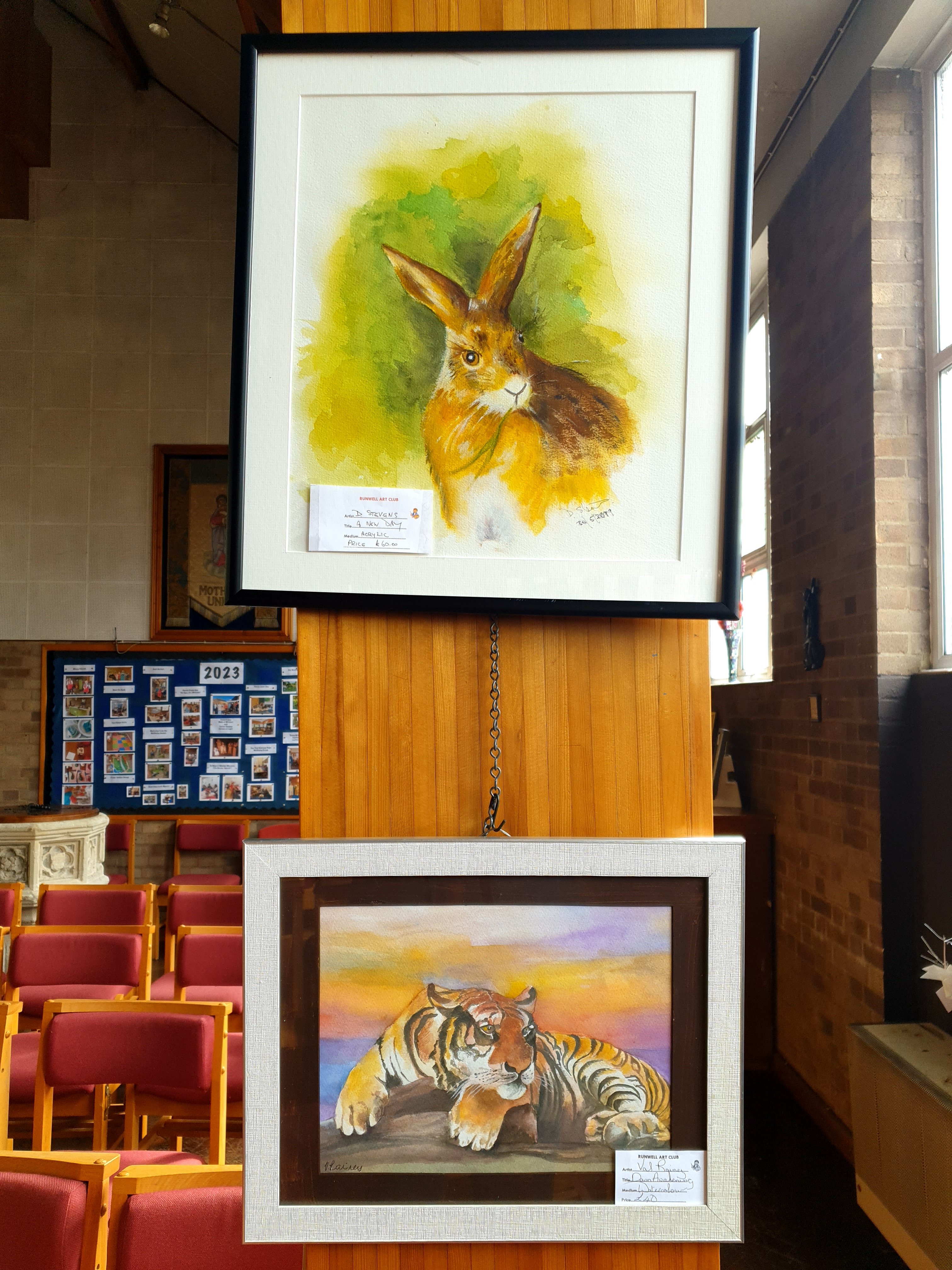
Brand New Day: Runwell Art Club exhibition


Brand New Day: Runwell Art Club exhibition
Friday 19 April – Friday 26 July 2024
St Andrew’s Church, 11 London Road, Wickford, Essex SS12 0AN


The summer exhibition at St Andrew's Wickford is called 'Brand New Day' and is a group show by Runwell Art Club. The theme is explored through landscapes and portraits with animals, babies and sunrises featuring prominently.

Runwell Art Club is a small but thriving art club that was started in 2010 by two dedicated artists, Carole Wellby and Paula Sloane. They meet in Runwell, every Friday at 10am.

St Andrew’s is usually open: Sat 9am-12.30pm; Sun 9.30am-12 noon; Mon 2-3.45pm; Tue 1-4.30pm; Wed 10am-12 noon; Fri 10am-1pm.

Exhibition viewing evening at ‘Unveiled’ - Friday 3 May, 7.00 pm.

See http://wickfordandrunwellparish.org.uk/whats-on.html for fuller information.

------------------------------------------------------------------------------------------------------------

Water into Wine Band - Hillclimbing For Beginners.

Monday, 11 December 2023

Artlyst: Holbein Politics Religion And Draughtsmanship – The Queen’s Gallery

My latest exhibition review for Artlyst is on ‘Holbein at the Tudor Court’ is at The Queen’s Gallery, Buckingham Palace:

"'Holbein at the Tudor Court' is an exhibition of social history as much as it is an exhibition of art. The art on show is, of course, stunning, as Holbein is a great Renaissance artist and, as curator Kate Heard notes, possessed an ‘unparalleled ability to capture the essence of his subjects’ that ‘still astonishes nearly 500 years later’.

This ability is seen, in particular, through more than 40 intimate portrait drawings of the royal family and the Tudor nobility, which imbue their subjects with a remarkable lifelike quality that brings the viewer as close as they will ever come to the men and women of Henry VIII’s court, from Jane Seymour to Sir Thomas More ...

The exhibition also tells the story of Holbein’s time in England, navigating the shifting sands of religious reform and political intrigue to rise to the position of King’s painter and create the enduring images of Henry VIII and his circle that we know today. This is where the social history aspect of this exhibition comes into play, enabling us to learn about the political and religious landscape of his day."

Other articles on Renaissance artists can be found here, here, here, here, and here.

Interviews -
Monthly diary articles -
Articles/Reviews -
--------------------------------------------------------------------------------------------------------

Neal Morse - World Without End.

Thursday, 1 December 2022

Artlyst: Lucian Freud And His Circle Surveyed In Two London Exhibitions

My latest exhibition review for Artlyst is of: Lucian Freud: New Perspectives; Friends and Relations: Lucian Freud, Francis Bacon, Frank Auerbach, Michael Andrews; and Bruce Bernard: Portraits of Friends.

'The exhibitions explore aspects of the camaraderie and interrelationships of these four painters whilst also highlighting the intimate relationships between artist and sitter, including artist and lover, partner, and offspring.

While figuration, existentialism, and portraiture remain significant strands within their work, the critical debate between them, within their works, seems to have been about distortion versus clarity and fine versus broad brushstrokes. Freud moves from his crisp, clear early style, which shows a debt to Neo-Romanticism, to a much more expressive use of broad brushstrokes, presumably somewhat influenced by Bacon’s distortions, Auerbach’s layers and Andrews’ mix of loose and tight passages of paint.

Bacon distorts his portraits to reveal the underlying existential angst found within, while Auerbach’s layers serve to suggest the subject’s presence more than their features. Both operate primarily in the liminal hinterland between figuration and abstraction. Andrews and Freud, while using abstract passages, remain more fundamentally figurative artists. Andrews’ use of looser and more tightly painted passages within the same painting is a way of indicating focus and creating atmosphere. Freud, who spoke of “wanting the paint to work as flesh does,” increasingly comes to paint flesh and how flesh forms and fails us as human beings.'

My other pieces for Artlyst are:

Interviews -
Monthly diary articles -
Articles/Reviews -
---------------------------------------------------------------------------------------------------------

Michael McDermott - Hit Me Back.