Wikio - Top Blogs - Religion and belief
Showing posts with label harvest. Show all posts

Sunday, 11 October 2026

Contrasting a scarcity mindset with a mindset of abundance

Here's the sermon that I shared this morning during the Harvest Festival at St Mary’s Runwell:

The cost-of-living crisis has, in recent years, seen inflation rise above normal levels because of a combination of global issues including the Ukraine and Iran conflicts. This comes after years of austerity where our governments implemented a series of sustained reductions in public spending all intended to reduce the budget deficit. As a result, we live in a time of relative scarcity compared with years of a booming economy prior to the time of austerity. When we are in a scarcity mindset we focus on all the deficits in our situation, all that is wrong, all we have lost and all that we don’t have.

When St Paul contrasts one who sows sparingly and also reaps sparingly with one who sows bountifully and also reaps bountifully, he is contrasting a scarcity mindset with a mindset of abundance (2 Corinthians 9.6-15). Harvest Festivals are times to remember the abundance of God’s provision in our world and to reflect on the difference between a scarcity mindset and an abundance mindset.

Today, we often experience a sense of scarcity in the Church as well. In our generation God has given his Church a financial crisis, and this can only be for one reason: to teach us that abundance does not lie in financial security, and to show us that only in relationships of mutual interdependence, relationships that money obscures as often as it enables, does abundant life lie.

Sam Wells, the Vicar of St Martin-in-the-Fields, says that, as Christians, we are called to live in such a way that gratefully receives the abundance God is giving us, evidences the transformation from scarcity to abundance to which God is calling us, dwells with God in that abundant life, and shares that abundance far and wide. That is what we celebrate annually in our Harvest Festivals and is what Paul commends to the Christians in Corinth when he calls us to be cheerful givers recognising that God provides us with every blessing in abundance, so that by always having enough of everything, we may share abundantly in every good work.

As Christians, we don’t have to look far for a mission statement for the church. ‘I came that they may have life, and have it abundantly.’ (John 10.10) Living abundant life. That’s what the Father intends, the Son embodies, the Spirit facilitates. God is a God of abundance who is continually giving us all we need even in the midst of scarcity and trouble; perhaps, especially, in the midst of scarcity and trouble. Jesus is our model of abundant life; his life, death and resurrection chart the transformation from the scarcity of sin and death to the abundance of healing and resurrection; he longs to bring all humankind into reconciled and flourishing relationship with God, one another, ourselves and all creation. The Church of today needs to rediscover his teaching because God gives us the abundance of the kingdom to renew the poverty of the church.

Why then do we often live with a scarcity mindset instead of an abundance mindset? Firstly, we often overlook what we already have. John McKnight and Peter Block are pioneers of asset-based community development. In their book The Abundant Community’ they talk about our consumer society as an economy of scarcity because it ‘constantly tells us that we are insufficient and that we must purchase what we need from specialists and systems outside of our immediate community.’ Instead, they argue that ‘we can do unbelievable things by starting with our assets, not our deficits. We all have gifts to offer, even the most seemingly marginal among us. Using our particular assets (our skills, experience, insights and ideas) we have the God-given power to create a hope-filled life and can be the architects of the future where we want to live.’

This is true too for churches, which thrive when the gifts of all their members are released and they build on one another’s assets. The currency of the kingdom of God is of things that never run out. ‘The secret of happiness is learning to love the things God gives us in plenty. There’s no global shortage of friendship, kindness, generosity, sympathy, creativity, faithfulness, laughter, love. These are the currency of abundance.

Our problem, though, is not just that we don’t always recognise the gifts that God is giving, it is also that we sometimes reject and do not receive the gifts he is giving. A key temptation we face as God's people is to a scarcity mindset in which we reject or fail to recognise the gifts that God is continually sending to us.

Jesus is described as the stone that the builders rejected. Sam Wells notes that 'the rejected stone became the cornerstone, the keystone – the stone that held up all the others, the crucial link, the vital connection. The rejected stone is Jesus. In his crucifixion he was rejected by the builders – yet in his resurrection he became the cornerstone of forgiveness and eternal life. That’s what ministry and mission are all about – not condescendingly making welcome alienated strangers, but seeking out the rejected precisely because they are the energy and the life-force that will transform us all. Every minister, every missionary, every evangelist, every disciple should have these words over their desk, their windscreen, on their screensaver, in the photo section of their wallet, wherever they see it all the time – the stone the builders rejected has become the cornerstone. The life of the church is about constantly recognising the sin of how much we have rejected, and celebrating the grace that God gives us back what we once rejected to become the cornerstone of our lives.'

Then, when we do recognise that God provides us with every blessing in abundance, we need to become cheerful givers so that, by always having enough of everything, we may share abundantly in every good work. We can become cheerful givers because Jesus has first given extravagantly and generously to us.

In Jesus’ life, death and resurrection God gave everything he had for us. Philippians 2 tells us that, of his own free will, Jesus “gave up all he had, and took the nature of a servant. He became like a human being and appeared in human likeness. He was humble and walked the path of obedience all the way to death – his death on the cross.” This is the extravagant nature of Jesus’ love for us, that he would give up all he had in order to walk the path of obedience all the way to his death on the cross. This is the pattern that we see repeated in God’s dealings with human beings throughout scripture and which we see summed up in the most famous verse of scripture, John 3: 16: “God loved the world so much that he gave his only Son …” God so loved that he gave.

Oliver O'Donovan writes that, “Generosity means: not staying within the limits which public rationality sets on its approval of benevolence. An extravagant, unmeasured goodness, corresponding to God’s own providential care, defies the logic of public expectation.”

So, the challenge for us as a church and as individuals is this, are we going to live in the economy of scarcity, ‘the economy that is fine as far as it goes, but turns out not to go very far – the economy that only includes certain people, only buys certain things, only lasts a limited length of time – the economy of anxiety and scarcity?’ Or are we going to live in the economy of abundance, ‘the economy where the only use of wealth is to make friends and set people free, the economy in which you are never homeless and you cannot be destitute because you have spent your time and money making friends who will always welcome you into their homes – the economy of abundance, where generosity is the best investment? Which is it to be?’

If we live in the economy of scarcity, we will spend our lives fearing for our jobs, our livelihoods, our reputations, our health, our families, our lives themselves. If we live in the economy of abundance we won’t fear anything. We’ll have the things that money can’t buy and we’ll know the things that hardship and even death can’t take away from us. We’ll have learned to love the things God gives us in plenty. We will be living truly abundant life. We will experience Harvest all year round.

But, in order to see what God is truly giving us, our mindset needs to change from a scarcity or deficit mindset which sees problems to an asset, abundance or Harvest mindset which looks for resources around us where we are. Then, as St Paul writes, each of us will be able to give as we have made up our minds, not regretfully or under compulsion, for God loves a cheerful giver as we recognise that God is able to provide us with every blessing in abundance, so that by always having enough of everything, we may share abundantly in every good work. May that blessing of God be true for each one of us in abundance this Harvest. Amen.

------------------------------------------------------------------------------------------------------------

Sunday, 5 October 2025

God's presence in the everyday


Here's the sermon that I shared at St Catherine's and St Andrew's this morning:  

God calls us, in prayer and contemplation, to see his presence in the everyday, our everyday lives, tasks, activities, and the people and things we see around us. With spiritual insight we will see Christ in all these things. In Philippians 4.4-9 we read: whatever is true, whatever is honourable, whatever is just, whatever is pure, whatever is pleasing, whatever is commendable, if there is any excellence and if there is anything worthy of praise, think about these things. We are, therefore, encouraged to go through life looking for God and the good in all that is around us. 

Today, therefore, we are going to pay attention to one of our Harvest donations. This humble jar of Branston Pickle. I wonder what we can see of God in this jar when we spend time with it and think about it. How might we see something of Christ in a jar of Branston Pickle?

Does anyone know what is in Branston Pickle? Branston Pickle is made from a variety of diced vegetables, including swede, carrots, onions and cauliflower pickled in a sauce made from vinegar, tomato, apple and spices. Reflecting on this aspect of its manufacture can lead us to give thanks to God for the wide variety of vegetables he has made and for those farmers who grow them.

Does anyone know where the recipe for Branston Pickle was created? We can give thanks, too, for the human creativity – another gift from God – that resulted in the recipe for Branston Pickle, which was first made in 1922 in the village of Branston near Burton upon Trent, Staffordshire, by Crosse & Blackwell.

For those who like it, Branston Pickle enhances certain meals by adding zest and flavour. Giving thanks to God for tasty and nutritious meals is what we do when we say Grace. We can certainly do this in relation to enjoyment of Branston Pickle. A partly consumed jar, as this now is, is a reminder to us of the many occasions and people who have enjoyed this food to date. Each of them has received something good from God for which we can give thanks.

There’s a part-used jar of Branston Pickle in the art installation we currently have in church. Usually, we might simply toss a part-used jar of Branston Pickle way without a further thought, however, in this Season of Creation we are specifically thinking of how we can reuse waste items. Including everyday items like this jar in this installation provides us with the opportunity to stop, to look, to think and to pray about humble, everyday items. If we are open to that possibility, there is much for which we can be thankful as a result of contemplating such an object.

Jesus encouraged us to be like salt in our everyday lives (Matthew 5.13). Salt is an ordinary, everyday object which is used sparingly to flavour and preserve food. A little salt has a significant effect. Just like salt, Branston Pickle enhances and flavours meals. Perhaps, if he were teaching today, Jesus might have taken a jar of Branston Pickle as his illustration to encourage us to be people that provide zest and flavour to the lives of others and to our community.

Today’s New Testament reading from Philippians encourages to look for good in everything around us. To pay attention to the things we see and to contemplate them. In this way, we can have a Harvest Festival every day of the year by celebrating the good things we see around us and remembering that they are all good gifts from God for which we should give thanks.

Just as we have done with this jar of Branston Pickle, why not go through your cupboards or rooms at home on a regular basis to reflect on what you can see of God in the everyday objects you have around you. If you do then you will be putting today’s reading into practice and will see the ordinary things around you in new ways as a result. May it be so for each one of us. Amen.

----------------------------------------------------------------------------------------------------------

Peter Mayer - Everything Is Holy Now.

Saturday, 2 November 2024

Wickford and Runwell Team Ministry Autumn church and community events


This autumn we've had a series of great church and community events and series in the Wickford and Runwell Team Ministry. These have included:

Exhibition: 'Trials and Tribulations: Modern Interpretations of Iconography', 13 September to 20 December 2024, St Andrew’s Church - 11 London Road, Wickford, Essex SS12 0AN. The arts programme at St Andrew's Wickford has continued in the autumn with an exhibition by Leigh-on-Sea-based artist John Paul Barrett called 'Trials and Tribulations'. The exhibition runs from 13 September to 20 December 2024 at St Andrew's Wickford. John Paul Barrett specialises in mixed media paintings, using acrylics and oil pastels on paintings that range from symbolism to landscapes and portraits. This exhibition focuses on his modern interpretations of Eastern European religious iconography. More information about him and his work can be found at https://www.jpbarrettart.com/.

Basildon Heritage displays - we have shown two heritage displays prepared by Basildon Heritage. Following on from our Unveiled talk about Depeche Mode, 'Sounds of Basildon' is on the Basildon music scene over the year's. The other display, linked to our Local History Day, was on 'Wickford's churches'.

Underfret gave us a great fundraising concert at St Andrew's Wickford. Underfret are a six-piece ukulele band, playing music from the 1960's onward - https://www.instagram.com/underfret/. Their concert raised funds for St Catherine’s Wickford (where subsidence has caused cracks in the walls requiring underpinning).

A joint Eucharist for all our three congregations included a guest preacher from A Rocha. A Rocha UK is a Christian charity working to protect and restore the natural world and committed to equipping Christians and churches in the UK to care for the environment. Our preacher was Rev Andy Jowitt, Community Engagement Officer for A Rocha's Foxearth Meadows nature reserve. View the service at https://www.facebook.com/WickfordandRunwellCofE/videos/516931424415753/?locale=en_GB

Difference Course - we ran this course which “explores what it means to follow Jesus in a complex and divided world, seeing transformation through everyday encounters”. Each week included films of stories from Christians facing conflict, Bible study, interactive exercises, prayer and discussion. RLN Difference is a part of the Reconciling Leaders Network. Archbishop of Canterbury’s Reconciliation Ministry.

Our Quiet Day at St Catherine's on The 7 S’s of the Nazareth Community enabled participants to consider Silence, Sacrament, Scriptures, Service, Sharing, Sabbath, and Staying as a personal Rule of Life. The Nazareth Community is based at St Martin-in-the-Fields and its growth through the Companions of Nazareth. 

Our Local History Day at St Catherine’s Church enabled those attending to view our registers (baptisms, weddings, burials etc,), meet re-enactors from the Napoleonic Association, see a display on Wickford’s churches from Basildon Heritage, tour the church and churchyard, take part in a Scavenger Hunt, support our fundraising appeal, and enjoy refreshments in our Church Hall. Visitors saw our: Commonwealth War Graves; War Memorial for Wickford; William Butterfield reredos; 15th century font; Medieval chancel ceiling; and Stained glass commemorating local characters.

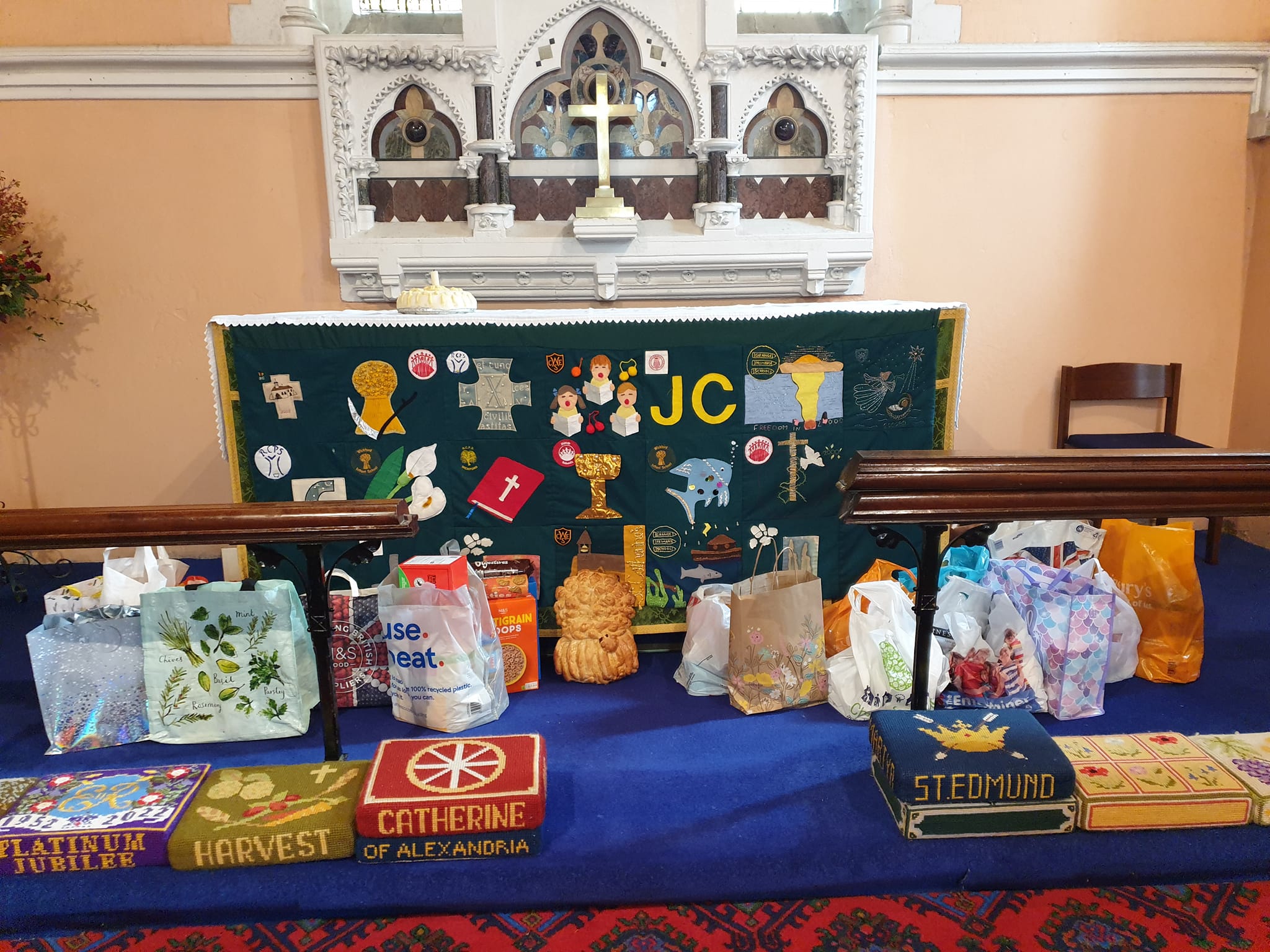
There were substantial Harvest donations and displays at our three churches. A lovely Harvest Service was also held at St Catherine's Wickford for Wickford Church of England School. The very generous harvest donations went to the Food Bank in Wickford - https://wickfordandrunwellparish.org.uk/gateway-project.html .

Our latest art workshop for children from Abacus Primary School also took place at St Andrew's. Current exhibiting artist John Paul Barrett showed the children his paintings and shared the early stages of his work: drawing with a grid; using a wash to create areas of light and dark; and mixing a gel to create texture.

Our first Craft Fayre was held at St Andrew's in October and proved very popular. A wide range of handmade crafts from a variety of different stalls were available, along with refreshments. 

---------------------------------------------------------------------------------------------------------

Underfret - Hallelujah.

Sunday, 6 October 2024

Dedicate your life to be concerned above everything else with the Kingdom of God

Here's the Harvest Festival sermon I shared at St Catherine’s Wickford this morning:

“Ever since God created the world his invisible qualities, both his eternal power and his divine nature, have been clearly seen, they are perceived in the things God has made.” (Romans 1. 20)

That is the claim which St Paul makes in the first chapter of Romans and that understanding forms the basis of the teaching about worry that Jesus gives us in the Sermon on the Mount (Matthew 6. 25 - 34).

The teaching Jesus gives us is based on lessons drawn from his understanding of nature and creation. Firstly, he looks at the cycle of existence – the circle of life - which enables all creatures to live and flourish in their way and time.

Birds provide his specific example, possibly because they would have been prolific and yet are not reliant on human beings for their survival. The birds don’t do any of the things that human beings do to provide food for themselves – they “do not sow seeds, gather a harvest and put it in barns” – yet, in the circle of life there is a sufficiency of the food that they need in order to survive.

In this way, Jesus says, we see that God the Father is taking care of them. Jesus is saying in effect what is repeated in Genesis 1 that God’s creation is good and provides all that is needed by the creatures which live in it. In Genesis 1 we specifically read that God has provided in creation the food which the birds need in order to increase in number (Genesis 1. 22 & 30).

For Jesus, God’s provision for the birds is a sign of the worth that he sees in his creation as a whole and in each specific part. Just as the creation as a whole is “good,” so are the birds which are found within it. If that is true of birds, then is it not also true of human beings? “Aren’t you worth much more than birds?” Jesus asks.

In Eucharistic Prayer G we read that in the fullness of time God made us in his image, the crown of all creation. Genesis 1 tells us that God made us to be like him, to resemble him and be made in his image. That gives us incredible worth and value, in and of ourselves and regardless of how we feel about ourselves. Jesus is saying that the power we have over creation and our unique position in creation - being conscious creators – speaks clearly to us of this incredible privilege of having been made in the image of God.

To what extent do we appreciate this reality? Often, we can be so caught up in the busyness of daily life that we do not stop to reflect on the wonder of existence and our existence. This Harvest Festival, stop for a moment to think about the incredible complexity of our physical bodies and of our conscious existence.

Stop for a moment and think about the incredible achievements of the human race – the harvesting of food around the world, amazing technological developments and inventions, the cities we have built, the scientific and medical advancements we have seen, the great art we have created, the depths of compassion and sacrifice which have been plumbed by the great saints in our history. While we are also well aware of the darker forces at work in human beings, our positive abilities and achievements reveal the reality of our creation as beings that resemble God in his creative power and energy. We can and should celebrate this reality – realising the worth that God sees in us – at the same time as giving thanks to our God for creating us in this way.

Isn’t life worth more than food and isn’t the body worth more than clothes, Jesus asks us. Often, we can be so caught up in the busyness of daily life that we do not realise the wonder of our existence and do not realise all that we could achieve if we were to use our abilities and creativity more fully in his service. “We were meant to live for so much more” is how the rock band Switchfoot put it. Jesus challenges us to be concerned with more than the worries of daily life, to be “concerned above everything else with the Kingdom of God and with what he [God] requires of you.”

This Harvest Festival, stop for a moment and think of the unique way in which you have been created by God – the unique combination of personality and talents with which you have been blessed – and ask yourself how these things could more fully be used for the building up of the Kingdom of God on earth, as in heaven.

Stop for a moment and think about the Kingdom of God as described in the Beatitudes with which Jesus began the Sermon on the Mount. The Kingdom of God is a place of happiness for those who know they are spiritually poor, a place of comfort for those who mourn, a place of receptivity for those who are humble, a place of satisfaction for those whose greatest desire is to do what God requires, a place of mercy for those who are merciful, a place in which God is seen by the pure in heart, a place in which those who work for peace are called God’s children, and a place which belongs to those who are persecuted because they do what God requires. What might God be calling us to do for him to bring the Kingdom of God to others?

Jesus argues that the goodness and worth of all created things can be seen in the way that creation provides all that is needed for creatures and plants to live and thrive. Our worth is greater still because we are made in the very image of God having power over creation and innate creative abilities ourselves. It is incumbent on us then to use the power we possess for the good of others and for the good of creation itself. We are, as God says, in Genesis to cultivate, tend and guard creation. Bringing happiness, satisfaction and belonging by giving comfort, practicing humility, sharing mercy and working for peace are all powerful ways of tending and guarding creation and building the Kingdom of God on earth, as in heaven.

This Harvest Festival, stop for a moment to recognise the something more for which we are meant to live. Dedicate your life to be concerned above everything else with the Kingdom of God and with what God requires of you.

---------------------------------------------------------------------------------------------------

Michael Kiwanuka - Place I Belong.

Wednesday, 24 January 2024

Planting the life of Jesus in the world

Here's the sermon that I shared at St Andrew’s Wickford this morning:

Most of the Bible was originally written to those living in an agrarian society, people familiar with working the land, managing livestock, and raising crops. Many of Jesus’ parables involve the farming life. Not surprisingly, then, the Bible contains many references to sowing and reaping.

At the beginning of a New Year, we can look forward to the seedtime in the Spring, when the earth is warm enough and moist enough from the early rains to best guarantee the "sprouting" of the seed once it is planted in the ground, and also to the Harvest, when we reap what has been sown. The Bible encourages us, when it comes to our giving, that the more seed that is planted, the more fruit will be harvested. In other words, those who sow generously will reap more than those who don’t. But Jesus also speaks of multiplication; of seed sown that brings forth “a hundred, sixty or thirty times what was sown.” A single grain produces many grains, the smallest seed grows into the largest tree, and the seeds which fell in good soil bore one hundred grains each. We are to sow generously and trust to God to bring about the multiplication.

Jesus said in Matthew 17. 20, “if you have faith as a mustard seed, you will say to this mountain, ‘Move from here to there,’ and it will move; and nothing will be impossible for you.” When we face a lack of harvest, and that is what the mountain here represents, our first reaction is often to look at the lack. We think about the lack, rehearse the lack, talk about the lack, sometimes at great length. Jesus says, in effect, ‘don’t start with the lack, instead start with the seed'. Imagine a farmer needs a thousand bushels of corn. He does not start with what he doesn’t have. He starts by sowing seed in the field, because the corn he wants will grow from the seed he plants.

When we face a lack of harvest in some area of life, instead of first trying to deal with the lack, consider first planting the seed. If, for example, we were lacking friendship would it help to lament the fact of being alone? It would be much better to try planting a seed of a smile or a helping hand.

What is the seed that we plant? Jesus said that many of his parables involving sowing and reaping were told to show us what the Kingdom of God is like. The most famous of his parables involving sowing and reaping is the Parable of the Sower in which Jesus identifies the seed as being the word of God (Mark 4.1-20). This is usually interpreted as meaning either the Bible or the Gospel but, if we take account of Jesus’ own identification of himself as the seed (John 12. 20 - 26), we can see that this also makes sense of the Parable of the Sower too as John 1 tells us that Jesus is the Word of God. On this basis God the Father is the farmer who sows Jesus, his Son, into the world as the seed which is buried before bringing into being the Kingdom of God. So, what is sown is life; the life of Jesus.

The great American writer Frederick Buechner has written about this focus on the life of Jesus. He notes that when Jesus says, "I am the way, and the truth, and the life," “he does not say the church is the way”: “He does not say his teachings are the way, or what people for centuries have taught about him. He does not say religion is the way, not even the religion that bears his name. He says he himself is the way. And he says that the truth is not words, neither his words nor anyone else's words. It is the truth of being truly human as he was truly human and thus at the same time truly God's. And the life we are dazzled by in him, haunted by in him, nourished by in him is a life so full of aliveness and light that not even the darkness of death could prevail against it.”

Jesus lived a life of generosity by living life for others and, ultimately, by dying for others. Jesus offered himself, his life, to come alive in hundreds and then in thousands and then in millions of others. His words were a prophecy in His death his life “will burst forth, and grow up, and multiply itself in the great spiritual harvest of the world.” “The history of all that is best, and truest, and noblest in the life of eighteen centuries comes to us as the fulfilment. Hearts hardened, sinful, dead, that have been led to think of His death, and in thoughts of it have felt germs of life springing up and bursting the husks of their former prison, and growing up into living powers which have changed their whole being” (Ellicott's Commentary for English Readers). But first he had to die and if we, his followers, are going to pass on his life then we too will have to learn the pattern of life through death. The Jesus way is what we are called to emulate. That is what we are to plant, the life of Jesus in the world, because it is what God the Father originally planted in order to bring the Kingdom of God into being.

Sowing seeds of God in the world is not primarily about teachings or words, instead it is primarily about living life the Jesus way - the truth of being truly human as Jesus was truly human and thus at the same time truly God's. Think of it like this, if God the Father gave for a specific harvest by sowing Jesus into our world, who are we to do any different. Jesus said in John 5:19 “the Son can do nothing of Himself, but what He sees the Father do; for whatever He does, the Son also does in like manner.” We can do no better than Jesus. He did as He saw the Father do, and we should now do the same. (http://wayofpeace.net/newsletter/it-is-a-seed-we-sow/)

So, the seed that we plant is our self; our life lived the Jesus way. Jesus lived a life of self-sacrifice, of service, and of love. That is what we should seek to sow, as generously as possible, through our lives. Jesus came to give a new view of life. "We look on glory as conquest, the acquisition of power, the right to rule. He looked on it as a cross. He taught us three amazing paradoxes: that only by death comes life; that only by spending life do we retain it; that only by service comes greatness. And the extraordinary thing is that when we come to think of it, Christ’s paradoxes are nothing other than the truth of common sense; the truth of the natural cycle of seedtime and harvest.”

-------------------------------------------------------------------------------------------------------

Amazing Blondel - Safety In God Alone.

Sunday, 1 October 2023

Paying attention: Consider the lilies

Here's the sermon that I shared at St Mary’s Runwell this morning for their Harvest Festival:

In our reading today we heard Jesus tell us that we should look at the flowers of the field. Stop and notice. In his painting called Consider the Lilies, Stanley Spencer depicts Jesus as mountainous in comparison with the daisies (not lilies) that he contemplates. Archbishop Stephen Cottrell has noted that this Jesus is playful, "huge and humble", godlike. Mark Oakley writes that ‘Whereas lilies call for attention, in church or posh hallways, daisies are overlooked, or considered problematic in our neat lawns. Jesus relishes their beauty, and, at the same time, challenges the sad fact about human beings that "when it comes to the present moment, we're not present".’ 

Cottrell then cleverly refers us to the words of Nadine Stair: ‘If I had my life to live over . . . I'd relax, I would limber up. I would be sillier than I have been. . . I would do more walking and looking. . . I would pick more daisies.’

Simon Small writes that we find it difficult to do this because: ‘Our minds find paying full attention to now very difficult. This is because our minds live in time. Our thoughts are preoccupied with past and future, and the present moment is missed.’ But, he says: ‘To pay profound attention to reality is prayer, because to enter the depths of this moment is to encounter God. There is always only now. It is the only place that God can be found.’

This is very much what Jesus seems to be saying to us through his teaching on worry and anxiety as found in today’s Gospel reading (Matthew 6. 24 -34). When we are preoccupied with what might happen in the future, we are not living fully in the present and may well misunderstand or misinterpret what is actually going on. Jesus encourages us to live fully in the present because, as Simon Small says, that is where we encounter God.

When we genuinely encounter God in the here and now, we know that his love and forgiveness surround us and that his Spirit fills us. As Jesus prayed in John 17, he is in us and we are in him. When we know this in our hearts in the here and now, we can relax because whatever happens to us, we are accepted, forgiven, loved and gifted by the God who created all things and who will bring all things to their rightful end. We are held in the palm of his hands and, therefore, as Julian of Norwich put it, “all shall be well, and all shall be well, and all manner of thing shall be well”.

Jesus says that the more we live in the present and the more we encounter God’s love in the here and now, the less we will be anxious or worried. Prayer is able to help us do both things and therefore helps us to reduce our sense of anxiety or worry. Not because we have listed all our worries to God and believe that he will solve them all for us, but instead because, through prayer, we encounter more of God’s love and, as a result, trust that he will be with us whatever comes our way.

Harvest provides a wonderful opportunity for us to do this in relation to the natural world around us including the birds of the air and the lilies of the field. Harvest provides an ‘opportunity to reflect and give thanks for all the good things in our lives, especially the way in which the earth produces food for us to eat, to give thanks for all those who work to produce food and drink for us to enjoy, to say sorry for the times we are not grateful, that we don’t notice God’s work in the world, that we don’t look after the things God has given us.’ ‘We live in a different time from our ancestors where the harvest and bringing the harvest in would have dominated everyone’s lives’ but today we probably hardly notice it. What we can do, however, is pay attention to what is around us, whether in our gardens and parks or in our homes and town.

Pope Francis has written on the connection between care for our common home and paying attention in his encyclical Laudato Si. There, he wrote: ‘Those who enjoy more and live better each moment are those who have given up dipping here and there, always on the look-out for what they do not have. They experience what it means to appreciate each person and each thing, learning familiarity with the simplest things and how to enjoy them. So they are able to shed their unsatisfied needs, reducing their obsessiveness and weariness. Even living on little they can live a lot, above all when they cultivate other pleasures and find satisfaction in fraternal encounters, in service, in developing their gifts, in music and art, in contact with nature and in prayer.’ (Laudato Si 223)

He continues, saying, ‘No one can cultivate a sober and satisfying life without being at peace with him or herself…. Inner peace is closely related to care for ecology and for the common good because, lived out authentically, it is reflected in a balanced lifestyle together with a capacity for wonder which takes us to a deeper understanding of life. Nature is filled with words of love, but how can we listen to them amid constant noise, interminable and nerve-wracking distractions, or the cult of appearances.’ (Laudato Si 225)

He concludes, drawing on today’s Gospel reading, that: ‘We are speaking of an attitude of heart, one which approaches life with serene attentiveness, which is capable of being fully present to someone…which accepts each moment as a gift from God to be lived to the full. Jesus taught us this attitude when he invited us to contemplate the lilies of the field and the birds of the air…. He was completely present to everyone and to everything and in this way he showed us the way to overcome that unhealthy anxiety which makes us superficial, aggressive and compulsive consumers.’ (Laudato Si 226)

Pope Francis quotes Patriarch Bartholomew as saying that we should look for solutions to the climate emergency in a change of humanity: ‘He asks us to replace consumption with sacrifice, greed with generosity, wastefulness with a spirit of sharing, an asceticism which “entails learning to give, and not simply to give up. It is a way of loving, of moving gradually away from what I want to what God’s world needs. It is liberation from fear, greed and compulsion”. Bartholomew says that, ‘As Christians, we are also called “to accept the world as a sacrament of communion, as a way of sharing with God and our neighbours on a global scale. It is our humble conviction that the divine and the human meet in the slightest detail in the seamless garment of God’s creation, in the last speck of dust of our planet”.’ 

Such an attitude begins with our looking closely, attentively, at the world around us as Jesus encourages us to do in today’s Gospel reading and as Stanley Spencer shows him doing in ‘Consider the Lilies’. This Harvest, may we increasingly do the same.


------------------------------------------------------------------------------------------------------------

Barclay James Harvest - Hymn.