Wikio - Top Blogs - Religion and belief
Showing posts with label exchange. Show all posts

Saturday, 14 March 2026

International Times: Opportunities for mutual exchange, generating sparks

My latest review for International Times is on Threads of Life by Chiharu Shiota and Heart to Heart by Yin Xiuzhen at the Hayward Gallery:
 
'Shiota’s signature installations engulf ordinary objects – such as shoes, keys, beds, chairs and dresses – within huge weblike structures of red, black or white woollen thread. These floor-to-ceiling immersive works explore the body, memory, consciousness and the fragility of existence, while making visible the intangible connections we make throughout life. Shiota describes the making of her delicately woven structures as painting three dimensionally in a space with string.'

My earlier pieces for IT are: an interview with the artist Alexander de Cadenet; an interview with artist, poet, priest Spencer Reece, an interview with the poet Chris Emery, an interview with Jago Cooper, Director of the the Sainsbury Centre for Visual Arts, a profile of singer-songwriter Bill Fay, plus reviews of: U2's 'Days of Ash', Mumford and Sons' 'Prizefighter' and Moby's 'Future Quiet'; 'Collected Poems' by Kevin Crossley-Holland; 'Lux' by RosalĂ­a; 'Springsteen: Deliver Me from Nowhere'; 'Great Art Explained' by James Payne; 'Down River: In Search of David Ackles' by Mark Brend; 'Headwater' by Rev Simpkins; 'The Invisibility of Religion in Contemporary Art' by Jonathan A. Anderson; 'Breaking Lines' at the Estorick Collection of Modern Italian Art, albums by Deacon Blue, Mumford and Sons, and Andrew Rumsey, also by Joy Oladokun and Michael Kiwanaku; 'Nolan's Africa' by Andrew Turley; Mavis Staples in concert at Union Chapel; T Bone Burnett's 'The Other Side' and Peter Case live in Leytonstone; Helaine Blumenfeld's 'Together' exhibition, 'What Is and Might Be and then Otherwise' by David Miller; 'Giacometti in Paris' by Michael Peppiatt, the first Pissabed Prophet album; and 'Religion and Contemporary Art: A Curious Accord', a book which derives from a 2017 symposium organised by the Association of Scholars of Christianity in the History of Art.

Several of my short stories have been published by IT including three about Nicola Ravenscroft's EarthAngel sculptures (then called mudcubs), which we exhibited at St Andrew's Wickford in 2022. The first story in the series is 'The Mudcubs and the O Zone holes'. The second is 'The Mudcubs and the Clean-Up King', and the third is 'The mudcubs and the Wall'. My other short stories to have been published by International Times are 'The Black Rain', a story about the impact of violence in our media, 'The New Dark Ages', a story about principles and understandings that are gradually fading away from our modern societies, and 'The curious glasses', a story based on the butterfly effect.

IT have also published several of my poems, including 'The ABC of creativity', which covers attention, beginning and creation, and 'The Edge of Chaos', a state of existence poem. Also published have been three poems from my 'Five Trios' series. 'Barking' is about St Margaret’s Barking and Barking Abbey and draws on my time as a curate at St Margaret's. 'Bradwell' is a celebration of the history of the Chapel of St Peter-on-the-Wall, the Othona Community, and of pilgrimage to those places. Broomfield in Essex became a village of artists following the arrival of Revd John Rutherford in 1930. His daughter, the artist Rosemary Rutherford, also moved with them and made the vicarage a base for her artwork including paintings and stained glass. Then, Gwynneth Holt and Thomas Bayliss Huxley-Jones moved to Broomfield in 1949 where they shared a large studio in their garden and both achieved high personal success. 'Broomfield' reviews their stories, work, legacy and motivations.

To read my poems published by Stride, click here, here, here, here, here, and here. My poems published in Amethyst Review are: 'Runwell', 'Are/Are Not', 'Attend, attend' and 'Maritain, Green, Beckett and Anderson in conversation down through the ages'.

I am among those whose poetry has been included in Thin Places & Sacred Spaces, a recent anthology from Amethyst Press. I also had a poem included in All Shall Be Well: Poems for Julian of Norwich, the first Amethyst Press anthology of new poems.

'Five Trios' is a series of poems on thin places and sacred spaces in the Diocese of Chelmsford. The five poems in the series are:
These poems have been published by Amethyst Review and International Times.

-------------------------------------------------------------------------------------------------------------

Shadows Fall - Redemption.

Wednesday, 1 June 2022

Unity, protection and sanctification

Here's my reflection from today's Communion Service at St Andrew's Wickford:

Our Gospel reading today (John 17.11-19) is part of the prayer that Jesus prayed for his disciples on the night before he died. Chronologically this prayer comes before Jesus’ Ascension, but, in terms of its content, it is a post-Ascension prayer because his concern is for his disciples once he has left them. Many of his disciples had been on the road with him for three years and had sat at his feet as disciples listening to his teaching, observing his example and imbibing his spirit. Following his Ascension, he would leave them and they would have the challenge of continuing his ministry without him there. He knew that that experience would be challenging and therefore he prayed for them to be supported and strengthened in the challenges they would face. I want us to reflect on three aspects of this section of Jesus’ prayer; unity, protection and sanctification.

Jesus prays that his disciples may be one, as he is one with God the Father and God the Spirit. In other words, we have to understand the unity that is the Godhead, before we can understand the unity that Jesus wants for his disciples. As God is one and also three persons at one and the same time, there is a community at the heart of God with a constant exchange of love between the Father, the Son and the Spirit. That exchange is the very heartbeat of God and is the reason we are able to say that God is love. Everything that God is and does and says is the overflow of the exchange of love that is at the heart of the Godhead. Jesus invites us to enter into that relationship of love and to experience it for ourselves. That is his prayer, his teaching and also the purpose of his incarnation, death and resurrection.

Earlier in his farewell discourse, Jesus gave the command that we should love one another as we have been loved by God. It is in the sharing of love with each other that we experience unity and experience God. Unity, then, does not come from beliefs or propositions. It is not to do with statements or articles of faith. It does not involve us thinking or believing the same thing. Instead, unity is found in relationship, in the constant, continuing exchange of love with others within community; meaning that unity is actually found in diversity. Jesus prays that we will have that experience firstly by coming into relationship with a relational God and secondly by allowing the love that is at the heart of the Godhead to fill us and overflow from us to others, whilst also receiving the overflow of that love from others.

The second aspect of Jesus’ prayer is his prayer for our protection. Our need for protection is often physical and immediate and there are many around our world and within our community who are in need of tangible protection at this time. In his prayer, however, Jesus asks that we will be protected in a different way, by being protected in God’s name. God’s name has been given to him, he says, and he has then given that name to his disciples.

In our day, we have lost much of the depth and richness that names held in more ancient cultures. Names in Jesus’ culture and earlier were signs or indicators of the essence of the thing named. When we read the story of Adam naming the animals in the Book of Genesis that is what was going on; Adam was identifying the distinctive essence of each creature brought before him and seeking a word to capture and articulate that essential characteristic. It is also why the name of God is so special in Judaism – so special that it cannot be spoken – as the name of God discloses God’s essence or core or the very heart of his being. Jesus prayed that we might be put in touch with, in contact with, in relationship with, the very essence of God’s being by knowing his name. That contact is what will protect us. If we are in contact with the essential love and goodness that is at the very heart of God then that will fill our hearts, our emotions, our words, our actions enabling us to live in love with others, instead of living selfishly in opposition to others. Jesus prays that the essential love which is at the heart of God will transform us in our essence, meaning that we are then protected from evil by being filled with love.

The third aspect of Jesus’ prayer is to do with sanctification. Sanctification is the process of becoming holy. Jesus prays that we will be sanctified in truth, with the truth being the word of God. The Prologue to John’s Gospel tells us that Jesus himself is the Word of God. Therefore Jesus’ prays for us to become holy in Him. It is as we live in relationship to him, following in the Way that he has established, that we are sanctified. This is what it means for us to know Jesus as the Way, the Truth and the Life. It is vital that we note that we are not sanctified by the Truth, meaning that sanctification is not about knowing and accepting truths that we are to believe. Instead, we are sanctified in the Truth, meaning that we are made holy as we inhabit, experience, practice and live out the Truth; with that truth being Jesus.

Knowing God is, therefore, like diving ever deeper into a bottomless ocean where there is always more to see and encounter. We are within that ocean – the truth of relationship with Jesus – and can always see and uncover and discover more of the love of God because the reality of God is of an infinite depth of love. God created all things and therefore all things exist in him and he is more than the sum of all things, so it is impossible for us with our finite minds to ever fully know or understand his love. However profound our experience of God has been, there is always more for us to discover because we live in and are surrounded by infinitude of love. St Augustine is reported to have described this reality in terms of God being a circle whose centre is everywhere and whose circumference is nowhere.

Jesus is constantly praying for a continual and continuing immersion in relationship with Him so that we will experience unity by sharing love, protection by experiencing the essence of God and holiness through living in Him. Because we are with God and in God and God in us, we can and, increasingly, will act in ways that are God-like and Godly. That happens because we are so immersed in God and in his love that his love necessarily overflows from us in ways that we cannot always anticipate or control. Essentially, we learn to improvise as Jesus did, because we are immersed in his ways and love. That is Jesus’ prayer for us. We pray Amen, may it be so.

-------------------------------------------------------------------------------------------------------

Wednesday, 14 June 2017

Start:Stop - Exchanges of Love


Bible reading

As you, Father, are in me and I am in you, may they also be in us, so that the world may believe that you have sent me. The glory that you have given me I have given them, so that they may be one, as we are one, I in them and you in me, that they may become completely one, so that the world may know that you have sent me and have loved them even as you have loved me.

“Righteous Father, the world does not know you, but I know you; and these know that you have sent me. I made your name known to them, and I will make it known, so that the love with which you have loved me may be in them, and I in them.” (John 17. 21 – 26)

Reflection

At several points in John’s Gospel we hear Jesus speaking about his relationship with God the Father and with God the Holy Spirit. When he speaks in this way it is as though Jesus is pulling back the veil which prevents us from seeing God and giving us, thereby, a glimpse of God as Trinity. For example, he says that God the Spirit takes what belongs to God the Son and declares it to us. All that belongs to God the Son, he says, also belongs to God the Father. So, all that Jesus has belongs equally to the Spirit and the Father. Therefore, we have a picture of God the Father giving to God the Son who gives to God the Holy Spirit who gives to us. What is being pictured for us is an exchange of love within the Godhead.

Similarly, when Jesus prayed that his followers might all be one, he prayed this on the basis that his followers might be in God as he is in the Father and the Father is in him. The united relationship of Father, Son and Holy Spirit means that, at the very heart of God is a dynamic relationship in which a constant exchange of love is underway. Jesus prayed that we, who follow in his footsteps, would experience the same oneness with God and each other that he enjoys with God, his Father. In essence, his prayer is that we will experience unity, because unity is what is at the very heart of God.

We can be part of the constant exchange of love in God; a love which involves the continual giving and receiving of affirmation and authority. If we live in God, we live in love and love lives in us. We become included in the constant exchange of love which exists in the Godhead and are, therefore, constantly loved no matter what else is going on in our lives.

The exchange of love at the heart of the Trinity creates an environment of acceptance and affirmation in which authority is constantly shared by being given and received. Our participation in that exchange, as God’s children, then compels us, to make the attempt to create similar exchanges within the communities, organisations and networks of which we are part; whether that is family, workplace, church or community.

How might that work in practice? We could think briefly of the contrast between places where co-operation exists and those where it does not. I can think of one person I know who was recently working in an environment where self-promotion and active criticism of those with whom they worked seemed to be rewarded and the experience of being in that workplace was one of tension, strained relationships, walking on eggshells. Conversely, I know someone who has doubts and questions about the existence of God but whose experience of the quality of relationships in the church she attends has been such a positive contrast with her experience of relationships in society generally that she has found God in her experience of being welcomed, accepted and affirmed for the person that she is. Her experience has been of an exchange of love which connects to that occurring in the Godhead, while the other person’s experience was of a workplace full of suspicion and tension because what was exchanged was gossip and critique rather than love.

I wonder to what extent we can create everyday exchanges of love as a result of our encounter with the love that is constantly being exchanged by God the Father, God the Son and God the Holy Spirit.

Prayer

Holy Trinity, as we enter our workplaces may we bring your presence with us. May we speak your peace, your grace, your mercy, and your perfect order in our offices. May the work that we do and the way we do it bring faith, joy, and a smile to all that we come into contact with today. May everything we do today bring hope, life, and encouragement to those around us.

In our everyday exchanges, may we know and share your exchange of love.

Enable us to maintain good relations within our workplaces by minimising scope for conflict or blame and by promoting respect for others. Enable us to go beyond minimum standards of behaviour by showing love to those with which we work.

In our everyday exchanges, may we know and share your exchange of love.

Loving God, you showed us what all-out love looks like when you sacrificed yourself for others. Enable us to love you and others with all our being and in word and deed. Help us to explore what that might mean in our workplaces.

In our everyday exchanges, may we know and share your exchange of love.

Blessing

Bring the presence of God, maintaining good relations, minimising scope for conflict, promoting respect, loving in word and deed, speaking peace, bring hope, life, and encouragement, sharing exchanges of love. May all those blessings of almighty God, Father, Son and Holy Spirit, rest upon you and remain with you always. Amen.

---------------------------------------------------------------------------------------------

Van Morrison - Street Choir.

Thursday, 2 June 2016

Start:Stop - Exchanges of love


Bible reading

As you, Father, are in me and I am in you, may they also be in us, so that the world may believe that you have sent me. The glory that you have given me I have given them, so that they may be one, as we are one, I in them and you in me, that they may become completely one, so that the world may know that you have sent me and have loved them even as you have loved me.

“Righteous Father, the world does not know you, but I know you; and these know that you have sent me. I made your name known to them, and I will make it known, so that the love with which you have loved me may be in them, and I in them.” (John 17. 21 – 26)

Reflection

At several points in John’s Gospel we hear Jesus speaking about his relationship with God the Father and with God the Holy Spirit. When he speaks in this way it is as though Jesus is pulling back the veil which prevents us from seeing God and giving us, thereby, a glimpse of God as Trinity. For example, he says that God the Spirit takes what belongs to God the Son and declares it to us. All that belongs to God the Son, he says, also belongs to God the Father. So, all that Jesus has belongs equally to the Spirit and the Father. Therefore, we have a picture of God the Father giving to God the Son who gives to God the Holy Spirit who gives to us. What is being pictured for us is an exchange of love within the Godhead.

Similarly, when Jesus prayed that his followers might all be one, he prayed this on the basis that his followers might be in God as he is in the Father and the Father is in him. The united relationship of Father, Son and Holy Spirit means that, at the very heart of God is a dynamic relationship in which a constant exchange of love is underway. Jesus prayed that we, who follow in his footsteps, would experience the same oneness with God and each other that he enjoys with God, his Father. In essence, his prayer is that we will experience unity, because unity is what is at the very heart of God.

We can be part of the constant exchange of love in God; a love which involves the continual giving and receiving of affirmation and authority. If we live in God, we live in love and love lives in us. We become included in the constant exchange of love which exists in the Godhead and are, therefore, constantly loved no matter what else is going on in our lives.

The exchange of love at the heart of the Trinity creates an environment of acceptance and affirmation in which authority is constantly shared by being given and received. Our participation in that exchange, as God’s children, then compels us, to make the attempt to create similar exchanges within the communities, organisations and networks of which we are part; whether that is family, workplace, church or community.

How might that work in practice? We could think briefly of the contrast between places where co-operation exists and those where it does not. I can think of one person I know who is currently working in an environment where self-promotion and active criticism of those with whom they work seems to be rewarded and the experience of being in that workplace is one of tension, strained relationships, walking on eggshells. Conversely, I know someone who has doubts and questions about the existence of God but whose experience of the quality of relationships in the church she attends has been such a positive contrast with her experience of relationships in society generally that she has found God in her experience of being welcomed, accepted and affirmed for the person that she is. Her experience has been of an exchange of love which connects to that occurring in the Godhead, while the other person’s experience was of a workplace full of suspicion and tension because what was exchanged was gossip and critique rather than love.

I wonder to what extent we can create everyday exchanges of love as a result of our encounter with the love that is constantly being exchanged by God the Father, God the Son and God the Holy Spirit.

Prayer

Holy Trinity, as we enter our workplaces may we bring your presence with us. May we speak your peace, your grace, your mercy, and your perfect order in our offices. May the work that we do and the way we do it bring faith, joy, and a smile to all that we come into contact with today. May everything we do today bring hope, life, and encouragement to those around us.

In our everyday exchanges, may we know and share your exchange of love.

Enable us to maintain good relations within our workplaces by minimising scope for conflict or blame and by promoting respect for others. Enable us to go beyond minimum standards of behaviour by showing love to those with which we work.

In our everyday exchanges, may we know and share your exchange of love.

Loving God, you showed us what all-out love looks like when you sacrificed yourself for others. Enable us to love you and others with all our being and in word and deed. Help us to explore what that might mean in our workplaces.

In our everyday exchanges, may we know and share your exchange of love.

Blessing

Bring the presence of God, maintaining good relations, minimising scope for conflict, promoting respect, loving in word and deed, speaking peace, bring hope, life, and encouragement, sharing exchanges of love. May all those blessings of almighty God, Father, Son and Holy Spirit, rest upon you and remain with you always. Amen.

---------------------------------------------------------------------------------------------

Van Morrison - Street Choir.

Thursday, 16 January 2014

Coming soon - the Seven Kings Time Bank

Sophia Hubs is based in Seven Kings as a pilot for a national project to create local hubs that help to build a thriving local economy and a rich community life.   We are running training courses, a weekly enterprise club with local speakers, business mentoring and more.  Our aim is to harness the wide and amazing wisdom, skills, resources, expertise and ideas that are already here in the community.  We are helping to inspire and kick start new social enterprises to meet the needs of Seven Kings/Ilford/Redbridge community.
Our next step is the Seven Kings time bank.  A time bank is a skills exchange network.  It will be a way for local people in Seven Kings and the surrounding areas to help each other, build relationships and be recognised for the help that they give. A time bank is a great way to get the services you need without the need for money plus to increase your confidence in the help you can give others with your own skills. 
Time banks are running all over the country. Individuals join as members and then for every hour’s help you give to another (e.g. Spanish lesson, guttering mending, web design) you receive one time credit which you can then spend on receiving help from another member (leg waxing, bike fixing, horrible internet connection problem solving).  The exchanges won’t have to be a give-take scenario between two people; time banking is a cycle of exchanges that continues on with many time bank members.
Sophia Hubs sees this as an important tool and resource to help our new entrepreneurs try out and develop their business offers and develop their customer base.  It is also a good way of increasing the relationships and networks in a neighbourhood.  The time bank broker (that’s me!) will be on hand to help you work out what you need, what you can offer and help to get you started.
The official launch will be announced soon through Redbridge CVS but in the meantime please register your interest at Sevenkingstimebank@sophiahubs.com or ring 020 8590 2568.  If you want to find out more about our training courses or enterprise club please ring or email me on ros.southern@sophiahubs.com.
In the meantime there is also an exciting and fast growing time bank for organisations (rather than individuals) in East London which we advise all Redbridge groups and businesses to join.  Find out more at ECHO:  http://economyofhours.com/.  This is an experienced time bank organisation that is helping us with the final plans for the Seven Kings time bank that is coming soon.
Ros Southern
Time bank broker, Sophia Hubs
(based at St John’s Church & Centre, St Johns Road, Seven Kings, Ilford, Essex IG2 7BB)

---------------------------------------------------------------------------------------------

Wednesday, 1 January 2014

Incarnation

The length of the journey become part of the gift,
beauty lying in discovery.
The privileges of deity exchanged

to take the status of a slave;
coming from heaven as helpless babe,

equality left with God.
Artist as self-portrait, creator as creation;

I and Thou, God and man
dying each other’s life,

living each other’s death,
descending into danger, depression,
despair, dismay, distress,
hopelessness, loneliness, homelessness.
Gift, come down to share our plight,

lift us into your love and light.

Flesh knowing what spirit knows.

Forgiveness in flesh,
the loss of life for the saving of life -
others he saved, himself he could not save -
life given that we might live, exchange.
I live as Christ lives in me,
his nature received as he took mine,
the burden of oppressive evil borne in God.
Burdens become light

in the exchange of burdens,
trespasses forgiven as we forgive.
The wealth of self

as the health of self exchanged.
Not Thou, yet Thou;

I and Thou exchanged, changed.
The length of the journey become part of the gift,

beauty lying in discovery.

-------------------------------------------------------------------------------------------

Mavis Staples - You Are Not Alone.

Sunday, 14 July 2013

Boundary Breaker II

You reached out and touched me -
aged and frail from constant menstruation,
seepage and flow of life’s blood,
stained and strained you reached out
to touch a hem, the merest flicker of a thread,
yet connecting and exchanging,
receiving purity for uncleanness,
healing for disease, transferring your afflictions
onto me; the pure one made unclean,
the healer become the diseased,
we change places, you rising, I falling,
partners for a moment in the dance of love.

------------------------------------------------------------------------------------------

Sunday, 23 June 2013

Cecilia Vicuña: Precarious prayer

Cecilia Vicuña’s exhibition at England & Co begins with a series of paintings from the 1970s in which religious icons are replaced by personal, political and literary figures.

Vicuña learned this technique in the late 1960s from the Surrealist artist Leonora Carrington and was initially inspired by the naĂŻve and subtly subversive images made by 16th Century indigenous artists in Latin America after the Spanish conquest when they were forced to paint angels and saints for the Catholic Church.

Salvator Allende, Fidel Castro and Karl Marx simply replace the Christian saints in these images; a reversal of the images indigenous artists were forced to paint by the Catholic Church and an acknowledgement that the Marxism of Latin America in the ‘60s and ‘70s was, for Vicuña, more compelling than Catholicism. Yet, as these works are also deliberately naĂŻve with their subjects depicted within a utopian setting, they also indicate the fragility of the freedoms which had been won and which the Chilean coup d'Ă©tat of 1973 - when Allende’s life was lost, along with 43 years of Chilean democracy - brought to an end.

Vicuña writes that her artistic practice changed as a result. Prior to the coup d'état she had each day made an object in support of the Chilean revolutionary process. Post coup d'état her objects supported the resistance against the dictatorship.

These objects, composed of feathers, stones, sticks, and other found materials, are known as ‘Precarios’ because they are literally precarious - “they can’t endure, they may fall apart by themselves.” They show their socialist character through their poverty and by the fact that “they can be done by anyone.”

Not only are these objects beautiful in and of themselves but they also reveal the beauty of what is thrown away and ephemeral. As such, they are also deeply spiritual. Vicuña has explained that: “Precarious is what is obtained by prayer. Uncertain, exposed to hazards, insecure. From the Latin precarius, from precis, prayer”:

"These materials are lying down and I respond by standing them up. The gods created us and we have to respond to the gods. There will only be equality when there is reciprocity. The root of the word 'respond' is to offer again, to receive something and to offer it back. 'We are made of throwaways and we will be thrown away,' say the objects. Twice precarious, they come from prayer and predict their own destruction. Precarious in history, they will leave no trace. The history of art written in the North includes nothing of the South. Thus they speak in prayer, precariously."

Vicuña finds deep personal connections between Taoism and Andean culture but her art of exile and its spirituality also resonate strongly with aspects of Christian understanding and practice, for example, Peter Rollins’ interpretation of St Paul’s claim that Christians are the refuse of the world. Rollins suggests that “Christians are the de-worlded … the part of no part, the community of outsiders … learning from, leaning toward and reaching out to the people who live day to day as the trash of the world … [who] lay down the various political, religious and cultural narratives that protect us from looking at our own brokenness and allow it to be brought to light.”

Would that we genuinely lived in the way Rollins suggests! Vicuña’s art provides an object lesson in visualising such praxis.

----------------------------------------------------------------------------

Rob Hallingan - Another Fine Mess.

Saturday, 9 July 2011

50/50 Auction and the Big Society


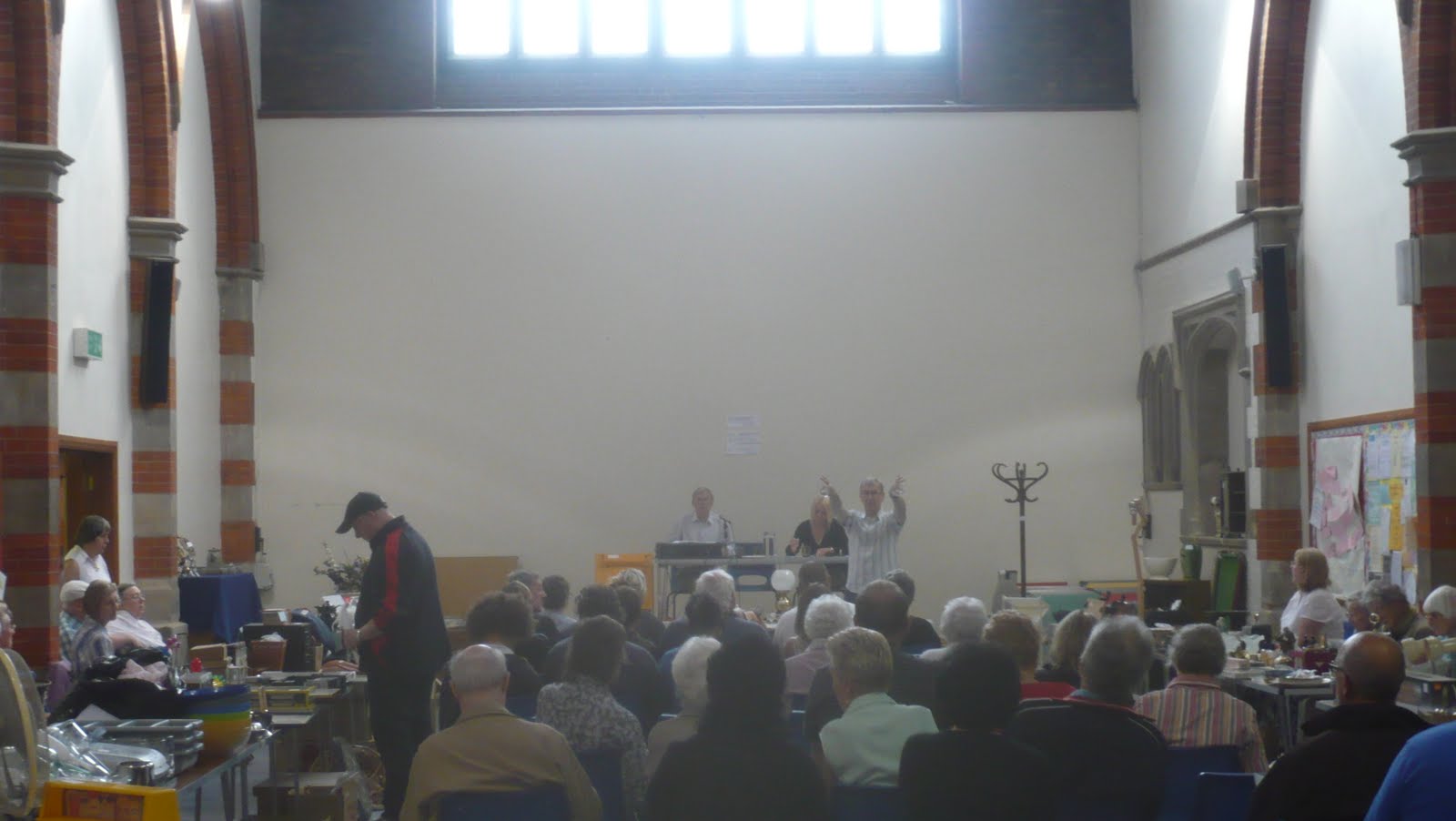
St John's Seven Kings held its 50/50 Auction today where 50% of the sale price comes to the church. Although we had stopped holding annual auctions and hadn't held an auction for three years, this one proved very successful.

This event, as with our other social and fundraising events, is an illustration of some of the reasons why churches generate community and contribute substantially to the Big Society. Those who organised the event gave a significant amount of their time in order to arrange a successful community event that generated funds for a community group and facility. The 220+ lots were all items that were being recycled by being sold and all sellers gave 50% of their income to the church. The event also brought together a wide range of different people from our local community to meet together for a shared activity which included shared food and conversation over the viewing of lots and lunchtime refreshments.

It would of course be possible to take a cynical line about our event seeing it simply as a money making exercise which is therefore tapping into consumerism or to argue a purist line that such fundraising distracts from the Church's core mission and reinforces stereotypes of the Church as an organisation which is always asking for money. Despite this event being a combination of gift and exchange economies, both these views ignore the significant levels of giving involved in such events and the degree of community engagement and cohesion that a regular programme of such events provide. Neither of these would be features of more commercially orientated sales or auctions and both are core elements of committed Christian living.

Earlier in the week, at Redbridge's Big Society mapping event, I quoted Jonathan Sacks, the Chief Rabbi, as saying “Religion creates community, community creates altruism and altruism turns us away from self and towards the common good ... There is something about the tenor of relationships within a religious community that makes it the best tutorial in citizenship and good neighbourliness.” Today's event is one small example of the point he makes being realised in practice and should be celebrated as such, particularly in a week where the main news item has forcefully demonstrated the corrupting and corrosive effect on personal, community and societal relationships of rampant aggressive consumerism.

---------------------------------------------------------------------------------------------

Sufjan Stevens-All Delighted People 

Sunday, 19 June 2011

The Gift and The Dance of Love

In one of those serendipitous occurences, I've started reading The Gift by Lewis Hyde at the same time as preparing sermons using Stephen Verney's The Dance of Love (click here for sermon). There have been several overlaps and parallels that I have noticed as a result.

I wrote that "If we don’t give love away to others then we become a blockage in the constant exchange of love of which we are a part and this prevents us from receiving love at the same time that love ceases to be shared with others through us." Hyde suggests "we think of the gift as a constantly flowing river" and allow ourselves "to become a channel for its current." When we try to "dam the river", "thinking what counts is ownership and size," "one of two things will happen: either it will stagnate or it will fill the person up until he bursts."
One of the forms of gift exchange with which Hyde's book is concerned is reciprocal giving:

"The gift moves in a circle, and two people do not make much of a circle. Two points establish a line, but a circle lies in a plane and needs at least three points. This is why ... most of the stories of gift exchange have a minimum of three people ... so long as the gift passes out of sight it cannot be manipulated by one man or one pair of gift partners. When the gift moves in a circle its motion is beyond the control of the personal ego, and so each bearer must be a part of the group and each donation is an act of social faith ... The gift can circulate at every level of the ego. In the ego-of-one we speal of self-gratification, and whether it's forced or chosen, a virtue or a vice, the mark of self-gratification is its isolation. Reciprocal giving, the ego-of-two, is a little more social. We think mostly of lovers. Each of these circles is exhilarating as it expands, and the little gifts that pass between lovers touch us because each is stepping into a larger circuit. But again, if the exchange goes on and on to the exclusion of others, it soon goes stale."

This, it seems to me, has clear parallels with the image I used of the interaction between the male and female partners in a ballroom dance which equates to Hyde's talk of lovers; George Bernard Shaw apparently said of ballroom dancing that it is "the vertical expression of a horizontal intent." Yet the exchanges possible between two people, whether dance partners or lovers, are linear. For exchange to become circular, moving beyond the control of the personal ego, a minimum of three people are required; which is where in my sermon we move to discussion of the eternal exchange found within the Trinity. Three persons are the minimum requirement for a group gift exchange and donation as an act of social faith.  

In another sermon on gift (click here) I quoted David Runcorn as saying that “the life of God is non-possessive, non-competitive, humbly attentive to the interests of the other, united in love and vision.” To be God-like, he writes, “is not to be grasping” and so “Jesus pours himself out ‘precisely because’ he is God from God.” The Biblical word for this is kenosis, the self-emptying of God. But Runcorn goes on to point out that this self-emptying or kenosis characterises every member of the Trinity and argues that Jesus’ incarnation “offers us a mysterious and astonishing vision”:


“the Holy Trinity as a dancing community of divine poverty. Each eternally, joyfully, dispossessing themselves; emptying, pouring themselves out to the favour and glory of the other. Nothing claimed, demanded or grasped. They live and know each other in the simple ecstasy of giving.”

-------------------------------------------------------------------------------
 
U2 - One.