Wikio - Top Blogs - Religion and belief
Showing posts with label way of the heart. Show all posts

Monday, 15 June 2015

The Way of the Heart


We enter the way of the heart
as we are led by emotion.
This is the path of passion
which is only begun
through an open vulnerability
of expression; this who I am,
this is how I feel.
Confusion and compassion,
anguish and ecstasy,
insecurity and joy,
pain and pleasure;
it is as we shuttle
forward and back
exploring, through art
or prayer, the twin poles
of our being, that
we encounter one
who walks beside
sharing our emotions
by means of
his own Passion
walked from
crucifixion to
resurrection.
Walk on, walk on,
through rain and storm
with hope in your heart
for you will never
walk alone.

-----------------------------------------------------------------------------------------------------------

M Ward - Epistemology.

Thursday, 11 June 2015

The Path of Generosity

This parable (Luke 16. 19 – 31), more than perhaps any other of the parables told by Jesus, is a story of contrasts. Contrasts between rich and poor, hell and heaven, and, perhaps most significant of all, between the way of greed and the way of generosity.

As in the parable of the Rich Fool, where a farmer stores up what he has for himself and then dies when he had expected to eat, drink and be merry, this parable is about the dangers of gaining wealth solely for oneself. Here, the focus isn’t on the inevitability of death but instead the impact of greed in the afterlife.

The selfishness of the Rich man in this life results in separation from God in the next. When he realises his predicament, the rich man wants to warn his siblings who are still alive so that they will follow the path of generosity rather than the path of greed, but is told that they have all the warning they need in the scripture – Moses and the prophets. If they don’t pay heed to their sacred writings then they are unlikely to pay heed to anything else.

So, the contrast between the way of greed and the way of generosity is the central contrast within this parable. The parable is told to encourage its hearers to take the path of generosity in their lives.

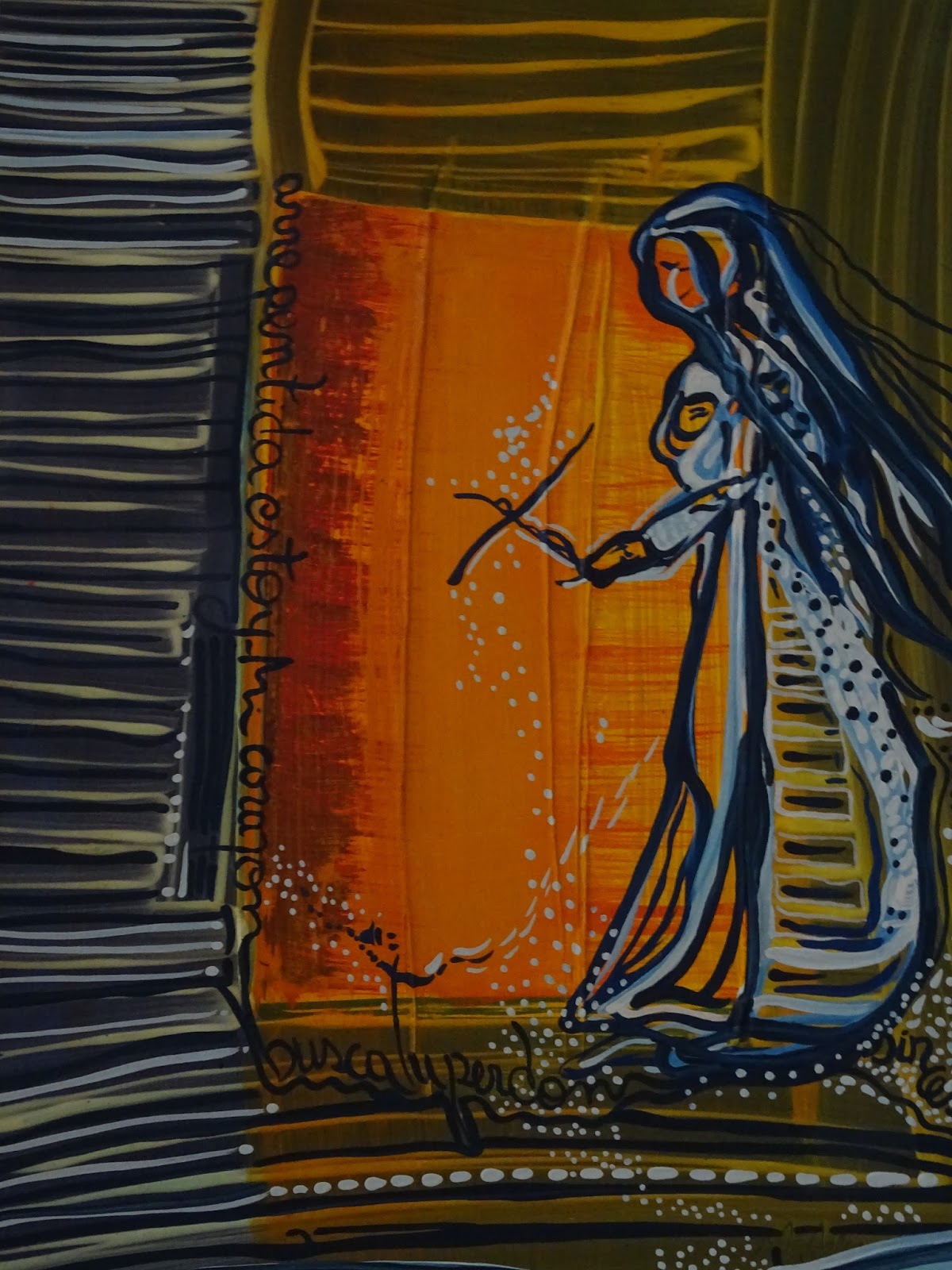
We have in church today paintings which share a similar message. María Inés Aguirre’s exhibition is called ‘The Way of the Heart’ and shows us scenes from the life of Christ and the Saints which encourage reflection on self-sacrifice and generous love.

MIA’s paintings result from her gifts as an artist. She thinks that the paintings are given to her by a higher power as she follows the emotions of line and colour. They are offered to us as a gift for our reflection on those emotions provoked by the Passion of Christ while seeing that story as also representing the different moods of our lives too. Contemplating MIA’s paintings, like reflecting on Jesus’ parables, leads us towards the path of passionate, generous love; the Way of the Heart.

The story of the rich man and Lazarus is chiefly aimed at the Pharisees who, we are told in an earlier verse, were lovers of money. It was not only the Pharisees’ love of wealth that set them apart but, more importantly, their hardness of heart. While we might feel revulsion at the lavish lifestyle of the rich man, the horror lies in the fact that he ignores the needs of his neighbour.

The story of the rich man and Lazarus does not call us to condemn wealth, but to notice the needs of our neighbours – both on our doorsteps and further afield – and to examine our own lives in the light of this. It asks us to consider the following questions:
  • Who is our neighbour? 
  • Are we so wrapped up in our own fulfilment that we forget our neighbours whose potential is denied? 
  • Are we ready to share our resources so that we can all become the people God would have us be?
These questions are as pertinent now as they were in Jesus’ day. And now as then, they are not questions to be put off for another day.

Jesus teaches that our resources are for the benefit of everyone. He continually considers the poor, and those who are on the margins of society first. Interestingly, this is seen in this parable by the fact that it is the only one of Jesus’ parables where someone is given a name. And the named person is Lazarus, not the rich man. In our society, the rich and powerful are constantly named to us, giving the message that these people are of more value than others. Who is it that we name and value? Is it the people society gives value to, or is it the people of the poor countries who are eating the scraps from our table? The answer to that question will reveal whether we are walking the way of greed or the way of generous love.

----------------------------------------------------------------------------------------------

Roland de Lassus - Psalmi Davidis Poenitentiales.

Tuesday, 9 June 2015

Via Cordis - The Way of the Heart


Via Cordis – The Way of the Heart: Paintings by María Inés Aguirre (MIA)
Monday 8th – Friday 26th June, 10.00am – 4.00pm. St Stephen Walbrook, 39 Walbrook, London EC4N 8BN.
Exhibition reception - Monday 15th June, 6.30pm. All are welcome.


Each painting, María Inés Aguirre (MIA) says, “is a solar flare of colours” where every colour is an emotion. The critic Pierre Restany identified the distinctive quality of MIA’s art as having its roots in her emotional life which then manifests itself in “the exuberance and spontaneity of her painting.”

MIA has spoken of risk and adventure, and the resulting spontaneity, as being key to her art. Her work fuses colour, music, emotion and nature in “a sun-burst of colour, of joy and imagination.”

As Michael Hutchinson-Uzielli has noted, this means that "Mia's paintings map her emotions and imagination, with colour, texture and sinuous lines depicting the landscape of her thoughts.” Her work is, therefore, cartography of the heart or soul, as she, herself, has suggested in selecting the title ‘Via Cordis: The Way of the Heart’ for this show.

MIA says the following words of Paul Klee, from 1918, describe her own creative process: “Everything around me dissolves and interesting works emerge as if of their own accord. My hand is entirely the instrument of a distant sphere. It isnʼt my head that is working, but something else, something higher, something somewhere more remote. I must have great friends out there – obscure, but also brilliant - and theyʼre all very good to me.”

MIA’s identification with Klee’s description of creativity as involving a sense of giftedness from a higher force helps us in understanding the emotional impact of her work more fully. As a result, we could either see the emotions she maps in her work as being divinely inspired or think that by following and depicting those emotions she taps into the divine.

Her work has connected with traditional religious iconography, although not with traditional outcomes. Her ‘Via Crucis’, ‘Via Lucis’ and now ‘Via Cordis’ exhibitions have engaged with the imagery of the ‘Stations of the Cross’, the ‘Path of Light’ and now the ‘Way of the Heart’. Through these series she has reflected on emotions provoked by the Passion of Christ while seeing that narrative as also representing the different moods of modern man.

These are works to contemplate as, through energy of line and brilliance of colour (that “sun-burst of joy and imagination”), they refresh the soul.

MIA studied Fine Art at the University of Tucumán (Argentina) and the Accademia di Belle Arti in Venice. She has exhibited in Europe, Asia and the Americas and has shows later this year in Hong Kong, France and Argentina. Her work stands out for its colour, energy and spontaneity. Her fascination with the connections between music and colour led her to become the first visual artist in residence at Steinway & Sons, London, where she transformed a Steinway Model D concert grand piano into 'Dancing Soul'. She is represented by ArtMoorHouse - Moor House, 120 London Wall, London, EC2Y 5ET. Tel: +44(0)7502211914. Email: info@artmoorhouse.com. Web: http://www.artmoorhouse.com/.

-----------------------------------------------------------------------------------------------------------

The Milgram Trio - Piano Trio in E minor Op 90 'Dumky'.