Here is the sermon that I preached at today's lunchtime Eucharist in St Martin-in-the-Fields, drawing on materials from A Soul Laid Bare, Liz Horwell, Alison Morgan, Randall Nolan and Gregory Wolfe:
“Over thirty years ago, W.H. Vanstone, canon of Chester Cathedral, wrote a book called, The Stature of Waiting. Early in the book, Vanstone talks about Jesus’ betrayal by Judas. The word ‘betrayed’, he says, as when Judas betrayed Jesus, really means ‘handed over’.” He explains that, “The word ‘betrayed’ is used only once in 33 mentions of what Judas did; the other 32 times the phrase ‘handed over’ is used. Where that phrase is used in other contexts of the NT it has no connotation of betrayal – eg the talents are ‘handed over’, Jesus ‘handed over’ his spirit as he died, Paul ‘hands over’ the gospel by preaching it to the Corinthians. The gospel writers use it consistently and automatically; it must have been the stock phrase, perhaps the one Jesus himself used at the Last Supper.”
“The gospels show a marked change from activity to passivity, action to passion, at the point where Jesus was ‘handed over’ – a phrase [which was] in common Christian currency in the first century.” According to John’s account … when Judas leaves the Last Supper to set in train the handing over of Jesus, John tell us ‘that it was night’… which must mean that the ‘daylight’ period is over and that the time foreseen by Jesus has come - the time at which ‘no one can work’, the time at which ‘working’ must give place to ‘waiting’…and is also associated, in a most striking way, with the end of Jesus’ freedom from restraint by human hands … ”from working to waiting and from freedom to constraint.” “The handing over of Jesus was His transition from working to waiting upon and receiving the works of others, from the status and role of subject to that of object, from ‘doing’ to ‘being done to’.”
“Jesus moves from being active to being passive in the Garden of Gethsemane when Judas hands him over.” “Until Gethsemane … Jesus had chosen to spend the whole of his ministry ‘demonstrating God’s kingdom’ both to individuals and to the people as a whole. And his ‘demonstrating’ invited people to respond. He longed for them to respond by choosing to deepen their relationship with God and work in the cause of justice: but that was their choice, it could never be obligatory.”
Vanstone “tells us that the word ‘passion’ comes from a Greek word meaning ‘suffer’: or ‘allow events to happen’.” It means, being passive. “The emphasis is … on being the subject not the object; being a patient.” “The passion then describes the time in Jesus’ life when he stopped taking control of the situation and simply allowed people to respond to him as they chose.” “So Vanstone says: ’The passion is not the pains he endured or the cruel manner in which he was treated by the hands of men but simply the fact that he was exposed to those hands and whatever those hands might do.’”
“This point is important because many people see God as ALWAYS taking control, always active, never passive; yet if Jesus is the perfect revelation of God’s character, Jesus’ passion demonstrates that being passive is also God-like.” “So Vanstone argues that Jesus’ death was the result of his passion, his ‘allowing events to happen’”: ”It wasn’t Jesus’ death that brought us benefits … It was his willingness to spare himself nothing, not even his own life, in the cause of winning the nation to the discipleship of God’s kingdom. He sought from the nation’s leaders that which could not be compelled: the response of discipleship.” “So, when Jesus prays in Gethsemane he still hopes that the priests might respond positively, though he knows it’s unlikely. He prays that God might be able to find him another way through this, another way for his message of love to be heard and understood. And until the moment when the priests come into the garden mob-handed there’s still the slim chance they’ll turn themselves around and support him. But in the garden they make their choice and he’ll accept it for what it is: their choice.”
“Jesus did the only thing that love can do: it can only offer itself out and wait for a response. With love, action must give way to passion, to waiting for a choice to be made. Because, as we know, Love is not possessive: it doesn’t insist on its own way; it never uses force. God offers such a love to us: an abundant, free-flowing, bountiful, love: and he waits longingly for us to want to love him in return. Jesus shows us that God’s love is not only active in showing itself, but passive in allowing us to choose what our response will be.” “The activity of love is always precarious … Herein lies the poignancy of love, and its potential tragedy. The activity of love contains no assurance or certainty of completion: much may be expended and little achieved. The progress of love must always be by tentative and precarious steps: and each step that is taken, whether it 'succeeds' or 'fails', becomes the basis for the next, and equally precarious, step which must follow.” “Love proceeds by no assured programme. In the care of children a parent is peculiarly aware that each step of love is a step of risk; and that each step taken generates the need for another and equally precarious step.”
So, “the hallmarks of the creator’s love for his creation [are] an endless love that must always shift with circumstances to see to the good of the beloved. And a vulnerable love that cannot force a response from the beloved but must watch and wait and hope for a response, whether it comes or not.” “Theologian that he is, Vanstone could not help feeling that these were the characteristics of God’s love for us — a self-emptying (kenosis) love that is always attempting to find out how to address the welter of circumstance that is every individual life.” “In the kenosis, or self-emptying of Christ, nothing is held back, nothing unexpended (Phil. 2:7). In this we recognize God’s love as unlimited. God’s love is also vulnerable. The Lord risks rejection at the hands of His own creatures and is pained by our refusal to accept love. And lastly, God’s love is precarious. By the humble condescension of the Lord, we have power to determine whether His love succeeds or fails in its communication, or its intended effect.” “The vulnerability of God means that the issue of His love as triumph or tragedy depends upon His creation.” This is the form of authentic love. If we want to know 'what love ought to be', we need enquire no further than what the love of God is.
“We live in a world which values activity and action over passivity and passion. We have lost [our understanding of what it means to be ‘handed over’]; but perhaps we should recover it, and in recovering it find our human dignity enhanced, our powerlessness removed – for so we can be like God himself, attaining the dignity which is ours because we share in his being, and reconnecting with some of the values we overlook in our emphasis on doing over being.”
-----------------------------------------------------------------------------------

Showing posts with label wolfe. Show all posts
Showing posts with label wolfe. Show all posts
Wednesday, 12 April 2017


Saturday, 22 October 2016
Modern Art and the Life of a Culture: The Religious Impulses of Modernism
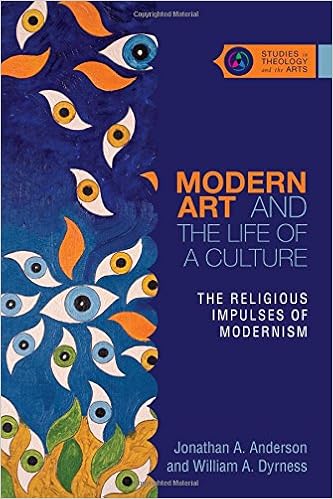
In Modern Art and the Life of a Culture Anderson and Dyrness, part of IVP's Studies in Theology and the Arts, also argue that there were strong religious impulses that positively shaped modern visual art. Instead of affirming a pattern of decline and growing antipathy towards faith, the authors contend that theological engagement and inquiry can be perceived across a wide range of modern art—French, British, German, Dutch, Russian and North American—and through particular works by artists such as Gauguin, Picasso, David Jones, Caspar David Friedrich, van Gogh, Kandinsky, Warhol and many others.
Dryness notes: 'Van Gogh is often recognized as a deeply spiritual artist, but usually he is pictured
as having given up his childhood (Reformed) Christian faith. But closer examination shows this not to have been the case. Others, like Gauguin, who are largely regarded as irreligious,
turn out to have had deep and formative experiences with (in this case) the Catholic faith.
Still others, like Malevich, inherited sensibilities from their religious contexts which made
deep inroads into their art. So there is no single story to be told.'
Anderson says: 'The research for this book was full of surprises for me. The religious backgrounds
of these artists, as well as the ongoing theological content of their work, are sometimes
buried deep in the academic literature and primary sources, but once you begin to dig you
find extraordinary things. Van Gogh was actually a fascinating theologian, and his paintings
were theologically oriented all the way to the end. Mondrian completed his art training in
the thick of the best neo-Calvinist thinking of the day. Until researching for this book, I
hadn’t realized just how deeply Kandinsky was preoccupied with the book of Revelation.
Warhol’s sharp social commentaries were oriented by his lifelong Catholicism. And so on:
the surprises abound.'
--------------------------------------------------------------------------------------
Van Morrison - In The Garden.
Monday, 11 February 2008
Allusive and elusive (2)
Within the visual arts one way of understanding modernism is to view it as progressing largely via deconstruction. In this view, the avant-garde developed by exploring the limits of the individual components of what had previously been the whole work of art. So, Impressionism explored effects of light, Cubism experimented with perspective, Expressionism set colour free, Futurism was driven by movement and so on. Each successive movement identified a new individual element of what had originally been a whole work of art and explored that fragment to its limits. Eventually, there were no component parts in the artist’s paint box left to play with.
Tom Wolfe has identified an art work produced by Lawrence Weiner in 1970 that he sees as representing the dead end of Modernism. This work read as follows:
"1. The artist may construct the piece
2. The piece may be fabricated
3. The piece need not be built
Each being equal and consistent with the intent of
the artist the decision as to condition rests with
the receiver upon the occasion of receivership."
Wolfe says, "there, at last, it was! No more realism, no more representational objects, no more lines, colours, forms, and contours, no more pigments, no more brushstrokes, no more evocations, no more frames, walls, galleries, museums, no more gnawing at the tortured face of the god Flatness, no more audience required, just a 'receiver' that may or may not be a person or may or may not be there at all, no more ego projected, just 'the artist', in the third person, who may be anyone or no one at all, for nothing is demanded of him, nothing at all, not even existence, for that got lost in the subjunctive mode."[i]
In terms of Art, this could be the place that T.S. Eliot mapped out so clearly at the beginning of the modernist period. The place of "stony rubbish" and of:
"A heap of broken images, where the sun beats,
And the dead tree gives no shelter, the cricket no relief,
And the dry stone no sound of water"[ii],
it is the waste land.
But The Waste Land, as a poem, does not accept the waste land that it describes. The narrative movement of the poem is towards escape, the finding of the water that will renew life. Eliot's intention was to "shore up" fragments against the ruins; in other words, to the extent to which he was able, to reconstruct. His seemingly disparate fragments include the Bible, the Grail legend, the 'Golden Bough', Tarot cards, Shakespeare, Dante, Buddha's Fire Sermon and many more. All are linked, all are reconciled, in the structure and content of a poem whose narrative thread articulates a rejection of and movement away from the sterility of twentieth century life.
The same impulse can be found in the poetry and paintings of David Jones. Jones said that he regarded his poem, The Anathemata: "as a series of fragments, fragmented bits, chance scraps really, of records of things, vestiges of sorts and kinds of disciplinae, that have come my way by this channel or that influence. Pieces of stuffs that happen to mean something to me and which I see as perhaps making a kind of coat of many colours, such as belonged to 'that dreamer' in the Hebrew myth."[iii]
Jones believed that objects, images and words accrue meanings over the years that are more than the object as object or image as image. Therefore all things are signs re-presenting something else in another form. Recessive signs which re-present multiple signification are what Jones aims to create in works such as The Anathemata and Aphrodite in Aulis. Jacques Maritain suggested that such multiple signification is what creates joy or delight in a work of art as “the more the work of art is laden with significance … the vaster and the richer and the higher will be the possibility of joy and beauty”.[iv]
Aphrodite in Aulis is full of Jones’ preoccupations: “the Grail, the Lamb, the soldiers (Greek and Roman, Tommy and Jerry), Doric, Ionic and Corinthian architecture, the moon, the stars and the dove.”[v] These disparate ideas and images are held together firstly by Jones’ composition with the whole painting revolving around the central figure of Aphrodite and secondly by his line which meanders over the whole composition literally linking every image. By holding these images and what they signify together in this way, Jones is able to create an image that both laments the way in which love is sacrificed by the violence and aggression of macho civilisations and also, through his crucifixion imagery, to hold out the hope that love may overcome that same violence and aggression.
[i] T. Wolfe, The Painted Word
[ii] T S Eliot, Collected Poems 1909-1962, Faber & Faber, 1974, p.63.
[iii] D. Jones, ‘Preface’ to The Anathemata, Faber & Faber, 1990, p.34.
[iv] J. Maritain, The Philosophy of Art (trans. The Revd J. O’Connor, Ditchling, Sussex, 1923) cited in J. Miles, Backgrounds to David Jones: a Study in Sources and Drafts, Cardiff: University of Wales Press, 1990, p.14.
[v] Ibid, p.44.
-----------------------------------------------------------------------------
Maria McKee - Opelousas (Sweet Relief)
Tom Wolfe has identified an art work produced by Lawrence Weiner in 1970 that he sees as representing the dead end of Modernism. This work read as follows:
"1. The artist may construct the piece
2. The piece may be fabricated
3. The piece need not be built
Each being equal and consistent with the intent of
the artist the decision as to condition rests with
the receiver upon the occasion of receivership."
Wolfe says, "there, at last, it was! No more realism, no more representational objects, no more lines, colours, forms, and contours, no more pigments, no more brushstrokes, no more evocations, no more frames, walls, galleries, museums, no more gnawing at the tortured face of the god Flatness, no more audience required, just a 'receiver' that may or may not be a person or may or may not be there at all, no more ego projected, just 'the artist', in the third person, who may be anyone or no one at all, for nothing is demanded of him, nothing at all, not even existence, for that got lost in the subjunctive mode."[i]
In terms of Art, this could be the place that T.S. Eliot mapped out so clearly at the beginning of the modernist period. The place of "stony rubbish" and of:
"A heap of broken images, where the sun beats,
And the dead tree gives no shelter, the cricket no relief,
And the dry stone no sound of water"[ii],
it is the waste land.
But The Waste Land, as a poem, does not accept the waste land that it describes. The narrative movement of the poem is towards escape, the finding of the water that will renew life. Eliot's intention was to "shore up" fragments against the ruins; in other words, to the extent to which he was able, to reconstruct. His seemingly disparate fragments include the Bible, the Grail legend, the 'Golden Bough', Tarot cards, Shakespeare, Dante, Buddha's Fire Sermon and many more. All are linked, all are reconciled, in the structure and content of a poem whose narrative thread articulates a rejection of and movement away from the sterility of twentieth century life.
The same impulse can be found in the poetry and paintings of David Jones. Jones said that he regarded his poem, The Anathemata: "as a series of fragments, fragmented bits, chance scraps really, of records of things, vestiges of sorts and kinds of disciplinae, that have come my way by this channel or that influence. Pieces of stuffs that happen to mean something to me and which I see as perhaps making a kind of coat of many colours, such as belonged to 'that dreamer' in the Hebrew myth."[iii]
Jones believed that objects, images and words accrue meanings over the years that are more than the object as object or image as image. Therefore all things are signs re-presenting something else in another form. Recessive signs which re-present multiple signification are what Jones aims to create in works such as The Anathemata and Aphrodite in Aulis. Jacques Maritain suggested that such multiple signification is what creates joy or delight in a work of art as “the more the work of art is laden with significance … the vaster and the richer and the higher will be the possibility of joy and beauty”.[iv]
Aphrodite in Aulis is full of Jones’ preoccupations: “the Grail, the Lamb, the soldiers (Greek and Roman, Tommy and Jerry), Doric, Ionic and Corinthian architecture, the moon, the stars and the dove.”[v] These disparate ideas and images are held together firstly by Jones’ composition with the whole painting revolving around the central figure of Aphrodite and secondly by his line which meanders over the whole composition literally linking every image. By holding these images and what they signify together in this way, Jones is able to create an image that both laments the way in which love is sacrificed by the violence and aggression of macho civilisations and also, through his crucifixion imagery, to hold out the hope that love may overcome that same violence and aggression.
[i] T. Wolfe, The Painted Word
[ii] T S Eliot, Collected Poems 1909-1962, Faber & Faber, 1974, p.63.
[iii] D. Jones, ‘Preface’ to The Anathemata, Faber & Faber, 1990, p.34.
[iv] J. Maritain, The Philosophy of Art (trans. The Revd J. O’Connor, Ditchling, Sussex, 1923) cited in J. Miles, Backgrounds to David Jones: a Study in Sources and Drafts, Cardiff: University of Wales Press, 1990, p.14.
[v] Ibid, p.44.
-----------------------------------------------------------------------------
Maria McKee - Opelousas (Sweet Relief)
Subscribe to:
Posts (Atom)