Wikio - Top Blogs - Religion and belief

Monday, 15 May 2017

HeartEdge seminars


HeartEdge is a growing ecumenical network of churches and other organisations working across the UK and overseas, initiated by St Martin-in-the-Fields.

It helps churches deepen and integrate their cultural, commercial and community reach while building association and learning with those on the edge

HeartEdge will organise useful workshops and events across the UK tailored to your priorities. The next events are:

Start:Stop seminar

Wednesday 31 May, 1 – 4pm, St Stephen Walbrook. Learn about the genesis of Start:Stop (10-minute work-based reflections for people on their way to work) together with Revd Jonathan Evens, Associate Vicar Partnership, St Martin-in-the-Fields, and Priest-in-charge, St Stephen Walbrook.

An opportunity to discuss:
  • growing a new congregation;
  • engaging with working people;
  • ministering in the workplace;
  • communicating with busy people.
Great Sacred Music seminar

Thursday 8 June, 12.50 – 4pm, St Martin-in-the-Fields. Learn about the genesis of Great Sacred Music (a 35-minute lunchtime sequence of words and music speaking to heart, head and soul) together with Revd Dr Sam Wells, Vicar of St Martin-in-the-Fields and Andrew Earis, Director of Music, St Martin-in-the-Fields.

An opportunity to discuss:
  • growing a new congregation; 
  • engaging with music lovers; 
  • using music in mission; 
  • sharing faith insights with secular audiences.
Both are free to HeartEdge members, £10 for others. Register with Revd Jonathan Evens at jonathan.evens@smitf.org or 020 7766 1127.


---------------------------------------------------------------------------------------

St Martin-in-the-Fields - Great Sacred Music.

Saturday, 13 May 2017

Windows on the world (344)


Margate, 2016

--------------------------------------------------------------------------------------------

Ed Kowalczyk - Dolphins Cry.

Terrence Ffyffe: Transformation


Artist Terrence Ffyffe presents a series of spectacular new ‘Cosmic’ paintings alongside a number of large dramatic religious works depicting the Passion of Christ, at St Stephen Walbrook (by Bank Station) EC4N 8BN, from 15th May - 9th June 2017. All are welcome to view these spectacular works at the Private View for the exhibition on 15th May from 6.30pm. Pianist Michael Homer will perform during the Private View, while Terrence Ffyffe, art critic Edward Lucie Smith and myself will all reflect briefly on the artworks.

As with his highly successful first show of ‘Cosmic’ paintings ‘Painting the Light’ in 2016, this exhibition entitled ‘Transformation’ brings the worlds of Quantum physics, Mathematics and Mystical Spirituality together in a new series of stunningly beautiful oil paintings. From his daily practise of meditation, which he describes as ‘a space journey to the source’, the lights, colours and shapes he sees mirror the images of Galaxies and Nebulas from the Hubble Telescope and the hidden world of atoms, cells and amoebas as revealed through the Electron Microscope. Ffyffe says “The amazing bio morphic patterns seen at all levels in nature demonstrate the oneness of all creation”. Terrence has found a way to create the patterns as blueprints and then with his skills as a figurative painter develop them into sumptuous paintings revealing a new form of beauty and a new vision of reality.

The exhibition coincides with the Feast of Pentecost, celebrating the ‘Descent of the Holy Spirit on the Apostles’, an event that transformed them from cowering in fear to boldly proclaiming the “Good News”.

Ffyffe formerly a figurative painter in the classic tradition had a “transformation” experience himself and is now firmly established in his new direction of depicting the beauty of the hidden world of nature and the inner world of the mind”. The exhibition brings together the last works that Ffyffe was working on before this profound change. He says, ”The early paintings are about the Historical Jesus and the New Paintings are about the Holy Spirit”.

Terrance Ffyffe is a visionary artist and as the eminent art critic Edward Lucie-Smith wrote on seeing the New Works for the first time “Wow!”: "Every now and then even a hardened old lag in the art business - yes folks, I mean me - gets a nice surprise … Terry Ffyffe-asked me to come and look at a new series of paintings … and my reaction was 'Wow!' … These were whirling, dynamic abstract designs - a total break with anything major of his that I had encountered previously”.

Terrence Ffyffe says: “Art should inspire the viewer, ideally raise the consciousness and elevate the mind to think of higher things like the beauty and mystery of the natural world, to contemplate the deep questions as to purpose and meaning, like ‘What is the origin of this life? What is Reality? Questions that have no easy answer but require a personal journey of developing awareness.”

Terrence Ffyffe was born in Melbourne, Australia. He studied at Swineburne University under Jeffrey Makin and Roger Kemp. After living the bohemian life of a painter in Carlton, extensive travels in the Australian Outback and several solo shows he came to England to study the “Old Masters” of European Painting at first hand. Unknown in the UK he painted portraits to support himself while he developed his uniquely expressive style. He eventually came to the attention of the art critics Edward Lucie-Smith and the late Daniel Farson who introduced him to the world of Francis Bacon and the “London school”. He has won a number of National Competitions including the Discerning Eye. David Lee, the fierce art critic and editor of the Jackdaw has said “Terrence Ffyffe will in time prove to be a Great Painter”.

St Stephen Walbrook hosts a regular programme of contemporary art exhibitions. We partner either with established art societies (such as the National Society of Painters, Sculptors & Printmakers or the Society of Catholic Artists) or significant art historian such Edward Lucie-Smith. In 2016 our programme featured work by the Stuckist artist Joe Machine, artist-priest Alan Everett, Brazilian artist Kim Poor, a digital installation by Michael Takeo Magruder, and group shows by the National Society and commission4mission. For 2017 we have planned an exhibition of crucifixion drawings by Francis Bacon, solo shows by Hannah Thomas, Regan O'Callaghan and Alexander de Cadenet, a digital residency by Daniel Bourke, and a Holy Saturday Night Vigil with the digital artwork of Mark Dean.

St Stephen Walbrook, while being a neo-Classical masterpiece, has, by acquiring a modern altar by Henry Moore complemented by a circular re-ordering and further commissions from Patrick Heron, Hans Coper and Andrew Varah, become a space which stands at the heart of the story of connections between the worlds of modern art and Christianity. The church also contains significant woodwork and carving by William Newman which provides a spatial frame and backdrop to the regular programme of contemporary art exhibitions that the church hosts. All of which makes St Stephen Walbrook a significant and special venue in which to view art.

----------------------------------------------------------------------------------------------

Scott Stapp - New Day Coming.

Friday, 12 May 2017

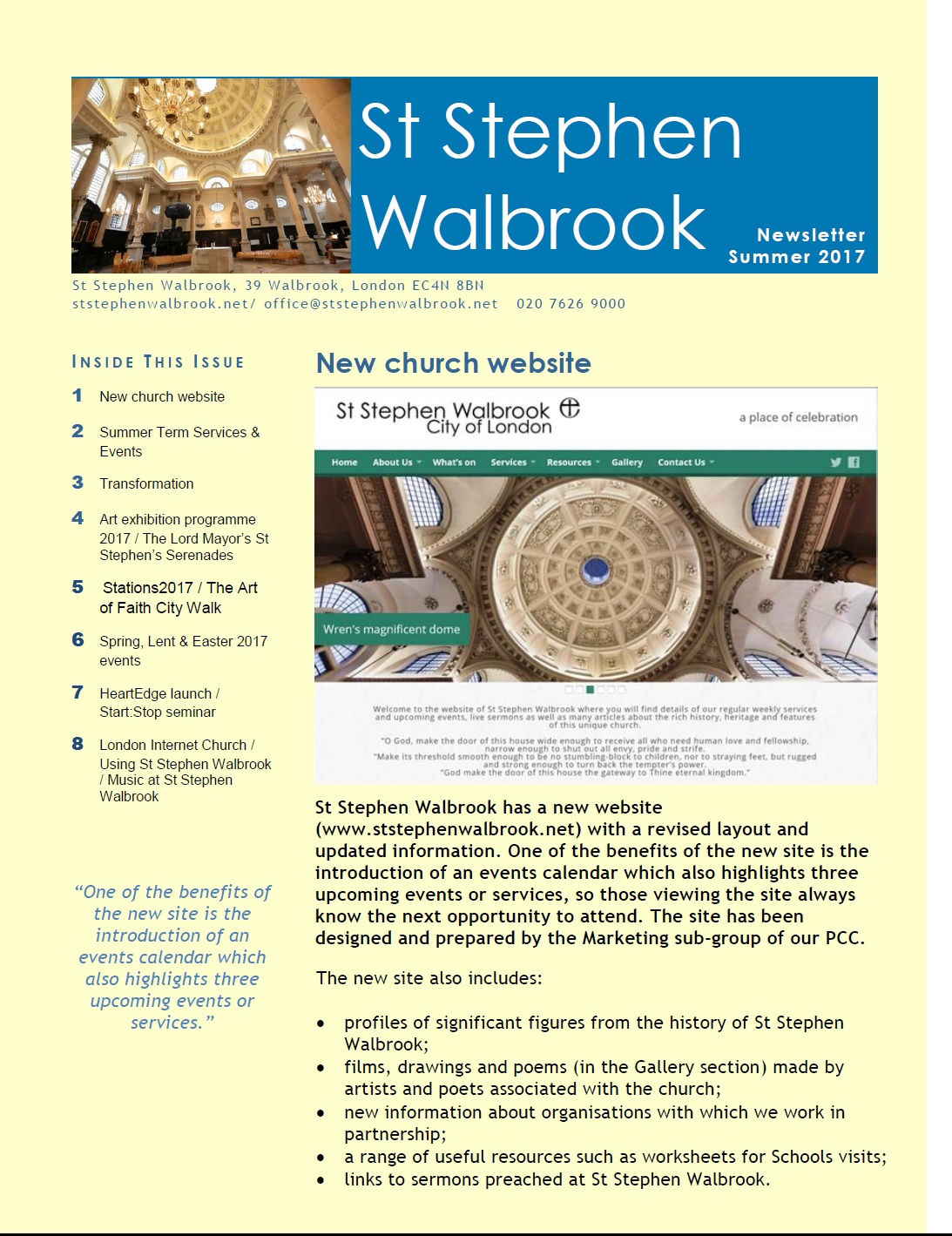
St Stephen Walbrook: Summer Newsletter


The Summer Newsletter for St Stephen Walbrook is now available through the new church website. Click here to view. This edition includes:
----------------------------------------------------------------------------------------------

Thomas Tallis - O Nata Lux.

Thursday, 11 May 2017

Confusion & childbirth

Here is my sermon from today's Eucharist at St Stephen Walbrook:

I’m going to talk about confusion and childbirth. Neither are easy topics for a sermon as we prefer to talk about certainty rather than confusion when it comes to faith and when men talk about childbirth it is always on the basis of a lack lived experience, even when you were present at the birth of both your children.

Let’s start with confusion, which for all our focus on certainty in the Christian faith, is actually an encouraging topic to address because it shows the realism and honesty of the Gospels. The Gospels could have been written as a hagiography of Jesus’ disciples but instead is a warts and all account. The disciples were fallible human beings, just as we are, yet were mightly used by God; and that is hugely encouraging for us, as it says that we can experience the same.

The confusion that the disciples experience here is in relation to Jesus’ teaching (John 16. 16 - 22). He says, ‘You won’t see me then you will.’ ‘You will grieve and be in pain and then you will rejoice.’ ‘I am going to the Father and then the Advocate will come to you.’ These were the messages Jesus was giving to his disciples just before the events of his Passion. With hindsight we understand what he was saying but we can understand, too, that at the time it was confusing and, as is clear from our Gospel reading, they didn’t really understand.

Jesus was trying to prepare them for his crucifixion – when they would no longer see them as he would have died and been buried – and for his resurrection – when joyfully and miraculously they would see him again. But these events were so far outside their frame of reference that they struggled to understand.

With hindsight we can see that Jesus was talking to them about his death and resurrection. Although we can see that in a way that the disciples could not at that time, there is still much that we don’t understand about the work of God in the world – questions, for example, about suffering, free will and our human propensity to evil – which mean that we will often feel as confused as the disciples felt at that time.

Later, they were able to see that Jesus knew what he was talking about and what he was doing, so they learnt to trust the work of God in the world even when they didn’t always understand what was going on. We need to learn to do the same and trust that, although we often don’t understand how, God is working his purpose out as year succeeds to year. In addition, Jesus wants us to understand that the pattern of his death and resurrection is also our natural and normal experience as human beings which we should expect to see worked out in our lives too. This is partly why he equates his experience of death and resurrection with childbirth.

He says to his disciples, ‘You are going to go through an experience that is very like that of childbirth. There will be a time when I am no longer with you and you will grieve and be in pain. That time will be like the pain that is experienced in labour. Then I will return to you through the resurrection and you will feel immense joy, the kind of joy that a mother feels when she first receives her new born baby in her arms; the kind of joy that overwhelms and over shadows the pain that was felt earlier.

Because he equates his unusual personal mission with an experience that is natural and normative for large numbers of the population in every generation, Jesus is suggesting to us that this pattern of death and resurrection, pain before birth, grief and joy, is one that will characterise our experience as Christians, so that whenever we are in a place of pain, grief or have the sense that death is occurring in some way in our lives, we should not despair because we can trust that resurrection, rebirth or new life is actually just around the corner and will be our experience in the future.

When we are in the midst of confusion, pain or grief, it is, of course, very hard to believe this and to trust that change will come. That is why Jesus wants to prepare us, as he tried to prepare his disciples, and wants us to understand that this will be our experience throughout our lives; that we will all move through periods of pain and grief before then experiencing new life and resurrection. His crucifixion and resurrection provide us with an understanding that the disciples did not possess before his Passion. The question is whether we will use that greater knowledge and understanding to prepare ourselves for the cycles of death and rebirth that remain to be experienced in the remainder of our time here on earth.         

-------------------------------------------------------------------------------

Déodat de Séverac -Tantum Ergo.

Tuesday, 9 May 2017

Start:Stop - Rising from the ruins of exile


Bible reading

These are the words of the letter that the prophet Jeremiah sent from Jerusalem to the remaining elders among the exiles, and to the priests, the prophets, and all the people, whom Nebuchadnezzar had taken into exile from Jerusalem to Babylon … It said: Thus says the Lord of hosts, the God of Israel, to all the exiles whom I have sent into exile from Jerusalem to Babylon: Build houses and live in them; plant gardens and eat what they produce. Take wives and have sons and daughters; take wives for your sons, and give your daughters in marriage, that they may bear sons and daughters; multiply there, and do not decrease. But seek the welfare of the city where I have sent you into exile, and pray to the Lord on its behalf, for in its welfare you will find your welfare. (Jeremiah 29. 1 – 7)

Meditation

The Israelite Exile had several phases. In 721 BC the Assyrians conquered the Northern Israelite kingdom. Assyrian policy was to stamp out national identities by mixing up populations. Therefore the 10 tribes of that Kingdom disappeared. The Southern kingdom, Judah, was not conquered until 597. By this time the dominant power was Babylon, whose policy was deportation. So, when Jerusalem was captured, the leading citizens were taken to Babylon. Then, in 587, Jerusalem and the temple were destroyed and all but the poorest were taken.

Walter Brueggemann writes that “Jerusalem was burned and its temple destroyed, the king was exiled, the leading citizens were deported and public life ended. For ancient Israel, it was the end of privilege, certitude, domination, viable public institutions and a sustaining social fabric. It was the end of life with God, which Israel had taken for granted. In that wrenching time, ancient Israel faced the temptation of denial—the pretence that there had been no loss—and it faced the temptation of despair—the inability to see any way out.” This was a crisis of faith, not simply defeat in war and separation from homeland, but the loss of every reference point that explained who they were as a people and the failure of their God to protect them. They had believed they were a people chosen out of all the nations to be in a special relationship with the one true God who created, sustained and controlled the cosmos. This testimony developed as God made covenants about their land, city, and kings. All were lost and this normative testimony was fundamentally threatened.

The Exile was a crisis to which the Israelites responded initially with grief and anger, but, as the Exile continued, they reacted, or were asked by God to react, in terms of reflection and reinterpretation. David Sceats has noted that “all the evidence points to the fact that the Old Testament came into existence in substantially its present form in and immediately after this period of defeat, exile and religious disintegration.” The purpose of both collating and organising older material, and of writing new material, was reflection. Those who put together the Old Testament in this way were reflecting on Israel’s past to “remind the nation of its identity, to help it understand its place in God’s purposes, and its responsibility as the covenant people, and, above all, to remember the universal claims of Yahweh, and his authority over all nations, including Babylon.” Sceats argues that the act of reflection undertaken by the Israelites was also about reinterpretation. God was, through the exile, revealing himself in a new way and therefore, in organising the religious literature of Israel, it was also necessary to reinterpret that literature “in such a way as to make religious sense of the crisis of faith it had gone through.”

As Western Christians in the twenty-first century, we have faced a crisis of exilic proportions. An increasing process of secularization has occurred within the West with Christianity being dethroned from the dominant position that it held at the end of the Medieval period. From the Reformation through the Enlightenment to Modernism, Christendom came under increasing threat and has now been gradually dismantled. Enlightenment thinking questioned the historical validity of central Christian doctrines, developed alternative ‘scientifically verifiable’ means of explaining the origins of species, positioned Government as the central means of meeting social/welfare needs, and created a consumer culture of aspiration and progress. The result is that for many in the West “God is dead”, “Man has come of age” and Christianity is dead in the water.

The theologians of the exile can help us in hearing and responding to the call of God in our day and time. Their pattern of reflection and re-interpretation based on the tradition gives a biblical means of reviving our roots and re-claiming our disputed lineage. We need to dream up what Church is and can be for future generations all over again. We should not expect to have all the answers to hand but should engage in a re-examination of our roots in order to imagine our future on a scale that is at least equal to that of the theologians of the exile. Our God is a God of new beginnings, of fresh starts. He is the resurrection God and, therefore, the one who gives hope that we can rise from the ruins.

Prayer

God of all times and all places, as we gather this day, we are mindful of the many who are in exile, living in temporary shelters as a result of war, poverty or extremes of weather. We pray for those who have been in exile for long years, those who are trying to make a life and care for their children, planting gardens and seeds of hope and survival in refugee camps with scarce resources. For all those without the comfort and safety of home, we pray rest and respite, courage and comfort. For all who are afraid and wonder if their exile will ever end, grant the peace that passes understanding. May we recount your promises, your provisions, your power and encourage hope in those longing for healing and home.

Thank you for seeing us, claiming us, healing us, making your home in us, so that no matter where we are, we are never alone. Thank you for the people on the journey with us, the ones who’ve opened their homes to us, those who have called us family, friends who have loved us, strangers who have cared for us, all who have been the hands and feet of Christ to us. Thank you for those who right this very moment are feeding the hungry, healing the sick, tending the dying, and in countless ways serving for the sake of others. May we recount your promises, your provisions, your power and encourage hope in those longing for healing and home.

(https://pres-outlook.org/2016/10/pastoral-prayer-storm-exile-hurricane-matthew/)

O God, the Creator and Preserver of all humankind: we humbly pray that it may please you to reveal your ways to all people and your saving power to all nations. In particular we pray for your church that it may be guided and governed by your Spirit in such a way that all who profess and call themselves Christians may be led into the way of truth and hold the faith in unity of spirit, in the bond of peace, and in righteousness of life. May we recount your promises, your provisions, your power and encourage hope in those longing for healing and home.

(http://www.churchsociety.org/publications/englishprayerbook/EPB_Prayers.asp)

The Blessing

May Christ, who makes saints of sinners, who has transformed those we remember today, raise and strengthen you that you may transform the world; and the blessing of God almighty, the Father, the Son, and the Holy Spirit, be among you and remain with you always. Amen.

--------------------------------------------------------------------------------------------

The Brilliance - Brother.

Discover & explore: God's written word


Discover & explore services at St Stephen Walbrook feature music and liturgy with the Choral Scholars of St Martin-in-the-Fields. These services explore their themes through a thoughtful mix of music, prayers, readings and reflections:

“A perfect service of peace in our busy lives.”
“Spiritual food in the middle of the day.”
“Beautifully and intelligently done.”

The current series of these services of musical discovery is exploring Reformation 500 themes and continued last Monday with the theme of 'God's written word'. The service featured the Choral Scholars singing: 'God be in my head' by John Rutter, 'Psalm 119', 'But the word of the Lord endureth forever' by Samuel Sebastian Wesley & 'O for a closer walk with God' by Charles Stanford.

All Discover & explore services begin at 1.10pm:

Mon 15 May - Through Christ alone
Mon 22 May - God loves you
Mon 29 May Bank Holiday – Church closed
Mon 5 June - Baptism saves
Mon 12 Jun - The Lord's Supper
Mon 19 Jun - The Cross alone
Mon 26 Jun - Forgiveness is free
Mon 3 Jul - Life of repentance

In today's service I shared the following reflection:
In the first Discover & explore service of this series, we reflected that the Reformers’ theological convictions about the essentials of Christianity were later summarised in five Latin phrases (or slogans) that emerged during the Reformation known as The Five Solas. These included Sola Scriptura (“Scripture alone”): The Bible alone is our highest authority.

The key implication of the principle is that interpretations and applications of the Scriptures do not have the same authority as the Scriptures themselves. Luther said, "a simple layman armed with Scripture is greater than the mightiest pope without it" and this was consistent with the intent of the Reformation which was to correct what Luther asserted to be the errors of the Catholic Church by appeal to the uniqueness of the Bible's textual authority.

Sola scriptura, however, does not ignore Christian history, tradition, or the church when seeking to understand the Bible. Rather, it sees the church as the Bible's interpreter, the ecumenical creeds as the interpretive context, and Scripture as the only final authority in matters of faith and practice. As Luther said, "The true rule is this: God's Word shall establish articles of faith, and no one else, not even an angel can do so."

Lutheranism, as we heard in today’s reading, loves and treasures the Word of God. The Scriptures are the sole source for doctrine and practice. The Scriptures deliver Christ to us, and for this we rejoice. As we heard in Colossians 3. 12 - 17, we are to let the word or message of Christ dwell in us richly as we worship together.

But for many people this raises as many questions as it answers because it is simply not possible for us to read scripture without interpreting what we read. All reading of scripture is interpreted reading. There is no ‘plain’ reading of scripture which does not involve interpretation. For scripture to be understood there has to be a struggle because the text has to be re-interpreted over and over again in terms of each generation and each culture. Engaging in this struggle may be what is meant by letting the word of Christ dwell in us richly.

The missiologist Lesslie Newbigin has helpfully unpacked some of what is involved in doing so. He wrote that: “The Bible is the body of literature which renders accessible to us the character, action and purpose of God. Taken as a whole, the Bible fitly renders God but this can only be understood as we are in engaged in the same struggle that we see in scripture. This is the struggle to understand and deal with the events of our time in the faith that God creates purpose, sustains all that is and will bring all to its proper end. The Bible comes to us in its “canonical shape”, as the result of many centuries of interpretation and re-interpretation, editing and re-editing, with a unity that depends on two primary centres - the rescue of Israel from Egypt and the events concerning Jesus - events, happening in the contingent world of history, which are interpreted as disclosures, in a unique sense, of the presence and action of God. However, the interpretation has to be re-interpreted over and over again in terms of another generation and another culture. The original interpretative language becomes a text which in turn needs interpretation. Yet the text cannot be eliminated. The events are not mere symbols of an underlying reality which could be grasped apart from them. What is presented in the bible is testimony.”

“The Bible is the book of community, and neither the book nor the community are properly understood except in their reciprocal relationship with each other. It is this relationship that is the clue to the meaning of both the book and the community. The Bible functions as authority only within a community that is committed to faith and obedience and which is embodying that commitment in an active discipleship embracing the whole of life, public and private.”

A final helpful way of understanding how the Bible can function with authority in our lives was set out by former Bishop of Durham, Tom Wright. He describes the story of the Bible as a five act play (containing the first four acts in full i.e. 1. Creation, 2. Fall, 3. Israel, 4. Jesus) within which we can understand ourselves to be actors improvising our part on basis of what has gone before and the hints we have of how the play will end:

"The writing of the New Testament ... would then form the first scene in the fifth act, and would simultaneously give hints (Romans 8, 1 Corinthians 15, parts of the Apocalypse) of how the play is supposed to end ... The church would then live under the 'authority' of the extant story, being required to offer an improvisatory performance of the final act as it leads up to and anticipates the intended conclusion ... the task of Act 5 ... is to reflect on, draw out, and implement the significance of the first four Acts, more specifically, of Act 4 in the light of Acts 1-3 ... Faithful improvisation in the present time requires patient and careful puzzling over what has gone before, including the attempt to understand what the nature of the claims made in, and for, the fourth Act really amount to."

Wright concludes that he is proposing "a notion of "authority" which is ... vested ... in the creator god himself, and this god's story with the world, seen as focused on the story of Israel and thence on the story of Jesus, as told and retold in the Old and New Testaments, and as still requiring completion." As Lesslie Newbigin has written, this story is understood "as we are in engaged in the same struggle that we see in scripture"; that "is the struggle to understand and deal with the events of our time in the faith that God creates purpose, sustains all that is and will bring all to its proper end." This is what I think it means to let the word of Christ dwell in us richly and to make the Bible authoritative in our lives.

Intercessions:

Open our eyes, that we may behold wondrous things out of your law. Open our spiritual eyes to show us the glimpses of glory we cannot see by ourselves. Give us the Spirit of wisdom and of revelation in the knowledge of Jesus, having the eyes of our hearts enlightened. May we see that the works of God stand as marvellous mountain ranges in the Bible, but also see that the highest peak, and the most majestic vista, is the person and work of your Son, our Lord Jesus Christ. Lord, in your mercy, hear our prayer.

Remind us of the sufficiency of your grace to produce genuine change in our lives. Allow seeds from Scripture to bear real, noticeable fruit in tangible acts of sacrificial love for others that we might be doers of the word, and not hearers only, deceiving ourselves. May your word shape and inform and direct our practical living making us more manifestly loving, not less, because of the time invested alone in reading and studying your word. Lord, in your mercy, hear our prayer.

May we experience the great goal of Bible reading and study as this: knowing and enjoying Jesus. This is a taste now of heaven’s coming delights. This is eternal life, that we know you the only true God, and Jesus Christ whom you have sent. In this way give direction, focus, and purpose to our study that we may press on to know you, the LORD. May this form great yearning and passion in our souls, so that we count everything as loss because of the surpassing worth of knowing Christ Jesus as our Lord. May we keep both eyes peeled for Jesus until we see how the passage at hand relates to Jesus’s person and work. Lord, in your mercy, hear our prayer.

(http://www.desiringgod.org/articles/four-prayers-for-bible-reading)

The Blessing

Go now in peace, knowing that you have been born again, not of perishable seed, but of imperishable, through the living and enduring word of God; and the blessing of God almighty, the Father, the Son, and the Holy Spirit, be among you and remain with you always. Amen.

------------------------------------------------------------------------------------------

Charles Stanford - O, For A Closer Walk With God