Wikio - Top Blogs - Religion and belief

Sunday, 3 August 2014

Sabbatical art pilgrimage: St Margaret's Ditchling and Ditchling Museum of Arts and Crafts


The beginning of the twentieth century saw the formation of many artist's colonies and communities. The most successful of these was probably at Gödöllő in Hungary and was based on the writings on John Ruskin and William Morris. During my sabbatical art pilgrimage I visited locations for two others; the artists’ colony which formed at Latem in Belgium and Ditchling in Sussex where the Guild of St Joseph and S Dominic was formed.

The formation of the Guild began in 1905 when Eric Gill moved to Hammersmith, not far from Edward Johnston, his tutor in lettering at the Central School of Arts and Crafts. Through Johnston, Gill met Hilary Pepler, then a social worker with London City Council, and the friendships, which were to bring this Guild into existence, were formed.

Gill, seeking the advantages of country living, moved to Ditchling in 1907. Johnston followed in 1912 and Pepler in 1915. In 1914 the three men issued their first edition of 'The Game', an occasional magazine which was to become the main forum for the views of the Guild. The catalyst for the transition from three friends living and working close by to the formation of the Guild came in 1917 with arrival of Fr. Vincent McNabb, prior of the Dominicans at Hawkesyard in Staffordshire. Gill had been received into the Roman Catholic Church in 1913 and Pepler likewise in 1916. On 29 July 1918 Pepler, Gill, his wife Mary and his apprentice Desmond Chute joined the Third Order of the Dominicans.

The January 1918 edition of 'The Game' stated 'The object of the Revolution is to replace the worship of Mammon by the worship of God. We adhere to the principle of human freedom, which we believe to be possible only by obedience to God and by recognising the institutions which are of God.' Johnston, however, was unable to follow in their ardent Catholicism and did not join, although he continued to live in Ditchling.

The Guild's first task was to build a small chapel with decoration by members of the community. Stone capitals were made in Gill's workshop while Gill contributed a rood and a bronze figure of Christ for the processional cross. A painted stone carving of the 'Madonna and Child' by Chute was placed to the left of the altar while on the right was 'St Joseph the Carpenter' by another of Gill's apprentices, Joseph Cribb. Several of these pieces can now be viewed in the Ditchling Museum of Art + Craft, located alongside the Anglican church of St Margaret Ditchling.

The Guild was formalised on 18 July 1920 and the details published in the September 1921 edition of 'The Game'. Only Dominican Tertiaries were eligible for membership, with postulants serving for one year before being admitted as members. Craftsmen were to own their own workshops and tools. The Spoil Bank Association was set up in 1921 to control the Guild's workshops and chapel. The Guild held that 'all work is ordained to God and should be divine worship' therefore 'work must be good in itself and good for use.'

Timothy Elphick describes much of the Guild's work as being devotional: 'Wood engravings of religious subjects were cut in profusion by Gill and Chute and the newly arrived David Jones, many for use as illustrations in THE GAME. Pepler's St Dominic's Press was printing Mass-sheets, ordination cards and music for psalms and canticles, as well as books and pamphlets written by guild members and their friends. One such book, a translation in 1923 of Jacques Maritain's Art et Scholastique, was to be of the greatest importance' ('Eric Gill and the Guild of St Joseph and St Dominic', Hove Museum and Art Gallery, 1990).

Again, examples of all these types of work plus Pepler's printing press can be viewed at the Ditchling Museum.

Rowan Williams wrote in 'Grace and Necessity' that: 'Jones’ exposure to Maritain came through his participation in Gill’s project. After demobilization in 1919, Jones studied first at the Westminster School of Art, where it appears that a catholic friend introduced him to Fr. John O’Connor. He became a Roman Catholic in 1921 and, prompted by O’Connor, joined Gill at Ditchling later that year … Thus, he was alongside Gill and Gill’s colleagues … during the crucial period during which they were all reading Maritain; and it is very clear that for Jones … this made sense of what he had assimilated at the Westminster School of Art.'

As Rene Hague later wrote, ‘the Post-Impressionist attitude to the arts fitted in very well with Maritain and Thomism’. Jonathan Miles and Derek Shiel write in 'The Maker Unmade' that: 'The philosophy of Maritain explored two related questions that are of importance for David Jones: signification and epiphany. By rigorous habit, the artist would not only be able to reveal this or that object under the form of paint but also make an epiphany, make the universal shine out from the particular. Thus, what is re-presented also becomes a sign of something else and if that something else is significant of something divine, then the art can claim to have a sacred character or function, a sacramental vitality.'

Similarly, Williams argues that what preoccupies Jones from the beginning is 'precisely what so concerns Maritain, the showing of the excess that pervades appearances.' As his work develops, Jones comes to see that you paint ‘excess’ by: 'the delicate superimposing of nets of visual material in a way that teases constantly by simultaneously refusing a third dimension and insisting that there is no way of reading the one surface at once. As in the Byzantine icon, visual depth gives way to the time taken to ‘read’ a surface: you cannot construct a single consistent illusion of depth as you look, and so you are obliged to trace and re-trace the intersecting linear patterns.'

Williams notes that in several respects Jones takes Maritain a stage further. Firstly, in that 'the half-apprehended consonances of impressions out of which an artwork grows has to be realized in the process of actually creating significant forms which, in the process of their embodiment, in stone, words, or pigment, uncover other resonances, so that what finally emerges is more than just a setting down of what was first grasped.'

Secondly, in 'the way in which a life may become a significant form – as, decisively and uniquely; in the life of Christ.' He: 'illustrates a point Maritain does not quite get to. Jones implies that the life of ‘prudence’, a life lived in a consciously moral context, however exactly understood, is itself an act of gratuitous sign-making; moral behavior is the construction of a life that can be ‘read’, that reveals something in the world and uncovers mystery.'

Both are exemplified by Jones’ life and practice as he turns away 'from one mode of representation in which he excelled in order to include more and more of the interwoven simultaneous lines of signification and allusion' in 'an attempt to embody a more radical love in what he produces, a love that attends to all the boundary-crossing echoes that characterize the real, which is also the good.'

In doing so, he embodies in his art Maritain’s view that 'the joy or delight of a work of art is in proportion to its powers of signification': 'the more there is of knowledge, or of things presented to the understanding, the vaster will be the possibility of joy; this is why Art, in so far as ordered to Beauty, does not, at least when its object permits, stop at forms or at colours, nor at sounds, nor at words taken in themselves and as things, but it takes them also as making known other things than themselves, that is to say as signs. And the thing signified may itself be a sign in turn, and the more the work of art is laden with significance … the vaster and the richer and the higher will be the possibility of joy and beauty.'

In 1924 Gill, having tried to pursue the Guild to move with him, left for Capel-y-ffin in Wales, where he was joined by Donald Attwater, Laurie Cribb, Philip Hagreen, Rene Hague and Jones. The Guild, however, survived the loss of Gill and those who accompanied him. Initially, it was maintained by Cribb, George Maxwell, Pepler and the newly arrived Valentine KilBride, joined in 1927 by Bernard Brocklehurst. Hagreen returned in 1932 and Dunstan Pruden also joined. These additions meant that the Guild now had weavers and silversmiths in addition to engravers, printers, stone carvers etc. Then in 1933 a further unfortunate dispute led to Pepler's expulsion from the Guild and the relocation of a now re-named Ditchling Press in new premises from 1937 onwards. John Skelton had two years in the Guild prior to his call-up in 1942. 

Elphick describes the final years thus: 'In 1949 Edgar Holloway came to Ditchling with his wife Daisy Monica, and a younger generation seemed at hand to continue the tradition. Office was still said daily in the chapel, and the monthly meetings of the Guild took place on the first Sunday, as ever; these became however noticeably more perfunctory, the services attended by one or two, the meetings lasting minutes, not hours. There was resistance to the recruiting of new members when they may not subscribe to the ideals of the community; those who did join, KilBride's daughter Jenny in 1974 (the first woman member), Pruden's widow Winefride in 1975 and finally the calligrapher Ewan Clayton, a grandson of KilBride, in 1983, they were, already, in every sense, part of the family. These, with Holloway, (Kenneth) Eager and Thomas Kilbride were the remaining members in 1988, when the decision was taken to wind up the affairs of the Guild.'

Whilst it was the Guild that provided the impetus and the focus for the Ditchling arts and crafts community to develop, their way of life and creative endeavours attracted a wider and more diverse group of artists and craftspeople to settle in the village. Thus there are notable figures who did not belong to the Guild of St Joseph and St Dominic, who are yet still very much part of the arts and crafts ethos of Ditchling. These included Johnston, Charles Knight and Ethel Mairet. In addition, although the Guild was Roman Catholic, members participated in the local community including commissions for the Parish church, where Johnston and Cribb are buried.

St Margaret's Ditchling has an east window designed in 1947 by Knight, an oak screen designed by John Denman and carved by Cribb in memory of the artist Louis Ginnett, while the font and the lettering of the 10 Commandments were also by Cribb. The gravestones of Johnston and Cribb overlook the Ditchling Museum of Art + Craft where examples of their work and that of Guild members is now displayed in new premises by Adam Richards Architects which in 2014 were shortlisted for the ArtFund's Museum of the Year award.The Museum offers an accessible and evocative insight into type of craftsmanship and way of life the Ditchling Arts and Crafts community developed. As the Museum’s publicity states, ‘The impact of the many artists and craftspeople who came to live and work in Ditchling from the beginning of the 20th century onwards established this village as one of the most important places for the visual arts and crafts in Britain.’

-------------------------------------------------------------------------------------------------

Erik Satie - Gymnopédie No.1.

Saturday, 2 August 2014

Sabbatical art pilgrimage: Canterbury Cathedral


Commissioning contemporary art for the Mother Church of the Anglican Communion, the seat of the Archbishop of Canterbury, is always going to be a tall order. Those who take on the task - deans, architects and artists - require strong constitutions to deal with the inevitable criticism when such an iconic building sees change. 

Some of the modern commissions have, therefore, been relatively small interventions in larger and earlier works such as the bronze Christ by Klaus Ringwald in the Christchurch Gate or the continuing series of stained glass commissions for the Cloister. In addition, the fabric of the building requires very significant maintenance and repair - Brian Sewell, with his usual hyperbole, has described the building as 'parting at the seams' - which is understandably the primary focus of Canterbury Cathedral's fundraising programme.

As Sewell states: 'The building is a great corporate work of art, of architecture, sculptural monuments and stained glass. Its foundation reaches back all but a thousand years, to the Norman Conquest, and it is part of the "and all that" of 1066, when plans were laid to replace the much smaller and simpler cathedral buildings that had stood and fallen since the seventh century. The first stage of the current building took a century or so to complete; a second stage began two centuries later, in 1376; the great central tower, Bell Harry, was undertaken in c. 1495 when the first of the Tudor dynasty, the seventh Harry, was on the throne; and the north tower of the West Front was built in the later 1830s, concurrently with the greatest of Gothic Revival monuments, the Houses of Parliament. A little less than eight centuries under construction, the victim of fire, collapse, reconstruction, stylistic revision and the desecrations of Henry VIII and Oliver Cromwell, it is now parting at the seams, its ancient stones — from massive buttresses to delicate tracery — friable, and, after a dozen decades of exposure, shrinking, expanding, oxidising, the sheets of lead that cover the acres of its many roofs let in the rain'.

In between such extreme pressures the scope for significant new commissions has been less than in other settings. There is one window in the style of the Arts and Crafts movement which was created by Christopher Whall. Whall was the influential designer in this style and made this window in 1902 together with another, once in St Andrew’s chapel, that was lost during World War II. The surviving window shows the Resurrection in the centre of the top register with the archangels Uriel and St Michael on either side. In the centre register is the Agony in the Garden, with the figures of John the Baptist and St John the Evangelist flanking. In the bottom register of the window is the Nativity with St Bartholomew and St James. Whall created the jewel like quality of intense colours by the use of thickly moulded ‘slab glass,’ known as ‘Early English,’ although it had been recently developed at that point.

A further modern stained glass commission was for the St Anselm’s Chapel. This came when Harry Stammers, a well-known stained glass designer from York, replaced the glass lost in World War II with new brightly coloured glass in 1959. St Anselm was the second Norman archbishop between 1093 and 1109, a great theologian and initiated the building of the major extension of the earlier Norman church of Lanfranc. The main five lights show the five people important in his life and beneath a story connected with each.

Giles Blomfield, while architect at the Cathedral created the Beckett altar in the Martyrdom (1986) with the 'Swords Point' sculpture above (where two metal swords and their shadows form the four swords which did for Thomas Becket). Blomfield also added the Compass Rose (symbol of the Anglican Communion) to the floor of the Nave's east end in 1988, when it was dedicated by Archbishop Robert Runcie during the final eucharist of that year's Lambeth Conference.
.
The Beckett altar was the first new altar in the Cathedral for 448 years but was rather more swiftly followed in 2005 by the St Anselm's altar which is the work of sculptor Stephen Cox. The altar was a gift to Canterbury Cathedral from the people of the Regione Autonoma Valle d'Aosta, the birthplace of Saint Anselm. Created in Aosta marble, the altar's dark symmetric simplicity lies in stark contrast to the pale, curving stone of the chapel. In selecting the stone, Stephen Cox ensured that the beauty of the colour and unique markings told the story of the majesty of the mountainous region that is Aosta and honours Anselm, both as Archbishop and Theologian. Cox is interested in ‘the ‘transformational’ that occurs in art i.e. that mundane materials through a sequence of actions are transformed into a whole different area of understanding.’ In the same way, he states, his altars have been subjected to the ritual of consecration and are, in consequence, changed.

Earlier plans for a St Anselm’s altarpiece involving the Hungarian born sculptor Andor Mészáros seem to have gone unrealized, although his 14 bronze medallions of the ‘Stations of the Cross’ together with a 15th made by his son Mikhael were completed and can be seen in the Cathedral’s Treasury. A further version of ‘The Canterbury Series’ was made for the Chapel at Trinity College in Melbourne. Mészáros came to England in 1949 but returned to Australia the following year. The medallions were made between 1942 and 1970.

Another Hungarian born artist, Ervin Bossanyi, was to have a rather better experience of a commission for Canterbury. Bossanyi’s experience illustrates some of the reasons why caution is often applied to commissions in a setting like Canterbury Cathedral but also reveals the benefits of trusting the vision of the artist commissioned.

Bossanyi was a Hungarian Jew who arrived in Britain in 1934 having gained a significant reputation for himself in Hamburg across the disciplines of ceramics, murals, paintings, sculpture and stained glass. His most significant commission to that point had been stained glass windows for the Ohlsdorf crematorium, which had been designed by Fritz Schumacher. However when the Nazi's gained power shortly after this commission was completed, Schumacher was suspended as Chief Architect of Hamburg and Bossanyi's promising career there was ended. He came to Britain with a reference from Schumacher but that counted for little and Bossanyi struggled initially to find commissions.

There were two turning points. First, he gained the support of Charles Holden, an architect who had championed the early work of Jacob Epstein, Eric Gill and Henry Moore. Holden helped Bossanyi gain commissions for Goldsmith's Library and Uxbridge Station. Second, was the creation of a window for the Tate Gallery which was eventually installed in 1948. Bernard Rackham from the V&A was among those who had supported Bossanyi over the Tate window. He also introduced Eric Milner-White, who became Dean of York Minster, to Bossanyi's work by means of this window. After repeated viewings Milner-White was convinced of Bossanyi's genius and recommended him to the Revd. C.T. Wood, Director of the South African Church Institute, who commissioned Bossanyi for windows at Michaelhouse School in Balgowan, Natal. Wood was a friend of the Archdeacon of Canterbury and, when the Cathedral was planning to re-glaze windows in the south-east transept, took the Venerable Alexander Sargent to meet Bossanyi. Rackham, who had authored two books on Canterbury's stained glass, also commended Bossanyi, who in 1935 was invited to meet the 'Red Dean' Hewlett Johnson. The two men hit it off immediately and the subsequent commission explored themes to which both were deeply committed; peace, salvation, faith and action.

In the first window, dedicated to unity and peace and conceived throughout in radiant colours, the ascended Christ welcomes children of all races. In the second, four prisoners are raised up from the leaden hues of darkness and despair into a glittering freedom where butterflies and birds take flight. Above these two are smaller upper windows; 'to the east is 'Christ Walking on the Waves", with Christ walking on stormy waters, representing faith, and to the west 'St Christopher', representing action' (Ervin Bossanyi: Vision, Art and Exile, ed. J. Bossanyi and S. Brown, Spire Books Ltd, 2008).

As Paul San Casciani notes in ‘Ervin Bossanyi: Vision, Art and Exile’, the windows were controversial with some complaining ‘that the scale of the transept has been altered by these striking works.’ The biography of Bossanyi on the British Museum website agrees that these windows divided the critics: ‘On the one hand his Romanesque figure of Christ in the eighteen foot high window "Peace", was considered sublime, one of the most majestic images in Western Europe. On the other, by those who did not understand the spiritual message and symbolism of the work, as an intrusion, out of scale with the other Cathedral glass. As always the colour was a revelation, and the artistry beyond criticism’.

In her guidebook, published by the Friends of Canterbury Cathedral, Dagmar Hayes says: ‘The Dean and Chapter decided courageously to entrust the creation of the new glass to a contemporary artist who would refurbish these windows so that they would stand as a monument to 20th-century artistry and craftsmanship, rather than be a meaningless imitation of past doctrinal style.’

Bossanyi is similar to Marc Chagall in that, while his stained glass commissions often required the use of specifically Christian imagery, he recognized the 'profound inspiration' of all the great religions, possessed a 'reverence for life' and longed for a 'new cosmopolitan world order, in which ideological, racist and cultural differences no longer mattered' (Ervin Bossanyi: Vision, Art and Exile). Where his work differs significantly from that of his peers is in the influence of Asian, and in particular Indian, art on his own designs.


The Canterbury windows, which Bossanyi considered to be among his finest work, led to further major projects including commissions for the National Cathedral in Washington DC. On my sabbatical art pilgrimage I have greatly appreciated the opportunity to see work by Bossanyi at St John's College Chapel in Oxford, the Stained Glass Museum in Ely Cathedral and the Sacred Silver and Stained GlassGallery at the V&A.


At Canterbury, as Casciani notes, ‘Bossanyi was given that rare thing for a stained-glass artist – a free hand to interpret his own themes – and for Canterbury he chose those dearest to his heart: peace and salvation.’ The obituary for Bossanyi published by the Daily Telegraph summed up his work well in saying that he had ‘brought a flood of colour to the world’ (Daily Telegraph, 1 October 1979).

-------------------------------------------------------------------------------------------------

Sabrina Johnson - Peace.

Enterprise Club

Ros Southern writes:

"Timebank afternoon tea & cakes on Wednesday afternoon at St John's Church (our base) 2-3.30pm. Kids welcome! Invitation flyer here. The Timebank is going to be an important resource for start-ups and community spirit. I am looking for ideas for venues and times to gather people together to 

Enterprise club update:  There are no lunchtime sessions in August but 2 evening sessions on Tuesday 19th and 26th at 7pm.
  • Tuesday 19th - Topic 'e-safety' and our speaker is Terry Freedman.   Some info here (will be updated):
  • Tuesday 26th - Topic customer service; and our speaker is Bev Stratton.  More info here.

Thanks so much to Ola Asgill for his session on business planning this week.   Brief report here.

And thanks to Nnenna Anyanwu for her session the week before on exploring personal qualities. The link did not work in the last email. More info about this useful session here.

We are proud of the practical impacts of our growing grassroots network and will start to capture some of the deals and partnerships forged at the enterprise club. See my blog entry 'When Vicky met Jeffery'."

-----------------------------------------------------------------------------

The Who - Who Are You?

St Peter's Chapel Bradwell: Evening Services

During August, the evening services at Bradwell-on-Sea are held in St Peter's Chapel, at the place where the land meets the sea and the sky comes close, a place where the distance between heaven and earth is tissue thin. All services start at 6.30pm.
AUGUST 3rd Trevor and Rev'd Pam Thorne - The cross and the cosmos
AUGUST 10th Suzy Edmunson - 'Gossiping the Gospel : Creative Preaching Through a Puppet.'
AUGUST 17th Camerata - Choral Evensong
AUGUST 24th Rev'd Brigid & Laurie Main - Music & Healing
AUGUST 31st Rev'd Jonathan Evens - Visual Art
The service I will be leading will involve Peter Banks, co-author with myself of 'The Secret Chord', and will feature work by commission4mission artists. The service will be a celebration of and thanksgiving for the Arts. All are very welcome.

------------------------------------------------------------------------------------

After The Fire - Pilgrim.

Sabbatical art pilgrimage: Belsey Bridge Conference Centre's Norfolk Room


Via Beata way station


St Julian's Church, Norwich


'Stations of the Cross' by Irene Orgden at St Julian's Church 

'The Revelations of Divine Love of Julian of Norwich,' are a series of paintings by Alan Oldfield which were first exhibited in Oldfield's home city of Sydney before being shown at Norwich Cathedral in 1988 as part of the Norwich Festival of the Arts. These huge paintings made a sizeable impact with aged vergers heard commenting on how strange it was that such images of a mere Norwich girl should have come all the way from 'down under.'

Oldfield first became aware of Julian of Norwich through her phrase 'all manner of things shall be well' which is quoted in T.S. Eliot's 'Four Quartets'. Later he found 'Enfolded in Love', a book of extracts from her writings, on a church bookstall and decided to learn more about the medieval anchoress, the first woman to write a book in English, who lived beside St Julian's Church in King Street Norwich in the 14th century.

Oldfield spoke of these paintings as being his way of paying back what he had learned from Julian of Norwich. 'She is not a very visual mystic,' he said, 'but as she struggled to put her vision into words, so I have struggled to clarify in paint what I feel about her work.'

Struggle and passion are not, however, part of the way in which these paintings have often been viewed. Rosemary Crumlin criticises the series for lacking passion as a result of the careful staging utilised by Oldfield in his theological reflections on Mother Julian's visions. Peter Haynes writes of this more positively as 'conceptual resolution' deriving from Oldfield's 'sensitive understanding' of both source (the visions) and context (medieval art).

Oldfield described the strengths of realism as being 'draughtsmanship, line and closed composition, its success in allusiveness and anonymity.' Crumlin suggests that Oldfield's mature paintings, drawings and theatre designs carry out this brief and incorporate the insights of colour field and hard edge.' He 'often places a frame around a moment of time ... so that the picture space becomes like the theatre stage and the figures become like actors frozen in time and isolated often from each other.' His paintings often 'include explicit references to paintings and to painters he admires,' such as Piero della Francesca and Fra Angelico.

One of the series, 'A High and Spiritual Shewing of Christ's Mother according to Julian of Norwich' was joint winner of The Blake Prize in 1987. In this painting 'Julian pulls back the curtain to see the young Mary at the moment of her 'yes' to the archangel Gabriel's news that, although a virgin (symbolised by the vase of lilies), she is to become the Mother of God' (R. Crumlin, 'The Blake Book,' Macmillan, Melbourne, 2011).

The Blake Prize for Religious Art began in 1951 with an exhibition in Sydney and was 'the idea of Michael Scott, a Jesuit priest, and Richard Morley, a Jewish businessman, who saw in it a way of encouraging the Church to become patron of the arts and remedying what they considered the appalling state of the art in churches.' The Blake Committee 'looked to the European Sacred Art Renewal Movement centred in France for inspiration,' in particular to Notre-Dame deToute Grâce at Assy in the French Alps where, 'within the one building, priest, architect and modern artists had worked together in creative dialogue' (R. Crumlin, 'The Blake Book,' Macmillan, Melbourne, 2011).

Despite the fact that 'before 1940 there was little religious art in Australia' and that 'Churches in Australia rarely took the best artists seriously enough to commission their work,' as Margaret Manion has written, for a 'surprisingly large number of gifted Australian artists, the relationship between art and religion has continued to provide a creative challenge' (R. Crumlin, 'Images of Religion in Australian Art,' Bay Books, 1988). Roy de Maistre was probably the best known of these artists in the UK with commissions at Westminster Cathedral and St Aidan's East Acton, a major retrospective at the Whitechapel Gallery and his friendship with Francis Bacon. Arthur Boyd also spent time in the UK, during the Sixties and had his work championed by the art critic, Peter Fuller. In Australia itself artists such as John Coburn, Leonard French, Roger Kemp, Justin O'Brien and Eric Smith all created art which communicated religious feeling and intention.

Oldfield's work came to England primarily because of its content and then stayed when another in the series, 'The Revelations of Julian of Norwich' was purchased by the Friends of Julian of Norwich and hung in what was then the Chapel of St Gabriel's Retreat Centre at Ditchingham in Norfolk. Oldfield gave an additional work 'The Revelations of Divine Love' to the Friends of Julian and this now hangs in the Julian Centre which sits beside St Julian's Church where Julian had her cell. This image depicts the beautiful and lively child who, in one of Julian's shewings, sprang up from a foul and stinking body on the ground.

Realising that the series would be broken up, Oldfield created a film of the paintings with Sheila Upjohn (whose translation of Julian's writings Oldfield had read) reading selected extracts from Julian's shewings. Upjohn would later make a similar use of extracts from Julian in the booklet based on the 'Stations of the Cross' by Irene Ogden which can be found at St Julian's Church. 'Julian and the Scribe' found an ecclesiastical setting, at St Peter's Cremorne, while Oldfield and Earle Backen both created significant work (sometimes jointly)  for Christchurch St Laurence in Sydney where both worshipped and where Oldfield served as churchwarden.

The St Gabriel's Centre in Ditchingham has since become the Belsey Bridge Conference Centre but Oldfield's painting still hangs in the Norfolk Room, which now doubles as the chapel and a conference room. I first encountered this striking image while on a training course here and returned to it as part of my sabbatical art pilgrimage by taking an individual retreat at the Belsey Bridge Centre. On this occasion I shared the space with priests and laity from the Oratory of the Good Shepherd (OGS), who were also there on retreat. The OGS is an international community of Anglicans, ordained and lay, who share a common Rule of Life.

A new addition to the site was a Via Beata way station. These are part of a developing series of shelters running west to east across the UK from St David’s to Lowestoft, each of which contain a single piece of Christian art. The image at the Belsey Bridge Centre is of Christ and his two disciples on the Emmaus road.

The Chapel has survived several changes since its construction in 1960 when it was the chapel for a school run by nuns from the nearby All Hallows Convent. The community of Sisters took up residence in the 1850s and the All Hallows community flourished so that by the end of the 19th century they were running a hospital, an orphanage, a home for fallen women and the school. The complex of late 19th and early 20th century red brick gothic buildings survives, a maze of corridors connecting what were once separate buildings. Simon Nott writes, 'The chapel of the school was rebuilt in 1960 in memory of Herbert Palmer, Warden of the Community of All Hallows and Chaplain to the school. It is a large, light, airy building, absolutely typical of its date: ten years earlier and there would have been more of a sense of a shadowy past, and ten years later it would have responded to the reforms of Vatican II (despite being Anglican) by having an altar in the centre rather than at the east end'.
  
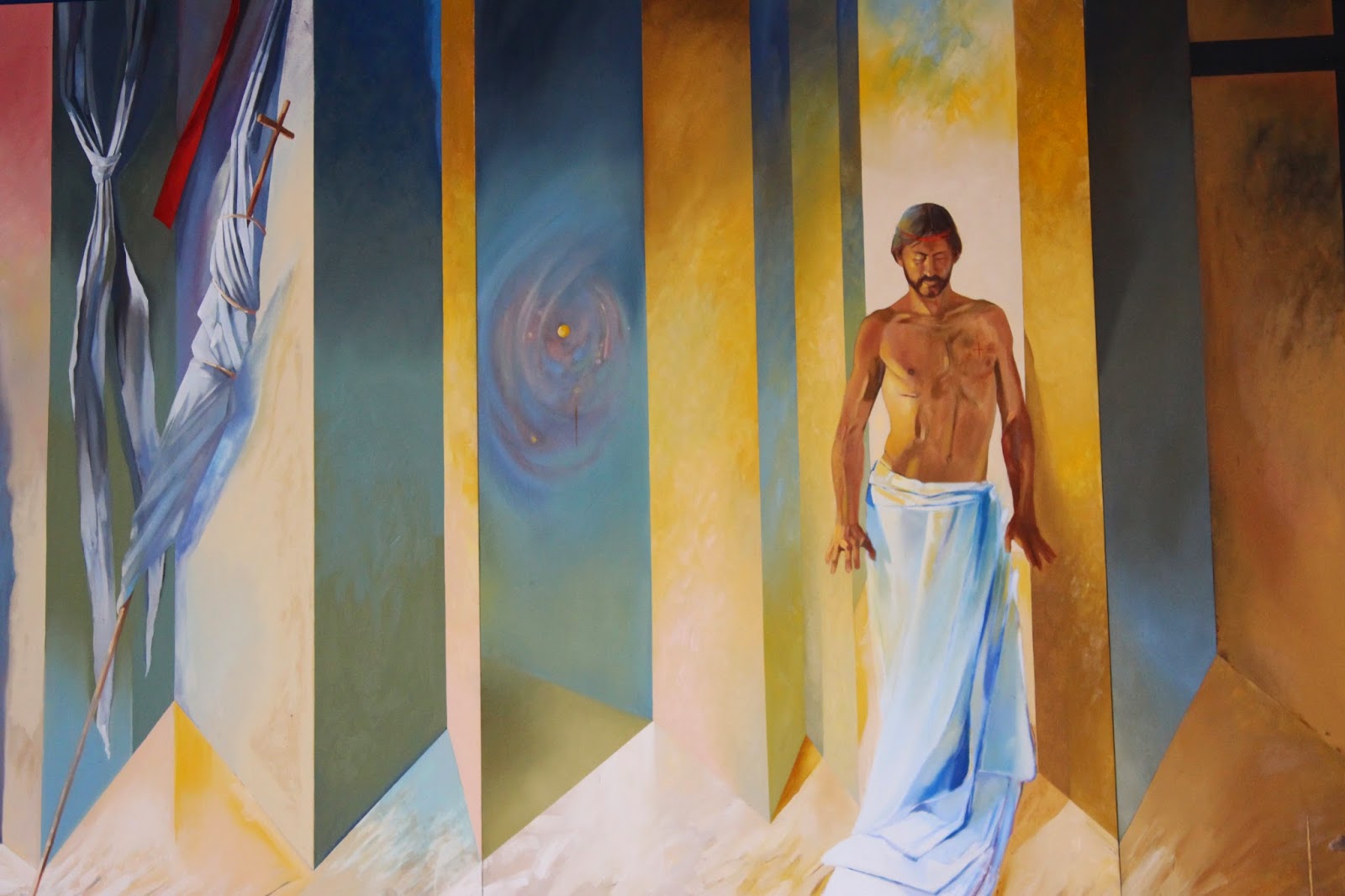
We enter the painting of 'The Revelations of Julian of Norwich' on the right in shadow; the shadow of Mother Julian on the wall of her cell. Constraining rectangles frame her for us, standing at her reading desk looking out into her field of vision. Red and white tiles circumscribe her cell-space, as sky-blue walls suggest the infinite breadth of her visions.

One painted panel contains her cell, a further three, her visions. 16 screens correspond to 16 showings set side-by-side like theatre sets; God's purposes played out on the stage of history. A tall, thin white candle levitates above the tiled floor illuminating Julian's cell; a 2D image at its apex, becoming 3D at its base. The first of several optical illusions; what we think we see never being all we see.

Julian looks back to her 16 showings and we follow her gaze to be taken back to the cross. Sombre shades and tones conceal a crown of thorns, an empty cross and barren land. Suffering indicated through absence and the shadow of death.

Beyond the cross, the resurrected Christ; his winding cloths now worn around his waist, spilling before him like the train of a bride rides behind. A red band rings him, a cross-shaped scar upon his breast, head bowed, palms held to bless those ministering and receiving at the altar below. Behind his head the stage-set of time opens revealing 'three heavens' of infinite eternity. Beyond him still the vision of the hazelnut painted planet-like in a galaxies' swirl; planet or nut, mass or pinprick, all will be well and all manner of thing be well - the resurrection initiates it!

So, finally, the cross wrapped in the winding sheets of the grave waiting for release, the sheets becoming the waved flag of victory at the return when the resurrection of all restores all to wellness and the vision of the hazelnut come to pass.


For now, vision extends beyond the painting beyond the showings, beyond ... where there is shadow, the shadow of God, revealing the limits of all our imaging. God is beyond the partial and incomplete images we construct. The shadow is God waiting in the wings for the moment of reunion when we shall see and know fully even as we are fully seen and known.

---------------------------------------------------------------------------------------------------

Sydney Carter and OHRWURM Folk Orchestra - Bells Of Norwich.

Friday, 1 August 2014

Sabbatical art pilgrimage: Latest ArtWay report

My latest sabbatical art pilgrimage report for ArtWay has been published in their Church of the Month slot. This report concerns SintMartinuskerk Latem in Belgium and the art colony that was there in the early part of the twentieth century. The reports which ArtWay are publishing generally contain additional information or reflections from those which I am posting here and, as with the posts here, will gradually build up a partial history of the revival of sacred art in the twentieth century.


This report follows others on Aylesford Priory, Chelmsford Cathedral and Lumen, as well as earlier reports of visits to sites associated with Marian Bohusz-Szyszko, Marc Chagall, Jean Cocteau, Antoni Gaudi and Henri Matisse.

------------------------------------------------------------------------------

Duke Special - Freewheel.

Norfolk scenes

Cley next the Sea


Walsingham


Norwich Cathedral


-----------------------------------------------------------------------------------

The Innocence Mission - Colours Of The World.