Wikio - Top Blogs - Religion and belief

Thursday, 17 July 2014

Sabbatical art pilgrimage: St Andrew Bobola Shepherds Bush


St Andrew Bobola Shepherds Bush is one of London’s hidden gems. St Andrew Bobola was a Polish Jesuit missionary and martyr, known as the Apostle of Lithuania, and this Roman Catholic Church dedicated to him opened in 1961 in a former Presbyterian Church building which has been extensively and beautifully restored as a living memorial to Poles who died during World War II. The church holds the main shrine in Britain to the dead of Katyn, the Second World War massacre of Polish officers by Soviet soldiers.

Alexander Klecki was the architect responsible for the transformation of the building. Klecki, who died earlier in 2014, also undertook architectural projects which included Brighton Marina, Heathrow Airport’s Terminal 3 (with Sir Frederick Gibberd), and Sheik Ali Al Qureishi Palace in Dammam, Saudi Arabia. His sculptural work included a bronze Our Lady of Ostra Brama, Wilno (presented to Pope John Paul II at the Vatican), Katyn Memorial in Clifton, Bristol, an aluminium Christ for an Anglican Church in Newcastle under Lyme, and murals at Putney House, the Curzon Club and in the City of London. He was a member of the Association of Polish Artists in Great Britain.

Klecki's Stations of the Cross at St Andrew Bobola are rectangular bronze reliefs showing stylised figures from the Passion narrative. His sculptures include the large Christ figure forming the altarpiece as well as figures of both St Andrew Bobola and St Maximilian Kolbe. Ten of the stained glass windows at St Andrew Bobola are also his work. Given his involvement with the church it is no surprise to find that he was appointed as its custodian.

A bas-relief icon in the chapel of Our Lady of Kozielsk was carved by a lieutenant in the Polish army, Tadeusz Zielinski, who survived imprisonment in the Soviet camp at Kozielsk. The icon was carved in secret, using for tools fragments of steel lying in the ruins, on a limewood plank from a door of a Russian Orthodox church that had been converted by the Bolsheviks into a prison. Being transported to a camp at Grazowiec, Zielinski hid the carving in the false bottom of his suitcase: there he added colour using paints intended for communist slogans. The icon eventually travelled to England by way of Persia, Palestine, Egypt and Italy, and was installed in the church in 1949. (Extracted from an article by Jan Pieńkowski in the Hammersmith and Fulham Historic Buildings Group Autumn Newsletter)

Jan Pieńkowski has also described the stained glass windows which have been skilfully integrated into the church and which relates to the Polish soldiers, sailors and airmen who fought alongside the Allies in World War II:

“Their most distinguished leader was General Wladyslaw Anders, whose memorial fills the triple lancet stained glass window in the south transept. General Anders led the Polish Second Corps in the final push against German troops in Italy, including the heroic assault on Monte Cassino. The window depicts the crucifixion and includes the most revered Polish military decoration, the Virtuti Militari Cross …

The second remarkable window – in the north transept – commemorates Polish airmen who fought in the Battle of Britain. This was designed by the painter Janina Baranowska, who won the competition set by the Union of Polish Airmen in 1979 … The window was made by the firm of Goddard & Gibbs and inaugurated by Cardinal Rubin on 3 April 1980. The three lancet windows cleverly integrate the Cross with two swooping plane trails. The composition is surmounted by the icon of Our Lady of Ostrobrama.

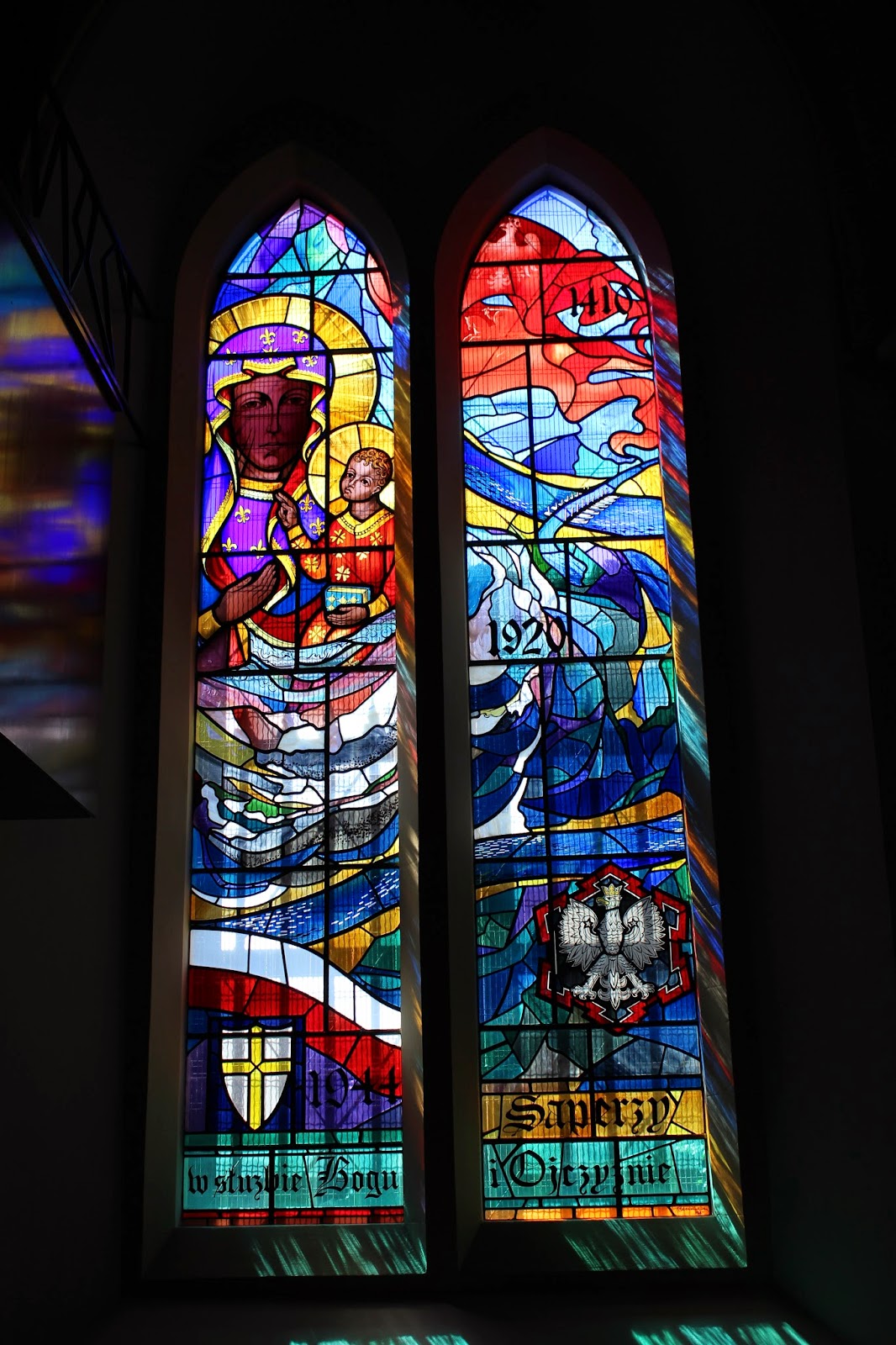
Another interesting window commemorates the Polish secret underground men who were trained at the SOE centre at Audley End and then parachuted into German occupied Poland.”

Janina Baranowska was born in Grodno and remained there until the outbreak of the Second World War. In 1940 she was arrested and deported to Russia. Two years later she was released and joined the Polish Army in its march to the Middle East. In 1946 she moved to London where she studied under Professor David Bomberg at the Borough Polytechnic in 1947-50. For a number of years she was on the Board of the National Society of Painters and Sculptors, and Association of International Arts. In 1980 she became President of the Polish Artists Society in Great Britain, later the Association of Polish Artists in Great Britain and she was a member of the Catholic and Christian Artists group. Baranowska practises painting and graphic art, and designs stained glass windows. She has exhibited in leading galleries in the UK, France, Poland and the United States. Stained glass windows by her can be found at Holy Trinity Church in Wolverhampton, as well as at St Andrew Bobola.

For the last twenty years Baranowska has been working as a Director of the Gallery in the Polish Social and Cultural Centre (POSK) in Hammersmith, in London organising exhibitions and helping artists from Poland and other countries. The mission of POSK is “to promote and encourage access to Polish Culture in all its forms to Poles and non Poles.”

Many Polish artists were forced to flee mainland Europe during the Second World War. Some of these artists journeyed through many countries before settling in the UK, while others were captured and imprisoned before finding their way to British shores. Marian Bohusz-Szyszko was one of the key organisers in this group of artists. Douglas Hall has recounted how Bohusz-Szyszko organised art classes:

“at first in a reception camp, later at various addresses in London and finally at the St Christopher Hospice at Sydenham. The classes became known as the Polish School of Painting, and were eventually taken under the wing of The Polish University Abroad. The relatively younger artists, including [Stanislaw] Frenkiel, founded in 1948 the Young Artists Association … A group calling themselves Group 49 took its place a year later and mainly consisted of pupils of Bohusz-Szyszko … In 1955, with Polish artists beginning to be more successful commercially, a society was formed with the neutral title of The Association of Polish Artists in Great Britain (APA) … Although APA was intended to be a broad church, the pupils of Marian Bohusz were still the most important element.” A former pupil, Halima Nałęcz, was the founder of the Drian Galleries which also regularly hosted “a plethora of personalities from the artistic world of London, both English and Polish.” In addition, Bohusz-Szyszko and other exiled Polish artists (such as Frenkiel, Adam Kossowski, Henryk Gotlib, Marek Zulawski and Alexander Zyw) were part of a consistent but under-recognised strand of artists utilising sacred themes. Bohusz-Szyszko’s work can be found at St Christopher’s Hospice in Sydenham, where he was artist-in-residence.

Many of these artists featured in the recent Pole Position exhibition at the Graves Gallery in Sheffield. Specifically religious paintings in this exhibition, such as Janina Baranowska's Crucifixion and Marian Bohusz-Szyszko's Christ Crowned with Thorns, were “on the anguished side of Christian art” and “agonise in brilliant, almost hellish colour” (Pole Position: Polish Art in Britain 1939 - 1989, Graves Gallery Sheffield, 2014).

As well as organisations like POSK and APA, the Church has been a key source of support for many in the émigré community. Monsignor Bronisław Gostomski was a recent parish priest at the church who was known for working hard to support and unite the Polish community. As parish priest since 2003, he had spearheaded a £1 million renovation project at the church and worked to unite older and younger generations of Poles within his congregation. As the chaplain of  the Polish Ex-Servicemen’s Association (SPK), he cared spiritually for those who had been left in England when the dramatic events of the Second World War and the Cold War took their course.  Moreover, he cared also for those who had come to England in more recent  years in pursuit of a new life and opportunities.  As the Parish Priest he could bring everyone together as one family, regardless of age or personal history. Tragically, he was among 96 victims of a plane crash on April 10 2010, which also claimed the lives of the Polish president Lech Kaczynski, Polish president-in-exile Ryszard Kaczorowski and many of the country's top officials and dignitaries.

With these connections and links St Andrew Bobola is a significant space for memory and memorial, specifically for Poles who died during World War II, but also, more generally, for the Polish community in the UK as a whole.

----------------------------------------------------------------------------------------------

Krzysztof Penderecki - Utrenja I: The Entombment of Christ.

Sunday, 13 July 2014

Sophia Hub update

Here is the latest update from the Seven Kings and Newbury Park Sophia Hub:

Sophia Course

Day One completed of the latest Sophia Course. This Sophia Course is aimed at Valentines Ward residents (funding from the Community First fund) and is a reflective and transformative opportunity to look at the community in which we live and generate ideas that can become social enterprises.

The six participants, plus Ros Southern and I, all loved this day together.  We are shaping businesses with a heart.

sophia course 1 flirt small group

We looked at:
  • our best examples of community projects and community spirit; 
  • what our values are;
  • what our neighbourhood is like (mainly, but not exclusively, the bad bits);
  • using statistics to back-up our perceptions;
  • finding the root value of the ideas we have for community projects and businesses; and
  • setting the homework!
Day two is next Saturday.  It is possible we could fit in another person or two, particularly if you live in or near Valentines ward in Ilford.  Get in touch if you are interested or want to be contacted for the next course.

sophia course 1 flirt wool ending

Comment from participant: “What I found inspiring was the sharing and caring and everybody thinking together” - Nima.

Thanks to Flirt Cafe for being a wonderful venue for us in the upstairs room.  It’s nice to be supporting a new enterprise in the area.  The cafe address is 361 Ley Street, Ilford IG1 4AA and telephone number 0208 001 7061.

Enterprise Club

A quick rundown on the speakers programme. July sessions will run from 12 – 2pm with the speaker starting at 12.15 pm (parking restrictions end at 12.00 noon).

15th – Manzoor Ahmed, community chef & promoter of pop ups.  Director of local business, Fusion Foods.

22nd – Nnenna Anyanwu a business growth development consultant and runs her own local business.  She is on the steering committee for Sophia Hubs Seven Kings and wants to talk on the personal characteristics needed to work for yourself.

29th – Ola Asgill, Managing Director of Ketco Ltd, based in Chadwell Heath,  He will be leading a session on business plans and will be here from 12 – 2.  He will present for about 45 minutes and then set some tasks and give time for feedback and support.  Ola is also on our steering committee

In August there will be two evening Tuesday sessions 7 - 9.00pm and then a break for two weeks.

Tuesday 5th August 7 - 9.00pm, St Johns Church – speaker to be arranged.

Tuesday 12th August 7 - 9.00pm, St Johns Church – speaker to be arranged.

No sessions on 19th and 26th.

In September the first session will be led by Sue Howard on the Map of Meaning. This will be a longer session looking at the map and working out how to make our work meaningful and fitting in with the meaning in our life.  We are starting the new term with something deep and reflective.

With thanks to volunteers Jenny Coverdale and Elaine Freedman who have been supporting the enterprise club over the last few months.

---------------------------------------------------------------------------

Lloyd Cole and the Commotions - Brand New Friend.

Sabbatical art pilgrimage: St Michael and All Angels Waterford


In 1919 designs by Harry Clarke for a two-light window, St Cecilia and a Listening Angel, commissioned for St Michael and All Angels Waterford were rejected by the Diocesan Advisory Committee (DAC) on the grounds that the design was out of keeping with the Pre-Raphaelite windows already in the church.

St Michael and All Angels is a minor gem of a Church which was consecrated in 1872, built in the style of Early English Gothic, and populated throughout with Pre-Raphaelite stained glass as well as mosaics from James Powell and Sons (the Whitefriars Studio). St Michael and All Angels, therefore, stands in a tradition which reflects a set of very English styles and influences.

Henry Woodyer, its architect, was a disciple of Augustus Pugin. Giles Worsley has written that Woodyer’s work is “predominantly muscular Gothic, in the spirit of A W N Pugin” and like Pugin “stems from his religious bent.” At its best, he argues, “there is an energetic vigour to his religious and secular work” and “a convincing vision of the Middle Ages, rich with colour and decoration.”

Augustus Welby Pugin - the architect, designer, writer, and theorist known as ‘God’s own architect’ - had a major influence on architecture and design throughout the English-speaking world well into the twentieth century. His importance lies both in his creation of the Neo-Gothic style and in his anticipation of many of the statements on design by John Ruskin which led to the formation of the Pre-Raphaelite Brotherhood, the work of Morris & Co., and the development of the Arts & Crafts Movement.

William Morris - poet, artist, philosopher, typographer and political theorist - was the greatest designer and one of the most outstanding figures of the Arts and Crafts Movement. In 1861, with a group of friends, he started the business Morris, Marshall, Faulkner & Co. which provided beautiful, hand-crafted products and furnishings for the home. Influenced by the ideas and writings of Thomas Carlyle and John Ruskin, the company revived many of the traditional arts which had been swept away by industrialisation including embroideries, tapestries and stained-glass.

In addition to the creation of new artefacts, Morris was also concerned about the preservation of art and architecture from earlier ages and so, in 1877, he and other notable members of the Pre Raphaelite brotherhood held the inaugural meeting of the Society for the Protection of Ancient Buildings (SPAB) in Bloomsbury. As founding members they were deeply concerned that well-meaning architects were scraping away the historic fabric of too many buildings in their zealous ‘restorations.’ When the DAC rejected Clarke’s design for St Michael and All Angels, they were in essence seeking to follow this strand of Morris’ thought; although whether he would have agreed with their decision is a moot point.

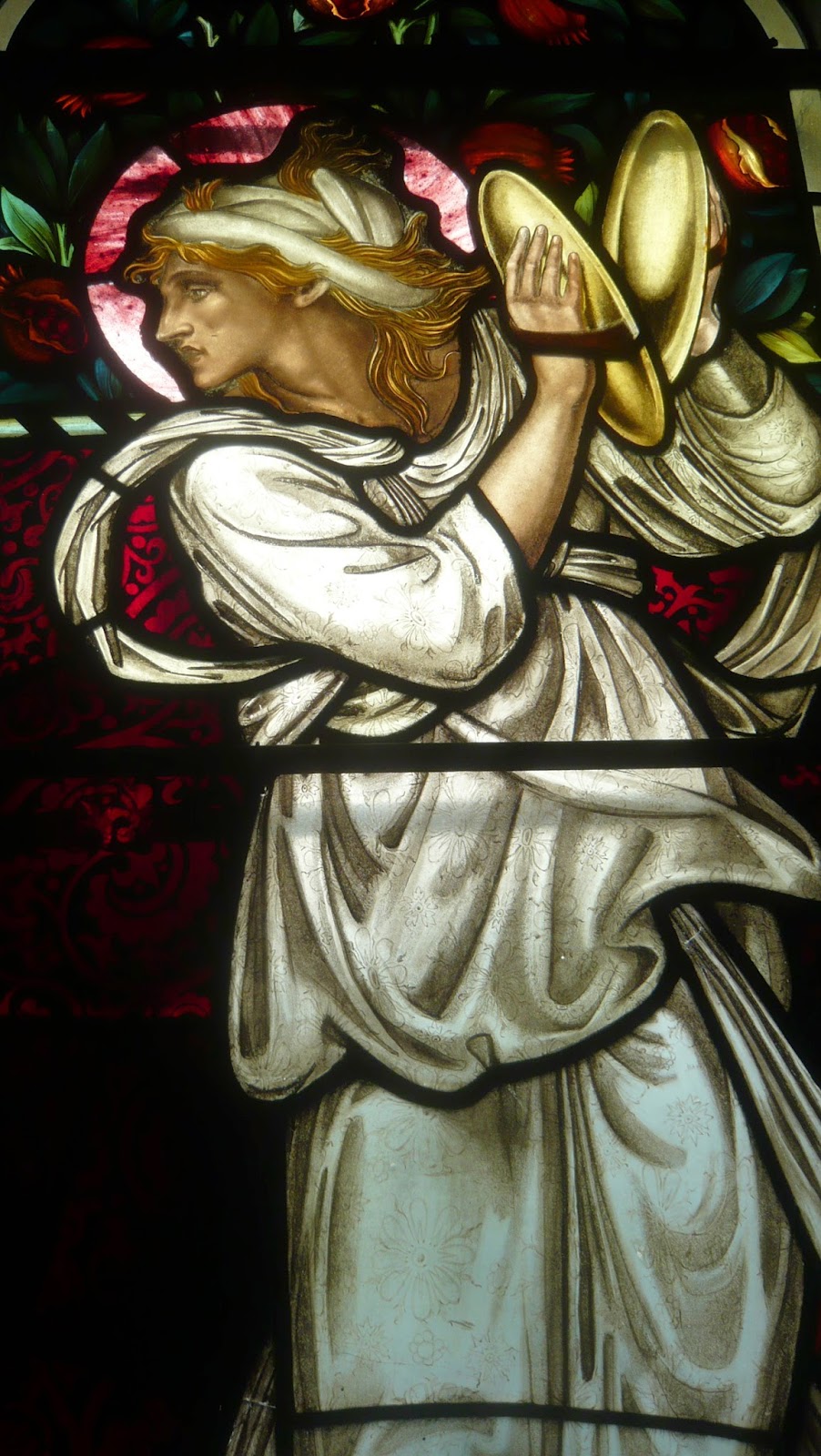
Many of the windows at St Michael and All Angels are by Morris & Co. and feature leading Pre-Raphaelites including Ford Madox Brown, Edward Burne-Jones, Morris, and, possibly, Dante Gabriel Rossetti. Later windows by Selwyn Image, Karl Parsons and Douglas Strachan are part of the same tradition and ensure that the feel of the building as a whole is cohesive. The third chancel window, which depicts the prophetess Miriam and was completed by Morris from a design by Burne-Jones, was included on a list of the 12 best stained glass windows in English churches as judged by photographer Lucinda Lambton.

The Whitefriars Company was a successful British glasshouse closely associated with leading architects and designers from the later portion of the 19th century onwards including Philip Webb who designed glass for William Morris. From 1876 James Crofts Powell ran the stained glass department which also developed mosaic techniques to the Byzantine standards of Ravenna. Powell’s opus sectile mosaics were tilted to deflect the light and gained sufficient credit to be used by William Blake Richmond in his work at St Paul’sCathedral. Whitefriars carried out the creation of the chancel mosaics at St Michael and All Angels to designs by J. P. Hutchinson.

Despite the beauty of the artwork and the building, it is not primarily the Pre-Raphaelite work that I have come to see here. The most recent of the windows, the 1929 St Cecilia and Angel by Karl Parsons, is described in the Church guide as being “especially beautiful when the summer evening sun shines through its vibrant colours.” Acid-etching and plating was used to create the enriched colour and texture found in this window. The window depicts St Cecilia, the Patron Saint of Music, and the music she has inspired on this occasion, which is included in the upper tracery section above the figures, is the fugue from Beethoven’s penultimate piano sonata.

Karl Parsons was pupil and assistant to Christopher Whall, who was an important member of the Arts and Crafts Movement, a leading designer of stained glass and a teacher at the Royal College of Art (RCA) and the Central School of Art and Design. In addition to his work in England, Whall also assisted in reviving the art of stained glass in Ireland. At the invitation of Edward Martyn, Whall, and his colleague Alfred Ernest Child, worked with Sarah Purser to set up a new school of stained glass in Dublin which was christened An Tύr Gloine (Tower of Glass), with a credo that “each window should be in all its artistic parts the work of one individual artist.’

Parsons, who also taught at the RCA and Central School was a craftsman of outstanding ability who worked from a studio at the Glass House Fulham; the centre for most stained glass designers during the first half of the twentieth century. He and Harry Clarke met in 1913, while Clarke was studying the craft and before he began work for his father’s glass workshop, the Clarke Studios, also based in Dublin. The two men remained close friends until Clarke’s death in 1931. The St Cecilia and Angel window at St Michael and All Angels, although “unmistakably by Parsons rather than Clarke” was based on Clarke’s rejected design and means that a trace of the rejected work is found in this church despite its perceived incongruity with the existing Pre-Raphaelite glass (Harry Clarke: The Life & Work, Nicola Gordon Bowe).

Among the many ironies of this story is the fact that Clarke has been described as “the last of the Pre-Raphaelites” and “played a major part in the Arts and Crafts movement in Ireland … as well as in the international stained glass revival which arose from the movement in England.” He “can also be seen as Ireland’s major Symbolist artist, whether in his illustrations or in his stained glass” (Gordon Bowe). Symbolism was also a wider international movement of which the Pre-Raphaelites were part. Therefore, the rejected design, while considered out of keeping with the Pre-Raphaelite windows already in the church, was actually part of a body of work that built on the foundation laid by the Pre-Raphaelites.

Clarke’s strange genius was to fuse “the Burne-Jones/Whall idiom” with “an eclectic and decadent Symbolism of medieval richness and Byzantine splendour” which was achieved by means of his having, as a young man, “absorbed Burne-Jones, [Aubrey] Beardsey, Charles Ricketts, Edmund Dulac, Kay Nielsen, the Glasgow School[Gustave] Klimt, the Japanese print, the Symbolists, and the Russian ballet.” As a result, “his art displays a wilful decadence and an ambivalent religious mysticism of medieval intensity which ranges from the sublimely beautiful to the grotesquely macabre, rarely found in the work of his Celtic peers.” (Gordon Bowe).

Similarly, James White has noted that Clarke “always carried the sensual-mystical conflict with him” - viewing “his drawings as an outlet from the religious subjects with which he was daily involved in his stained glass work” – and that, as a result, “few artists have been more concerned with the conflict of religion and sensuality.” His works are “uniquely imaginative creations” undertaken with remarkable technical skill meaning that “when he applied his minute and precise line to his process of plating and aciding he achieved an art form of extraordinary perfection.” Peyton Skipwith has suggested that by means of Clarke’s work, alongside that of Evie Hone at An Tύr Gloine, it was Ireland which revived the art of stained glass in the twentieth century (Gordon Bowe).

During his short life Clarke created 160 stained glass windows for churches and private patrons in Ireland, England, the United States and Australia. His unique style and technique combined rich colours with elongated figures that exude poise and grace. Deep blues and ruby reds were the hallmark of his work. As an illustrator of books, his five books for Harrap and Co show his genius in the area of graphic art. In England, work by Clarke is most easily seen at the Victoria & Albert Museum in London and the Stained Glass Museum in Ely.

--------------------------------------------------------------------------------------

The Blue Aeroplanes - Colour Me.

Windows on the world (300)


Barcelona, 2013

----------------------------------------------------------------------

Hothouse Flowers - Don't Go.

Friday, 11 July 2014

Review - Barbara Kruger

I have a review of Barbara Kruger's exhibition at Modern Art Oxford  published today in the Church Times.

In the review I explore how Kruger's work leads naturally into reflections on the nature of belief. The words BELIEVERS, DOUBTERS, AIRHEADS are at the very centre of her main installation while an earlier Kruger installation contained the equation BELIEF + DOUBT = SANITY. Kruger’s work refuses cheap solutions to that balance and the question of our own identity. 

I also refer to work by Rose Finn-Kelcey and Caroline Richardson which can be viewed here and here.

-----------------------------------------------------------------------------------------------

Woven Hand -  Obdurate Obscura.

Sabbatical art pilgrimage: Chapelle Sainte-Thérèse-de-l'Enfant-Jésus et de la Sainte-Face, Hem


I began the European leg of my sabbatical art pilgrimage with a mixture of excitement and trepidation. Excitement because, as Edward Knippers said of my plans, this is the start of a wonderful adventure. Trepidation because I am unsure as to whether my itinerary and the practical arrangements which I need to make as I travel will work out.

My journey does not have an auspicious start as, on the approach to Lille, I become part of one of the longest tailbacks it has been my misfortune to encounter. We are, however, mostly moving throughout many kilometres, albeit at a snail’s pace, and eventually reach the cause of the delay – a convoy of tractors filling the lanes and accompanied by the emergency and highways services. Why it was necessary for such a large group of tractors to be moving together I have no idea but the delay certainly increased my initial anxieties about the possible difficulties of keeping to my planned itinerary.

Eventually I arrive at Hem for my first visit not knowing for sure whether this first church, or those that I planned to visit subsequently, would be open. As the Chapelle Sainte-Thérèse-de-l'Enfant-Jésus et de la Sainte-Face has external sculptures and a mosaic over its entrance, I reasoned that the journey would not be completely wasted were the church to be locked. It is not and, as I travel on, it is only when I return to Calais that I find churches which are not regularly open.

The Chapelle Sainte-Thérèse-de-l'Enfant-Jésus et de la Sainte-Face was built in 1956 - 1958 with mosaics and windows by Alfred Manessier, sculptures by Eugène Dodeigne and Jean Roulland, and a tapestry of the Sainte-Face based on a painting by Georges Rouault which was made by the Plasse Le Caisne workshop. The architect was Hermann Bauer and the church has been described as “a fine example of art sacré after World War II.”

I had come to see the work by Manessier and did not realise prior to arrival that I would also see an image by Rouault, who is a favourite artist of mine. To enter the evocative space of this chapel and see not only Manessier’s amazing walls of stained glass but also the Rouault image was confirmation that, despite my anxieties about the unknowns in this great adventure, I was on the right path.

The combination of Rouault and Manessier is particularly appropriate as Manessier has been described, by Werner Schmalenbach, as 'after Georges Rouault the only great painter of Christian art in our age.' In 1947, Manessier received a visit from Rouault who advised him to take up stained-glass design. From 1948 to 1950 he worked on six windows for Sainte-Agathe des Bréseux (which I would see later on my pilgrimage) before promoting "the modern concept of stained glass architecture,” as found here, “rather than isolated stained glass windows."

Despite this the differences between them exceed the similarities. Rouault was a figurative expressionist who loved to paint circus players, prostitutes and judicial figures, as well as the iconic sainte face (holy face) of Christ. These were painted “as penetrating types of the misery of human existence” but with grace also seen as “divine meaning is given to human life by the continuing passion of Jesus Christ.” He summed up his vision in several studies entitled (quoting Virgil's Aeneid), ‘Sunt Lacrymae Rerum’ – ‘There are tears (of grief) at the very heart of things.’ The image of the Holy Face used for the tapestry, taken from a painting of 1946 which is now in the Vatican Museum, "focuses on the conquest of death by giving the face a serene expressionwith wide open eyes and by using calm harmonious colours."

Rouault was apprenticed to a stained glass maker and, as here, often used thick black outlines in his work, which were regularly compared to the lead lines in stained glass, yet he was only commissioned for stained glass in old age while Manessier, after taking Rouault’s advice, went on to create in excess of 70 windows.

Manessier, by contrast with Rouault, was a lyrical abstractionist who thought of stained glass less as a design than as “the simultaneous creation of a light-filled architectural unit, thought-out and created by the painter at one go.” Similarly concerned with suffering as was Rouault, he aimed to saturate his works with human feelings. For this to occur no resort to figuration was permitted, his goal being not to “portray a man in his state of suffering, but suffering itself”; “an attempt to translate this through the use of equivalent signs and colours.” “I start painting,” he stated, “when I feel a very close coincidence between the scene that I have before my eyes and my inner state. That relationship releases a creative joy which I long for and need to express.” As a result he sought “a new pictorial language” that would “fortify expression”. He wished to incarnate inner experience in visible form. As he put it, “More and more I want to express man’s inner prayer.” Abstraction was, for him, the means to achieve this desire; “The further I penetrated into non-figuration,” he said, “the more I approached the inwardness of things.” (Manessier, J. P. Hodin)

These approaches to his art developed from his experience while on retreat with the poet Camille Bourniquel at the Trappist monastery of Soligny in 1943. During the Salve Regina on the first evening he “felt profoundly the cosmic link between that sacred chanting and the world of nature all around, which thrust itself into the silence of the twilight.” It was the moment, he said, “when nature was appeased.” He saw in his mind songs rising and falling and thought that, if he “could succeed in grasping this inner light, this rhythm, this meaning,” he “could do more than render a visible image of it,” he “could give its essence.”

The concept of stained glass architecture - of a light-filled architectural unit – that we find at Hem is an attempt to recreate that experience for all who enter the space. Stained glass here is not windows, but walls. There is no narrative, instead a loose cubist concrete grid holds a great chromatic richness. The play of light and colour created in the space is redolent of the Carmelite spirituality of Thérèse of Lisieux, which was the inspiration for Manessier’s design. Stained glass here creates spiritual space, a sense of prayer and a glimpse of heaven.

Reflections on human suffering constitute the predominant theme of Jean Roulland’s work. In 1956 his discovery of Germaine Richier's works in the Dujardin Gallery in Roubaix was decisive in his definitive turn to sculpture which has led to his becoming chiefly known for his tormented lost-wax cast (cire perdu) bronzes. His expressive work shows no concession to the decorative aspects of sculpture in its relentless focus on the contorted anguish of human misery. Although I didn’t know it at this stage, I would see examples of these works when I returned to Calais at the end of the European leg of my pilgrimage. Roulland is a featured artist in Calais, at home and away, a series of exhibition spaces at the Musée des Beaux-arts de Calais which serve as an introduction to Calais, its artists and landscapes.

Roulland was collected by Philippe Leclercq, the wealthy manufacturer who had the Chapel at Hem built, and was commissioned to create a bust of Jean XIII and a processional cross (Christ de Procession). The processional cross shows the influence of Richier in that, as with Richier’s crucifix at Assy, Christ is made one with the cross and reduced to the most minimal representation possible. As with Richier’s work this has the effect of emphasising the sub-human state to which torture, torment and suffering reduce all who truly experience their pain and anguish. These works, as with the Sainte Face and Passion images of Rouault and the Crown of Thorns paintings of Manessier, are part of a strand of twentieth century art which equates the sufferings of the crucified Christ with that of the numberless victims found in a century characterised by persecution, torture and war.

Roulland and Eugène Dodeigne were close friends and fellow members of the Groupe de Roubaix, a group of friends who were artists characterized by their northern origins. Dodeigne has said that he views sculpture as a struggle against the material. His struggle may be sensed in the stressed and patterned surfaces of the Soignies blue limestone which he has sculpted since moving to Bondues in northern France in 1949. By contrast, his smaller Soignies forms, as here with his sculpture of St Thérèse, are highly polished. His work, in both monumental and modest scale conveys a mastery of the balance of volumes and lines of force.

For all that the works by Dodeigne, Rouault and Roulland make their distinctive contributions here in Hem, it is Manessier’s glass which sets the tone and creates the spirituality which informs this marvellous space. Rightly, when reviewing Manessier’s exhibition at the Venice Biennale in 1962 - for which he was awarded the international prize for painting (to date, the last occasion that a French artist has been awarded this prize) - Jacques Lassaigne wrote of Manessier’s “majestic orchestration of vibrant tonalities and pure rhythms.” Lassaigne also suggested that at various points in Manessier’s very rich career “a kind of pause of meditation and inner transformation” had “enabled him to transform the powerful impressions which he had received … into new means of evoking and glorifying secret presences. Reflecting now on my visit to Hem, those words seem to be an accurate description of the experience that I enjoyed there at this the first stop on my sabbatical art pilgrimage.

-------------------------------------------------------------------------------------------------

The Frames - Star, Star.

Wednesday, 9 July 2014

Sabbatical art pilgrimage: latest ArtWay report

ArtWay have just published the latest of my sabbatical art pilgrimage visit reports in their Church of the Month slot. This report concerns Aylesford Priory and the work of Adam Kossowski. The reports which ArtWay are publishing generally contain additional information or reflections from those which I am posting here and, as with the posts here, will gradually build up a partial history of the revival of sacred art in the twentieth century.

The report on Aylesford Priory follows reports on Chelmsford Cathedral and Lumen, as well as earlier reports of visits to sites associated with Marian Bohusz-Szyszko, Marc Chagall, Jean Cocteau, Antoni Gaudi and Henri Matisse.

One of the real pleasures of the European leg of my sabbatical art pilgrimage was the opportunity to meet Marleen Hengelaar-Rookmaaker, who is editor-in-chief of ArtWay. We visited two churches together and talked art, music, popular culture and faith finding many synergies as we did so.

-------------------------------------------------------------------------------

Sufjan Stevens - Impossible Soul.