Wikio - Top Blogs - Religion and belief
Showing posts with label woodhead. Show all posts

Sunday, 24 August 2014

Greenbelt Festival: Saturday


Yesterday I enjoyed a day at Greenbelt seeing the Festival in its new setting at Boughton House. The new venue comes with different opportunities for layout, programming and artworks.

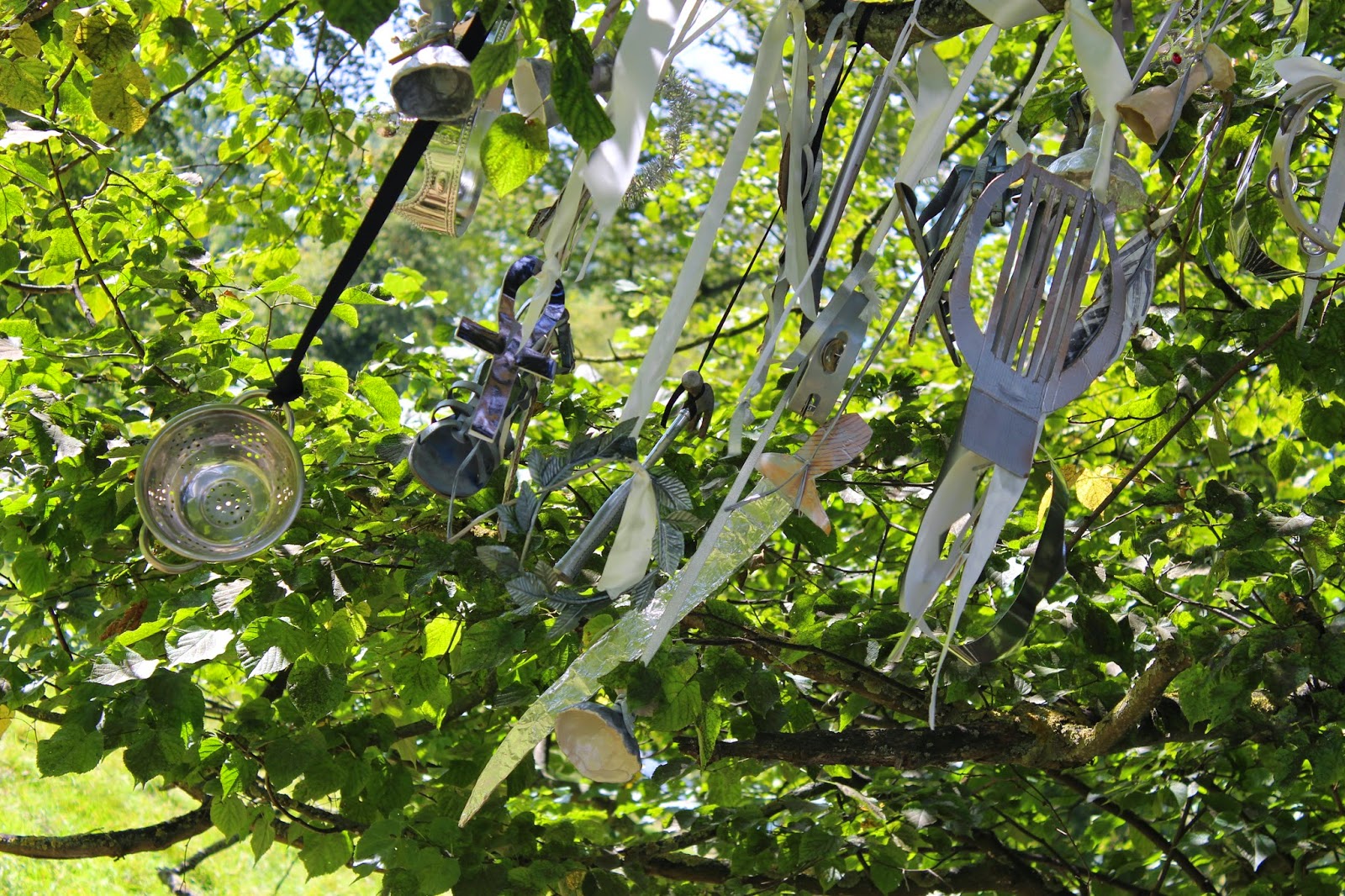
The Allotment Gallery is Greenbelt’s garden shed and is playing host to around 20 artists throughout the weekend, each exhibiting their work in their own two-hour slot. Six artists have also created temporary sculptural, performance and installation works for the grounds of Boughton House. I also briefly heard Beth Rowley, Martyn Joseph, Hope & Social, Levi Hummon, Dizraeli and the Small Gods, and The Travelling Band

The highlights for me (in addition to the friends I met up with) were the seminars I attended. I caught the end of Nadia Bolz-Weber's talk, heard Linda Woodhead talk on 'The Crisis of Religion in the UK,' Brian McLaren on 'What will Religion become?' and a panel session on 'Can we reimagine marriage?' (see post here).

Linda Woodhead said that crises are tipping points requiring decisions. A crisis in a fever is the moment at which the fever breaks. 

Society and Christianity have generally been on different tracks in recent years. Historic forms of Christianity are generally in decline and opposition to the growing liberalism of society is part of the reason for this decline. New forms of religion are increasing. The current social context is the second demographic transition, where the birth rate falls below the mortality rate. The first demographic transition was focused around the nuclear family but in the second, population declines, the marriage rate drops and there is a rise in divorce and cohabitation, meaning that the nuclear family unit is no longer the norm. there is a growth of affluence and education combined with the impact of greater equality for women. These are unprecedented historical changes. 

These changes go hand in hand with a growth in liberalism - defined as personal freedom - which is the opposite of authoritarianism and paternalism. Each generation is becoming more liberal. However, religious groups contain a higher proportion of the 'moral majority'. The leadership of churches is generally more conservative than there members meaning that a values gap exists between leaders and members. Overall belief in God is declining but not at the extent that participation in organised religion is declining. There is an active spirituality which is not expressed within the established churches.  Research in Kendal found 126 kinds of alternative spirituality; largely hidden and led by women. 

There seems to be no correlation between church tradition and growth or decline. Mini or maxi does best when it comes to Church. Midi (congregations of 50 - 120) is in trouble. Occasional events such as festivals also do well. The established churches do have adavantages which could be used more effectively; these include occasional offices, chaplaincy, schools, cathedral services, heritage. Of Fresh Expressions, Messy Church seems most effective. Churches need to give people voice, choice and participation. Choice requires branding. Variety is essential because of the diversity within society. religion needs to be presented as a whole-life resource.

Alternative ways of funding religion can be identified. People will pay for alternative spiritualities. A membership model, like that of the National Trust, could be used. In countries where a Church Tax exists, people who don't attend contribute because they want the Church to provide a resource in society. Where a congregational model of funding is used, the Church becomes controlled by conservatism.

Brian MacLaren also spoke about the challenges of our current context, in particular the challenges that all religions face regarding the planet, poverty and peace. He argued that the Faiths will need to collaborate to address these challenges. We need people prepared to do in our own age what the founders of our faiths did in their own age, rather than simply repeating what they said. The key question in a pluralistic world is what benefits do religions bring to non-members. Religions say different things in response to different problems; they are all answering different questions. We need to bring the treasures from our faith and shares these with people of other faiths, as they do the same with us. We need to rub up against those who are different from us in order to experience disruption and to be converted all over again.

-----------------------------------------------------------------------------------

Hope & Social - The Big Wide.      

The Virgin Birth and the Resurrection: Subverting Patriarchy

I’ve just returned from a day at Greenbelt where one of the most interesting sessions I attended was a panel discussion exploring whether we can re-imagine marriage. This was chaired by Vicky Beeching, who rightly received a standing ovation on arrival for her bravery in recently coming out. Her panellists were Linda Woodhead, Sarah Miles and Robert Song.

Linda Woodhead briefly summarised the history of approaches to marriage within Church history. All marriages were civil contracts until part-way through the medieval period, only becoming predominantly church ceremonies at the Reformation. Affirmation of the nuclear family is much more recent phenomenon with the Church. The Church has, therefore, viewed a spectrum of relationships – some formal, some informal – as marriage across its history, with celibacy often being the primary stance recommended. Since the 1970s, the numbers marrying within our society have been in decline, while within these numbers civil marriage has grown significantly. One consequence has been that society is accepting of a greater diversity of relationships.

Sarah Miles spoke from her own experience of same-sex marriages as a sign of the radical inclusion to which Jesus’ ministry points. God’s love is at work to bind all people together and equal marriage can be a sign of this reality.

Robert Song suggested that sex before Christ is not the same as sex after Christ. Much of our thinking about marriage is based on the creation patterning of Genesis 1 and 2 and this is also the case with Jewish identity which is based on genealogy. In Christ, however, membership of God’s people is not based on shared ancestral blood but on the blood of Christ, and, as a result, the hope of having children is not intrinsic to the Christian community (as demonstrated by its affirmation of celibacy). In Christ, procreation is no longer central. The resurrection changes everything. If there is no death, there is also no need for birth or marriage. Therefore, Jesus said that in heaven there is no marriage. This makes non-procreative covenant partnerships possible – with a focus on faithfulness, permanence and fruitfulness - as a third vocation (after marriage and celibacy).   

For me, this made connections with some of my thinking and reading during my sabbatical. On my sabbatical I visited lots of churches which were dedicated to Our Lady and, as a result, had thought rather more than usual about her significance for Christianity. Martin Jay in ‘Force Fields’ suggests that the monotheistic religions of Judaism and Christianity sought to replace “their mother-goddess predecessors with a stern patriarchal deity.” At times on my sabbatical the Protestant in me has wanted to argue that if that is so, the significance that Mary gained within Catholicism, in particular, could be seen as an attempt to redress the balance and reintroduce a mother-goddess to Christianity.

As a counter-balance, though, I’ve also seen a number of churches and chapels dedicated to St Joseph. At Aylesford Priory, where I had my first sabbatical retreat, St Joseph’s Chapel contains the following inscription: ‘The wise and faithful servant set over your family as guardian and fosterfather of Jesus Christ our Lord.’

One of the art books that I read during my sabbatical offers a different and more helpful perspective on the Virgin Birth and patriarchy which is, I think, closer to the subversive nature of Jesus’ words and actions. It seems to me that the significance of the argument which Thierry De Duve advances in ‘Re-Enchantment’ begins with the existence of two creation stories at the beginning of Genesis. In the first, men and women are created equal while in the other the woman is created by God from the man's rib as a help-meet to him and is named by him as well as taken in the context of marriage. The second story, therefore, institutes or confirms patriarchy. The primary purpose of patriarchy is to assure the man of the legitimacy of his offspring.

De Duve quotes Amelia Jones: “Patriarchy's investment in systems that ensure proof of authorial possession results from the necessity of overcoming male anxiety over the ultimate uncertainty of biological paternity. Although the woman always knows she is the mother - through her physical connection with the developing foetus - the man never knows for sure that he is the father, and thus has a high stake in maintaining a system by which he can claim paternal ‘ownership’.”

Genealogy plays a very important role in Patriarchial systems. The Ancestors of Christ windows at Canterbury Cathedral originally consisted of eighty-six life-sized seated patriarchs of the Old Testament, largely based on the list of names contained in the Gospel of St Luke (III, 23–28) and interpolated with additional names from the Gospel of St Matthew (I, 1–17). It was the largest known series of the genealogy of Christ in medieval art and the images represent his male biblical genealogy, beginning with Adam and coming forward to King David, from whom Mary and Joseph are said to descend. Matthew’s genealogy is, of course, strange in that it is traced through the ancestry of Joseph who, by virtue of the Virgin Birth, did not have a blood relationship to Jesus.

The anomaly of Jesus’ genealogy may highlight a different perspective i.e. that the Virgin Birth subverts patriarchy. Joseph is not the father and does not know whether Mary has slept with another man or not. The Joseph-based genealogy of Jesus is by adoption only. A different role is asked of Joseph from that of the Patriarch. As the inscription in the St Joseph’s Chapel at Aylesford Priory reads: ‘The wise and faithful servant set over your family as guardian and fosterfather of Jesus Christ our Lord.’

De Duve suggests: “The great invention, the great coup of Christianity, is to short-circuit all this [i.e. patriarchal ownership through genealogies] … the production line of sons is brought to a sudden halt … And the status of woman changes drastically … Virgin and mother, rather than virgin and then mother! and then mother-in-law, and then grandmother, and then old. This means that her function is no longer to take her place in the production line that fabricates sons. One Son is enough. He will have no offspring. He will save the world instead …”

Jesus' birth occurs outside of or at a tangent to the Patriarchal system. He is a man who doesn’t marry and who has no physical offspring - the furtherance of his 'seed' is of no interest to him. His emphasis is on his followers as his family, rather than his blood and adoptive relatives. His death is for the entire family of God - all people everywhere.

On the one hand, this seems a part of what it means that: “if anyone is in Christ, he is a new creation. The old has passed away. Behold, the new has come.” Also, as St Paul suggests in his discussion of marriage, the new situation created by Christ means that it is better not to marry. Physical offspring is now less important than bringing people into the family of God and the make-up of that family takes us back to that first creation story as in Christ there is neither Jew nor Greek, male nor female, slave nor free; all are equal.

Putting De Duve and Song’s arguments together, therefore, suggests that both the Virgin Birth and the Resurrection subvert the patriarchal system and the necessity of creating physical offspring in families meaning that, in the present, relational and family structures in society can be diverse while in the future family of God, marriage is no longer necessary and equality will be the norm.

--------------------------------------------------------------------------------------------------------------

U2 - Ordinary Love.

Tuesday, 26 May 2009

Responses to 'Airbrushed from Art History?' (3)

Richard Davey writes:

I'm finding this conversation really fascinating and helpful, particularly because I am currently trying to re-write my PhD thesis for publication, and many of these questions lie at the heart of what I was then, and am still, addressing - the taboo surrounding an artists' faith.

Fundamentally I think your project is worthwhile and important, and my comments arise on that fascinating edge where differences in nuance and emphasis can lead to development and transformation. Your considered and thoughtful responses to my own comments have provoked further reflection both about specific points and more generally.

None of the books and exhibitions that I have cited so far comprehensively address Christian influences on Modern and Contemporary Art and I am unaware of any book or exhibition that seeks to do so.

1. Do you think that a comprehensive survey is possible? I think that you are setting yourself up for a fall by an ambition that sets out to be comprehensive. It seems to me a narrow focus would allow you a better chance to realise your desire to be thorough and at the same time to raise the fundamental questions that you are seeking to address. By striving to be comprehensive you are either going to have to be so broad that your project will be full of holes, or you will never finish.

2. What do you mean by Christian influences? This is such a simple statement and yet so problematic. Do you mean influences that come from culture that are specifically Christian i.e.. the use of Christian iconography? Do you mean the essential themes that lie at the heart of Christianity- but what are those, and can we say that an influence comes from active 'Christian' influence or from the residual Christianity that underpins western society? Do you mean the faith of the artist? Or is it your own Christian faith that is being read into Modern and Contemporary art?

3. Do you mean British, French, Italian, Spanish, American art. This may seem a strange point since so much contemporary and modern art transcends geographic borders, but I think this is important when addressing the subject of faith and Christianity, because in reality attitudes to faith are fundamentally different across these different contexts. American attitudes to Faith and Christianity are very different to British 'secular' attitudes, where faith is on the back foot. The recent American presidential elections highlight this with their strong influence of faith, whereas in the upcoming general election in Britain will faith feature, or will we once again have the Blair effect - where faith and public life don't mix? And then on the continent Christian art is often tied into a Roman Catholic spirituality and integration into liturgy that is fundamentally different to British Anglicanism.

You echo Taylor's criticism of Greenberg, but I don't have a problem with Greenberg's approach - why is that? I suppose I know that when I write on an artist I am aware that I am going to be addressing it from the starting point of my own world-view, and that my reading will be coloured by that. However much I try to be open to the full range of influences that may be found in artist's work I can never achieve a truly objective stance, I will always see a spiritual perspective and this will obscure some of the secular perspectives that may equally legitimately exist in it as well. Again, in your review of Traces du sacre your implicit criticism is based upon what I take as an objection to their position that argues that the secularization of society delivered artists from their subordination to the Church and that, as a result, the traces of spirituality found in both Modern and Contemporary Art are ones that stand outside of organised religion (and Christianity, in particular). I may not completely agree with the origin being secularisation but I think that they are fundamentally right. In my many years of doing research in this area the majority of artists I have met say very early on 'I am not religious', and you have to accept this position. They are very rarely church goers and often stand outside organised religion. If I had used Church membership ,or adherence to a specific organised religion as a criteria for inclusion I would have had a very limited pool of artists of a quality worth addressing. My reflection over the years is that for artists their engagement with their faith and spiritual impulse occurs within the loneliness of the creative process, whereas non-artists do so within the parameters of organised religious practice and membership. The artists I have met who have an incredibly deep faith and highly developed spiritual awareness support Linda Woodhead's arguments that faith in the uk is becoming increasingly implicit rather than explicit, something carried out privately rather than within the bounds of traditional associational religion. Cecil Collins was an artist of incredible faith, but very explicitly anti-religion.

I remember Peter Eugene Ball's frustration and anger at being labelled a secret Christian by Keith Walker in his Images and Idols book. Peters' reaction was, 'I am not a Christian, and I know that I am not a Christian because I do not believe in the resurrection'. Yet Peter is a person of deep spiritual awareness and faith which shapes his life. Your comments about your friend Alan Stewart's reading of Andres Serrano bring this to mind. We should be honest in what we are doing. If we are doing theology through art lets say that, rather than trying to imply that our reading is necessarily implicit within the work. Is his reading true to the embodiment of the work? I think the work is what it is, an image of a crucifix suspended in a golden liquid, which we later discover is urine. That image says nothing more than that. The reading into that by the viewer is valid, but not embodied in the work. Similarly an image of the crucifixion is nothing more than paint pushed around a surface to make marks that depict a man on a cross. Any theological interpretation occurs in the viewer's mind not in the work. Paint cannot speak of resurrection, it can provoke emotions that can evoke a sensation of joy or despair etc, but resurrection etc and Christian theology are not emotions, they are concepts that are formed in the mind, constructs of theology. I actually am not certain that art can be 'Christian', it is the interpretation of the subject matter that is Christian.

I suppose I am interested in the faith that an artist has, and how this is unconsciously reflected in the sensibilities that ripple the surface of an art work. I remember being at an ACE event chaired by Marjorie Allthorpe-Guyton where she asked the panel does an artist have to have faith to use Christian iconography or work for the church. The answer has to be no, and that is important, but what gets hidden is the possibility that artists with faith may explore the subject differently and that this needs to also be recognised. But we don't want to ask about an artist's faith. We are too influenced by the de-humanising debates that Dan Siedell is currently discussing on his blog, where we are suspicious of allowing an artist's intentions into a work of art. But there is a difference for me between artists having specific agendas which they want to put into a work, and the influence of the integral world view that an artist brings into the creative process, often without conscious thought.

Where did this denigration of an artist's faith begin? I think one place we can discern it is in Art Sacre, and their belief that the quality of an artist is more important than their faith. We see this recapitulated in Sister Wendy and Keith Walker who both use artists for their fame rather than their faith.

Another question about the airbrushing for me is whether the airbrushing is about Christian influences themselves. Figurative art of a certain kind, abstract art of a certain kind, and other types of artistic practice and concern have also been airbrushed out. Beauty is treated with suspicion by art history and theory, the sublime has become secularised, mystery has been denigrated. Artists continue to address these themes but critical theory, which in the uk has been dominated by continental post-modern philosophy, finds them problematic. The visual has been denigrated by schools of art history and cultural theory dominated by philosophy, semiotics, psychology rather than visual aesthetics cf. Bourriaud's relational aesthetics which underpinned altermodern at Tate Britain recently. But artists exploring the spiritual tend to naturally explore these taboo territories of the sublime, beauty, wonder etc. I think art history ignores Christian influences not out of an anti-Christian agenda, but because the themes that underpin 'Christian' spiritual art, and that absorb artists intrigued by a spiritual world fall outside the themes that are dominant in the art world at present, where the world is a hyper-real, space of irony - something which is antipathetic to a perspective intrigued by transcendent possibilities.

--------------------------------------------------------------------------------------

Jan Garbarek & The Hilliard Ensemble - Parce Mihi Domine.