Wikio - Top Blogs - Religion and belief

Wednesday, 9 July 2014

Sabbatical art pilgrimage: Sint Martinuskerk Latem


1919 was a significant year in the twentieth century revival of sacred art. Alexandre Cingria and others formed the Society of Saint Luc andSaint Maurice which went on to decorate hundreds of churches in Switzerland and elsewhere. In that same year, Maurice Denis and Georges Desvallières also set up the Ateliers d’Art Sacre in Paris that was to play a similar role in France. Yet, unlike these positive developments, 1919 also saw the beginnings of the first significant controversy arising from the revival.  

In 1919 a set of Stations of the Cross and an altarpiece, The Death of St Teresa, were commissioned from the Flemish artist Albert Servaes for the church of the Discalced Carmelites in Luithagen, a suburb of Antwerp. From the point that the Stations were exhibited in Ghent prior to being placed in the chapel at Luithagen they attracted criticism as well as praise on account of their use of deformation in service to expression; as Lydia Schoonbaert has noted emaciated bodies, sunken features and incomplete execution offended against classical aestheticism (Ecce Homo, ed. Jos Huls). In 1921 a decree from the Holy Office based on Canon 1399.12, which states that images may not be ‘unusual’, resulted in first the Stations and then the altarpiece being removed from the chapel.

Servaes had moved to Sint-Martens-Latem in 1905 where he became part of what is now known as the Second Group of Sint-Martens-Latem which also included Frits van den Berghe, Constant Permeke, Léon de Smet and Gustave de Smet. Gustave van de Woestyne, Valerius de Saedeleer, George Minne and Alfons Dessenis formed the first 'generation' of the Latem School. Robert Hoozee writes in Belgian Art 1880 - 1914 that the "central idea of the little artists' colony was to search for a meaningful, spiritual art."

Examples of work by these artists can be found at the Gemeentelijk Museum Gevaert-Minne (as well as at other museums in Deinze, Ghent and Latem). This museum is the former home and studio of the painter Edgar Gevaert (1891-1965) who married Marie Minne, the eldest daughter of George Minne. In the early 1920s Gevaert build this house and studio, in a style that combines monastic and Gothic influences with those of cottages. The museum opened in 1994 and houses, in addition to the work by Gevaert enthusiast, pictures and sculptures by George Minne, Xavier de Cock, Albert Servaes, Gustave van de Woestyne, Valerius de Saedeleer, Frits Van den Berghe, Gustave and Leon De Smet, and Constant Permeke, among others.

Servaes moved to Sint-Martens-Latem in 1905 and the depth of spirituality among both the artists and the local farmers stimulated his own faith leading to his taking the discalced Carmelite, Father Jerome of the Mother of God, in Ghent as his spiritual director. Schoonbaert has noted that “Neo-Thomism was the basis for the spiritual affinity that Father Jerome had with Cardinal Mercier in Belgium, with Titus Brandsma, his fellow Carmelite in Holland, and with Garrigou-Lagrange O.P., Jacques Maritain, Pieter van de Meer de Walcheren, and later with Raymond Régamy O.P., editor-in-chief of Art Sacré in France.”

Under Father Jerome’s direction Servaes explored Carmelite spirituality including those mystics who visualised the crucifixion during their prayers. Servaes linked this spirituality with the sense of suffering which still resonated in society following the First World War and, as a result, was a pioneer in the creation of images of the crucifixion for the context of churches which viewed Christ’s sacrifice as emblematic of human suffering in conflict and persecution. Maritain accurately wrote that the Stations were conceived as “a pure vertigo of grief.”

Brandsma and Maritain were amongst those who sought to support Servaes in the controversy which arose from the Luithagen commission, although Servaes ultimately felt betrayed when Maritain, advised throughout the controversy by van de Meer de Walcheren, distanced himself from Servaes by writing in the second edition of Art and Scholasticism that the Stations were “false to certain theological truths of capital importance.” While Maritain pushed the boundaries in his friendships with artists and in the ideas which he explored as a result, he also understood Church politics and knew when to rein back in order to keep his wider programme on track.

Despite the controversy Servaes continued to receive and create commissions for churches. During the Second World War, however, he was caught in another controversy as he was lured into the cultural activities of the Nazi occupiers. As a result, after the War, he moved to Switzerland where he continued to undertake church commissions. Father Jerome was initially moved from Ghent to Bruges. In 1946 he was sent to Les Méjades where he prepared Albert Gleizes for his first communion. The propensity for controversy that existed within the revival of sacred art is indicated by the fact that relations between the two soured as a result of disagreements over Neo-Thomism. Gleizes distrusted Thomism, which he saw as the beginning of Humanism, and instead wanted to return to the thinking of St Augustine. This aligned him more with the Benedictines than with the Dominicans and, in 1948, resulted in a further quarrel over sacred art; on this occasion with Father Régamy through articles in the journals Arts and Art Sacré.

My day in Sint-Martens-Latem was free from controversy, however, and began in the most leisurely way of my entire Sabbatical art pilgrimage. After a lengthy drive from Lyon and a late arrival in Latem, breakfast was a relaxing affair in a room overlooking the River Leie. Cattle grazed and rabbits played in the fields stretching into the distance where the roofs of houses in the next village could just be seen. The scene was exactly as would have been painted by artists from the Sint-Martens-Latem artist's colony were it not for the presence of a large, lurid red sculpture of what appeared to be a pitbull terrier on the river bank.

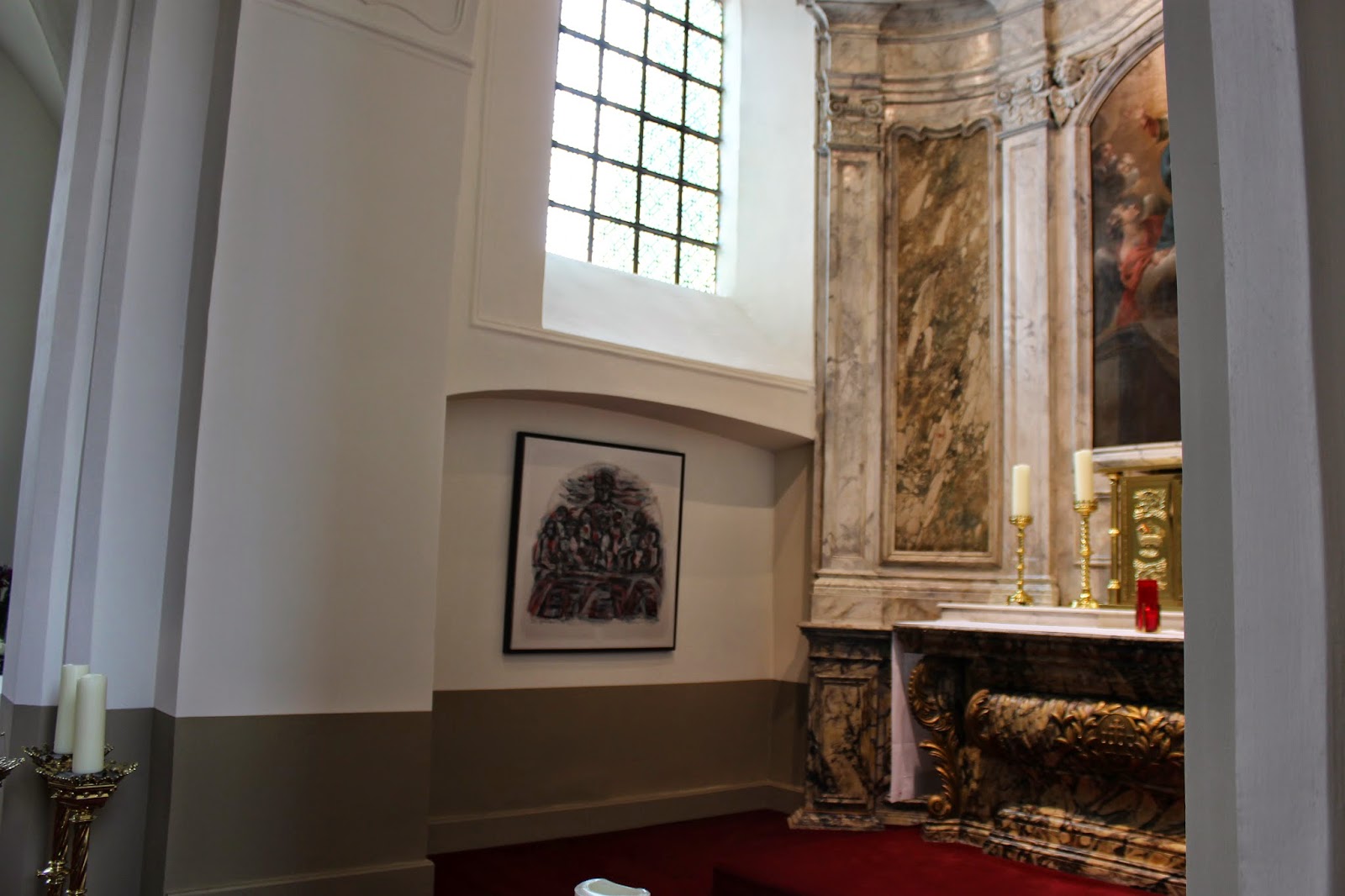
On entering Sint Martinuskerk I see that the baptistery contains a Passion charcoal by Servaes. Given all that he experienced in the controversy over the Luithagen Stations, including the removal of work which was a genuine expression of his faith by the Church of which he was part, I found it profoundly moving that a work of his, in the same vein as the Luithagen Stations, should be displayed here in the church and area where his faith and art first fused.

Other work in the church by the Latem School includes a painting above the left side altar by Gustave Van de Woestijne which represents Mary giving the rosary to St. Dominic and a Sacred Heart statue in the front right aisle by George Minne. Minne’s grave with a sculpture of a grieving woman, can also be found in the churchyard.

The church has continued to commission new work and accept gifts of art. The stained glass in the church was designed by Harold Van de Perre (1978 and 1993) and includes a sequence of scenes from the Annunciation to Pentecost. The rear windows depict the glorification of Sint-Martens-Latem and the heavenly Jerusalem with the apocalyptic vision of St John, while the baptistery contains images of Mary, St Joseph; the Nativity, the Sacraments; the Eucharist, Alpha and Omega. Van de Perre’s stained glass can be found at churches or chapels in Oudenaarde, Diksmuide, Bruges, Ghent, Dendermonde, Tongeren, Nederboelare, Antwerp, Lille, Aarschot, Zwijndrecht, the Abbey of Königsmünster, Meschede (Germany) and Pietermaai Cathedral, Willemstad (Curaçao).

In 1966 the painter Maurice Schelck donated a painting, which is now above the right side altar, showing St. Martin sharing his cloak with a beggar. Stations of the Cross from 1983 are the work of ceramist Paul de Bruyne. Other contemporary work is by Omer Gielliet, Erna Roelens and Dick de Gryse

As in many Belgian churches, contemporary art is integrated with the artwork of the past in a melange of different styles which, while not specifically harmonised, nevertheless possesses integrity. It is a great encouragement to see churches, already rich in heritage, wishing to continue to develop and add to that tradition from the work of their own day and time. Here this can be seen as a continuation of the legacy created by the Latem School of artists.

-----------------------------------------------------------------------------------------------------

Julie Miller - Jesus In Your Eyes.

Tuesday, 8 July 2014

Exhibitions and events update

An exhibition themed on the “Sermons and Holy Sonnets of John Donne” is being held at St Giles, Cripplegate and St James, Piccadilly in Central London until 20th July 2014. Christian Arts has worked with Art and Christianity Enquiry on the exhibition organisation and the ACE International Conference will be held during the exhibition period.

The Sacred City - Public lectures from the ACE/ASK conference: The Revd Dr Sam Wells, Vicar of St Martin-in-the-Fields, Turning All into Alleluia: Arts and the Renewal of St Martin-in-the-Fields on Tuesday 8 July, 6.30pm at St Giles Cripplegate, Fore Street, London EC2Y 8DA. Professor Alison Milbank, Associate Professor of Literature and Theology at the University of Nottingham, Visualising London through the Eyes of Dante on Wednesday 9 July, 6.30pm at St James's Church, 197 Piccadilly, London W1J 9LL. Tickets on the door: £5, concessions and ACE members £4 (free to ACE conference delegates). The lectures are kindly suported by the Community of St Andrew and the Gibbs Family Charitable Trust. Also, as part of the conference, two artworks by Anna Sikorska and Benedict Romain will be exhibited at St Giles-in-the-Fields, 7–11 July.

CANA Christian Arts Seminar at New Jerusalem Church, Phnom Penh, August 12 - 13, 8.00 am - 5.00 pm. Two days of teaching, sharing and worship, exploring ways to use creative gifts to serve God. CANA stands for Christian Artists Networking Association. Their vision is to see artists and creative people redeemed and rooted in the love of God, so that their creativity reflects Truth in beautiful ways. CANA has helped organize Christian arts conferences in Bali, Thailand, and different parts of Europe. They are making plans for a similar conference to be held in Cambodia in the summer of 2015.

As a precursor to that, they are inviting people to attend a two-day seminar on August 12-13, 2014, 8:00 a.m. - 5:00 p.m., at New Jerusalem Church, Phnom Penh, to learn more about their vision and to explore how they might be involved in the 2015 conference. At the 2014 seminar, they are partnering with CCAM, Cambodian Christian Arts Ministry, to present some teaching and examples about how to integrate faith with creativity. This teaching will focus on who we are in Christ, and how we may effectively bear fruit for Him through the arts. It will draw upon Biblical foundations and perspectives, exploring insights revealed by Jesus Himself in His creation and in His Word, especially gleaned from the Gospel of John.

If you are an artist searching for your God-ordained niche in the Kingdom of God, or a creative person wondering how your gifts can make a difference for Christ in the world, or a missionary or church leader desiring new ideas for creative ministry, then this seminar is for you! For additional information, or to pre-register, contact Steve Scott at info.cana.arts@gmail.com . There is no registration fee, but donations to help cover expenses are welcome. Participants are requested to bring their own picnic lunch.

Adam Boulter, who is priest at the Church of St Peter and St Paul in Aqaba, Jordan, will be holding an exhibition of paintings and pastels from Jordan entitled: out of the wilderness at Piers Feetham Gallery (475 Fulham Road, London SW6 1HL) from 15th-20th September 2014. Private Views: 6.30 - 8.30 pm, Tuesday 16th  & Thursday 18th September. Gallery opening times: Monday 3 pm - 6 pm, Tuesday - Friday 10 am - 6 pm, Saturday 10 am - Midday.

---------------------------------------------------------------------------------------

Steve Scott - The Resurrection Of The Body.

Windows on the world (299)


Barcelona, 2013

----------------------------------------------------------------------

The Swell Season - I Have Loved You Wrong.

Saturday, 5 July 2014

Enterprise Club

Ros Southern writes:

Please have a look at the blog to find a bit more about next week's speaker - Nicola Millington, Director of FP Comms. It will be worth attending - lots of tips from a wealth of
experience in discerning who your customers are.
https://sophiahubs7k.wordpress.com/2014/07/04/the-who-of-your-business-inspiring-speaker-nicola-of-fp-coms/[1]

And here's an update on the very useful session last week on the
different legal structures for businesses:
https://sophiahubs7k.wordpress.com/2014/07/04/inspiration-and-clarity-on-legal-structures-for-social-enterprises/

Friday, 4 July 2014

Sabbatical art pilgrimage: Eton College Chapel


Reproduced by permission of the Provost and Fellows of Eton College.


Due to building work public visits to Eton College have not been possible during 2014, so I was grateful to the Provost for allowing a private visit to see the College Chapel and its modern windows by Evie Hone and John Piper. Verger Tom Oakshott introduced me to the space and, despite being relatively new to the post, provided a wealth of information.
A bomb that fell on Upper School in 1940 shattered all the Chapel glass except that in the window above the organ. The east window, which was created by Evie Hone and inserted in 1952 as a replacement, is considered by many to be one of the masterpieces of modern stained-glass art. The designs for the windows flanking it, four on each side, are by John Piper and were executed in glass by Patrick Reyntiens from 1959 onwards. The subjects are divided into four miracles on the north side and four parables on the south, each built around a general theme of success and failure.
Patrick Reyntiens wrote in The Technique of Stained Glass that Hone’s window was, "a dramatic breakthrough ... Which may look historic now but when it was done it proved to be the herald of a new period of co-operation between the eye of the painter and the eye of the artist in stained glass." He also suggested that it was “John Piper's interest in stained glass, following on from the remarkable achievement of Evie Hone, at Eton College Chapel in 1948-49, that started the medium towards the sensibility of the painter."
In Hone’s work, this painterly sensibility derived from the dual influences of Albert Gleizes and Georges Rouault. Despite his influence on Jacques Maritain and the ideas Maritain developed in Art and Scholasticism, the work of Georges Rouault had not been well received by the Roman Catholic Church and until 1950, when five windows based on his designs were included among the many artworks commissioned through Père Couturier for Notre-Dame-de-Toute-Grâce at Assy, he received no church commissions. One incident demonstrating the continuing controversy caused by his work concerned a painting Christ in His Passion which was presented to the Municipal Gallery of Modern Art in Dublin in 1942 by the Friends of the National Collections of Ireland but was rejected on the grounds that it was ‘offensive to Christian sentiment’ despite its creator being widely recognised as the foremost Catholic artist of the twentieth century.
Evie Hone was among those who defended Rouault’s work in this controversy. In the stained glass that she increasingly produced from the 1930s onwards, Hone has been said to have passed from the influence of Albert Gleizes, her teacher of many years, to “the rugged, emotional, representational style of Rouault’s paintings” (Bruce Arnold, Mainie Jellett and the Modern Movement in Ireland). However, what Hone and her close friend Mainie Jellett (both students of Gleizes) appreciated about the work of Rouault involved continuity with the teachings of Gleizes. Jellett spoke of the “harmonic quality of colour” in Rouault’s work with his use of “velvety black lines” (often compared to the lead lines of stained glass) which are “used to emphasise the rhythm of the form.” She perceived “a close link with primitive Christian art and Celtic Christian art,” a link which was also of importance to Hone who had, on other occasions, related “her sense of rhythm and colour to her Irish Celtic roots.” (Bruce Adams, Rustic Cubism)
Hone’s design for the window takes a layered approach with a lower tier Last Supper scene flanked by the sacrifices of Melchizedek and Abraham below an upper tier Crucifixion scene flanked by worshippers on the surrounding hillsides and finally a sequence of ten Christian symbols. While each band of images is complete in itself, the lower tier precedes the upper tier visually and within the narrative. This design provides a sense of structure and order conveying a sense of stillness and peace despite the strength of colour and emotion contained within.
The centre for this expression of emotive colour is the crucifixion scene which revisits that found at St Mary’s Downe. The window at Downe was installed in 1950 and has three lights containing the crucified Christ, Mary and St John with related symbols above, as here. Its effect at Downe is quite different, however. There the image dominates the church as the primary focus within a smaller space and being closer and larger to the viewer, the emotive power of its colour and design is more apparent. Here, the image is within a larger scheme and at a greater remove reducing the visceral emotive impact but gaining a sense of story and sequence that is both immediate (the Passion narrative) and which also links to past and future (the Old Testament images in the lower tier and the Revelation-linked images of worshippers in the upper tier).
Piper and Reyntiens had considerable opportunity to study Hone’s design as they were commissioned to create eight windows in the Chapel; the subjects of these being: the Miraculous Draft of Fishes, the Feeding of the Five Thousand, the Stilling of the Waters, the Raising of Lazarus, the Light Under a Bushel, the House Built on the Rock, the Lost Sheep, and the Sower.
In the design of their own windows they made a number of clever and sensitive connections to the east window. The deep reds and blues of their first two windows mirror the colours which predominate in the Hone window. As we noted, the Hone window is designed with an early and concluding scene from the narrative. Piper and Reyntiens structure their windows in the same way. So, in the Light Under a Bushel, we have below the light hidden and above the light revealed; in the House Built on the Rock, the scene below is the house which was destroyed while above is the house that stood firm. This pattern continues throughout the sequence of parables and miracles.
As there is no resurrection image at the east end of the Chapel (the tapestry below the window depicting the Nativity), Piper and Reyntiens begin their sequence of miracles with the Raising of Lazarus. Each of their miracle and parable windows are also paired across the nave. So, light hidden and revealed in the Light Under a Bushel is contrasted with death and resurrection in the Raising of Lazarus; the Stilling of the Waters is linked with the House on the Rock; the Lost Sheep with the Feeding of the Five Thousand (the significance of the few, rather than the many); and the Sower with the Miraculous Draft of Fishes (scarcity and abundance).
Hone’s “earlier abstract work helped her create a newly simplified style of stained glass where superfluous detail was removed and pure colors and shapes soared” (Marianne Hartigan in When Time Began To Rant and Rage). It is this that we see continued and developed in the work of Piper and Reyntiens. Hitherto, Reyntiens writes, ‘the craft had been dominated by line rather than by blocks of colour.’ We were conscious, he says, ‘of bringing stained-glass into the modern movement of painting and design and in so doing bringing the eye of the painter to the medium.’

------------------------------------------------------------------------------------------------

Maurice Duruflé - Libera Me.


Tuesday, 1 July 2014

Modern Art Oxford: Barbara Kruger

Barbara Kruger at Modern Art Oxford until 31 August 2014

'Through ironic appropriation of specific slogans and imagery, Kruger deploys the visual strategies of mass communication in order to challenge the often manipulative logic at work in the language of advertising, television and other media and the role of Western consumerist culture.'

'Kruger’s investigation of rhetoric is further intensified by the work’s loud graphic style of which the artist says “I attempt to investigate the complex inter-relationships between power and society, but as for the visual presentation itself, I try to avoid a high degree of difficulty. I would like for people to be drawn directly in the work.”'


'While the exhibition addresses ideas of value and consumerism, this work also presents a more philosophical trajectory, confronting the viewer with questions and declarations such as, “IS THERE LIFE WITHOUT PAIN?” “IS THAT ALL THERE IS?” and “THE BRUTAL RELENTLESS FEARFUL END OF IT ALL.” The repeated motif of an emoticon – a hallmark of smartphone and social media communication – references the explosion of digital culture across online and mobile platforms and the influence of these technologies on our lives.'


'Kruger’s work is primarily concerned with the machinations of power in contemporary life. Through ironic appropriation of specific slogans and imagery, she deploys the visual strategies of mass media in order to subvert the often manipulative logic at work in the language of advertising, television and other media. Kruger’s use of both declarative statements and the imperative, what she terms ‘direct address’, is a consistent tactic throughout her work. This mode of address is utilised not only to grab the viewer’s attention but also to implicate us in the work’s content, forcing us to confront and question familiar social and cultural orthodoxies.'

--------------------------------------------------------------------------------------------------