Wikio - Top Blogs - Religion and belief

Tuesday, 21 August 2012

Windows on the world (209)


Birmingham, 2012
--------------------------------------------------------------------------------------------

Van Morrison - Song Of Being A Child.

Sunday, 19 August 2012

Remember your Creator

“When most people think of young people they see us as a horizontal line. One end screams, "Violent! Asbos! Hoodies!" and the other end whispers, "A* student; passes; friendly".
We are lumped into one group or the other. More often than not the only group that is ever reported on is the former. Well what about the rest of us? …

Why aren't we reported on, or our lives documented and televised? It seems that we can only be interesting if we are smoking, snorting or stabbing.”

That’s what Dominique Mitchell, 18, from Leicester, said when he was interviewed by the Guardian about stereotypes of young people in 2009.

King Solomon was a young man and a young King, yet we see him acting with real wisdom in today’s Bible reading (1 Kings 3. 3 - 14). God asks him an entirely open question - What would you like me to give you? It’s a question to which it would be very easy to give an entirely selfish answer. Solomon could have asked for long life for himself or riches or the death of his enemies but he didn’t.

Instead, we see him make a wise request based on a wise assessment of his situation. He recognises that he is facing a huge task – ruling a people who are so many that they cannot be counted – and that he doesn’t have the life experience or knowledge to carry out the task – “I am very young and don't know how to rule.” Wisdom starts with a realistic assessment of the situation we find ourselves in. It is only once we have a realistic understanding of where our starting point is that we can begin to find ways forward. So, Solomon shows wisdom before he asks for and is given wisdom.

That makes him an example of a wise young person. In fact if you look at the way his life pans out, he actually turns the stereotype completely on its head because he is wiser as a young person than he is as an older person. In his youth he listens to God and follows God’s instructions while in his old age he listens to other human beings and worships other gods.

Jesus confronted his disciples with the same challenge when they asked him, ‘Who is the greatest in the Kingdom of heaven?’ He called a child to come and stand in front of them, and said, ‘I assure you that unless you change and become like children, you will never enter the Kingdom of heaven.’ (Matthew 18. 1 – 3)
What is the wisdom of those who are greatest in the kingdom of God? What is the wisdom of youth? Well, the young King says, the task is huge and I am young and inexperienced, therefore I need the leading, guidance and wisdom of God. As we are told King Solomon was later to say, ‘Remember your Creator while you are still young.’ (Ecclesiastes 12. 1)
Going for Growth, a Church of England report considering how we engage with and express God’s love to this generation of children and young people, whoever and wherever they may be, responds to these challenges by saying that the Church needs to listen to children and young people themselves and take seriously what it hears.
The report recognises the sadness that churches rarely have the confidence which enables them to face the devastating directness which theological questions may take on in the mouth of a child (or young person). Churches lack the humility (that we saw in the young King Solomon) to face the truth about the quality of their life and worship and to set about addressing the needs which are then identified. Instead, we want to seem wise in our own eyes instead of recognising the wisdom of youth.
The report suggests that if, instead of trying to teach good news to children (and young people), the Church tries to become good news, it will need fresh eyes to see itself. Such a church would need the confidence to deal with questions rather than always having to find the answers. It would be prepared to surrender its life and lets its institutions be transformed. A church which genuinely welcomes children (and young people), accepts their gifts and ministries, meets their needs, advocates justice, seeks new life, challenges evil with love and truth, continues to learn the values of the Kingdom by living them, so is going to be a Church which is good news not only for young people but also for all its members and for the world.
This leads us towards the second thing for us to note, which is that wisdom is not an end in itself. Solomon doesn’t ask for wisdom simply in order to be wise or knowledgeable instead he asks for wisdom in order to rule with justice. Wisdom is not an end in itself instead it is needed in order to do justice.
We see this also later on in the pages of scripture because, after Solomon, the majority of Israel’s Kings are not wise. Instead, unlike Solomon, they use their position and power to exploit others for their own personal gain. They oppress and exploit their people in a way that is unjust and when they are then criticised by the prophets which God sends to denounce them it is this lack of justice that they highlight.
Amos speaks to the great leaders of the great nation Israel to say:
“You people hate anyone who challenges injustice and speaks the whole truth in court. You have oppressed the poor and robbed them of their grain. And so you will not live in the fine stone houses you build or drink wine from the beautiful vineyards you plant. I know how terrible your sins are and how many crimes you have committed. You persecute good people, take bribes, and prevent the poor from getting justice in the courts.” (Amos 5. 10 – 12)
“How terrible it will be for you that stretch out on your luxurious couches, feasting on veal and lamb! You like to compose songs, as David did, and play them on harps. You drink wine by the bowlful and use the finest perfumes, but you do not mourn over the ruin of Israel. So you will be the first to go into exile.” (Amos 6. 4 – 8)

What should they have been doing? What would have made them wise, not foolish? Amos says, “Make it your aim to do what is right, not what is evil, so that you may live. Then the Lord God Almighty really will be with you, as you claim he is. Hate what is evil, love what is right, and see that justice prevails in the courts.”

Wisdom is not an end in itself instead it is needed in order to do justice. At the end of wisdom there is the achievement of justice.

King Solomon is credited with summing all this up in the words of Proverbs 8:

Listen! Wisdom is calling out.
      Reason is making herself heard.
 On the hilltops near the road
      and at the crossroads she stands.
 At the entrance to the city,
      beside the gates, she calls:
 
         I appeal to all of you;
      I call to everyone on earth.
 Are you immature? Learn to be mature.
      Are you foolish? Learn to have sense.
 Listen to my excellent words;
      all I tell you is right …


Choose my instruction instead of silver;
      choose knowledge rather than the finest gold.


I am Wisdom, I am better than jewels;
      nothing you want can compare with me.
 I am Wisdom, and I have insight;
      I have knowledge and sound judgment.
 To honour the Lord is to hate evil;
      I hate pride and arrogance,
      evil ways and false words …


I walk the way of righteousness;
      I follow the paths of justice …


Those who find me find life,
      and the Lord will be pleased with them.


Let us learn from one who was wise when he was young. He says:

So remember your Creator while you are still young, before those dismal days and years come when you will say, I don't enjoy life. That is when the light of the sun, the moon, and the stars will grow dim for you, and the rain clouds will never pass away. Then your arms, that have protected you, will tremble, and your legs, now strong, will grow weak. Your teeth will be too few to chew your food, and your eyes too dim to see clearly. Your ears will be deaf to the noise of the street. You will barely be able to hear the mill as it grinds or music as it plays, but even the song of a bird will wake you from sleep. You will be afraid of high places, and walking will be dangerous. Your hair will turn white; you will hardly be able to drag yourself along, and all desire will be gone.

We are going to our final resting place, and then there will be mourning in the streets. The silver chain will snap, and the golden lamp will fall and break; the rope at the well will break, and the water jar will be shattered. Our bodies will return to the dust of the earth, and the breath of life will go back to God, who gave it to us. (Ecclesiastes 12. 1 – 7)

So remember your Creator while you are still young.

-------------------------------------------------------------------------------------------

The Bluebells - Young At Heart.

Thursday, 16 August 2012

The Dark Knight Rises

Having watched The Dark Knight I commented that it was the theme of sacrifice and substitution, which runs throughout the film, that set up the possibility of a sequel and may become the most interesting development emerging from the film. Having seen The Dark Knight Rises tonight that is unquestionably the case as, like Harry Potter, with its conclusion the series becomes an imaginative retelling of the 'Greatest Story Ever Told.' Alfred plays Judas to Bruce Wayne's Jesus while Peter's denial features both in Foley's reluctance to commit to the resistance and also in the use made by Bane of Commissioner Gordon's confession speech. To cap it all there is even a resurrection appearance included. Why is that stories of those who make the ultimate sacrifice for others retain their power and fascination even in what often seems to be a cynical, sceptical and selfish age?

----------------------------------------------------------------------------------

Extreme - Peacemaker Die.

Tuesday, 14 August 2012

Matisse Chapel: Chapelle du Rosaire Vence


Henri Matisse wrote that his design and decoration of the Chapelle du Rosaire for the Dominican Nuns of Vence was not a work that he chose, but rather a work for which he was chosen by fate. The story of how this work came about is surely an example of the mysterious ways in which God sometimes moves. As a student nurse, Monique Bourgeois cared for Matisse in his recovery from intestinal cancer and modelled for four paintings. Later, after Monique had become a Dominican nun (Sister Jacques-Marie), they met again in Vence renewing their friendship which led in turn to Matisse’s offer to design and decorate a chapel for the nuns there.

For Matisse the chapel was his masterpiece and the culmination of his life’s work because it afforded him the possibility of realising his researches - his separate study of each element of construction (drawing, colour, value, composition) - by uniting them. ‘Simple colours,’ he wrote, ‘can affect the innermost feelings, their impact being all the more forceful through their simplicity.’ The spiritual expression of the blues, greens and yellows he used in the stained glass of the chapel struck him as unquestionable. His goal ‘was to find a balance between a light surface and colour with a solid wall of black-on-white line drawing.’ The line drawings on ceramic tiles of both St Dominic and the Virgin and Child he thought to have a ‘tranquil reverent nature all their own’ while the great drama of Christ in the Stations of the Cross had made ‘his impassioned spirit overflow within the Chapel.’

While Matisse approached the design of the Chapel primarily as an artistic composition it is clear he though that, by doing so, the chapel was an expression of spirituality. As he had said in a letter to Sister Jacques-Marie, he had travelled over his lifetime to admire the beauty of the light God created so he might share it with others through his work.

Iconographer Aidan Hart has spoken of this strand of Matisse's thinking in relation to his response to the icons he saw when in Russia in 1911. What he notes seems relevant to Matisse's work at the Chapelle du Rosaire. During his visit Matisse seemed deeply affected and overwhelmed by the art of the icons and spent his days frantically visiting monasteries, churches and private collections. He spoke of seeing his efforts confirmed by the ancient icon tradition and also said:

“They are really great art. I am in love with their moving simplicity which, to me, is closer and dearer than Fra Angelico. In these icons the soul of the artist who painted them opens out like a mystical flower. And from them we ought to learn how to understand art.”

Hart suggests that the chief stylistic things about icons which struck Matisse were their colour or use of light, and their conception of space:

'He saw that great art must know what to leave out; he needs to abstract to be real: “..he will have to sift rather than accumulate details, selecting for example, from all possible combinations, the line that expresses most and gives life to the drawing ...” He believed that imitating nature really means that the art object itself gives the viewer the same feeling of delight, inspiration that nature gives: ”The work will then appear as fertile and as possessed of the same power to thrill, the same resplendent beauty as we find in the works of nature.” He said that ultimately “great love is needed to achieve this effect ... This love, which is necessary for artistic creation, has a divine aspect: Nothing is more gentle than love, nothing stronger, nothing higher, nothing larger, nothing more pleasant, nothing more complete, nothing better in heaven or on earth—because love is born of God and cannot rest other than in God, above all living beings."'

Vence is a hill town 20 miles from Nice and the Chapelle du Rosaire is near the St-Jeannet road climbing out of the town towards the fine views of the Col de Vence. Set into the hillside looking back towards the town, the chapel itself affords attractive views of Vence and its surroundings. Basically, a simple white rectangle, the chapel externally offers little hint of the beauty contained within although two small line drawings on ceramic tiles decorate the entrance and sanctuary wall, while the blue and white tiled roof is surmounted by a tall metal cross, incorporating a bell, which Matisse designed to stand out against the sky rising high in prayer in a spiral-like smoke.

As tourists, we descend steep stairs to the cash desk by the chapel’s entrance - the window at the head of the stairs depicting a fish, net, and blue star is easily missed when doing so. A feisty guide then seats us in the main body of the chapel and commences telling the story of its design while indicating the main elements of Matisse’s work. Those sitting at the back are remorselessly shuffled forwards in order to see the Stations of the Cross on the rear wall and the children present are asked to report back on what can be seen through the confessional door (which recalls the Oriental hangings featured in many of Matisse’s paintings).

The talk over, most depart to view the charcoals given by Matisse to the chapel showing various stages in his design work and the vestments which he also designed. Unusually for a church, the format of the visit and talk does not seem to encourage lingering contemplation. For those who do loiter longer, the play of coloured light on the clean, white spaces of the chapel can be enjoyed as can the balance and clarity of its design. In its natural state, this is a place of light and peace negated somewhat by its rightful place on the tourist trail and this despite the rigour with which the chapel is kept as a place of worship for its own committed community.

-------------------------------------------------------------------------------------------------

The Monkees - Pleasant Valley Sunday.

Cocteau Chapel: Notre Dame de Jerusalem


Notre Dame de Jerusalem is the final chapel decorated by Jean Cocteau. The contemplative experience which this chapel provides is of an all-surrounding multi-media immersion in the mysterious world of Cocteau.
Cocteau was, as James S. Williams writes, "a totally new breed of modern artist ... because his art is intrinsically biographical":
"Cocteau's artistic strength was precisely to chronicle his own existential crisis by becoming his own subject of experimentation and recording the vicissitudes of his being with implacable honesty and courage. His restless self-construction through the Other revealed itself to be an existential 'work in progress', that is, a continuous putting into question of the Self."

Gino Severini wrote that Cocteau was chief among the “somewhat atheist poets” that Jacques Maritain transformed into Christian artists but notes too that this period “was all too brief.” Neal Oxenhandler has written that what these artists found in Maritain was both "a spiritual leader" and "an esthetician" who "accorded a large place to the mystery of art with its double nature, its concreteness and its spirituality."

Rowan Williams considers in Grace and Necessity that “Maritain’s relations with Cocteau … constituted an important if inconclusive episode in the lives of both.” Although Cocteau’s subsequent life seemed, from the perspective of Maritain, to be “going deeper “into the caves of death” and to be dealing with the “powers of darkness”, the influence that Maritain and Catholicism had had on Cocteau was not altogether lost. Something of this can be sensed in the church decorations that Cocteau undertook.
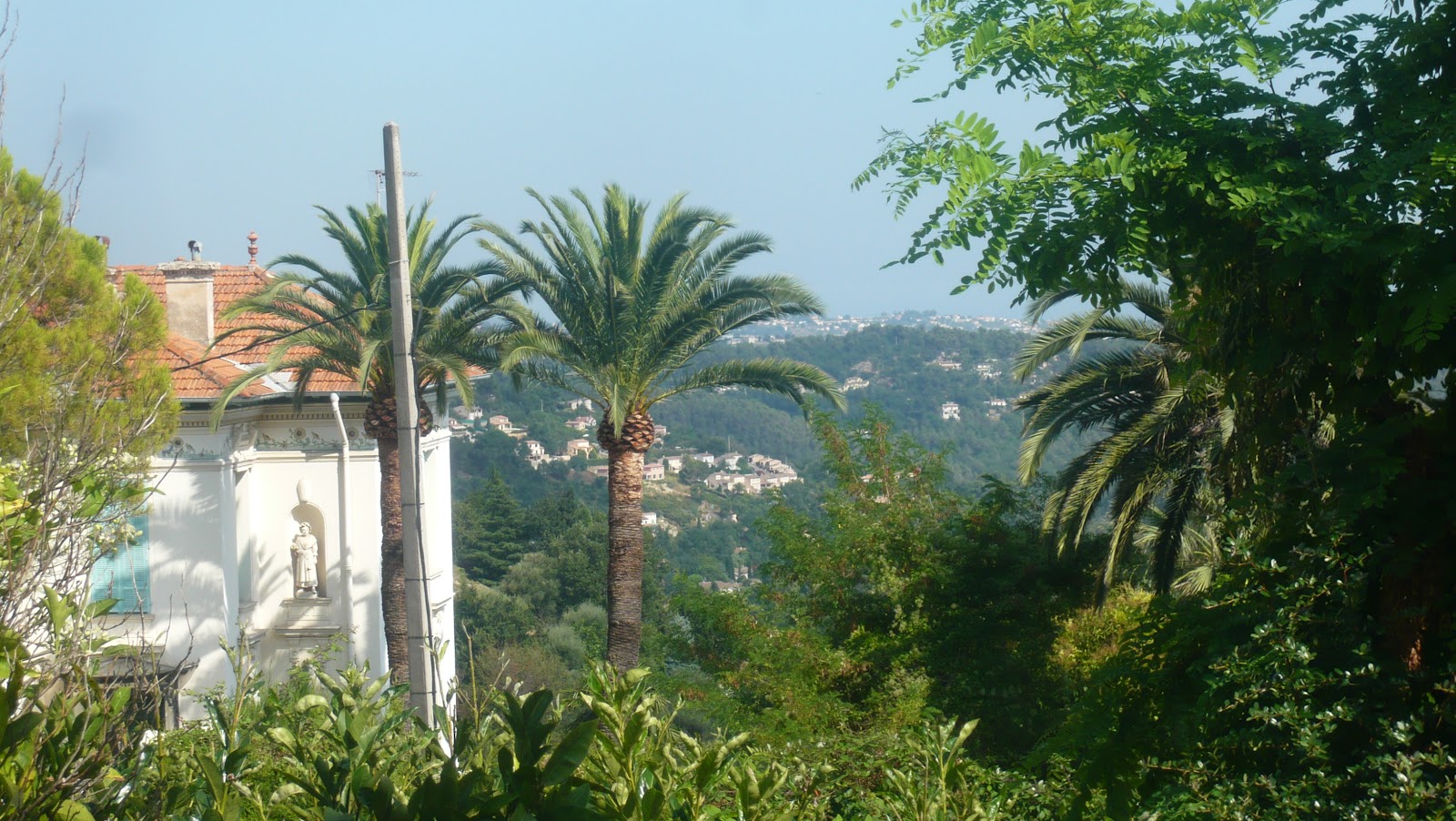
On my visit to Notre Dame de Jerusalem the afternoon sun beat down on the grave-grey gravel of the slow incline climbing the forested hills outside of Fréjus which leads to the chapel. The track wound up the hillside opening on views of the steeper slopes further on and deeper in before revealing the small shelf of plateauxed land on which octagonal footprint of Notre Dame de Jerusalem sits.

The area in which the chapel was built was bought in the early sixties by Jean Martinon, a banker from Nice and the project is unfinished in the sense both that Cocteau died in 1963 before its completion and the chapel is isolated without the artist’s colony it was originally intended to serve. Cocteau drew up the plans and designs for a Chapel assisted by architect Jean Triquenot and the project was finished by his close friend, the muralist Edouard Dermit, and ceramicist Roger Pelissier.

The octagonal floorplan of the chapel is laid out in two concentric rings creating an octagonal ambulatory outside and an similarly shaped inner chamber. Mosaics of the Exile, the rebuilding of the Temple and the Annunciation ring the ambulatory while three heavy iron stained glass double doors provide the entrance to the inner octagon. The Cross of Jerusalem may have been the basis for the octagonal floorplan and this emblem of the Equestrian Order of the Holy Sepulchre of Jerusalem (a Roman Catholic order of knighthood under the protection of the pope) appears elsewhere within the overall design. The floor tiles, which include the Cross of Jerusalem, are glazed tiles shaped in elongated hexagons radiating from a central point and shining like the ocean in different tones of blue. Knights of the Holy Sepulchre also feature in the stained glass and frescoes. 'Dieu le Veult', a motto of the First Crusade, can be found in the floor mosaic and also on the altar.
The frescoes portray Christ's Passion (The Last Supper, Crucifixion and Resurrection) in crayon on concrete. The style (as which all Cocteau’s murals) is line drawing with muted colour. Cocteau, although untrained as an artist, had an intuitive affinity for line and a talent for suggesting mass through line alone. Line is life and the ‘soul’s style,’ he wrote, arguing that the artist’s presence makes itself felt when a line lives at each point along its course. 
Cocteau - prefiguring artists like Andy Warhol and Tracy Emin for whom life and art are co-mingled - seeks to immerse us in Cocteau-world. His church murals - at Villefranche-Sur-Mer, Milly-la-Foret, Leicester Square, and here - aim to do so by surrounding us with his personal combination of traditional and esoteric religious imagery filling every inch of the chapel’s walls and ceiling and among which the artist and his friends regularly appear. Here, for example, we have a Last Supper featuring Cocteau, Coco Chanel, Max Jacob, Raymond Radiguet, Francine and Carole Weisweiller. As with Warhol and Emin, Cocteau’s use of his life, faith and image is inclusive and distancing, sincere and ironic, arrogant and humble; a means of immersing us in the paradoxes and mystery of life.
Art is artifice; a lie, as Picasso stated, that makes us realise truth. Cocteau personalised this perception in an epigram saying, ‘I am a lie that always speaks the truth.’ For that reason he preferred mythology to history: ‘History is made of truths that are, with time, turned to lies; while mythology is made of lies that with time, turn to truth.’  The Catholicism of his youth and his public return to the faith under the influence of Maritain are part of the mythology of Cocteau’s life and feature prominently in the church murals which he undertook in his later years. They are among the most idiosyncratic contributions to the renewal of religious art in twentieth century France.

Cocteau finished his first church murals in 1957 for the Chapelle Saint-Pierre in Villefranche-Sur-Mer. This was a deconsecrated chapel which fishermen used to store their nets. Cocteau began work on the murals when he was 68 although he had become enchanted with the rundown chapel while staying at the nearby Hotel Welcome in the 1920s. His designs there, as in all of his work for churches, reflect his singular vision; a merging of myth and catechism.

The façade and the exterior depict the life of Saint Peter - his walk on water, and his arrest by Roman soldiers - and a homage to Saint-Mary-of-the-Sea (who is serenaded by Django Reinhardt) and the women of Villefranche (who carry their baskets of fish and sea urchins under the watchful eyes of the angels). Above it all, angels swoop in a cascade of movement. The chapel was reopened and reconsecrated in 1957 with the admission fee paid to the fishermen. Today, only the families of the fishermen of Villefranche-sur-Mer can use it for weddings.

Cocteau continued with frescoes and decorations at the registry office in Menton and redecoration with the themes from Greek mythology of an ancient theatre at The Mediterranean Centre for French Studies in Cap d’Ail. He and Dermit painted Francine Weisweiller's Villa Santo Sospir, near Cap Ferrat, with largely mythological imagery. His other church decorations include: Interior frescos (depictions of plants and the resurrection of Christ) at Chapelle Saint-Blaise des Simples (1960) at Milly-la-Foret and for Our Lady’s chapel at Notre Dame de France, London (1959), and motifs on the stained glass windows at the Chapelle des Gournay in the Église Saint-Maximin at Metz (1962).

Cocteau received his honorary doctorate from Oxford University with the support of the French cultural advisor in London, René Varin. Cocteau asked him if there was anything he could do in return. Varin suggested that he decorate a chapel at Notre Dame de France. Cocteau came to London to paint these murals between November 3rd and 11th 1959 and to play the role of narrator in the London production of Oedipus Rex, a performance conducted by Stravinsky. The murals are dedicated to the Virgin Mary divided into 3 panels: the Annunciation, the Crucifixion and the Assumption. The murals are simplified drawings, lines with muted colours. Cocteau included a self-portrait within the Crucifixion scene on the left side of the altar.

Jean Cocteau died of a heart attack at his chateau in Milly-la-Foret, France, on 11 October 1963 at the age of 74. He is buried in the Chapelle Saint Blaise Des Simples with his epitaph reading: "Je reste avec vous" (I stay among you).

-------------------------------------------------------------------------------------------------

U2 - The Fly.

Time for Youth


-------------------------------------------------------------------------------------------

Delirious? - Now Is The Time.

Angels amidst the acetate


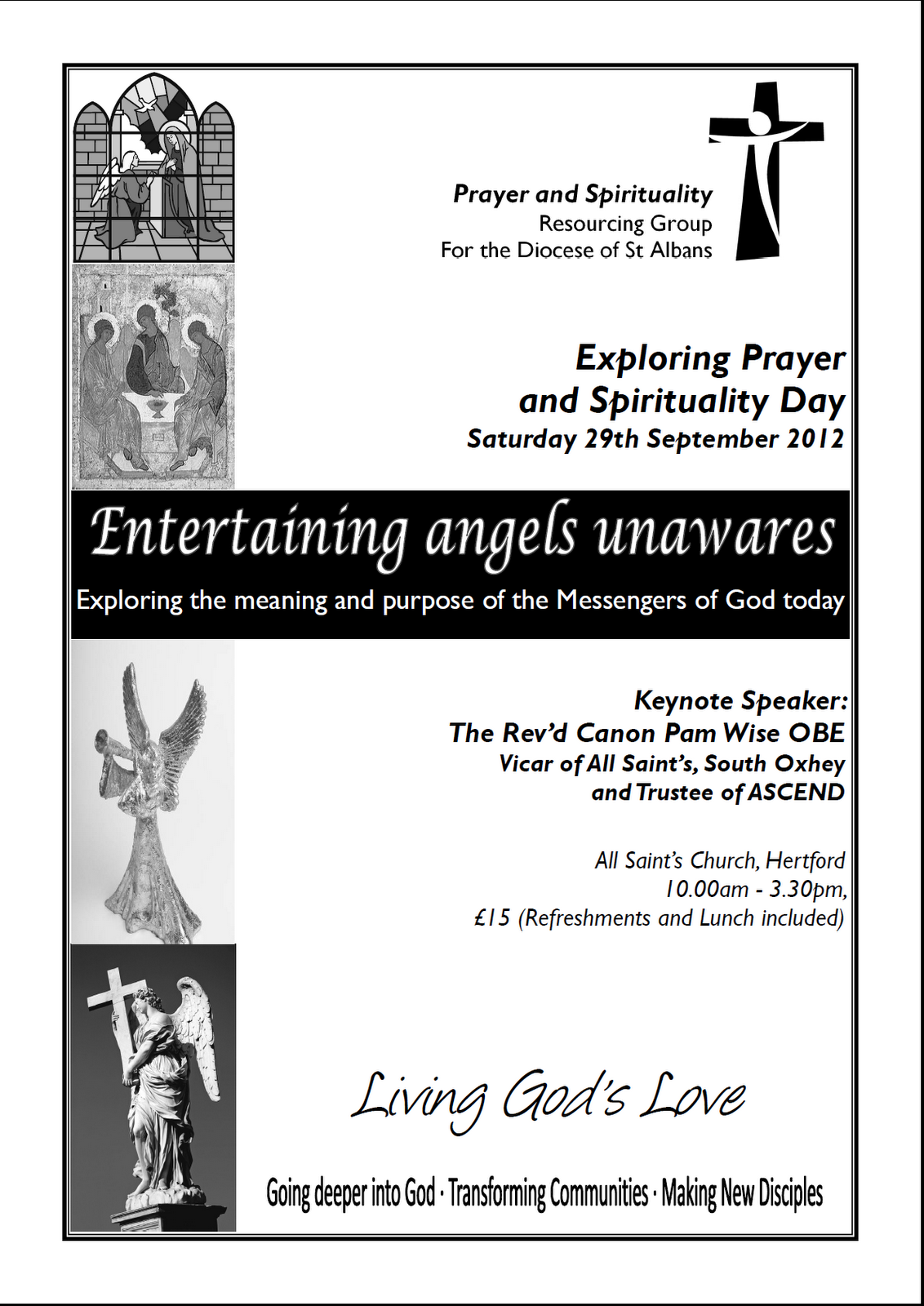
Paul Trathen will be leading a workshop on Angels amidst the acetate: Some glimpses of those we have entertained at the cinema as part of Entertaining Angels Unawares, the Exploring Prayer & Spirituality Day to be held on Saturday 29th September at All Saint's Hertford from 10.00am - 3.30pm.
Film is an allusive medium, well able to suggest realities just a little more subtle, mysterious and wonderful than the everyday. It is also a mass medium, telling accessible and powerful stories. This workshop - illustrated with a series of film clips - will explore iconography and narrative strands of a number of films and genres which might just glimpse the angelic …
There are accounts of the work and ministry of Angels throughout Bible and for many in our modern age that is where Angels remain - in history. Having had Angels captured by the
New Age spirituality that pervades society, the Exploring Prayer and Spirituality Day will seek to answer questions such as:
  • If God used angels in the past, are they still here now?
  • How do we understand and know Angels as part of Christian faith and practice today?
  • What can we learn from Angels about the message of faithfulness and hospitality?
With workshops rooted firmly in the Scriptures, in the worshipping life of the church and in the teachings of our forebears in faith, the day has a range of Workshops to encourage exploration and delight in the calling that we should:
not neglect to show hospitality to strangers, for by doing that some have entertained angels without knowing it. (Hebrews 13:2)
The Keynote Speaker will be The Reverend Canon Pam Wise MBE, Vicar of All Saint’s South Oxhey.

-------------------------------------------------------------------------------------------

John Tavener - Song of the Angel.