Wikio - Top Blogs - Religion and belief
Showing posts with label youth. Show all posts

Sunday, 1 February 2026

Ways in which young and old can minister to each other

Here's the sermon that I shared at St Catherine's Wickford, St Mary's Runwell and St Gabriel's Pitsea this morning:

The film ‘The Road’ stars Viggo Mortensen in an epic post-apocalyptic tale of the survival of a father and his young son as they journey across a barren America that was destroyed by a mysterious cataclysm. Reckoned to be a masterpiece, the film imagines a future in which people are pushed to the worst and the best that they are capable of and a future in which a father and his son are sustained by love.

It is a film in which an older person supports and encourages someone younger, as in the story of the presentation of Jesus in the Temple, where Simeon and Anna recognised and encouraged the potential in the baby Jesus (Luke 2: 22-40). 

This story is a wonderful example of the way in which young and old can minister to each other. It is the older folk in this story who see and encourage the potential in the young child Jesus. They spoke about and praised God for Jesus’ potential in ways that amazed his parents despite all the revelations that they themselves had already received. It may well be that they had begun to settle into the usual and ordinary pattern of care for their baby and had therefore lost their focus on the special nature of their child.

For teenagers it can often be difficult to accept that older people have something positive to contribute to their lives. They are often at the stage in life where they are testing things out for themselves and wanting to blaze their own trail through life. But those around them who are older in their family or church and at school can all be a positive influence as they recognise and encourage what they may have to offer.

That was certainly the case for me, as I look back on my teenage years. Like the boy in the film, I was inspired and encouraged by my dad who has remained a big influence on my life, but I was also encouraged in creative writing by a teacher at my school and brought back to faith by a youth leader at my youth club. So, if you are a young person here today, be on the lookout for adults who see your potential and encourage it, as Simeon and Anna did for the young Jesus, and if you are a person of years and experience look out for young people that you can encourage and affirm.

Every child is a unique combination of personality and possibilities that will lead to a life that will never be repeated. However, for many children their potential and their possibilities are never fully identified and explored and when this is the case their unique potential is often expressed in destructive activities. In our churches and communities, it can often be those who are older that have the wisdom and time to see the potential that lies latent in young people.

One of the most exciting pieces of youth work that I ever saw came when a youth worker arranged for small groups of young people to go to after-school groups in the homes of elderly people from their church. At these groups there was time to think about the Bible and time for the older people to teach skills of cookery and art to the young people. Deep friendships were formed between young and old and the whole family of one of the young people became Christians as a result of this initiative.

And this kind of initiative is not only one way. It is not just about older folk sharing their skills and time with the young. Young people are able to give much in return to those who are older. Think how blessed Simeon and Anna were by their encounters with the baby Jesus. Simeon had waited all his life for this moment having been promised that he would not die until he had seen the Lord’s promised Messiah. “Now, Lord,” he says, “you have kept your promise, and you may let your servant go in peace.” What a wonderful conclusion this was to Simeon’s life; the fulfilment of all his hopes, dreams and prayers.

Those of you who are grandparents know all about this – the joy that comes into your lives through your grandchildren but, in Church we don’t need to be grandparents to receive this joy if we share in the ministry of Simeon and Anna by using our wisdom and time to see and encourage the potential that lies latent in young people.

Then, be aware that it may take time for that potential to be fully realised. Simeon and Anna recognised Jesus’ potential when he was only a baby and Mary, his mother, remembered the things they said and treasured them in her heart. But it was thirty years later that Jesus began the ministry which was to fulfil the potential they had seen in him. And for those first thirty years of his life, he lived a very ordinary life. Over those years, his parents might well have wondered when are the things that Simeon and Anna spoke about going to happen? When is the potential that they saw in Jesus going to be realised?

TV talent shows suggest that our hopes and dreams can be achieved overnight but life doesn’t always develop in the way that we expect and it is important not to get frustrated when our hopes and dreams may not be realised instantly. Many people need significant life experience before their potential can be fully realised and we therefore need to persevere in order to get to a place in our lives where that occurs. The time it took for Jesus' potential to be realised in the way predicted by Simeon and Anna can therefore be an encouragement to patience in our lives as we wait for our potential to come to fruition.

Simeon and Anna also had to watch and wait themselves in order to see the Lord’s promised Messiah. Because they were prepared to watch and wait, they saw for the new thing that God was about to do for Israel and for the world. Anna was in the Temple every day looking and listening for all that God would reveal to her. Simeon, too, was alert to the prompting of the Holy Spirit who led him into the Temple to see Jesus. As we wait for our prayers to be answered, are we looking and listening to see and hear what God is wanting to reveal to us in our waiting.

We often need to wait for the right time for God’s purposes to come about. When we pray, God may well answer our prayers by asking us to wait. Waiting can be frustrating as when we are waiting for a bus in the rain or part of a long queue that seems to be taking forever. But we have a choice about what we do as we wait; will we just while away the time or will we look around us and see what there is to see as we wait.

W. H. Vanstone wrote a wonderful book called The Stature of Waiting in which he argued that it is only to human beings as we wait that “the world discloses its power of meaning” and we become “the sharer with God of a secret – the secret of the world’s power of meaning.” For many of us because we don’t stop and reflect the world exists for us simply as a “mere succession of images recorded and registered in the brain” but when we do stop, wait, look and listen then we “no longer merely exist” but understand, appreciate, welcome, fear and feel.

So, watching and waiting is vital if we are to understand and not simply receive the answers to prayer that God longs to give to us. It may well be that it was because of the length of his wait that Simeon was able to identify Jesus as the Lord’s promised Messiah.

As we watch and wait we can grow in our understanding of our world and we can see the potential and possibilities in the young. These are important ministries in which we can share. Someone in your youth did this for you. Now is the time when we can do this for others. May it be so for each one of us. Amen.

----------------------------------------------------------------------------------------------------------

Mumford and Sons - I Will Wait.

Saturday, 9 January 2021

Youth and Age

I've taken two funerals in the last two weeks. One for someone who died tragically young and the other for someone who lived a long life. This post combines my reflections on age from both services:

‘Blessed are those who mourn, for they will be comforted.’ Those are words first spoken by one who was in his thirties and who would die aged 33. He lived a short life as an obscure itinerant preacher in an obscure part of the Roman Empire, yet his words are remembered today, millions have followed in his footsteps, and his actions have opened relationship with God to all who do so.

Lives don’t need to be long to have impact when those who die young have been those that have loved family, friends and life itself deeply in the time that they have been with us.

X is one of those whose life has been short yet whose impact on our lives has been deep and wide and therefore will be long lasting. That is because of three reasons. The first of those was character. He was central to his group of friends and to his family because of the love that was apparent in his character. We have all experienced that and have heard examples of it in the tributes and eulogy given today. The Beatitudes is a reading about character; about those who practice meekness, righteousness, mercy, purity, peacemaking, and endurance in the face of suffering. Those who do so practice love and live love because their focus is on others, rather than themselves.

The second reason was his endurance in the face of suffering. Like all those with sickle cell he experienced periods of excruciating pain; pain of which those of us who are not sicklers do not know. He rode out the periods of pain that he suffered just like those who endure persecution for righteousness’ sake. They could do so because they knew that there was a better future – the kingdom of heaven – ahead. He knew that he could look forward to pain-free periods in which to enjoy and appreciate life to the full if he could ride out the periods of pain.

The third reason was his appreciation of life’s changes and his determination to live life deeply and fully in the periods when he was free of pain. That is the attitude that we see set out in the passage read from Ecclesiastes. Life is bittersweet in its mix of joys and traumas. We need to accept and understand that that is so in order to appreciate the times of laughter, dancing, embracing, healing, planting and keeping.

We can honour his memory best by following in his footsteps, adopting his attitudes, and mirroring his character. Lives don’t need to be long to have impact when those who die young have been those that have loved family, friends and life itself deeply in the time that they have been with us. We will have honoured X’s memory best if those things are what is said about us after we have died, however long or short our lives.

What does it mean to live well? Life can’t be measured in years alone, although X lived a long life, but perhaps life is measured by the legacy we leave for others; primarily the love we have shown and shared.

St Paul’s classic description of love is often shared at weddings and therefore serves often as a foundation to the forming of family life which is the principal forum in which love is learnt, shared, tested and developed. This description of love is one that it is very appropriate to use as we look back on a long life well lived. It's often only as we look back that we appreciate with fresh insight the love we received at an earlier stage in our lives as at that earlier stage such love was simply what normal life felt like. So, children can now say that they appreciate just how lucky they were to grow up with their parents.

St Paul’s description of love is somewhat generic but we have heard today stories of love expressed in specific ways. We can therefore rewrite 1 Corinthians 13 for your actual experience of family life together. Love is the sharing of interests and enthusiasms - of cycling, ballet and opera, love is the memory of a first kiss, love is dawn bike rides as a family to time trials, love is being taught to swim, pitch a tent and play chess, love is gifts of sticky buds, catkins and pussy willow, love is whole house renovations, love is unblocking drains, maintaining boilers, cleaning and repairing a local church, love is leading the project to redevelop and renovate that church building. Love is also the devotion and care shown by one partner to the other that meant they were able to spend their remaining years of marriage at home together.

There are many stories about X because of his caring character and because he had a long life in which to express that care. Methuselah is a well-known Bible character because of the length of his life. Interestingly those, like Methuselah, who are listed in Genesis as having lived long lives are listed there because their lives were shorter than those supposed to have been lived by kings of the tribes surrounding them. Long lives were claimed for those kings as a signs of their supposed divinity. So the lists included in Genesis were to demonstrate that Israel’s ancestors were ordinary working people like shepherds and not semi-divine kings. From what I know of X he would have been happy to stand with the likes of Methuselah on that basis.

Memories and stories are what we need to tell today because they remind us of all the ways in which X impacted our lives. As we do so, we realize that our lives have been richer for knowing him and that it is only because he was part of our lives and brought so much into our lives that we mourn him as much as we do today. And so it is that, as we remember all the good that we received from him, we focus on giving thanks that he was a part of our lives.

Our Bible reading also speaks of another way in which X lives today, as it speaks of the Christian hope for the future. Life is like looking through a grubby pane of glass. That’s essentially what St Paul said in 1 Corinthians 13. When we look out through a dirty window we can see but we can’t see clearly. That, he says, is our experience in this life.

Why? Because none of us are perfect and therefore we don’t love others as we should. We don’t fully love in the way that he describes in this passage. Are we always long-suffering, kind, unenvying, unself-seeking, not puffed up and not easily provoked? Do we always think no evil, bear all things, believe all things, hope all things, and endure all things? The short and honest answer is no. We do not experience perfection in this world and therefore do not see love perfected.

But, as we have reflected, we do see love in part; particularly in our close family relationships. As we reflect on X’s life today, we are remembering the ways in which he loved and in which we received love from him. He knew love and gave love in his life. But whatever he knew and gave of love in this life has now been exceeded in the next. Now he sees love perfected because he sees Jesus face to face. What was partial has been left behind and what is perfect is now his experience.

More than this, Paul says that faith, hope and love abide or remain. He seems to be saying that we can take something with us when we die. That all our acts of faith, hope and love from this life continue and are perfected in our future life. And this means that funerals are important times for us to reflect on our own lives. Are we modelling our lives on what we know of Jesus? Are our lives characterised by acts that are full of faith, hope and love? If not, then we will enter eternity with very little. But what a joy there is when someone can take much that was of love into their future life together with God.

----------------------------------------------------------------------------------------------------------

Sufjan Stevens - Mystery Of Love.

Wednesday, 22 July 2020

Freedom in our time

Tonight I led the Bread for the World service for St Martin-in-the-Fields with young people from St Mary's Cathedral, Johannesburg. This week's theme was 'Freedom in our time'. View the service at https://www.facebook.com/stmartininthefields/videos/280675573241382.

We had planned to host a Youth Pilgrimage in Holy Week and Easter this year, with young people coming from the Cathedral of St Mary the Virgin in Johannesburg. The Pilgrimage has had to be postponed but the young people remain in contact with us contributing to our service on Pentecost Sunday and now to tonight’s Bread for the World.

The young people of St Mary’s Cathedral chose tonight’s theme of "Freedom in our time". They brought us our Bible reading, reflections, a poem, some of our music, and the wonderings for our Listening Groups after the service.

Plans for the Youth Pilgrimage represent a significant development in our partnership with the Cathedral presenting an opportunity to support the development of future leaders of the Cathedral’s community. The Pilgrimage will, we hope and pray, have a significant impact on the personal and spiritual development of the young people and, through them, on the mission and ministry of the Cathedral. We hope our plans can go ahead next year, possibly in Holy Week and at Easter.

In the meantime we have the opportunity to learn from the young people at the Cathedral as they share their thoughts and reflections on freedom in our time. Their longing to see justice, freedom and love in their society and their generation is truly inspiring.

Reports of my visit to Johannesburg to meet the young people can be found here.

---------------------------------------------------------------------------------------------------------

The Soweto Gospel Choir - Ingoma.

Tuesday, 24 September 2019

St Martin-in-the-Fields, HeartEdge & St Mary the Virgin Cathedral, Johannesburg (3)


Day 5 of my visit to Johannesburg took me firstly to Sophiatown. Sophiatown and the western area neighbourhoods were historically famous particularly for their racially-mixed communities which were a hive of artistic, political, business and intellectual and cultural innovations from the early 1930s until apartheid legislation destroyed them beginning in 1955. Sophiatown was a celebrated freehold and the first area in South Africa to feel the force of apartheid’s Native Resettlement Act and Group Areas segregation.

By 1962, Sophiatown had been flattened and rebuilt as a whites-only area called Triomf, yet Sophiatown today is probably one of the most diverse suburbs in Johannesbug, with long time residents from the 1960s, returned residents from the 1950s, and new families and students who know little of the area's rich past.

Father Trevor Huddleston was sent to Sophiatown in 1943 to continue the education and pastoral work of his religious community, Community of the Resurrection, based in the UK. He was 30 years old and found a vibrant community which instantly took him to its heart. By the time he was 42 years old, he had written a book about apartheid called 'Naught for Your Comfort'. It was banned in South Africa but sold 250,000 copies all over the world, so many people came to hear about apartheid. When Fr Huddleston returned to the UK in 1956 he committed to the struggle in new ways, and was one of the founding members of the 'Boycott Movement' - the pre-cursor to the Anti-Apartheid Movement in the UK.

The Trevor Huddleston CR Memorial Building, was officially opened in September 2015, by elders and youth with links to Fr Huddleston, in the presence of families who had lived in Sophiatown before the forced removals, and residents who live there today. Here work continues to enable young South African’s to develop their full potential, following in the footsteps of hundreds of youngsters who were schooled and supported by Fr Trevor and his colleagues and brothers working across Soweto and the historic western area neighbourhoods close to historic Sophiatown.

Their vision is a Sophiatown and surrounding communities where all people truly belong: where there is healing, opportunity and prosperity; so that resources are used to create a society where none live in poverty. Their values are inspired by the life-long service of Fr Huddleston to the recognition of every person’s intrinsic and equal value: they aim to operate with integrity, a focus on service, while valuing innovation and respecting diversity. Their venues, known as Sophiatown the Mix - are a state of the art ‘green’ building and an original 1930s Sophiatown home that has a rich history and can be viewed as a museum.

Christ the King, Sophiatown was an icon of the liberation struggle in South Africa. In this way, under the spiritual guidance of the Community of the Resurrection (CR) fathers it kept the proclamation, practice, and spirit akin of the historical institution of the feast day of its dedication – No heavenly and earthly power is above that of Christ, and those made in God’s image may not be subordinated. In 1940 Trevor Huddleston CR was appointed Rector. His ashes reside at a memorial site at the back of the church. It is often used for memorial services and is an attractive tourist destination. On the north-eastern side of the church there is a mural depicting Huddleston walking the dusty streets of Sophiatown. This mural was painted by 12 apprentice students under patronage of the Gerard Sekoto Foundation. It shows two children tugging at his cassock as well as Sekoto’s famous yellow houses.

Inside the church, a mosaic depicting Christ with multiracial disciples in contemporary dress has been unveiled. Designed by artist Bon Chandiyamba, the work was produced after an act of philanthropy by a British businessman. Stephen Hargrave, a regular visitor to Johannesburg, commissioned it when he learned how a previous mural at the church was destroyed. The original mural had been painted between 1938 and 1941 by an Anglican nun, Sister Margaret. Only blurred photographs remain of her vision of a white Jesus and his white disciples. It was whitewashed over and lost after the church was sold to the government in 1967 and used as a boxing gym. The church also has Stations of the Cross painted by O. J. Zwane in 2006. 

From Sophiatown I went to the Apartheid Museum, which opened in 2001 and is acknowledged as the pre-eminent museum in the world dealing with 20th century South Africa, at the heart of which is the apartheid story. An architectural consortium, comprising several leading architectural firms, conceptualised the design of the building on a seven-hectare stand. The museum is a superb example of design, space and landscape offering the international community a unique South African experience.

The exhibits have been assembled and organised by a multi-disciplinary team of curators, film-makers, historians and designers. They include provocative film footage, photographs, text panels and artefacts illustrating the events and human stories that are part of the epic saga, known as apartheid. A series of 22 individual exhibition areas takes the visitor through a dramatic emotional journey that tells a story of a state-sanctioned system based on racial discrimination and the struggle of the majority to overthrow this tyranny.

For anyone wanting to understand and experience what apartheid South Africa was really like, a visit to the Apartheid Museum is fundamental. The museum is a beacon of hope showing the world how South Africa is coming to terms with its oppressive past and working towards a future that all South Africans can call their own.

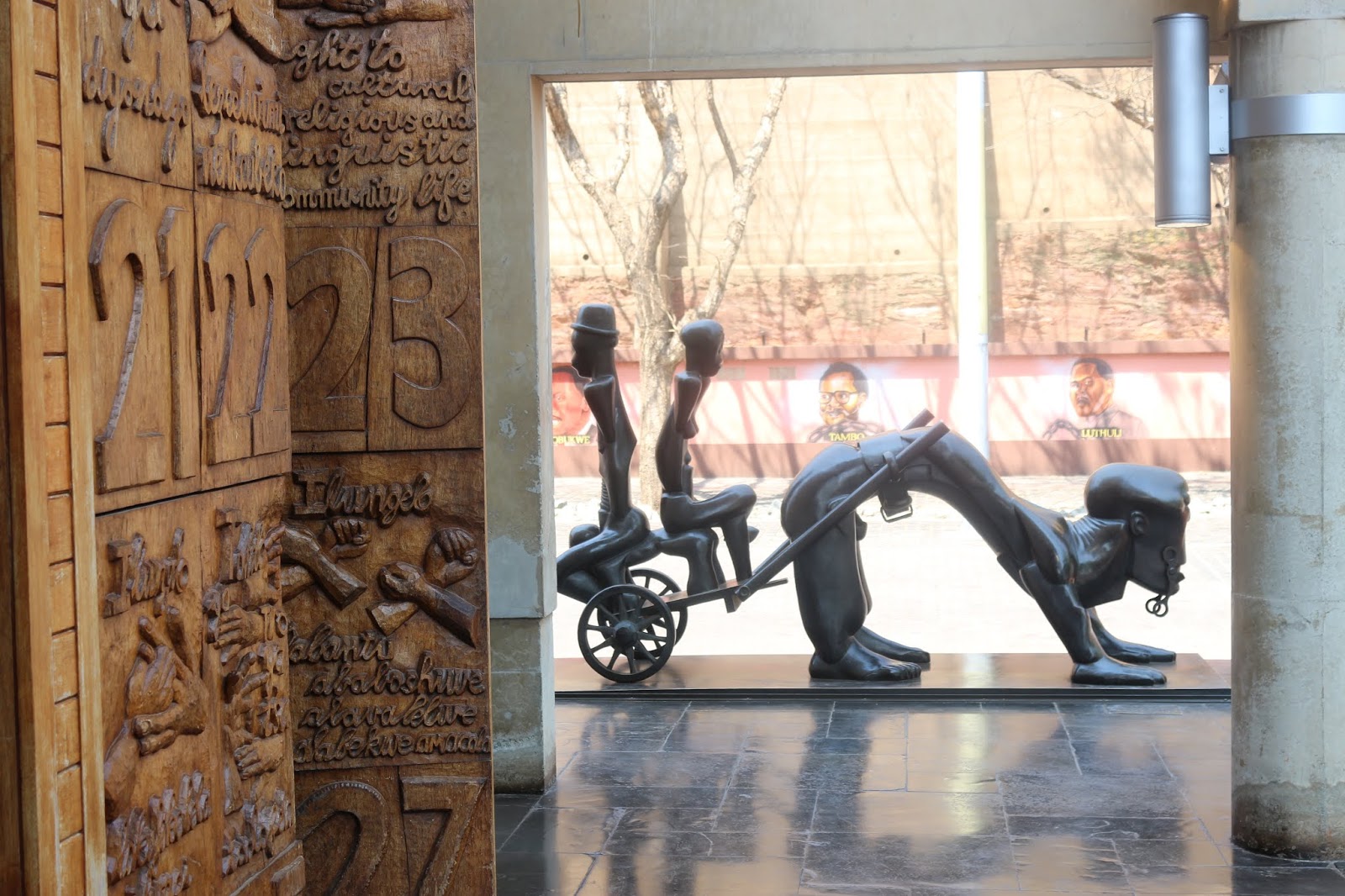
Similarly with Constitution Hill, which I visited on Day 6 of my trip. Constitution Hill is a living museum that tells the story of South Africa’s journey to democracy. The site is a former prison and military fort that bears testament to South Africa’s turbulent past and, today, is home to the country’s Constitutional Court, which endorses the rights of all citizens.

There is perhaps no other site of incarceration in South Africa that imprisoned the sheer number of world-renowned men and women as those held within the walls of the Old Fort, the Women's Jail and Number Four. Nelson Mandela. Mahatma Gandhi. Joe Slovo. Albertina Sisulu. Winnie Madikizela-Mandela. Fatima Meer. They all served time here. But the precinct also confined tens of thousands of ordinary people during its 100-year history: men and women of all races, creeds, ages and political agendas; the indigenous and the immigrant; the everyman and the elite. In this way, the history of every South African lives here.

Constitution Hill is also a place of contrasts: of injustice and justice, of oppression and liberation. The precinct is testament to the importance of preserving sites of atrocity for posterity, and also to recreating them so that they can serve the purposes of the present and serve to mould the future.

Part of what makes the Constitutional Court such a remarkable building is its fusion of architecture, art and adornment. It is a space that reflects a profound interest in humanity and a deep yearning for justice, both of which are evidenced in the court’s aesthetic, including its permanent, curated art collection.

The curation of this collection was driven by Justices Albie Sachs and Yvonne Mokgoro, who began by commissioning Joseph Ndlovu to create a tapestry titled 'Humanity' that would reflect humanity and social interdependence in the new democratic South Africa’s Bill of Rights. Prominent South African artist Cecil Skotnes donated a panel depicting his interpretation of democracy, a work called Freedom. Willie Bester’s Discussion, William Kentridge’s Sleeper – Black, Robert Hodgins’ Hotel with Landscape and Marlene Dumas’s The Benefit of the Doubt soon followed. A special ceremony was held for the installation of The Man Who Sang and the Woman Who Kept Silent by Judith Mason, a work that is based on proceedings at the Truth and Reconciliation Commission and one that is now perhaps the court’s most famous piece.

Today, art not only adorns the walls of the Constitutional Court at Constitution Hill. It is in the foyer’s chandeliers and light fittings, designed by sculptor Walter Oltmann. It is in the court’s rugs, carpets and acoustic panels, designed by Andrew Verster. It is in the engraved doors, carved gates and mosaicked columns, and in the abundant use of texture and symbolism.

I was fortunate to enjoy two trips to the Market Theatre, on the second of which I saw a performance of ‘Eclipsed’, a play developed and performed by student of the Market Theatre Laboratory in Johannesburg. This was an electrifying journey into a major social and political scandal in South Africa, known as Life Esidemeni, brought about when cost savings in contracts resulted in 1,300 people who had been receiving care in from a specialist mental health provider were transferred to the care of their families, non-governmental organisations (NGOs), and other hospitals. Over 144 people subsequently died from causes including starvation and neglect.

The drama students drew on testimonies, articles, documentaries, news bulletins, and the commission statements that cross-examined the government officials responsible for this unspeakable tragedy, to devise a powerful physical interpretation of this event and its aftermath. Their re-telling of these events focused on Maria Phehla whose daughter, Deborah, was the first to die just three days after her transfer. The play was a protest at the events which caused the tragedy and the political situation in South Africa that allowed it to occur, but ended with Maria Phehla reminding the Court that all those who died were made in the image of God. These young people were drawing on faith to explore meaning in chaos, scandal and protest. By doing so, whether consciously or not, they were sharing something of the kingdom of God and providing a means by which South Africans could engage with the scandal of Life Esidemeni in order, at least, to ensure those events were not repeated. In this way, the play provided healing space.

Young people played a vital role in the struggle against apartheid. The events of the 1976 Soweto uprising saw township youth take control of the struggle and those events marked the beginning of the end of apartheid. Young people continue to advocate for change in South Africa and St Mary’s Cathedral in Johannesburg wish to support their development as current activists and future leaders within South Africa. As part of a wider leadership development initiative for young people at the Cathedral, a group of nine young people and two adults will visit St Martin’s from 6 – 17 April 2020 to gain a broader set of leadership and cultural experiences. My visit involved time spent with the young people of the Cathedral exploring understandings and examples of leadership and the beginning of preparations for their youth pilgrimage in 2020.

---------------------------------------------------------------------------------------------------

Christ the King, Sophiatown.