Wikio - Top Blogs - Religion and belief

Monday, 6 October 2014

Airbrushed from Art History: Stained Glass from Welsh Churches


Martin Crampin is an artist working in West Wales. Since 1999 he has been based at the University of Wales Centre for Advanced Welsh and Celtic Studies in Aberystwyth, where he has worked on research projects concerning aspects of visual culture in Wales. He has been recording stained glass in Wales since about 2005, and thousands of his photographs of stained glass in Wales can be found on the Stained Glass in Wales Catalogue.

His fully illustrated book Stained Glass from Welsh Churches brings together over six years of research and an archive of thousands of high-quality photographs, to produce a detailed narrative outlining the range and development of stained glass in Wales from the 14th century up to the present day.

In a post describing the scope of the book Martin has written:

'During the 1950s some tentative steps towards Modernism can be seen, and in Wales the beginnings of its own tradition of stained glass are also found. From the 1840s there is little to distinguish Welsh ecclesiastical stained glass from that made for English churches, and exported around the British Empire. The work of the Swansea firm Celtic Studios, and the course established in Swansea by Celtic Studios main designer, Howard Martin, laid the foundations for a Welsh tradition of making stained glass. This ‘Welsh’ tradition became increasingly internationalist in character, and some windows in churches of the late 1970s and 80s were made by Swansea students and ex-students, who sometimes came from other parts of the country and around the world, and have gone on to be distinguished artists in glass.

From the 1970s my chosen title of Stained Glass from Welsh Churches is all the more significant. More stained glass was being made for buildings that were not places of worship, and consequently some of the interesting work by artists based in and around Swansea such as Amber Hiscott, David Pearl, Alexander Beleschenko and Catrin Jones is not found in the book. Work in churches however becomes ever more vibrant, and exhibits a wide variety of personal styles, although often staying closer to traditional methods of making stained glass, rather than the growing vocabulary of techniques encompassed in the term ‘architectural glass’.

The book closes with an attempt to see what has happened in the last fifteen years and tentatively suggest what might lie ahead, as intimated by the gradually decreasing number of commissions and the creation of internal divisions in churches that invite the use of architectural glass techniques such as etching, enamelling and bonding.'

Martin also writes that, 'The chapters on Modernism and the creative artists of the end of the last century touched on the problems of commissioning stained glass for churches, and the freedoms of the artists within these commissions. What I also found was that changes in position of the Diocesan Advisory Committees had a huge effect on the work that was commissioned. Unfortunately it's now more of a historic problem, as here in Wales the number of new commissions is seriously limited by funds and diminishing congregations. Which is why commission4mission is such an important project!'

He thinks that the engagement of the church with visual arts has not been properly celebrated, probably 'because stained glass, murals and other church furnishings have been on the periphery of the core art market of painting and sculpture, which has largely determined which artists we now define as 'mainstream' according to the accepted narratives of western art.'

-----------------------------------------------------------------------------------------

Bryan Ferry - Gates of Eden.

Windows on the world (312)


Newbury Park, 2014

------------------------------------------------------------------------------------

Orchestral Manoeuvres In The Dark - Enola Gay.

Sunday, 5 October 2014

Patronal Festival


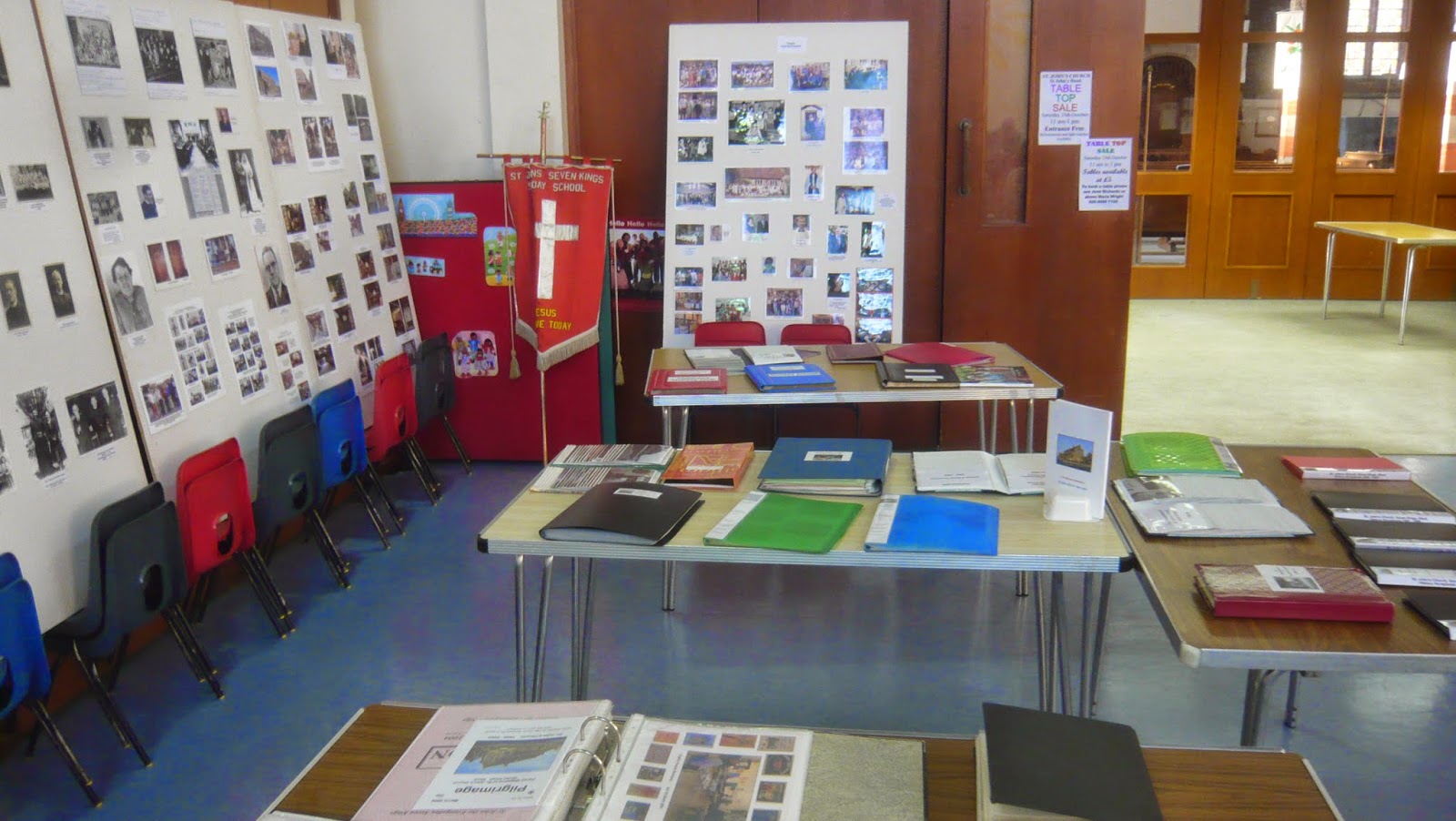
St John's Seven Kings celebrated its 110th Anniversary over its Patronal Festival weekend on Saturday 4th and Sunday 5th October. Our celebrations included Choral Evensong (Saturday 4th October, 6.00pm) followed by refreshments, Patronal Festival Service (Sunday 5th October, 10.00am) followed by a Bring & Share Lunch, plus photographic displays and the celebration of special anniversaries/birthdays for congregation members.

Choir members from several local churches supported the St John's Choir in leading worship for our Choral Evensong. The service included the anthem 'A Clare Benediction' by John Rutter.

Many former members of St John's returned for the weekend including:
  • Revs. John & Rosemary Enever, who preached at the Patronal Festival Service. Rosemary is a former curate at St John's who became Vicar of St Andrews Great Ilford and Area Dean of Redbridge; and
  • Judy Acheson, our former Church Mission Society Link Worker in the Democratic Republic of the Congo . Judy was celebrating 50 years as a Christian. As a result of her ministry in the Congo , St John's continues to support youth work in that country.
Returning and current members gave testimonies in our Patronal Festival Service to the work of God in their lives through St John's. We heard from Michael Blackstaff, Margaret Willmott, Dr. Winston Solomon, Chris & Veronica Watts, Charity Anyika, Julia Beaman, Lester & Margaret Amann, and Judy Acheson. 

Michael Blackstaff, a former server at St John's , had written a reminiscence in which he said, ' St John’s was, and is, a very special place. I was a bit short on blood relations (though very rich in adoptive ones) and came to regard it and its many good people as part of my family. I shall always feel greatly privileged to have been welcomed into its loving embrace.'

There have been more that 15 different significant anniversaries/birthdays which are being celebrated within our congregation this year and all these people were congratulated as part of the Patronal Festival Service. They included two 60th wedding anniversaries, one 50th wedding anniversary, and two 90th birthdays, among others. We prayed for these folk using the following prayer: 

Lord Jesus, we thank you for the special milestones which these people have reached in the course of this year. Such moments provide a reason for stopping and remembering all that we have experienced up to that point in our lives; times of great joy and great challenge. In all, as we look back, we see your presence alongside us supporting and equipping us for life. Enabling us to enjoy and share those times of intense joy and pleasure, to bear and share those times of deep anxiety and pain, and to live fully the times in between – those times of ordinary, everyday life in families, church, community, and at work. Thank you for all that you have done and continue to do in the lives of these people and may they know a special joy and blessing from you in the celebration of these particular milestones. Amen.

We also presented a gift to our former curate, Rev. Santou Beurklian-Carter. Following the service, we enjoyed a delicious and varied Bring & Share lunch and viewed photographic displays from the extensive Church archive.

Former Vicar Rev. Gordon Tarry sent a message saying, 'St Johns will always be a very special place and people for Julia and I, and our family. We hope you have a great week-end, with much joy and laughter.'

The weekend was a great encouragement and inspiration through the many testimonies to God's work in many lives through St John's.

At our 8.00am service I preached the following sermon:

The traditional image for our Patron Saint, St John the Evangelist, is the eagle and that is, of course, why images of eagles can be seen in different parts of our church. This image for John and the writings we traditionally attribute to him wasn’t chosen at random but was selected because it expresses something of what John’s writing do for us.

Richard Burridge, in his important book Four Gospels, One Jesus? tells us that the eagle was used to represent the Evangelist because he gives us the high-flying, far-seeing perspective of the eagle when he writes about Jesus. These writings give us the big picture about Jesus and his significance.

We can see this in our Bible readings. In 1 John 1, we read that Jesus, the Word of life, has existed from the very beginning and in John’s Gospel we read of Jesus speaking of his coming again at the end of time. This is the big picture into which John sets the stories and theology that he gives us about Jesus. When John writes about Jesus, he is not simply saying that these are interesting stories about a great human being. Instead he is saying that this is God himself, the alpha and omega, the beginning and the end, walking, talking and acting in the flesh.

In 1 John 1 there are two key features of God that John wants us to grasp in our to understand the significance of the big picture. The first is that God is someone that we can see and the second that God is someone who enables us to see.

John uses the image of the Word made visible to tell us that God is someone that we can see. The heart of the Christian faith, he is saying, is the incarnation; the reality that God, in Jesus, became a human being and lived in a particular culture and time. John was able to say of this Word; “we have heard it, and we have seen it with our eyes; yes, we have seen it and our hands have touched it.” God is no longer detached from us and unknowable to us, instead he has chosen to come close to us, to move into our neighbourhood, to become one of us.

The incarnation is at the heart of Christianity because it is a sign of the love that God has for us. God loves us so much that he is prepared to become one of us, even though this means huge constraints and ultimately leads to his death. As a result, he understands us and understands human life. Now whatever we go through, God has been there before because he has experienced life in all its wonder and heartache.

However, God is not simply someone who can be seen by us. He is also the one by whom we can see. John gives us the image of God as light to help us grasp this facet of God’s being. Light is not something we can see directly but something that enables us to see ourselves and our world. This is what Jesus does for us through the incarnation; he shows what humanity was originally intended to become. For the very first time in the history of the world a human being lives a fully human life.

As a result when we see ourselves and our world in the light of the life of Jesus, what we see is our failure and inability to be the people that we were created to become. In the light of the way that Jesus lived his life, we see our lack of love, joy, peace, patience, kindness, goodness, faithfulness, humility, and self-control. As this letter says, if we say that we have no sin, we deceive ourselves, and there is no truth in us. But when we live in the light, seeing ourselves as we really are, then we become honest with ourselves and with God. By coming into that honesty we confess our sins and are purified of them.

Both these understandings of Jesus are necessary for us to become fully human. If God was just light that exposed our failures then we would be condemned by God. If God was just alongside us as the Word made flesh then there would be no prospect of change for us. But because God, in Jesus, is both the light revealing our failings and the Word made flesh understanding our failings, we can receive forgiveness and change to become more fully human.

John gives us many paradoxes and parallels in his writings. Jesus is both this and that; both Word and flesh; both flesh and light; both message and image; both human and divine. As a result, his writings can seem difficult and dense; yet it is only because Jesus is both/and that we can know what real humanity looks like and have some real prospect of moving towards that reality in our lives. To repeat, it is only because God, in Jesus, is both the light revealing our failings and the Word made flesh understanding our failings that we can receive forgiveness and change to become more fully human. So this Patronal Festival, let us be thankful for the big picture that John paints for us and thank God for the salvation that comes to us because he is Word and flesh; flesh and light; message and image; human and divine.
-----------------------------------------------------------------------------------------

John Rutter - A Clare Benediction.

Saturday, 4 October 2014

Sophia Hub update

Ros Southern writes:

'Thanks to all those that came to our wonderful first anniversary celebration. Please do read all about it here.

The Enterprise Exchange has now opened and there is an incredible array of business support on the top floor of the Ilford Exchange all this month.. Info here which is being regularly updated.

Sophia Hub Seven Kings is running most of the activities on Tuesdays and our enterprise club will take place at Ilford Exchange and not at St Johns Church. 12.30-2.30,plus some of us will be staying around afterwards to promote the Timebank, build up our networks, share our hospitality and knowledge.

Tuesday 7th October - create your own visual right side brain business plan with start-up Marie Ndolo! Info here.

Tuesday 14th October - Beat Procrastination with experienced trainer Awele Odeh. Info here

Thanks so much to Nicola Millington of FPComms who came to the enterprise club on Tuesday to help start-ups develop their elevator pitches for the anniversary event in the event. Info here.

In recognition of the voluntary input into Sophia Hub Seven Kings in the first year please take a look at the long list of volunteers, including the enterprise club speakers.

Any help you can give in helping us promote the free re-used paint giveaway to help launch and establish a new green enterprise in the borough would be much appreciated. Info here.

From next week we will be planning a series of Timebank events and focussing on increasing trading, so more of an update next week.

Hot off the press - start up Marie Ndola is running Kundalini yoga sessions at the enterprise exchange. More into here.'

-----------------------------------------------------------------------------------------

Beyond Airbrushed from Art History: Bronson, Finster and Pass

In his Hyperallergic article Rob Colvin sets out strongly the thesis that, when it comes to art and religion, never the twain shall meet:

'The close relationship that art and religion maintained for several millennia has in recent decades eroded so drastically that it’s difficult to imagine fine arts and contemporary religion having anything in common. Art is, on the whole, a secular enterprise, and religion is frequently more anesthetic than aesthetic in character. The two worlds happily foster vulgar understandings of each other almost to a point of pride. Some might even suggest that adherence to one entails a rejection of, or at least critical distance from, the other.'

Despite this beginning, his main interest in the piece is to do with a place where the two do meet, in this case the Artist AA Bronson and the Institute for Art, Religion and Social Justice:

'Serene Jones says that the largest population of the US declares themselves to be spiritual but nondenominational. And she says that’s the horse she wants to be riding on; that’s the audience she wants to be able to harness at Union. Because, for the most part those people — a very large number of people — have nothing to feed them spiritually.

I see the art world much the same way, because there are many, many artists who would declare themselves as spiritual but don’t really know what to do with that. As a result of being at Union, I wanted to create some kind of conversation between the two: not only could the art world learn from the theological world but vice versa. It seemed just crazy to me to have this division between the two.'

One place where art and religion have always co-existed has been in Visionary Art:

'The American Visionary Art Museum (AVAM)’s 20th original thematic exhibition hails the great dreamers and doers throughout history, exploring the astonishing visions of Hildegard von Bingen and Leonardo da Vinci, to Nikola Tesla and Philip K. Dick, as we pay tribute to the ecstatic “Aha!” and “Eureka!” moments that propel discovery, leaps in consciousness, and cultural renewal. The Visionary Experience: Saint Francis to Finster examines the human impulse to forge a path out of darkness into illumination, as well as the duality and complexity of vision, from radical clarity to unfettered delusion, and the legacy of visionary experiences throughout time.
Guest curator, acclaimed filmmaker and book publisher Jodi Wille, and AVAM founder
and director Rebecca Alban Hoffberger have together assembled a diverse and wildly
transcendent collection of artists, scientists, philosophers, and spiritual pioneers who have
ventured straight to the source of inspiration itself.
In anticipation of his centennial birthday celebration, The Visionary Experience includes a
lifetime of visions in paint, and the process of the most acclaimed intuitive artist of the 20th
century, Rev. Howard Finster

The Visionary Experience exists out of and above the influence of time or place, socioeconomic background, age, race or gender. It is a path ancient and modern, futuristic and primitive.
Within this experience, discovery can be found down the road to Damascus, inside the depths
of the cave of Athena, via the power of music, intoxicants, spiritual emergency, meditation or
prayer. The touch of grace, the whisper of the muse and the still small voice beckon, offering the
traveler transportive visions: personal, cultural, and cosmic.'

In addition to this thematic exhibition, AVAM is also showing work by Donald Pass:

'A celebration of the late British visionary artist’s ethereal spirit paintings, inspired by his own
life-changing glimpse into the afterworld. Donald Pass (1930–2010) was a well known painter of
lyrical abstract landscapes until the late 1960s when he experienced a series of spiritual visions
of the Resurrection that radically and forever changed his view of reality, and subsequently, his
artwork. Sir John Rothenstein, late Director of the Tate Gallery in London, described Pass as “a
spark of genius, a very rare talent.”'

------------------------------------------------------------------------------------------

Gerry Rafferty - Baker Street.

Thursday, 2 October 2014

Sabbatical art pilgrimage: Report - Part 1

The commissions that I have seen during this sabbatical tell a story of a continuing engagement by the Church with contemporary art from the Post-Impressionists to the present day. This engagement has often been contentious and contested but it has nevertheless been a continuing relationship involving both mainstream artists with a Christian faith and church commissions undertaken by mainstream artists who have not professed the faith.

Benedict Read in his 1998 lecture to the Royal Society of British Sculptors noted that following the Second World War: “Churches were being repaired. New work was being installed in them. There was an expansion of church buildings with works of art in them … There is an alternative world there of the commissioning of art for specific purposes that, with no disrespect to established art historians, simply doesn't feature in our notion of cultural history in the post-war period.” 

Read was speaking of the UK but a similar situation occurred in mainland Europe and in both settings, while the church building programme has slowed somewhat, the commissioning of contemporary art has not, meaning we have and are witnessing something of a renaissance of commissioned art for churches and cathedrals.

Key figures in initiating and then sustaining aspects of this renaissance in its initial phases included the artists Maurice Denis and Albert Gleizes, the philosopher Jacques Maritain, and the churchmen Bishop George Bell, Dominican Friar’s Couturier and Régamey, and Canon Walter Hussey.

Significant thematic developments within this period include:

·       commissions by secular artists or artists of other faiths who have brought alternative perspectives to Christian imagery, beliefs and themes. Artists such as Ervin Bossanyi and Marc Chagall, while using Christian imagery in their stained glass commissions, also recognized the 'profound inspiration' of all the great religions, possessed a 'reverence for life' and longed for a 'new cosmopolitan world order, in which ideological, racist and cultural differences no longer mattered';
·       images of the crucifixion by, for example, Albert Servaes, Germaine Richier and Graham Sutherland which viewed Christ’s sacrifice as emblematic of human suffering in conflict and persecution. These were often controversial as they challenged sentimental images of Christ and deliberately introduced ugliness into beautiful buildings;
·        in England church commissions gave émigré artists – such as Bossanyi (stained glass), Hans Feibusch (murals) and Adam Kossowski (ceramics) - the opportunity to build new careers. In writing about Feibusch, Jutta Vinzent has noted the extent to which this was “a period of intense artistic activity in Britain” which was “stimulated to an inestimable extent by émigré artists”; and
·       a move from storytelling in stained glass by means of narrative figuration (e.g. Chagall) to the creation of spiritual space using abstract colour (as pioneered by Jean Bazaine and Alfred Manessier) has occurred, primarily in France. The concept of stained glass architecture - of a light-filled architectural unit – that we find, for example, at the Chapelle Sainte-Thérèse-de-l'Enfant-Jésus et de laSainte-Face in Hem is an attempt to create spiritual space - a sense of prayer and a glimpse of heaven – through the play of light and colour within the building. In the past churches were centres for the drama of the visual - the drama and spectacle of the liturgy combined with the visual narrative of scripture in stained glass. Now people find their visual stimulation elsewhere - through the media primarily – and, as a result, churches have become centres for the opposite of visual stimulation e.g. centres of visual contemplation, where narrative is less essential than ambience and atmosphere.

This story is not one which has been well told, either by the Church or the mainstream art world. There are many reasons for this on both sides. The Church has often not valued sufficiently the artworks it has commissioned; at times their significance has not been understood or shared, at other times the works have been controversial and may have been banned or not publicized as a result. Often the artworks have been regarded as subsidiary to the liturgy and have not been publicized in order that the focus of the faithful would not be deflected. ‘Christian Art’ has become a contested term and the Church has been unsure whether to continue to use it and, if not, how else to speak of its commissions. There has also been significant debate about the relative values of commissioning artists who are Christians and contemporary ‘masters’ who may not be Christians.

In terms of the mainstream art world, the beginning of the modern period saw art and artists firmly and finally separating from dependence on Church patronage and wishing to maintain that independence. In addition, the speed with which new movements formed within modernism meant that artists engaging with church commissions in their later career could be portrayed as no longer being cutting edge and as having declined in the quality of their work. Many of the media used for Church commissions have not been central to modernism’s movements while the ‘alternative world’ of artists for whom Church commissions are a significant part of their practice tends not to feature on the radar of the mainstream art world.

Each of the above is open to question and critique. Controversy over commissions tends to fade leading to more widespread acceptance. Controversy can also generate valuable debate. The place of icons in Orthodox Churches shows that artworks can enhance rather than detract from worship. Commissions have gone to artists who are Christians and to contemporary ‘masters’ who are not Christians throughout the modern period. There are examples of successful and less successful commissions using both approaches. A mixed economy is the only practical and realistic approach. Commissions should be judged on their own merits and not on the reputation of the artist(s) involved. Reputations change over time meaning that those who are viewed as contemporary ‘masters’ may not be considered as significant by future generations while artists who do not have national or international reputations in their day may nevertheless produce high quality and/or visionary work. The quality of work produced by artists does not necessarily diminish with age or a change of style or when Church commissions are accepted, although the reputation of an artist or the perception as to whether they are or are not cutting edge may be affected by such considerations. The story of the revival of sacred art in the twentieth century can be told as one story among many in modernism and as a means of increasing the historical accuracy within the telling of the standard story of modernism.

My concern in making this story the focus of my sabbatical has been to encourage the Church to tell and to value this story. As both a parish priest and through commission4mission, the group of artists of which I am part, I have seen the value of promoting and publicising the artworks which churches have commissioned. Through the creation of Art Trails locally and regionally, we have provided churches with a means of publicity which has led to events such as art competitions, exhibitions, festivals and talks, community art workshops, guided and sponsored walks, and Study Days. Each has brought new contacts to the churches involved and has built relationships between these churches and local artists/arts organisations.

It is my contention that to tell more fully the story of the engagement which the Church has had with modern and contemporary art could have similar impact on a wider scale and would also have the effect of providing emerging artists from within the Church and the faith with a greater range of role models and approaches for their own developing inspiration and practice. The commissions themselves often speak powerfully and movingly of the Christian faith and therefore also inform the spirituality of those who see them.

------------------------------------------------------------------------------------------

Leonard Cohen - Born In Chains.

Wednesday, 1 October 2014

Presence: Exhibition views


------------------------------------------------------------------------------

Peter Gabriel - My Body Is A Cage.