Here is the reflection that I shared in the Choral Eucharist at St Martin-in-the-Fields today:
I recently visited the Friary at Hilfield which is part of the Society of St Francis, an Anglican Franciscan Religious Order. They are followers of Jesus Christ after the manner of St Francis of Assisi, the patron saint of ecology. Established in 1921 on the edge of the Dorset Downs and overlooking the Blackmore Vale, Hilfield has regularly provided refuge and rehabilitation for homeless men. Today, six Franciscan brothers form the core of a larger community who work on the Friary land - 19 acres of wildflower meadows and woodlands which have been designated as Special Nature Conservation Interest - and who offer hospitality to people of diverse backgrounds and needs. Each day is shaped by a pattern of prayer, meals together, work, reflection and recreation.
One of the many aspects of Hilfield that attracted my attention is their meditative Canticle Garden based on the Canticle of the Creatures which he composed towards the end of his life, a song which gives voice to all creation in praise and honour of God: Most High, all powerful, good Lord, To you be praise, glory, honour and blessing. Only to you, Most High, do they belong And no one is worthy to call upon your name. May you be praised, my Lord, with all your creatures…… and he goes on to include the sun, moon, stars, earth, water, fire, plants, fruits and flowers.
Brother Samuel from Hilfield has explained what Francis is doing in this Canticle as follows: ‘Everything gives praise, finds its true purpose, by being what it truly is and by doing what it does – the sun in shining, the moon in gleaming, the stars in glistening, the earth in producing fruit, fire in warming etc – and we, the human brothers and sisters of Francis, joining the song. Most people seem to think that worship is something done exclusively in and by churches – with organs and choirs and the like – and, certainly, the task of the Church is to offer praise and worship back to God, but Francis reminds us that when we worship in church we are joining in with something that has been going on since the beginning of time, since the ‘morning stars sang together’. Perhaps we should spend more effort and energy in trying to sing in harmony with them rather than just working our way through Hymns Ancient & Modern or Mission Praise! Having lived at Hilfield Friary now for a good number of years, I have seen from the experience of some of those who have come to us quite broken and lost and who have worked the land with us (and I know this from my own experience too) how engaging closely with creation can heal, restore and re-direct our lives; it can become an act of praise and worship. Singing from the same song-sheet with the whole created order brings us back into right relationship with ourselves, with each other and with the Source and Giver of all.’
It was for this reason that 'the Feast Day of Saint Francis was also designated World Animal Day in 1931 by ecologists in Florence Italy in order to bring focus to endangered species and celebrate animals everywhere. Numerous churches throughout the world observe the Sunday closest to October the 4th with a Blessing of the Animals, and animals are celebrated all over the world with celebrations in synagogues, parks and fields. The mission of World Animal Day is to: celebrate animal life in all its forms; celebrate humankind’s relationship with the animal kingdom; acknowledge the diverse roles that animals play in our lives – from being our companions, supporting and helping us, to bringing a sense of wonder into our lives; and acknowledge and be thankful for the way in which animals enrich our lives.'
'Today about 40% of all species on Earth are threatened with extinction due to habitat destruction, pollution, climate change, invasive species and illegal hunting, poaching and wildlife trade. There are about 3,100 animals classified worldwide as endangered and that number is growing larger every day. It is now more important than ever for people everywhere to take action to protect animals. Some simple steps you can take to protect animals are: protect wildlife habitats, pick up litter and participate in beach cleanups, recycle and reduce energy use and minimize the use of herbicides and pesticides.'
To take such simple steps is to begin to do what the Hilfield Community do, as they seek to put Jesus Christ at the heart of their community life and, following the example of St Francis, seek to: live in simplicity, humility and peace with each other; welcome others who come to visit us, especially the marginal and the stranger; have care for and delight in our environment; work for justice and peace in our world; witness to the abundant generosity of God in our life together; share the vision of living peacefully and sustainably in our world; and, as the Canticle of the Creatures enables us to do, join in the song of all creation in praise and thanksgiving.
--------------------------------------------------------------------------------------------
Sofia Gubaidulina - The Canticle of the Sun of St Francis of Assisi Part I.

Showing posts sorted by relevance for query st francis of assisi. Sort by date Show all posts
Showing posts sorted by relevance for query st francis of assisi. Sort by date Show all posts
Wednesday, 4 October 2017


Saturday, 21 January 2023
ArtWay Visual Meditation: In Him All Things Hold Together
My latest Visual Meditation for ArtWay is on Canticle for Assisi by Andrew Vessey:
'This painting was the fruit of a visit to Assisi by the artist Andrew Vessey (b. 1945) and his wife. They were hosted by an artist who was then working on a ‘tavola’ of St Francis, to hang in the Franciscan Church in Assisi and match one made earlier on the life of St Clare, one of St Francis’ first followers and founder of a Franciscan order for women, The Poor Clares. Through excursions and little pilgrimages made during the stay Francis was brought to life for Vessey and his wife, enabling a vision of Christ to emerge – as had inspired St Francis at nearby San Damiano – when he began a painting intended to gather up his impressions of Assisi.
Vessey has described what happened as he painted: ‘As the painting developed something wonderful began to happen. Having painted the city steps and turrets, combining elements from above, below and around the city, its olive groves and poplar trees out on the plain, it was as if the arms and body of the crucified Christ became the perfect cohesion needed to hold everything together. The stretched out body of the crucified Christ … started to emerge through the countryside, wrapping even the hills in its embrace.’'
My review for Church Times of Andrew's recent exhibition at St Edmundsbury Cathedral can be found here.
My visual meditations include work by María Inés Aguirre, Giampaolo Babetto, Marian Bohusz-Szyszko, Alexander de Cadenet, Christopher Clack, Marlene Dumas, Terry Ffyffe, Jake Flood, Antoni Gaudi, Nicola Green, Maciej Hoffman, Lakwena Maciver, S. Billie Mandle, Giacomo Manzù, Sidney Nolan, Michael Pendry, Maurice Novarina, Regan O'Callaghan, Ana Maria Pacheco, John Piper, Nicola Ravenscroft, Albert Servaes, Henry Shelton, Anna Sikorska, Alan Stewart, Jan Toorop, Edmund de Waal and Sane Wadu.
My Church of the Month reports include: All Saints Parish Church, Tudeley, Aylesford Priory, Canterbury Cathedral, Chapel of St. Thérèse of the Child Jesus and the Holy Face, Hem, Chelmsford Cathedral, Churches in Little Walsingham, Coventry Cathedral, Église de Saint-Paul à Grange-Canal, Eton College Chapel, Lumen, Metz Cathedral, Notre Dame du Léman, Notre-Dame de Toute Grâce, Plateau d’Assy,Romont, Sint Martinuskerk Latem, St Aidan of Lindisfarne, St Alban Romford, St. Andrew Bobola Polish RC Church, St. Margaret’s Church, Ditchling, and Ditchling Museum of Art + Craft, St Mary the Virgin, Downe, St Michael and All Angels Berwick and St Paul Goodmayes, as well as earlier reports of visits to sites associated with Marian Bohusz-Szyszko, Marc Chagall, Jean Cocteau, Antoni Gaudi and Henri Matisse.
Blogs for ArtWay include: Congruity and controversy: exploring issues for contemporary commissions;
Photographing Religious Practice; Spirituality and/in Modern Art; and The Spirituality of the Artist-Clown.
Interviews for ArtWay include: Sophie Hacker, Peter Koenig and Belinda Scarlett. I also interviewed ArtWay founder Marleen Hengelaar Rookmaaker for Artlyst.
I have reviewed: Art and the Church: A Fractious Embrace, Kempe: The Life, Art and Legacy of Charles Eamer Kempe and Jazz, Blues, and Spirituals.
Other of my writings for ArtWay can be found here. My pieces for Church Times can be found here. Those for Artlyst are here and those for Art+Christianity are here. See also Modern religious art: airbrushed from art history?
----------------------------------------------------------------------------------------------------------
Sinead O'Connor - Make Me A Channel Of Your Peace.
Wednesday, 10 May 2023
Artlyst: Saint Francis Of Assisi - A Timely Exhibition
My latest exhibition review for Artlyst is on Saint Francis of Assisi at the National Gallery:
'The National Gallery’s Saint Francis of Assisi exhibition explores how Saint Francis captured the imagination of artists, how his image has evolved over centuries, and how his universal appeal has transcended time, continents, and differing religious traditions. Through more than 40 works of art which span more than seven centuries and range from medieval painted panels and relic-like objects to manuscripts and a Marvel comic, the exhibition illustrates the claim that, apart from the saints of the New Testament, Francis is probably the most represented saint in the history of art. That reality came about because the growth of the Franciscan movement went hand in hand with the rapid spread of imagery by some of the greatest artists. Art historians have estimated that as many as 20,000 images of Francis might have been made just in the century after his death.
Francis embraced Christ, his message, and way of life – as is literally depicted for us in Bartolomé Esteban Murillo’s ‘Saint Francis embracing the Crucified Christ’ – with a depth of insight and commitment that was unsurpassed in his own time and has remained so ever since. That is part of his continuing inspiration and attraction to so many, alongside the breadth of his radicalism, which embraces environmental concerns, gender equality, issues of poverty and wealth, and interfaith engagement.'
In the review I also mention Arthur Boyd: The Life of Saint Francis at the David Roche Foundation in Adelaide and Sacred Meetings - paintings by Greg Tricker at the Marylebone Theatre. For more on Arthur Boyd see here and for my Visual Commentary of Scripture exhibition that includes a piece from Boyd's Nebuchadnezzar series click here. My review of Greg Tricker's The Christ Journey for Art + Christianity can be found here.
My other pieces for Artlyst are:
Interviews -
- Sean Scully A Humility Towards Nature
- Winslow Homer: American Passage An Interview With Biographer Bill Cross
- Grayson Perry Tapestries On Show At Salisbury Cathedral
- Sidney Nolan’s Africa: Interview With Andrew Turley
- Ilona Bossanyi: Tate’s Ervin Bossanyi Stained Glass Window Mothballed After 2011 Redevelopment
- Louis Carreon: Sampling Art History
- Modus Operandi - What Makes Successful Public Art: Vivien Lovell InterviewedGenesis Tramaine: A Queer Devotional Painter
- Lakwena Maciver: Review-Interview Hastings Contemporary
- Nicola Ravenscroft - Sculpture With A Peaceful Stillness
- Artist Hannah Rose Thomas – Tears of Gold – Interview
- Marcus Lyon: Human Atlas Explorations
- Elizabeth Kwant Interview
- Helaine Blumenfeld: Undulating Structures
- National Gallery Explores ‘Sin’ In New Exhibition – Interview Dr Joost Joustra Curator
- Betty Spackman: Posthumanism Debates
- Christopher Clack: Connecting The Material And Immaterial
- Peter Howson Artlyst Interview
- Marleen Hengelaar-Rookmaaker On The Legacy Of ArtWay
- Alastair Gordon A Testament To His Faith
- Katrina Moss Chaiya Art Awards Interview: Where is God in our 21st century world?
- Apocalypse Now: Michael Takeo Magruder Interviewed
- Jonathan Anderson: Religious Inspirations Behind Modernism
- Caravan – An Interview With Rev Paul Gordon Chandler On Arts Peacebuilding
- Art Awakening Humanity Alexander de Cadenet Interviewed
- Michael Pendry New Installation Lights Up St Martin In The Fields
- Mark Dean Projects Stations of the Cross Videos On Henry Moore Altar
- The Art Diary May 2023
- The Art Diary April 2023
- The Art Diary March 2023
- The Art Diary February 2023
- Surveying New Exhibitions With A Spiritual Twist January 2023 Art Diary
- Christmas: The Art Of Faith December 2022 Diary
- Soulages And Strange Clay November 2022 Art Diary
- Alexander de Cadenet And Michael Forbes October 2022 Diary
- Spiritual Joseph Beuys Plus More: September Diary
- Holiday Snaps – End Of Summer Art Diary
- Art Search: August 2022 Diary
- Re-imagining Essex July 2022 Diary
- Art Illuminating spirituality June 2022 Diary
- Venice To London May 2022 Diary
- Jacob Epstein, Louis Carreon, Titus Kaphar, Betty Spackman – April 2022 Diary
- Audrey Flack Carlo Crivelli And Robert Indiana – March Diary
- My Art Diary And Other Thoughts February 2022
- And On An Art Note: End Of Year Diary 2021
- International Autumn Art Exhibition Reviews
- And On An Art Note: End Of Year Diary 2021
- Why Critics Have A Problem With The Pre-Raphaelites?
- Religion and Spirituality in Post Impressionism National Gallery
- Black Artists From The American South Royal Academy
- Donatello: The Divine Fused With The Human V&A
- Lucian Freud And His Circle Surveyed In Two London Exhibitions
- A Question Of Clay: Strange Clay – Hayward Gallery
- William Kentridge: Merging Politics With Aesthetics – RA
- Winslow Homer: Beyond The Sea – National Gallery
- Hidden Depths: The Woman in the Window – Dulwich Picture Gallery
- Heavenly Visions: Churches As Spaces For Contemporary Art
- In The Black Fantastic London’s Best Summer Exhibition
- Hew Locke And The Christian Roots Of Carnival – Tate BritainLes Lalanne, Schütte And Gursky London Spring Exhibition Highlights
- Sensuous Sickert and Philpot Two Major UK Solo Exhibitions
- Raphael The Human And Divine – National Gallery
- Damien Hirst The Visceral Reality Of Death
- Ali Cherri: Artist in Residence National Gallery
- Surrealism Outside The Usual Story – Tate Modern
- Marcus Lyon Creates Fields of Vision At St Martin-in-the-Fields London
- Van Gogh Self Portraits The Infinite And The Ordinary
- Marvellous Icons: The London Jesuit Centre
- Albrecht Dürer Travels Of A Renaissance Artist – National Gallery London
- Diasporan Identities: Life Between Islands Caribbean British Art – Tate Britain
- Isamu Noguchi: Socially Engaged Art – Barbican Centre
- Pablo Bronstein: A This-World Vision Of Hell
- Bosco Sodi: In The Beginning Of Wisdom
- George Condo Lockdown Works Hauser & Wirth
- Theaster Gates Clay As A Profound Metaphor
- Mark Rothko: Mesmerising And Intimate Works On Paper
- Roger Cecil: A Once In A Generation Welsh Painter
- Tino Sehgal: Location, Nature And Pandemic – Blenheim Palace
- Michael Armitage And The Power Of Art – Royal Academy
- Marie Raymond And Post-War Avant Garde Painting In Paris
- Rachel Kneebone: A Complex Tableau Of Organic And Geometric Forms
- Rodin: Suffering And Conflict – Tate Modern
- Barbara Hepworth: Symbols Of Art & Life – Hepworth Wakefield
- 20th Century Women Artists Challenging Conventions In Britain
- Chaiya Art Awards 2021 Gallery OXO
- Marc Chagall’s Exquisite Stained Glass Window Commissions
- George Gittoes Equal parts artist and warrior
- Keith Haring: Personal Spiritual Imagery
- Sean Scully: Philosophical Poetic Pastoral The 12 / Dark Windows
- Arthur Jafa: The Art Of Cutting And Pasting
- Blackpentecostal Breath: Spirit-Led Movement Jumps From Music To Visual Art
- Made in USA Ed Ruscha An American Perspective
- Robert Smithson: The Archetypal Nature Of Things
- If Jesus Is A Man Of Colour Why Did We Make Him Aryan?
- Cosmic Patches And Quilts Five Exhibitions
- Everyday Heroes: Southbank Exhibition Celebrates Low-paid Key Workers
- Entwining Spiritualism And Art – Three Shows
- Of Church And The Visual Arts
- Has The Word Master Reached Its Sell-By Date?
- The People Behind Community Is Kindness Billboard Campaign
- André Daughtry: Art, Rebellion And Racial Justice
- Salisbury Cathedral 800 Years Of Art And Spirit
- Home Alone Together Twenty Five Artists
- Botanical Mind Online: Art, Mysticism and the Cosmic Tree
- Salvador Dalí The Enigma of Faith
- Art And Faith A Time For Seeing
- Andy Warhol: Catholicism His Work, Faith And Legacy
- Kiki Smith: Embodied Art
- Art and Christianity Awards A Positive New Millennium Legacy
- Arnulf Rainer: 90th Birthday Exhibition Celebrated At Albertina Museum
- A Belonging Project And Exiles Loss and Displacement
- Robert Polidori: Fra Angelico Opus Operantis
- Art, Faith, Church Patronage and Modernity
- Contemplating the Spiritual in Contemporary Art
- Mat Collishaw Challenges Faith Perspectives With Ushaw Installation
- Waterloo Festival Launches At St. John’s Waterloo
- John Bellany Alan Davie Spiritual Joy and Magic
- RIFT Unites 17 Art and Science MA Graduates At Central St Martins
- Visionary Cities: Michael Takeo Magruder – British Library
- Van Gogh’s Religious Journey Around London
- William Congdon Holy Sites And The Kettle’s Yard Connection
- Mark Dean Premieres Pastiche Mass At Banqueting Hall Chelsea College of Arts
- John Kirby: The Torment
- Underlying The Civilised Facade
- Curating Spiritual Sensibilities In Changing Times
- Homeless Highlighted: New Beau Exhibition At St Martin-in-the-Fields
- Ken Currie: Protest Defeat And Victory
- Bosco Sodi: A Moment Of Genesis
- Bill Viola And The Art Of Contemplation
- Art In Churches 2018: Spiritual Combinations Explored
- Sister Wendy Beckett – A Reminiscence
- Guido Guidi: Per Strada Flowers Gallery London
- Peter Howson: The play is over – Flowers Gallery
- Camille Henrot: Scientific History And Creation Story Mash Up
- Nicola Green Explores Recent And Contemporary Religious Leaders – St Martin-in-the-Fields
- Art And The Consequences Of War Explored In Two Exhibitions
- Helaine Blumenfeld Translating Her Vision
- Sam Ivin: Physically Scratched Portraits Of Asylum Seekers Exhibited
- Sacred Noise: Explores Religion, Faith And Divinity
- Bill Viola: Quiet Contemplative Video Installation St Cuthbert’s Church Edinburgh
- The ground-breaking work of Sister Corita Kent
- Picasso To Souza: The Crucifixion Imagery Rarely Exhibited
- Michael Takeo Magruder: De / coding the Apocalypse – Panacea Museum
- Giorgio Griffa: The Golden Ratio And Inexplicable Knowledge
- Arabella Dorman Unveils New Installation At St James Church Piccadilly
- Can Art Transform Society?
- Art Awakening Humanity Conference Report
- Central St Martins in the Fields Design Then And Now
- The Sacramental And Liturgical Nature Of Conceptual Art
- Polish Art In Britain: Centenary Marked At London’s Ben Uri Gallery
- Refugee Artists: Learning from The Lives Of Others
- The Religious Impulses Of Robert Rauschenberg
- The Christian Science Connection Within The British Modern Art Movement
- Artists Rebranding The Christmas Tree Tradition
- Art Impacted - A Radical Response To Radicalisation
- The Art of St Martin-in-the-Fields
- Was Caravaggio A Good Christian?
Mumford and Sons - The Cave.
Sunday, 8 March 2009
One step beyond
Some of you might remember a song called ‘One Step Beyond’ by Madness from 1979. I'm going to take that phrase, ‘One Step Beyond,’ as a catchphrase for thinking about what Jesus meant by saying: "If anyone wants to come with me, he must forget self, carry his cross, and follow me.” As I do so I hope you will see why it is relevant that this catchphrase comes from a band called Madness.
To understand this key statement from Jesus about what it means to follow him we need to think through what he was doing by taking up his own cross. For me, in my journey of faith, a key verse for that understanding has been Romans 5. 6-8: “For when we were still helpless, Christ died for the wicked at the time that God chose. It is a difficult thing for someone to die for a righteous person. It may even be that someone might dare to die for a good person. But God has shown us how much he loves us – it was while we were still sinners that Christ died for us!”
Jesus took up his cross and died for us, who at that time were sinners – those opposed to and rebelling against God; in other words, the enemies of God. So these verses from Romans actually explain Jesus’ death as being the outworking of his own teaching because Jesus said, "You have heard that it was said, 'Love your friends and hate your enemies.' But now I tell you: love your enemies and pray for those who persecute you, so that you may become the children of your Father in heaven.” (Matthew 5. 43-45)
Now this pattern of teaching - ‘you have heard it said ... but I now tell you ...’ – is one that Jesus regularly uses and each time he uses it he is, in effect, saying, go one step beyond what people normally think is acceptable. If someone slaps you on one cheek, offer them the other (Matthew 5. 39); if someone sues you for your shirt, let that person have your coat as well (Matthew 5. 40); if someone forces you to carry their luggage for one mile, then actually carry it for two (Matthew 5. 41). If someone says it is enough to love your neighbour, go one step beyond and love your enemies as well.
Jesus’ teaching and example in this respect are taken seriously in an important book called What would Jesus Deconstruct? by the Christian philosopher John Caputo. Here are some helpful quotes from Caputo’s book:
Jesus’ “life and death are marked precisely by excess, not the excess of violence but the excess of gift, of finding the point of equilibrium and then recommending the step beyond so that to follow in his steps is to be committed to taking an extra step, to going the extra mile. You have heard it said, love your friends and hate your enemies, but I say love your enemies ... The opposite of love is not hate ... but to be mean spirited, nit picking, parsimonious, never straying from inside the borders of an economy or a set of rules, never taking the risk of love. The only measure of love is love without measure.”
“The key to the kingdom is to love those who do not love you, who hate you, and whom you, by worldly standards, should also hate ... Loving the loveable is entirely possible but loving the unlovable, those who are impossible to love, that is when the kingdom reigns.”
“If you love those who love you, what good is that? It makes perfect sense. Even the mafia does that. The unaccountable excess of love is felt when you love your enemies, when you love the unlovable – those whom it is unreasonable to love – which is the madness of the kingdom ...”
This is, Caputo says, the madness of the kingdom. You can see now why it was appropriate that our catchphrase ‘One Step Beyond’ is the title of a song by Madness. The madness of this unaccountable excess of love - the impossible becoming possible – is what we see lived out in the life of St Francis of Assisi.
If you would like a suggestion for a book to read this Lent then I would suggest reading G.K. Chesterton’s biography of St Francis. In this book “Chesterton takes us into the life of St. Francis not by giving us a list of facts, dates, and accomplishments, but rather by taking us into the mind and heart of the man.”
Unlike the rich young ruler that Jesus asked to give away all he had to the poor, Francis literally abandoned his fine clothes, his possessions, his rights and the privileged life he had been living in order to help the sick and the lepers, and the derelicts and outcasts from society. He took on the clothing of a poor farmhand, the tunic which to this day is the trademark dress of the religious order he founded – the Franciscans. He kissed lepers, stripped himself of all possessions and clothing, gave his money away, and greeted animals as brothers and sisters.
Chesterton writes that “it was truly under the inspiration of his divine Master that St Francis did these ... quaint or eccentric acts of charity ...” and that in them he is a Mirror of Christ in which we see “something of gentle mockery of the very idea of possessions; something of a hope of disarming the enemy by generosity; something of a humorous sense of bewildering the worldly with unexpected; something of the joy of carrying an enthusiastic conviction to a logical extreme.”
It is our responsibility to do what Francis did and to fashion our lives on the pattern of Christ’s. Caputo writes that it “is our responsibility to breathe with the spirit of Jesus ”; to have “the same madness for the impossible and love of paradox which scrambles the laws of worldly common sense and submits them to the foolishness of the cross.”
How do we begin? By taking one step beyond! One step beyond the way in which we love now and one step beyond the people who we are comfortable in loving right now. One step beyond, may that be our prayer and practice this Lent and beyond.
-------------------------------------------------------------------------------
Donovan - Brother Sun, Sister Moon.
Wednesday, 4 October 2023
Putting God first
Here's the reflection I shared at St Andrew's Wickford this morning:
In this passage (Luke 9. 57 – end) Jesus challenges his actual disciples and his would-be disciples about what it means to follow him and be a disciple.
In speaking to would-be disciples Jesus is emphatic that God comes first. Before commitments to home and to family, God comes first. This is the practical implication and application of Jesus’ summary of the Law: “Love the Lord your God with all your heart, with all your soul; and with all your mind.” That is the greatest and most important commandment. Love for others follows on from it, as we are then told to love our neighbour as we love ourselves.
Jesus is talking here to people who were wanting to be part of his itinerant ministry but, as we also know, he did have followers who stayed in their homes and workplaces and who provided support for the team of disciples who were on the road. So, these words of Jesus don’t mean that every Christian should leave home and family in order to follow him but they do mean that wherever we are, we must put God first in our lives.
As one example, “The obligation to bury one’s father was regarded by many Jews of Jesus’ time as the most holy and binding duty of a son; but Jesus says that that is secondary to the call to follow him and announce God’s kingdom.” Jesus’ call cuts across family life and our traditional understandings of family. Here, even saying goodbye to your family before you leave seems to be criticised by Jesus!
There is no point pretending that any of this is easy. What Jesus says to his would-be disciples still strikes us today as extreme but he is doing is making clear the real choice for us; between putting God first or putting ourselves, our needs and commitments first. That is the choice and dilemma that faces us each day. If we are to be followers of Jesus, then we need to continually say to ourselves WWJD; What would Jesus do.
That’s what Francis of Assisi did and today is the day when the Church remembers him particularly. Francis was born in Assisi in central Italy either in 1181 or the following year. He was baptised Giovanni but given the name Francesco by his father, a cloth merchant who traded in France and had married a French wife. There was an expectation that he would eventually take over his father's business but Francis had a rebellious youth and a difficult relationship with his father. After suffering the ignominy of imprisonment following capture whilst at war with the local city of Perugia, he returned a changed man. He took to caring for disused churches and for the poor, particularly those suffering from leprosy. Whilst praying in the semi-derelict church of St Damian, he distinctly heard the words: "Go and repair my church, which you see is falling down." Others joined him and he prepared a simple, gospel-based Rule for them all to live by. As the Order grew, it witnessed to Christ through preaching the gospel of repentance, emphasising the poverty of Christ as an example for his followers. Two years before his death, his life being so closely linked with that of his crucified Saviour, he received the Stigmata, the marks of the wounds of Christ, on his body.
At his death, on the evening of 3 October 1226, his Order had spread throughout western Christendom. It did so, in part, because of inspirational team talks from St. Francis, such as this one recorded in the Legend of the Three Companions:
'Calling together the six brothers, Saint Francis, since he was full of the grace of the Holy Spirit, predicted to them what was about to happen. “Dearest brothers,” he said, “let us consider our vocation, to which God has mercifully called us, not only for our own good, but for the salvation of many. We are to go throughout the world, encouraging everyone, more by deed than by word, to do penance for their sins and to recall the commandments of God. Do not be afraid that you seem few and uneducated. With confidence, simply proclaim penance, trusting in the Lord, who conquered the world. Because by his Spirit, He is speaking through and in you, encouraging everyone to be converted to him and to observe his commandments”.’
Like Francis and his followers, wherever we are and whatever we are doing, Jesus calls us to proclaim the kingdom of God by deeds and words.
Donovan - The Lovely Day / Brother Sun, Sister Moon.
In this passage (Luke 9. 57 – end) Jesus challenges his actual disciples and his would-be disciples about what it means to follow him and be a disciple.
In speaking to would-be disciples Jesus is emphatic that God comes first. Before commitments to home and to family, God comes first. This is the practical implication and application of Jesus’ summary of the Law: “Love the Lord your God with all your heart, with all your soul; and with all your mind.” That is the greatest and most important commandment. Love for others follows on from it, as we are then told to love our neighbour as we love ourselves.
Jesus is talking here to people who were wanting to be part of his itinerant ministry but, as we also know, he did have followers who stayed in their homes and workplaces and who provided support for the team of disciples who were on the road. So, these words of Jesus don’t mean that every Christian should leave home and family in order to follow him but they do mean that wherever we are, we must put God first in our lives.
As one example, “The obligation to bury one’s father was regarded by many Jews of Jesus’ time as the most holy and binding duty of a son; but Jesus says that that is secondary to the call to follow him and announce God’s kingdom.” Jesus’ call cuts across family life and our traditional understandings of family. Here, even saying goodbye to your family before you leave seems to be criticised by Jesus!
There is no point pretending that any of this is easy. What Jesus says to his would-be disciples still strikes us today as extreme but he is doing is making clear the real choice for us; between putting God first or putting ourselves, our needs and commitments first. That is the choice and dilemma that faces us each day. If we are to be followers of Jesus, then we need to continually say to ourselves WWJD; What would Jesus do.
That’s what Francis of Assisi did and today is the day when the Church remembers him particularly. Francis was born in Assisi in central Italy either in 1181 or the following year. He was baptised Giovanni but given the name Francesco by his father, a cloth merchant who traded in France and had married a French wife. There was an expectation that he would eventually take over his father's business but Francis had a rebellious youth and a difficult relationship with his father. After suffering the ignominy of imprisonment following capture whilst at war with the local city of Perugia, he returned a changed man. He took to caring for disused churches and for the poor, particularly those suffering from leprosy. Whilst praying in the semi-derelict church of St Damian, he distinctly heard the words: "Go and repair my church, which you see is falling down." Others joined him and he prepared a simple, gospel-based Rule for them all to live by. As the Order grew, it witnessed to Christ through preaching the gospel of repentance, emphasising the poverty of Christ as an example for his followers. Two years before his death, his life being so closely linked with that of his crucified Saviour, he received the Stigmata, the marks of the wounds of Christ, on his body.
At his death, on the evening of 3 October 1226, his Order had spread throughout western Christendom. It did so, in part, because of inspirational team talks from St. Francis, such as this one recorded in the Legend of the Three Companions:
'Calling together the six brothers, Saint Francis, since he was full of the grace of the Holy Spirit, predicted to them what was about to happen. “Dearest brothers,” he said, “let us consider our vocation, to which God has mercifully called us, not only for our own good, but for the salvation of many. We are to go throughout the world, encouraging everyone, more by deed than by word, to do penance for their sins and to recall the commandments of God. Do not be afraid that you seem few and uneducated. With confidence, simply proclaim penance, trusting in the Lord, who conquered the world. Because by his Spirit, He is speaking through and in you, encouraging everyone to be converted to him and to observe his commandments”.’
Like Francis and his followers, wherever we are and whatever we are doing, Jesus calls us to proclaim the kingdom of God by deeds and words.
-------------------------------------------------------------------------------------------------------
Tuesday, 29 October 2024
Oxford: Ervin Bossányi, Nicholas Mynheer, Roger Wagner, James MacMillan


Yesterday, I was in Oxford to see the transformational refurbishment of the ground and lower-ground public areas at Modern Art Oxford and their first exhibition on reopening Belkis Ayón: Sikán Illuminations. While in Oxford, I also visited St Peter's College Chapel, St John's College Chapel, and St Mary the Virgin, Iffley, before attending the Oakeshott Lecture given by Sir James MacMillan at The Sheldonian Theatre.
.
Ervin Bossányi (1891-1975) now best known for his stained glass, was an immensely productive and versatile artist. His work, expressed in a language of strong colour and skilful draughtsmanship, speaks of harmony, serenity, and human dignity which tells much about a sensitive artist who shunned publicity and was happiest in the sanctuary of his studio. His life and career were closely interwoven with major upheavals and events in European and world history of the 20th century. Born in Hungary, Bossányi was twice exiled, first in Germany, and then after the rise of National Socialism, in England. The influences upon him crossed cultural divides and continents and were blended into an unmistakable personal style. His artistic achievements range from small personal ornaments, interior decoration and textile designs, to paintings, friezes and stained glass windows in prestigious buildings such as Canterbury Cathedral and Washington National Cathedral in the USA.
At the west end of the south wall of the nave in St Peter's College Chapel is a wonderful window by Bossányi on the theme of ‘In his hands a seed will grow’. It was created as a personal project in 1943 and installed in 1997 as a memorial to the artist and his wife. It sits at eye level, so affording a rare opportunity to get a close-up view of a window by Bossányi executed in his unique style. St Peters College Chapel also has designs Bossányi made for several of his most significant windows including Canterbury Cathedral and Washington National Cathedral. The Ervin Bossányi collection was generously gifted to St Peter’s College by the artist’s estate in 1996. The East window at St Peter's College Chapel is a superb example of John Hayward’s distinctive style with close, cross-hatched leading, brilliant colours, and witty details. Hayward (1929-2007) was one of the foremost stained glass artists of the post-war period.
St. Mary the Virgin in Iffley is a fine example of late Romanesque architecture built in the 1160s by the Clinton family whose castle was at Kenilworth. The complexity of the symbolism throughout the church, including the geometry of the design, suggests educated and pious patrons. The sumptuous sculpted decoration and the quality of the materials brought to the site for the building, including Tournai marble shafts from present day Belgium, demonstrate that the building was designed to make a statement in this world as well as to God. Apart from the early thirteenth century extension at the east end, the church is substantially as originally built. During the last twenty five years, two magnificent windows have been installed in the baptistery, one by John Piper related to Christ’s birth, and the other by Roger Wagner depicting the ‘Flowering Tree’. Wagner and Nicholas Mynheer designed the new font cover and Mynheer also designed the new aumbry to the south of the altar.
In the third Oakeshott (formerly Scruton) Lecture of 2024, world-renowned composer and conductor James MacMillan spoke about music and the idea of the sacred, contrasting antiquity with the modern world, reflecting on the relationship between faith and the arts. Following his lecture, Macmillan was joined on stage by the composer and Prior of Blackfriars Dominic White, for a wider discussion.
MacMillan spoke about his appreciation for the writings and ideas of Roger Scruton after whom this series of Lectures was originally named. He spoke about the music that Jesus would have sung at the Last Supper and the links between that style of singing and Gregorian chant. He noted that Gregorian chant has been widely appreciated and studied by composers throughout history, including modern and contemporary composers. He also noted that, although churches in the Western have experienced declining numbers in the modern and contemporary period, composers have, in large numbers, continued to be inspired by religions and the music of religion. Although, as a post-War reaction, many composers eschewed the stirring up of emotions through music, opting for a more abstract style, increasingly composers, including MacMillan himself, have re-embraced emotion in more recent years.
---------------------------------------------------------------------------------------------------------
James MacMillan - Who Shall Separate Us.
Tuesday, 5 September 2023
The Art of Creation


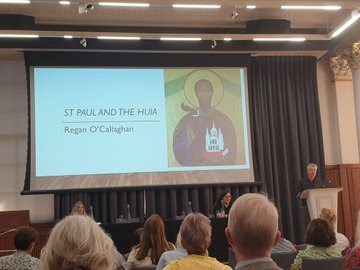


This one-day conference brought together speakers from a wide range of disciplines to explore the intersection of art, theology, and ecology. The event, at King's College London, fostered dialogue and collaboration between these fields and encouragement of innovative approaches.
The programme included short papers that explored the relationship between art, theology, and ecology in relation to three works of art from the National Gallery’s collection: Monet’s 'Flood Waters', Van Gogh’s 'Long Grass with Butterflies', and Ruysch’s 'Flowers in a Vase'. It also featured a reflection on the 'Saint Francis of Assisi' exhibition at the National Gallery, from co-curator Joost Joustra.The presentations were:
- Art At Creation’s Extinction: Ecological Theologies in Ruysch’s Flowers in a Vase and Regan O’Callaghan’s St Paul and the Huia – Steve Taylor
- ‘God Saw All That He Had Made and Found it Very Good’ – Melissa Raphael
- Letting Creation Speak: A Theology of Resonance and the Ecological Art of Vincent van Gogh – Wes Vander Lugt
- Nouvelle Theologie, Van Gogh, and Artist Practice – Anna Yearwood
- Reflections on St Francis of Assisi – Dr Joost Joustra, as Howard and Roberta Ahmanson Associate Curator of Art and Religion and one of the curators of the exhibition
- ‘We Are Water Spirits’: An Ecofeminist Theological Response to Monet’s Floodwaters in Conversation with South African Poetry – Ninnaku Oberholzer
------------------------------------------------------------------------------------------------------------
Water into Wine Band - Harvest Time.
Tuesday, 8 August 2023
In the Ille-et-Vilaine




Combourg is a small town in the north western part of Brittany. This small town is said to have risen from a small parish town when in the 6th century Irish monk, Saint Lunaire, built a church. Much later in the 11th century the archbishop of Dol-de-Bretagne built a château where his younger brother Riwallon lived. The town grew around three centres; the château, the feudal settlement that developed due to the protection of Riwallon and then a priory settlement that developed after Riwallon summoned Benedictine monks to the area.
Even though the town has changed over the centuries it is said that the part of the town centred on the former priory has remained mostly unchanged over the last 300 years. It has 16th century residences such as the Maison de la Lanterne, newer 19th and 20th century buildings and, with the former priory site, you can see there are buildings spanning over many different architectural periods.
Viewed from the peaceful waters of Lac Tranquille, the Château de Combourg majestically rises above the large trees and houses and buildings built on the lower water level. From this view Château de Combourg, with its turrets and chimneys looks more like a fairytale castle than the austere fortress that it really is. A romantic symbol, the medieval castle of Combourg is not only the birthplace of writer François-René de Chateaubriand but it is also one of the prettiest medieval fortresses in Brittany with its beautiful 25-hectare parc à l’anglaise (English-style park) designed by the Bühler brothers.
Constructed between the 12th and the 15th century to defend the Dol cathedral as well as the independence of Brittany, the Combourg castle originally belonged to the Du Guesclin family before becoming the stronghold of the Chateaubriand family. It is behind those high crenellated towers that the great writer and politician François-René de Châteaubriand spent his youth haunted by loneliness and ghosts. Immortalised in his book entitled Mémoires d’outre-tombe (Memoires from beyond the grave) the castle is is still inhabited today by the author's descendants.
He had bestowed on him the honour of being called the “most famous of all French romantic authors” and authored the Genius of Christianity in defense of the Catholic faith, then under attack during the French Revolution. Chateaubriand defends the wisdom and beauty of Christianity against the attacks on it by French Enlightenment philosophers and revolutionary politicians. In the work, Chateaubriand aims to prove "Christianity comes from God, because it is excellent". The book had an immense influence on nineteenth-century culture and not just on religious life. In fact, it might be said its greatest impact was on art and literature: it was a major inspiration for the Romantic movement.
The Church of Our Lady of the Assumption in Combourg was completely rebuilt in the 19th century on the site of the old 13th century church. It is built in Lanhélin granite, from 1859 to 1887. Two very important architects worked on the construction of the church. Charles Langlois participated in many enlargements of churches and he started work on this church; He also did a drawing of the bell tower, then he withdrew. The architect Arthur Regnault resumed the work. He was very well known in Ille-et-Vilaine, having made plans for 42 churches, including three in the canton of Combourg. He extended the transept and made the choir, the central square, and the chair plan. To him is owed the drawing of the high altar which is extraordinary.
The stained glass of the transept and the choir are of very good quality. They were made by the Parisian workshop Claudius Lavergne. On the right side are: Saint Roch, Saint Gilduin, Saint Catherine of Siena, Sainte Claire, Saint François-Xavier, Saint Francis of Assisi. On the left side are: Saint Lunaire (Leonarius), Saint Alphonse de Ligori, Saint Clotilde, Saint Cloud, Saint Francis of Amboise, Saint Maurice, Saint Michel Archangel. The right transept (south) has a huge glass roof, offered by the Count and Countess of Chateaubriand which contains in the crown of thorns forming a rosette, Mary's assumption. Below, is the tomb of the Virgin Mary around which the apostles are placed. Eight stained glass windows towards the bottom of the nave were made in 1966 by the Robert Briand workshop, Rennes (see below).
The architecture of the high altar is made to attract the gaze. It is of a Gothic style - flamboyant, with pinnacles, arrows, golden angels. The sun with a triangle in the centre evokes the Trinity, Father, Son and Holy Spirit. The altar table is marble with a reliquary. It is an impressive set, one of the most beautiful in Ille-et-Vilaine. There are two wooden statues on pillars of black marble at the entrance of the choir. A statue of Saint Gilduin, in stone, is to the left of the apse. An 18th century statue of the Virgin Mary is on the right of the altar in the south transept south. She was hidden during the French Revolution and returned to the parish church in 1945. There are significant traces of the Chateaubriand family: the concession of a chapel was made in 1883. There are the tombstones of Count Geoffroy de Chateaubriand and his wife, the great-nephews of François-René of Chateaubriand. A photocopy of their death certificates hangs on the wall above their tombstones. The statue of Saint Gilduin is the work of Count Geoffroy de Chateaubriand. In front of the church a trompe-l'œil represents Chateaubriand leaning against a window.
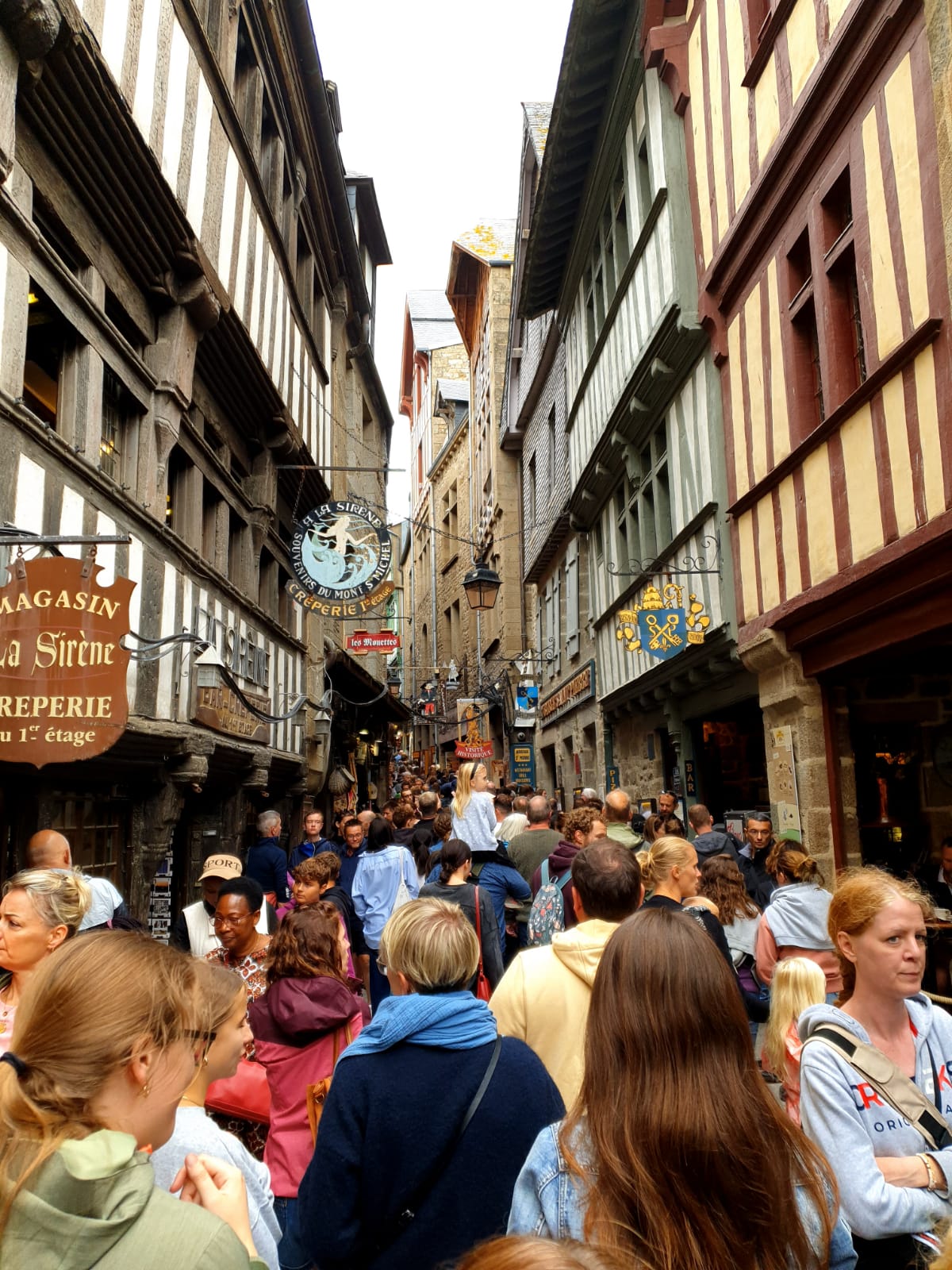
Part way up the Grande Rue of Mont St-Michel stands the small Église St-Pierre. It blends in with the stonework all around and is easy to miss—keep an eye out for it. Dating from the 15th and 16th centuries, St-Pierre is considered the parish church of Mont St-Michel (as opposed to the Abbey church or chapel). The church is dedicated to St-Pierre, or Saint Peter, the patron saint of fishermen. Given its location on Mont St-Michel, in the interior is a side chapel with a statue of Saint Michael slaying the dragon. The church provides a quiet oasis and a break from the hustle and bustle of the Grande Rue. Just above the Église St-Pierre is a small cemetery, and the church's tall bell tower is both a landmark and a reminder of passing time.
Art is Magic is the first French retrospective of Jeremy Deller, winner of the 2004 Turner Prize and Britain’s representative at the Venice Biennale in 2013. The exhibition is a city-wide co-production that takes place in the spaces of Frac Bretagne, La Criée Centre d’art contemporain and the Musée des beaux-arts de Rennes. Frac Bretagne, founded in 1981 by the National Government and the Brittany Regional Council, is a leading institution in the western region of France. Since 2012, it has been located in a building designed by the French architect Odile Decq in Beauregard park in Rennes. La Criée center for contemporary art is an exhibition space and generator of ideas, encounters and verbal exchange. It is dedicated to artistic experiment and the production and dissemination of the work of emerging or established artists from France and abroad, both on site and in other venues. The Rennes Museum of Fine Arts is, like most museums in France, a revolutionary creation. Constituted in 1794 from works seized in the religious and civil buildings of the city, the museum of fine arts however draws most of its wealth from the fabulous cabinet of curiosities of Christophe-Paul de Robien (1698-1756), President of the Parliament of Brittany. This encyclopedic collection was one of the richest in Europe: paintings, sculptures, Egyptian, Greek and above all Celtic antiquities, works of art from all continents, as well as an exceptional set of drawings featuring Leonardo da Vinci , Botticelli, Durer and Rembrandt.Robert Briand was born in Rennes, in a family where drawing and painting are “genetic” gifts. His grandfather, his father, and a brother have always drawn. As a young man, he studied at the Beaux-Arts in Rennes, where he was taught by the painter Mathurin Méheut. On leaving the Beaux-Arts, he perfected himself for a year by making copies. Then, he embarked on the art of stained glass and the restoration of stained glass windows, he undertook from 1945 many restorations of stained glass windows in particular for: the church of Carnac, cathedral of Vannes and Dol-de-Bretagne, Locmaria church in Belle-Ile en Mer, Notre Dame de Bonne Nouvelle church in Lorient, Notre Dame de Combourg church, Il du Ponan church, Saint Pierre church in Ploemeur, parish church of Saint Méloir des Bois, while continuing painting and decorating. He exhibited in France, in Quiberon, in Japan, in Germany, in Luxembourg, and in Canada. His first exhibition dates from 1944, in Paris "Aux Artistes français". His glass workshop was in Rennes at 8 rue Hoche. He says: "I did the Fine Arts during the years 1941,1942, and I had Mathurin Méheut as professor. I worked in the realization of stained glass, and I started painting, charcoal, and gouache, then oil painting. Beach scenes, horses, birds, and especially Gabiers."
--------------------------------------------------------------------------------------------------------
Jonathan Jackson + Enation - Young World's Riot.
Subscribe to:
Posts (Atom)