Wikio - Top Blogs - Religion and belief

Tuesday, 8 August 2023

In the Ille-et-Vilaine


 Combourg is a small town in the north western part of Brittany. This small town is said to have risen from a small parish town when in the 6th century Irish monk, Saint Lunaire, built a church. Much later in the 11th century the archbishop of Dol-de-Bretagne built a château where his younger brother Riwallon lived. The town grew around three centres; the château, the feudal settlement that developed due to the protection of Riwallon and then a priory settlement that developed after Riwallon summoned Benedictine monks to the area. 

Even though the town has changed over the centuries it is said that the part of the town centred on the former priory has remained mostly unchanged over the last 300 years. It has 16th century residences such as the Maison de la Lanterne, newer 19th and 20th century buildings and, with the former priory site, you can see there are buildings spanning over many different architectural periods.

Viewed from the peaceful waters of Lac Tranquille, the Château de Combourg majestically rises above the large trees and houses and buildings built on the lower water level. From this view Château de Combourg, with its turrets and chimneys looks more like a fairytale castle than the austere fortress that it really is. A romantic symbol, the medieval castle of Combourg is not only the birthplace of writer François-René de Chateaubriand but it is also one of the prettiest medieval fortresses in Brittany with its beautiful 25-hectare parc à l’anglaise (English-style park) designed by the Bühler brothers. 

Constructed between the 12th and the 15th century to defend the Dol cathedral as well as the independence of Brittany, the Combourg castle originally belonged to the Du Guesclin family before becoming the stronghold of the Chateaubriand family. It is behind those high crenellated towers that the great writer and politician François-René de Châteaubriand spent his youth haunted by loneliness and ghosts. Immortalised in his book entitled Mémoires d’outre-tombe (Memoires from beyond the grave) the castle is is still inhabited today by the author's descendants.

Chateaubriand was born at Saint Malo and the town boasts a large sculpture honouring the man. Saint-Malo was named for Maclou, or Malo, a Welsh monk who fled to Brittany, making his headquarters on the island, in the 6th century and probably became the first bishop of Aleth (Saint-Servan). The fortress at the northeast corner of the ramparts, built between the 14th and the 17th century, has four great round towers, one of which houses a museum devoted largely to famous mariners born in the city, including the 16th-century French navigator Jacques Cartier. Chateaubriand died in Paris during the Revolution of 1848 on 4 July and was buried, as he had requested, on the tidal island Grand Bé near Saint-Malo, accessible only when the tide is out. 

He had bestowed on him the honour of being called the “most famous of all French romantic authors” and authored the Genius of Christianity in defense of the Catholic faith, then under attack during the French Revolution. Chateaubriand defends the wisdom and beauty of Christianity against the attacks on it by French Enlightenment philosophers and revolutionary politicians. In the work, Chateaubriand aims to prove "Christianity comes from God, because it is excellent". The book had an immense influence on nineteenth-century culture and not just on religious life. In fact, it might be said its greatest impact was on art and literature: it was a major inspiration for the Romantic movement.

The Church of Our Lady of the Assumption in Combourg was completely rebuilt in the 19th century on the site of the old 13th century church. It is built in Lanhélin granite, from 1859 to 1887. Two very important architects worked on the construction of the church. Charles Langlois participated in many enlargements of churches and he started work on this church; He also did a drawing of the bell tower, then he withdrew. The architect Arthur Regnault resumed the work. He was very well known in Ille-et-Vilaine, having made plans for 42 churches, including three in the canton of Combourg. He extended the transept and made the choir, the central square, and the chair plan. To him is owed the drawing of the high altar which is extraordinary.

The stained glass of the transept and the choir are of very good quality. They were made by the Parisian workshop Claudius Lavergne. On the right side are: Saint Roch, Saint Gilduin, Saint Catherine of Siena, Sainte Claire, Saint François-Xavier, Saint Francis of Assisi. On the left side are: Saint Lunaire (Leonarius), Saint Alphonse de Ligori, Saint Clotilde, Saint Cloud, Saint Francis of Amboise, Saint Maurice, Saint Michel Archangel. The right transept (south) has a huge glass roof, offered by the Count and Countess of Chateaubriand which contains in the crown of thorns forming a rosette, Mary's assumption. Below, is the tomb of the Virgin Mary around which the apostles are placed. Eight stained glass windows towards the bottom of the nave were made in 1966 by the Robert Briand workshop, Rennes (see below). 

The architecture of the high altar is made to attract the gaze. It is of a Gothic style - flamboyant, with pinnacles, arrows, golden angels. The sun with a triangle in the centre evokes the Trinity, Father, Son and Holy Spirit. The altar table is marble with a reliquary. It is an impressive set, one of the most beautiful in Ille-et-Vilaine. There are two wooden statues on pillars of black marble at the entrance of the choir. A statue of Saint Gilduin, in stone, is to the left of the apse. An 18th century statue of the Virgin Mary is on the right of the altar in the south transept south. She was hidden during the French Revolution and returned to the parish church in 1945. There are significant traces of the Chateaubriand family: the concession of a chapel was made in 1883. There are the tombstones of Count Geoffroy de Chateaubriand and his wife, the great-nephews of François-René of Chateaubriand. A photocopy of their death certificates hangs on the wall above their tombstones. The statue of Saint Gilduin is the work of Count Geoffroy de Chateaubriand. In front of the church a trompe-l'œil represents Chateaubriand leaning against a window.

Robert Briand was born in Rennes, in a family where drawing and painting are “genetic” gifts. His grandfather, his father, and a brother have always drawn. As a young man, he studied at the Beaux-Arts in Rennes, where he was taught by the painter Mathurin Méheut. On leaving the Beaux-Arts, he perfected himself for a year by making copies. Then, he embarked on the art of stained glass and the restoration of stained glass windows, he undertook from 1945 many restorations of stained glass windows in particular for: the church of Carnac, cathedral of Vannes and Dol-de-Bretagne, Locmaria church in Belle-Ile en Mer, Notre Dame de Bonne Nouvelle church in Lorient, Notre Dame de Combourg church, Il du Ponan church, Saint Pierre church in Ploemeur, parish church of Saint Méloir des Bois, while continuing painting and decorating. He exhibited in France, in Quiberon, in Japan, in Germany, in Luxembourg, and in Canada. His first exhibition dates from 1944, in Paris "Aux Artistes français". His glass workshop was in Rennes at 8 rue Hoche. He says: "I did the Fine Arts during the years 1941,1942, and I had Mathurin Méheut as professor. I worked in the realization of stained glass, and I started painting, charcoal, and gouache, then oil painting. Beach scenes, horses, birds, and especially Gabiers."

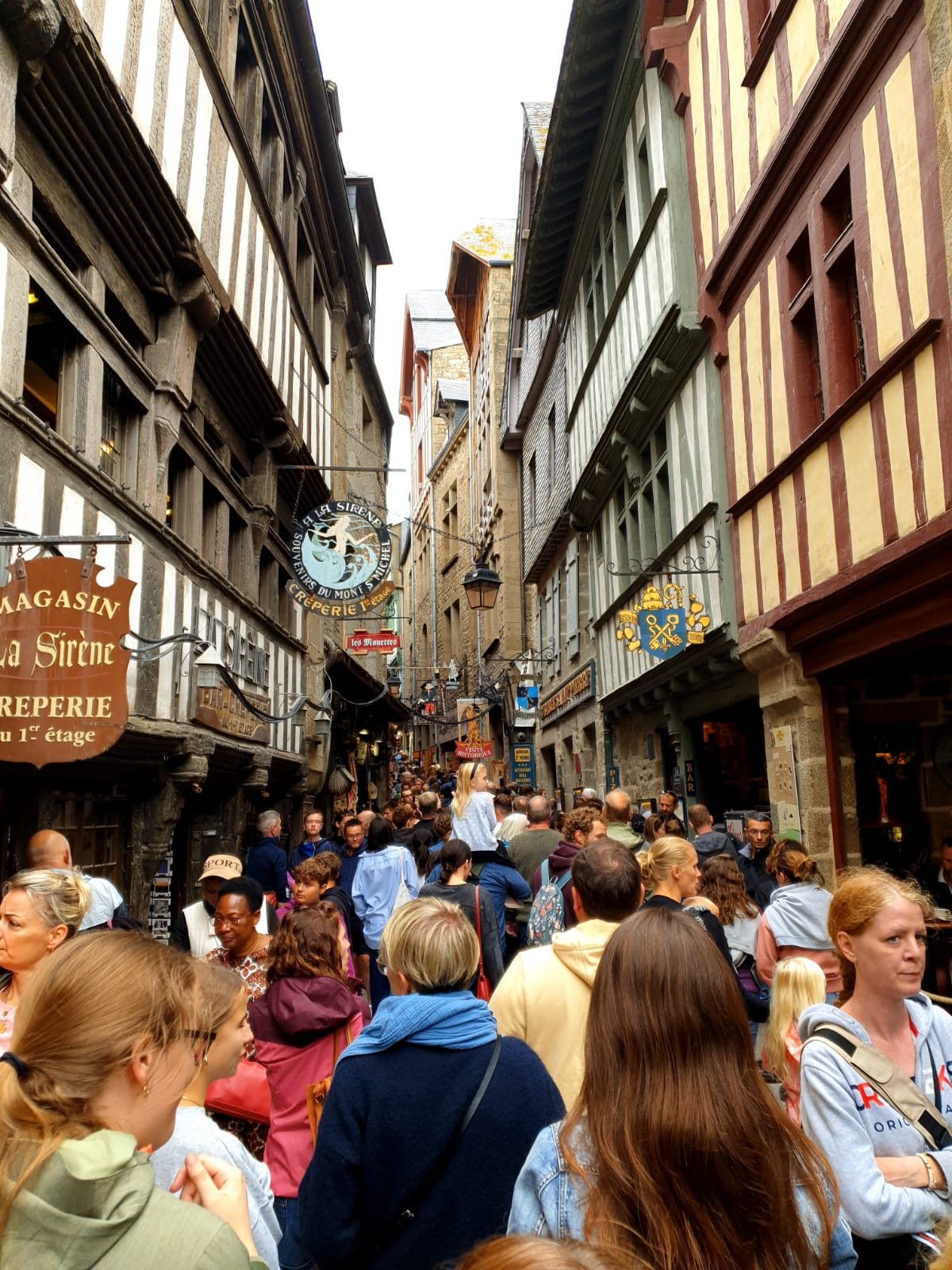
Part way up the Grande Rue of Mont St-Michel stands the small Église St-Pierre. It blends in with the stonework all around and is easy to miss—keep an eye out for it. Dating from the 15th and 16th centuries, St-Pierre is considered the parish church of Mont St-Michel (as opposed to the Abbey church or chapel). The church is dedicated to St-Pierre, or Saint Peter, the patron saint of fishermen. Given its location on Mont St-Michel, in the interior is a side chapel with a statue of Saint Michael slaying the dragon. The church provides a quiet oasis and a break from the hustle and bustle of the Grande Rue. Just above the Église St-Pierre is a small cemetery, and the church's tall bell tower is both a landmark and a reminder of passing time.

Art is Magic is the first French retrospective of Jeremy Deller, winner of the 2004 Turner Prize and Britain’s representative at the Venice Biennale in 2013. The exhibition is a city-wide co-production that takes place in the spaces of Frac Bretagne, La Criée Centre d’art contemporain and the Musée des beaux-arts de Rennes. Frac Bretagne, founded in 1981 by the National Government and the Brittany Regional Council, is a leading institution in the western region of France. Since 2012, it has been located in a building designed by the French architect Odile Decq in Beauregard park in Rennes. La Criée center for contemporary art is an exhibition space and generator of ideas, encounters and verbal exchange. It is dedicated to artistic experiment and the production and dissemination of the work of emerging or established artists from France and abroad, both on site and in other venues. The Rennes Museum of Fine Arts is, like most museums in France, a revolutionary creation. Constituted in 1794 from works seized in the religious and civil buildings of the city, the museum of fine arts however draws most of its wealth from the fabulous cabinet of curiosities of Christophe-Paul de Robien (1698-1756), President of the Parliament of Brittany. This encyclopedic collection was one of the richest in Europe: paintings, sculptures, Egyptian, Greek and above all Celtic antiquities, works of art from all continents, as well as an exceptional set of drawings featuring Leonardo da Vinci , Botticelli, Durer and Rembrandt.

--------------------------------------------------------------------------------------------------------

Jonathan Jackson + Enation - Young World's Riot.

Monday, 7 August 2023

Windows on the world (437)


Rennes, 2023

-----------------------------------------------------------------------------------------------------------

Willie Nelson & Sinéad O'Connor - Don't Give Up.

Saturday, 29 July 2023

Parish Quiet Day: Balance in our lives


We had a wonderful day at the Diocesan Retreat House in Pleasley today enjoying the stillness there during our annual Parish Quiet Day for the Wickford and Runwell Team Ministry. We were reflecting on Martha, Mary and Lazarus, Companions of Our Lord and, although I was the one reflecting on Lazarus, I was also reminded of an earlier reflection that I prepared about Martha and Mary - see here.

Our theme for the day was balance in our lives. This is what I shared regarding Lazarus (which is adapted from David Eiffert):

Fyodor Dostoevsky was a famous and talented author who was born in 1821 in St. Petersburg, Russia, and died in 1881. At 27, he became involved in a group of authors who got together regularly to discuss ideas. The ideas they discussed were considered treason. They were all arrested and imprisoned.

At Peter and Paul Fortress, Dostoevsky and his book club were sentenced to execution by firing squad. This was actually a mock execution but they didn’t know that. They were brought out, told they were going to be executed, taken to the spot, blindfolded, their crimes read out, the command was given, and the rifles were raised. Then, at the last moment, the execution was stopped and their sentence changed to four years hard labour in prison in Siberia and then four years in exile. Dostoyevsky writes a lot about this; how life was given back to him, how he had thought he was seconds away from being executed.

He was put in chains, put in a sleigh, as it was winter, and travelled to Siberia. He suffered with severe frostbite and for the rest of his life would have scars from the chains. As he was going into the prison, he was given a little New Testament. So, the only thing he had to read for four years was this New Testament. He read it over and over, especially the gospel of John, especially the story of Lazarus.

He came to believe in Jesus and, in his writings, he compares himself to Lazarus having a chance to live again. All his novels after that contain in some form, his Christian faith. Richard Harries notes that “He wrote that his faith had come ‘through a furnace of doubt’ and was focused on a deep attraction to the person of Jesus Christ.” “He entered deeply into the atheism of his age” so that, as Malcolm Jones has written, “in reading Dostoevskii we are in the presence of a genius wrestling with the problems of rethinking Christianity in the modern age.” 

His most famous novel is ‘Crime and Punishment’, a novel written in 1866. People say that ‘Crime and Punishment’ is a poor translation and that the title would be better translated ‘Crime and Consequences’.

The novel centres around the main character – a young man – named Raskolnikov who is a young intelligent, college student, very poor, and living in St. Petersburg. He is an atheist who believes that ‘exceptional men’ are beyond good and evil. Normal laws of morality do not apply to such men. He gives the example of Napoleon; a man who killed hundreds of thousands, perhaps millions, but is regarded a great man because he’s exceptional. Ordinary laws of morality didn’t apply to him. Raskolnikov believes he is an exceptional man and, to prove it, murders two old woman who are sisters. Obviously, he is a very lost young man.

Most of the novel is spent inside his head, as he is “locked up in a mental prison”. Ultimately, though, it’s a book about redemption. In the end, Raskolnikov - the murderer, the atheist, the man who convinced himself that he was beyond good and evil – finds redemption. He finds redemption in a young woman named Sonya, who has been forced into prostitution through poverty and to provide for two orphaned children. She is like Mary Magdalene, having found redemption and meaning in Christ.

In one of the most moving scenes, which is actually “the turning point in the book”, the two are together. Raskolnikov has not confessed his crime to Sonya, but will later. She has a bible laying on her table. Raskolnikov picks up the bible and asks, “Where is the part about Lazarus?” She flips to it and reads him the story of the raising of Lazarus, tears streaming down her face as she reads. Afterwards, he says “Do you believe this?” She replies, “With all my heart.” He’s not asking if she believes in the story, what he’s really asking is: “Do you believe there’s redemption for someone like me, a murderer?”

The closing sentence of this scene reads as follows:

Sonya says “That’s all about the raising of Lazarus.” she whispered. The candle was flickering out and the battered candlestick casting a dim light in this destitute room upon the murderer and the harlot strangely come together over the reading of the eternal book.

They are two lost souls on the road to redemption reading about the raising of Lazarus.

Eventually, Raskolnikov confesses his crime to Sonya; that he’s murdered the two older women. One of these women was Sonya’s close friend, Lizaveta. In fact, it was Lizaveta who gave the bible to Sonya. Sonya’s response to Raskolnikov is, “What have you done to yourself?” and she cries. She gives him her cross, which was also given her by Lizaveta, and urges him to confess in public and give himself up for arrest and punishment. Eventually, he wears her cross, goes to the police and confesses. He is convicted and sent to Siberia to prison. Sonya travels with him, to be near him and to visit him in prison. She is a picture of Christ, who doesn’t forsake him.

The closing paragraphs of the book read as follows:

Under his pillow lay the New Testament. He took the book out. It belonged to Sonya, it was the same one from which she had read to him about the raising of Lazarus. At the beginning, he had thought she would hound him with religion, forever talking about the Gospels and forcing books on him. But to his great amazement, she never once spoke of it, never once even offered him the New Testament. He had to ask her for it himself.

He had not even opened it yet. Nor did he open it now, but a thought flashed in his mind: “Can her convictions be mine?

Here begins a new account, the account of a man’s gradual renewal, the account of his gradual regeneration, his gradual transition from one world to another. It might make the subject of a new story—but our present story is ended.

So, the “reading of the Lazarus story to Raskolnikov and the wearing of the cross bear fruit as the novel proceeds.” “Raskolnikov’s state is effectively death; and the significance of Christ’s command to Lazarus, ‘Come forth!’ is obvious.” That is what happens to Raskolnikov as the novel proceeds. “The divine words addressed to Lazarus – ‘Come forth’ – have been heard” and Raskolnikov stumbles out of the death of his mental tomb.

Dostoyevsky who became a Christian because of the New Testament, especially the story of Lazarus, then wrote a book about a murderer finding redemption through the New Testament and the story of Lazarus. Neither Dostoevsky or Raskolnikov die physically, but their experiences lead them to a place where they see themselves as having been given new life in Christ. Their old story ends and a new story begins. That is what the story of Lazarus promises; when we’re scared and feel defeated – caught up in our despair, sorrow, anger, guilt, or shame, Jesus comes and brings redemption into our stories. That is what the story of Lazarus is about and that is how we regain balance after trauma, grief, imprisonment, shame, guilt or whatever. Dostoevsky knew this in his own life and described it in depth in the story of Raskolnikov.
  • I wonder whether you have ever been locked in a mental prison and how you got free.
  • I wonder what Jesus’ words to Lazarus, ‘Come forth’, mean for you.
  • I wonder whether there is a story in your life which needs to end, so another can begin.
(Adapted from David Eiffert, ‘The God who bleeds 8: Lazarus and Dostoevsky’ - https://gospelanchor.org/the-god-who-bleeds-8-lazarus-and-dostoyevsky/; with additional quotes from Richard Harries’ ‘Haunted By Christ’ and Rowan Williams’ ‘Dostoevsky: Language, Faith and Fiction’)

------------------------------------------------------------------------------------------------------------

Joy Oladokun - Breathe Again.

Windows on the world (436)


 Basildon, 2023

----------------------------------------------------------------------------------------------------------------

Glen Hansard - Brother's Keeper.

ArtWay Visual Meditation - Gwen John: The Nun

My latest Visual Meditation for ArtWay is on the work of Gwen John, which can currently be seen at Pallant House in the exhibition Gwen John: Art and Life in London and Paris:

"The wisdom of quietude and purity which derives from paying prayerful attention is what we find expressed throughout John’s work and is the great gift that she offers to us."

My preview of Gwen John: Art and Life in London and Paris for Artlyst can be found here and my review of Reunited: Gwen John, Mere Poussepin and the Catholic Church for Art+Christianity can be found here. See also 20th Century Women Artists Challenging Conventions In Britain here.

My visual meditations for ArtWay include work by María Inés Aguirre, Giampaolo Babetto, Marian Bohusz-Szyszko, Alexander de Cadenet, Christopher Clack, Marlene Dumas, Terry Ffyffe, Jake Flood, Antoni Gaudi, Nicola Green, Maciej Hoffman, Lakwena Maciver, S. Billie Mandle, Giacomo Manzù, Sidney Nolan, Michael Pendry, Maurice Novarina, Regan O'Callaghan, Ana Maria Pacheco, John Piper, Nicola Ravenscroft, Albert Servaes, Henry Shelton, Anna Sikorska, Alan Stewart, Jan Toorop, Andrew Vessey, Edmund de Waal and Sane Wadu.

My Church of the Month reports include: All Saints Parish Church, Tudeley, Aylesford Priory, Canterbury Cathedral, Chapel of St. Thérèse of the Child Jesus and the Holy Face, Hem, Chelmsford Cathedral, Churches in Little Walsingham, Coventry Cathedral, Église de Saint-Paul à Grange-Canal, Eton College Chapel, Lumen, Metz Cathedral, Notre Dame du Léman, Notre-Dame de Toute Grâce, Plateau d’Assy,Romont, Sint Martinuskerk Latem, St Aidan of Lindisfarne, St Alban Romford, St. Andrew Bobola Polish RC Church, St. Margaret’s Church, Ditchling, and Ditchling Museum of Art + Craft, St Mary the Virgin, Downe, St Michael and All Angels Berwick and St Paul Goodmayes, as well as earlier reports of visits to sites associated with Marian Bohusz-Szyszko, Marc Chagall, Jean Cocteau, Antoni Gaudi and Henri Matisse.

Blogs for ArtWay include: Congruity and controversy: exploring issues for contemporary commissions; Ervin Bossanyi: A vision for unity and harmony; Georges Rouault and André Girard: Crucifixion and Resurrection, Penitence and Life Anew; Photographing Religious Practice; Spirituality and/in Modern Art; and The Spirituality of the Artist-Clown.

Interviews for ArtWay include: Sophie Hacker, Peter Koenig and Belinda Scarlett. I also interviewed ArtWay founder Marleen Hengelaar Rookmaaker for Artlyst.

I have reviewed: Art and the Church: A Fractious Embrace, Kempe: The Life, Art and Legacy of Charles Eamer Kempe and Jazz, Blues, and Spirituals.

Other of my writings for ArtWay can be found here. My pieces for Church Times can be found here. Those for Artlyst are here and those for Art+Christianity are here.

------------------------------------------------------------------------------------------------------------

Sinead O'Connor - Take Me To Church.

Wednesday, 26 July 2023

The indiscriminate sowing of God's love

Here's the reflection I shared at St Andrew's Wickford this morning:

I wonder whether you have noticed the strange thing about the Parable of the Sower (Matthew 13. 1 - 17); something that does not make sense from the point of view of an efficient farmer. Jesus says that the parables, the stories he tells, are not easy to understand and there is an aspect of this parable that doesn’t seem to make sense from a farming point of view.

What I am thinking of is the indiscriminate nature of the way the sower sows the seed. The sower scatters the seed on the path, on the rocky ground and among the thorn bushes, as well as in the good soil. Any farmer would know that the seed falling on the path, on the rocky ground and among the thorn bushes is going to be wasted because it is not going to grow well and yet the sower goes ahead regardless. What sort of farmer wastes two-thirds of the seed like that?

Was it because the sower was uninformed about the principles of farming or unconcerned about the harvest? Perhaps, instead, the actions of the sower are telling us something significant about the nature of God. The seed was sown indiscriminately, even recklessly. Those places that were known to be poor places for seed to grow were nevertheless given the opportunity for seeds to take root. Doesn’t this suggest to us the indiscriminate and reckless nature of God’s love for all?

The seed is the Word of the Kingdom and the Word, John’s Gospel tells us is Jesus himself. So Jesus himself, this parable, seems to suggest is being scattered throughout the world (perhaps in and through the Body of Christ, the Church).

Some parts of the Body of Christ find themselves in areas like the path where the seed seems to be snatched away almost as soon as it is sown. That may seem a little like our experience in a culture where people seem resistant towards Christian faith and the media revel in sensationalising the debates that go on within the Church.

Other parts of the Body of Christ are in areas like the rocky ground where it is hard for the seed to take root and grow. We might think about situations around the world where Christians experience persecution or where the sharing of Christian faith is illegal.

Other parts of the Body of Christ are amongst the thorn bushes where the worries of this life and the love of riches choke the seed. Again, we might think about our situation and the way in which our relatively wealthy, consumerist society makes people apathetic towards Christian faith.

Finally, there is the good soil where the seed grows well and the yield can be as much as a hundred fold. Again, there are parts of the Body of Christ who find themselves in good soil. “Currently, there are more than 2.3 billion affiliated Christians (church members) worldwide. That number is expected to climb to more than 2.6 billion by 2025 and cross 3.3 billion by 2050. But it’s not just numerical growth, Christianity is growing in comparison to overall population. More than one-third (33.4 percent) of the 7.3 billion people on Earth are Christians. That’s up from 32.4 percent in 2000. By 2050, when the world population is expected to top 9.5 billion people, 36 percent will be Christians. Those positive numbers are due to explosive growth in the global south. Only in Europe and North America is Christianity growing at a less than one percent rate. In Africa and Asia, the rate is currently more than double and will continue to climb.”

We can rejoice in that growth, although it is not an experience we currently share in the UK, and can support its continued growth through our mission giving and partnerships. We should not be discouraged because that kind of growth is not our current experience in the UK. Growth does still occur even when we are on the path or the rocky ground or among the thorn bushes.

For example, in our most recent Annual Report, we noted that much of “our mission and outreach, including Messy Church (bi-monthly on Saturdays), the Gateway foodbank (Ecumenical initiative), Open the Book (Schools work), ministry in care homes (monthly services in four homes), and other initiatives, is enabled by teams drawn from across our three churches” and we “are increasingly developing mission initiatives related to our context including: Contemplative Commuters - a Facebook group for any commuter wanting quiet reflective time and content on their journeys to and from work; Saturday Solace - 10-minute reflection and Christian mindfulness sessions between 10.00 am & 12 noon on Saturdays at St Andrew’s; and Unveiled – an arts and performance evening which attracted an average of 25 people per event, with events including artist talks, concerts, dance performances, exhibition viewings, heritage talks, lectures, and an Open Mic Night.” Seeds have taken root even in the hard ground that is our current experience overall here in the UK.

This happens because God’s love is indiscriminate wanting all to have the opportunity to receive the seed of his Word. He sows Jesus, the Body of Christ, into the poor soil as well as the good soil knowing that some seed will not grow or be as fruitful but wanting all to have the opportunity to receive the seed of his Word. He knows too that ground which at one time was perhaps rocky ground can become good soil in which spectacular growth can occur. In this country we need to pray that our culture which currently feels like the path or the thorn bushes will in time also become good soil once again and, in the meantime, celebrate that growth that does occur on the path and among the thorn bushes.

---------------------------------------------------------------------------------------------------------

Michael McDermott & Heather Horton - A Wall I Must Climb.