I have had a review published, in the Journal of Theological Studies, of Wording a Radiance: Parting Conversations on God and the Church by Daniel W. Hardy, with Deborah Hardy Ford, Peter Ochs, and David F. Ford (Wording a Radiance: Parting Conversations on God and the Church. By DANIEL W. HARDY with DEBORAH HARDY FORD, PETER OCHS, and DAVID F. FORD. Jonathan Evens .
The Journal of Theological Studies 2011; doi: 10.1093/jts/flr058)
The book derives from the moment when theologian Daniel W. Hardy was given six months to live. As part of his response he initiated specific conversations with his daughter, Deborah Hardy Ford; his friend and philosopher Peter Ochs; and his son-in-law and theologian, David F. Ford. It is these conversations which form the basis for the book and re-present the final flowering of Hardy’s theology. In what is a fascinating development and summary of Hardy's theology, he seeks to articulate the radiance seen when the divine floods in without inhibition and things and people are knit together in the divine abundance.
My review can be read by clicking here.
-----------------------------------------------------------------------------------
John Rutter - Requiem Aeternam.

Monday, 18 July 2011


Thursday, 14 July 2011
New local mural


Goodmayes Methodist Church has added to the range of church and community art in the Goodmayes and Seven Kings area with a new mural undertaken by students from the graphic design department of Barking College. The mural, which depicts the fruit of the Spirit, has been installed this week and will be officially unveiled on Saturday at 11.00am.
The mural adds to the Downshall Primary School mural and work in churches which is highlighted through our local Church Art Trail. These works will in time be joined by a mosaic and sculpture in the community garden at St John's Seven Kings.
-------------------------------------------------------------------------------------------
The Lightning Seeds - Pure.
Meeting Eileen Cooper
It was a pleasure to meet Eileen Cooper this morning when she visited the commission4mission exhibition in the Crypt Gallery of St Martin-in-the-Fields, at the invitation of Sergiy Shkanov.
Over three decades Cooper has developed an "evolving imaginative narrative" expressed through a "highly personal style always reflects stages in her own life that readily associate with archetypal themes and mythologies." Her playful, "tender, stylised paintings of women and couples are concerned with the fundamental human processes of birth, growth and nourishment." Her myth-making places her in a line of artists such as Ken Kiff and Albert Herbert, both of whom she knew. We spoke about her experience of working with Herbert, with whom, at one stage, she collaborated on paintings.
Cooper is one of the major British figurative artists who emerged in the mid 1980's, many of whom featured in The New British Painting exhibition, organized by the Contemporary Arts Center Cincinnati, which consisted of new paintings from a new generation of English and Scottish young artists. I first came across her work through the Benjamin Rhodes Gallery, where she exhibited from the late 1980s, and have appreciated the development of her work since. She became a Royal Academician in 2001 and exhibits regularly in the Summer Exhibition.
Other artists visiting the commission4mission exhibition have included Geoff Tune, Miriam Kendrick, Christopher Clack, and Chandrakumar Sukumaran, with the latter two becoming new commission4mission members.
-----------------------------------------------------------------------------------------------
Carleen Anderson - Mama Said.
Over three decades Cooper has developed an "evolving imaginative narrative" expressed through a "highly personal style always reflects stages in her own life that readily associate with archetypal themes and mythologies." Her playful, "tender, stylised paintings of women and couples are concerned with the fundamental human processes of birth, growth and nourishment." Her myth-making places her in a line of artists such as Ken Kiff and Albert Herbert, both of whom she knew. We spoke about her experience of working with Herbert, with whom, at one stage, she collaborated on paintings.
Cooper is one of the major British figurative artists who emerged in the mid 1980's, many of whom featured in The New British Painting exhibition, organized by the Contemporary Arts Center Cincinnati, which consisted of new paintings from a new generation of English and Scottish young artists. I first came across her work through the Benjamin Rhodes Gallery, where she exhibited from the late 1980s, and have appreciated the development of her work since. She became a Royal Academician in 2001 and exhibits regularly in the Summer Exhibition.
Other artists visiting the commission4mission exhibition have included Geoff Tune, Miriam Kendrick, Christopher Clack, and Chandrakumar Sukumaran, with the latter two becoming new commission4mission members.
-----------------------------------------------------------------------------------------------
Carleen Anderson - Mama Said.
Wednesday, 13 July 2011
Modest Fashion
I recently met up with Professor Reina Lewis, Artscom Centenary Professor of Cultural Studies at the London College of Fashion, who is running a very interesting project looking at Modest Fashion.
Faith-based Fashion and Internet Retail studies the growing market for modest clothing among women of the three Abrahamic faiths: Islam, Christianity and Judaism. With increasing numbers of women who are religiously motivated to dress modestly, online retailing is making it easier for women who dress this way to combine fashion with faith.
For women seeking fashionable ways to dress modestly, like the growing numbers of Muslim women who obtain modest clothing over the web, the internet has been indispensible. Other faith groups that have dress requirements show similar developments in the commercial production and distribution of clothing: observant and orthodox Jews, and some Christian groups like the Church of the Latter-day Saints (Mormons).
Internet marketing has been invaluable for consumers who want specialist items and has reduced overheads for specialist producers and retailers. This has been especially important in clothes marketing, where consumers seeking non-standard items can now shop online to replace or augment the high street. In most cases, internet marketing allows brands to reach beyond their immediate location, serving consumers internationally. Women are now far more likely to be able to dress in line with their sense of piety but still in fashion.
The project has three main aims:
1. To discover if the expansion and diversification through e-commerce of clothes for modest dressing is creating a new retail and style category of 'modest fashion' that has the potential to transcend specific religions and reach out to consumers across faith groups.
2. To explore the extent to which 'modest fashion' is beginning to be recognisable as a form of dressing adopted by women from different faith communities.
3. To evaluate the social and personal impact of modest fashion for the future development of interfaith dialogue and religious/secular community relations.
---------------------------------------------------------------------------------------
Jennifer Warnes - Famous Blue Raincoat.
Faith-based Fashion and Internet Retail studies the growing market for modest clothing among women of the three Abrahamic faiths: Islam, Christianity and Judaism. With increasing numbers of women who are religiously motivated to dress modestly, online retailing is making it easier for women who dress this way to combine fashion with faith.
For women seeking fashionable ways to dress modestly, like the growing numbers of Muslim women who obtain modest clothing over the web, the internet has been indispensible. Other faith groups that have dress requirements show similar developments in the commercial production and distribution of clothing: observant and orthodox Jews, and some Christian groups like the Church of the Latter-day Saints (Mormons).
Internet marketing has been invaluable for consumers who want specialist items and has reduced overheads for specialist producers and retailers. This has been especially important in clothes marketing, where consumers seeking non-standard items can now shop online to replace or augment the high street. In most cases, internet marketing allows brands to reach beyond their immediate location, serving consumers internationally. Women are now far more likely to be able to dress in line with their sense of piety but still in fashion.
The project has three main aims:
1. To discover if the expansion and diversification through e-commerce of clothes for modest dressing is creating a new retail and style category of 'modest fashion' that has the potential to transcend specific religions and reach out to consumers across faith groups.
2. To explore the extent to which 'modest fashion' is beginning to be recognisable as a form of dressing adopted by women from different faith communities.
3. To evaluate the social and personal impact of modest fashion for the future development of interfaith dialogue and religious/secular community relations.
---------------------------------------------------------------------------------------
Jennifer Warnes - Famous Blue Raincoat.
Monday, 11 July 2011
Windows on the world (152)

Birmingham, 2010
----------------------------------------------------------------------------------
The Mighty Wah - Come Back.
Saturday, 9 July 2011
The News of the World as soap opera
Ian Jack, in today's Guardian, suggests that with the closure of the News of the World "the great age of Britain's popular press is drawing squalidly to its close."
What he calls the great age of the popular press, he characterises in two vignettes. First, the owning by the News of the World of "what the Victorians knew as our baser selves" through the paper's specialisation in "salacious accounts of sex and violence." Second, the "enterprising devotion" of the popular press to the frivolous as characterised by Lord Northcliffe, who "spread the word to his staff like a preacher: roughly, to subvert the words of Philip Larkin, readers were forever surprising a hunger in themselves to be more trivial."
"Crime exclusives," Northcliffe noted: "are noticed by the public more than any other sort of news. They attract attention, which is the secret of newspaper success. They are the sorts of dramatic news the public always affects to criticise but is always in the greatest hurry to read ... Watch the sales during a big murder mystery, especially if there is a woman in it. It is a revelation of how much the public is interested in realities, action and mystery. It is only human."
This "only human" principle of feeding our baser selves with a daily diet of reality, action, sex, violence, and the trivial has led, in time, to the ongoing reality soap opera which forms the substance of the redtops, celebrity mags, reality TV, and online chats/tweets encompassing as it does the 'who has been seen where', 'who is with who', 'who has broken up with who', 'who has attacked who', and 'who has cracked up and/or rehabilitated' of the real (and, sometimes, manufactured for money) lives of celebrities, entertainers, politicians, sportstars and victims of serious crime.
This ongoing soap opera which blurs the boundaries between fact and fiction has become 'the news' for many, if not most of us. In what Ian Jack calls "the great age of Britain's popular press," it was the redtops which provided this daily diet to millions of us but, with the advent of rolling news and the internet, the ability of the redtops to deliver, sufficiently quickly, the public face of this celebrity reality soap opera has diminished pushing the News of the World into its alleged illegal focus on the secret face of the celebrity reality soap opera.
This soap opera now provides our sense of the sacred. Gordon Lynch, writing in the same edition of the Guardian, explains that: "Coverage of the death of Baby P or processions at Wootton Bassett honouring soldiers killed in action momentarily bind their audiences together in strong, moral sentiment, either through their recognition of a particular sacred form or horror at its pollution ... The moral credibility of news media lies partly in their ability to work with the grain of sacred meanings shared with their audience ... The degree to which the News of the World profaned what many people take as sacred is unprecedented in post-war media history ... The tipping point came when the actions of people associated with the News of the World became profanations, an evil polluting the cherished sacred significance embodied in the stories of Milly Dowler, Holly Wells and Jessica Chapman, and the 7/7 bombings."
The death of the News of the World, however, does not diminish in any way the celebrity reality soap opera. Instead, it feeds it. Rupert Murdoch, Rebekah Brooks and Andy Coulson have all become part of the story in ways that they never intended - indeed they are 'the story' for the moment - but, because we are fed by this ongoing soap opera and therefore need those who become stories in it, I predict that - as in the career of Piers Morgan - the story will rehabilitate them at some point in the future and by means of some other role in the soap opera, as long as they come to accept that they have, by foul means, become characters within the ongoing celebrity reality soap opera that they themselves have helped to perpetuate.
-----------------------------------------------------------------------------------
Echo and The Bunnymen - The Puppet.
What he calls the great age of the popular press, he characterises in two vignettes. First, the owning by the News of the World of "what the Victorians knew as our baser selves" through the paper's specialisation in "salacious accounts of sex and violence." Second, the "enterprising devotion" of the popular press to the frivolous as characterised by Lord Northcliffe, who "spread the word to his staff like a preacher: roughly, to subvert the words of Philip Larkin, readers were forever surprising a hunger in themselves to be more trivial."
"Crime exclusives," Northcliffe noted: "are noticed by the public more than any other sort of news. They attract attention, which is the secret of newspaper success. They are the sorts of dramatic news the public always affects to criticise but is always in the greatest hurry to read ... Watch the sales during a big murder mystery, especially if there is a woman in it. It is a revelation of how much the public is interested in realities, action and mystery. It is only human."
This "only human" principle of feeding our baser selves with a daily diet of reality, action, sex, violence, and the trivial has led, in time, to the ongoing reality soap opera which forms the substance of the redtops, celebrity mags, reality TV, and online chats/tweets encompassing as it does the 'who has been seen where', 'who is with who', 'who has broken up with who', 'who has attacked who', and 'who has cracked up and/or rehabilitated' of the real (and, sometimes, manufactured for money) lives of celebrities, entertainers, politicians, sportstars and victims of serious crime.
This ongoing soap opera which blurs the boundaries between fact and fiction has become 'the news' for many, if not most of us. In what Ian Jack calls "the great age of Britain's popular press," it was the redtops which provided this daily diet to millions of us but, with the advent of rolling news and the internet, the ability of the redtops to deliver, sufficiently quickly, the public face of this celebrity reality soap opera has diminished pushing the News of the World into its alleged illegal focus on the secret face of the celebrity reality soap opera.
This soap opera now provides our sense of the sacred. Gordon Lynch, writing in the same edition of the Guardian, explains that: "Coverage of the death of Baby P or processions at Wootton Bassett honouring soldiers killed in action momentarily bind their audiences together in strong, moral sentiment, either through their recognition of a particular sacred form or horror at its pollution ... The moral credibility of news media lies partly in their ability to work with the grain of sacred meanings shared with their audience ... The degree to which the News of the World profaned what many people take as sacred is unprecedented in post-war media history ... The tipping point came when the actions of people associated with the News of the World became profanations, an evil polluting the cherished sacred significance embodied in the stories of Milly Dowler, Holly Wells and Jessica Chapman, and the 7/7 bombings."
The death of the News of the World, however, does not diminish in any way the celebrity reality soap opera. Instead, it feeds it. Rupert Murdoch, Rebekah Brooks and Andy Coulson have all become part of the story in ways that they never intended - indeed they are 'the story' for the moment - but, because we are fed by this ongoing soap opera and therefore need those who become stories in it, I predict that - as in the career of Piers Morgan - the story will rehabilitate them at some point in the future and by means of some other role in the soap opera, as long as they come to accept that they have, by foul means, become characters within the ongoing celebrity reality soap opera that they themselves have helped to perpetuate.
-----------------------------------------------------------------------------------
Echo and The Bunnymen - The Puppet.
50/50 Auction and the Big Society


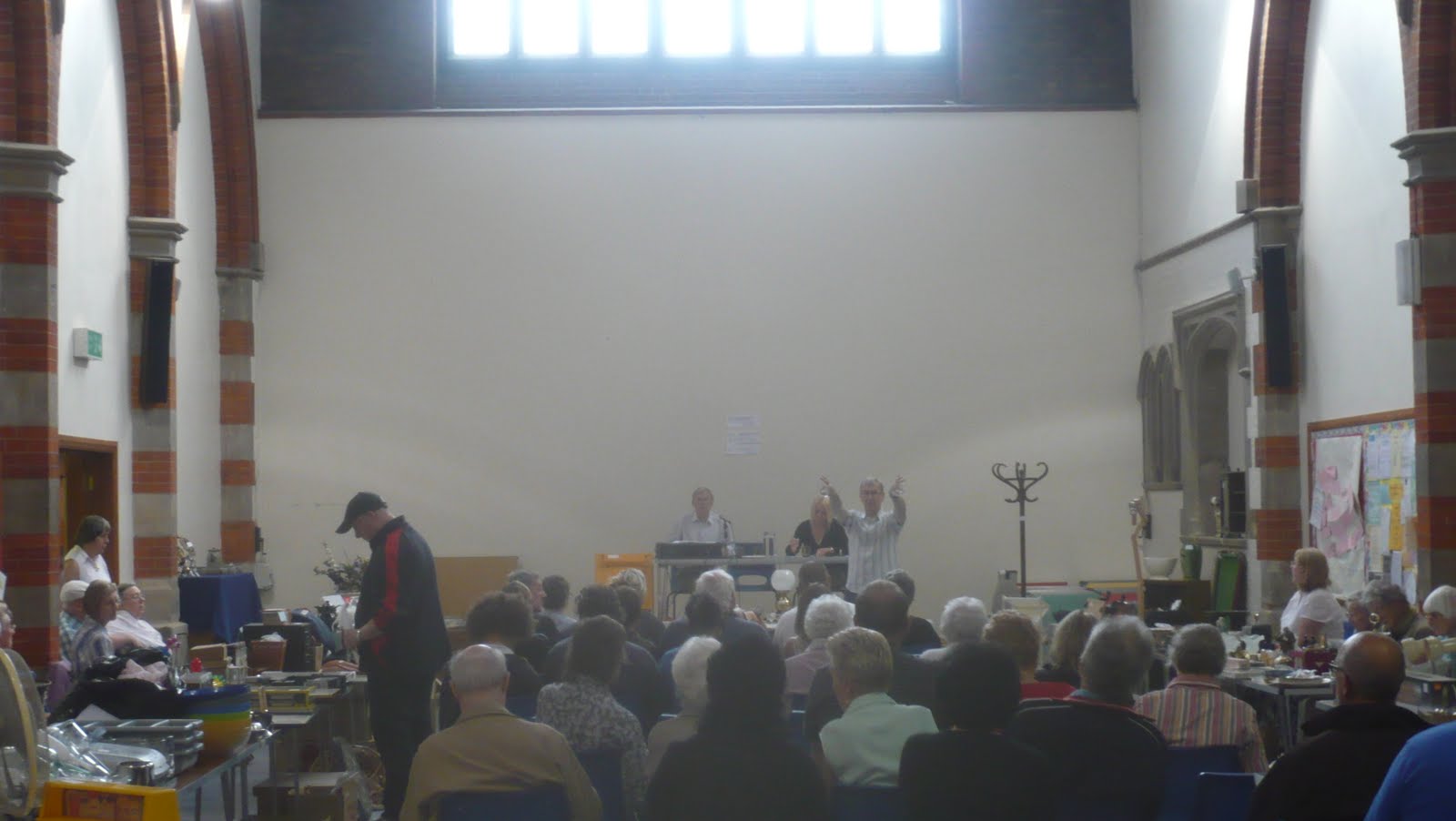
St John's Seven Kings held its 50/50 Auction today where 50% of the sale price comes to the church. Although we had stopped holding annual auctions and hadn't held an auction for three years, this one proved very successful.
This event, as with our other social and fundraising events, is an illustration of some of the reasons why churches generate community and contribute substantially to the Big Society. Those who organised the event gave a significant amount of their time in order to arrange a successful community event that generated funds for a community group and facility. The 220+ lots were all items that were being recycled by being sold and all sellers gave 50% of their income to the church. The event also brought together a wide range of different people from our local community to meet together for a shared activity which included shared food and conversation over the viewing of lots and lunchtime refreshments.
It would of course be possible to take a cynical line about our event seeing it simply as a money making exercise which is therefore tapping into consumerism or to argue a purist line that such fundraising distracts from the Church's core mission and reinforces stereotypes of the Church as an organisation which is always asking for money. Despite this event being a combination of gift and exchange economies, both these views ignore the significant levels of giving involved in such events and the degree of community engagement and cohesion that a regular programme of such events provide. Neither of these would be features of more commercially orientated sales or auctions and both are core elements of committed Christian living.
Earlier in the week, at Redbridge's Big Society mapping event, I quoted Jonathan Sacks, the Chief Rabbi, as saying “Religion creates community, community creates altruism and altruism turns us away from self and towards the common good ... There is something about the tenor of relationships within a religious community that makes it the best tutorial in citizenship and good neighbourliness.” Today's event is one small example of the point he makes being realised in practice and should be celebrated as such, particularly in a week where the main news item has forcefully demonstrated the corrupting and corrosive effect on personal, community and societal relationships of rampant aggressive consumerism.
---------------------------------------------------------------------------------------------
Sufjan Stevens-All Delighted People
Subscribe to:
Posts (Atom)