Wikio - Top Blogs - Religion and belief
Showing posts with label westminster abbey. Show all posts

Friday, 19 April 2019

The Cross on Victoria Street – Good Friday Walk of Witness


It was a pleasure to represent Churches Together in Westminster today for The Cross on Victoria Street – Good Friday Walk of Witness. The walk went from Methodist Central Hall Westminster to Westminster Cathedral and Westminster Abbey, with the Cross carried by people from The Passage and accompanied by the CEO, Mick Clarke

Reflections were given by The Venerable David Stanton, The Rt Rev John Wilson, Rev Preb Rose Hudson-Wilkin. The Rt Rev John Wilson shared two images. The first being the shimmering cross in the devastation of Notre-Dame; an image of God's love seen in the suffering of the Cross. The second being the sun glinting on an unopened tin of sardines given to torment Magda Elefant in Auschwitz which led to her rescue by the Allies; the instrument of torment become the means of salvation. Rev Preb Rose Hudson-Wilkin said, 'Today must not be a 'Holy Huddle. If the cross is going to make any sense then we must witness to what the cross is about.'

This Walk of Witness is held in association with The Passage, Churches Together in Westminster, and the Ecumenical Society of The Blessed Virgin Mary.

See photographs here and here.

-----------------------------------------------------------------------------------------------

Graham Kendrick - The Servant King.

Friday, 19 January 2018

Lumiere London 2018: Westminster


------------------------------------------------------------------------------------------------

Bruce Cockburn - Northern Lights.

Tuesday, 9 January 2018

London Lumiere 2018 and churches


London Lumiere 2018 launches on the evening of Thursday 18 January and runs over four nights through to Sunday 21 January.

Lumiere first came to central London in January 2016 and wowed visitors with light installations placed across the city centre. This year the show is even bigger with installations on the Southbank and at Waterloo, Westminster, Mayfair, The West End and Kings Cross. Visitor numbers are expected to reach over 2m. The works are illuminated from 17.30 – 22.30 each night.

St Martin-in-the-Fields will be hosting Echelle, by Ron Haselden – a neon pink illuminated ladder that will be attached to the spire. Dreamlike, it will disappear into the ether above like a glowing stairway to heaven. Haselden (France/UK) is an international artist working with light, electronics, sound, film and other materials. He lives and works in London and in Plouër-sur-Rance, France. The work was originally commissioned for the Salisbury Festival in 2000. The Café in the Courtyard will open from 17.00 – 21.00 Thurs – Sat and from 16.00 – 19.00 on Sunday and will be serving homemade soup, paninis, hot drinks, snacks and licensed refreshments. 

Experience a soothing meditation connecting colour, sound, light and texture through UK artist Chris Plant’s Harmonic Portal. In this new work at St James Piccadilly, Plant seeks to piece together our fragmented world. The soundtrack is derived from the frequencies of red, green, and blue light, creating a synesthetic colour organ that explores and magnifies both the inside and the outside of the frame. https://www.instagram.com/harmonicportal/.

See Tracy Emin’s neon work Be Faithful to Your Dreams, in St James’s Churchyard during Lumiere London 2018. London-born Emin is one of Britain’s most celebrated contemporary artists. Since the early 1990s, she has used her own life as inspiration for her art, exposing the most harrowing and intimate details of her personal history through needlework, sculpture, drawing, photography, painting, and of course neon.

Emin (UK) uses neon to illuminate emotions, memories, feelings and ideas in graphic messages, sentences and poems. Translating handwriting and drawings into blown and bent neon tubing presents technical challenges, and the choice of words or images is crucial. As the artists notes: “Neon is light, so, can you live with this thing glowing and the chemicals moving all the time?”

Experience moving tales through My Light is Your Light, a tribute from artist Alaa Minawi (Palestine/Lebanon) to Syrian refugees, in St James’s Churchyard (viewed from Church Place).

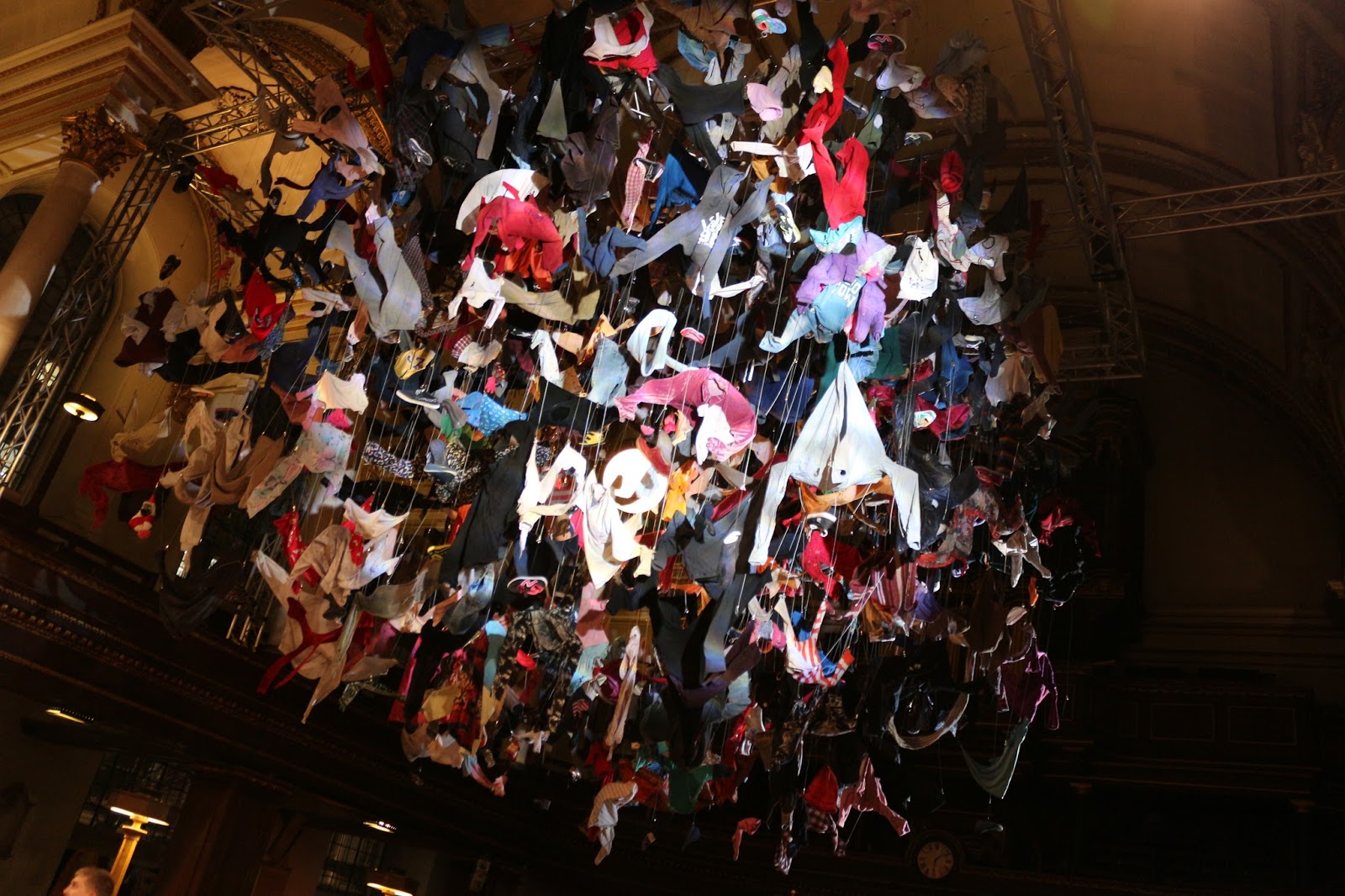
This installation pays tribute to Syrian refugees and the terrible conditions they have experienced in their migrations across the world. The work was realised after Alaa Minawi worked for three years as an interpreter for Syrian, Iraqi, Sudanese and Somali refugees. Also see Suspended, an installation artwork by Arabella Dorman inside St James's Church Piccadilly.

He interpreted the final interviews that took place between the refugees and a DHS (Department of Homeland and Security) officer within which they received their final resettlement decisions. In these interviews, the refugees tell their traumatic stories, what they have been through and the reasons behind their displacement. Minawi interpreted interviews for more than 1,000 families and felt the need to express what he had heard. These stories are now embodied in art, the fragile outlines of a family glowing in the darkness.

Minawi says: “I would like people to know that these are not refugees. As an artist, it is important to highlight the fact that we need to view them as people who were forced to leave their homes. That is a much more powerful approach…. We have to go to the real meaning of the word 'refugee' without the fears that are currently stigmatising it.”

See French digital artist Patrice Warrener’s magnificent The Light of the Spirit (Chapter 2), at Westminster Abbey. Warrerner created one of the most popular installations during Lumiere London 2016; and for the second instalment, in 2018, he brings the facade of the abbey’s Great West Gate to life by incorporating sculptural details in his distinctive colourful style.

Bathing Westminster Abbey in colour and light, the projection highlights the architectural mastery of the building, enabling us to witness the glorious statuettes of 20th-century martyrs reimagined. Usually perched unobtrusively on the facade above the Great West Doors, the figures are once again transformed into kaleidoscopic illuminations, a tribute to their lives in technicolour.

Warrener is recognised worldwide for his chromolithe projection system. His polychromatic illuminations on buildings give the impression of a spectacularly bright painted surface. He has designed more than 80 astounding creations and continues to share this unique art form across the globe.

Discover how simple technology is changing thousands of lives across the world with The Rose at Westminster Cathedral. Lumiere London celebrates light in all its forms but for many people access to light is a luxury, and Mick Stephenson's installation with Electric Pedals (UK) highlights how communities can be transformed by light.

A rose window with a difference, this work is made from thousands of recycled plastic bottles transformed into beautiful illuminated art. In another twist, The Rose is powered by bicycles pedalled by members of the public. Join in and work off those Christmas calories!

Artist Stephenson explores issues relating to poverty, sustainability and climate change in his works. Filled with bottles designed during workshops with local school children, The Rose asks us to acknowledge the growing need for alternative technologies to support our everyday lives.

Stephenson’s Litre of Light installation for Lumiere London 2016 attracted thousands to Central Saint Martins. He also created installations for Lumiere Durham in 2015, 2013 and 2011.

---------------------------------------------------------------------------------------------------

Larry Norman - Shine A Light.

Sunday, 19 April 2015

Modern art in City churches


Death Mask of Jesus Christ by Enzo Plazzotta can be seen at St Mary Abchurch.

"Plazzotta was born in Mestre, near Venice and died aged sixty after having worked in London as a sculptor for more than half his life. He always maintained his links with Italy and had a studio at Pietrasanta in Tuscany from 1967.

He studied at the Accademia di Brera in Milan under Giacomo Manzù, among others. His studies were interrupted by World War II in which he became a Partisan leader near Lago Maggiore.

After the war Plazzotta took up sculpture again and following a commission from the Italian Committee of Liberation to commemorate their successful collaboration with the British Special Forces, he came to London to present the statuette personally to the Special Forces club. This proved to be a major turning point in his career as a sculptor for, liking the English and the freedom of political thought, he decided to make London his home.

He gradually established himself as a portrait sculptor but found this field rather limiting and preferred to experiment with his growing fascination for movement, developing techniques for conveying it in such diverse subjects as dance, horses and the human form.

There was also a stronger, more deeply expressive and less immediately appealing side to his work. Through his studies and adaptations of mythology and classical/Christian themes he was able to convey great power and emotion encompassing the frequent vain striving of mankind."

"In 1976 Plazzotta was knighted by the Italian government and was awarded the title of Cavaliere for his services to art. The artist died in 1981. His work can be seen today in several public spaces throughout London, such as the Barbican Centre, the College Gardens of Westminster Abbey and the Royal Opera House."

---------------------------------------------------------------------------------------------------

Ben Harper - Picture of Jesus.

Saturday, 24 January 2015

In The Wilderness: Preparing for Public Service

In The Wilderness: Preparing for Public Service is an exhibition for Lent featuring paintings by Adam Boulter and poetry by Malcolm Guite which will be St Margaret's Church, Westminster Abbey, from 17th February to 2nd April 2015.

The Biblical wilderness with its rocky mountainous desert has been a place of sanctuary and transformation for prophets and holy men since the dawn of history. Here Abraham and Jacob encountered the divine, Jesus confronted the diabolical, St Paul and the early monks learnt to speak the truth to those who would listen, and contemporary Christians seek refuge from the wars that are ripping apart this region. Here many stories and cultures that have shaped civilisations are layered onto the land. These paintings by Adam Boulter and poems by Malcolm Guite uncover some of these stories and tie them into our lives and times.

Adam Boulter’s work has revolved around landscape and religious themes. It is concerned with a sense of belonging and of the sacred in places as diverse as the inner-city and deserts, and in ancient stories, myths and sacred texts. Adam has exhibited frequently in and around London, and currently lives in Jordan, where he is the Mission to Seafarers Chaplain to the port of Aqaba.

Malcolm Guite is a poet and singer-songwriter living in Cambridge. He is a priest, chaplain, teacher and author. He also plays in Cambridge rock band Mystery Train, and lectures widely in England and USA on poetry and theology.

----------------------------------------------------------------------------------------------

Monday, 29 April 2013

If Statues Could Talk ... a London Adventure


Dr Samuel Johnson's cat Hodge is your guide in the new Step Outside Guide to be published on May 13th and entitled 'If Statues Could Talk... a London Adventure'.

Hodge will escort you on a trail around some of Westminster Abbey's most interesting and important statues, before leading you out and about as you help him complete his A-Z catalogue of London Statues. 

This, the fifth Step Outside Guide is particularly exciting because families using it are able to enter Westminster Abbey absolutely free of charge! The ticket is valid for 1 or 2 adults, plus accompanying child/ren. It is not valid for adults unaccompanied by children, or for tour groups. Normal entry fee is £18 per adult.

The Guide includes all of Step Outside's usual features; illustrated once again by Sam Fenn, there are bus rides, Rest-your-Legs pages, detailed maps and directions. And of course everything is absolutely free-to-see!

All orders received on line before the publication date of May 13th will be signed copies. To order your copy visit stepoutsideguides.com. 

---------------------------------------------------------------------------------------

Gerry Rafferty - Baker Street.

Sunday, 13 November 2011

The significance of unknown and unregarded actions

At the west end of the Nave of Westminster Abbey is the grave of the Unknown Warrior, whose body was brought from France to be buried there on 11 November 1920. The grave, which contains soil from France, is covered by a slab of black Belgian marble from a quarry near Namur. On it is the following inscription, composed by Herbert Ryle, Dean of Westminster: 

 BENEATH THIS STONE RESTS THE BODY
OF A BRITISH WARRIOR
UNKNOWN BY NAME OR RANK
BROUGHT FROM FRANCE TO LIE AMONG
THE MOST ILLUSTRIOUS OF THE LAND
AND BURIED HERE ON ARMISTICE DAY
11 NOV: 1920, IN THE PRESENCE OF
HIS MAJESTY KING GEORGE V
HIS MINISTERS OF STATE
THE CHIEFS OF HIS FORCES
AND A VAST CONCOURSE OF THE NATION
THUS ARE COMMEMORATED THE MANY
MULTITUDES WHO DURING THE GREAT
WAR OF 1914-1918 GAVE THE MOST THAT
MAN CAN GIVE LIFE ITSELF
FOR GOD
FOR KING AND COUNTRY
FOR LOVED ONES HOME AND EMPIRE
FOR THE SACRED CAUSE OF JUSTICE AND
THE FREEDOM OF THE WORLD
THEY BURIED HIM AMONG THE KINGS BECAUSE HE
HAD DONE GOOD TOWARD GOD AND TOWARD
HIS HOUSE

Around the main inscription are four texts:

“THE LORD KNOWETH THEM THAT ARE HIS.”
“GREATER LOVE HATH NO MAN THAN THIS.”
“UNKNOWN AND YET WELL KNOWN, DYING AND BEHOLD WE LIVE.”
“IN CHRIST SHALL ALL BE MADE ALIVE.”

The idea for this burial seems first to have come to a chaplain at the Front, the Reverend David Railton (1884-1955), when he noticed in 1916 in a back garden at Armentières, a grave with a rough cross on which were pencilled the words "An Unknown British Soldier". In August 1920 he wrote to the Dean of Westminster, Herbert Ryle, through whose energies this memorial was carried into effect. The body was chosen from unknown British servicemen exhumed from four battle areas, the Aisne, the Somme, Arras and Ypres. (The number of bodies exhumed varies in different accounts between four and six). The remains were brought to the chapel at St. Pol on the night of 7 November 1920. The General Officer in charge of troops in France and Flanders, Brigadier General L.J.Wyatt, with Colonel Gell, went into the chapel alone, where the bodies on stretchers were covered by Union Flags. They had no idea from which area the bodies had come. General Wyatt selected one and the two officers placed it in a plain coffin and sealed it. The other bodies were reburied.

In the morning Chaplains of the Church of England, the Roman Catholic Church and Non-Conformist churches held a service in the chapel before the body was escorted to Boulogne. The next day the coffin was placed inside another made of two-inch thick oak from
Hampton Court
, lined with zinc, sent over from England. It was covered with the flag that David Railton had used as an altar cloth during the War (known as the Ypres or Padre's Flag, which now hangs in St George's Chapel). The destroyer HMS Verdun transported the coffin to Dover and it was then taken by train to Victoria station in London where it rested overnight.

On the morning of 11 November the coffin was placed on a gun carriage drawn by six black horses and began its journey through the crowd-lined streets to the north door of Westminster Abbey. The coffin was borne to the west end of the Nave through a guard of honour of 100 holders of the Victoria Cross, under the command of Colonel Freyburg VC. During the shortened form of the Burial Service, after the hymn "Lead kindly light", the King stepped forward and dropped a handful of French earth onto the coffin as it was lowered into the grave.

On 11 November 1921 the present black marble stone was unveiled at a special service. General Pershing, on behalf of the United States of America, conferred the Congressional Medal of Honor on the Unknown Warrior on 17 October 1921 and this hangs in a frame on a pillar near the grave. The body of the Unknown Warrior may be from any of the three services, Army, Navy or Air Force, and from any part of the British Isles, Dominions or Colonies and represents all those who died who have no other memorial or known grave.

Our Bible readings tonight are also of those whose role or responsibilities or sacrifice is potentially overlooked. In our first reading (1 Kings 1. 15-40), Solomon, who had been promised the throne by his father David, is in danger of being overlooked and out manoeuvred when his elder step-brother claims the throne for himself. In our second reading (Revelation 1. 4-18), we read of the glory of the risen and ascended Jesus, but that picture also then reminds us that during his life, and in his death, he was despised and rejected by humanity. In both readings we also see those who have been overlooked then being recognised and honoured; Solomon is affirmed as King by David and Christ is glorified following his ascension.    

Here at St John’s Seven Kings we have our own story of those who fought and died in the First World War yet were overlooked because their names were, for many years, absent from the War Memorial here in church. The absence of the names of Charles Brooks Smith and Frederick Allam Smith from the memorial commemorating those from the parish who in the First World War was discovered as a result of a successful entry in 2006 to a TV competition in Channel 4's Lost Generation season.

Sara James, one of our young people at St. John’s Seven Kings, together with her friends Rebecca Smith and Zeenat Pelaria, won first prize out of 1000 students who had entered the competition. Entries were open to students aged 11-16, working in groups of three or five to create a short project about World War One. For their project Sara, Rebecca and Zeenat decided to adopt the war memorial dedicated to those who lost their lives in the First World War from St. John’s. The three 14 year olds represented the Chadwell Heath Foundation School and were up against GCSE students from the best private and grammar schools from all over England, Wales, Scotland and Northern Ireland.

Initially they obtained information from historical research of St. John’s. They then compared the names on our War Memorial with a photograph of the church football team from a few years before the war and found that several of the names matched. They were able to obtain more information on the internet using sites such as the Commonwealth War Graves Commission, 1837 Online and the Western Front Association in order to find out more about some of those who had died.

Their competition entry, along with all the others, was judged by a panel of historians, writers, teachers and others involved in Channel 4’s history programmes. They won a ClipBank History Library worth £700 for their school’s history department, which will enable everyone to obtain further wide-ranging historical materials about the two World Wars. There was also a VIP trip for Sara’s class of around 30 students, along with some humanities teachers, to the Imperial War Museum
in London.

As a result of their research featuring on the website of St John's Seven Kings we were contacted by the family of Charles Brooks Smith, in the football photo, and his brother Frederick Allam Smith. Both had been killed during WW1, Charles Brooks Smith at the Somme, but their names had not been included on the War Memorial. Their family, therefore, asked whether their names could be added to the Memorial and earlier this year that
work was completed with the letter cutting being undertaken by Mark Tremaine of Woodenyou. We are thrilled that members of the family can be here this evening.

So today, as we remember all those who have given their lives in the service of others through the armed forces, we remember particularly Charles Brooks and Frederick Allam Smith and we rededicate this War Memorial, with the addition of their names, to the glory of God and in memory of all those from this parish who lost their lives during the First World War in the name of God almighty, Father, Son and Holy Spirit.

All this is also a reminder and encouragement to each of us in our service of God through our own lives. The contribution we make through our lives and the service we offer to others may not be well known and may not be publicly celebrated but it is significant and of real and lasting value nonetheless. Most importantly, it is seen and known by God and will be valued and celebrated when we, like Jesus, are in his presence. The reality for most of us is that our contribution to others and to the wider community is known only to our friends and family, but it is nonetheless important and significant for all that. The significance of service is to be found in what people do rather than in what is known of what people do. In his ministry Jesus criticised the leaders of his day for actions designed to impress and St Paul in his letter to the Thessalonians says make it your ambition to lead a quiet life. As with all those we have thought about today, including Charles Brooks and Frederick Allam Smith, it can be our unknown and unregarded actions which are actually the most significant of all. As Jesus says in the Sermon on the Mount, “your Father, who sees what is done I secret, will reward you.”

------------------------------------------------------------------------------

George Harrison - All Things Must Pass.