Wikio - Top Blogs - Religion and belief

Sunday, 20 April 2025

The only way is up


Here's the sermon that I'm sharing at St Mary the Virgin, Little Burstead, this morning:

In his great book The Gulag Archipelago Alexander Solzhenitsyn wrote of the way the Siberian labour camps to which the Soviet government consigned those they deemed enemies of the state robbed him of everything that makes life meaningful: 

“He is robbed of his name – he is known only by a number. He is robbed of books and pen and paper – a dreadful deprivation for a writer of his stature. He is robbed of work he can do with dignity. Instead he must labour as a slave. He is deprived of sufficient food and sleep. He gets no letters. He hears no news of his family or of the outside world. He is stripped of his own clothes and dressed in verminous rags. He is robbed of his health – he succumbs to cancer.

Solzhenitsyn, robbed of everything, sinks as it were to the bottom, to the very base of being. And then he says something extraordinary. He writes of the day, ‘when I deliberately let myself sink to the bottom and felt it firm under my feet – the hard rocky bottom which is the same for all.’

On the Friday that we call ‘good’, Jesus too descends to rock bottom. He is betrayed by a friend, arrested, deserted and denied by his friends, falsely accused, wrongly condemned, beaten and mocked, before being killed by extreme torture. More than this even, scripture implies that in death Jesus descends to hell and, if hell is separation of God and the absence of all that is good, then, because Jesus cries out “My God, my God, why have you abandoned me?” we can understand that he enters hell.

As a result, we can say that however low you go Jesus has already been there and that it is Jesus that we find when we, like Solzhenitsyn, reach rock bottom. He is the rock that we find when we have lost everything that is ours or have reached the outer limits of who we understand ourselves to be. He is the firm foundation on which a different way of life can then be built because when you do reach rock bottom and find there a firm foundation on which to stand, then the only way to go is up.

Some of you will remember these lines from Yazz’s No. 1 song:

“We've been broken down / To the lowest turn / Being on the bottom line /

Sure ain't no fun ... / I wanna thank you / For loving me this way / Things may be a little hard now / But we'll find a brighter day

Hold on, hold on / Hold on, Won't be long

The only way is up, baby / For you and me now / The only way is up, baby /

For you and me now”

That is what we celebrate today and that is why this is an Easter Day sermon and not the Good Friday sermon that it has appeared to be so far. Jesus reached rock bottom on Good Friday but that was not where the story ends. For Jesus, the resurrection meant that the only way for him, following Good Friday, was up. And because Jesus dies and is resurrected as the forerunner for each one of us, this can be our experience too. Jesus went into the depths of human sin and suffering to save us, to bring us up and out from our depths of sin and suffering into new life together with him; a life in which resurrection has begun to be our experience and will become our eternal experience.

This change was brilliantly captured in a sermon that the American preacher and sociologist, Tony Campolo has made famous. A sermon based on the repeated line; “It’s Friday, but Sunday’s coming”:

“It was Friday, and my Jesus is dead on a tree. But that’s Friday, and Sunday’s coming.

Friday, Mary’s crying her eyes out, the disciples are running in every direction like sheep without a shepherd. But that’s Friday, and Sunday’s coming.

Friday, some are looking at the world and saying, “As things have been, so they shall be. You can’t change nothing in this world! You can’t change nothing in this world!” But they didn’t know that it was only Friday, and Sunday’s coming.

Friday, them forces that oppress the poor and keep people down, them forces that destroy people, the forces in control now, them forces that are gonna rule, they don’t know it’s only Friday, but Sunday’s coming.

Friday, people are saying, “Darkness is gonna rule the world, sadness is gonna be everywhere,” but they don’t know it’s only Friday, but Sunday’s coming.

Even though this world is rotten, as it is right now, we know it’s only Friday. But Sunday’s coming!”

St John in his Revelation prophesies: “I saw Heaven and earth new-created. Gone the first Heaven, gone the first earth, gone the sea. I saw Holy Jerusalem, new-created, descending resplendent out of Heaven, as ready for God as a bride for her husband. I heard a voice thunder from the Throne: "Look! Look! God has moved into the neighborhood, making his home with men and women! They're his people, he's their God. He'll wipe every tear from their eyes. Death is gone for good—tears gone, crying gone, pain gone—all the first order of things gone." The Enthroned continued, "Look! I'm making everything new.” (Revelation 21. 1-5, The Message)

There is light at the end of the tunnel. Ain’t no valley low enough to keep us from Jesus, even the valley of the shadow of death. A change is gonna come. The times, they are a’changin’. We can move on up to our destination. We will rise from the ruins. The only way is up. The songs and the clichés find their truth in Jesus and his resurrection which is the promise of our own personal resurrection and the resurrection of our world itself. Alleluia! Christ is risen! He is risen indeed! Alleluia!

------------------------------------------------------------------------------------------------------

The improbable truth


Here's the sermon I shared at St Mary's Runwell this morning:

“Sherlock Holmes once remarked to Dr Watson that, ‘When you have eliminated the impossible, whatever remains, however improbable, must be the truth.’

This is what motivates Professor John Polkinghorne. As a Cambridge physicist he might be expected to disbelieve such an extraordinary miracle as resurrection, which appears to contravene the laws of nature. But in fact, it is the cornerstone of his faith. Reflecting on the remarkable rise of the early Church, he concluded: ‘Something happened to bring it about. Whatever it was it must have been of a magnitude commensurate with the effect it produced. I believe that was the resurrection of Jesus from the dead.’

“Only a tiny handful of people have founded immense, influential movements. They shared three vital assets:

• a charismatic personality
• a long life
• a fast growing number of committed followers

Muhammad is a good example. He died in his sixties after a very energetic life. His following had momentum -lots of people, good organisation, a buoyant mood. So it's no surprise to find that Muhammad's charisma gave rise to a great movement, known today as Islam.

The single exception to the 'long life and growing movement' rule is Jesus. He died young - in his thirties. He spent only three years in the public eye and that in a small country under enemy occupation. He stayed local and didn't write anything down (apart from a word or two in the sand). Towards the end his popularity ran out and his followers ran away, their lofty dreams shattered.

To sum up ... it was quite impossible for this sequence of events to give rise to a movement of any size or consequence, let alone the largest movement in all history. Yet ... IT DID!”

(John Young, Build on the Rock – Faith, doubt and Jesus’)

As Sherlock Holmes remarked, ‘When you have eliminated the impossible, whatever remains, however improbable, must be the truth.’

We are not speaking here of proof. Just as the existence or non-existence of God cannot be conclusively proved and is therefore, for both Christians and atheists, a matter of belief; so the resurrection cannot be conclusively proved or disproved and, on both sides, is ultimately a matter of belief.

What is being said though is that we have to make sense of the historical facts about the remarkable rise of the Early Church and that belief in the resurrection makes sense of that story. As John Polkinghorne has said, ‘Something happened to bring it about. Whatever it was it must have been of a magnitude commensurate with the effect it produced.’

More than that, the Christian story of Jesus’ life, death and resurrection makes sense of life itself. For the early Church and for Christians ever since, this story enables us to understand life, to make sense of it, to see it as a journey with meaning, purpose and an ultimate destination which is not death and destruction but new life and rebirth.

Death AND resurrection. Suffering AND salvation. This is the journey which Christians make, following in the footsteps of Jesus, as we travel through Lent and Easter. While it is a journey which in no way minimises the reality and pain of suffering and bereavement, it is ultimately a journey of hope. One which leads to new life, where we proclaim that Jesus is alive and death is no longer the end.

As a result, to go on this journey, builds resilience and endurance in those who travel this way. As we look at our lives, the difficulties and challenges we might face, our Christian faith tells us that this is not the end instead change and new life are possible; indeed, that they will come. The story of Christ’s death and resurrection takes us forward into a new life. The reality of his presence with us on the way helps us endure and persevere. The combination of the two brings hope for the future. Whatever we may experience in the here and now, ultimately Love wins.

In his book ‘Surprised by Joy C.S. Lewis sets out the series of moves which led him to faith in God, using a chessboard analogy’: ‘What Lewis describes in Surprise by Joy is not a process of logical deduction: A therefore B, therefore C. It is much more like a process of crystallisation, by which things that were hitherto disconnected and unrelated are suddenly seen to fit into a greater scheme of things ... Things fall into place ...

It is like a scientist who, confronted with many seemingly unconnected observations, wakes up in the middle of the night having discovered a theory which accounts for them ... It is like a literary detective, confronted with a series of clues, who realises how things must have happened, allowing every clue to be positioned within a greater narrative. In every case, we find the same pattern – a realisation that, if this was true, everything else falls into place naturally, without being forced or strained. And by its nature, it demands assent from the lover of truth. Lewis found himself compelled to accept a vision of reality that he did not wish to be true, and certainly did not cause to be true ...

Lewis finally bowed to what he now recognised as inevitable. “In the Trinity Term of 1929 I gave in, and admitted God was God, and knelt and prayed: perhaps, that night, the most dejected and reluctant convert in all England.”

Lewis ... realised that if Christianity was true, it resolved the intellectual and imaginative riddles that had puzzled him since his youth ... he began to realise that there was a deeper order, grounded in the nature of God, which could be discerned – and which, once grasped, made sense of culture, history, science, and above all the acts of literary creation that he valued so highly and made his life’s study.’

(Alister McGrath, C.S. Lewis: A Life)

So, we have seen that belief in the resurrection not only makes sense of the rise of the Early Church but also can make sense of life itself, seeing it as a journey with meaning, purpose and an ultimate destination which is not death and destruction but new life and rebirth. This gives us a means of enduring the difficulties and challenges we face now with resilience and endurance because of our belief that this is not the end and that change and new life are possible and will come.

As a result, the story of Christ’s death and resurrection takes us forward into a new life. The reality of his presence with us on the way helps us endure and persevere. The combination of the two brings hope for the future because whatever we may experience in the here and now, ultimately Love wins. That is what made sense to John Polkinghorne and C.S. Lewis and is also what has made sense for millions of Christians over the centuries since that first Easter Day. May we also know Christ’s resurrection not only making sense for us but also making sense of our lives too.

---------------------------------------------------------------------------------------------------------

Mark Heard - Rise From The Ruins.

Windows on the world (515)

London, 2025

----------------------------------------------------------------------------------------------------------

Lone Justice - You Are The Light.


Saturday, 19 April 2025

International Times: The Conundrum

My latest set of album reviews to be published by International Times covers recent albums by Deacon Blue, Mumford and Sons, and Andrew Rumsey:

'Knowing how best to develop your sound as you progress as a band or musician is a conundrum which many musicians do not solve. The best, make significant changes in style while retaining their core interests, while others continue to plough the same furrow, often with diminishing rewards.

Deacon Blue, after two hiatuses, are in the full flush of a late flowering, Mumford and Sons are returning to their original base after a somewhat unconvincing reinvention, and Andrew Rumsey is on his second album in a similar style.'

For more on Deacon Blue see here and for Mumford and Sons see here. For more on music and faith see my co-authored book 'The Secret Chord'.

My earlier pieces for IT are an interview with the poet Chris Emery, an interview with Jago Cooper, Director of the the Sainsbury Centre for Visual Arts, a profile of Bill Fay, plus reviews of: 'Breaking Lines' at the Estorick Collection of Modern Italian Art, albums by Joy Oladokun and Michael Kiwanaku; 'Nolan's Africa' by Andrew Turley; Mavis Staples in concert at Union Chapel; T Bone Burnett's 'The Other Side' and Peter Case live in Leytonstone; Helaine Blumenfeld's 'Together' exhibition, 'What Is and Might Be and then Otherwise' by David Miller; 'Giacometti in Paris' by Michael Peppiatt, the first Pissabed Prophet album - 'Zany in parts, moving in others, you’ll be hard pressed to find a more unusual, inspired & profound album this year. ‘Pissabed Prophet’ will thrill, intrigue, amuse & inspire' - and 'Religion and Contemporary Art: A Curious Accord', a book which derives from a 2017 symposium organised by the Association of Scholars of Christianity in the History of Art.

Several of my short stories have been published by IT including three about Nicola Ravenscroft's EarthAngel sculptures (then called mudcubs), which we exhibited at St Andrew's Wickford in 2022. The first story in the series is 'The Mudcubs and the O Zone holes'. The second is 'The Mudcubs and the Clean-Up King', and the third is 'The mudcubs and the Wall'. My other short stories to have been published by International Times are 'The Black Rain', a story about the impact of violence in our media, 'The New Dark Ages', a story about principles and understandings that are gradually fading away from our modern societies, and 'The curious glasses', a story based on the butterfly effect.

IT have also published several of my poems, beginning with The ABC of creativity, which covers attention, beginning and creation, Also published have been three poems from my 'Five Trios' series. 'Barking' is about St Margaret’s Barking and Barking Abbey and draws on my time as a curate at St Margaret's. 'Bradwell' is a celebration of the history of the Chapel of St Peter-on-the-Wall, the Othona Community, and of pilgrimage to those places. Broomfield in Essex became a village of artists following the arrival of Revd John Rutherford in 1930. His daughter, the artist Rosemary Rutherford, also moved with them and made the vicarage a base for her artwork including paintings and stained glass. Then, Gwynneth Holt and Thomas Bayliss Huxley-Jones moved to Broomfield in 1949 where they shared a large studio in their garden and both achieved high personal success. 'Broomfield' reviews their stories, work, legacy and motivations.

-----------------------------------------------------------------------------------------------------

Friday, 18 April 2025

The Trinity’s eternal commitment to be with us

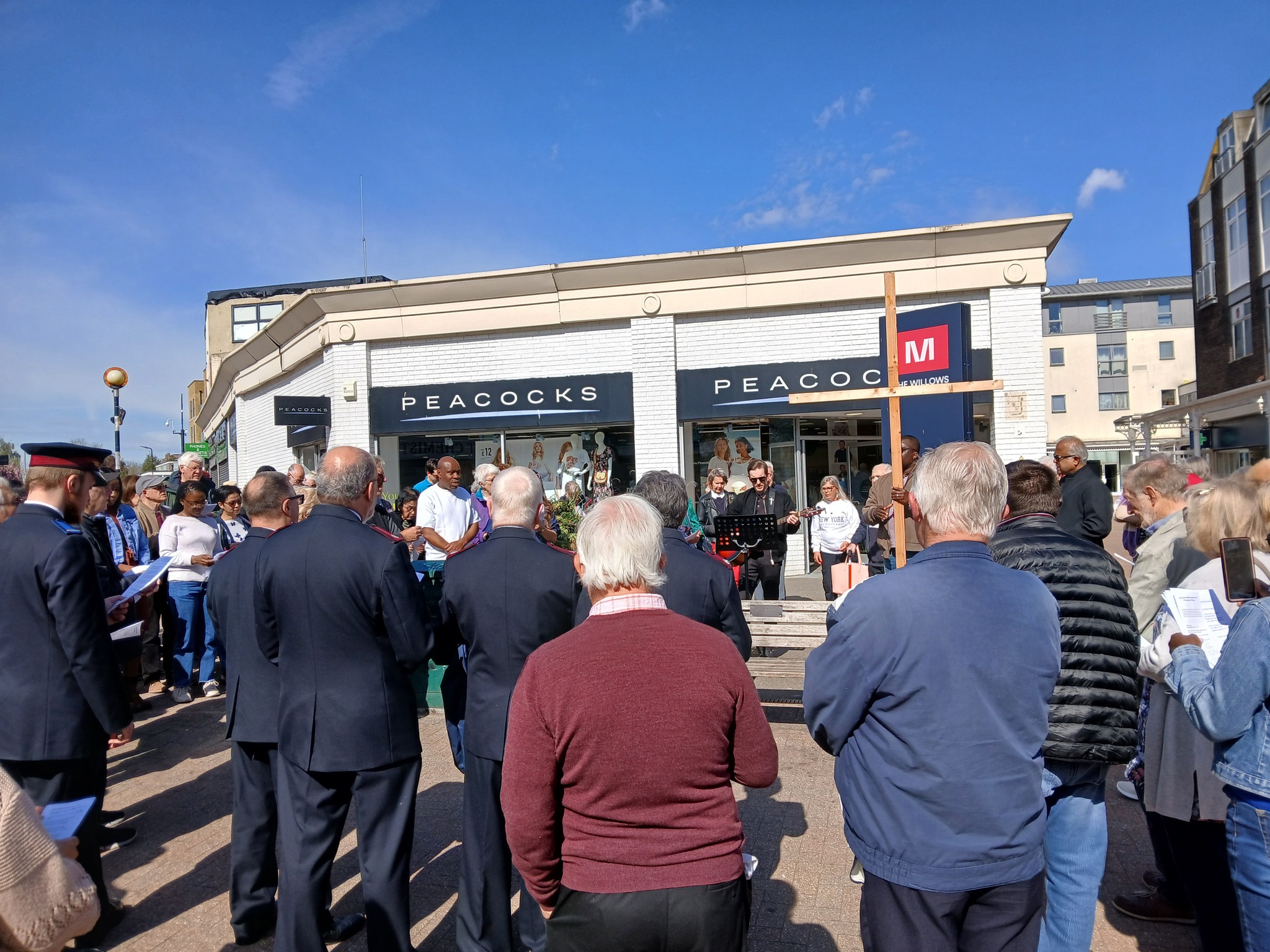
Photographs below from Stations of the Cross, Walk of Witness and At the Foot of the Cross, plus my reflection for the At the Foot of the Cross service:

The cross first made an impact in my life when I was about 7 or 8 years of age. I remember attending a Holiday Bible Club at the church we attended where I heard the story of the crucifixion and realised that Jesus died for me. That night I knelt by my bed before going to sleep and asked Jesus into my life. It was the realisation that Jesus had been willing to die to save me that led me to pray that prayer.

Later, as an under-confident teenager I came to think and feel that I was not good enough for God because I was self-critical and felt that I was inadequate in many respects. One evening I talked about these feeling to a leader at the Church Youth Club that I was then attending. He pointed me to Romans 5. 8 which says “God proves his love for us in that while we still were sinners Christ died for us”. His argument was that the cross reveals that we are loved as we are. We don’t need to change in order to be loved by God. Any change that may be necessary will come once we realise that we are loved by God and will come about because of gratitude for that love. As a result, I gradually became more confident in myself because I understood deep down that I was fully loved by God. Again, it was Christ’s death of the cross that brought me to that realisation.

As my understanding of the cross grew, I began to be deeply moved in the way the hymn writer William Walsham How describes in ‘It is a thing most wonderful’ when he writes:

I sometimes think about the cross,
and shut my eyes, and try to see
the cruel nails and crown of thorns,
and Jesus crucified for me.

I continue to find it amazing and deeply moving that Jesus was prepared to suffer and die for my sake. A song about the cross that has always moved me since I first heard it is ‘How could you say no’ by Julie Miller:

Thorns on his head spear in his side
Yet it was a heartache that made him cry
He gave his life so you would understand
Is there any way you could say no to this man

If Christ himself were standing here
Face full of glory and eyes full of tears
And he held out his arms and his nail printed hands
Is there any way you could say no to this man

How could you look in his tear-stained eyes
Knowing it's you he's thinking of
Could you tell him you're not ready to give him your life
Could you say you don't think you need his love

Jesus is here with his arms open widе
You can see him with your heart if you'll stop looking with your eyes
Hе's left it up to you, he's done all that he can
Is there any way you could say no to this man

‘There was a cross in the heart of God before there was one planted on the green hill in Jerusalem. And now that the cross of wood has been taken down, the one in the heart of God abides, and it will remain so long as there is one sinful soul for whom to suffer.’

Finally, what I’ve realised most recently, through the time I spent at St Martin-in-the-Fields learning from the theology of their Vicar Sam Wells, is that the cross is Jesus’ ultimate demonstration of being with us. If there’s one word that sums up all four gospels, that word is ‘with.’ Jesus’ ministry, above all else, is about being with us, in pain and glory, in sorrow and in joy, in quiet and in conflict, in death and in life.

Jesus then faces true despair on the cross. He experiences the isolation that humankind has brought on itself, and in his case it’s even more ghastly: he’s isolated from God the Father, who seems to have forsaken him. He must choose between being with us and being with the Father. He chooses us. The Father meanwhile must choose between letting Jesus be with us or drawing Jesus back into the Trinity. Both are terrible choices, because they jeopardise the integrity of the Trinity: but there’s no way for God to continue to be God without the commitment to be with costing not less than everything. This then is what is taking place on Good Friday: we behold Jesus, embodying the Trinity’s eternal commitment to be with us, becoming isolated from the Father. Agony of agony: a rupture in the Trinity; a cross in the heart of God.

Is our alienation from God really so profound that it pushes God to such lengths to reverse and heal it? We don’t want to believe it. But here it is, in front of our eyes. That’s what the cross is – our cowardice and cruelty confronted by God’s wondrous love. Is being with us forever really worth God going to such lengths to secure? Now that is, perhaps, the most awesome question of all. It takes us to the heart of God’s identity, and the heart of our own. Can we really believe God thought we were worth it? Are our paltry lives worth the Trinity setting aside the essence of its identity in order that we might be with God and incorporated into God’s life forever?

Jesus’ cry is one of agony that to reach us he had, for a moment, to let go of his Father. What is our cry? Our cry is one of grief, that we were not with him. It’s a cry of astonishment, that he was, despite everything, still with us. And it’s a cry of conviction and commitment, that we will be with him henceforth, and forevermore.


---------------------------------------------------------------------------------------------------------

Julie Miller - How Could You Say No?

Seen and Unseen: Why sculpt the face of Christ?

My latest article for Seen and Unseen is entitled 'Why sculpt the face of Christ?' and explores how, in Nic Fiddian Green’s work, we feel pain, strength, fear and wisdom:

"In these images, Fiddian Green is reading back into the events of the crucifixion the outcomes that it gains for us and showing, in his Christ figures, the peace that he personally finds in the love and forgiveness which overflows from the crucified Christ to each and every human being throughout time and history."

My first article for Seen and Unseen was 'Life is more important than art' which reviews the themes of recent art exhibitions that tackle life’s big questions and the roles creators take.

My second article 'Corinne Bailey Rae’s energised and anguished creative journey' explores inspirations in Detroit, Leeds and Ethiopia for Corinne Bailey Rae’s latest album, Black Rainbows, which is an atlas of capacious faith.

My third article was an interview with musician and priest Rev Simpkins in which we discussed how music is an expression of humanity and his faith.

My fourth article was a guide to the Christmas season’s art, past and present. Traditionally at this time of year “great art comes tumbling through your letterbox” so, in this article, I explore the historic and contemporary art of Christmas.

My fifth article was 'Finding the human amid the wreckage of migration'. In this article I interviewed Shezad Dawood about his multimedia Leviathan exhibition at Salisbury Cathedral where personal objects recovered from ocean depths tell a story of modern and ancient migrations.

My sixth article was 'The visionary artists finding heaven down here' in which I explored a tradition of visionary artists whose works shed light on the material and spiritual worlds.

My seventh article was 'How the incomer’s eye sees identity' in which I explain how curating an exhibition for Ben Uri Online gave me the chance to highlight synergies between ancient texts and current issues.

My eighth article was 'Infernal rebellion and the questions it asks' in which I interview the author Nicholas Papadopulos about his book The Infernal Word: Notes from a Rebel Angel.

My ninth article was 'A day, night and dawn with Nick Cave’s lyrics' in which I review Adam Steiner’s Darker With The Dawn — Nick Cave’s Songs Of Love And Death and explore whether Steiner's rappel into Cave’s art helps us understand its purpose.

My 10th article was 'Theresa Lola's poetical hope' about the death-haunted yet lyrical, joyful and moving poet for a new generation.

My 11th article was 'How to look at our world: Aaron Rosen interview', exploring themes from Rosen's book 'What Would Jesus See: Ways of Looking at a Disorienting World'.

My 12th article was 'Blake, imagination and the insight of God', exploring a new exhibition - 'William Blake's Universe at the Fitzwilliam Museum - which focuses on seekers of spiritual regeneration and national revival.

My 13th article 'Matthew Krishanu: painting childhood' was an interview with Matthew Krishanu on his exhibition 'The Bough Breaks' at Camden Art Centre.

My 14th article was entitled 'Art makes life worth living' and explored why society, and churches, need the Arts.

My 15th article was entitled 'The collective effervescence of sport's congregation' and explored some of the ways in which sport and religion have been intimately entwined throughout history

My 16th article was entitled 'Paradise cottage: Milton reimagin’d' and reviewed the ways in which artist Richard Kenton Webb is conversing with the blind poet in his former home (Milton's Cottage, Chalfont St Giles).

My 17th article was entitled 'Controversial art: how can the critic love their neighbour?'. It makes suggestions of what to do when confronted with contentious culture.

My 18th article was an interview entitled 'Art, AI and apocalypse: Michael Takeo Magruder addresses our fears and questions'. In the interview the digital artist talks about the possibilities and challenges of artificial intelligence.

My 19th article was entitled 'Dark, sweet and subtle: recovered music orientates us'. In the article I highlight alt-folk music seeking inspiration from forgotten hymns.

My 20th article was entitled 'Revisiting Amazing Grace inspires new songs'. In the article I highlight folk musicians capturing both the barbaric and the beautiful in the hymn Amazing Grace and Christianity's entanglement with the transatlantic slave trade more generally.

My 21st article was entitled 'James MacMillan’s music of tranquility and discord'. In the article I noted that the composer’s music contends both the secular and sacred.

My 22nd article was a book review on Nobody's Empire by Stuart Murdoch. 'Nobody's Empire: A Novel is the fictionalised account of how ... Murdoch, lead singer of indie band Belle and Sebastian, transfigured his experience of Myalgic encephalomyelitis/chronic fatigue syndrome (ME) through faith and music.'

My 23rd article was entitled 'Rock ‘n’ roll’s long dance with religion'. The article explores how popular music conjures sacred space.

My 24th article was an interview with Alastair Gordon on the artist’s attention which explores why the overlooked and everyday capture the creative gaze.

My 25th article was about Stanley Spencer’s seen and unseen world and the artist’s child-like sense of wonder as he saw heaven everywhere.

My 26th article was entitled 'The biblical undercurrent that the Bob Dylan biopics missed' and in it I argue that the best of Dylan’s work is a contemporary Pilgrim, Dante or Rimbaud on a compassionate journey.

My 27th article was entitled 'Heading Home: a pilgrimage that breaks out beauty along the way' and focuses on a film called 'Heading Home' which explores how we can learn a new language together as we travel.

My 28th article was entitled 'Annie Caldwell: “My family is my band”' and showcased a force of nature voice that comes from the soul.

-------------------------------------------------------------------------------------------------------

Arvo Pärt - Silentium.

Thursday, 17 April 2025

Church Times - Book review: Messianic Commons: Images of the Messiah after Modernity by David Benjamin Blower

My latest book review for Church Times is on Messianic Commons: Images of the Messiah after Modernity by David Benjamin Blower:

"This book, which explores ideas of a reconciliatory and open messianic vision as opposed to a divisive and hierarchical vision, is ... particularly timely and prophetic, in a potentially terrifying age when nations increasingly seem to be embracing the spirit of the Antichrist rather than that of the coming Messiah."

Other of my pieces for Church Times can be found here. My writing for ArtWay can be found here. My pieces for Artlyst are here, those for Seen & Unseen are here, and those for Art+Christianity are here.

---------------------------------------------------------------------------------------------------------

David Benjamin Blower - The Soil.