Wikio - Top Blogs - Religion and belief

Sunday, 13 March 2016

10 best places for reflection

In today's Observer Aaron Rosen chooses his 10 best places for reflection. From Reykjavik to Tate Modern, he looks at spaces to inspire contemplation during Lent.

Aaron has some great choices but his choices are clearly intended to prompt reflection among his readers on the choices they would make, so here is my top 10:

l’Abbaye de la Fille Dieu, Romont


Brian Clarke says that stained glass ‘can transform the way you feel when you enter abuilding in a way that nothing else can!’ I would concur, especially after arriving at l’Abbaye de la Fille Dieu in time for a memorable service of Vespers followed by silent contemplation in the still onset of darkness falling.Tomas Mikulas, the architect on the restoration of this Cistercian Abbey, has stated that the overall goal of the restoration was to offer both nuns and visitors an ‘atmosphere conducive to meditation and prayer.’ Mikulas suggests that it is the ‘warm and vibrant atmosphere’ created by Clarke’s windows ‘with the changing light of day’ that ‘makes a decisive contribution’ to the space and to the restoration as a whole.

Chapelle Sainte-Thérèse-de-l'Enfant-Jésus et de laSainte-Face, Hem


Alfred Manessier was a lyrical abstractionist who thought of stained glass less as a design than as “the simultaneous creation of a light-filled architectural unit, thought-out and created by the painter at one go.” In this way he wanted "to express man’s inner prayer.” Chapelle Sainte-Thérèse-de-l'Enfant-Jésus et de laSainte-Face in Hem is an attempt to create spiritual space - a sense of prayer and a glimpse of heaven – through the play of light and colour within the building.


Pleshey was the first Diocesan Retreat House to be established in the country. Amongst the list of Retreat conductors is Evelyn Underhill. Arguably the most distinguished Conductor of that time, it is largely due to Underhill that the Retreat house became so popular. When you come to the Retreat House in Pleshey you sense an atmosphere created by six hundred years of prayer. For me, it is a special place because of ordination and cell group retreats.


Down dimly-lit stairwells / into a cavernous immensity / of curved brick, concrete and darkness / to stand still, transfixed, / in silent expanse / focused on the glow / and gleam / of the white stone table / over which / the crucified Christ hangs / from concrete cross-beams. / Morning light softly infiltrates, / casting shadows, / bringing the dawn ... The space and acoustic / act and appear as /
the inside of a hi-fi speaker; / the lantern, like an industrial chimney, / funnels the aromatic incense /
of prayer and praise / to tease and to please / the senses of God.

St Benet's Chapel


Adam Kossowski's murals at St Benet's Chapel fill the entire wallspace of this circular chapel surrounding and enveloping worshippers with their imagery. When services are held, however, the altar table is located in front of the panel depicting worship in heaven of the lamb that was slain. In this way, worship on earth is conducted in the context of worship in heaven. This work is about rescue, redemption and salvation. Fr. Edward Maguire has written, 'From clay and fire he forged a vision of the past, present and future to lift up and inspire countless others ... May we be inspired by him to use our gifts as he used his."

Notre-Dame du Bon Conseil, Lourtier


Lourtier is to be found among the imposing alpine architecture of snow-capped peaks in the Val de Bagnes, one of Switzerland's largest nature reserves. I arrived at the end of the afternoon to find the mountain sunshine flooding the empty church. Alberto Sartoris’ design for Notre-Dame du Bon Conseil is clean, spare and minimalist. Internally, the church is a simple white rectangle with a sleek arched wooden roof. Both the ceiling’s planks and the grey-painted wooden pews draw the eye to the sanctuary wall containing two large stained glass windows by Albert Gaeng. The triumph of Lourtier is an influential design coupled with a dramatically beautiful building that is well suited to the liturgy and well used by its people.

The Crypt of Colònia Güell


The Crypt of Colònia Güell is a warm, womb-like enclosure; intimate yet archetypal. It is real and usable communal space while also being of great architectural worth, innovation and beauty. Here the ‘heaven in ordinarie’ of the Eucharist is celebrated in the surround of natural forms recreated by man-made means. 'Gaudí based his buildings on a simple premise: If nature is the work of God, and if architectural forms are derived from nature, then the best way to honor God is to design buildings based on his work. As the Barcelona scholar Joan Bassegoda Nonell notes, "Gaudí's famous phrase, 'originality is returning to the origin,' means that the origin of all things is nature, created by God."'

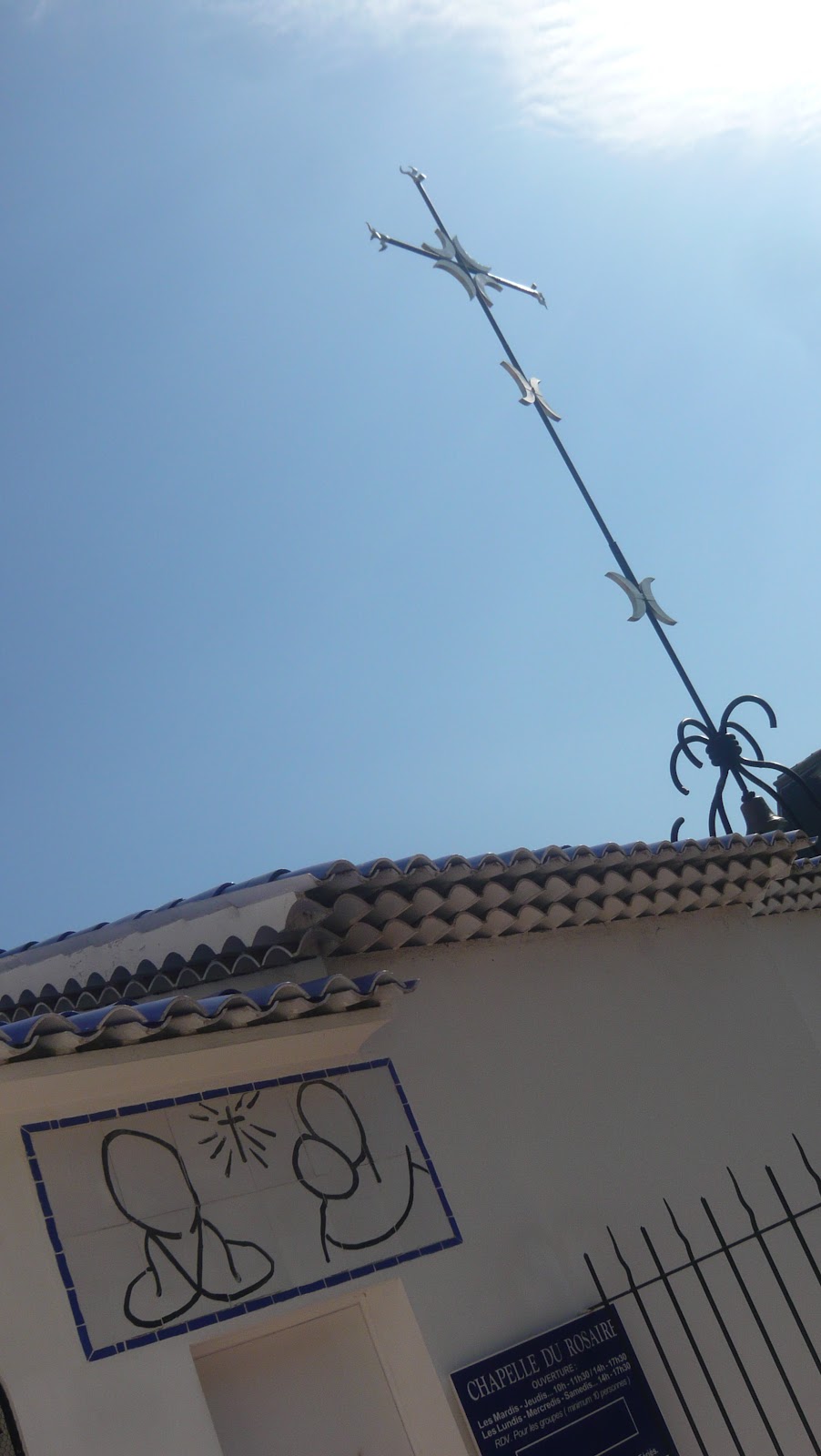
Chapelle du Rosaire, Vence


‘Simple colours,’ Henri Matisse wrote, ‘can affect the innermost feelings, their impact being all the more forceful through their simplicity.’ The spiritual expression of the blues, greens and yellows he used in the stained glass of the chapel struck him as unquestionable. His goal ‘was to find a balance between a light surface and colour with a solid wall of black-on-white line drawing.’ The line drawings on ceramic tiles of both St Dominic and the Virgin and Child he thought to have a ‘tranquil reverent nature all their own,’ while the great drama of Christ in the Stations of the Cross had made ‘his impassioned spirit overflow within the Chapel.’

Musée Chagall, Nice


On entering the rooms of the Message Biblique - first the room of Genesis and Exodus, then the Song of Songs - one is struck by the colours of the works before their content. Chagall viewed painting as the reflection of his inner self and therefore colour contained his character and message. In his museum inauguration speech he said, ‘If all life moves inevitably towards its end, then we must, during our own, colour it with our colours of love and hope.’ These are paintings which seek to dream by their colours and lines an ideal of fraternity and love. To be surrounded by these massive statements demonstrating - through content and construction - the potential of religion for reconciliation, was a wonderful and moving experience.


A stunning blend of old and new art and architecture is to be found at St Stephen Walbrook, Sir Christopher Wren’s masterpiece. Bombed in the Second World War and restored to its present magnificent state in 1981, twentieth century artists and craftsmen have adorned its interior. Henry Moore’s travertine marble altar now stands at the centre under Wren’s dome surrounded by dazzling kneelers from Patrick Heron. Moore’s altar design was intended for people to gather as a community around the altar where God could be found at the centre. Currently contemplation is aided by 'Lamentation for the Forsaken, 2016’, a digital art installation by Michael Takeo Magruder which evokes the memory of Syrians who have passed away in the present conflict by weaving their names and images into a contemporary Shroud of Turin.

What would your 10 choices be?

----------------------------------------------------------------------------------------------

Lavine Hudson - Flesh Of My Flesh.

Exhibitions update: Jones, Piper, Johnston & Russian portraits

David Jones: Vision & Memory is now at the Djanogly Gallery in Nottingham. This major exhibition has been organised to coincide with the publication of a new monograph and includes some 60 works from throughout Jones’s life in a timely reassessment of one of the most imaginative artists of his era. Exhibits range from sketches made on the Western Front to watercolours of trees, flowers and thorns, as well as drawings of Arthurian subjects and painted inscriptions.

David Jones (1895-1974) was a painter, engraver, poet and maker of inscriptions. A lyrical draughtsman, he responded with delight to the visual world, yet his vision was informed by memory reaching back into the depths of time and history. The celebrated art historian and broadcaster, Kenneth Clark, believed he was the greatest British watercolourist of the 20th century.

In the 1920s, working in the circle of Eric Gill, Jones became an engraver of the first rank. His illustrated books engage with the world of symbol and myth. They will be exhibited alongside his shimmering watercolours of still lives, seascapes and portraits. In later years, as David Jones devoted more time to poetry, he painted inscriptions that are as vital in design as they are allusive in content.

The exhibition has been organised by Pallant House Gallery, Chichester, with the support of Amgueddfa Cymru – National Museum Wales, and features works drawn from both private and public lenders including Kettle’s Yard, Cambridge, Tate and the V&A.

John Piper: The Fabric of Modernism at Pallant House is the first exhibition to focus on John Piper’s textile designs, exploring key motifs in the artist’s work such as historic architecture, abstract and religious imagery, as well as subjects explored in the final years of the artist’s life, such as foliate heads, sunflowers and the church at Long Sutton. Shown alongside related paintings and other studies the exhibition demonstrates how Piper’s designs were intricately connected with his wider work.

John Piper was one of the leading Modern British artists of the 20th century, best known for his paintings of Britain’s romantic heritage including churches, country houses and wartime ruins. In the post-war period Piper was also noted for his work as an accomplished designer of theatre sets, stained glass windows, and textiles. Through over 80 works, this major exhibition is the first to focus on John Piper’s textile designs, exploring key motifs in the artist’s work such as historic architecture, abstract and religious imagery, as well as subjects explored in the final years of the artist’s life, such as foliate heads, sunflowers and the church at Long Sutton. Shown alongside related paintings and other studies the exhibition demonstrates how Piper’s designs were intricately connected with his wider work.

Piper’s textile designs included furnishing fabrics for the post-war home for companies including Arthur Sanderson & Sons Ltd, scarves for Asher, ecclesiastical garments, and tapestries created for cathedrals and other public spaces. Marking the 50th anniversary of the installation of the artist’s celebrated altar tapestry in Chichester Cathedral, many of the studies for this important example of religious art will be shown alongside several of the Foliate Head tapestries woven to Piper’s designs at West Dean Tapestry Studio near Chichester. The exhibition will be accompanied by a new book by Simon Martin, with contributions by Frances Spalding.

Underground: 100 Years of Edward Johnston’s Lettering for London at the Ditchling Museum of Art & Craft marks the centenary of Edward Johnston’s world famous typeface for London Underground. Remarkably, it has barely changed over 100 years, a testament to its success as station way finders.

Hand drawn by Johnston whilst living in Ditchling this alphabet is gloriously simple, but its design is rooted in much earlier lettering since it bears the proportions of Roman capitals. The design was initially proposed in 1913 by Frank Pick, commercial manager of London Underground Railway as a joint project for Edward Johnston and Eric Gill, but Gill was unable to proceed since he had agreed to a major commission of Stations of the Cross stone reliefs for Westminster Cathedral.

Johnston’s typeface is known variously as Underground, or Johnston Sans. It is also known as the basis on which Eric Gill, one of Johnston’s first pupils at Central School of Arts & Crafts, designed his typeface Gill Sans for the Monotype Corporation, released in 1928. With similar proportions to Johnston’s earlier typeface, it was initially criticised for being too similar but both Johnston Sans and Gill Sans have become modern classics.

This exhibition shows Johnston as a true man of letters, resurrecting and redefining calligraphy in the West, and designing an elegant typeface for London Underground. Highlights include Johnston’s calligraphy for W R Lethaby which secured his post as a teacher at Central School of Arts & Crafts; manuscripts showing his development as a calligrapher; rarely seen working drawings of the Underground typeface, and original drawings for Gill Sans.

Russia and the Arts at the National Portrait Gallery is a once-in-a-lifetime opportunity to see masterpieces on loan from the State Tretyakov Gallery in Moscow.

The exhibition will focus on the great writers, artists, composers and patrons, including Tolstoy, Chekhov and Dostoevsky, whose achievements helped develop an extraordinary and rich cultural scene in Russia between 1867 and 1914.

The exhibition will also show how Russian art of the period was developing a new self-confidence, with the penetrating Realism of the 1870s and 1880s later complemented by the brighter hues of Russian Impressionism and the bold, faceted forms of Symbolist painting.

-------------------------------------------------------------------------------------------

Paul Johnson - The Road.

Mary of Bethany: the gratuitous, intuitive aroma of the love of Christ

Here my sermon for today's Eucharist at St Vedast-alias-Foster:

As a child my faith was impacted by a musical drama of the life of Christ using scripture drawn from Genesis to Revelation which was called Yesterday Today Forever and was staged in Oxford in the mid-1970s. It was an ambitious production with three complete stage sets, a complicated lighting system, quadraphonic sound, a 50-piece choir, a 12-piece band, dance, narration, a great variety in music, and a back projected film. I was impressed by the integration of the Arts and scripture in a way that I had not seen prior to that point.

Included in the show was a beautiful ballad based on this story of Mary of Bethany anointing Jesus’ feet and wiping them with her hair (John 12. 1 - 8). Called ‘Remember Mary’, the song imagines Mary’s thoughts as she carries out this extravagant gesture:

“I cannot look at your face - I dare not - for I have sinned so much and you know my heart. I want to look at you Jesus, but I have not the power to lift my eyes for I am guilty - oh so guilty. What can I do? For I am lost and yet you care - even for me. So I will pour this ointment upon your feet, dear Lord. The ointment smells so sweet; smells so. sweet; and yet I am a broken creature, I'm only but dust, only dust …”

Jesus responds: “You have done a beautiful thing to me Mary, in pouring this ointment on my body, you have prepared me for burial. Your sins are forgiven, for you have loved much.”

The way in which Mary gives to Jesus in this story could perhaps be summed up in a verse from 2 Corinthians 9: “You should each give, then, as you have decided, not with regret or out of a sense of duty; for God loves the one who gives gladly.” (2 Corinthians 9. 7)

It was her decision to pour ointment over Jesus’ feet and to dry her feet with her hair. No one expected her action – it was not done out of duty - and at least one person criticised her severely for it. It was her entirely her decision, her personal way of giving to Jesus.

Giving in this way involved giving generously from her possessions because the ointment that she used was expensive (imported from countries such as India) and extravagant (half a litre was an enormous amount to use in this way). It also involved giving generously of herself as Jewish women traditionally kept their hair tied up in public and only unloosened their hair in the presence of their husbands. What Mary did in wiping Jesus’ feet with her hair was the ultimate sign of her love for and commitment to Jesus. She did all this, not with regret or out of a sense of duty, but gladly and generously.

In fact, her gift to Jesus is a response to the love that Jesus has shown towards her. She gives because Jesus has first given extravagantly and generously to her. This is the pattern that we see repeated in God’s dealings with human beings throughout scripture and which we see summed up in the most famous verse of scripture, John 3: 16: “God loved the world so much that he gave his only Son …” God so loved that he gave.

Love is the reason for giving, not duty, not regret, but love. In Jesus’ life, death and resurrection God gave everything he had for us. Philippians 2 tells us that, of his own free will, Jesus “gave up all he had, and took the nature of a servant. He became like a human being and appeared in human likeness. He was humble and walked the path of obedience all the way to death – his death on the cross.” This is the extravagant nature of Jesus’ love for us that he would give up all he had in order to all the path of obedience all the way to his death on the cross.

‘This is what Mary saw in Jesus and why she responded by giving extravagantly and generously to him. God does not need us; yet he created us out of his gratuitous love. Jesus astonished the disciples by giving Mary the highest commendation anyone receives in the pages of the Gospels:

“Leave her alone,” said Jesus. “Why are you bothering her? She has done a beautiful thing to me. The poor you will always have with you, and you can help them any time you want. But you will not always have me. She did what she could. She poured perfume on my body beforehand to prepare for my burial. Truly I tell you, wherever the gospel is preached throughout the world, what she has done will also be told, in memory of her.” (Mark 14:6 -9)’

In reflecting on this story the artist Makoto Fujimura has said that he prays that, ‘there will be a new aroma in the air: an aroma of Mary of Bethany, who in response to Jesus’ tears in John 11 and 12 brought her most precious belonging, her most gratuitous, expensive nard. I pray that in the days to come, this aroma will fill the air whenever the words of Gospel are spoken, that outsiders to faith will sense this extravagant air and feel it, particularly for them. I pray that when our children speak of faith, this gratuitous, intuitive aroma of the love of Christ will be made manifest in their lives.’

Fujimura sees an analogy between the extravagance of Mary’s gesture and the extravagance of art. He prays ‘that artists will no longer have to be on the defensive as was Mary in that aroma-filled room while disciples grumbled that her perfume could have been sold to feed the poor. “What a waste,” they said. What a waste. Is our art wasteful, too?

Art is gratuitous. Art is extravagant. But so is our God.’ And we need to learn a similar extravagance in our response to Jesus.

Oliver O'Donovan writes that, “Generosity means: not staying within the limits which public rationality sets on its approval of benevolence. An extravagant, unmeasured goodness, corresponding to God’s own providential care, defies the logic of public expectation.”

David Dark writes that, “Extravagant kindness of action … amounts to apocalyptic disruption of whatever norms currently crown themselves as “realistic,” “prudent,” or “appropriate.” “These confrontations bring onto the scene an indiscriminate generosity that will often appear supernatural and scandalous as they necessarily go beyond what has appeared previously available or reasonable.” In this way, such actions expand “the sphere of what’s considered historically possible” and “testify to a transcendence in everyday activity with an earth-bound agility that interpenetrates all that appears mundane and insignificant.”

Perhaps, most incredibly of all, what Mary gave was a blessing and help to Jesus. Jesus had been explaining for some time that he was shortly to die but no one believed him or accepted what he was saying. Famously, Peter had told Jesus that he would try to stop that from happening and Jesus rebuked him by saying, “Get behind me, Satan.”

But here Mary anoints Jesus for burial. She understands. She accepts what is going to happen and she prepares Jesus for it. What a blessing that must have been to Jesus that someone understood and supported him in what he was about to do. And in just the same way we bless and encourage God when we give generously of our time, talents and treasure to God.

Judas didn’t understand the love and generosity in Mary’s gifts and this seems to have been because his motives were selfish not loving. In criticising Mary’s gift, he purported to be concerned about the poor but actually wanted to help himself to some of the money. Today it is still easy for us to find reasons not to give. We will all have heard people give a whole string of reasons for not giving – excuses like the money is spent on administration or wasted through corruption rather than going to those that it is meant to benefit. While these are valid issues that need to be addressed, the end result of people’s reasoning is that their money stays in their bank accounts and pockets to be spent on themselves rather than others. As a result, their motivations for not giving can be viewed as selfish, as was the case for Judas too.

Giving to God does not mean ignoring the poor. Jesus said that we show our love for God by loving our neighbours as we love ourselves. He calls us to commit our lives, our time, our talents, our treasure to God for the transforming of our communities and the treasuring of our environment.

So, together with Makoto Fujimura, let us offer a ‘prayer and invitation to encounter the mystery of the Gospel, one which is still filled with the aroma of Mary of Bethany.’ Let us ‘pray that this aroma will invade us too with love and hope.’ May our lives and work ‘witness in some way to this extravagance of the Gospel’; ‘without reduction, in the grace of this encounter, let us continue our work in the extravagance’ of God’s love.

As we do so, out of love rather than duty, we will be following in the footsteps of Mary as she anointed the feet of Jesus and dried his feet with her hair.

------------------------------------------------------------------------------

11:59 - Psalm 107: Let Us Thank The Lord.

Saturday, 12 March 2016

commission4mission and The Worship Cloud


Three collections of images by commission4mission artists are available for download via theworshipcloud.com.
  • Mark of the Cross features 20 poetic meditations on Christ’s journey to the cross and reactions to his resurrection and ascension (images by Henry Shelton and words by myself).
  • The Passion: Reflections and Prayers features pictures, poems and prayers by Henry Shelton and I which enable us to follow Jesus on his journey to the cross reflecting both on the significance and the pain of that journey as we do so and published as a double-sided A3 sheet with all the images, haiku-like meditations and prayers laid out in sequence for ease of devotional use.
  • Stations of the Cross by Valerie Dean are available as a powerpoint presentation and as a pdf file. Her Stations of the Cross have a very clear and intense focus on details which are evocative of the whole.
Individual images, pdfs and powerpoints for these collections are all available for download from The Worship Cloud.

The Worship Cloud brings you over 22,000 resources for you to use in leading worship or for personal devotion. Every resource is available to buy as an individual download, however you can also take out one of The Worship Cloud’s subscription packages. A subscription package tops up your account with credits each Monday morning. These credits can be used to download resources, saving you money and making sure you have the resources to bring your congregation or yourself that bit closer to God. The Worship Cloud Store has a selection of print and digital books available to buy, as well as PowerPoints, movies and music. 

commission4mission artists can sell images and presentation of their images through commission4mission’s page on theworshipcloud.com which has all the packages and images currently available from our artists.

---------------------------------------------------------------------------------------------

The Voices Of East Harlem - For What It's Worth.

Discover & explore and Lamentation for the forsaken


Shared service with St Martin-in-the-Fields - Monday 21st March, 1.10pm at St Stephen Walbrook. 

This will be a Discover & explore service with the Choral Scholars of St Martin-in-the-Fields, the Choir of St Stephen Walbrook and our organist Joe Sentance. The choirs will sing the anthem which has given the themes for this Discover & explore service series; Eric Whitacre's 'Hope, Faith, Life, Love'.

The theme of this service will be 'Soul' and the preacher will be Dr Carolyn Rosen. Following the service, the artist Michael Takeo Magruder will discuss his digital art installation 'Lamentation for the Forsaken, 2016'. 

This installation can be seen until Good Friday at St Stephen Walbrook (weekdays, 10am – 4pm, except on Wednesdays, 11.00am - 3.00pm), as part of ‘Stations of the Cross 2016’ an exhibition across 14 iconic locations in London during Lent. In his installation, Takeo offers a lamentation not only for the forsaken Christ, but others who have felt his acute pain of abandonment. Click here to view Arriving at Station XIII, a short series of videos exploring the development of this newly commissioned artwork for the Stations of the Cross project. The videos follow Takeo's progress as he conceives, develops and finally presents his installation at St. Stephen.

The Tablet has said of this installation:

"In the richly harmonious interior of Christopher Wren’s St Stephen’s Walbrook, Michael Takeo Magruder’s Lamentation for the Forsaken is inspired by a passage from Lamentations (5:1-2) whose contemporary relevance is achingly obvious: “Remember, O Lord, what has befallen us; look and see our disgrace! Our inheritance has been turned over to strangers, our homes to aliens.”

On the tomb-shaped installation’s four modular screens an image of the Turin Shroud comes in and out of focus as parts of Christ’s body merge with news photographs of Syrian refugees. In the place of Christ’s feet we see migrants in transit, littering railway lines and piled on to overloaded boats; in the place of Christ’s hands we find refugees caring for loved ones, alive, injured and dead; in the place of Christ’s body we witness asylum seekers caught up in conflict, clashing with police with riot shields. Christ’s face, meanwhile, yields place to a hollow-eyed young woman and a wide-eyed child dangling a limp doll. Underlying the shifting images is a mesh of Roman capitals recording the names of the dead as a roll of honour."

Before then our next Discover & explore service at St Stephen is Trust (Monday 15th March) at 1.10pm. All are most welcome.


--------------------------------------------------------------------------------------------

Eric Whitacre - hope, faith, life, love.

Enterprising Redbridge


Enterprising Redbridge will be launched on Wednesday 6th April at the Redbridge CVS networking event. This is a significant opportunity for the voluntary and community sector in Redbridge to get support to become more entrepreneurial. The first seminar open to all community groups that sign up, is on Thursday 21st April 6-8pm. For more info click on this blog and to sign up click here.

Ross Diamond of RCVS writes:

  • Are you a voluntary sector leader in Redbridge?
  • Wanting to make your organisation more sustainable?
  • Want to explore new ideas and new ways of working?
  • Want to find a positive critical friend to support you in making changes?
  • Why not get involved in a project that aims to help organisations to become sustainable through being entrepreneurial?

In the current climate a significant reduction in the availability of grants, particularly from public sector sources, has resulted in some voluntary sector groups closing – leaving a void in local service provision. We believe some of this can be avoided. In order to help local groups move to a more sustainable future, we are offering a programme of seminars, networking opportunities and one-to-one advice on becoming more independently sustainable. We believe this package of support can provide the positive encouragement such groups need.

We know that solutions are not always obvious, as you tend to be (rightly) totally focused on your day-to-day operations.  So this programme gives you the opportunity to think beyond the day to day, the space to consider difficult questions in a safe place, and the chance to say the unsayable. We want this programme to inspire you, challenge you, support you and affirm the work you are doing.

Our goal is to inform and inspire 450+ local voluntary organisations to become more entrepreneurial through the provision of information and online tools. That’s a big ask. But it will depend on you. Your willingness to engage. Your desire to continue change.

For those most committed to trying new ideas or introducing change to their organisation, we will provide intensive tailored support to 10 groups not only to survive into the future but go on to thrive with greater independence.

Interested? Fill out the simple registration form.

This is a project that Sophia Hubs is partnering with RCVS. To read our blog about it click here.

---------------------------------------------------------------------------------------------

Deacon Blue - Win.

Windows on the world (383)


Arranmore, 2015

--------------------------------------------------------------------------------------------

Van Morrison and the Chieftains - Star Of The County Down.