Wikio - Top Blogs - Religion and belief

Saturday, 10 May 2025

Windows on the world (518)


 South Woodham Ferrers, 2025

-------------------------------------------------------------------------------------------------------------

Gillian Welch & David Rawlings - Empty Trainload Of Sky.

Thursday, 8 May 2025

Faith that sustains in wartime

Here's the Address that I shared at St Catherine's Wickford this afternoon for our Act of Remembrance on VE Day 80th Anniversary:

In his book ‘Wickford’s Heroes’, Steve Newman writes: “In the Second World War, whether air crew flying missions over enemy territory, soldiers retreating to Dunkirk, or fighting their way across Europe, from the jungles of the Far East and the unimaginable Japanese labour camps and hell ships, to the freezing seas of the North Atlantic and North Sea, or indeed on the home front, all were served by and indeed claimed the lives of men and women from Wickford and Runwell.”

Today we have gathered to remember the many soldiers, sailors, airmen, and civilians who gave their lives restraining evil and opposing tyranny, whether from our local area or further afield, in order that we can know peace and commemorate this significant anniversary of Victory in Europe Day.

In doing so, it is helpful to know something of the lives of those we remember today. Albert Chable and his younger brother Ernest are among those named on our War Memorial and were sons of Joseph and Sarah Chable, who lived on the Nevendon Road. Albert was a Sergeant in 1st Battalion Kings Royal Rifle Corps and was first injured and then killed in fighting in Italy, having been earlier involved in the North African campaign. Ernest was a Lance Bombadier in 7th Battery 5th Heavy Anti Aircraft Regiment, Royal Artillery, and was killed in action in the Japanese attack on Hong Kong, a battle that started less than eight hours after the infamous strike on Pearl Harbour that brought America into the war. Both died when the eventual outcome of World War II was still in the balance but it was their sacrifice and that of so many more like them that would eventually lead to the War’s end. Albert’s grave is in the Cesena War Cemetery in Italy. His grieving parents chose to add a personal inscription to the headstone which read ‘The things which are seen are temporal but the things that are not seen are eternal’. Their belief was that their sons were safe in the everlasting arms of God.

The faith of those like John and Sarah Chable as they mourned the loss of their sons, sustained and inspired many involved in action, whether on the home front or the front lines. In 1944, Major John Pott led his battalion to support the defence of Arnhem Bridge during a fierce battle against German forces. Despite facing heavy enemy fire, Major Pott’s unwavering faith and courage led him to pray over wounded soldiers and show remarkable forgiveness even as a prisoner of war.

On Sunday, 17 September 1944, Major Pott’s Parachute Regiment battalion was airdropped into the Netherlands to support the defence of Arnhem Bridge. As the men of the battalion parachuted from Dakota planes, they faced enemy fire from German snipers.

The drop zone was at Ginkel Heath and the route to Arnhem Bridge led through a forest. As they moved through the woods, they encountered heavy enemy fire and several men were wounded and unable to continue. Major Pott, unable to carry the wounded with him, hid them under bushes for protection. Then, with bullets flying and explosions nearby, he stood and prayed over them.

Sergeant George Sheldrake, one of the men who witnessed this moment, recalled, “I was with another two lads. We were all in a bad way. Major Pott said he couldn’t take us with him, but he put us carefully under some bushes. He said the battalion might make a fresh attack and we could be rescued, or we would be picked up by the Germans.

“Before he moved off, he stood there and prayed over us for a couple of minutes, although there was mortar and machine-gun fire. A couple of minutes is a long time to stand in those conditions. It is something I shall never forget.”

With disregard for his own safety, Major Pott stood over the wounded men and spoke to them before leaving: "I am sorry that I have only led the Company to death and pain; but remember there is another Commander who is 'The Way, the Truth, and the Life,' and I am committing you into His hands as I leave you now. Lord Jesus, watch over them, please."

Despite the conditions, the men survived. Major Pott continued on and was shot and severely injured in the battle for Lichtenbeek Hill, with his right hand and femur shattered. When the Germans came to collect the wounded, Major Pott, unable to walk, was left behind to die. He lay in the forest for 18 to 20 hours, struggling with his wounds and writing a letter to his wife. But in a miraculous turn of events, Dutch teenagers found him and fetched their relatives with a stretcher who then carried him to safety, hiding him in a shed until a doctor could be found to treat him.

However, he was eventually discovered by the Germans and sent to a prisoner-of-war camp. While receiving treatment, he managed to escape, attempting to swim across a river despite having a plaster cast on his leg. Unfortunately, he was recaptured by the Gestapo and returned to the prison camp, where he remained for the rest of the war.

Major Pott’s son David later recalled how his father took the Bible’s command to “love your enemies” literally. “My father’s love towards Germans was maybe one of the most remarkable things,” he said. “How does a Christian soldier obey the command to ‘Love your enemies’? I think he got somewhere with that. It was amazing how he made lifelong friends with SS officer Werner Elfering and his wife in the hospital in Gronau. They became friends playing chess together!”

Even in the darkest moments of battle, Major John Pott’s faith was visible to all around him. Even as a prisoner of war, he continued to practise forgiveness and friendship, extending kindness even to his enemies.

As we come together today conscious of our need for God’s forgiveness for the sin and the desire to dominate others that leads to conflict between people, and war between nations, in our own day and time, it is the examples of those like Major Potts and the Chables that we need to remember and replicate if we are to have hope for the future and peace in our time. Amen.

--------------------------------------------------------------------------------------------------------

Wednesday, 7 May 2025

Nothing lost, all raised up on the last day

Here's the Stewardship sermon I shared at St Andrew's Wickford this morning:

Justin Welby once welcomed an Evening Standard campaign on tackling food poverty and waste by saying that as “hunger is a complex, widespread and shocking blight on our country … more needs to be done to highlight this issue.”

In commenting on this statement, the paper noted that the Archbishop had good scriptural reasons to join the Food for London campaign. They noted that after ‘feeding the five thousand, Christ instructed the waste to be gathered up afterwards’ and said that it was in that spirit that the Archbishop had supported this campaign.

It was positive to see a major newspaper quoting scripture and doing so with some understanding. This contemporary reminder of the feeding of the five thousand and the 12 baskets of fragments that were gathered up afterwards gives us one way of reflecting on Jesus’ words in today’s Gospel reading (John 6. 37 – 40) that it ‘is the will of him who sent me, that I should lose nothing of all that he has given me, but raise it up on the last day.’

These words come in the middle of Jesus’ teaching about being the Bread of Life which followed shortly after the feeding of the 5,000. When Jesus gave thanks over the bread, the word used is ‘eucharistesas’, the word which gives us ‘Eucharist’. Jesus shares the bread around in communion, then, when everyone is satisfied, he instructs his disciples to pick up the fragments using that same phrase, ‘so that nothing may be lost.’ Just as none of this ‘eucharisticized’ bread was lost after the feeding, so, because ‘Jesus is the bread of life, [those who] see and believe in him … receive eternal life [and] become a fragment which he will gather up on the last day.’ (John, Richard Burridge, BRF 1998)

This is the reason why Christ came, which he reveals both here and in the parables he told about the lost sheep and coin. The shepherd and woman in those two stories are exactly the same; because of their concern for the sheep and coin which are lost, they will not give up searching until these have been found. The sheep and the coin are loved and this love is revealed or proved through the search.

The point of those parables is for us to know that we and all souls are similarly loved by God because he also searches for us until we are found. This search is the story of the Gospels:

‘Christ Jesus, who, though he was in the form of God,
did not regard equality with God as something to be exploited,
but emptied himself, taking the form of a slave,
being born in human likeness.
And being found in human form,
he humbled himself and became obedient to the point of death
— even death on a cross.’ (Philippians 2. 6 – 8)

Christ went on that search to seek and save those who are lost and thereby to ensure that none shall be lost and all souls shall be safely gathered in.

How much are we loved by God? So much that his Son left all he had in heaven to become a human being and die to rescue us for God. Jesus, the Good Shepherd, searches for all souls with God’s attentive love, looking and listening, finding and carrying; carrying us home, like a sheep on the shoulders, from the cliff edges of our lives.

The lost almost universally consider themselves worthless but these parables and this story specifically deny that assumption. What is lost is actually the most precious thing or person of all; the person or thing for which everything else will be given up or set aside. What is lost and found is us. We are the ones for whom Christ searches at the expense of all that he has, including, in the end, his own life. We are the most precious lost person for whom he searches. We are precious, we are loved.

We live in the light of this love and as his love resulted in his giving himself to us and for us, so our response to him should be the same. Stewardship month is an annual reminder to us that that is so when it comes to the contribution we make as Christian disciples; when it comes to the money we give back to God, the talents we use in his service, the community contribution we make and the environmentally-friendly actions we take.

‘God has given you unique abilities, talents, and gifts … If you think your talents are simply for you to make a lot of money, retire, and die, you’ve missed the point of your life. God gave you talents to benefit others, not yourself. And God gave other people talents that benefit you … We’re all a part of the body of Christ, and each part matters. There are no insignificant people in the family of God. You are shaped to serve God, and he is testing you to see how you are going to use the talents he gave you. Whether you are a musician or an accountant, a teacher or a cook, God gave you those abilities to serve others … You are a manager of the gifts God has given to you.’

Ministry belongs to the whole people of God. Every person, because of their baptism, has a ministry. Each of us has special qualities, skills and talents. How could your talents and gifts be used more fully for the work of God through St Andrew’s? Each of us has time, talents and treasure which could be given out of gratitude and to help this church. Will you help in some way? Can you use your gifts to share in God’s plan for his kingdom and for the work of ministry here at St Andrew’s?

Could you offer your time and talents for tasks such as Administering Communion, Contemplative Commuters, Campaigning on issues, Children’s work, MU Committee, Choir member, Musician, DCC member, Odd jobs, Committee member, Painting & decorating, Church officer, PCC member, Cleaning, Toddler Group helper, Coffee Morning helper, Prayer for others, Reading the Bible in church, Sidesperson, among other tasks? I encourage you to reflect on how you use your gifts and talents currently and whether you could give us of your talents in new ways out of gratitude to God and to help this church.

We do so because we are the most precious lost person for whom he searches. We are precious, we are loved. We live in the light of this love and, as his love resulted in his giving himself to us and for us, so our response to him should be the same. Amen.

------------------------------------------------------------------------------------------------------

Moby featuring Gregory Porter - In My Heart.

Sunday, 4 May 2025

Windows on the world (517)


Dublin, 2025

-------------------------------------------------------------------------------------------------------------

Van Morrison - Down To Joy.


A God who entrusts us with things of enormous worth

Here's the Stewardship sermon that I shared at St Catherine's Wickford and St Mary's Runwell this morning:

Many of Jesus’ parables are set in the world of work. They concern masters, servants and slaves, as those were the primary work roles at the time and, because Israel was an agrarian culture, they often relate to farming. Ours is a very different context but, despite the many differences between the working life of Jesus’ day and time, the universal nature of the stories that he told, means that they still have much to say to the work practices of our own day and time.

One person who has specifically explored the implications of Jesus’ parables for the workplace is Will Morris who is both PwC’s Deputy Global Tax Policy Leader and a priest in the Episcopal Church. In his book ‘Where is God at Work?’ he devotes five chapters to exploring the Parable of the Talents or Pounds (Luke 19.11-28).

He notes firstly that this is story about workers and work. In the story people at work are ‘entrusted with vast sums of money and expected to use them in commercial ways’: ‘People are given assignments, they have responsibilities, and they have to report back to the boss, who then assesses them and rewards them with further work responsibility – or punishes them with demotion (or the sack). The relationships are business relationships. There is one worker who obviously has real commercial smarts, another who is not quite as high-powered but still does pretty well, and then there is the one who has no commercial savvy at all, and who lets his employer’s money sit in the ground doing nothing. So we have the successful risk-taker and the conservative, risk-adverse colleague who’d much rather do nothing than try anything. And there’s a hierarchy. It really is just like a workplace.’

He makes three key points. The first is that this is not directly a story about God-given abilities (a pound or talent was a measure of money, not a skill or gift). It is ‘rather a story about the entrustment of something of great price to various individuals.’

‘Second, the sums of money – the pounds or talents – are something given, entrusted by the master when he leaves and required to be turned back over when he returns.’ It is about ‘something entrusted to us which we are expected to work with – fruitfully – and then return to the person who gave it to us.’

Third, there is the size of the gifts. One talent is sixteen years’ wages, five is eighty years’ worth. ‘That’s a lot to entrust to a slave ... Slaves, those way down the pecking order, were here entrusted with huge wealth. The master didn’t entrust the talents to his fellow owners or to his friends, but to his slaves.’ In that sense, ‘this parable is more about equality, at least of opportunity, than it is about inequality. Slaves, if they can handle it, are as worthy of being trusted as the leaders of society.’

This parable ‘upholds commercial activity – even ... banking’ and, more specifically, ‘Jesus does indicate that – in the right settings – using money to make money is completely acceptable.’ ‘For Christians in the workplace that is welcome and affirming.’ Despite this, ‘the parable doesn’t tell us that money is good, or that we will be doing God’s work if we earn more talents for Him by any means we wish as long as we end up increasing the amount.’

However, ‘done well, done properly, these activities will validly contribute to the building up of the kingdom. As a result, we must be open to the possibility that God has placed them there for us to use in this way. If we approach the workplace with the idea, the preconception, that good cannot possibly be achieved there, then the chances are that it won’t be. But if, in part thanks to this parable, we are open to the possibility that God can work through instruments such as money and in the workplace, then who know what might happen? ... God can turn up and do amazing things in the most unlikely places.’

How will we respond to the challenge of Jesus’ parable? In the story, the faithful workers are those that accept responsibility and act on it. The unfaithful worker is the one who does nothing, who does not act. Are we faithful or unfaithful workers? Are our lives dedicated to working for the benefit of others and our world? It is important to also note that in the parable we have been given the resources needed for this responsibility. In the parable the master gave out resources (the ‘talents’) alongside responsibilities. In the same way, the Holy Spirit has come to empower all of Jesus’ disciples.

We are currently in Stewardship month, an annual reminder to us that that is so when it comes to the contribution we make as Christian disciples; when it comes to the money we give back to God, the talents we use in his service, the community contribution we make and the environmentally-friendly actions we take.

Our Parish needs a whole series of contributions at present as we need new volunteers across the whole range of our ministry. We are looking for a new PCC Treasurer, members of our District Church Councils (the DCCs) and Parochial Church Council (our PCC). We would value musicians and singers, people who could work with children when they come to our services, and people who can volunteer at the foodbank. We always value help with administration, pastoral visiting, prayer ministry and with our publicity (website, social media etc). The packs that you have been given include more information about Stewardship and response forms to help you think more about the ways you give currently and what might be possible in the future. The packs include a form you can fill in to offer your help.

The ‘parable of the talents is not about the unequal handing out of skills and about the punishment of the weak. It is about whether we try to be the best we can be, working with God to build His kingdom, heal His creation, including the workplace – which, like everything else, will be perfected at the end of time. It’s about being ourselves, not trying to be people we’re not. It’s about doing only what we are capable of doing, but doing it very well. It’s about a God who entrusts us with things of enormous worth – the possibilities of being His co-workers – and who will love us for what we have done unless (and only unless we hide the gift, don’t ask Him for help using it, and then turn around and tell Him it was all His own fault anyway). Our God loves us. He really does. And all we have to do is love him back.’ That’s what Stewardship is all about.

So, do we recognise that each of us has much that we can give; that we are all people with talents and possessions however lacking in confidence and means we may sometimes be? We all have something we can offer, so how can we, through our lives and work, benefit and develop the world for which God has given humanity responsibility? What resources - in terms of abilities, job, income and possessions - has God given to us in order to fulfil our responsibility to benefit and develop the world? These are questions that Stewardship month encourages us to ask.

As we ask those questions together, we also want to affirm all the many ways in which people here give to St Mary’s and to the Parish is many different ways. We are very grateful for all you do and for all that is done to maintain and grow this church and its ministry. Thank you for all your contributions currently and in the past. Will you continue making those contributions or will there be changes going forward. Stewardship month is the time to have that conversation with yourself and God.

Jesus challenges us as to whether we will be faithful or unfaithful servants? How will we respond? If we accept the responsibility we have been given, we should then pray for quiet courage to match this hour. We did not choose to be born or to live in such an age; but we ask that its problems challenge us, its discoveries exhilarate us, its injustices anger us, its possibilities inspire us and its vigour renew us for the sake of Christ’s kingdom come, on earth as in his heaven. Amen.

--------------------------------------------------------------------------------------------------------

David Ackles - Berry Tree.

Friday, 2 May 2025

Max Blake: Adventures in Joy


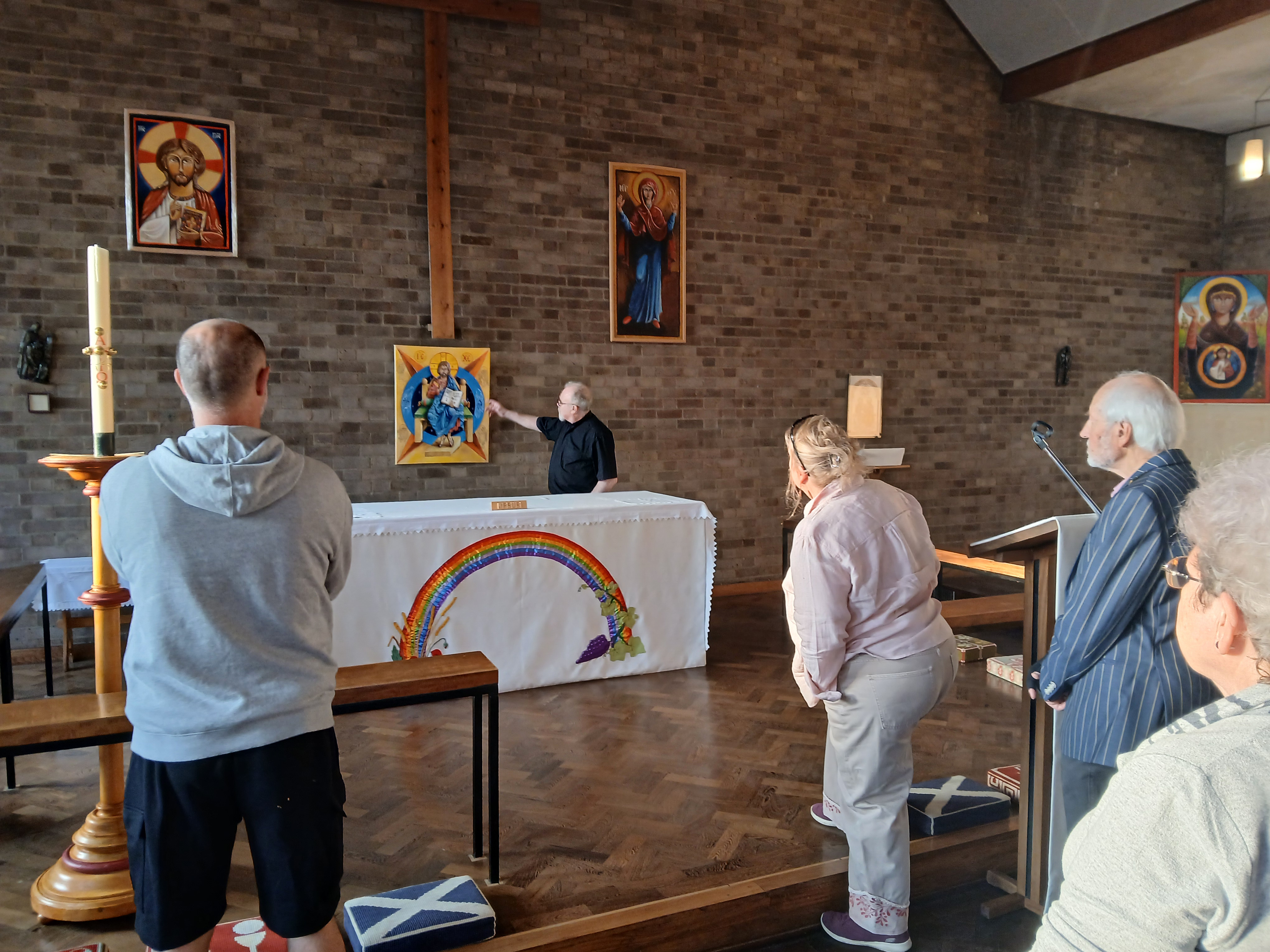
At tonight's Unveiled, our fortnightly Friday night arts & performance event at St Andrew's Wickford, we heard Max Blake talk about his wonderful exhibition 'Adventures in Joy'.

Adventures in Joy: An exhibition by Max Blake
2 May – 25 July 2025
St Andrew’s Church, 11 London Road, Wickford SS12 0AN


St Andrew’s is usually open: Sat 9am-12.30pm; Sun 9.30am-12 noon; Mon 2-3.45pm; Tue 1-4.30pm; Wed 10am-12 noon; Fri 10am-1pm. https://wickfordandrunwellparish.org.uk/whats-on.html

“Adventures in Joy” presents the most recent work produced by artist and cleric Max Blake. It includes some of the work he has developed though his studies of Icons, as well as his experiments in a more abstract and surreal direction. Max explores his own deep imagination, which is fed by his wide knowledge of religion and reflections amongst other things.

As a man of faith, much of his work expresses an exploration of the Christian faith. Over recent years, Max has studied Byzantine and Coptic Iconography and he has used this study to develop his own interpretations of the icon. Much of Max’s work is highly detailed and the viewer can find many hidden details, people, faces and shapes in his work. This creates a joyful adventure for the eye through bright and vivid worlds. Max uses a range of media including oil paints, inks and coloured pencils.

Max Blake was born in East London in the early 50s and then grew up in Basildon. After graduating as a teacher, Max taught art in secondary schools across south Essex. He also worked with children with anxiety and children with special needs. He was ordained deacon followed by priesting in the early 2000s. Although he is now retired, Max still works as a retired priest with Permission to Officiate in the United Benefice of Horndon, Orsett and Bulphan.

As well as artwork Max has also illustrated book covers and books for children. He continues to exhibit his vibrant work in various locations, including the Well House Gallery in Horndon on the Hill and St Catherine’s Church in East Tilbury. https://www.wellhousegallery.co.uk/art/max-blake

--------------------------------------------------------------------------------------------------------

Methuselah - My Poor Mary.

Thursday, 1 May 2025

Artlyst: May Art Diary

My May Art Diary for Artlyst has been published today:

"Three artists I have interviewed are opening new exhibitions this month – Márta Jakobovits, Genesis Tramaine and Helaine Blumenfeld. For the May Art Diary, I also include three exhibitions involving gardens – at Gainsborough’s House, Philip Mould and Company, and Waddesdon Manor. I also highlight exhibitions featuring aspects of the mystical or mythological. This includes a group show, ‘Finding My Blue Sky’ at Lisson Gallery. Finally, two exhibitions in church or former church spaces include Martin Creed at Camden Arts Projects and Max Blake at St Andrew's Wickford."

For more on Márta Jakobovits see here and here, Genesis Tramaine see here and here, and Helaine Blumenfeld see here, here, here and here. For information about Max Blake's exhibition at St Andrew's Wickford see here.

My other pieces for Artlyst are:

Interviews -
Monthly diary articles -
Articles/Reviews -

---------------------------------------------------------------------------------------------------------

Iain Archer - Streamer On A Kite.