Wikio - Top Blogs - Religion and belief

Saturday, 7 October 2023

Windows on the world (446)


 Lyveden, 2023

-----------------------------------------------------------------------------------------------------------------

Scott Stapp - World I Used To Know.

Epiphany: Telling an Alternative History of Modern Art

My latest article is for Epiphany, the magazine of Epiphanyart, an ecumenical society of Christian artists in Britain formed over 70 years ago and affiliated to the international movement Société Internationale des Artistes Chrétiens (SIAC) which supports national Christian arts events in many countries.

Epiphanyart aims: 1.To bring the work of Christian artists to the notice of churches and the public; 2. To provide opportunities for mutual support and encouragement to its members; 3. To provide a resource for exhibition organisers and others to contact and commission artists via its website; and 4. To serve as a focus for all forms of creativity.

This edition of Epiphany features: a review and reflections on the 'Disparate Threads' exhibition; Helen Armstrong on commissions at St Peter's Hove; poetry by Janet Wilkes; Vision for a National Christian Arts Festival; John Armstrong on Joy; and an obituary for Rosemary Roberts.

In my article I give an overview of the history of modern art flagging up the religious influences in order to counter the traditional narrative of modern art as a secular enterprise:

"... this story is not yet consistently or thoroughly told in the standard art histories of modern art, and that matters. From an art historical point of view, it matters because significant strands within the
story of modern art are absent from it and the story, as a whole, is diminished and incomplete.

From the perspective of emerging artists, it matters because, for those wishing to explore spirituality, their range of reference and role models is lessened. For practising artists, it has mattered because, for those wishing to explore spirituality, opportunities to exhibit and sell work have been constrained. For the Church and other faith communities, it matters because the traditional telling of the story, which excludes spirituality, privileges and promotes secularism.

The telling of stories matters because stories are what we live by or within. To see a change maintained in the way this story is told, we all need to be involved in its telling and to be those who tell the story in as great a breadth and depth as we each can manage."

In my first article for Epiphany, I gave an account of two war-time artists who made their way to Britain and ended up making an important contribution to the cultural life of the country through their art.

Join Epiphanyart to receive Epiphany magazine regularly.

-----------------------------------------------------------------------------------------------------------

Ed Kowalczyk - Angels On A Razor.

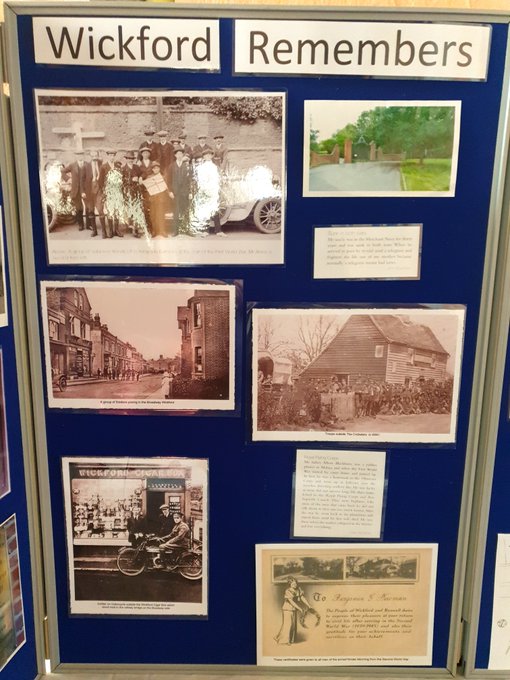
Wickford Remembers


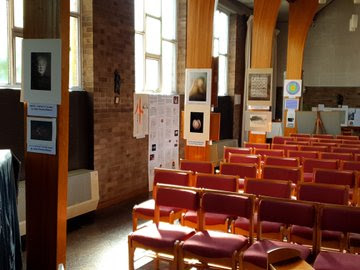
See the 'Wickford Remembers' display at St Catherine's Wickford until 12 November. Archive photographs and stories of those who served in the two World Wars. Our thanks to Basildon Heritage for the display. See also the War Memorial and Commonwealth War Graves at St Catherine's.

Also, 'Wickford Heroes': A talk by Steve Newman, 3 November 2023, 7.00 pm, St Andrew’s Church, 11 London Road, Wickford SS12 0AN.

Hear Steve Newman of the Wickford War Memorial Association and author of ‘Wickford Heroes - The Wickford & Runwell Roll of Honour Book’ speak about the War Memorial & some of those from Wickford & Runwell who made the supreme sacrifice in the World Wars.

Part of ‘Unveiled’, the fortnightly Friday night arts and performance event at St Andrew’s Church.

------------------------------------------------------------------------------------------------------------

Mark Knopfler - Remembrance Day.

Friday, 6 October 2023

'From Hong Kong to Wickford' exhibition viewing evenings


We have held two further exhibition viewing evenings for the 'From Hong Kong to Wickford' exhibition at St Andrew's Wickford.

On Monday, Martin Singleton gave a talk entitled 'Flying Wild: Beautiful Birds and Insects' based on his photographs and included in the exhibition, which also feature in Ho Wai-On's video 'Flying Wild'.

Tonight, Ho Wai-On (Ann-Kay Lin) spoke about and showed extracts from her videos which include images from her collaborators in the exhibition. She spoke about music, rhythm and image modification/animation saying that, in her videos, she uses photos and videos clips given to her as raw materials meaning that the finished product is quite different from the the original photo or video clip.

The exhibition can be viewed until 16 December 2023 during St Andrew’s opening hours: Sat 9 am - 12.30 pm; Sun 9.30 am - 12 noon Mon 2 – 3.45 pm; Tue 1 – 4.30 pm; Wed 10 am - 12 noon; Fri 10 am – 1 pm.

---------------------------------------------------------------------------------------------------------

Ho Wai-On - Four Songs.

Wednesday, 4 October 2023

Putting God first

Here's the reflection I shared at St Andrew's Wickford this morning:

In this passage (Luke 9. 57 – end) Jesus challenges his actual disciples and his would-be disciples about what it means to follow him and be a disciple.

In speaking to would-be disciples Jesus is emphatic that God comes first. Before commitments to home and to family, God comes first. This is the practical implication and application of Jesus’ summary of the Law: “Love the Lord your God with all your heart, with all your soul; and with all your mind.” That is the greatest and most important commandment. Love for others follows on from it, as we are then told to love our neighbour as we love ourselves.

Jesus is talking here to people who were wanting to be part of his itinerant ministry but, as we also know, he did have followers who stayed in their homes and workplaces and who provided support for the team of disciples who were on the road. So, these words of Jesus don’t mean that every Christian should leave home and family in order to follow him but they do mean that wherever we are, we must put God first in our lives.

As one example, “The obligation to bury one’s father was regarded by many Jews of Jesus’ time as the most holy and binding duty of a son; but Jesus says that that is secondary to the call to follow him and announce God’s kingdom.” Jesus’ call cuts across family life and our traditional understandings of family. Here, even saying goodbye to your family before you leave seems to be criticised by Jesus!

There is no point pretending that any of this is easy. What Jesus says to his would-be disciples still strikes us today as extreme but he is doing is making clear the real choice for us; between putting God first or putting ourselves, our needs and commitments first. That is the choice and dilemma that faces us each day. If we are to be followers of Jesus, then we need to continually say to ourselves WWJD; What would Jesus do.

That’s what Francis of Assisi did and today is the day when the Church remembers him particularly. Francis was born in Assisi in central Italy either in 1181 or the following year. He was baptised Giovanni but given the name Francesco by his father, a cloth merchant who traded in France and had married a French wife. There was an expectation that he would eventually take over his father's business but Francis had a rebellious youth and a difficult relationship with his father. After suffering the ignominy of imprisonment following capture whilst at war with the local city of Perugia, he returned a changed man. He took to caring for disused churches and for the poor, particularly those suffering from leprosy. Whilst praying in the semi-derelict church of St Damian, he distinctly heard the words: "Go and repair my church, which you see is falling down." Others joined him and he prepared a simple, gospel-based Rule for them all to live by. As the Order grew, it witnessed to Christ through preaching the gospel of repentance, emphasising the poverty of Christ as an example for his followers. Two years before his death, his life being so closely linked with that of his crucified Saviour, he received the Stigmata, the marks of the wounds of Christ, on his body.

At his death, on the evening of 3 October 1226, his Order had spread throughout western Christendom. It did so, in part, because of inspirational team talks from St. Francis, such as this one recorded in the Legend of the Three Companions:

'Calling together the six brothers, Saint Francis, since he was full of the grace of the Holy Spirit, predicted to them what was about to happen. “Dearest brothers,” he said, “let us consider our vocation, to which God has mercifully called us, not only for our own good, but for the salvation of many. We are to go throughout the world, encouraging everyone, more by deed than by word, to do penance for their sins and to recall the commandments of God. Do not be afraid that you seem few and uneducated. With confidence, simply proclaim penance, trusting in the Lord, who conquered the world. Because by his Spirit, He is speaking through and in you, encouraging everyone to be converted to him and to observe his commandments”.’

Like Francis and his followers, wherever we are and whatever we are doing, Jesus calls us to proclaim the kingdom of God by deeds and words. 

-------------------------------------------------------------------------------------------------------

Donovan - The Lovely Day / Brother Sun, Sister Moon.

Monday, 2 October 2023

Artlyst: The Art Diary October 2023

My October Art Diary for Artlyst features several artists I have interviewed or featured previously who have work on display this month. These include Louis Carreon, Alexander de Cadenet, Marcus Lyon, Hannah Rose Thomas and Christopher Clack. Exhibitions featured are at The Arx, Rochester Cathedral, Bankside Gallery, Pallant House Gallery, Brownston Gallery, Carpenters Workshop Gallery, Rachel Bebb Contemporary, St John's Waterloo, St Andrew's Wickford and St Stephen's, St Julian's and St John the Baptist, Norwich:

'The Arx are currently showing works by two of the artists I have had the pleasure of interviewing previously for Artlyst. The display of paintings by Louis Carreon at The Arx provides a first opportunity to see his work in the UK. Carreon reimagines classic art through the lens of sampling, echoing the spirit of hip-hop’s homage and creation. His “story of transformation, from addiction and incarceration to redemption through art and religion, is an inspiring testament to the power of creativity”. The images shown allow viewers to delve into his world, “inspired by art giants like El Greco and Caravaggio”... 

Key sculptures displayed at The Arx – ‘Creation’ and the Life-Burgers – by Alexander de Cadenet are among those that I showed at St Stephen Walbrook in 2017. The Life-Burger sculptures explore the relationship between the spiritual dimension of art and consumerism and investigate what gives life meaning. De Cadenet is a visual artist working in London who has been exhibiting his artworks internationally for the past twenty years. His artworks reveal an exploration into philosophical and spiritual questions such as the meaning of life and death and the nature of human consciousness.'

My interviews with these artists can be found at: Louis Carreon; Alexander de Cadenet; Marcus Lyon; Hannah Rose Thomas; and Christopher Clack. My review of Richard Kenton Webb's recent exhibition is here and my piece about St John's Waterloo is here.

My other pieces for Artlyst are:

Interviews -
Monthly diary articles -

Articles/Reviews -
---------------------------------------------------------------------------------------------------------------

Norman Greenbaum - Spirit In The Sky.

Sunday, 1 October 2023

Paying attention: Consider the lilies

Here's the sermon that I shared at St Mary’s Runwell this morning for their Harvest Festival:

In our reading today we heard Jesus tell us that we should look at the flowers of the field. Stop and notice. In his painting called Consider the Lilies, Stanley Spencer depicts Jesus as mountainous in comparison with the daisies (not lilies) that he contemplates. Archbishop Stephen Cottrell has noted that this Jesus is playful, "huge and humble", godlike. Mark Oakley writes that ‘Whereas lilies call for attention, in church or posh hallways, daisies are overlooked, or considered problematic in our neat lawns. Jesus relishes their beauty, and, at the same time, challenges the sad fact about human beings that "when it comes to the present moment, we're not present".’ 

Cottrell then cleverly refers us to the words of Nadine Stair: ‘If I had my life to live over . . . I'd relax, I would limber up. I would be sillier than I have been. . . I would do more walking and looking. . . I would pick more daisies.’

Simon Small writes that we find it difficult to do this because: ‘Our minds find paying full attention to now very difficult. This is because our minds live in time. Our thoughts are preoccupied with past and future, and the present moment is missed.’ But, he says: ‘To pay profound attention to reality is prayer, because to enter the depths of this moment is to encounter God. There is always only now. It is the only place that God can be found.’

This is very much what Jesus seems to be saying to us through his teaching on worry and anxiety as found in today’s Gospel reading (Matthew 6. 24 -34). When we are preoccupied with what might happen in the future, we are not living fully in the present and may well misunderstand or misinterpret what is actually going on. Jesus encourages us to live fully in the present because, as Simon Small says, that is where we encounter God.

When we genuinely encounter God in the here and now, we know that his love and forgiveness surround us and that his Spirit fills us. As Jesus prayed in John 17, he is in us and we are in him. When we know this in our hearts in the here and now, we can relax because whatever happens to us, we are accepted, forgiven, loved and gifted by the God who created all things and who will bring all things to their rightful end. We are held in the palm of his hands and, therefore, as Julian of Norwich put it, “all shall be well, and all shall be well, and all manner of thing shall be well”.

Jesus says that the more we live in the present and the more we encounter God’s love in the here and now, the less we will be anxious or worried. Prayer is able to help us do both things and therefore helps us to reduce our sense of anxiety or worry. Not because we have listed all our worries to God and believe that he will solve them all for us, but instead because, through prayer, we encounter more of God’s love and, as a result, trust that he will be with us whatever comes our way.

Harvest provides a wonderful opportunity for us to do this in relation to the natural world around us including the birds of the air and the lilies of the field. Harvest provides an ‘opportunity to reflect and give thanks for all the good things in our lives, especially the way in which the earth produces food for us to eat, to give thanks for all those who work to produce food and drink for us to enjoy, to say sorry for the times we are not grateful, that we don’t notice God’s work in the world, that we don’t look after the things God has given us.’ ‘We live in a different time from our ancestors where the harvest and bringing the harvest in would have dominated everyone’s lives’ but today we probably hardly notice it. What we can do, however, is pay attention to what is around us, whether in our gardens and parks or in our homes and town.

Pope Francis has written on the connection between care for our common home and paying attention in his encyclical Laudato Si. There, he wrote: ‘Those who enjoy more and live better each moment are those who have given up dipping here and there, always on the look-out for what they do not have. They experience what it means to appreciate each person and each thing, learning familiarity with the simplest things and how to enjoy them. So they are able to shed their unsatisfied needs, reducing their obsessiveness and weariness. Even living on little they can live a lot, above all when they cultivate other pleasures and find satisfaction in fraternal encounters, in service, in developing their gifts, in music and art, in contact with nature and in prayer.’ (Laudato Si 223)

He continues, saying, ‘No one can cultivate a sober and satisfying life without being at peace with him or herself…. Inner peace is closely related to care for ecology and for the common good because, lived out authentically, it is reflected in a balanced lifestyle together with a capacity for wonder which takes us to a deeper understanding of life. Nature is filled with words of love, but how can we listen to them amid constant noise, interminable and nerve-wracking distractions, or the cult of appearances.’ (Laudato Si 225)

He concludes, drawing on today’s Gospel reading, that: ‘We are speaking of an attitude of heart, one which approaches life with serene attentiveness, which is capable of being fully present to someone…which accepts each moment as a gift from God to be lived to the full. Jesus taught us this attitude when he invited us to contemplate the lilies of the field and the birds of the air…. He was completely present to everyone and to everything and in this way he showed us the way to overcome that unhealthy anxiety which makes us superficial, aggressive and compulsive consumers.’ (Laudato Si 226)

Pope Francis quotes Patriarch Bartholomew as saying that we should look for solutions to the climate emergency in a change of humanity: ‘He asks us to replace consumption with sacrifice, greed with generosity, wastefulness with a spirit of sharing, an asceticism which “entails learning to give, and not simply to give up. It is a way of loving, of moving gradually away from what I want to what God’s world needs. It is liberation from fear, greed and compulsion”. Bartholomew says that, ‘As Christians, we are also called “to accept the world as a sacrament of communion, as a way of sharing with God and our neighbours on a global scale. It is our humble conviction that the divine and the human meet in the slightest detail in the seamless garment of God’s creation, in the last speck of dust of our planet”.’ 

Such an attitude begins with our looking closely, attentively, at the world around us as Jesus encourages us to do in today’s Gospel reading and as Stanley Spencer shows him doing in ‘Consider the Lilies’. This Harvest, may we increasingly do the same.


------------------------------------------------------------------------------------------------------------

Barclay James Harvest - Hymn.