Wikio - Top Blogs - Religion and belief

Sunday, 23 October 2016

Paul Nash and James Ensor

Paul Nash opens at Tate Britain on 26 October. Paul Laity has an excellent piece in The Guardian on Nash and his work:

'Nash’s transformations of reality were the product of a visionary sensibility that harked back to William Blake and Samuel Palmer; he searched for inner meanings in the landscape, what he called the “things behind” ...

he was caught up, as ever, in looking at the world and seeing patterns and mysterious “things behind”. An artist both full of wonder and wonderful, knowing the end was near, painted pictures that were stranger than ever.'

Paul and Margaret Nash practiced Christian Science, and Paul shared a Christian Science practitioner with Barbara Hepworth and Ben Nicholson. Hepworth, Nicholson and Winifred Nicholson were profoundly influenced by Christian Science (a faith that was of great importance to Stanley Spencer’s wife, Hilda Carline).

For Intrigue: James Ensor by Luc Tuymans at the Royal Academy of Arts from 29 October 2016 — 29 January 2017, Tuymans, a fellow Belgian and admirer of Ensor, will look back at Ensor’s singular career through a selection of his most bizarrely brilliant and gloriously surreal creations.
Astrid Schenk has written that

'It was 1888 when James Ensor began work on his monumental painting Christ's Entry into Brussels in 1889. The painting would become one of his most iconic and eagerly analysed compositions, and is now regarded as a milestone in the history of modern art. Not surprisingly, perhaps, it has also encouraged art historians to take a closer look at the representation of religious subject matter in Ensor's oeuvre in general. The focus of this scholarly attention has been mainly on Ensor's various approaches to the Crucifixion (especially the grotesque or sinister elements in some of his renderings), as well as on the series entitled The Aureoles of Christ or the Sensitivities of the Light, which Ensor first exhibited in 1887, and on different versions of The Temptation of Saint Anthony, Abbot of Egypt ...

The size of his religious oeuvre, the great variation in religious subject matter, and the fact that he continued throughout his life to produce religious work are strong indications that, to Ensor, religious sources of inspiration were key to achieving his artistic goals. This relevance went well beyond the supposed identification of the artist with the suffering of Christ and the exploration of particular visual effects. Ensor borrowed from the Christian iconography in order to be able to visualise his ideas in a recognisable idiom and to conduct visual experiments in his quest for exaltation.'

----------------------------------------------------------------------------------------

Gungor - You.

Saturday, 22 October 2016

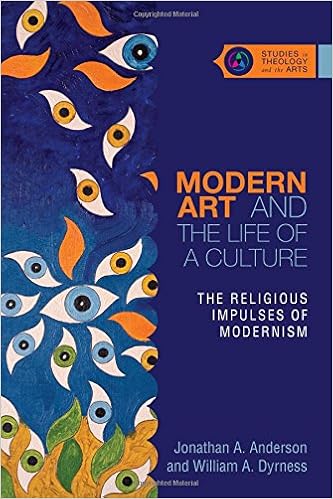
Modern Art and the Life of a Culture: The Religious Impulses of Modernism


As Jonathan A. Anderson and William A. Dyrness note in Modern Art and the Life of a Culture: The Religious Impulses of Modernism, I have for some time been arguing that, as Daniel A. Siedell suggested in God in the Gallery, "an alternative history and theory of the development of modern art" is needed, "revealing that Christianity has always been present with modern art, nourishing as well as haunting it, and that modern art cannot be understood without understanding its religious and spiritual components and aspirations." In my Airbrushed from Art History and Sabbatical Art Pilgrimage series of posts I have highlighted some of the artists and movements (together with the books that tell their stories) that should feature in that alternative history when it comes to be written.

In Modern Art and the Life of a Culture Anderson and Dyrness, part of IVP's Studies in Theology and the Arts, also argue that there were strong religious impulses that positively shaped modern visual art. Instead of affirming a pattern of decline and growing antipathy towards faith, the authors contend that theological engagement and inquiry can be perceived across a wide range of modern art—French, British, German, Dutch, Russian and North American—and through particular works by artists such as Gauguin, Picasso, David Jones, Caspar David Friedrich, van Gogh, Kandinsky, Warhol and many others.

Gregory Wolfe writes that this book provides a 'nuanced and sympathetic view of the religious aspects that truly did haunt modernism in the visual arts' noting that, after a couple of introductory chapters, 'the book moves into a sequence of historical surveys ranging from Van Gogh to Andy Warhol, with many stops in between.'

Dryness notes: 'Van Gogh is often recognized as a deeply spiritual artist, but usually he is pictured as having given up his childhood (Reformed) Christian faith. But closer examination shows this not to have been the case. Others, like Gauguin, who are largely regarded as irreligious, turn out to have had deep and formative experiences with (in this case) the Catholic faith. Still others, like Malevich, inherited sensibilities from their religious contexts which made deep inroads into their art. So there is no single story to be told.' 

Anderson says: 'The research for this book was full of surprises for me. The religious backgrounds of these artists, as well as the ongoing theological content of their work, are sometimes buried deep in the academic literature and primary sources, but once you begin to dig you find extraordinary things. Van Gogh was actually a fascinating theologian, and his paintings were theologically oriented all the way to the end. Mondrian completed his art training in the thick of the best neo-Calvinist thinking of the day. Until researching for this book, I hadn’t realized just how deeply Kandinsky was preoccupied with the book of Revelation. Warhol’s sharp social commentaries were oriented by his lifelong Catholicism. And so on: the surprises abound.'

--------------------------------------------------------------------------------------

Van Morrison - In The Garden.

Notes on Blindness: A more inclusive future for VOD

The acclaimed film Notes On Blindness (which was screened last week at St Martin-in-the-Fields as part of our 'Prophets & Seers' weekend), is now available on DVD and also to stream on Curzon Home Cinema, Virgin Media and the BFI Player. Not only is the film available with subtitles, but it also comes with a range of different audio tracks specially designed for blind and partially sighted audiences. Charlie Lyne suggests in The Guardian that the film's exemplary package points towards a more inclusive future for Video On Demand.

----------------------------------------------------------------------------------------

Leonard Cohen - Treaty.

Bob Dylan: In an imaginative conversation with scripture

Malcolm Guite makes an excellent argument in the Church Times for the appropriateness of awarding Bob Dylan the Nobel Prize in Literature, including the following:

'... it is the Bible, more even than the work of previous poets, that has inspired and informed Dylan’s best work; and this biblical strand in his poetry is not confined to the more obvious and dramatic quotations in the intense period of his Christian conversion (1979-82).

Throughout his work, from his earliest days to the present, he has been in an imaginative conversation with scripture. In his best songs, it is not only direct quotation, but subtle allusion, that informs and deepens the poetry. Dylan often allows a Bible passage to work quietly behind his song. We can hear and appreciate the song without at first hearing the biblical echoes, but, once we do hear them, the whole meaning of the song is enhanced.'

For more reflection on Dylan and faith, read my co-authored book 'The Secret Chord'.

-------------------------------------------------------------------------------------------------------

Bob Dylan - Blowing In The Wind.

Update: Sophia Hub Redbridge

Ros Southern writes ...

'Coming up this week
  • Tomorrow - Redbridge Hack Day to try to solve the problem of some residents not going online. Info here
  • Tomorrow - Isatu Harrison, South Woodford fashion designer has big Sierra Leone fashion event Info here
  • Tuesday - Chamber networking breakfast IS CANCELLED.
  • Wednesday - 5.30 Entrepreneurs clubfor 6. Mindfulness for business owners with Pipa Moye. Info and booking here
Sophia Hubs stuff coming up
  • Timebank community skills swap - We 've found a nice cafe! Weds 9 November 6pm info here. Please do come and join in.
  • Sophia course - from a vague community or business idea to first pilot - Saturday mornings. Info here
  • Entrepreneurs club dates until Christmas - available here.
Other great stuff coming up
  • Google digital training - Saturday 29 October - info here
  • Volunteering fair - Thurs 3 November 11-2 - info here (we'll be there!)
  • Tech club for techie businesses - Thurs 3 November 6pm - Info here
  • Free open source IT tools - Friday 4 November 1-3. Info here
  • Monday 7th November - Wanstead Business Network meeting - open to all
  • Next 3 hour starting a business workshop 15th Nov 10-1. Info here
Some of our social media shares/posts this week

Have a nice weekend,

Best wishes,

Ros Southern, Coordinator.
07707 460309

--------------------------------------------------------------------------------------

Neil Young & Crazy Horse - Be The Rain.

Windows on the world (315)


London, 2016

-------------------------------------------------------------------------------------------

Joni Mitchell - Harry's House.

ArtWay Visual Meditation: Albert Servaes


My latest Visual Meditation for ArtWay concerns three stained glass windows by Albert Servaes in the Church of the Holy Family in Woluwé-Saint-Lambert, a district of Brussels. 

I greatly enjoyed my visit to the Church of the Holy Family, with its welcoming worship and congregation, in August. The bright and busy pair of East windows provide colourful focus for the space, although they lack clarity in the content of their imagery, while the contemplative West window provides a creative turn away from the colour and clamour of the central lights.

In the meditation I write: 'In contrast to the minimal figural focus of Servaes’ Luithagen Stations, these are busy designs filled with figures and faces. The colours and contrasts are generally brighter than is usual within the work of Servaes and, despite the themes which include expulsion and judgement, the look and feel of the work has less of the anguish and strain that characterises much of Servaes’ oeuvre.'

My other ArtWay meditations include work by María Inés Aguirre, Marian Bohusz-Szyszko, Christopher Clack, Marlene Dumas, Antoni Gaudi, Maciej Hoffman, Giacomo Manzù, Maurice Novarina, Ana Maria Pacheco, John Piper, and Henry Shelton.

------------------------------------------------------------------------------------------

Julie Miller - All My Tears.