Wikio - Top Blogs - Religion and belief
Showing posts sorted by date for query Robert Koenig. Sort by relevance Show all posts

Saturday, 24 April 2021

After the Uprising: Wat Tyler Country Park


Wat Tyler Country Park has countryside adventure for everyone including 125 acres of country walks, wildlife spotting, adventure play for kids, a Village Green edged by historic, picturesque thatched cottages, and a marina on Pitsea Creek in atmospheric Essex marshland.

The sculpture trail includes huge crawling creatures, whispering dishes and sound pods to interact with, and art you can sit on to get a different view of the world.

After the uprising was made from 7 sweet chestnut trees in 2006 by Robert Koenig. In 1381 peasants from the Essex marshland villages marched on London to protest against the poll tax. The rebellion was quickly suppressed. Most of the rebels were allowed to go home but the leaders were pursued, captured and executed. The leader of the peasant’s revolt was Wat Tyler. 

In order to represent this mass of humanity marching on London Robert Koenig chose to carve 7 symbolic figures from sweet chestnut trees. Wat Tyler stands proudly at the front of this group, other figures are bound and captive behind him. Sited in this clearing and looking as if they have just emerged from the wooded area behind, the eleven foot carvings convey a sense of the drama of the event and its often overlooked importance in the history of the area.

See my other posts about Robert Koenig's work here, including his Odyssey exhibition at St Martin-in-the-Fields.

------------------------------------------------------------------------------------------------------------ 

Peter Frampton - Show Me The Way.

Wednesday, 21 April 2021

ArtWay: Photographing Religious Practice

My latest article for ArtWay is entitled Photographing Religious Practice and discusses the increasing prevalence of photographic series and books exploring aspects of religious practice:

"Gorick’s discoveries provided her with a completely different perspective on the City of London and her hope now is that her photographs will inspire others to push open church doors and explore their spiritual nuances.

Similarly with the work of Mandle, Polidori and Tomlinson, where the beauty of their photographs, encourages us to go beyond their images by entering the history, tradition and reality of peaceful prayerfulness to which they connect."

I have previously written about Niki Gorick here, S. Billie Mandle here, Alys Tomlinson here, 
Markéta Luskacová here, and Robert Polidori here.

My Church of the Month reports for ArtWay are: Aylesford Priory, Canterbury Cathedral, Chapel of St. Thérèse of the Child Jesus and the Holy Face, Hem, Chelmsford Cathedral, Churches in Little Walsingham, Coventry Cathedral, Église de Saint-Paul à Grange-Canal, Eton College Chapel, Lumen, Metz Cathedral, Notre Dame du Léman, Notre-Dame de Toute Grâce, Plateau d’Assy,Romont, Sint Martinuskerk Latem, St Aidan of Lindisfarne, St Alban Romford, St. Andrew Bobola Polish RC Church, St. Margaret’s Church, Ditchling, and Ditchling Museum of Art + Craft, St Mary the Virgin, Downe, St Michael and All Angels Berwick, and St Paul Goodmayes, as well as earlier reports of visits to sites associated with Marian Bohusz-Szyszko, Marc Chagall, Jean Cocteau, Antoni Gaudi and Henri Matisse.

My visual meditations for ArtWay include work by María Inés Aguirre, Giampaolo Babetto, Marian Bohusz-Szyszko, Alexander de Cadenet, Christopher Clack, Marlene Dumas, Terry Ffyffe, Antoni Gaudi, Nicola Green, Maciej Hoffman, Lakwena Maciver, S. Billie Mandle, Giacomo Manzù, Michael Pendry, Maurice Novarina, Regan O'Callaghan, Ana Maria Pacheco, John Piper, Nicola Ravenscroft, Albert Servaes, Henry Shelton, Anna Sikorska and Edmund de Waal.

Interviews for ArtWay include: Sophie Hacker and Peter Koenig. I also interviewed ArtWay founder Marleen Hengelaar Rookmaaker for Artlyst.

I have also reviewed: Art and the Church: A Fractious Embrace, Kempe: The Life, Art and Legacy of Charles Eamer Kempe, and Jazz, Blues, and Spirituals.

Other of my writings for ArtWay can be found here. My pieces for Church Times can be found here, those for Artlyst here, and those for Art+Christianity are here.

---------------------------------------------------------------------------------------------------------

Revolutionary Army of the Infant Jesus - Bright Field.

Saturday, 20 February 2021

Exploring connections between the Arts and faith

My most recent series here explored the art of contemplation. Entitled Seeing is Receiving, this is a series about art and prayer but is not like any book on prayer you may have read. Most books about prayer are about the words we should speak or, if they are books of prayers, give us the words we are to speak. This is a series using words to bring us to silence. Why? Because when we fall silent we begin to see. Here is the index to the series:

Seeing is Receiving is the latest in my ongoing exploration of connections between the Arts and faith. To explore the contribution made by Christianity to the Arts is important because the story of modern and contemporary Arts is often told primarily as a secular story. To redress this imbalance has significance in: encouraging support for those who explore aspects of Christianity in and through the Arts; providing role models for emerging artists who are Christians; and enabling appreciation of the nourishment and haunting which can be had by acknowledging the contribution which Christianity has made to the Arts.

My co-authored book The Secret Chord explored aspects of a similar interplay between faith and music (and the Arts, more broadly). Posts related to the themes of The Secret Chord can be found here. I have also posted an outline summary of the Christian contribution to rock and pop music. Pieces on contemporary choral and classical music are here and here.

Tracing the connections between artists that were either part of the Church and were engaged by the Church in the 20th century is an important element in the argument that the level and extent of the engagement between the Church and the Arts has been more significant than is generally acknowledged. Some of my posts tracing these connections include:
My key literature posts are:
The index to my 'Airbrushed from Art History' series of posts is as follows:

Additions to the series and related posts are as follows:

On my sabbatical in 2014 I enjoyed the opportunity to visit churches in Belgium, England, France and Switzerland to see works of modern and contemporary art. I documented these visits at http://joninbetween.blogspot.com/search/label/sabbatical and they resulted in a series of Church of the Month reports for ArtWay: Aylesford Priory, Canterbury Cathedral, Chapel of St. Thérèse of the Child Jesus and the Holy Face, Hem, Chelmsford Cathedral, Churches in Little Walsingham, Coventry Cathedral, Église de Saint-Paul à Grange-Canal, Eton College Chapel, Lumen, Metz Cathedral, Notre Dame du Léman, Notre-Dame de Toute Grâce, Plateau d’Assy,Romont, Sint Martinuskerk Latem, St Aidan of Lindisfarne, St Alban Romford, St. Andrew Bobola Polish RC Church, St. Margaret’s Church, Ditchling, and Ditchling Museum of Art + Craft, St Mary the Virgin, Downe, St Michael and All Angels Berwick, and St Paul Goodmayes, as well as earlier reports of visits to sites associated with Marian Bohusz-Szyszko, Marc Chagall, Jean Cocteau, Antoni Gaudi and Henri Matisse.

My visual meditations for ArtWay include work by María Inés Aguirre, Giampaolo Babetto, Marian Bohusz-Szyszko, Alexander de Cadenet, Christopher Clack, Marlene Dumas, Terry Ffyffe, Antoni Gaudi, Nicola Green, Maciej Hoffman, Lakwena Maciver, S. Billie Mandle, Giacomo Manzù, Michael Pendry, Maurice Novarina, Regan O'Callaghan, Ana Maria Pacheco, John Piper, Nicola Ravenscroft, Albert Servaes, Henry Shelton, Anna Sikorska and Edmund de Waal.

Interviews for ArtWay include: Sophie Hacker and Peter Koenig. I also interviewed ArtWay founder Marleen Hengelaar Rookmaaker for Artlyst.

I have also reviewed: Art and the Church: A Fractious Embrace, Kempe: The Life, Art and Legacy of Charles Eamer Kempe, and Jazz, Blues, and Spirituals.

Other of my writings for ArtWay can be found here. My pieces for Church Times can be found here and those for Art+Christianity are here.

My pieces for Artlyst are:

Interviews -
Articles -
-----------------------------------------------------------------------------------------------------

King's X - It's Love.

Tuesday, 21 August 2012

Reaching Beyond


Today I visited the Reaching Beyond exhibition at Bow Road Methodist Church and met Richard Smith, one of the artists and organisers.

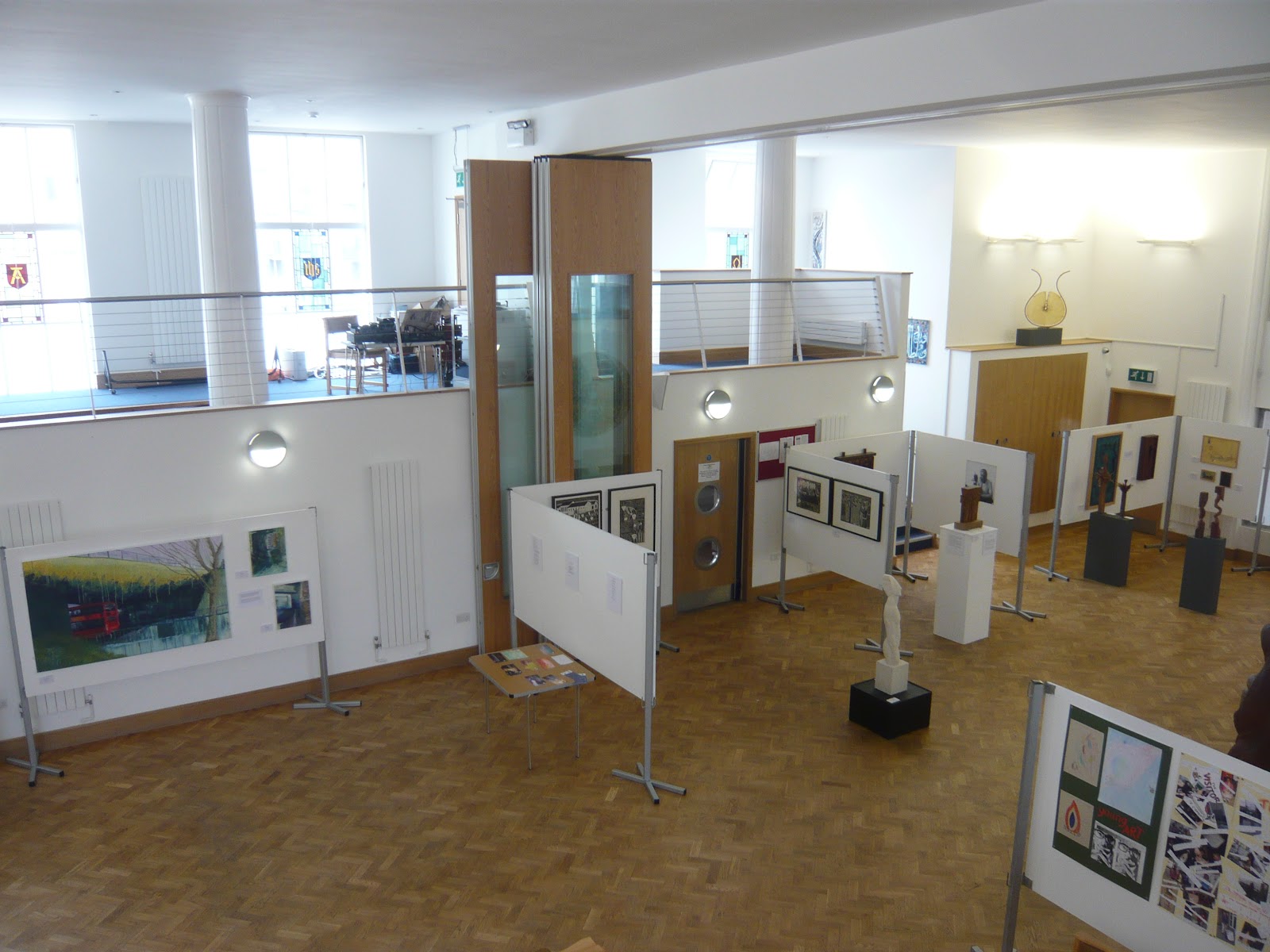
Reaching Beyond is an exhibition celebrating the human spirit reaching beyond the mundane both through endeavour and an openness to something transcendent. The exhibition's title is intentionally open to a wide range of interpretation and the work shown by the 19 artists included invites those who see it to think afresh, and reach beyond their assumptions. The range of media and styles featured is also correspondingly broad with fabrics, icons, mosaics, paintings and sculptures all included. The recent renovation of the church makes it, among other things, an excellent exhibition space. The sculptures set on the exterior provide an arresting beginning to the show and certainly drew other visitors  into the building over the course of my visit.

Richard Smith is one half of Smith and Moore (the other being David Moore). The pair have been friends and colleagues since 1966, and have been creating sculptures together since 1994. In their art they explore/question/challenge serious matters with humour, levity and a touch of incredulity. They bring to this their experience of living and working within poor communities, political and social engagement, and reflection on theology. David is a Methodist minister and runs Colloquy, an art and theology project which is part of the Methodist Church, from which the idea for the exhibition grew. Richard has had a varied career, ranging from research in physical chemistry to community development and management, with illustrating having been taken in along the way.

From early 2012 Smith and Moore sent their small, sturdy sculpture, the Visitor, on an uncharted journey via churches and other organisations through five London boroughs (Greenwich, Hackney, Newham, Tower Hamlets and Waltham Forest). People seeing the Visitor on its journey sent in photographs and notes of what happen, all of which are posted on the project's website and have been used in the exhibition along with the Visitor itself.

Other particularly strong work in the exhibition includes: Aaron Distler's abstract ‘Fire Drawings’ (using paper which has been treated and burnt to create extraordinary effects contained within frames which are themselves part of the work); Robert Koenig's monumental wood figures symbolising the artist’s ancestors as part of a search for ancestral and sculptural roots; Jean Lamb, an Anglican Priest living in Nottingham, who is a woodcarver in the storytelling tradition and is showing two casts from Stations of the Holocaust which follow the path of Christ to the Cross, each one including in the background images from the record of the Jewish holocaust during the Second World War; and Santiago Bell, a brilliant artist, educator, political activist and thinker imprisoned and tortured by the Pinochet regime in the 1970s, who expressed his insights and reflected on his experience in finely carved, imaginative, wooden constructions, such as Age of Emptiness.

-----------------------------------------------------------------------------------

After The Fire - Joy.

Thursday, 29 March 2012

Art @ St Martin-in-the-Fields


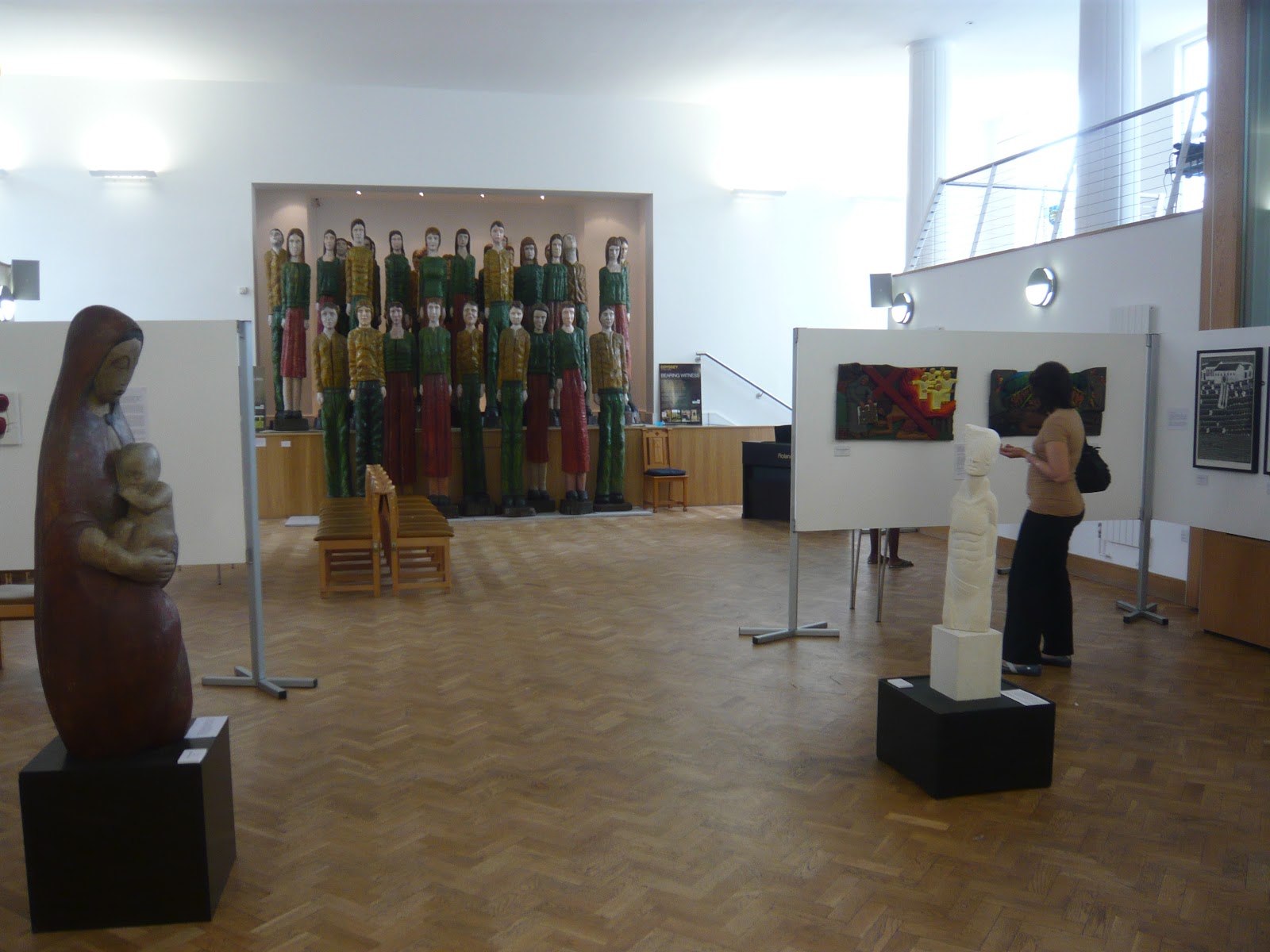
Robert Koenig's Odyssey consists of a crowd of 32 monumental wood figures , each 2.5m tall. Most of these male and female figures were carved in the village of Dominikowice in the foothills of the Carpathian Mountains in South East Poland between 1997 – 2002. Odyssey deals with important issues of migration, forced or voluntary. It talks about heritage, belonging, displacement and people’s place in the world. This project which started out as a search for Polish ancestral roots is taking on a pan-European and universal dimension.

The Saint John's Bible is a work of art and a work of theology. A team of artists coordinated by Donald Jackson in Wales and a team of scholars in Central Minnesota have brought together the ancient techniques of calligraphy and illumination with an ecumenical Christian approach to the Bible rooted in Benedictine spirituality. The result is a living document and a monumental achievement.

The Statons of Cross by Siku originally come from the Manga Bible which has had more than 100,000 sales distributed in over 16 countries. As a follow up Siku produced The Manga Jesus which contains some of the most stunning artwork of that story.

-----------------------------------------------------------------------------------------------

Mumford & Sons - Home.

Friday, 23 March 2012

'Simulacro' and 'Odyssey'


Odyssey is Robert Koenig’s attempt to call up his Polish ‘ancestral ghosts’ by carving a large group of male and female figures, each 2.5m tall, out of lime trees which grew in his mother’s home village of Dominikowice in South East Poland. These trees bore witness to the many dramatic events that shaped the lives of people over the last 100 years.

These remarkable figures are on display across the site of St Martin-in-the-Field’s from 19 March – 20 July. During his Gallery exhibition (4 - 10 June), the artist will be creating a new sculpture inspired by his time at St Martin’s. The current Gallery show - Simulacro, an exhibition of works made by sixteen multidisciplinary artists - can be seen until 1st April.

-------------------------------------------------------------------------------------------

Michael Kiwanuka - Home Again.