Wikio - Top Blogs - Religion and belief
Showing posts with label word of god. Show all posts

Sunday, 18 January 2026

A life lived to introduce others to Jesus Christ

Here's the sermon I shared this morning at St Gabriel’s Pitsea:

Here, in five short verses at the beginning of today's Gospel reading (John 1:29-34), we have the testimony of John the Baptist regarding Jesus. Who does John say that Jesus is?

Firstly, John says that Jesus is the Lamb of God who takes away the sin of the world. The image of Jesus as the lamb that takes away sin reminds us of the story of the Exodus and the Passover. Death was coming to the entire land of Egypt and those saved were those who sacrificed lambs and daubed the blood of the lamb on the doorposts of their homes. John was saying that when Jesus died his sacrifice would affect the entire world not just the people of Israel and would do so by taking away our sin for which the punishment is death. 

Next, John says that Jesus ranks ahead of him because he was before him. John the Baptist was a great prophet. So much so, that Jesus compares him to Elijah referring to the prophecy in Malachi 4:5 that God would send Elijah the prophet before the coming of the great and terrible day of the Lord. Despite the greatness of John’s role and ministry (and despite the fact that he is the elder of the two), Jesus is the one to whom John bows the knee (the strap of whose sandal he is not worthy to untie) because, as we hear at the beginning of John’s Gospel, in the beginning was the Word, and the Word was with God, and the Word was God. The Word was Jesus. He was in the beginning with God. All things came into being through him, and without him not one thing came into being.

John then says that Jesus is the one on whom the Spirit remains. The Spirit “came upon” such Old Testament people as Joshua (Numbers 27:18), David (1 Samuel 16:12-13) and even Saul (1 Samuel 10:10). In the book of Judges, we see the Spirit “coming upon” the various judges whom God raised up to deliver Israel from their oppressors. The Holy Spirit came upon these individuals for specific tasks. What happens with Jesus is different, as the Spirit remains with him. In Jesus the fruit of the Spirit -  love, joy, peace, patience, kindness, generosity, faithfulness, gentleness, and self-control – can be fully expressed, therefore the Spirit remains with Jesus in a way which had not been possible until then. All of Jesus' ministry, "must be understood as accomplished in communion with the Spirit of God".

Fourthly, John says that Jesus is the one who baptises others with the Holy Spirit. As the Holy Spirit remains with Jesus, so she also remains with those who are his followers.  The New Testament teaches the permanent indwelling of the Holy Spirit in believers (1 Corinthians 3:16-17; 6:19-20). When we place our faith in Christ for salvation, the Holy Spirit comes to live within us. The Apostle Paul calls this permanent indwelling the “guarantee of our inheritance” (Ephesians 1:13-14).

Finally, John sums up his testimony by saying that Jesus is the Son of God, a title that implies His deity (John 5:18) because it is one of equality with God. This title has many facets, including showing that He is to be honoured equally with the Father (John 5:22-23), that He is to be worshipped (Matt. 2:2, 11, 14:33, John 9:35-38, Heb. 1:6), called God (John 20:28, Col. 2:9, Heb. 1:8), and prayed to (Acts 7:55-60, 1 Cor. 1:1-2).

John was sent as a man of God expressly to prepare the way for and to testify regarding the Christ, so the people would believe in Him. He plainly said that Jesus was the One for Whom He was preparing the way. He said Jesus would have pre-eminence, that Jesus was the Christ, that He was the Lamb of God who takes away the sin of the world, and that He was the Son of God. John lived his life to introduce others to Jesus Christ and his testimony is a model of Christian witness to Jesus. 

John believed in the Christ and his great faith prepared him for hardships, but it kept him steadfast on his course until the time when he could say as he saw Jesus approach, “Look, the Lamb of God, who takes away the sin of the world!” (John 1:29). As believers, we can all have this steadfast faith. John is also a model of Christian discipleship in his humility, a key characteristic of discipleship in this Gospel. We see this because, even when he is asked to testify concerning himself, he points to Jesus. Therefore, we can find in John the Baptist a powerful example of humility, single-mindedness and witness. We will do well to follow in his footsteps.

----------------------------------------------------------------------------------------------------------

Mavis Staples - Everybody Needs Love.

Sunday, 12 May 2024

Living and loving in Truth

Here's the sermon that I shared at St Mary's Runwell and St Nicholas Laindon this morning;

Last year was the twentieth anniversary of my ordination. I can still remember well the beginning of my training for ordination and the circumstances, changes and feelings involved for me and my family in the challenges of that new beginning. For me, my ministerial studies involved exploring my faith more deeply through theological study and responding to the challenge of exploring many different understandings of what ordained ministry would involve. I had fears about the impact that my change of vocation would have on my family, as they began to experience what life as a clergy family was going to involve. I was also unsure about the extent to which I could meet the expectations that others might place on me once I put on ‘the collar’.

Our Gospel reading (John 17.6-19) takes us into a similar period of change for Jesus’ disciples. Our reading is part of the prayer that Jesus prayed for his disciples on the night before he died and it is a prayer about vocation for those disciples. Chronologically this prayer comes before Jesus’ Ascension, but, in terms of its content, it is a post-Ascension prayer because Jesus’ concern is for his disciples once he has left them. Many of his disciples had been on the road with him for three years and had sat at his feet as disciples listening to his teaching, observing his example and imbibing his spirit. Following his Ascension, he would leave them and they would have the challenge of continuing his ministry without him there. He knew that that experience would be challenging and therefore he prayed for them to be supported and strengthened in the challenges they would face.

I want us to reflect today on three aspects of the section of Jesus’ prayer that we have as today’s Gospel reading. The three aspects are unity, protection and sanctification; but before considering those things, I want us to note that the prayer which Jesus began on earth continues in eternity. In Hebrews 7:25 we read that Jesus ‘always lives to make intercession’ for us and, in Romans 8:34, St Paul writes: ‘Christ Jesus … is at the right hand of God [and] intercedes for us.’ Many of us will have experienced the benefit, particularly in times of stress and trial, of knowing that others are praying for us and that we are, therefore, regularly on their minds and in their hearts. These verses assure us that we are constantly and eternally on the mind and heart of God and Jesus is consistently sending his love to us in the form of his prayers. That reality underpins this prayer and can be a source of strength and comfort to us, particularly when times are tough.

What Jesus prays in today’s Gospel reading, he continues to pray in eternity, so let’s think now about the first aspect of Jesus’ prayer for us, which is unity. Jesus prays that his disciples may be one, as he is one with God the Father and God the Spirit. In other words, we have to understand the unity that is the Godhead, before we can understand the unity that Jesus wants for his disciples. As God is one and also three persons at one and the same time, there is a community at the heart of God with a constant exchange of love between the Father, the Son and the Spirit. That exchange is the very heartbeat of God and is the reason we are able to say that God is love. Everything that God is and does and says is the overflow of the exchange of love that is at the heart of the Godhead. Jesus invites us to enter into that relationship of love and to experience it for ourselves. That is his prayer, his teaching and also the purpose of his incarnation, death and resurrection. 

Jesus gave the command that we should love one another as we have been loved by God. It is in the sharing of love with each other that we experience unity and experience God. Unity, then, does not come from beliefs or propositions. It is not to do with statements or articles of faith. It does not involve us thinking or believing the same thing. Instead, unity is found in relationship, in the constant, continuing exchange of love with others within community; meaning that unity is actually found in diversity. Jesus prays that we will have that experience firstly by coming into relationship with a relational God and secondly by allowing the love that is at the heart of the Godhead to fill us and overflow from us to others, whilst also receiving the overflow of that love from others.

The second aspect of Jesus’ prayer is his prayer for our protection. Our need for protection is often physical and immediate. That is certainly the case for those caught up in conflict around our world currently. Their need to be protected is one that can be met by ceasefires, provision of aid and then home building, underpinned by prayer. Similarly, church communities can provide tangible protection. I remember hearing a guest of the Sunday International Group at St Martin-in-the-Fields say that that church had been a ‘shelter from the stormy blast’ for him. In his prayer Jesus asks that we will be protected in a different way, by being protected in God’s name. Jesus said that God’s name had been given to him and that he had then given that name to his disciples.

In our day, we have lost much of the depth and richness that names held in more ancient cultures. Names in Jesus’ culture and earlier were signs or indicators of the essence of the thing named. When we read the story of Adam naming the animals in the Book of Genesis that is what was going on; Adam was identifying the distinctive essence of each creature brought before him and seeking a word to capture and articulate that essential characteristic. It is also why the name of God is so special in Judaism – so special that it cannot be spoken – as the name of God discloses God’s essence or core or the very heart of his being. Jesus prayed that we might be put in touch with, in contact with, in relationship with, the very essence of God’s being by knowing his name. That contact is what will protect us. If we are in contact with the essential love and goodness that is at the very heart of God then that will fill our hearts, our emotions, our words, our actions enabling us to live in love with others, instead of living selfishly in opposition to others. Jesus prays that the essential love which is at the heart of God will transform us in our essence, meaning that we are then protected from evil by being filled with love.

The third aspect of Jesus’ prayer is to do with sanctification. Sanctification is the process of becoming holy. Jesus prays that we will be sanctified in truth, with the truth being the word of God. The Prologue to John’s Gospel tells us that Jesus himself is the Word of God. Therefore Jesus’ prays for us to become holy in Him. It is as we live in relationship to him, following in the Way that he has established, that we are sanctified. That is what it means for us to know Jesus as the Way, the Truth and the Life. It is vital that we note that we are not sanctified by the Truth, meaning that sanctification is not about knowing and accepting truths that we are to believe. Instead, we are sanctified in the Truth, meaning that we are made holy as we inhabit, experience, practice and live out the Truth; with that truth being Jesus. 

Knowing God is, therefore, like diving ever deeper into a bottomless ocean where there is always more to see and encounter. We are within that ocean – the truth of relationship with Jesus – and can always see and uncover and discover more of the love of God because the reality of God is of an infinite depth of love. God created all things and therefore all things exist in him and he is more than the sum of all things, so it is impossible for us with our finite minds to ever fully know or understand his love. However profound our experience of God has been, there is always more for us to discover because we live in and are surrounded by infinitude of love. St Augustine is reported to have described this reality in terms of God being a circle whose centre is everywhere and whose circumference is nowhere.

It was in my ordination training that I discovered and experienced the reality of these things in a new way for myself. Through debate and discussion with others on my course I was able to re-examine my faith while also being held by the sense of unity that we quickly developed despite our differences. Those relationships have proved extremely strong and necessary as our ordained ministries have later been lived out. My fears about my personal inadequacy and the pressures there would be for my family were eased through a sense that we were on an unfolding journey of discovering God’s love which protects and sanctifies.

I moved from an understanding of God as being there for us – the one who fixes us and who fixes the world for us – to an understanding that we are in God – that in him we live and move and have our being. Because we are with God and in God and God in us, we can and will act in ways that are God-like and Godly. That happens not because we hold a particular set of beliefs or follow a particular set of rules, instead it happens because we are so immersed in God and in his love that his love necessarily overflows from us in ways that we cannot always anticipate or control. Essentially, we learn to improvise as Jesus did, because we are immersed in his ways and his love. Jesus prays constantly for a continual and continuing immersion in relationship with Him so that we will experience unity by sharing love, protection by experiencing the essence of God and holiness through living in Him. May it be so for each one of us. Amen.

-------------------------------------------------------------------------------------------------------

The Call - Everywhere I Go.


Wednesday, 17 May 2017

Start:Stop - Let the word of Christ dwell in you richly


Bible reading:

As God’s chosen ones, holy and beloved, clothe yourselves with compassion, kindness, humility, meekness, and patience. Bear with one another and, if anyone has a complaint against another, forgive each other; just as the Lord has forgiven you, so you also must forgive. Above all, clothe yourselves with love, which binds everything together in perfect harmony. And let the peace of Christ rule in your hearts, to which indeed you were called in the one body. And be thankful. Let the word of Christ dwell in you richly; teach and admonish one another in all wisdom; and with gratitude in your hearts sing psalms, hymns, and spiritual songs to God. And whatever you do, in word or deed, do everything in the name of the Lord Jesus, giving thanks to God the Father through him. (Colossians 3. 12 - 17)

Reflection:

Our Monday lunchtime Discover & explore services are currently exploring themes taken from the 500th anniversary of the Reformation. Recently we reflected on the Reformers beliefs regarding scripture including: to love and treasure the Word of God; seeing the Scriptures are the sole source for doctrine and practice; rejoicing because the Scriptures deliver Christ to us; the Word is to be read, taught and proclaimed; the Word informs us of God’s love and instructs us in His will; and God’s written Word is given for all people. (http://lutheranreformation.org/wp-content/uploads/2017/01/ref500-Kit-Bulletin-Insert-2.pdf)

Colossians 3 says we are to let the word or message of Christ dwell in us richly as we worship together. The missiologist Lesslie Newbigin has helpfully unpacked some of what is involved in doing so. He wrote that: “The Bible is the body of literature which renders accessible to us the character, action and purpose of God. Taken as a whole, the Bible fitly renders God but this can only be understood as we are in engaged in the same struggle that we see in scripture. This is the struggle to understand and deal with the events of our time in the faith that God creates purpose, sustains all that is and will bring all to its proper end. The Bible comes to us in its “canonical shape”, as the result of many centuries of interpretation and re-interpretation, editing and re-editing, with a unity that depends on two primary centres - the rescue of Israel from Egypt and the events concerning Jesus - events, happening in the contingent world of history, which are interpreted as disclosures, in a unique sense, of the presence and action of God. However, the interpretation has to be re-interpreted over and over again in terms of another generation and another culture. The original interpretative language becomes a text which in turn needs interpretation. Yet the text cannot be eliminated. The events are not mere symbols of an underlying reality which could be grasped apart from them. What is presented in the bible is testimony.”

“The Bible is the book of community, and neither the book nor the community are properly understood except in their reciprocal relationship with each other. It is this relationship that is the clue to the meaning of both the book and the community. The Bible functions as authority only within a community that is committed to faith and obedience and which is embodying that commitment in an active discipleship embracing the whole of life, public and private.”

A further helpful way of understanding how the Bible can function with authority in our lives was set out by former Bishop of Durham, Tom Wright. He describes the story of the Bible as a five act play (containing the first four acts in full i.e. 1. Creation, 2. Fall, 3. Israel, 4. Jesus) within which we can understand ourselves to be actors improvising our part on basis of what has gone before and the hints we have of how the play will end:

"The writing of the New Testament ... would then form the first scene in the fifth act, and would simultaneously give hints (Romans 8, 1 Corinthians 15, parts of the Apocalypse) of how the play is supposed to end ... The church would then live under the 'authority' of the extant story, being required to offer an improvisatory performance of the final act as it leads up to and anticipates the intended conclusion ... the task of Act 5 ... is to reflect on, draw out, and implement the significance of the first four Acts, more specifically, of Act 4 in the light of Acts 1-3 ... Faithful improvisation in the present time requires patient and careful puzzling over what has gone before, including the attempt to understand what the nature of the claims made in, and for, the fourth Act really amount to."

Wright concludes that he is proposing "a notion of "authority" which is ... vested ... in the creator god himself, and this god's story with the world, seen as focused on the story of Israel and thence on the story of Jesus, as told and retold in the Old and New Testaments, and as still requiring completion." As Lesslie Newbigin has written, this story is understood "as we are in engaged in the same struggle that we see in scripture"; that "is the struggle to understand and deal with the events of our time in the faith that God creates purpose, sustains all that is and will bring all to its proper end." This is what I think it means to let the word of Christ dwell in us richly and to make the Bible authoritative in our lives.

Intercessions:

Open our eyes, that we may behold wondrous things out of your law. Open our spiritual eyes to show us the glimpses of glory we cannot see by ourselves. Give us the Spirit of wisdom and of revelation in the knowledge of Jesus, having the eyes of our hearts enlightened. May we see that the works of God stand as marvellous mountain ranges in the Bible, but also see that the highest peak, and the most majestic vista, is the person and work of your Son, our Lord Jesus Christ. May your word shape and inform and direct our practical living.

Remind us of the sufficiency of your grace to produce genuine change in our lives. Allow seeds from Scripture to bear real, noticeable fruit in tangible acts of sacrificial love for others that we might be doers of the word, and not hearers only, deceiving ourselves. May your word shape and inform and direct our practical living making us more manifestly loving, not less, because of the time invested alone in reading and studying your word. May your word shape and inform and direct our practical living.

May we experience the great goal of Bible reading and study as this: knowing and enjoying Jesus. This is a taste now of heaven’s coming delights. This is eternal life, that we know you the only true God, and Jesus Christ whom you have sent. In this way give direction, focus, and purpose to our study that we may press on to know you, the LORD. May this form great yearning and passion in our souls, so that we count everything as loss because of the surpassing worth of knowing Christ Jesus as our Lord. May we keep both eyes peeled for Jesus until we see how the passage at hand relates to Jesus’s person and work. May your word shape and inform and direct our practical living.

(http://www.desiringgod.org/articles/four-prayers-for-bible-reading)

The Blessing

Go now in peace, knowing that you have been born again, not of perishable seed, but of imperishable, through the living and enduring word of God; and the blessing of God almighty, the Father, the Son, and the Holy Spirit, be among you and remain with you always. Amen.

-------------------------------------------------------------------------------------

Mark Heard - Well Worn Pages.

Monday, 15 May 2017

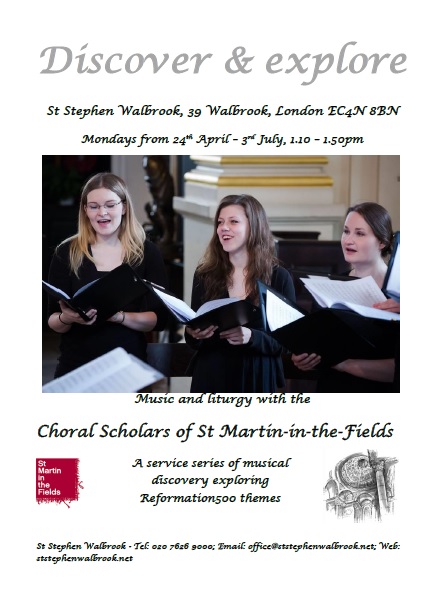
Discover & explore: Through Christ alone


Discover & explore services at St Stephen Walbrook feature music and liturgy with the Choral Scholars of St Martin-in-the-Fields. These services explore their themes through a thoughtful mix of music, prayers, readings and reflections:
  • “A perfect service of peace in our busy lives.”
  • “Spiritual food in the middle of the day.”
  • “Beautifully and intelligently done.”
The current series of these services of musical discovery is exploring Reformation 500 themes and continued last Monday with the theme of 'Through Christ alone'. The service featured the Choral Scholars singing: Morning star & The Deer's Cry by Arvo Pärt; God so loved the world by Bob Chilcott; and O Lord, give thy Holy Spirit by Thomas Tallis.

All Discover & explore services begin at 1.10pm:
  • Mon 22 May - God loves you 
  • Mon 29 May Bank Holiday – Church closed 
  • Mon 5 June - Baptism saves 
  • Mon 12 Jun - The Lord's Supper 
  • Mon 19 Jun - The Cross alone 
  • Mon 26 Jun - Forgiveness is free 
  • Mon 3 Jul - Life of repentance
In today's service I shared the following reflection:

‘When Martin Luther preached from the Gospel passages on John the Baptist, he always emphasized how John’s finger pointed to Christ, and how the church most follow in John’s footsteps and point people to the Lord without fail.” He said:

“…The devil does not intend to allow this testimony about Christ. He devotes all his energy to opposing it and will not desist until he has struck it down and suppressed it …”

“For this reason it is necessary constantly to persevere and adhere to John’s testimony concerning Christ. For it requires toil and effort to continue with word and testimony, for a person at death to be able to say, I must die, but I have a Saviour concerning whom John the Baptist testifies; on him and on no other creature, either in heaven or on earth, do I rely …”

“What I am telling you is that it is easier for us humans to believe and trust in everything else than in the name of Christ, who alone is all in all, and more difficult for us for us to rely on him in whom and through whom we possess all things.”’ (https://reformedreader.wordpress.com/2012/03/24/martin-luther-on-solus-christus/)

How could we understand this key Reformation emphasis today? For me, the key to understanding is the incarnation. In John’s Gospel we are told that: “No one has ever seen God” but “The only Son, who is the same as God and is at the Father’s side, he has made him known.” In the Prologue to John’s Gospel, Jesus is described as being God’s Word to human beings; he is in himself the message that God wants to communicate to us. This Word is a real person, not simply a description of God or a statement of the truth about God. What this means is that the truth about God is found in a relationship with Jesus and not in a set of statements or beliefs about him. Truth is not a prescription that we can swallow but a relationship in which we live.

The key difference between the Old and the New Testament for Christians is that in the Old Testament God was revealing himself to and through fallible human beings – meaning that his revelation is imperfectly made and imperfectly received - while in the Gospel stories of Jesus, God is able to fully reveal himself in the humanity of Jesus. So, there is in scripture a developing revelation of God which culminates in the person, ministry, death and resurrection of Jesus. This means that where we see a difference between the revelation of God found in the Old Testament and that found in the Gospels we have to resolve that difference in favour of what we find in Gospels, because it is the only Son, who is the same as God and is at the Father’s side, that has made God known.

Jesus is the creativity, the definition and the wisdom of God; all wrapped up and revealed in human form and flesh. Jesus’ creativity is seen in the new way of being human that he reveals to us. In him, the divine and the human come together enabling us to see all that human beings can potentially be; all that we can potentially become. In him we see the best of humanity because in him we see God expressed as fully as can be in human form.

What we see is love because God is love and therefore, in Jesus, we see pure love expressed without reserve and without self-seeking: the way of compassion instead of the way of domination; the way of self-sacrifice instead of the way of selfishness; the way of powerlessness instead of the way of power; and the way of giving instead of the way of grasping. Therefore to follow in his way is to experience divinity in our lives; to move towards the divine. When we see him call his disciples to follow him that is what occurs; they leave their old way of life behind in order to begin to experience a new and divine way of being human. As the Prologue to John’s Gospel puts it, God himself becomes their Father.

In doing so, he is also the Word of God which describes and defines us. The Prologue to John’s Gospel explains Jesus’ ability to define us in terms of light and darkness. John gives us the image of God as light to help us grasp the idea that Jesus is the one by whom we can come to see humanity as we really are and as we were intended to be. Light is not something we can see directly but something that enables us to see ourselves and our world. This is what Jesus does for us through the incarnation; he shows what humanity was originally intended to become. In Jesus, for the very first time in the history of the world, a human being lives a fully human life.

As a result when we see ourselves and our world in the light of the life of Jesus, what we see are our failure and inability to be the people that we were created to become. In the light of the way that Jesus lived his life, we see our lack of love, joy, peace, patience, kindness, goodness, faithfulness, humility, and self-control. As the writer of 1 John says, if we say that we have no sin, we deceive ourselves, and there is no truth in us. But when we live in the light, seeing ourselves as we really are, then we become honest with ourselves and with God. By coming into that honesty we confess our sins and are purified of them.

Ultimately, the Word that God speaks to us in and through Jesus is ‘Love’. In 1 John 4. 9 – 10 we read, “God showed his love for us by sending his only Son into the world, so that we might have life through him. This is what love is: it is not that we have loved God, but that he loved us and sent his Son to be the means by which our sins are forgiven.”

Jesus came into our world as the Word of God to live a life of self-sacrificial love as a human being. He shows us what true love looks like and he shows us that human beings are capable of true love even when most of the evidence around us seems to point towards the opposite conclusion. But he did not come solely as an example or a description of love. He is love itself, the reality of love, and, therefore, as we come into relationship with him we come into a true relationship with love. This why he came, that we might receive him; that we might receive love. He is then in us and in him. Love in us and we in love.

In the beginning Love already existed; Love was with God, and Love was God. From the very beginning Love was with God. Through him God made all things; not one thing in all creation was made without him. Love was the source of life, and this life brought light to people. The light shines in the darkness, and the darkness has never put it out.

“God is love. And God showed his love for us by sending his only Son into the world, so that we might have life through him. This is what love is: it is not that we have loved God, but that he loved us and sent his Son to be the means by which our sins are forgiven.

Dear friends, if this is how God loved us, then we should love one another. No one has ever seen God, but if we love one another, God lives in union with us, and his love is made perfect in us. (1 John 4. 8 – 12).

Intercessions:

For love God came to us in the person of Jesus—God With Us—and poured his Spirit into us that we might be one with him forever. In his name, let us pray to the Lord, saying: Christ is all, and is in all. Lord, thank you for the gift of your constant presence. Give us the desire to commit our hearts to you. Thank you for the grace of your unfailing love. Grant us the willingness to love others as you have loved us. Thank you for uniting us with your Son. Help us put on our new selves, setting our hearts and minds on things above. Lord, in your mercy, hear our prayer.

God of hope, with thanks and praise we open our hearts to you, who unite us with you through Christ. Help us to pursue you with the passion only your Spirit can provide, and to reflect you with the light only your Spirit can supply. So we say, Thanks be to thee, my Lord Jesus Christ, for all the benefits thou hast given me, for all the pains and insults thou hast borne for me. O most merciful redeemer, friend and brother, may I know thee more clearly, love thee more dearly, and follow thee more nearly, day by day. Lord, in your mercy, hear our prayer.

Thou hast led me to place all my nature and happiness in oneness with Christ, in having heart and mind centred only on him, in being like him in communicating good to others; This is my heaven on earth, but I need the force, energy, impulses of thy Spirit to carry me on the way to my Jerusalem. Here, it is my duty to be as Christ in this world, to do what he would do, to live as he would live, to walk in love and meekness; then would he be known, then would I have peace in death. Lord, in your mercy, hear our prayer.

(https://ace.nd.edu/files/resources/Prayer%20to%20be%20Anchored%20in%20Christ%20Alone.pdf and http://www.scripturezealot.com/2014/07/20/puritan-prayer-christ-alone/)

The Blessing

With our lives hidden in Christ, let us now depart in peace, united in the faith and joined in His call to
serve through the power of His in-dwelling Spirit; and the blessing of God almighty, the Father, the Son, and the Holy Spirit, be among you and remain with you always. Amen.

-------------------------------------------------------------------------------------------

Arvo Pärt - Morning Star.

Monday, 19 January 2015

Text for 2015 - St John's Seven Kings

Most of the Bible was originally written to those living in an agrarian society, people familiar with working the land, managing livestock, and raising crops. Many of Jesus’ parables involve the farming life. Not surprisingly, then, the Bible contains many references to sowing and reaping.

At the beginning of a New Year we can look forward to the seedtime in the Spring, when the earth is warm enough and moist enough from the early rains to best guarantee the "sprouting" of the seed once it is planted in the ground, and also to the Harvest, when we reap what has been sown. The Bible encourages us, when it comes to our giving, that the more seed that is planted, the more fruit will be harvested. In other words, those who sow generously will reap more than those who don’t. But Jesus also speaks of multiplication; of seed sown that brings forth “a hundred, sixty or thirty times what was sown.” A single grain produces many grains, the smallest seed grows into the largest tree, and the seeds which fell in good soil bore one hundred grains each. We are to sow generously and trust to God to bring about the multiplication.

Jesus said in Matthew 17. 20, “if you have faith as a mustard seed, you will say to this mountain, ‘Move from here to there,’ and it will move; and nothing will be impossible for you.” When we face a lack of harvest, and that is what the mountain here represents, our first reaction is often to look at the lack. We think about the lack, rehearse the lack, talk about the lack, sometimes at great length. Jesus says, in effect, ‘don’t start with the lack, instead start with the seed. Imagine a farmer needs a thousand bushels of corn. He does not start with what he doesn’t have. He starts by sowing seed in the field, because the corn he wants will grow from the seed he plants.

When we face a lack of harvest in some area of life, instead of first trying to deal with the lack, consider first planting the seed. If, for example, we were lacking friendship would it help to lament the fact of being alone? It would be much better to try planting a seed of a smile or a helping hand.

What is the seed that we plant? Jesus said that many of his parables involving sowing and reaping were told to show us what the Kingdom of God is like. The most famous of his parables involving sowing and reaping is the Parable of the Sower in which Jesus identifies the seed as being the word of God. This is usually interpreted as meaning either the Bible or the Gospel but, if we take account of our Bible reading tonight where Jesus identifies himself as the seed, we can see that this also makes sense of the Parable of the Sower too as John 1 tells us that Jesus is the Word of God. On this basis God the Father is the farmer who sows Jesus, his Son, into the world as the seed which is buried before bringing into being the Kingdom of God. So what is sown is life; the life of Jesus.

Jesus lived a life of generosity by living life for others and, ultimately, by dying for others. Jesus offered himself, his life, to come alive in hundreds and then in thousands and then in millions of others. But first he had to die and if we, his followers, are going to pass on his life then we too will have to learn the pattern of life through death. The Jesus way is what we are called to emulate. That is what we are to plant, the life of Jesus in the world, because it is what God the Father originally planted in order to bring the Kingdom of God into being. Sowing seeds of God in the world is not primarily about teachings or words, instead it is primarily about living life the Jesus way - the truth of being truly human as Jesus was truly human and thus at the same time truly God's.

So, the seed that we plant is our self; our life lived the Jesus way. Jesus lived a life of self-sacrifice, of service, and of love. That is what we should seek to sow, as generously as possible, through our lives. This is what Jesus says in verses which have been chosen as the Text for 2015 for St John's Seven Kings taken from John 12. 24 – 25: “Listen carefully: Unless a grain of wheat is buried in the ground, dead to the world, it is never any more than a grain of wheat. But if it is buried, it sprouts and reproduces itself many times over. In the same way, anyone who holds on to life just as it is destroys that life. But if you let it go, reckless in your love, you’ll have it forever, real and eternal.”

--------------------------------------------------------------------------------------------

Bill Fay - Be Not So Fearful.