Wikio - Top Blogs - Religion and belief

Wednesday, 22 March 2023

Invited in to the Dance of Love

Here's the sermon that I shared at St Andrew's Wickford this morning:

Jesus said to them, ‘Very truly, I tell you, the Son can do nothing on his own, but only what he sees the Father doing; for whatever the Father does, the Son does likewise. The Father loves the Son and shows him all that he himself is doing; and he will show him greater works than these, so that you will be astonished.” (John 5. 17-30)

“God wants to communicate with humanity, and … Jesus represents the essence of that desire to talk,” says Mike Riddell. As God’s Son, Jesus was in a constant conversation with both God the Father and with God the Spirit. In these verses and others, the Son claims that he hears from the Father and speaks just what the Father has taught him (John 8: 26 – 29). He also claims that his relationship with the Father is not just one way, rather the Father also always hears the Son (John 11: 41 & 42). Similarly, he says that the Spirit will not speak on his own but only what he hears (John 16: 13). The Spirit is sent, like the Son, by the Father, but comes in the name of the Son to remind the disciples of everything that the Son said to them (John 14: 26 & 27). This interplay or dialogue within the Godhead between Father, Son and Spirit can be summed up in the words of John 3. 34-35: “For the one whom God has sent speaks the words of God; to him God gives the Spirit without limit. The Father loves the Son and has placed everything in his hands.”

Stephen Verney calls this interplay between Father, Son and Spirit, which he believes we are called to enter, ‘the Dance of Love.’ He writes: “”I can do nothing”, [Jesus] said, “except what I see the Father doing”. If he lays aside his teaching robes and washes the feet of the learners … it is because he sees his Father doing it. God, the Father Almighty, the maker of heaven and earth, is like that; he too lays aside his dignity and status as a teacher. He does not try to force his objective truth into our thick heads, but he gives himself to us in acts of humble service; he laughs with us and weeps with us, and he invites us to know him in our hearts through an interaction and an interplay between us. It is this knowledge that Jesus has received from the Father, and in the to and fro of this relationship he and the Father are one. They need each other. That is the pattern of how things potentially are in the universe, and of how God means them to be”.

The beginning of John’s Gospel can be read as saying that this kind of conversation, dialogue and partnership with God is actually what life is all about: “It all arose out of a conversation, conversation within God, in fact the conversation was God. So God started the discussion, and everything came out of this, and nothing happened without consultation.

This was the life, life that was the light of human beings, shining in the darkness, a darkness which neither understood nor quenched its creativity …

The subject of the conversation, the original light, came into the world, the world that had arisen out of his willingness to converse. He fleshed out the words but the world did not understand. He came to those who knew the language, but they did not respond. Those who did became a new creation (his children). They read the signs and responded.

These children were born out of sharing in the creative activity of God. They heard the conversation still going on, here, now, and took part, discovering a new way of being people.

To be invited to share in a conversation about the nature of life was for them, a glorious opportunity not to be missed.” (John 1: 1-14 revisited)

God wants us to be in conversation, in dialogue, in debate, with him so that we can find him for ourselves, find ourselves in him, and embody his characteristics and interests in ourselves. The philosopher, Martin Buber, has argued that “God is not met by turning away from the world or by making God into an object of contemplation, a “being” whose existence can be proved and whose attributes can be demonstrated.” Instead, we can know God only in dialogue with him and this dialogue goes on moment by moment in each new situation as we respond with our whole being to the unforeseen and the unique.

Our dialogue with God interrogates the very nature of what we are, and how we understand our identity, as it is from the art of conversation that truth emerges and our identity is constructed. It is through this conversation that the Father loves us, showing us all that he is doing. Truth emerging and identity constructed are the greater works which he shows to us through this conversation and which astonish us.

-----------------------------------------------------------------------------------------------------------

U2 - Invisible.

Sunday, 19 March 2023

Celebrating motherhood in its messy reality

Here's the sermon that I shared at St Andrew's Wickford this morning:

Whether she’s mum, mummy, mam or mother, this Mother’s Day we will have been encouraged to find a card or gift to tell our mother just how much we care and love her.

The cards we found on offer will likely have contained messages such as this:

God made a wonderful mother,
A mother who never grows old;
He made her smile of the sunshine,
And He moulded her heart of pure gold;
In her eyes He placed bright shining stars,
In her cheeks fair roses you see;
God made a wonderful mother,
And He gave that dear mother to me.

It's a lovely thing to be able to bless and encourage mothers with those kinds of sentiments and messages but what do we do when our mother's haven't met that ideal or haven't been there for us in that way? How do mother's feel about that kind of idealised image being held up for admiration and how do those who haven't had the experience of motherhood feel on Mothering Sunday as a result?

This is a complicated day for many and not necessarily a day of simple celebration. In the Church, some will say, put the focus on Mother Church rather than human mothers but, if, for example, you are LGBTIQA+, then Mother Church will still feel less than welcoming of you at present.

The Bible, however, does not give us an idealised view of motherhood or family life. Our readings today are from the early days of Moses who led the People of Israel out of Egypt to the Promised Land (Exodus 2: 1-10) and of Jesus who became the Saviour of all people everywhere (Luke 2: 33-35). These are the great heroes of our faith, yet life for their mothers was far from easy and their family lives were complicated and far from the idealised picture found in that Mother's Day poem.

Moses's mother Jochebed had to give him up to an adoptive mother from the regime that oppressed her people in order to save his life. She became his nurse having to hide her true role as his mother. Mary, the mother of Jesus, endured that most terrible of experiences for mother's, of seeing your child die before you. No wonder Simeon spoke of a sword piercing her heart! As one bringing up a child known to have been conceived before her marriage to her husband, she would, no doubt, have lived with considerable opprobrium from those who didn't understand the way in which she had faithfully obeyed God.

So, the Nativity story sets out the unconventional and non-idealised relationships which God chose to use at the beginning of Jesus’ life; a conception outside of marriage, a relationship on the brink of divorce, a foster-father, a birth in cramped and crowded circumstances, an immediate threat to life followed by refugee status. When these are added to the fact that, during his ministry, Jesus called his followers to leave behind their family obligations in order to follow him, said that families would be divided because some would respond to him and others not, while, on one occasion, when told his family were outside, said: "Who is my mother? Who are my brothers? … Whoever does what my Father in heaven wants is my brother, my sister, and my mother", we see that conventional structures for family life were not really a major priority in Jesus’ thinking or praxis. Jesus’ emphasis in his teaching was on his followers as his family, rather than his blood and adoptive relatives, while his death was for the entire family of God - all people everywhere.

What we might now call Mother Church was, therefore, the key family relationship which was at the fore-front of Jesus’ teaching and practice. Within this, he seems less interested in particular structures for our relationships and more interested in those relationships being ones which nurture those who are in relationship, whilst also being open to support others in need through that same relationship. On this basis, it does not really matter whether we are in a nuclear family, single parent family, same-sex family, extended family etc. What matters is the quality of relationships within that family and our openness to others.

So, in seeking to understand what life might have been like for Jochebed and for Mary, we can perhaps see that the Bible celebrates love expressed in the challenges posed by the messiness of real life, rather than presenting us with an ideal from which we will always fall short. As a result, we need to celebrate motherhood in its messy reality rather than an idealised version of it, “understand that many of us are (and have) mothers in the non-biological sense, honour foster parents, affirm unconventional relationships, celebrate same-sex parents, and - sadly - recognise that not all experiences of mothering are positive. If we can do that, then Mothering Sunday becomes a dynamic means of embracing people where they are, rather than a sentimental celebration of unrealistic expectations.” (https://opentable.lgbt/our-blog/2022/3/27/mothering-sunday-mothers-day-ancient-tradition-or-modern-invention).

I have seen how losing a son pierces a mother’s heart, as that is what happened to my mum when my younger brother died in a plane crash. My love for and appreciation of my mum grew through seeing her response to sharing the same experience as that of Mary. Some of you have, I know, fostered the children of others, some may have been through the experience of letting your children be fostered or adopted, as was the experience of Jochebed. These are experiences from which we should all seek to learn, seeing them, as was the case for Jochebed and Mary, as being bound up in God’s good purposes for humanity; even, as in their stories, as the seedbed for the greatest acts of liberation in human history.

I end with a sonnet for Mothering Sunday by Malcolm Guite which is a thanksgiving for all parents, especially those who bore the fruitful pain of labour, but, more particularly, in this poem he singles out for praise those heroic single parents who, for whatever reason, have found themselves bearing alone the burdens, and sharing with no-one the joys of their parenthood. As with all those whose care we celebrate today, in their lives God’s kingdom is reflected and Christ shares with them the birth-pangs of that Kingdom.

Mothering Sunday

At last, in spite of all, a recognition,
For those who loved and laboured for so long,
Who brought us, through that labour, to fruition
To flourish in the place where we belong.
A thanks to those who stayed and did the raising,
Who buckled down and did the work of two,
Whom governments have mocked instead of praising,
Who hid their heart-break and still struggled through,
The single mothers forced onto the edge
Whose work the world has overlooked, neglected,
Invisible to wealth and privilege,
But in whose lives the kingdom is reflected.
Now into Christ our mother church we bring them,
Who shares with them the birth-pangs of His Kingdom.

-----------------------------------------------------------------------------------------------------------

U2 - Tomorrow.

Saturday, 18 March 2023

Windows on the world (417)


London, 2012

------------------------------------------------------------------------------------------------------------------

Lonnie Holley - I Am A Part Of The Wonder.

Friday, 17 March 2023

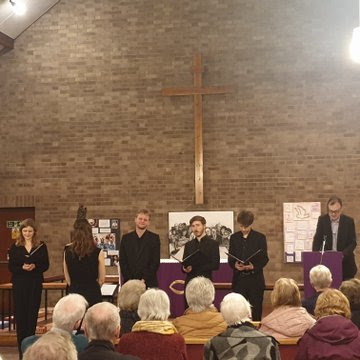
Pearls of Polyphony


In their programme of radiant choral polyphony, St Martin's Voices took us on a musical tour of sixteenth century Europe. This selection of sacred works by the leading composers of the age demonstrates the expressive beauty and dexterity of the polphonic style, bridging the gap from the Late Renaissance to the Early Baroque.

Polyphony is defined as a musical texture with two or more melodic lines and, when applied to vocal writing, means that the text is performed independently by each voice apart, according to the rhythm and phrasing of their individual melodic line. Stylistically, this results in waves of sound with soaring peaks, ever-shifting harmonies, and powerful moments of unity when the voices come together.

The programme tonight at St Andrew's Wickford included Orlande de Lassus, Peter Phillips, Francisco Guerrero, Richard Dering, Jan Pieterszoon Sweenlinck, Heinrich Schutz and Giovanni Pierluigi da Palestrina. The texts explored in their programme spanned the liturgical year, from All Saints to Ascension, in settings by composers from across Europe.

--------------------------------------------------------------------------------------------------------

St Martin's Voices - Love Divine.

Wednesday, 15 March 2023

David Miller: Time, Wisdom, & Koalas


The latest book from the wonderfully prolific David Miller is Time, Wisdom, & Koalas, a new work of fantastic fiction:

"David Miller is a writer with not only fantasy, but a depth of feeling and philosophical content. Yet, one feels a sense of whimsy as well. What he imparts to the reader is often done with a gentle and beautiful subtlety that stays with one long after the book has been closed."--Gloria Coates

"Meet Norm. E. T. A. Hoffmann didn't write about koalas. He didn't write about Norm. But in a parallel universe, where Herne Bay had been a concentration camp, he could have. David Miller wrote Norm. Or maybe Norm dreamt himself, because Norm is very wise. And he sleeps. A lot."--Keith Jebb

"'Despite what the first pages may suggest, this is most definitely not a children's tale.' Or so we're told. It's more like what Byron thought about 'true poetry': that 'tis the part/ Of a true poet to escape from fiction'. David Miller escapes from fiction in 'spirit dreams' he learned from a certain Koala named Norman, who seems to have passed them along through a certain wombat named Archie. If I told you any more about David's escapes you'd think I was making it up, or maybe that I just dreamed it all. But as David once said - I think he was at Felpham - 'you can never tell about these things.'"--Jerome McGann

"It may be impossible to describe Time, Wisdom, and Koalas. It may be impossible even to think who might read such a book. But having written a book about philosophical frogs myself, I'm open to the possibility that there are sufficient numbers of wildly imaginative, erudite, fauna-loving readers ready for a serious romp through time, space, and the history of ideas, to make this odd book a best-seller."--Gail Holst-Warhaft

David Miller was born in Melbourne, Australia, but has lived in the UK for many years. His recent publications include SPIRITUAL LETTERS (SERIES 1-5) (Chax Press, 2011), Reassembling Still: Collected Poems (Shearsman Books, 2014), SPIRITUAL LETTERS (Contraband Books, 2017 / Spuyten Duyvil, 2022), TOWARDS A MENAGERIE (Chax Press, 2019), Matrix I & II (Guillemot Press, 2020), Some Other Days and Nights (above/ground press, 2021), Afterword (Shearsman Books, 2022), circle square triangle (Spuyten Duyvil, 2022), An Envelope for Silence (above/ground press, 2022) and Some Other Shadows (Knives Forks and Spoons Press, 2022). He is also a painter and a musician.

For his next publication (close), I've written the following appreciation:

"David Miller examines words and phrases as if they are displayed on a rotating stand enabling us to view them from a myriad of different perspectives. In his poetry, prose and prose poems, things are never simply what they seem; there is always something more, something deeper, something beyond. Whether creating expansive word collages or paring poems down to their constituent parts, he is a skilled craftsperson utilising concision, elision, contrast and paradox to open up meanings as one opens up Matryoshka Dolls. At the heart of his vision are pathways leading us to the experience of expanse."

In reviewing Some Other Shadows for Stride Magazine, I wrote that:

"David Miller, under the influence of the sublime RobertLax, is past and present master of just such a contemplative approach. Both combine close attention to each word chosen, the resonances of each word, and that word’s position on the page, with an equally close attention to the ordinary events of daily life and the depths that their words reveal of those events ...

Miller’s like and unlike images, questions and thoughts – affirmations and negations - are held together to form a whole that is simple yet complex, without contradiction because both are owned and honoured ...

Miller writes of Lax, that “it is the gentle yet strong focus, lucidity and faithfulness of the act of attention (to words, to the things and the people around him, to whatever he names in poems) that constitutes one of the most salient features of Lax’s poetry and also his life.” The same focus can be seen in Miller’s more diverse and genre crossing works and it is this core to his approach – whatever the genre – that becomes a model, not just for poetry, but also for life."

-----------------------------------------------------------------------------------------------------------

David Miller & SpiritWORK - memory water flowing.

Tuesday, 14 March 2023

St Martin's Voices in concert


St Martin's Voices, Friday 17 March, 7.00 pm, St Andrew's Wickford.

St Martin’s Voices are one of the UK’s most versatile professional vocal ensembles, performing concerts on the international stage as well as giving regular BBC broadcasts and special services at London’s iconic St Martin-in-the-Fields. The ensemble performs regularly alongside the Academy of St Martin in the Fields and London Mozart Players and is featured in the Church of England’s online worship resources that have attracted over 4 million downloads.

No ticket required - just turn up. A collection will be taken during the concert.

-----------------------------------------------------------------------------------------------------------

St Martin's Voices - Gloria.

Sunday, 12 March 2023

Art, Art Trails and the Society of Catholic Priests

Last Wednesday I gave a talk at St Mary's Runwell to the Chelmsford Chapter of the Society of Catholic Priests. My talk was about the art and artists in the Parish of Wickford and Runwell and the use that can be made of Art Trails to develop greater awareness of such art. 

The talk was based on the case study that I wrote last year for the Gods' Collections project. My case study on Wickford and Runwell can be found at https://www.godscollections.org/case-studies/wickford-and-runwell, while a second case study on St Martin-in-the-Fields is at https://www.godscollections.org/case-studies/st-martin-in-the-fields.

----------------------------------------------------------------------------------------------------------------

VOCES8 - May It Be.